Results by title
3027 books match the query 'Sociology' and 166 start with p

Photographs from Detroit, 1975–2019
Bruce Harkness
Ohio University Press, 2022
A retrospective survey of Bruce Harkness’s striking social documentary photographs and an invaluable historical record that bears witness to irrevocably lost swaths of Detroit’s social and urban fabric.
In 1980, the cities of Detroit and Hamtramck, Michigan, exercised eminent domain to develop nearly five hundred acres of land for a new industrial park and General Motors assembly plant. But the land was not vacant. Some thirty-five hundred people lived there in Poletown—some of them for their entire lives. They attended neighborhood schools and churches, worked for and patronized small businesses, walked the sidewalks, drove the streets, and tended to lawns and gardens. Harkness began photographing the area in February 1981. He recorded street scenes, intersections, panoramic views, homes, businesses, churches, and people. Ten months, ninety visits, and six hundred photographs later, it all disappeared forever.
The Poletown series established Harkness as a major Detroit documentarian. It came on the heels of late-1970s projects located in and around the city’s skid row: Cass Corridor. The images include gritty streetscapes, a portrait series depicting residents living in a crumbling apartment building, and the lively cultural milieu of a local gay and transgender bar. Most of this old portion of inner-city Detroit since has been supplanted by urban redevelopment and gentrification.
During the late 1980s, Harkness collaborated with urban historian John J. Bukowczyk on a major documentary project, Urban Interiors. While the Poletown project had documented the exteriors of buildings and streetscapes on Detroit’s East Side, Urban Interiors captured the insides of inner-city Detroit homes and businesses and included extended oral history interviews.
While Harkness has always found human dignity and resilience in his subjects, the tone of his work brightened in the 1990s alongside Detroit’s revival. Photographs from this era include blues musicians performing in clubs and at outdoor concerts and the distinctive, robust youth culture that flourished in Dearborn’s now-defunct Zone Coffee House.
Featuring images from these and other projects, Photographs from Detroit, 1975–2019 includes Harkness’s extensive notes, which describe and contextualize the encounters he shared with the people and places he photographed, and offer insight into his working methods and equipment. The volume and quality of Harkness’s work merits him recognition as one of Detroit’s most important documentary photographers during this pivotal, transitional era in the city’s history.
Harkness’s images depict the struggles and resilience of ordinary individuals and families in working-class communities who together have indelibly shaped the spirit of Detroit. This book is a must-have for Detroiters past and present as well as historians, anthropologists, social documentary advocates, and photobook collectors everywhere.
Picturing Culture
Explorations of Film and AnthropologyJay Ruby
University of Chicago Press, 2000
The book begins with analyses of key filmmakers (Robert Flaherty, Robert Garner, and Tim Asch) who have striven to generate profound statements about human behavior on film. Ruby then discusses the idea of research film, Eric Michaels and indigenous media, the ethics of representation, the nature of ethnography, anthropological knowledge, and film and lays the groundwork for a critical approach to the field that borrows selectively from film, communication, media, and cultural studies. Witty and original, yet intensely theoretical, this collection is a major contribution to the field of visual anthropology.

Pierre Bourdieu and Literary History, Volume 58
Marshall Brown
Duke University Press, 0
Essays included in this collection discuss the hesitant response of the American academy to Bourdieu; Bourdieu on Derrida on Kant; “pure poetry,” cultural capital, and the rejection of classicism; and the insight Bourdieu’s work lends to our understanding of the position of eighteenth-century women writers.
Contributors. Marilyn Butler, John Guillory, Elizabeth W. Harries, Jonathan Joesberg, Toril Moi, William Paulson, Trevor Ross
Pierre Bourdieu's Political Economy of Being
Ghassan Hage
Duke University Press, 2025
Pillars of the Nation
Child Citizens and Ugandan National DevelopmentKristen E. Cheney
University of Chicago Press, 2007
How can children simultaneously be the most important and least powerful people in a nation? In her innovative ethnography of Ugandan children—the pillars of tomorrow’s Uganda, according to the national youth anthem—Kristen E. Cheney answers this question by exploring the daily contradictions children face as they try to find their places amid the country’s rapidly changing social conditions.
Drawing on the detailed life histories of several children, Cheney shows that children and childhood are being redefined by the desires of a young country struggling to position itself in the international community. She moves between urban schools, music festivals, and war zones to reveal how Ugandans are constructing childhood as an empowering identity for the development of the nation. Moreover, through her analysis of children’s rights ideology, national government strategy, and children’s everyday concerns, Cheney also shows how these young citizens are vitally linked to the global political economy as they navigate the pitfalls and possibilities for a brighter tomorrow.
Places in Need
The Changing Geography of PovertyScott W. Allard
Russell Sage Foundation, 2017
Using census data, administrative data from safety net programs, and interviews with nonprofit leaders in the Chicago, Los Angeles, and Washington, D.C. metropolitan areas, Allard shows that poor suburban households resemble their urban counterparts in terms of labor force participation, family structure, and educational attainment. In the last few decades, suburbs have seen increases in single-parent households, decreases in the number of college graduates, and higher unemployment rates. As a result, suburban demand for safety net assistance has increased. Concerning is evidence suburban social service providers—which serve clients spread out over large geographical areas, and often lack the political and philanthropic support that urban nonprofit organizations can command—do not have sufficient resources to meet the demand.
To strengthen local safety nets, Allard argues for expanding funding and eligibility to federal programs such as SNAP and the Earned Income Tax Credit, which have proven effective in urban and suburban communities alike. He also proposes to increase the capabilities of community-based service providers through a mix of new funding and capacity-building efforts.
Places in Need demonstrates why researchers, policymakers, and nonprofit leaders should focus more on the shared fate of poor urban and suburban communities. This account of suburban vulnerability amidst persistent urban poverty provides a valuable foundation for developing more effective antipoverty strategies.

Planetary Longings
Mary Louise Pratt
Duke University Press, 2022
Planning Families in Nepal
Global and Local Projects of ReproductionBrunson, Jan
Rutgers University Press, 2016
Planning the City upon a Hill
Boston since 1630Lawrence W. Kennedy
University of Massachusetts Press, 1992
Plantation Crisis
Ruptures of Dalit Life in the Indian Tea BeltJayaseelan Raj
University College London, 2022
What does the collapse of India’s tea industry mean for Dalit workers who have lived, worked, and died on the plantations since the colonial era? Since the mid-1990s, the colonial era plantation system—and its workforce of more than two million people— has faced a series of ruptures stemming from neoliberal economic globalization. In the South Indian state of Kerala, the Dalit workforce is at the forefront of this crisis and its profound effects on their social identity and economic wellbeing. Plantation Crisis offers a complex understanding of how processes of social and political alienation unfold in moments of economic rupture. Based on long-term ethnographic fieldwork in the Peermade and Munnar tea belts, the book analyzes the profound, multidimensional sense of crisis felt by those who are at the bottom of global plantation capitalism. Out of the colonial history of racial capitalism and indentured migration, Plantation Crisis opens our eyes to the collapse of the plantation system in India, and the profound impacts this has on the Dalit workers who lived there for generations.
Play Reconsidered
Sociological Perspectives on Human ExpressionThomas S. Henricks
University of Illinois Press, 2006
Understanding the significance of adult play in the life of modern societies
Within the social sciences, few matters are as significant as the study of human play--or as neglected. In Play Reconsidered, rather than viewing play simply as a preoccupation of the young and a vehicle for skill development, Thomas S. Henricks argues that it’s a social and cultural phenomenon of adult life, enveloped by wider structures and processes of society. In that context, he argues that a truly sociological approach to play should begin with a consideration of the largely overlooked writings on play and play-related topics by some of the classic sociological thinkers of the twentieth century.
Henricks explores Karl Marx’s analysis of creativity in human labor, examines Emile Durkheim’s observations on the role of ritual and the formation of collective consciousness, extends Max Weber’s ideas about the process of rationalization to the realm of expressive culture and play, surveys Georg Simmel’s distinctive approach to sociology and sociability, and discusses Erving Goffman’s focus on human conduct as process and play as “encounter.” These and other discussions of the contributions of more recent sociologists are framed by an initial consideration of Johan Huizinga’s famous challenge to understand the nature and significance of play. In a closing synthesis, Henricks distinguishes play from other forms of human social expression, particularly ritual, communitas, and work.

Play to Submission
Gaming Capitalism in a Tech FirmTongyu Wu
Temple University Press, 2024
Play to Submission shows how Behemoth’s games undermined and manipulated workers. They lost their work-life balance and the constant competition made labor organizing difficult. Nonetheless, many workers embraced management’s games as a chance to show off their “gamer” identities and create a workplace culture with privileged insiders and exiled outsiders, with female and migrant workers usually in the latter group. Moreover, Wu indicates this may be the future of work for high- and low-skilled and, creative workers in an environment where capitalists have heightened demands for technology and creativity.
Drawing from 13 months of ethnographic work, Wu presents a persistent reality in which the company reaps the reward of surplus productivity, leaving employees themselves in a highly competitive and sometimes precarious work position.
Players and Pawns
How Chess Builds Community and CultureGary Alan Fine
University of Chicago Press, 2015
Full of idiosyncratic characters and dramatic gameplay, Players and Pawns is a celebration of the fascinating world of serious chess.

Playing Sociology
Theory and Games for Coping with Mimetic Crisis and Social ConflictMartino Doni
Michigan State University Press, 2024

Playing Time
Boys, Coaches, and Parents in the Battle for Minutes in Youth BasketballScott N. Brooks
University of Chicago Press, 2027
An in-depth look at the timeless quandary of how average high school basketball players navigate their dreams of greatness with the adults who coach and support them.
We all admire the stories of famous athletes with humble origins who rose to the top through hard work and dedication. Michael Jordan and Steph Curry, after all, both started as second-string players. But their climbs to athletic dominance call to us because they seem to prove a message we all want to believe: Anything is possible with hard work and determination. But for most people, it simply isn’t. Most of us will end up being more or less average rather than extraordinary.
In Playing Time, sociologist and sports scholar Scott N. Brooks introduces readers to young athletes who are middle-status players on their basketball teams—not the best, but not the worst—who often find themselves at odds with their coaches and teammates as they compete for playing time to show off their skills. Drawing on his extensive experience as a coach of middle and high school-age boys, Brooks invites us into the inner lives and daily experiences of kids, parents, and coaches, as players try to make sense of who they are and differentiate themselves on the court. These boys have been told by coaches, their parents, and society that hard work, effort, and attitude determine effectiveness, and Brooks reveals how that message affects them when it’s clear that their best efforts are not always enough. Middle-status boys often feel alone, alienated, socially stigmatized, and powerless to improve their fate.
By focusing on the boys stuck in the middle, Brooks uncovers essential aspects of the formative years of adolescence when kids dream of and plan for a future. As many of us will recognize our own dreams of greatness in these kids, we can all learn to support them as they build their sense of self, both on and off the court.

Playing for Time Theatre Company
Perspectives from the PrisonEdited by Annie McKean and Kate Massey-Chase
Intellect Books, 2018
Plazas and Barrios
Heritage Tourism and Globalization in the Latin American Centro HistóricoJoseph L. Scarpaci
University of Arizona Press, 2004
This book explores how heritage tourism and globalization are reshaping the Latin American centro histórico, analyzing the transformation of the urban core from town plaza to historic center in nine cities: Bogotá, Colombia; Buenos Aires, Argentina; Cartagena, Colombia; Cuenca, Ecuador; Havana, Cuba; Montevideo, Uruguay; Puebla, Mexico; Quito, Ecuador; and Trinidad, Cuba. It tells how these pressures, combined with the advantage of a downtown location, have raised the potential of redeveloping these inner city areas but have also created the dilemma of how to restore and conserve them while responding to new economic imperatives.
In an eclectic and interdisciplinary study, Joseph Scarpaci documents changes in far-flung corners of the Latin American metropolis using a broad palette of tools: urban morphology profiles, an original land-use survey of 30,000 doorways in nine historic districts, numerous photographs, and a review of the political, economic, and globalizing forces at work in historic districts. He examines urban change as reflected in architectural styles, neighborhood growth and decline, real estate markets, and local politics in order to show the long reach of globalization and modernity.
Plazas and Barrios spans all of Spanish-speaking America to address the socio-political dimensions of urban change. It offers a means for understanding the tensions between the modern and traditional aspects of the built environment in each city and provides a key resource for geographers, urban planners, architectural historians, and all concerned with the implications of the emerging global economy.

Pobladoras, Indígenas, and the State
Conflict Over Women's Rights in ChileRichards, Patricia
Rutgers University Press, 2004
Chile has made a public commitment to equality between women and men through the creation of a National Women’s Service, SERNAM. Yet, indigenous Mapuche women and working-class pobladora activists assert that they have been excluded from programs implemented by SERNAM. Decisions about what constitutes "women’s interests" are usually made by middle class, educated, lighter-skinned women, and the priorities and concerns of poor, working-class, and indigenous women have not come to the fore.
Through critical analysis of the role of the state, the diversity of women’s movements, and the social and political position of indigenous peoples in Latin America, Richards provides an illuminating discussion of the ways in which the state defines women’s interests and constructs women’s citizenship. This book makes important contributions to feminist studies, theories of citizenship, and studies of the intersections of class, gender, and race.
Pockets of Crime
Broken Windows, Collective Efficacy, and the Criminal Point of ViewPeter K. B. St. Jean
University of Chicago Press, 2007
Why, even in the same high-crime neighborhoods, do robbery, drug dealing, and assault occur much more frequently on some blocks than on others? One popular theory is that a weak sense of community among neighbors can create conditions more hospitable for criminals, and another proposes that neighborhood disorder—such as broken windows and boarded-up buildings—makes crime more likely. But in his innovative new study, Peter K. B. St. Jean argues that we cannot fully understand the impact of these factors without considering that, because urban space is unevenly developed, different kinds of crimes occur most often in locations that offer their perpetrators specific advantages.
Drawing on Chicago Police Department statistics and extensive interviews with both law-abiding citizens and criminals in one of the city’s highest-crime areas, St. Jean demonstrates that drug dealers and robbers, for example, are primarily attracted to locations with businesses like liquor stores, fast food restaurants, and check-cashing outlets. By accounting for these important factors of spatial positioning, he expands upon previous research to provide the most comprehensive explanation available of why crime occurs where it does.

Poison in the Ivy
Race Relations and the Reproduction of Inequality on Elite College CampusesByrd, W. Carson
Rutgers University Press, 2017
Poison in the Ivy challenges popular beliefs about the importance of cross-racial interactions as an antidote to racism in the increasingly diverse United States. He shows that it is the context and framing of such interactions on college campuses that plays an important role in shaping students’ beliefs about race and inequality in everyday life for the future political and professional leaders of the nation. Poison in the Ivy is an eye-opening look at race on elite college campuses, and offers lessons for anyone involved in modern American higher education.
Police and the Empire City
Race and the Origins of Modern Policing in New YorkMatthew Guariglia
Duke University Press, 2023

Police in the Hallways
Discipline in an Urban High SchoolKathleen Nolan
University of Minnesota Press, 2011
As zero-tolerance discipline policies have been instituted at high schools across the country, police officers are employed with increasing frequency to enforce behavior codes and maintain order, primarily at poorly performing, racially segregated urban schools. Actions that may once have sent students to the detention hall or resulted in their suspension may now introduce them to the criminal justice system. In Police in the Hallways, Kathleen Nolan explores the impact of policing and punitive disciplinary policies on the students and their educational experience.
Through in-depth interviews with and observations of students, teachers, administrators, and police officers, Nolan offers a rich and nuanced account of daily life at a Bronx high school where police patrol the hallways and security and discipline fall under the jurisdiction of the NYPD. She documents how, as law enforcement officials initiate confrontations with students, small infractions often escalate into “police matters” that can lead to summonses to criminal court, arrest, and confinement in juvenile detention centers.
Nolan follows students from the classroom and the cafeteria to the detention hall, the dean’s office, and the criminal court system, clarifying the increasingly intimate relations between the school and the criminal justice system. Placing this trend within the context of recent social and economic changes, as well as developments within criminal justice and urban school reform, she shows how this police presence has created a culture of control in which penal management overshadows educational innovation.
Police in the Hallways also examines the prevalent forms of oppositional behavior through which students express their frustrations and their deep sense of exclusion. With compassion and clear-eyed analysis, Nolan sounds a warning about this alarming convergence of prison and school cultures and the negative impact that it has on the real lives of low-income students of color—and, in turn, on us all.
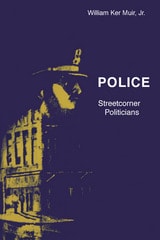
Police
Streetcorner PoliticiansWilliam K. Muir Jr.
University of Chicago Press, 1979
"Other social scientists have observed policemen on patrol, or have interviewed them systematically. Professor Muir has brought the two together, and, because of the philosophical depth he brings to his commentaries, he has lifted the sociology of the police on to a new level. He has both observed the men and talked with them at length about their personal lives, their conceptions of society and of the place of criminals within it. His ambition is to define the good policeman and to explain his development, but his achievement is to illuminate the philosophical and occupational maturation of patrol officers in 'Laconia' (a pseudonym) . . . . His discussions of [the policemen's] moral development are threaded through with analytically suggestive formulations that bespeak a wisdom very rarely encountered in reports of sociological research."—Michael Banton, Times Literary Supplement
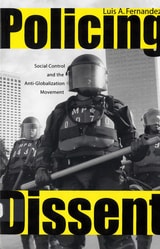
Policing Dissent
Social Control and the Anti-Globalization MovementLuis A. Fernandez
Rutgers University Press, 2008
In November 1999, fifty-thousand anti-globalization activists converged on Seattle to shut down the World Trade Organization’s Ministerial Meeting. Using innovative and network-based strategies, the protesters left police flummoxed, desperately searching for ways to control the emerging anti-corporate globalization movement. Faced with these network-based tactics, law enforcement agencies transformed their policing and social control mechanisms to manage this new threat.
Policing Dissent provides a firsthand account of the changing nature of control efforts employed by law enforcement agencies when confronted with mass activism. The book also offers readers the richness of experiential detail and engaging stories often lacking in studies of police practices and social movements. This book does not merely seek to explain the causal relationship between repression and mobilization. Rather, it shows how social control strategies act on the mind and body of protesters.
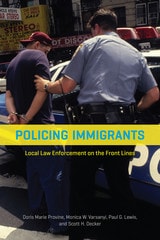
Policing Immigrants
Local Law Enforcement on the Front LinesDoris Marie Provine, Monica W. Varsanyi, Paul G. Lewis, and Scott H. Decker
University of Chicago Press, 2016
Policing Immigrants traces the transition of immigration enforcement from a traditionally federal power exercised primarily near the US borders to a patchwork system of local policing that extends throughout the country’s interior. Since federal authorities set local law enforcement to the task of bringing suspected illegal immigrants to the federal government’s attention, local responses have varied. While some localities have resisted the work, others have aggressively sought out unauthorized immigrants, often seeking to further their own objectives by putting their own stamp on immigration policing. Tellingly, how a community responds can best be predicted not by conditions like crime rates or the state of the local economy but rather by the level of conservatism among local voters. What has resulted, the authors argue, is a system that is neither just nor effective—one that threatens the core crime-fighting mission of policing by promoting racial profiling, creating fear in immigrant communities, and undermining the critical community-based function of local policing.
Policing Welfare
Punitive Adversarialism in Public AssistanceSpencer Headworth
University of Chicago Press, 2021

Policing and the Poetics of Everyday Life
Jonathan M. Wender
University of Illinois Press, 2008
This book reflects a conscious attempt to follow the general model of Martin Heidegger’s Zollikon Seminars, in which Heidegger engaged psychiatrists and psychologists in a sustained dialogue aimed at developing their critical awareness of the unexamined philosophical foundations informing their everyday clinical practice. Wender draws on Heidegger to argue that “praxis is poetry” and from this standpoint interprets all social action as intentional creation (or “poiesis”), which by its very nature is intrinsically meaningful. Using an interpretive framework that he calls a “phenomenological aesthetics of encounter,” Wender takes up a number of case studies of police-citizen encounters, including cases of domestic violence, contacts with juveniles, drug-related situations, instances of mental and emotional crisis, and death.

Political Economy of the Urban Ghetto
Daniel R. Fusfeld and Timothy Bates
Southern Illinois University Press, 1984
The income of blacks in most northern industrial states today is lower relative to the income of whites than in 1949.Fusfeld and Bates examine the forces that have led to this state of affairs and find that these economic relationships are the product of a complex pattern of historical development and change in which black-white economic relationships play a major part, along with patterns of industrial, agricultural, and technological change and urban development. They argue that today’s urban racial ghettos are the result of the same forces that created modern America and that one of the by-products of American affluence is a ghettoized racial underclass.
These two themes, they state, are essential for an understanding of the problem and for the formulation of policy. Poverty is not simply the result of poor education, skills, and work habits but one outcome of the structure and functioning of the economy. Solutions require more than policies that seek to change people: they await a recognition that basic economic relationships must be changed.
Political Epistemics
The Secret Police, the Opposition, and the End of East German SocialismAndreas Glaeser
University of Chicago Press, 2011
What does the durability of political institutions have to do with how actors form knowledge about them? Andreas Glaeser investigates this question in the context of a fascinating historical case: socialist East Germany’s unexpected self-dissolution in 1989. His analysis builds on extensive in-depth interviews with former secret police officers and the dissidents they tried to control as well as research into the documents both groups produced. In particular, Glaeser analyzes how these two opposing factions’ understanding of the socialist project came to change in response to countless everyday experiences. These investigations culminate in answers to two questions: why did the officers not defend socialism by force? And how was the formation of dissident understandings possible in a state that monopolized mass communication and group formation? He also explores why the Stasi, although always well informed about dissident activities, never developed a realistic understanding of the phenomenon of dissidence.
Out of this ambitious study, Glaeser extracts two distinct lines of thought. On the one hand he offers an epistemic account of socialism’s failure that differs markedly from existing explanations. On the other hand he develops a theory—a sociology of understanding—that shows us how knowledge can appear validated while it is at the same time completely misleading.
Political Leadership in Contemporary Japan
Terry Edward MacDougall, Editor
University of Michigan Press, 1982
Political Monopolies in American Cities
The Rise and Fall of Bosses and ReformersJessica Trounstine
University of Chicago Press, 2008
Situating her in-depth studies of Chicago and San Jose in the broad context of data drawn from more than 240 cities over the course of a century, she finds that the answer—a resounding yes—illuminates the nature of political power. Both political machines and reform governments, she reveals, bias the system in favor of incumbents, effectively establishing monopolies that free governing coalitions from dependence on the support of their broader communities. Ironically, Trounstine goes on to show, the resulting loss of democratic responsiveness eventually mobilizes residents to vote monopolistic regimes out of office. Envisioning an alternative future for American cities, Trounstine concludes by suggesting solutions designed to free urban politics from this damaging cycle.
Political Process and the Development of Black Insurgency, 1930-1970
Doug McAdam
University of Chicago Press, 1999
"[A] first-rate analytical demonstration that the civil rights movement was the culmination of a long process of building institutions in the black community."—Raymond Wolters, Journal of American History
"A fresh, rich, and dynamic model to explain the rise and decline of the black insurgency movement in the United States."—James W. Lamare, Annals of the American Academy of Political and Social Science

Political Sociology
Tom Bottomore
Pluto Press, 1993
Political Visions of Ukraine
Models of a Common FutureBogdan Kolesnyk
Central European University Press, 2026
Drawing on intellectual discourses from 2013 onwards, this book maps those collisions, reconstructing Ukraine’s “noumenal parliament” — the constellation of voices that have vied to define the nation’s future. Bogdan Kolesnyk explains why Ukraine’s is not a single story but a composite of many, why neither liberal consolidation nor national stories alone provide a sufficient answer, and suggests how justice, reason and republican institutions might be the anchors for plural polity to endure.
In attempting to understand Ukrainian socio-political reality on its own terms from beyond its borders, this book urgently enquires what kind of future is worth fighting for?
Politicians, Judges, and City Schools
Reforming School Finance in New YorkJoel S. Berke
Russell Sage Foundation, 1984
Politics Of Selfhood
Bodies And Identities In Global CapitalismRichard Harvey Brown
University of Minnesota Press, 2003
Looks at the ways social change is expressed through debates over identities and bodies
In bodies and selves, we can see politics, economics, and culture play out, and the tensions and crises of society made visible. The women’s movement, lobbies for the elderly, pro-choice and pro-life movements, AIDS research and education, pedophilia and repressed memory, global sports spectacles, organ donor networks, campaigns for safe sex, chastity, or preventive medicine—all are aspects of the contemporary politics of bodies and identities touched on in this book. Three broad themes run through the collection: how the body is constructed in various ways for different purposes, how the electronic media and its uses shape selves and sensualities and contribute to civic discourse, and how global capitalism acts as a direct force in these processes. By taking a distinctly cross-cultural and comparative approach, this volume explores more fully than ever the political, economic, institutional, and cultural settings of corporeality, identity, and representation.
Contributors: Antonella Fabri, John Jay College and New York Academy of Medicine; Eva Illouz, Hebrew U of Jerusalem; Philip W. Jenks, Portland State U; Lauren Langman, Loyola U; Timothy W. Luke, Virginia Polytechnic Institute and State U; Timothy McGettigan, Colorado State U, Pueblo; Margaret J. Tally, SUNY, Empire State College.
Politics and Partnerships
The Role of Voluntary Associations in America's Political Past and PresentEdited by Elisabeth S. Clemens and Doug Guthrie
University of Chicago Press, 2011
But despite the ubiquity of the idea of volunteerism in public policy debates, analysis of its role in American governance has been fragmented. Bringing together a diverse set of disciplinary approaches, Politics and Partnerships is a thorough examination of the place of voluntary associations in political history and an astute investigation into contemporary experiments in reshaping that role. The essays here reveal the key role nonprofits have played in the evolution of both the workplace and welfare and illuminate the way that government’s retreat from welfare has radically altered the relationship between nonprofits and corporations.
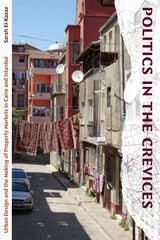
Politics in the Crevices
Urban Design and the Making of Property Markets in Cairo and IstanbulSarah El-Kazaz
Duke University Press, 2023
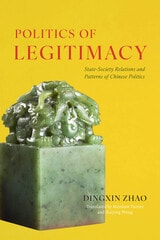
Politics of Legitimacy
State-Society Relations and Patterns of Chinese PoliticsDingxin Zhao
University of Chicago Press, 2026
The Chinese communist state has survived massive social changes, including the introduction of capitalist markets, an ongoing explosion of technological innovation, and an unprecedented jump in wealth and education, accompanied by a major cultural transformation. How has China managed to maintain its power even as the ground has so profoundly shifted? In Politics of Legitimacy, Dingxin Zhao argues that state power can be legitimized in three ideal-typical ways: a set of values upheld by the state (ideological legitimacy), recognized political processes such as regular competitive elections (procedural legitimacy), and the state’s capacity to provide public goods (performance legitimacy).
Building on this theoretical framework, Zhao analyzes different aspects of Chinese politics, including the tragic ending of the 1989 pro-democracy movement, the weak development of mass-based nationalism in post-Mao China, the reasons behind China’s economic success, the anti-establishment tendency of the Chinese mass media and social media, and the sources of political tension in China, despite a superb economy. Moreover, Zhao’s innovative framework is widely applicable beyond China, shifting our attention from regime-type categories to the tools and relationships that determine their survival or collapse, and illuminating the current global emergence of conservatism and religious nationalism.

Poor but Proud
Alabama's Poor WhitesWayne Flynt
University of Alabama Press, 2001
CHOICE OUTSTANDING ACADEMIC BOOK (SPONSORED BY CHOICE MAGAZINE)
JAMES F. SULZBY BOOK AWARD (SPONSORED BY ALABAMA HISTORICAL ASSOCIATION)
ALABAMA LIBRARY AUTHOR AWARD (SPONSORED BY ALABAMA LIBRARY ASSOCIATION)
LILLIAN SMITH BOOK AWARD (SPONSORED BY SOUTHERN REGIONAL COUNCIL)
A groundbreaking history of class, culture, and resilience in the Alabama South.
First published in 1989 by The University of Alabama Press, this new paperback version will make the classic work available for general readers, bookstores, and classrooms.
Wayne Flynt addresses the life experiences of poor whites through their occupations, society, and culture. He explores their family structure, music, religion, folklore, crafts, and politics and describes their attempts to resolve their own problems through labor unions and political movements. He reveals that many of our stereotypes about poor whites are wildly exaggerated; few were derelicts or "white trash." Even though racism, emotionalism, and a penchant for violence were possible among poor whites, most bore their troubles with dignity and self-respect - working hard to eventually lift themselves out of poverty.
The phrase "poor but proud" aptly describes many white Alabamians who settled the state and persisted through time. During the antebellum years, poor whites developed a distinctive culture on the periphery of the cotton belt. As herdsmen, subsistence farmers, mill workers, and miners, they flourished in a society more renowned for its two-class division of planters and slaves. The New Deal era and the advent of World War II broke the long downward spiral of poverty and afforded new opportunities for upward mobility.
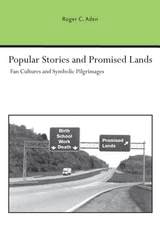
Popular Stories and Promised Lands
Fan Cultures and Symbolic PilgrimagesRoger C. Aden
University of Alabama Press, 2007
A conversation about who we are, where we’ve been, and where we might be going.
Popular Stories and Promised Lands enters a conversation about who we are, where we’ve been, and where we might be going by suggesting that possible answers to those questions can be found in the popular stories we encounter at the movies, on television, in popular magazines, and even on the funny pages.
As countless scholars and popular writers have noted, those of us living in the United States find ourselves at a cultural crossroads. We are increasingly aware that the stories that once permeated life in these United States, stories that tell us that social and economic progress comes from working hard, that everyone has an equal opportunity to experience such progress, do not resonate to the degree they once did. Because many Americans have traditionally defined themselves, others, and their unique sense of place through these stories, we find ourselves displaced socially, economically, politically, and/or culturally.
So, Roger Aden says, we go to places of our own making. Fans of the television series The X-Files return to the Funhouse each week for a dose of frightening fun. Fans of the weekly magazine Sports Illustrated play in the American Elysian Fields where democratic efforts at balancing work and play are valued. Fans of the movie Field of Dreams work as altruistic producers in an alternative garden spot.
Grounded in the author’s own experiences and reinforced by the voices of approximately two hundred additional fans of the four popular stories, this book offers a compelling case for understanding the alleged wasteland of popular culture as a fertile site of individually and communally created sacred places.
Population and Economic Change in Developing Countries
Edited by Richard A. Easterlin
University of Chicago Press, 1987
"An important landmark in the growing field of economic demography."—Dudley Kirk, Journal of Developing Areas

Population-Environment Dynamics
Ideas and ObservationsGayl D. Ness, Steven R. Brechin, and William D. Drake, Editors
University of Michigan Press, 1993

Population
The First EssayThomas R. Malthus
University of Michigan Press, 1959
Porkopolis
American Animality, Standardized Life, and the Factory FarmAlex Blanchette
Duke University Press, 2020

Portrait of a Young Painter
Pepe Zuniga and Mexico City's Rebel GenerationMary Kay Vaughan
Duke University Press, 2015
Portraits of Persistence
Inequality and Hope in Latin AmericaJavier Auyero
University of Texas Press, 2024
Profiles of triumph and hardship amid massive inequality in Latin America.
Each chapter of Portraits of Persistence, a project of the University of Texas Urban Ethnography Lab, offers an intimate portrait of one or two individual lives. The subjects are a diverse group of individuals from across the continent: grassroots activists and political brokers, private security entrepreneurs, female drug dealers, shantytown dwellers, and rural farmers, as well as migrants finding routes into and out of the region. Through these accounts, the writers explore issues that are common throughout today's world: precarious work situations, gender oppression, housing displacement, experiences navigating the bureaucracy for asylum seekers, state violence, environmental devastation, and access to good and affordable health care. Carefully situating these experiences within the sociohistorical context of their specific local regions or countries, editor Javier Auyero and his colleagues consider how people make sense of the paths their lives have taken, the triumphs and hardships they have experienced, and the aspirations they hold for the future. Ultimately, these twelve compelling profiles offer unique and personal windows into the region’s complex and multilayered reality.
Post-Ethical Society
The Iraq War, Abu Ghraib, and the Moral Failure of the SecularDouglas V. Porpora, Alexander G. Nikolaev, Julia Hagemann May, and Alexander Jenkins
University of Chicago Press, 2013
In this singular examination of the American discourse over war and torture, Douglas V. Porpora, Alexander Nikolaev, Julia Hagemann May, and Alexander Jenkins investigate the opinion pages of American newspapers, television commentary, and online discussion groups to offer the first empirical study of the national conversation about the 2003 invasion of Iraq and the revelations of prisoner abuse at Abu Ghraib a year later. Post-Ethical Society is not just another shot fired in the ongoing culture war between conservatives and liberals, but a pensive and ethically engaged reflection of America’s feelings about itself and our actions as a nation. And while many writers and commentators have opined about our moral place in the world, the vast amount of empirical data amassed in Post-Ethical Society sets it apart—and makes its findings that much more damning.
Post-Racial or Most-Racial?
Race and Politics in the Obama EraMichael Tesler
University of Chicago Press, 2016
Michael Tesler shows how, in the years that followed the 2008 election—a presidential election more polarized by racial attitudes than any other in modern times—racial considerations have come increasingly to influence many aspects of political decision making. These range from people’s evaluations of prominent politicians and the parties to issues seemingly unrelated to race like assessments of public policy or objective economic conditions. Some people even displayed more positive feelings toward Obama’s dog, Bo, when they were told he belonged to Ted Kennedy. More broadly, Tesler argues that the rapidly intensifying influence of race in American politics is driving the polarizing partisan divide and the vitriolic atmosphere that has come to characterize American politics.
One of the most important books on American racial politics in recent years, Post-Racial or Most-Racial? is required reading for anyone wishing to understand what has happened in the United States during Obama’s presidency and how it might shape the country long after he leaves office.
Postcapitalist Countrysides
From Commoning to Community Wealth BuildingEdited by Nick Gallent, Menelaos Gkartzios, Mark Scott, and Andrew Purves
University College London, 2025
Postcapitalist Countrysides exposes the entrenched inequalities that capitalism has imposed on rural communities and charts a path toward more just and sustainable futures. Built upon case studies from around the world, the book critiques the failures of privatization and market-driven development while showcasing alternative economic models that reclaim land and wealth for the many, not the few.
Through analyses of land reform and community wealth building, contributors depict how local initiatives can reshape rural economies and empower communities when reinforced by structural change. From challenging exploitative land ownership to confronting the encroachment of platform capitalism, this volume engages with urgent global crises while offering tangible strategies for transformation. Postcapitalist Countrysides presents a bold vision for rural life beyond capitalism—one rooted in collective prosperity and resilience.