Results by title
4155 books match the query 'State & Local' and 170 start with p
Pfeiffer Country
The Tenant Farms and Business Activities of Paul Pfeiffer in Clay County, Arkansas, 1902-1954Sherry Laymon
Butler Center for Arkansas Studies, 2009
Phantoms of the Prairie
The Return of Cougars to the MidwestJohn W. Laundré
University of Wisconsin Press, 2012
Last seen in the 1880s, cougars (also known as pumas or mountain lions) are making a return to the plains regions of the Midwest. Their comeback, heralded by wildlife enthusiasts, has brought concern and questions to many. Will the people of the region make room for cougars? Can they survive the highly altered landscape of the Midwest? Is there a future for these intrepid pioneers if they head even farther east?
Using GIS technology, and historical data, among many other methods, Phantoms of the Prairie takes readers on a virtual journey, showing how the cougar might move over the landscape with minimal human contact. Drawing on his years of research on cougars, John W. Laundré offers an overview of what has been, what is, and what might be regarding the return of cougars to their ancestral prairie homeland.

Phil Jasner "On the Case"
His Best Writing on the Sixers, the Dream Team, and BeyondAndy Jasner
Temple University Press, 2017
Allen Iverson loved Philadelphia Daily News basketball beat reporter Phil Jasner, calling him “the best” in the world of sports journalism. From 1981 until his death in 2010, Jasner was always “on the case,” going to great lengths to track athletes down for a quote or a story. He was most known for covering the team’s famous players, including World B. Free and Bobby Jones, Julius Erving and Moses Malone, Charles Barkley, and, of course, Iverson. His tremendous output was beloved by players and fans alike, earning him many honors, including inductions into six Halls of Fame.
Phil Jasner “On the Case” collects the best of Jasner’s writing throughout his illustrious career. Jasner wrote about baseball, the Eagles, and the Philadelphia Atoms’ soccer with the same insight and aplomb he showed in his coverage of The Big 5, the 76ers’ championship season in 1983, and the Dream Team. Lovingly assembled—each chapter is introduced by some of the most prominent figures Jasner covered, from Vince Papale, Doug Collins, and Billy Cunningham to Iverson and Barkley—this collection recounts a distinguished sportswriter’s remarkable career.

Philadelphia Mural Arts @ 30
Jane Golden
Temple University Press, 2014
The Mural Arts Program of Philadelphia began in 1984 as a summer youth program with modest support from city government. Under the guidance of Jane Golden, however, it gradually grew into one of the largest and most successful public art organizations in the country, garnering support from local corporations, foundations, and individuals to extend the reach and effectiveness of its innovative programs.
Now three decades later, the Mural Arts Program has created more than 3,800 murals and public art projects that have made lasting imprints in every Philadelphia neighborhood. In the process, Mural Arts has engaged thousands of people of all ages from across the city, helped hundreds of ex-offenders train for new jobs, transformed the face of struggling commercial corridors, and developed funding partners in both public and private sectors.
While the Mural Arts Program has significantly changed the appearance of the city, it has also demonstrated how participatory public art can empower individuals and promote communal healing around difficult issues. Philadelphia Mural Arts @ 30 is a celebration of and guide to the program's success. Unlike Philadelphia Murals and the Stories They Tell and its sequel, More Philadelphia Murals and the Stories They Tell, Philadelphia Murals @ 30 showcases the results of 21 projects completed since 2009 and features essays by policy makers, curators, scholars, and educators that offer valuable lessons for artists, activists, and communities to emulate.
Philadelphia Mural Arts @ 30 traces the program's history and evolution, acknowledging the challenges and rewards of growth and change while maintaining a core commitment to social, personal, and community transformation.
Contributors include: Dr. Arthur C. Evans, Jr., Arlene Goldbard, Thora Jacobson, Rick Lowe, Dr. Samantha L. Matlin, Paulette Moore, Jeremy Nowak, Maureen H. O'Connell, Elisabeth Perez Luna, Robin Rice, Dr. Jacob Kraemer Tebes, Elizabeth Thomas, Cynthia Weiss, Howard Zehr, and the editors.
Philadelphia in the Civil War, 1861–1865
Frank H. Taylor
Westholme Publishing, 2014
First published one hundred years ago, Philadelphia in the Civil War presents the complete story of the city during America’s greatest conflict. Richly illustrated with rare images, the book describes every detail of the region’s response to the war, ranging from accounts of each of the military units that served, medicine and medical staffs, and the city’s defense measures to lists of information, such as regiments losing fifty or more men, officers who gained the rank of general, recruiting stations, and famous songs.
Philadelphia, Corrupt and Consenting
A City’s Struggle against an EpithetBrett H. Mandel
Temple University Press, 2023
He examines the costs of corruption, both financial and nonpecuniary, and considers the opportunity cost that corruption imposes. Mandel explores the nature and development of Philadelphia’s unique culture of corruption, emphasizing how machine politics and self-dealing are entwined with city history, creating a culture that allows corruption to thrive. In addition, he provides practical, achievable policies and actions that can produce positive change in Philadelphia and elsewhere.
Mandel seeks to provide insight into how our collective actions or inattention give consent to the corruption, as well as its roots and effects, and the reasons for its persistence. Philadelphia, Corrupt and Consenting is a critique, but above all, it is a call to action.
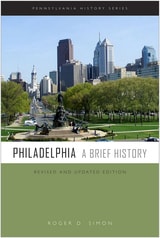
Philadelphia
A Brief HistoryRoger D. Simon
Temple University Press, 2017
Understanding Philadelphia’s history requires that we understand that nothing is inevitable; history is not made by abstract forces, but by the decisions of real individuals as they conduct their lives. With its insightful analysis and engaging prose, Philadelphia provides an accessible and readable overview of the history of the Quaker City from its founding by William Penn to the deindustrialization and gentrification of the early twenty-first century. Roger Simon asserts that the history of Philadelphia is a story of the efforts to sustain economic prosperity while fulfilling community needs, and the continued tension between those priorities.
Philadelphia devotes considerable attention to the evolving physical development of the city and to the social conditions and class structure of the people. Three dozen maps and illustrations enrich this edition, which has been fully updated and revised to reflect new scholarship on Philadelphia’s role in the post-industrial present and the diverse communities that incorporated women and minorities into the economic and social fabric of the city.
Published in association with the Pennsylvania Historical Association
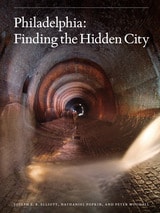
Philadelphia
Finding the Hidden CityJoseph E. B. Elliott
Temple University Press, 2017
Philadelphia possesses an exceptionally large number of places that have almost disappeared—from workshops and factories to sporting clubs and societies, synagogues, churches, theaters, and railroad lines. In Philadelphia: Finding the Hidden City, urban observers Nathaniel Popkin and Peter Woodall uncover the contemporary essence of one of America’s oldest cities. Working with accomplished architectural photographer Joseph Elliott, they explore secret places in familiar locations, such as the Metropolitan Opera House on North Broad Street, the Divine Lorraine Hotel, Reading Railroad, Disston Saw Works in Tacony, and mysterious parts of City Hall.
Much of the real Philadelphia is concealed behind facades. Philadelphia artfully reveals its urban secrets. Rather than a nostalgic elegy to loss and urban decline, Philadelphia exposes the city’s vivid layers and living ruins. The authors connect Philadelphia’s idiosyncratic history, culture, and people to develop an alternative theory of American urbanism, and place the city in American urban history. The journey here is as much visual as it is literary; Joseph Elliott’s sumptuous photographs reveal the city's elemental beauty.
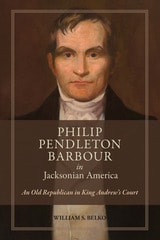
Philip Pendleton Barbour in Jacksonian America
An Old Republican in King Andrew’s CourtWilliam S. Belko
University of Alabama Press, 2016
Barbour, a Virginia lawyer, participated in America’s transition from a mostly republican government to a truer majority democracy, notably while serving as the twelfth Speaker of the United States House of Representatives and later as an associate justice of the United States Supreme Court. After being elected to the US Congress during the War of 1812, Barbour also emerged as one of the foremost champions of states’ rights, consistently and energetically fighting against expansions of federal powers. He, along with other Jeffersonian Old Republicans, opposed federal plans for a national tariff and internal improvements. Later, Barbour became one of the first Jeffersonian politicians to join the Jacksonian Democrats in Jackson’s war against a national bank.
Barbour continued to make crucial strides in support of states’ rights after taking his seat on the United States Supreme Court in 1836 under Chief Justice Roger Taney. He contributed to the Charles River Bridge v. Warren Bridge and Briscoe v. Bank of Kentucky decisions, which bolstered states’ rights. He also delivered the opinion of the court in New York v. Miln, which provided the basis for the State Police Powers Doctrine.
Expertly interweaving biography, history, political science, and jurisprudence, Philip Pendleton Barbour in Jacksonian America remembers the man whose personal life and career were emblematic of the decades in which the United States moved from the Age of Jefferson to the Age of Jackson, contributing to developments that continue to animate American politics today.
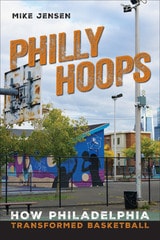
Philly Hoops
How Philadelphia Transformed BasketballMike Jensen
Temple University Press, 2027
Sportswriter Mike Jensen would argue that Philadelphia has earned a unique place in basketball history. In Philly Hoops, he makes an incontrovertible case that the city contributed to the sport on and off the court. Jensen, who spent decades covering the game for The Philadelphia Inquirer, charts the strategies, players, coaches, and even some referees from the pre-Wilt Chamberlain days to the post-Kobe Bryant era to show the region’s impact and influence on the sport worldwide.
Philadelphia didn’t merely play the game. It shaped it through ahead-of-their-time approaches, such as the value of pushing the pace. Jensen chronicles Hall-of-Fame game changers, including Earl Monroe and Paul Arizin, and coaches John Chaney, Jack Ramsay, Jay Wright, and Geno Auriemma. He recounts how the powerhouse teams at Immaculata and Cheyney University, along with Dawn Staley’s landmark playing and coaching achievements, helped make Philadelphia ground zero for women’s basketball. Philly Hoops also celebrates the influence of the Big 5 glory days, Jewish teams like The SPHAS, and icons Kyle Lowry, Tom Gola, and Rasheed Wallace.
Jensen knows how and why Philly loves basketball. His Philly Hoops is all about that love of and for the game.

Philly Sports
Teams, Games, and Athletes from Rocky's TownRyan Swanson
University of Arkansas Press, 2016
Philadelphia sports—anchored by the Eagles, Flyers, Phillies, and 76ers—have a long, and sometimes tortured, history. Philly fans have booed more than their share and have earned a reputation as some of the most hostile in the country. They’ve been known, so the tales go, to jeer Santa Claus and cheer at the injury of an opposing player.
Strangely though, much of America’s perception of Philadelphia sports has been shaped by a fictional figure: Rocky. The series of Hollywood films named after their title character has told and retold the Cinderella story of an underdog boxer rising up against long odds. One could plausibly make the argument that Rocky is Philadelphia’s most famous athlete.
Beyond the major sports franchises and Rocky, lesser-known athletic competition in Philadelphia offers much to the interested observer. The city’s boxing culture, influence on Negro Leagues baseball, role in establishing interscholastic sport, and leadership in the rise of cricket all deserve and receive close investigation in this new collection. Philly Sports combines primary research and personal experiences—playing in the Palestra, scouting out the tombstones of the city’s best athletes, enjoying the fervor of a Philadelphia night with a local team in pursuit of a championship title. The essence of Philadelphia sport, and to a certain extent the city itself, is distilled here.
Phoenix Indian School
The Second Half-CenturyDorothy R. Parker
University of Arizona Press, 1996
This book provides a history of the school from 1930 until the graduation of its final class of nineteen students in 1990. Dorothy Parker tells how the Phoenix Indian School not only adapted to policy changes instituted by the federal government but also had to contend with events occurring in the world around it, such as the Great Depression, World War II, and the advent of the "red power" movement.
Although the Phoenix Indian School has closed its doors forever, the National Park Service has undertaken an archaeological analysis of the site and an architectural documentation of the school's buildings. This history of its final years further attests to the legacy of this institution.
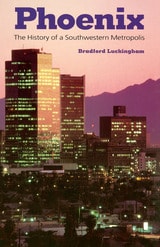
Phoenix
The History of a Southwestern MetropolisBradford Luckingham
University of Arizona Press, 1989
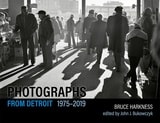
Photographs from Detroit, 1975–2019
Bruce Harkness
Ohio University Press, 2022
A retrospective survey of Bruce Harkness’s striking social documentary photographs and an invaluable historical record that bears witness to irrevocably lost swaths of Detroit’s social and urban fabric.
In 1980, the cities of Detroit and Hamtramck, Michigan, exercised eminent domain to develop nearly five hundred acres of land for a new industrial park and General Motors assembly plant. But the land was not vacant. Some thirty-five hundred people lived there in Poletown—some of them for their entire lives. They attended neighborhood schools and churches, worked for and patronized small businesses, walked the sidewalks, drove the streets, and tended to lawns and gardens. Harkness began photographing the area in February 1981. He recorded street scenes, intersections, panoramic views, homes, businesses, churches, and people. Ten months, ninety visits, and six hundred photographs later, it all disappeared forever.
The Poletown series established Harkness as a major Detroit documentarian. It came on the heels of late-1970s projects located in and around the city’s skid row: Cass Corridor. The images include gritty streetscapes, a portrait series depicting residents living in a crumbling apartment building, and the lively cultural milieu of a local gay and transgender bar. Most of this old portion of inner-city Detroit since has been supplanted by urban redevelopment and gentrification.
During the late 1980s, Harkness collaborated with urban historian John J. Bukowczyk on a major documentary project, Urban Interiors. While the Poletown project had documented the exteriors of buildings and streetscapes on Detroit’s East Side, Urban Interiors captured the insides of inner-city Detroit homes and businesses and included extended oral history interviews.
While Harkness has always found human dignity and resilience in his subjects, the tone of his work brightened in the 1990s alongside Detroit’s revival. Photographs from this era include blues musicians performing in clubs and at outdoor concerts and the distinctive, robust youth culture that flourished in Dearborn’s now-defunct Zone Coffee House.
Featuring images from these and other projects, Photographs from Detroit, 1975–2019 includes Harkness’s extensive notes, which describe and contextualize the encounters he shared with the people and places he photographed, and offer insight into his working methods and equipment. The volume and quality of Harkness’s work merits him recognition as one of Detroit’s most important documentary photographers during this pivotal, transitional era in the city’s history.
Harkness’s images depict the struggles and resilience of ordinary individuals and families in working-class communities who together have indelibly shaped the spirit of Detroit. This book is a must-have for Detroiters past and present as well as historians, anthropologists, social documentary advocates, and photobook collectors everywhere.
Physicians for the People
Black Doctors and the Struggle for Health-Care Equality in Alabama, 1870–1970Jack D. Ellis with a foreword by Alan I Marcus
University of Alabama Press, 2025
WINNER OF THE JAMES F. SULZBY AWARD
Healing against the odds—Black doctors, bold resistance, and the fight for medical justice in Alabama.
Physicians for the People chronicles the remarkable stories of 241 Black doctors who practiced medicine in Alabama during the Jim Crow era. Historian Jack D. Ellis reveals the ingenuity and resilience of these trailblazing doctors who defied segregation by establishing hospitals and clinics and providing vital healthcare to underserved Black communities.
This meticulously researched work draws on archival sources, oral histories, and an unparalleled database to dismantle the myth of a monolithic medical system in the Jim Crow South. Jack D. Ellis argues that the post–Civil War lives of Black physicians, dentists, pharmacists, nurses, and midwives hold special significance, illuminating both the causes of health care disparities among African Americans and the reasons for their continued underrepresentation in the medical professions.
Offering much of interest to students and scholars of Black history, medical history, and the civil rights movement, Physicians for the People exposes the deliberate exclusion faced by Black doctors within the white medical establishment and their ongoing fight for racial equality in medicine.
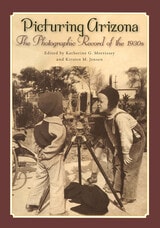
Picturing Arizona
The Photographic Record of the 1930sEdited by Katherine G. Morrissey and Kirsten Jensen
University of Arizona Press, 2005
This book places the work of local Arizonans alongside that of federal photographers both to illuminate the impact of the Depression on the state’s distinctive racial and natural landscapes and to show the influence of differing cultural agendas on the photographic record. The more than one hundred images—by well-known photographers such as Dorothea Lange and Laura Gilpin as well as by an array of less familiar photographers—represent a variety of purposes and perspectives, from public to personal, political to promotional. Six essays and three photo-essays bring together prominent authorities in history, the arts, and other fields who provide diverse perspectives on this period in Arizona and American history. Viewed together, the words and images capture a Depression-era Arizona bustling with activity as federally funded construction projects and seasonal agricultural jobs brought migrants and newcomers to the state. They convey the celebrations and the struggles of commercial photographers, archaeologists, city folks, farmers, tourists, native peoples and others in these hard times.
As the economic strains of the decade reverberated through the state, local photographers documented the lives of Arizona residents—including those frequently overlooked by historians. As this book persuasively shows, photographs can conceal as much as they reveal. A young Mexican American girl stands in front of a backdrop that hides the outhouse behind her, a deeply moving image for what it suggests about the efforts of her family to conceal their economic circumstances. Yet this image is a perfect metaphor for all the photographs in this book: stories remain hidden, but when viewers begin to question what they cannot see, pictures resonate more loudly than ever before.
This book is a history of Arizona written from the photographic record, offering a point of view that may differ from the written record. From the images and the insights of the authors, we can gain a new appreciation of how one state—and its indomitable people—weathered our nation’s toughest times.
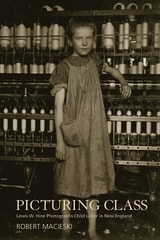
Picturing Class
Lewis W. Hine Photographs Child Labor in New EnglandRobert Macieski
University of Massachusetts Press, 2015
In this richly illustrated book, Robert Macieski examines Lewis W. Hine's art and advocacy on behalf of child laborers as part of the National Child Labor Committee (NCLC) between 1909 and 1917. A “social photographer”—as he called himself—Hine created images that documented children at work throughout New England, revealing their exploitation in the North as he had for rural working children in the South. Hine staged his images, highlighting particular types of labor in specific places: the “newsies” in Connecticut cities; sardine canners in Eastport, Maine; cranberry pickers in Cape Cod bogs; industrial homeworkers in Boston and Providence; and cotton textile workers throughout the region. His association with the NCLC connected him to a network of local and national reformers, social workers, and child welfare professionals, a broad coalition he supported in their fight to end this unethical labor practice. Macieski also chronicles Hine's efforts to mount major exhibitions that would help move public opinion against child labor.
In Picturing Class, Macieski explores the historical context of Hine's photographs and the social worlds of his subjects. He offers a detailed analysis of many of the images, unearthing the stories behind the creation of these photographs and the lives of their subjects. In telling the story of these photographs, their creation, and their reception, Macieski demonstrates how Hine worked to advance an unvarnished picture of a rapidly changing region and the young workers at the center of this important shift.
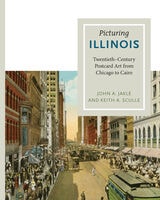
Picturing Illinois
Twentieth-Century Postcard Art from Chicago to CairoJohn A. Jakle and Keith A. Sculle
University of Illinois Press, 2012
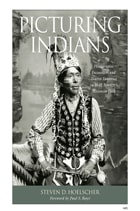
Picturing Indians
Photographic Encounters and Tourist Fantasies in H. H. Bennett's Wisconsin DellsSteven D. Hoelscher
University of Wisconsin Press, 2008
Winner, Book Award of Merit, Wisconsin Historical Society, Best Books for General Audiences, selected by the American Association of School Librarians, and Best Books for Regional Interests, selected by the Public Library Association
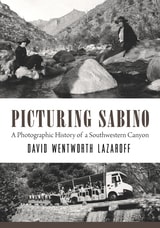
Picturing Sabino
A Photographic History of a Southwestern CanyonDavid Wentworth Lazaroff
University of Arizona Press, 2023
The story is vividly told through numerous historical photographs, lively anecdotes, and an engaging text, informed by decades of research by David Wentworth Lazaroff. Along the way the reader makes the acquaintance of ordinary picnickers as well as influential citizens who helped to reshape the canyon, while witnessing the canyon’s evolving relationship with its growing urban neighbor. The book will fascinate readers who are already familiar with Sabino Canyon, as well as anyone with an interest in local or regional history, or in historical photography.
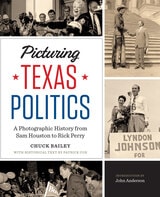
Picturing Texas Politics
A Photographic History from Sam Houston to Rick PerryBy Chuck Bailey; with historical text by Patrick Cox; introduction by John Anderson
University of Texas Press, 2015
With rare, previously unpublished photographs and iconic images of politicians from the state’s founders to Ann Richards, George W. Bush, and Rick Perry, here is the first-ever photographic album of Texas politicians and political campaigns.
The Republic of Texas was founded in 1839, around the time that photography was being invented. So while there were no photographers at the Alamo or San Jacinto, they arrived soon after to immortalize, on film, Sam Houston, David Burnett, Mirabeau Lamar, and many other founding fathers of the Lone Star State. Over the following nearly two centuries, Texas politics and politicians have provided reliable, often dramatic, and sometimes larger-than-life subjects for photographers to capture in the moment and add to the historical record.
Picturing Texas Politics presents the first photographic album of Texas politicians and political campaigns ever assembled. Chuck Bailey has searched archives, museums, libraries, and private collections to find photographs that have never been published, as well as iconic images, such as Russell Lee’s pictures of one of Ralph Yarborough’s campaigns. These photographs are arranged into four chronological sections, each one introduced by historian Patrick Cox, who also provides informative photo captions. The photographs display power and political savvy from the early Republic to Lyndon Johnson and Bob Bullock; unmatched dedication to Texas in the Hobby and Bush families; and the growing influence of women in politics, from Miriam “Ma” Ferguson to Barbara Jordan, Ann Richards, and Kay Bailey Hutchison. With Sam Houston’s jaguar vest, W. Lee “Pappy” O’Daniel’s hillbilly band, a famous governor with an ostrich, and prominent Texans eating watermelons, shooting guns, and riding horses, this is Texas politics at its liveliest and best.

Picturing Utopia
Bertha Shambaugh and the Amana PhotographersAbigail Foerstner
University of Iowa Press, 2005
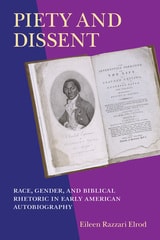
Piety and Dissent
Race, Gender, and Biblical Rhetoric in Early American AutobiographyEileen R. Elrod
University of Massachusetts Press, 2008
For pious converts to Christianity in late eighteenth- and early nineteenth-century New England, all reality was shaped by religious devotion and biblical text. It is therefore not surprising that earnest believers who found themselves marginalized by their race or sex relied on their faith to reconcile the tension between the spiritual experience of rebirth and the social ordeal of exclusion and injustice.
In Piety and Dissent, Eileen Razzari Elrod examines the religious autobiographies of six early Americans who represented various sorts of marginality: John Marrant, Olaudah Equiano, and Jarena Lee, all of African or African American heritage; Samson Occom (Mohegan) and William Apess (Pequot); and Abigail Abbott Bailey, a white woman who was subjected to extreme domestic violence. Through close readings of these personal narratives, Elrod uncovers the complex rhetorical strategies employed by pious outsiders to challenge the particular kinds of oppression each experienced. She identifies recurrent ideals and images drawn from Scripture and Protestant tradition—parables of liberation, rage, justice, and opposition to authority—that allowed them to see resistance as a religious act and, more than that, imbued them with a sense of agency.
What the life stories of these six individuals reveal, according to Elrod, is that conventional Christianity in early America was not the hegemonic force that church leaders at the time imagined, and that many people since have believed it to be. Nor was there a clear distinction between personal piety and religious, social, and political resistance. To understand fully the role of religion in the early period of American letters, we must rethink some of our most fundamental assumptions about the function of Christian faith in the context of individual lives.
Pigeon River Country
A Michigan ForestDale Clarke Franz
University of Michigan Press, 2007
The long awaited new edition of a classic offers memories, myths, and meanings of the largest contiguous piece of wild land in Michigan's Lower Peninsula.
This updated edition explores more deeply why and how the outdoors moves and compels us. It’s a book about mice who sing, elk who wear collars, deer who kiss, and birds who could dictate their compositions to Mozart. It's about the human species interacting in generous and sometimes misguided ways with the rest of life. It's about men trying to ripen pinecones into pineapples and women taking better aim with a revolver than expected. It's about poetry—from Mary Oliver, Lao Tzu, and Theodore Roethke—and seeing hawks dive in a night sky or feeling oil geologists shake the earth below. It's about finding fish dead in the river by the thousands and crouching behind a stump to watch beaver build a dwelling. While this book considers life beyond the boundaries of Pigeon River Country, it is steeped in the specifics of a place that lives mostly on its own, instead of human, terms.
The Pigeon River Country is a remote northern forest, ecologically distinct from most of the United States. Laced with waterways, it has a storied past. Dale Clarke Franz has collected personal accounts from various people intrigued with the Pigeon River Country—including loggers, conservationists, mill workers, campers, even the young Ernest Hemingway, who said he loved the forest "better than anything in the world." There are comprehensive discussions of the area's flora and fauna, guides to trails and camping sites, and photos showcasing the changing face of this hidden national treasure.
Pikes Peak Partnership
The Penroses and the TuttsThomas J. Noel
University Press of Colorado, 2002
Pillars of Salt, Monuments of Grace
New England Crime Literature and the Origins of American Popular Culture, 1674-1860Daniel A. Cohen
University of Massachusetts Press, 2006
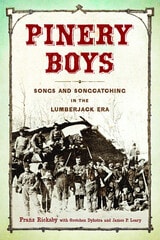
Pinery Boys
Songs and Songcatching in the Lumberjack EraEdited by Franz Rickaby with Gretchen Dykstra and James P. Leary
University of Wisconsin Press, 2017
Pinery Boys now incorporates, commemorates, contextualizes, and complements Rickaby's early work. It includes an introduction and annotations throughout by eminent folklore scholar James P. Leary and an engaging, impressively researched biography by Rickaby's granddaughter Gretchen Dykstra. Central to this edition are Rickaby's own introduction and the original fifty-one songs that he published—including "Jack Haggerty's Flat River Girl," "The Little Brown Bulls," "Ole from Norway," "The Red Iron Ore," and "Morrissey and the Russian Sailor"—plus fourteen additional songs selected to represent the varied collecting Rickaby did beyond the lumber camps.
Supplemented by historical photographs, Pinery Boys fully reveals Franz Rickaby as a visionary artist and scholar and provides glimpses into the past lives of woods poets and singers.
Pioneer Family
Life on Florida's Twentieth-Century FrontierMichel Oesterreicher
University of Alabama Press, 1996
Tracing the roots of resilience on the American frontier.
Pioneer Family is based on the recollections of Hugie and Oleta Oesterreicher, who lived in rural northeast Florida in the early decades of the twentieth century. Northeast Florida was still frontier country then, and Hugie and Oleta were pioneers. Although the time and setting of their story are particular, the theme of survival during hard times is universal. Born in a cypress cabin on the edge of the great Durbin Swamp located midway between St. Augustine and Jacksonville, Hugie knew every alligator hole, every bog, every creek; he could dry venison so it lasted without refrigeration for months, could build a potato bank that kept potatoes warm all winter, and put down a well without machinery. He knew how to cope with rattlesnakes and moccasins. Early one morning in 1925, Hugie fell in love with a tall, brown-eyed girl as he passed her place on a cattle drive. He courted this girl, Oleta Brown, with no success at first, but finally they were married in 1927.
Their daughter retells their story from vivid accounts they gave of their childhood, courtship, early years of marriage, and struggles during the Great Depression. In an age bereft of heroes, the story of their courage, their faith, and their commitment provides a fascinating empathy with a time that has passed; a place that has disappeared.
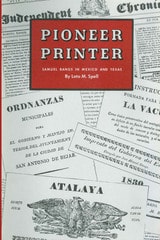
Pioneer Printer
Samuel Bangs in Mexico and TexasBy Lota M. Spell
University of Texas Press, 1963
Samuel Bangs, the first printer in the territory that is now Texas, once owed his life to his printing press. One of the few survivors of the Mina Expedition to Mexico in 1817, Bangs wrote to Servando de Mier, “I had the good fortune, through the will of God, to have my life saved, as I was a printer.”
Bangs was not always so fortunate. Losses and disappointments plagued him throughout his career, and he spent many miserable months in Mexican jails. But his ingenuity in the face of adversity, his courage and charm, stamped him not only as a storybook hero but as a man whose virtues were large enough to be their own reward.
Lota Spell’s fine biography of Samuel Bangs is at the same time a fascinating history of northern Mexico (including Texas) in the first half of the nineteenth century. Through the successes and failures of an individual it presents the facts about the operation of a business during a time of important political and economic change.
Even more important is its contribution to our knowledge of printing and of the contemporary periodical press. Although first of all a printer, Samuel Bangs was also involved in the production of newspapers, making this book a detailed history of journalism in the Mexico and Texas of his day. His printing office also functioned as a typographer’s school, through which he instituted the apprentice system in the Southwest; and as a result of his interest in presses as a commodity of trade, the first business for merchandising and servicing printing presses in the area was developed.
This narrative, combining the story of a man’s life, the history of his times, and the development of his profession, fills a gap in our knowledge of Mexico and Texas, and does it with perception and charm.
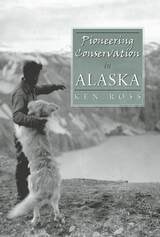
Pioneering Conservation in Alaska
Ken Ross
University Press of Colorado, 2006
The Alaskan frontier tempted fur traders, whalers, salmon fishers, gold miners, hunters, and oilmen to take what they could without regard for long-term consequences. Wildlife species, ecosystems, and Native cultures suffered, sometimes irreparably. Damage to wildlife and lands drew the attention of environmentalists, including John Muir, who applied their influence to enact wildlife protection laws and set aside lands for conservation. Alaska served as a testing ground for emergent national resource policy in the United States, as environmental values of species and ecosystem sustainability replaced the unrestrained exploitation of Alaska's early frontier days.
Efforts of conservation leaders and the territory's isolation, small human population, and late development prevented widespread destruction and gave Americans a unique opportunity to protect some of the world's most pristine wilderness.
Enhanced by more than 100 photographs, Pioneering Conservation in Alaska illustrates the historical precedents for current natural resource disputes in Alaska and will fascinate readers interested in wildlife and conservation.
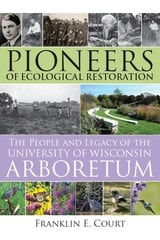
Pioneers of Ecological Restoration
The People and Legacy of the University of Wisconsin ArboretumFranklin E. Court
University of Wisconsin Press, 2012
Internationally renowned for its pioneering role in the ecological restoration of tallgrass prairies, savannas, forests, and wetlands, the University of Wisconsin Arboretum contains the world’s oldest and most diverse restored ecological communities. A site for land restoration research, public environmental education, and enjoyment by nature lovers, the arboretum remains a vibrant treasure in the heart of Madison’s urban environment.
Pioneers of Ecological Restoration chronicles the history of the arboretum and the people who created, shaped, and sustained it up to the present. Although the arboretum was established by the University of Wisconsin in 1932, author Franklin E. Court begins his history in 1910 with John Nolen, the famous landscape architect who was invited to create plans for the city of Madison, the university campus, and Wisconsin state parks. Drawing extensive details from archives and interviews, Court follows decades of collaborative work related to the arboretum’s lands, including the early efforts of Madison philanthropists and businessmen Michael Olbrich, Paul E. Stark, and Joseph W. “Bud” Jackson.
With labor from the Civilian Conservation Corps during the 1930s Depression, University of Wisconsin scientists began establishing both a traditional horticultural collection of trees and plants and a completely new, visionary approach to recreate native ecosystems. Hundreds of dedicated scientists and staff have carried forward the arboretum’s mission in the decades since, among them G. William Longenecker, Aldo Leopold, John T. Curtis, Rosemary Fleming, Virginia Kline, and William R. Jordan III.
This archival record of the arboretum’s history provides rare insights into how the mission of healing and restoring the land gradually shaped the arboretum’s future and its global reputation; how philosophical conflicts, campus politics, changing priorities, and the encroaching city have affected the arboretum over the decades; and how early aspirations (some still unrealized) have continued to motivate the work of this extraordinary institution.
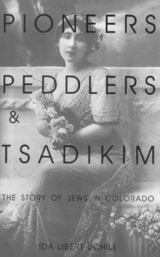
Pioneers, Peddlers, and Tsadikim
The Story of Jews in ColoradoIda Libert Uchill
University Press of Colorado, 2000
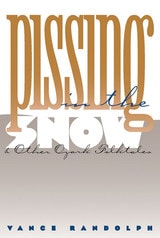
Pissing in the Snow and Other Ozark Folktales
Vance Randolph
University of Illinois Press, 1976
Randolph's reputation rests on the massive accumulation of folksong, folktale, and ballad materials he collected during forty years of living and working in the Ozarks. Unfortunately, in the 1950s when Randolph published several collection of Ozark tales, the material in this volume was considered unprintable.
Pissing in the Snow departs from the academic prudery that until recently has restricted the amount of bawdy folklore available for study. It presents a body of material that for twenty years has circulated only in manuscript or microfilm under its present title.
When placed in their rightful context alongside Randolph's other collections of folk material, the bawdy tales help provide evidence of what Ozark hill people think about their own lives and language. As Rayna Green writes in her introduction, "The entire body of material . . . offers a picture of expressive behavior unparalleled by any other American region's or group's study." Hoffmann's annotations draw parallels between the erotic narrative tradition of the Ozarks and that in other parts of the country and the world, especially Europe.

Place Names in Alabama
Virginia O. Foscue
University of Alabama Press, 1988
Discover the stories, people, and histories behind the names on Alabama's map.
Place Names in Alabama is the first comprehensive and systematic study of the names that define Alabama's geographic landscape. In this indispensable reference work, Virginia O. Foscue examines more than 2,600 place names drawn from across the state, including counties, cities, towns, rivers, lakes, streams, mountains, and other significant geographic features. Each entry provides detailed information on location, historical development, etymology, naming history, and documented sources, creating a rich portrait of the people, cultures, and events that have shaped Alabama over time.
Drawing upon archival records, historical documents, maps, and interviews with local informants, Foscue uncovers the stories behind the names that appear on Alabama's maps. The volume reveals the influence of Native American languages, European settlement, transportation networks, natural features, political leaders, local families, and regional traditions on the state's evolving identity. By tracing how communities and landmarks acquired their names, the book illuminates broader patterns of migration, settlement, economic development, and cultural exchange throughout Alabama's history.
More than a dictionary of place names, this work offers a unique window into Alabama's social and cultural heritage. Readers discover not only the origins of familiar names but also the histories of the individuals and communities that helped build the state. Whether used as a scholarly resource, a genealogical tool, or a source of fascinating historical insights, Place Names in Alabama remains an essential guide to understanding the connections between geography, language, and history in the American South.
Valuable for historians, genealogists, geographers, librarians, educators, students, journalists, and local history enthusiasts, this landmark volume continues to serve as the definitive reference on Alabama's geographic names and the stories they preserve.
Place Names of Illinois
Edward Callary
University of Illinois Press, 2007
Place Names of Wisconsin
Edward Callary
University of Wisconsin Press, 2016
Plague Among the Magnolias
The 1878 Yellow Fever Epidemic in MississippiDeanne Stephens Nuwer
University of Alabama Press, 2009
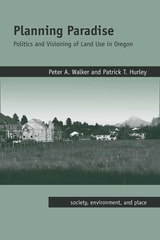
Planning Paradise
Politics and Visioning of Land Use in OregonBy Peter A. Walker and Patrick T. Hurley
University of Arizona Press, 2011
Oregon is one of the nation’s most celebrated exceptions. In the early 1970s Oregon established the nation’s first and only comprehensive statewide system of land-use planning and largely succeeded in confining residential and commercial growth to urban areas while preserving the state’s rural farmland, forests, and natural areas. Despite repeated political attacks, the state’s planning system remained essentially politically unscathed for three decades. In the early- and mid-2000s, however, the Oregon public appeared disenchanted, voting repeatedly in favor of statewide ballot initiatives that undermined the ability of the state to regulate growth. One of America’s most celebrated “success stories” in the war against sprawl appeared to crumble, inspiring property rights activists in numerous other western states to launch copycat ballot initiatives against land-use regulation.
This is the first book to tell the story of Oregon’s unique land-use planning system from its rise in the early 1970s to its near-death experience in the first decade of the 2000s. Using participant observation and extensive original interviews with key figures on both sides of the state’s land use wars past and present, this book examines the question of how and why a planning system that was once the nation’s most visible and successful example of a comprehensive regulatory approach to preventing runaway sprawl nearly collapsed.
Planning Paradise is tough love for Oregon planning. While admiring much of what the state’s planning system has accomplished, Walker and Hurley believe that scholars, professionals, activists, and citizens engaged in the battle against sprawl would be well advised to think long and deeply about the lessons that the recent struggles of one of America’s most celebrated planning systems may hold for the future of land-use planning in Oregon and beyond.
Planning White Supremacy
Civil Rights and City Planning in Montgomery, Alabama, 1920–1970Rebecca Coleen Retzlaff
University of Alabama Press, 2026
An unflinching account of how city planning was deployed to enforce white supremacy in Montgomery, Alabama—the birthplace of the Civil Rights Movement—and how Black activists fought back, block by neighborhood block.
At the heart of the Civil Rights Movement was a city meticulously designed to enforce inequality. In Planning White Supremacy: Civil Rights and City Planning in Montgomery, Alabama, 1920–1970, Rebecca Coleen Retzlaff traces how city officials used the tools of modern planning—zoning, infrastructure, housing codes, public investment, and highway construction—to suppress political power, economic opportunity, and spatial freedom for Black citizens.
As the birthplace of the Civil Rights Movement, Montgomery became a battleground where urban planning and direct-action protest collided, shaping the city’s culture in ways that still resonate today. Retzlaff’s analysis exposes the calculated use of municipal power to control land use, displace Black communities, keep schools and neighborhoods segregated, and preserve white political dominance. By placing urban planning at the center of Montgomery’s story, this groundbreaking work reframes the movement not only as a fight for voting rights and legal equality, but as a struggle for space, housing, mobility, education, and the right to live with dignity. Retzlaff also highlights the resilience and joy of the close-knit Black neighborhoods that nurtured the civil rights activists who changed history.
Retzlaff reveals how urban planning decisions systematically targeted Black neighborhoods, reinforcing racial inequality under the guise of modernization. With historical depth and critical insight, Planning White Supremacy situates Montgomery within the broader context of American urban history—offering a vital perspective on the intersection of race, space, and power. Essential for scholars of urban planning, history, and racial justice, this book also provides urgent insight into how these legacies continue to shape cities and Black socioeconomic opportunities today.
Planning as Persuasive Storytelling
The Rhetorical Construction of Chicago's Electric FutureJames A. Throgmorton
University of Chicago Press, 1996
Planning the City upon a Hill
Boston since 1630Lawrence W. Kennedy
University of Massachusetts Press, 1992
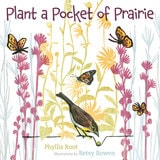
Plant a Pocket of Prairie
Phyllis Root
University of Minnesota Press, 2014
Author Phyllis Root and illustrator Betsy Bowen last explored the vast, boggy peatlands of northern Minnesota in their book Big Belching Bog. Now, in Plant a Pocket of Prairie, Root and Bowen take young readers on a trip to another of Minnesota’s important ecosystems: the prairie.
Once covering almost 40 percent of the United States, native prairie is today one of the most endangered ecosystems in the world. Plant a Pocket of Prairie teaches children how changes in one part of the system affect every other part: when prairie plants are destroyed, the animals who eat those plants and live on or around them are harmed as well. Root shows what happens when we work to restore the prairies, encouraging readers to “plant a pocket of prairie” in their own backyards.
By growing native prairie plants, children can help re-create food and habitat for the many birds, butterflies, and other animals that depend on them. “Plant cup plants,” Root suggests. “A thirsty chickadee might come to drink from a tiny leaf pool. Plant goldenrod. A Great Plains toad might flick its tongue at goldenrod soldier beetles.” An easy explanation of the history of the prairie, its endangered status, and how to go about growing prairie plants follows, as well as brief descriptions of all the plants and animals mentioned in the story.
With Betsy Bowen’s beautiful, airy illustrations capturing the feel of an open prairie and all its inhabitants, readers of all ages will be inspired to start planting seeds and watching for the many fascinating animals their plants attract. What a marvelous transformation could take place if we all planted a pocket of prairie!
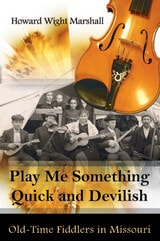
Play Me Something Quick and Devilish
Old-Time Fiddlers in MissouriHoward Wight Marshall
University of Missouri Press, 2012
Beginning with the French villages on the Mississippi River, Marshall leads us chronologically through the settlement of the state and how these communities established our cultural heritage. Other core populations include the “Old Stock Americans” (primarily Scotch-Irish from Kentucky, Tennessee, North Carolina, and Virginia), African Americans, German-speaking immigrants, people with American Indian ancestry (focusing on Cherokee families dating from the Trail of Tears in the 1830s), and Irish railroad workers in the post–Civil War period. These are the primary communities whose fiddle and dance traditions came together on the Missouri frontier to cultivate the bounty of old-time fiddling enjoyed today.
Marshall also examines regional styles in Missouri fiddling and comments on the future of this time-honored, and changing, tradition. Documentary in nature, this social history draws on various academic disciplines and oral histories recorded in Marshall’s forty-some years of research and field experience. Historians, music aficionados, and lay people interested in Missouri folk heritage—as well as fiddlers, of course—will find Play Me Something Quick and Devilish an entertaining and enlightening read.
With 39 tunes, the enclosed Voyager Records companion CD includes a historic sampler of Missouri fiddlers and styles from 1955 to 2012.
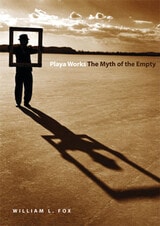
Playa Works
The Myth of the EmptyWilliam L. Fox
University of Nevada Press, 2024
In eight brilliant essays, Fox explores many of the major playas of the American West , examining locations as diverse as Nellis Air Force Base and Frenchman Flat, where the federal government has tested experimental aircraft and atomic weaponry; the Great Salt Lake Desert, where land-speed records have been broken; and the Black Rock Desert of Northern Nevada, site of the colorful Burning Man arts festival. He analyzes the geological and climatological conditions that created the playas and the historical role that playas played in the exploration and settlement of the West. And he offers lucid and keenly perceptive discussions of the ways that artists have responded to the playas, from the ancient makers of geoglyphs to the work of contemporary artists who have found inspiration in these enigmatic spaces, including earthworks builder Michael Heizer, photographer Richard Misrach, and painter Michael Moore. The ensemble is a compelling combination of natural history, philosophy, and art criticism, a thoughtful meditation on humankind's aversion to and fascination with the void.
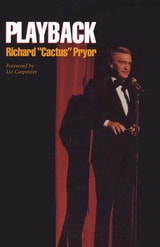
Playback
By Richard "Cactus" Pryor
University of Texas Press, 1995
From the town that brought you Molly Ivins, Liz Carpenter, John Henry Faulk, and Greater Tuna, here's Cactus Pryor. For decades, Cactus' wit and wisdom have delighted radio listeners, as well as the many social, political, business, and philanthropic groups throughout the United States whose functions have been enlivened by this accomplished master of ceremonies and after-dinner speaker.
Now the University of Texas Press takes great pleasure in bringing you this quintessential Texas humorist. Playback gathers over forty of Cactus Pryor's favorite radio essays, translating "ear words into eye words," as he puts it. In these pieces, Cactus paints vivid word pictures of people and places, offering readers the same "you are there" immediacy that makes his radio broadcasts so popular. In them, you'll take a sentimental journey with Cactus and his wife to the Maui grave site of Charles Lindbergh—discover how legendary University of Texas football coach Darrell Royal faced the agony of defeat with humor—meet unsung heroes like the 104-year-old who's teaching himself to read and write—get acquainted with the notable folks Cactus has known, including Lady Bird Johnson, John Wayne, Jane Fonda, and James Michener—and, of course, share Cactus' love of family, friends, and the Texas coast.
As Bailey White's essays on National Public Radio have introduced listeners across the country to the lifeways of the Deep South, so Cactus Pryor offers a humorous, revealing look at how we Texans view ourselves, our neighbors, and the world. Read Playback now, and see what you've been missing.

Played Out on the Strip
The Rise and Fall of Las Vegas Casino BandsJanis L. McKay
University of Nevada Press, 2016
From 1940 to 1989, nearly every hotel on the Las Vegas Strip employed a full-time band or orchestra. After the late 1980s, when control of the casinos changed hands from independent owners to corporations, almost all of these musicians found themselves unemployed. Played Out on the Strip traces this major shift in the music industry through extensive interviews with former musicians.
In 1989, these soon-to-be unemployed musicians went on strike. Janis McKay charts the factors behind this strike, which was precipitated by several corporate hotel owners moving to replace live musicians with synthesizers and taped music, a strategic decision made in order to save money. The results of this transitional period in Las Vegas history were both long-lasting and far-reaching for the entertainment industry. With its numerous oral history interviews and personal perspectives from the era, this book will appeal to readers interested in Las Vegas history, music history, and labor issues.

Playgrounds to the Pros
Legends of Peoria BasketballJeff Karzen
University of Illinois Press, 2023
Howard Nathan. A. J. Guyton. Sergio McClain. Marcus Griffin. Frank Williams. Shaun Livingston. This dazzling constellation of talent helped make Peoria a prep basketball hotbed from the 1980s to the 2000s. Jeff Karzen takes readers inside the lives of the players, coaches, and others who defined an era that produced six state titles and four Illinois Mr. Basketball winners.
Drawing on dozens of in-depth interviews, Karzen tells the stories behind the on-court triumphs while providing a panorama of the entire Peoria scene--the rivalries and relationships, the families and friendships, the hopes and hard work. Karzen also follows the players into their Division 1 and NBA careers and pays special attention to the pipeline that, by connecting Peoria to Champaign-Urbana, powered one of the most successful periods in Fighting Illini basketball history.
Intense and intimate, Playgrounds to the Pros chronicles a basketball golden age in America’s quintessential blue collar town.
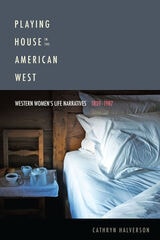
Playing House in the American West
Western Women's Life Narratives, 1839–1987Cathryn Halverson
University of Alabama Press, 2013
How domestic life shaped identity, gender, and power in the American West
The controlling metaphor Cathryn Halverson uses in her engrossing study is “playing house.” From Caroline Kirkland and Laura Ingalls Wilder to Willa Cather and Marilynne Robinson, from the mid-nineteenth to the late-twentieth centuries, western authors have persistently embraced wayward or eccentric housekeeping to prove a woman’s difference from western neighbors and eastern readers alike.
The readings in Playing House investigate the surprising textual ends to which westerners turn the familiar terrain of the home: evaluating community; arguing for different conceptions of race and class; and perhaps most especially, resisting traditional gender roles. Western women writers, Halverson argues, render the home as a stage for autonomy, resistance, and imagination rather than as a site of sacrifice and obligation.
The western women examined in Playing House in the American West are promoted and read as representatives of a region, as insiders offering views of distant and intriguing ways of life, even as they conceive of themselves as outsiders. By playing with domestic conventions, they recast the region they describe, portraying the West as a place that fosters female agency, individuality, and subjectivity.
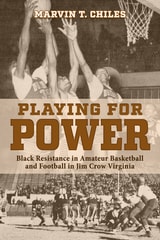
Playing for Power
Black Resistance in Amateur Basketball and Football in Jim Crow VirginiaMarvin T. Chiles
University of Alabama Press, 2025
Reveals the role of amateur Black football and basketball in Virginia before integration as a form of resistance to white supremacy
In Playing for Power, Marvin T. Chiles offers a fascinating account of amateur sports in Jim Crow Virginia, revealing how, in addition to churches, workspaces, and civil rights organizations, sports were also a key arena for Black resistance to white supremacy. Drawing from a rich trove of primary sources, Chiles recounts the development of Black football and basketball culture at the high school and college levels in Virginia from the 1890s to the early 1970s. Looking beyond their role as leisure pastimes, Chiles demonstrates how amateur sports strengthened education, neutralized class divisions, shaped Black masculinity, mentored Black male leadership, cultivated race pride, and reflected Black desires for urban modernity.
Illuminating the ways Black athletes created a world that pushed for racial progress through objective, meritocratic achievement anchored by masculine leadership and institutional success, Playing for Power traces how amateur sports coalesced into a key cultural institution that fostered Black Virginians’ collective sense of community, achievement, and purpose during segregation, cornerstones of later advances in the Civil Rights Movement. Playing for Power also contributes to a larger understanding of sports history and how amateur sports became favorite American spectacles and markers of Southern identity. Chiles’s groundbreaking work will interest historians, scholars, and individuals interested in the intersection of sports and civil rights and the history of Black sports during the Jim Crow era.

Playing with Dynamite
Sharon Harrigan
University of Wisconsin Press, 2017
Playing with Dynamite is about the family secrets that can distance us from each other and the honesty that can bring us closer. It’s about a daughter who goes looking for her father but finds her mother instead. It’s about memory and truth, grieving and growing, and what it means to go home again.