Results by title
3258 books match the query 'Art' and 209 start with p
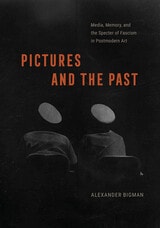
Pictures and the Past
Media, Memory, and the Specter of Fascism in Postmodern ArtAlexander Bigman
University of Chicago Press, 2024
A fresh take on the group of artists known as the Pictures Generation, reinterpreting their work as haunted by the history of fascism, the threat of its return, and the effects of its recurring representation in postwar American culture.
The artists of the Pictures Generation, converging on New York City in the late 1970s, indelibly changed the shape of American art. Rebelling against abstraction, they borrowed liberally from the aesthetics of mass media and sometimes the work of other artists. It has long been thought that the group’s main contribution was to upend received conceptions of authorial originality. In Pictures and the Past, however, art critic and historian Alexander Bigman shows that there is more to this moment than just the advent of appropriation art. He presents us with a bold new interpretation of the Pictures group’s most significant work, in particular its recurring evocations of fascist iconography.
In the wake of the original Pictures show, curated by Douglas Crimp in 1977, artists such as Sarah Charlesworth, Jack Goldstein, Troy Brauntuch, Robert Longo, and Gretchen Bender raised pressing questions about what it means to perceive the world historically in a society saturated by images. Bigman argues that their references to past cataclysms—to the violence wrought by authoritarianism and totalitarianism—represent not only a coded form of political commentary about the 1980s but also a piercing reflection on the nature of collective memory. Throughout, Bigman situates their work within a larger cultural context including parallel trends in music, fashion, cinema, and literature. Pictures and the Past probes the shifting relationships between art, popular culture, memory, and politics in the 1970s and ’80s, examining how the specter of fascism loomed for artists then—and the ways it still looms for us today.
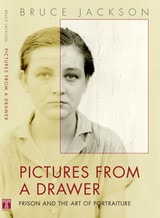
Pictures from a Drawer
Prison and the Art of PortraitureBruce Jackson
Temple University Press, 2009

Pictures of Romance
Form against Context in Painting and LiteratureWendy Steiner
University of Chicago Press, 1988
Romances violate the casual, temporal, and logical cohesiveness of realist novels, and they do so in part by depicting love as a state of suspension, a condition outside of time. Steiner argues that because Renaissance and post-Renaissance painting also represents a suspended moment of perception with "unnatural" clarity and compression of meaning, it readily serves the romance as a symbol of antirealism. Yet the atemporality of stopped-action painting was actually an attempt to achieve pictorial realism—the way things "really" look. It is this paradox that interests Steiner: to signal their departure from realism, romances evoke the symbol of "realistic" visual artwork. Steiner explores this problem through analyses of Keats, Hawthorne, Joyce, and Picasso. She then examines a return to narrative conventions in visual art in the twentieth century, in the work of Lichtenstein and Warhol, and speculates on the fate of pictorial storytelling and the romance in postmodern art. An aesthetic fantasia of sorts, this study combines theory and analysis to illuminate an unexpected interconnection between literature and the visual arts.
Picturing
Edited by Rachael Z. DeLue
Terra Foundation for American Art, 2016
The first volume in a new series on critical concerns in the history of American art, Picturing brings together essays by a distinguished international group of scholars who discuss the creation and consumption of images from the early modern period through the end of the twentieth century. Some of the contributions focus on art critical texts, like Gertrude Stein’s portrait of Cézanne, while others have as their point of departure particular artworks, from a portrait of Benjamin Franklin to Eadweard Muybridge’s nineteenth-century photographs of the California Coast. Works that addressed images and image making were not confined to the academy; they spilled out into poetry, literature, theater, and philosophy, and the essays’ considerations likewise range freely, from painting to natural history illustrations, travel narratives, and popular fiction. Together, the contributions demonstrate a rich deliberation that thoroughly debunks the notion that American art is merely derivative of a European tradition.
With a wealth of new research and full-color illustrations, Picturing significantly expands the terrain of scholarship on American art.
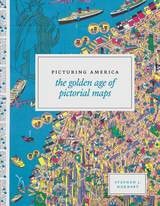
Picturing America
The Golden Age of Pictorial MapsStephen J. Hornsby
University of Chicago Press, 2017
Picturing America is the first book to showcase this vivid and popular genre of maps. Geographer Stephen J. Hornsby gathers together 158 delightful pictorial jewels, most drawn from the extensive collections of the Library of Congress. In his informative introduction, Hornsby outlines the development of the cartographic form, identifies several representative artists, describes the process of creating a pictorial map, and considers the significance of the form in the history of Western cartography. Organized into six thematic sections, Picturing America covers a vast swath of the pictorial map tradition during its golden age, ranging from “Maps to Amuse” to “Maps for War.” Hornsby has unearthed the most fascinating and visually striking maps the United States has to offer: Disney cartoon maps, college campus maps, kooky state tourism ads, World War II promotional posters, and many more. This remarkable, charming volume’s glorious full-color pictorial maps will be irresistible to any map lover or armchair traveler.
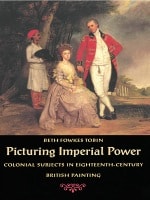
Picturing Imperial Power
Colonial Subjects in Eighteenth-Century British PaintingBeth Fowkes Tobin
Duke University Press, 1999
Informed by the varied perspectives of postcolonial theory, Tobin explores through close readings of colonial artwork the dynamic middle ground in which cultures meet. Linking specific colonial sites with larger patterns of imperial practice and policy, she examines paintings by William Hogarth, Benjamin West, Gilbert Stuart, Arthur William Devis, and Agostino Brunias, among others. These works include portraits of colonial officials, conversation pieces of British families and their servants, portraits of Native Americans and Anglo-Indians, and botanical illustrations produced by Calcutta artists for officials of the British Botanic Gardens. In addition to examining the strategies that colonizers employed to dominate and define their subjects, Tobin uncovers the tactics of negotiation, accommodation, and resistance that make up the colonized’s response to imperial authority. By focusing on the paintings’ cultural and political engagement with imperialism, she accounts for their ideological power and visual effect while arguing for their significance as agents in the colonial project.
Pointing to the complexity, variety, and contradiction within colonial art, Picturing Imperial Power contributes to an understanding of colonialism as a collection of social, economic, political, and epistemological practices that were not monolithic and inevitable, but contradictory and contingent on various historical forces. It will interest students and scholars of colonialism, imperial history, postcolonial history, art history and theory, and cultural studies.
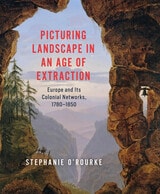
Picturing Landscape in an Age of Extraction
Europe and Its Colonial Networks, 1780–1850Stephanie O'Rourke
University of Chicago Press, 2025
In the late eighteenth and early nineteenth centuries, European artists confronted the emergence of a new way of thinking about and treating the Earth and its resources. Centered on extraction, this new paradigm was characterized by large-scale efforts to transform and monetize the physical environment across the globe. With this book, Stephanie O’Rourke considers such practices, looking at what was at stake in visual representations of the natural world during the first decades of Europe’s industrial revolutions.
O’Rourke argues that key developments in the European landscape painting tradition were profoundly shaped by industries including mining and timber harvesting, as well as by interlinked ideas about race, climate, and waste. Focusing on developments in Britain, France, Germany, and across Europe’s colonial networks, she explores how artworks and technical illustrations portrayed landscapes in ways that promoted—or pushed against—the logic of resource extraction.
Picturing the Invisible
Exploring Interdisciplinary Synergies from the Arts and the SciencesEdited by Paul Coldwell and Ruth M. Morgan
University College London, 2022
Picturing the Invisible presents different disciplinary approaches to articulating the invisible, that which is not known or not provable. The challenge is how to articulate these concepts, not only to those within a particular academic field but beyond, to other disciplines and society at large. As our understanding of the complexity of the world grows incrementally, so does our realization that issues and problems can rarely be resolved within neat demarcations. Therefore, the authors argue, the importance of finding means of communicating across disciplines and fields must become a priority. This book brings together insights from leading academics from a wide range of disciplines, including art and design, curatorial practice, literature, forensic science, medical science, psychoanalysis and psychotherapy, philosophy, astrophysics, and architecture, who share an interest in exploring how in each discipline we strive to find expression for the invisible or unknown and to draw out and articulate some of the explicit and tacit ways of communicating those concepts that transcend traditional disciplinary boundaries.
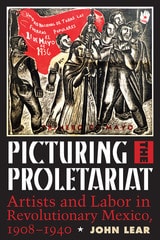
Picturing the Proletariat
Artists and Labor in Revolutionary Mexico, 1908–1940By John Lear
University of Texas Press, 2017
Thomas McGann Memorial Prize, Rocky Mountain Council on Latin American Studies, 2017
Runner-up, Humanities Book Prize, Mexico Section of the Latin American Studies Association, 2018
In the wake of Mexico’s revolution, artists played a fundamental role in constructing a national identity centered on working people and were hailed for their contributions to modern art. Picturing the Proletariat examines three aspects of this artistic legacy: the parallel paths of organized labor and artists’ collectives, the relations among these groups and the state, and visual narratives of the worker. Showcasing forgotten works and neglected media, John Lear explores how artists and labor unions participated in a cycle of revolutionary transformation from 1908 through the presidency of Lázaro Cárdenas (1934–1940). Lear shows how middle-class artists, radicalized by the revolution and the Communist Party, fortified the legacy of the prerevolutionary print artisan José Guadalupe Posada by incorporating modernist, avant-garde, and nationalist elements in ways that supported and challenged unions and the state. By 1940, the state undermined the autonomy of radical artists and unions, while preserving the image of both as partners of the “institutionalized revolution.”
This interdisciplinary book explores the gendered representations of workers; the interplay of prints, photographs, and murals in journals, in posters, and on walls; the role of labor leaders; and the discursive impact of the Spanish Civil War. It considers “los tres grandes”—Rivera, Siquieros, and Orozco—while featuring lesser-known artists and their collectives, including Saturnino Herrán, Leopoldo Méndez, Santos Balmori, and the League of Revolutionary Writers and Artists (LEAR). The result is a new perspective on the art and politics of the revolution.
Piero Della Francesca
The FlagellationMarilyn Aronberg Lavin
University of Chicago Press, 1990
"[Lavin] leaves the picture more wondrous than before, a simultaneous triumph of the theological and biographical, as well as pictorial, imagination."—Rackstraw Downes, New York Times Book Review
Pilgrimage and Pogrom
Violence, Memory, and Visual Culture at the Host-Miracle Shrines of Germany and AustriaMitchell B. Merback
University of Chicago Press, 2013

Pilgrimage to the End of the World
The Road to Santiago de CompostelaConrad Rudolph
University of Chicago Press, 2004

Pin-Up Grrrls
Feminism, Sexuality, Popular CultureMaria Elena Buszek
Duke University Press, 2006
Beginning with the pin-up’s origins in mid-nineteenth-century carte-de-visite photographs of burlesque performers, Buszek explores how female sex symbols, including Adah Isaacs Menken and Lydia Thompson, fought to exert control over their own images. Buszek analyzes the evolution of the pin-up through the advent of the New Woman, the suffrage movement, fanzine photographs of early film stars, the Varga Girl illustrations that appeared in Esquire during World War II, the early years of Playboy magazine, and the recent revival of the genre in appropriations by third-wave feminist artists. A fascinating combination of art history and cultural history, Pin-Up Grrrls is the story of how women have publicly defined and represented their sexuality since the 1860s.
Pissarro, Neo-Impressionism, and the Spaces of the Avant-Garde
Martha Ward
University of Chicago Press, 1996
Paying particular attention to the participation of Camille Pissarro, the only older artist to join the otherwise youthful movement, Ward sets the neo-impressionists' individual achievements in the context of a generational struggle to redefine the purposes of painting. She describes the conditions of display, distribution, and interpretation that the neo-impressionists challenged, and explains how these artists sought to circulate their own work outside of the prevailing system. Paintings, Ward argues, often anticipate and respond to their own conditions of display and use, and in the case of the neo-impressionists, the artists' relations to market forces and exhibition spaces had a decisive impact on their art.
Ward details the changes in art dealing, and chronicles how these and new freedoms for the press made artistic vanguardism possible while at the same time affecting the content of painting. She also provides a nuanced account of the neo-impressionists' engagements with anarchism, and traces the gradual undermining of any strong correlation between artistic allegiance and political direction in the art world of the 1890s.
Throughout, there are sensitive discussions of such artists as Georges Seurat and Paul Signac, as well as Pissarro. Yet the touchstone of the book is Pissarro's intricate relationship to the various factions of the Paris art world.
Place-Keepers
Latina/x Art, Performance, and Organizing in the Twin CitiesJessica Lopez Lyman
University of Minnesota Press, 2025
An in-depth look at how Latina/x artists transform art into activism and reclaim space in the Twin Cities
In Place-Keepers, Jessica Lopez Lyman examines how Latina/x artists in the Twin Cities navigate and challenge the region’s deep-seated racial injustices. Using “Inter-Latina movidas”—subtle yet strategic actions through which Latina/x artists forge solidarities, mobilize for justice, and reclaim space—these artists respond to systemic oppression through public performances and behind-the-scenes negotiations with the state, nonprofits, and other institutions.
Centering Latina/x women and gender nonconforming artists from Chicana/Mexicana, U.S. Central American, and Caribbean backgrounds, Place-Keepers confronts reductionist theories of Latinidad that flatten ethnic and racial identities. It demonstrates how the creative and activist practices of these cultural organizers address urgent social struggles from resisting gentrification and environmental destruction to opposing police violence. Lopez Lyman situates these efforts within the broader history of racial justice organizing in Minnesota, tracing a lineage of resistance that long precedes the 2020 Minneapolis uprising following the murder of George Floyd.
Through firsthand accounts and revealing case studies, Place-Keepers charts how these artists harness aesthetics as a tool for movement-building, strategically redistributing resources and transforming policy. Expanding the foundational concept of “movidas” in Chicana/o/x and Latina/o/x studies by highlighting maneuvers of infiltration, improvisation, individual ritual, and interdependence, Lopez Lyman establishes a crucial framework for understanding art as activism.
Places of Public Memory
The Rhetoric of Museums and MemorialsEdited by Greg Dickinson, Carole Blair, and Brian L. Ott
University of Alabama Press, 2010
A sustained and rigorous consideration of the intersections of memory, place, and rhetoric
Though we live in a time when memory seems to be losing its hold on communities, memory remains central to personal, communal, and national identities. And although popular and public discourses from speeches to films invite a shared sense of the past, official sites of memory such as memorials, museums, and battlefields embody unique rhetorical principles.
Places of Public Memory: The Rhetoric of Museums and Memorials is a sustained and rigorous consideration of the intersections of memory, place, and rhetoric. From the mnemonic systems inscribed upon ancient architecture to the roadside accident memorials that line America’s highways, memory and place have always been deeply interconnected. This book investigates the intersections of memory and place through nine original essays written by leading memory studies scholars from the fields of rhetoric, media studies, organizational communication, history, performance studies, and English. The essays address, among other subjects, the rhetorical strategies of those vying for competing visions of a 9/11 memorial at New York City’s Ground Zero; rhetorics of resistance embedded in the plans for an expansion of the National Civil Rights Museum; representations of nuclear energy—both as power source and weapon—in Cold War and post–Cold War museums; and tours and tourism as acts of performance.
By focusing on “official” places of memory, the collection causes readers to reflect on how nations and local communities remember history and on how some voices and views are legitimated and others are minimized or erased.
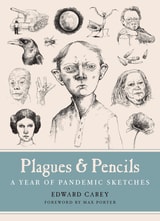
Plagues and Pencils
A Year of Pandemic SketchesEdward Carey, with a foreword by Max Porter
University of Texas Press, 2022
Honorable Mention, 2022 Nonfiction Prize, Writers' League of Texas
A remarkable collection of words and illustrations documenting the first year of the pandemic.
In March 2020, as lockdowns were imposed around the world, author and illustrator Edward Carey raced home to Austin, Texas. The next day, he published on social media a sketch of “A Very Determined Young Man.” The day after, he posted another drawing. One year and one hundred and fifty Tombow B pencil stubs later, he was still drawing.
Carey’s pencil fills the page with the marvelous and intriguing, picturing people, characters, animals, monsters, and his favorite bird to draw, the grackle. He reaches into history and fiction to escape grim reality through flights of vivid imagination—until events demand the drawings “look straight on.”
Breonna Taylor, the Brontë sisters, John Lewis, King Lear, and even the portraits that mark the progress of the year for the Very Determined Young Man combine into a remarkable document of the pandemic and its politics. For Carey, though, trapped inside a home he loves, these portraits are something more, a way to chart time, an artist’s way of creating connection in isolation. With an introduction by Max Porter, this exceptional collection from the acclaimed author of Little marks a year of a man trapped with his pencil, determined to find solace amid uncertainty.
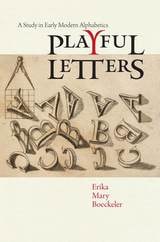
Playful Letters
A Study in Early Modern AlphabeticsErika Mary Boeckeler
University of Iowa Press, 2017
Drawing on Shakespeare, anthropomorphic typography, figured letters, and Cyrillic pedagogy and politics, this book explores the ways in which alphabetic thinking and writing inform literature and the visual arts, and it develops reading strategies for the “letterature” that underwrites such cultural production. Playful Letters begins with early modern engagements with the alphabet and the human body—an intersection where letterature emerges with startling force. The linking of letters and typography with bodies produced a new kind of literacy. In turn, educational habits that shaped letter learning and writing permeated the interrelated practices of typography, orthography, and poetry. These mutually informing processes render visible the persistent crumbling of words into letters and their reconstitution into narrative, poetry, and image.
In addition to providing a rich history of literary and artistic alphabetic interrogation in early modern Western Europe and Russia, Playful Letters contributes to the continuous story of how people use new technologies and media to reflect on older forms, including the alphabet itself.
Playing Darts with a Rembrandt
Public and Private Rights in Cultural TreasuresJoseph L. Sax
University of Michigan Press, 2001
Some incidents are famous. A great artist's mural is demolished because the rich man who commissioned it is offended by its political implications. One of America's most famous collections is closed to virtually every notable person in the art world, whose requests for visits produce only a postcard from the owner saying "go to Blazes." Scholars who seek access to the Dead Sea Scrolls, monopolized and secreted by a handful of individuals for nearly forty years, are dismissed as "slime," "fleas," "gang-snatchers," and "manure," and told, "You will not see these things in your lifetime."
Playing Darts with a Rembrandt explores abuses of ownership of cultural treasures in a wide range of settings, including material of historic and scientific interest, as well as art and antiquities. It examines the claims made on behalf of the public for preservation, protection, and access to important artifacts, balancing those claims against proprietary and privacy interests, and discusses the proper role of institutions such as museums and libraries that act as repositories. Acknowledging the complexities that sometimes arise (such as the claims of history against the desire of a great figure's family to withhold private letters), Playing Darts with a Rembrandt proposes a new species of qualified ownership: to own an object of great public importance is to become a "fortunate, if provisional, trustee, having no right to deprive others who value the objects as much as they do themselves."
The fascinating stories that comprise the bulk of the book, ranging from dinosaur excavations and the Dead Sea Scrolls to the fate of presidential papers and the secrets held by the Library of Congress, will be of interest to a wide range of general readers. The extensive discussion of collectors, and their role, should commend the book to those in the art world, as well as to those professionally associated with museums, libraries, and archives. While written in a readable and untechnical way, it should also be of interest to those in the legal community who are interested in the philosophical and theoretical underpinnings of our property system.
"Sax turns his attention from public rights to conserve land and water to protection of cultural treasures. As always, he sees both sides of the argument and comes to reasoned and wise conclusions, balancing private and public interests. His prose is lucid, and his examples are both instructive and entertaining. An invaluable book for anyone interested in the preservation of our cultural resources." --I. Michael Heyman, Secretary, Smithsonian Institution
Joseph L. Sax is Professor of Law, University of California, Berkeley. He was formerly the counselor to the Secretary of the Interior and Professor of Law, the University of Michigan Law School.
Playing with Earth and Sky
Astronomy, Geography, and the Art of Marcel DuchampJames Housefield
Dartmouth College Press, 2016
Playing with Things
Engaging the Moche Sex PotsBy Mary Weismantel
University of Texas Press, 2021
Winner, Association for Latin American Art-Arvey Foundation Book Award, 2022
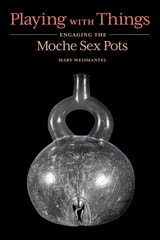
More than a thousand years ago on the north coast of Peru, Indigenous Moche artists created a large and significant corpus of sexually explicit ceramic works of art. They depicted a diversity of sex organs and sex acts, and an array of solitary and interconnected human and nonhuman bodies. To the modern eye, these Moche “sex pots,” as Mary Weismantel calls them, are lively and provocative but also enigmatic creations whose import to their original owners seems impossible to grasp.
In Playing with Things, Weismantel shows that there is much to be learned from these ancient artifacts, not merely as inert objects from a long-dead past but as vibrant Indigenous things, alive in their own inhuman temporality. From a new materialist perspective, she fills the gaps left by other analyses of the sex pots in pre-Columbian studies, where sexuality remains marginalized, and in sexuality studies, where non-Western art is largely absent. Taking a decolonial approach toward an archaeology of sexuality and breaking with long-dominant iconographic traditions, this book explores how the pots "play jokes," "make babies," "give power," and "hold water,” considering the sex pots as actual ceramic bodies that interact with fleshly bodies, now and in the ancient past. A beautifully written study that will be welcomed by students as well as specialists, Playing with Things is a model for archaeological and art historical engagement with the liberating power of queer theory and Indigenous studies.
Playthrough Poetics
Gameplay as Research MethodMilena Droumeva
Amherst College Press, 2025
Rigorous scholarship meets cultural practice in this innovative, multi-modal edited collection that includes video essays and offers transcripts of the playthroughs themselves. Readers (and viewers) will come away with a toolkit of models, case studies, and conceptual frameworks for analyzing video games through gameplay. This volume is a fresh return to the joy of play: the poetics of games as contemporary forms of storytelling and interactivity.
With contributions from Ashlee Bird, Brandon Blackburn, Milena Droumeva, Kishonna Gray, Robyn Hope, Ben Scholl, Maria Sommers, Ashlyn Sparrow, Christine Tran, and Aaron Trammell.
Please RSVP
Questions on Collaborative Aesthetics, Trans-Subjectivity, and the Politics of LoveApril Durham
Dartmouth College Press, 2019
Please Touch
A History of the First Four Children's Museums in the United States (1899–1965)Jessie Swigger
University of Massachusetts Press, 2026
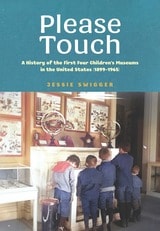
When it opened in 1899, the Brooklyn Children’s Museum greeted visitors with a new experience. Rather than carefully ensconcing artifacts and curios behind protective glass, the staff took the unusual step of moving the objects out of their cases and into the hands of the children, inviting them to “please touch.” Born out of the reformist spirit of the Progressive Era, the museum represented a new kind of institution, one whose primary purpose was not to collect, preserve, and display objects but rather to educate a specific audience. Over the next twenty-five years, three other children’s museums opened with a similar mission and approach: the Boston Children’s Museum (1913), the Detroit Children’s Museum (1917), and The Children’s Museum of Indianapolis (1925).
At a time when most museums were led by men, women played a critical role in overseeing this first wave of children’s museums. As the number of children’s museums grew, women rose to prominence in the museum profession at large, advocating for new ways for institutions to interact with and serve their audiences. By 1965, the children’s museum movement had succeeded in demonstrating rich rewards and had influenced all types of museums and continues to do so to this day.
Drawing on archival materials, newspaper accounts, and the writings of museum workers and professionals, Please Touch carefully chronicles the early histories of these four seminal children’s museums. Jessie Swigger provides thorough institutional histories of each and connects them to broader currents in education, such as the Progressive education movement, and to key events in early- to mid-twentieth-century US history, including immigration, the Great Depression, World Wars I and II, and the Cold War. She also demonstrates how these institutions were fundamentally shaped by women’s leadership, and how they challenged and expanded the definition of museums and pressed museum practices in new directions.
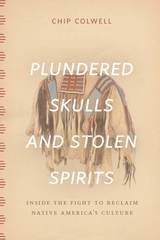
Plundered Skulls and Stolen Spirits
Inside the Fight to Reclaim Native America's CultureChip Colwell
University of Chicago Press, 2017
Five decades ago, Native American leaders launched a crusade to force museums to return their sacred objects and allow them to rebury their kin. Today, hundreds of tribes use the Native American Graves Protection and Repatriation Act to help them recover their looted heritage from museums across the country. As senior curator of anthropology at the Denver Museum of Nature & Science, Chip Colwell has navigated firsthand the questions of how to weigh the religious freedom of Native Americans against the academic freedom of scientists and whether the emptying of museum shelves elevates human rights or destroys a common heritage. This book offers his personal account of the process of repatriation, following the trail of four objects as they were created, collected, and ultimately returned to their sources: a sculpture that is a living god, the scalp of a massacre victim, a ceremonial blanket, and a skeleton from a tribe considered by some to be extinct. These specific stories reveal a dramatic process that involves not merely obeying the law, but negotiating the blurry lines between identity and morality, spirituality and politics.
Things, like people, have biographies. Repatriation, Colwell argues, is a difficult but vitally important way for museums and tribes to acknowledge that fact—and heal the wounds of the past while creating a respectful approach to caring for these rich artifacts of history.

Pluralising Pasts
Heritage, Identity and Place in Multicultural SocietiesBrian Graham, G. J. Ashworth, and J. E. Tunbridge
Pluto Press, 2007
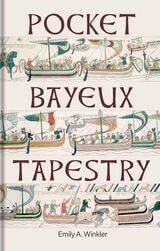
Pocket Bayeux Tapestry
Emily A. Winkler
Bodleian Library Publishing, 2026
A stunning reproduction of the Bayeux Tapestry, transcribed and translated for today’s readers.
Undoubtedly, the Bayeux Tapestry is one of the most important documents in British history. The tapestry is a visual narrative account of the events leading up to, and including, the Norman Conquest during the eleventh century; as such, the tapestry’s historical significance is unparalleled in its depiction of one of the United Kingdom’s most pivotal time periods. This book reproduces the full cycle of images of the Bayeux Tapestry made in the nineteenth century by Victor Sansonetti, based on drawings made by Charles Alfred Stothard and published in his Vetusta Monumenta (1821-23) for the Society of Antiquaries. This edition not only translates the Latin tituli and includes an accessible introduction, but each tapestry scene is beautifully reproduced to maximum effect and accompanied by both the text and translation.
Poet's Work, Poet's Play
Essays on the Practice and the ArtEdited by Daniel Tobin and Pimone Triplett
University of Michigan Press, 2008
A follow-up to the highly praised Poets Teaching Poets, Daniel Tobin and Pimone Triplett's Poet's Work, Poet's Play gathers together essays by some of the most important voices in contemporary poetry: Carl Dennis, Stephen Dobyns, Tony Hoagland, Heather McHugh, Ellen Bryant Voigt, Eleanor Wilner, Dean Young, and the late Larry Levis and Agha Shahid Ali.
Lively, accessible, and erudite, the pieces range from discussions on syntax and the syllable to an exploration of the complexities of canon formation under the shadow of imperialism, race, and history. Exploring the work of John Donne, William Butler Yeats, Robert Frost, Philip Larkin, Charles Olsen, Ezra Pound, Anne Carson, Robert Herrick, Harryette Mullen, and many others, Poet's Work, Poet's Play---like its predecessor volume---will be an invaluable tool for teachers, students, and poets at every level.
"Much more than a set of essays on poetic craft or aesthetic understandings, this collection takes on two of the most prevalent anxieties about writing poetry in our time: the place of subjectivity in poetry, and how to make a significant shape in language while both affirming and interrogating the poetic I's authority. This is a book for anyone who wants to write better poems, who wants to read with greater passion, and who believes that poetry is an independent category of human consciousness that can be as capaciousness as the world, and as nuanced."
---Tom Sleigh, author of Space Walk and Far Side of the Earth
"Gathering together essays by unquestionably important poets, Poet's Work, Poet's Play has immense pedagogical value in the way it demonstrates how to discover in poetry resources of language and structure often overlooked in first, and ensuing, readings of complex texts."
---Laurence Goldstein, Professor of English, University of Michigan, and Editor, Michigan Quarterly Review
"A valuable document illuminating critical aspects of the contemporary American poetry scene."
---John Koethe, Distinguished Professor of Philosophy at the University of Wisconsin, Milwaukee, and author of Sally's Hair: Poems
Poetic Operations
Trans of Color Art in Digital Mediamicha cárdenas
Duke University Press, 2021
Poetics of Repair
Contemporary Arts and Afterlives of Colonial-Era Mass Housing in the MaghrebKatarzyna Pieprzak
Duke University Press, 2025
Poetries - Politics
A Celebration of Language, Art, and LearningJenevieve DeLosSantos
Rutgers University Press, 2023
Reproduced in full color and with the accompanying poems in both their original language and a translation, this catalogue commemorates the incredible creative spirit of the project and provides a new way of contemplating these great poetic works.
Poetry in a World of Things
Aesthetics and Empiricism in Renaissance EkphrasisRachel Eisendrath
University of Chicago Press, 2018
In Poetry in a World of Things, Rachel Eisendrath explores how poetry responded to this new detachment by becoming a repository for a more complex experience of the world. The book focuses on ekphrasis, the elaborate literary description of a thing, as a mode of resistance to this new empirical objectivity. Poets like Petrarch, Spenser, Marlowe, and Shakespeare crafted highly artful descriptions that recovered the threatened subjective experience of the material world. In so doing, these poets reflected on the emergence of objectivity itself as a process that was often darker and more painful than otherwise acknowledged. This highly original book reclaims subjectivity as a decidedly poetic and human way of experiencing the material world and, at the same time, makes a case for understanding art objects as fundamentally unlike any other kind of objects.
Points of Contact
Disability, Art, and CultureSusan Crutchfield and Marcy Epstein, Editors
University of Michigan Press, 2000

Polanski and Perception
The Psychology of Seeing and the Cinema of Roman PolanskiDavide Caputo
Intellect Books, 2012
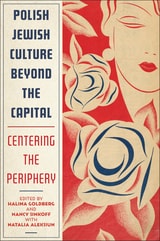
Polish Jewish Culture Beyond the Capital
Centering the PeripheryHalina Goldberg
Rutgers University Press, 2023
PIASA's 2024 Anna M. Cienciala Award for Best-Edited Multi-Authored Scholarly Volume
Polish Jewish Culture beyond the Capital: Centering the Periphery is a path-breaking exploration of the diversity and vitality of urban Jewish identity and culture in Polish lands from the second half of the nineteenth century to the outbreak of the Second World War (1899–1939). In this multidisciplinary essay collection, a cohort of international scholars provides an integrated history of the arts and humanities in Poland by illuminating the complex roles Jews in urban centers other than Warsaw played in the creation of Polish and Polish Jewish culture.
Each essay presents readers with the extraordinary production and consumption of culture by Polish Jews in literature, film, cabaret, theater, the visual arts, architecture, and music. They show how this process was defined by a reciprocal cultural exchange that flourished between cities at the periphery—from Lwów and Wilno to Kraków and Łódź—and international centers like Warsaw, thereby illuminating the place of Polish Jews within urban European cultures.
Companion website (https://polishjewishmusic.iu.edu)
Polish Media Art in an Expanded Field
Aleksandra Kaminska
Intellect Books, 2016
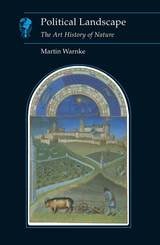
Political Landscape
The Art History of NatureMartin Warnke
Reaktion Books, 2004
The Political Landscape is underpinned with a fascinating array of examples and illustrations, many of which will be new even to experts in the art of landscape and related disciplines.
Politics of Emotion/Power of Affect
Edited by Susanne Witzgall and Marietta Kesting
Diaphanes, 2021
With contributions by Marie-Luise Angerer, Ben Anderson, Jace Clayton, Keren Cytter, Antonio Damasio, Cécile B. Evans, Karianne Fogelberg, Deborah Gould, Susanna Hertrich, Serhat Karakayali, Marietta Kesting, Carolyn Pedwell, and Susanne Witzgall.
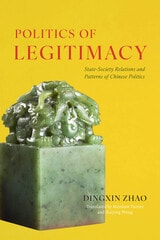
Politics of Legitimacy
State-Society Relations and Patterns of Chinese PoliticsDingxin Zhao
University of Chicago Press, 2026
The Chinese communist state has survived massive social changes, including the introduction of capitalist markets, an ongoing explosion of technological innovation, and an unprecedented jump in wealth and education, accompanied by a major cultural transformation. How has China managed to maintain its power even as the ground has so profoundly shifted? In Politics of Legitimacy, Dingxin Zhao argues that state power can be legitimized in three ideal-typical ways: a set of values upheld by the state (ideological legitimacy), recognized political processes such as regular competitive elections (procedural legitimacy), and the state’s capacity to provide public goods (performance legitimacy).
Building on this theoretical framework, Zhao analyzes different aspects of Chinese politics, including the tragic ending of the 1989 pro-democracy movement, the weak development of mass-based nationalism in post-Mao China, the reasons behind China’s economic success, the anti-establishment tendency of the Chinese mass media and social media, and the sources of political tension in China, despite a superb economy. Moreover, Zhao’s innovative framework is widely applicable beyond China, shifting our attention from regime-type categories to the tools and relationships that determine their survival or collapse, and illuminating the current global emergence of conservatism and religious nationalism.

Politics, Religion, and Art
Hegelian DebatesDouglas Moggach
Northwestern University Press, 2011

Polka Heartland
Why the Midwest Loves to PolkaRick March
Wisconsin Historical Society Press, 2015
"Polka Heartland" captures the beat that pulses in the heart of Midwestern culture--the polka--and offers up the fascinating history of how "oompah-pah" came to be the sound of middle America. From the crowded dance tent at Pulaski Polka Days to an off-the-grid Mexican polka dance in small-town Wisconsin, "Polka Heartland" explores the people, places, and history behind the Midwest's favorite music.
From polka's surprising origin story as a cutting-edge European fad to an exploration of the modern-day polka scene, author Rick March and photographer Dick Blau take readers on a joyful romp through this beloved, unique, and richly storied genre. "Polka Heartland" describes the artists, venues, instruments, and music-makers who have been pivotal to polka's popularity across the Midwest and offers six full-color photo galleries to immerse readers in today's vibrant polka scene.
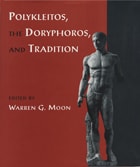
Polykleitos, the Doryphoros, and Tradition
Warren G. Moon
University of Wisconsin Press, 1995
Polykleitos of Argos, who flourished between 450 and 420 BC, is one of the most celebrated sculptors of classical Greece. A philosopher and theoretician as well as a sculptor, Polykleitos sought to capture in his statues the ideal proportions of the human body, and his work was frequently copied by later artists. This richly illustrated volume of superb essays by art historians, classical scholars, and archaeologists discusses Polykleitos’ life and influence, his intellectual and cultural milieu, and his best-known work, the Doryphoros, or “Spearbearer.”
Polykleitos, the Doryphoros, and Tradition displays an impressive range of approaches, beginning with commentary on the artistic and philosophical antecedents that influenced Polykleitos’ own aesthetic, as well as the role of contemporary Greek anatomical knowledge in his representation of the human form. Many of the essays offer extended analysis and detailed illustration of his surviving sculptures, later copies of his work, and reflections of his style in sculpture, paintings, coins, and other art in Greece, Italy, and Asia Minor. Several essays offer an extended discussion of Polykleitos’ original bronze Doryphoros, its pose, its relation to other spearbearer sculptures, and the fine Roman marble copy of it now at the Minneapolis Institute of Arts.
The volume as a whole is a visually and intellectually appealing work that will interest not only specialists but general readers interested in the art of ancient Greece. This volume resulted from a 1989 symposium held at the University of Wisconsin–Madison and the Minneapolis Institute of Arts.
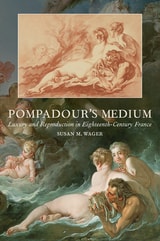
Pompadour's Medium
Luxury and Reproduction in Eighteenth-Century FranceSusan M. Wager
University of Delaware Press, 2027
Pompadour's Medium reveals the depth of patron, amateur artist, and royal mistress Madame de Pompadour's contributions to the visual arts, long dismissed as superficial and trivial. Her artistic activities centered on an innovative exploration of the relationships between painting, sculpture, and the decorative arts at a moment when advances in reproductive printmaking threatened to flatten the differences between individual mediums. Eighteenth-century France experienced an unprecedented surge in the circulation of images. Increasingly faithful and affordable reproductive prints introduced works of art to ever-widening audiences, while a culture of reproduction was simultaneously thriving at the highest end of the artistic and economic spectrum—in luxury media, such as ceramics, textiles, and metalwork. This book recovers the pivotal role of luxury reproduction in Pompadour’s artistic endeavors, and her essential role in cultivating the intermedial approach of her frequent collaborator, painter François Boucher, who tended to think between media. It is only by restoring the centrality of reproductive media in this artist-patron relationship that we can understand the magnitude of Pompadour’s and Boucher’s contributions to the history of modern art.
Poor Things
How Those with Money Depict Those without ItLennard J. Davis
Duke University Press, 2024
Pop Against Empire
Art as Masked Critique in Japan, Okinawa, and the US DiasporaHiroko Ikegami
University of Chicago Press, 2027
How Pop artists confronted the legacies of modern Empire of Japan and post-1945 American imperialism from the 1960s to the present.
Looking at a pivotal period spanning the 1960s to the present, Hiroko Ikegami explores how artists in Japan, Okinawa, and the United States have adopted Pop strategies to critique legacies of imperialism.
Ikegami focuses on locales—Tokyo, Okinawa, Minidoka, and New York—that were deeply impacted by the complex relationship between the Japanese and American empires and considers artists across different situations and generations. The book begins with Tokyo Pop artists and graphic designers, including Shinohara Ushio and Tanaami Keiichi, who critically parodied American Pop during the long 1960s. It then turns to Okinawa, where Tom Max probed Okinawans’ convoluted reality regarding the American Occupation and the Vietnam War. Artists in the second half of the volume confronted legacies of the Asia-Pacific War as a historical condition of the present. Roger Shimomura, the third-generation Japanese American who had been incarcerated in the Minidoka camp as a child, dealt with the subject by appropriating motifs of ukiyo-e woodblock prints. Takashi Murakami, now a global art star, created otaku-inspired art and capitalized on his country’s experience of the atomic bombs in promoting his “Superflat” enterprise. The book concludes with a new generation of artists protesting repercussions of empire in the twenty-first century. This is the first study to treat artists of post-1945 Japan, Okinawa, and the US diaspora in a single volume as mutually independent yet interrelated, using Pop’s criticality as a connecting thread.
Pope.L
Showing Up to WithholdThe Renaissance Society at the University of Chicago
University of Chicago Press, 2014
Published to accompany his wonderfully inscrutable exhibition Forlesen at the Renaissance Society at the University of Chicago, Pope.L: Showing Up to Withhold is simultaneously an artist’s book and a monograph. In addition to reproductions of a number of his most recent artworks, it includes images of significant works from the past decade, and presents a forum for reflection and analysis on art making today with contributions by renowned critics and scholars, including Lawrie Balfour, Nick Bastis, Lauren Berlant, and K. Silem Mohammad.

Portable Borders
Performance Art and Politics on the U.S. Frontera since 1984By Ila Nicole Sheren
University of Texas Press, 2015
After World War II, the concept of borders became unsettled, especially after the rise of subaltern and multicultural studies in the 1980s. Art at the U.S.-Mexico border came to a turning point at the beginning of that decade with the election of U.S. President Ronald Reagan. Beginning with a political history of the border, with an emphasis on the Chicano movement and its art production, Ila Sheren explores the forces behind the shift in thinking about the border in the late twentieth century.
Particularly in the world of visual art, borders have come to represent a space of performance rather than a geographical boundary, a cultural terrain meant to be negotiated rather than a physical line. From 1980 forward, Sheren argues, the border became portable through performance and conceptual work. This dematerialization of the physical border after the 1980s worked in two opposite directions—the movement of border thinking to the rest of the world, as well as the importation of ideas to the border itself. Beginning with site-specific conceptual artwork of the 1980s, particularly the performances of the Border Art Workshop/Taller de Arte Fronterizo, Sheren shows how these works reconfigured the border as an active site. Sheren moves on to examine artists such as Guillermo Gómez-Peña, Coco Fusco, and Marcos Ramirez “ERRE.” Although Sheren places emphasis on the Chicano movement and its art production, this groundbreaking book suggests possibilities for the expansion of the concept of portability to contemporary art projects beyond the region.

Portable Gray, volume 4 number 2 (Fall 2021)
The University of Chicago Press
University of Chicago Press Journals, 2021
Portable Gray, volume 5 number 1 (Spring 2022)
The University of Chicago Press
University of Chicago Press Journals, 2022
Portable Gray, volume 5 number 2 (Fall 2022)
The University of Chicago Press
University of Chicago Press Journals, 2022