Results by title
3071 books match the query 'Business & Economics' and 143 start with p
Probable Justice
Risk, Insurance, and the Welfare StateRachel Z. Friedman
University of Chicago Press, 2020
Probable Justice traces a history of social insurance from the eighteenth century to today, from the earliest ideas of social accountability through the advanced welfare state of collective responsibility and risk. At the heart of Rachel Z. Friedman’s investigation is a study of how probability theory allows social insurance systems to flexibly measure risk and distribute coverage. The political genius of social insurance, Friedman shows, is that it allows for various accommodations of needs, risks, financing, and political aims—and thereby promotes security and fairness for citizens of liberal democracies.
Procurement 4.0
A Survival Guide in a Digital, Disruptive WorldAlexander Batran, Agnes Erben, Ralf Schulz, and Franziska Sperl
Campus Verlag, 2017
As the authors show, dynamic, interconnected value chains are key factors of sustainable business success, with procurement managed and steered by strategic purchasers in their new role as value chain managers. This evolving environment will be influenced by a variety of digitalization forces, including Industry 4.0, the Internet of Things, smart data and clouds, Enterprise 2.0, social media, and mobile computing. Integrating all network levels of procurement—from intra-company and inter-company relationships to global connectivity along value chains—and drawing on interviews with corporate heads of BMW, Lufthansa, Maersk, BP, and Allianz, the authors explore four dimensions of procurement that will address the business needs of the future: competing value chains, co-creation, leadership, and digital transformation.
Producer Dynamics
New Evidence from Micro DataEdited by Timothy Dunne, J. Bradford Jensen, and Mark J. Roberts
University of Chicago Press, 2009
The Census Bureau has recently begun releasing official statistics that measure the movements of firms in and out of business and workers in and out of jobs. The economic analyses in Producer Dynamics exploit this newly available data on establishments, firms, and workers, to address issues in industrial organization, labor, growth, macroeconomics, and international trade.
This innovative volume brings together a group of renowned economists to probe topics such as firm dynamics across countries; patterns of employment dynamics; firm dynamics in nonmanufacturing industries such as retail, health services, and agriculture; employer-employee turnover from matched worker/firm data sets; and turnover in international markets. Producer Dynamics will serve as an invaluable reference to economists and policy makers seeking to understand the links between firms and workers, and the sources of economic dynamics, in the age of globalization.

Product Design, Technology, and Social Change
A Short Cultural HistoryLaura Scherling
Intellect Books, 2024
This cultural history critically examines the development of product design, considering major milestones in the mass production of goods and services and aiming to incorporate a more inclusive worldview than traditional surveys of the topic.
The breadth and versatility of product design throughout history have been profound. Products have long supported the integration and interpretation of emerging technologies into our lives. These objects include everything from tools, accessories, furniture, and clothing to types of transportation, websites, and mobile applications. Products provide singular or multiple functions, are tangible and intangible, and in many instances have affected the quality of our lives by saving time or money or by increasing feelings of personal satisfaction. At the same time, many products have negatively affected people and the environment. For nearly every product that makes it into the hands of a consumer, there is also a designer who created it and someone who labored to make it.
An eye-opening survey of product design from preindustrial times to the present day, Product Design, Technology, and Social Change provides a thorough examination of the relationship between products, consumption, sustainability, politics, and social movements.
Productivity Growth in Japan and the United States
Edited by Charles R. Hulten
University of Chicago Press, 1991
The contributors focus their efforts on the accurate measurement and comparison of Japanese and U.S. economic growth. Assuming that any sustained increase in real GNP must be due either to an increase in the quantity of capital and labor used in production or to the more efficient use of these inputs, the authors analyze the individual contributions of various factors and their importance in the process of output growth.
These essays extend the methodology of growth analysis and offer many insights into the factors leading to the superior performance of the Japanese economy. They demonstrate that growth is a complex process and no single factor can explain the Japanese 'miracle.'
Productivity in Higher Education
Edited by Caroline M. Hoxby and Kevin Stange
University of Chicago Press, 2019
Professionalism Reborn
Theory, Prophecy, and PolicyEliot Freidson
University of Chicago Press, 1994
In this concise synthesis of the major debates about the professions since World War II, Eliot Freidson explores several broad questions about professionalism today—what it is, what its future is likely to be, and its value to public policy. Freidson argues that because professionalism is based on specialized knowledge, it is distinct from either bureaucratic or market-based forms of work. He predicts a rebirth of the professions during which practitioners lose some of their independence and become more accountable to standards of a professional elite. And, defending professionalism as a desirable method of providing complex, discretionary services to the public, Freidson argues that market-based or bureaucratic methods would impoverish the quality of service to consumers, and suggests ways the virtues of professionalism can be reinforced.
The most accessible survey available of almost fifty years of theory and research by the scholar whose own work helped define the field, this book will appeal to the growing international body of scholars concerned with studying and theorizing about the professions.

Professionalism and Healthcare Ethics for Kinesiologists
Danny Rosenberg
FiT Publishing, 2024
A first-of-its-kind text for students entering a career in kinesiology, Professionalism and Healthcare Ethics for Kinesiologists provides a thorough explanation of professionalism and ethical theories, a method and many examples for making ethical decisions in kinesiology workplaces, and an exploration into accountability, governance topics, and the scope of professional misconduct in kinesiology, as well as the possible future of professional kinesiology education and ethics.
Profit over Privacy
How Surveillance Advertising Conquered the InternetMatthew Crain
University of Minnesota Press, 2021
A deep dive into the political roots of advertising on the internet
The contemporary internet’s de facto business model is one of surveillance. Browser cookies follow us around the web, Amazon targets us with eerily prescient ads, Facebook and Google read our messages and analyze our patterns, and apps record our every move. In Profit over Privacy, Matthew Crain gives internet surveillance a much-needed origin story by chronicling the development of its most important historical catalyst: web advertising.
The first institutional and political history of internet advertising, Profit over Privacy uses the 1990s as its backdrop to show how the massive data-collection infrastructure that undergirds the internet today is the result of twenty-five years of technical and political economic engineering. Crain considers the social causes and consequences of the internet’s rapid embrace of consumer monitoring, detailing how advertisers and marketers adapted to the existential threat of the internet and marshaled venture capital to develop the now-ubiquitous business model called “surveillance advertising.” He draws on a range of primary resources from government, industry, and the press and highlights the political roots of internet advertising to underscore the necessity of political solutions to reign in unaccountable commercial surveillance.
The dominant business model on the internet, surveillance advertising is the result of political choices—not the inevitable march of technology. Unlike many other countries, the United States has no internet privacy law. A fascinating prehistory of internet advertising giants like Google and Facebook, Profit over Privacy argues that the internet did not have to turn out this way and that it can be remade into something better.

Profits and Morality
Edited by Robin Cowan and Mario J. Rizzo
University of Chicago Press, 1995
Presenting arguments for and against the morality of profit making, the contributors examine the nature of profits and which ethical theories can support them. Two essays address how profits are made: one explores entrepreneurship as a legitimate source of profit, while another argues that recent advances in welfare economics weaken the case for the morality of profits. The other chapters focus on ethical theory, covering the right to profits from economic rent; the morality of how profits are used—those directed toward library or university endowments, for example, are considered morally acceptable—and whether or not profits are deserved.

Prologue to a Farce
Communication and Democracy in AmericaMark Lloyd
University of Illinois Press, 2006
Mark Lloyd has crafted a complex and powerful assessment of the relationship between communication and democracy in the United States. In Prologue to a Farce, he argues that citizens’ political capabilities depend on broad public access to media technologies, but that the U.S. communications environment has become unfairly dominated by corporate interests.
Drawing on a wealth of historical sources, Lloyd demonstrates that despite the persistent hope that a new technology (from the telegraph to the Internet) will rise to serve the needs of the republic, none has solved the fundamental problems created by corporate domination. After examining failed alternatives to the strong publicly owned communications model, such as antitrust regulation, the public trustee rules of the Federal Communications Commission, and the underfunded public broadcasting service, Lloyd argues that we must re-create a modern version of the Founder’s communications environment, and offers concrete strategies aimed at empowering citizens.
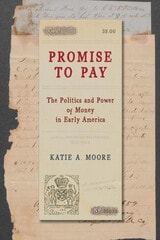
Promise to Pay
The Politics and Power of Money in Early AmericaKatie A. Moore
University of Chicago Press, 2024
Promise to Pay follows America’s first paper money—the “bills of credit” of British North America—from its seventeenth-century origins as a means of war finance to its pivotal role in catalyzing the American Revolution. Katie A. Moore combs through treasury records, account books, and the bills themselves to tell a new story of money’s origins that challenges economic orthodoxy and mainstream histories. Promise to Pay shows how colonial governments imposed paper bills on settler communities through existing labor and kinship relations, their value secured by thousands of individual claims on the public purse—debts—and the state’s promise to take them back as payment for taxes owed. Born into a world of hierarchy and deference, early American money eroded old social ties and created new asymmetries of power, functioning simultaneously as a ticket to the world of goods, a lifeline for those on the margins, and a tool of imperial domination.
Grounded in sustained engagement with scholarship from multiple disciplines, Promise to Pay breathes new life into old debates and offers an incisive account of the centrality of money in the politics and conflicts of empire, community, and everyday life.
Promise to Pay
The Politics and Power of Money in Early AmericaKatie A. Moore
University of Chicago Press, 2024
An incisive account of the crucial role money played in the formation and development of British North America.
Promise to Pay follows America’s first paper money—the “bills of credit” of British North America—from its seventeenth-century origins as a means of war finance to its pivotal role in catalyzing the American Revolution. Katie A. Moore combs through treasury records, account books, and the bills themselves to tell a new story of money’s origins that challenges economic orthodoxy and mainstream histories. Promise to Pay shows how colonial governments imposed paper bills on settler communities through existing labor and kinship relations, their value secured by thousands of individual claims on the public purse—debts—and the state’s promise to take them back as payment for taxes owed. Born into a world of hierarchy and deference, early American money eroded old social ties and created new asymmetries of power, functioning simultaneously as a ticket to the world of goods, a lifeline for those on the margins, and a tool of imperial domination.
Grounded in sustained engagement with scholarship from multiple disciplines, Promise to Pay breathes new life into old debates and offers an incisive account of the centrality of money in the politics and conflicts of empire, community, and everyday life.
Promises and Predicaments
Trade and Entrepreneurship in Colonial and Independent Indonesia in the 19th and 20th CenturiesEdited by Alicia Schrikker and Jeroen Touwen
National University of Singapore Press, 2015
The authors deal with entrepreneurship and economic specialization within different ethnic groups, the geographical distribution of exports and resource drains from exporting regions, and connections between an export economy and mass poverty. One recurring issue is the way actors from different ethnic groups occupied complementary niches, highlighting the rich variety of roles played by Asian entrepreneurs. A study of the international sugar trade shows how regime change fostered co-operation between different ethnic groups and nationalities involved with trading networks, inter-island shipping, urban public transport, and the construction sector. A comparison of export earnings and population groups involved in trade before and after 1900 shows that unexpected agricultural and industrial transitions could underpin a fundamental shift in income growth, with improved living standards for broad sectors of the population.
Property Rules
Political Economy in Chicago, 1833-1872Robin L. Einhorn
University of Chicago Press, 1991
A Choice "Outstanding Academic Book"
"[A] masterful study of policy-making in Chicago."—Choice
"[A] major contribution to urban and political history. . . . [A]n excellent book."—Jeffrey S. Adler, American Historical Review
"[A]n enlightening trip. . . . Einhorn's foray helps make sense out of the transition from Jacksonian to Gilded Age politics on the local level. . . . [She] has staked out new ground that others would do well to explore."—Arnold R. Hirsch, American Journal of Legal History
"A well-documented and informative classic on urban politics."—Daniel W. Kwong, Law Books in Review

Prophets of Agroforestry
Guaraní Communities and Commercial GatheringBy Richard K. Reed
University of Texas Press, 1995
For almost four centuries, the indigenous Chiripá (Guaraní) people of eastern Paraguay have maintained themselves as a distinct society and culture, despite continual and often intense relations with Paraguayan society and the international economy. In this study, Richard K. Reed explores the economic and social basis for this ethnic autonomy.
Reed finds that Chiripá economic power derives from their practice of commercial agroforestry. Unlike Latin American indigenous societies that have been forced to clear land for commercial agriculture, the Chiripá continue to harvest and sell forest products, such as caffeinated yerba mate, without destroying the forests. Reed also explores the relation of this complex economy to Chiripá social organization and shows how flexible kin ties allowed the Chiripá to adapt to the pressure and opportunities of the commercial economy without adopting the authoritarian nature of rural Paraguayan society.
These findings offer important insights into the relations among indigenous groups, nation-states, and the international economy. They also provide a timely alternative model for sustainable management of subtropical forests that will be of interest in the fields of development and environmental studies.
Prosperity For All?
The Economic Boom and African AmericansRobert Cherry
Russell Sage Foundation, 2000
Prosperity in the Twenty-First Century
Concepts, Models and MetricsEdited by Henrietta L. Moore, Matthew Davies, Nikolay Mintchev, and Saffron Woodcraft
University College London, 2023
Prosperity in the Twenty-First Century sets out a new vision for prosperity in the twenty-first century and how it can be achieved for all. The volume challenges orthodox understandings of economic models but goes beyond contemporary debates to show how social innovation drives economic value. Drawing on substantive research in the UK, Lebanon, and Kenya, it develops new concepts, frameworks, models, and metrics for prosperity across a wide range of contexts, emphasizing commonalities and differences. Departing from general propositions about post-growth to delineate pathways to prosperity, the volume emphasizes that visions of the good life are diverse and require empirical work co-designed with local communities and stakeholders to drive change. It will be essential reading for policymakers who are stuck, local government officers who need new tools, activists who wonder what is next, academics in need of refreshment, and students and people of all ages who want a way forward.

Prosperity without Greed
How to Save Ourselves from CapitalismSahra Wagenknecht
Campus Verlag, 2016
Prostitution, Power and Freedom
Julia O'Connell Davidson
University of Michigan Press, 1998
The author has conducted an impressive amount of research in nine countries, including conversations with male and female sex tourists, adult and child prostitutes, procurers, and clients. Through her research, O'Connell Davidson demonstrates the complexity of prostitution, arguing that it is not simply an effect of male oppression and violence or insatiable sexual needs, nor is it an unproblematic economic encounter. The book provides a sophisticated explanation of the economic and political inequalities underlying prostitution, but also shows that while prostitution necessarily implies certain freedoms for the clients, the amount of freedom experienced by individual prostititutes varies greatly.
This highly accessible book will be of great interest to those in gender and women's studies, sexuality and cultural studies, the sociology of work and organizations, and social policy. General readers will also appreciate having new ways of thinking about this age-old social phenomenon.
Julia O'Connell Davidson is Lecturer in Sociology, University of Leicester.
Protest and the Politics of Blame
The Russian Response to Unpaid WagesDebra Javeline
University of Michigan Press, 2003
Prudential Supervision
What Works and What Doesn'tEdited by Frederic S. Mishkin
University of Chicago Press, 2001
The contributors to this thoughtful volume examine the current state of prudential supervision, focusing on fundamental issues and key pragmatic concerns. Why is prudential supervision so important? What kinds of excess must it guard against? What particular forms does it take? Which of these are the most effective deterrents against mismanagement and system overload in today's rapidly shifting financial climate? The contributors foresee a continued movement beyond simple regulatory rules in banking and toward a more active evaluation and supervision of a bank's risk management practices.

Psychodynamics Organization
Larry Hirschorn
Temple University Press, 1993

Public Catastrophes, Private Losses
Sarah Tobias
Rutgers University Press, 2025
This essay collection explores how the definition of catastrophe might be expanded to include many forms of large-scale structural violence on communities, species, and ecosystems. Using feminist methodologies, the contributors to Public Catastrophes, Private Losses trace the connections between seemingly unrelated forms of violence such as structural racism, environmental degradation, and public health crises. In contrast to a news media that focuses on mass fatalities and immediate consequences, these essays call our attention to how catastrophes can also involve slow violence with long-term effects.
The authors also consider how these catastrophes are profoundly shaped by government action or inaction, offering a powerful critique of how government neglect has cost lives and demonstrating how vulnerable populations can be better protected. The essays in this collection examine how public catastrophes imprint themselves on lives, as individuals and communities narrate, process, and grapple with legacies of loss. The book is thus a feminist intervention that challenges the binary between public and private, personal and political.

Public Education and Social Reform
A History of the Illinois Education AssociationThomas J. Suhrbur
University of Illinois Press, 2025
Suhrbur pays particular attention to the impact of race, gender, religion, and tax policy on the IEA and public schools. He also examines the IEA’s evolution from a professional organization controlled by administrations and officials through its radical transformation into a teacher-led independent labor union. As a workers’ organization, the IEA successfully fought for collective bargaining and organized K–12 and higher education while continually standing against right-wing efforts to privatize education and undermine public schools with vouchers, for-profit institutions, and tax credits.
Multifaceted and up to date, Public Education and Social Reform tells the story of the organization and figures dedicated to sustaining and advancing Illinois public education.
Public Management Reform and Innovation
Research, Theory, and ApplicationH. George Frederickson
University of Alabama Press, 1999
A foundational examination of how research, theory, and innovation shape effective public management and democratic governance.
The subject of reform in the public sector is not new; indeed, its latest rubric, reinventing government, has become good politics. Still, as the contributors ask in this volume, is good politics necessarily good government?
Given the growing desire to reinvent government, there are hard questions to be asked: Is the private sector market model suitable and effective when applied to reforming public and governmental organizations? What are the major political forces affecting reform efforts in public management? How is public management reform accomplished in a constitutional democratic government? How do the values of responsiveness, professionalism, and managerial excellence shape current public management reforms? In this volume, editors H. George Frederickson and Jocelyn M. Johnston bring together scholars with a shared interest in empirical research to confront head-on the toughest questions public managers face in their efforts to meet the demands of reform and innovation.
Throughout the book, the authors consider the bureaucratic resistance that results when downsizing and reinvention are undertaken simultaneously, the dilemma public managers face when elected executives set a reform agenda that runs counter to the law, and the mistaken belief that improved management can remedy flawed policy.
Public Policies and Household Saving
Edited by James M. Poterba
University of Chicago Press, 1994
Each of the seven chapters focuses on one country and addresses a core set of topics: types of accumulated household savings and debt; tax policies toward capital income; saving in the form of public and private pensions, including Social Security and similar programs; saving programs that receive special tax treatment; and saving through insurance.
This detailed summary of the saving incentives of the G-7 nations will be an invaluable reference for policymakers and academics interested in personal saving behavior.
Public Policy and the Income Distribution
Alan J. Auerbach
Russell Sage Foundation, 2006
Public Sector Payrolls
Edited by David A. Wise
University of Chicago Press, 1987
The volume, developed from a 1984 National Bureau of Economic Research conference, focuses on various labor issues in military and other governmental employment. Several contributors discuss compensation in the armed forces and its relationship to that in the private sector, as well as the interaction between the military and the private sector in the employment of youth. This latter is of particular interest because studies of youth employment have generally ignored the important influence of military hiring practices on labor market conditions. In other contributions, the response of wages and employment in the public sector to economic conditions is analyzed, and a detailed study of government pension plans is presented. Also included is a theoretical and empirical analysis of comparable worth in the public sector from the viewpoint of analytical labor economics. The volume concludes with a look at public school teachers' salaries in the context of current debates over improving the quality of American education.
A valuable resource to policymakers, Public Sector Payrolls will be an important addition to research in the field of labor economics.

Public Spending and Democracy in Classical Athens
By David M. Pritchard
University of Texas Press, 2015
In his On the Glory of Athens, Plutarch complained that the Athenian people spent more on the production of dramatic festivals and “the misfortunes of Medeas and Electras than they did on maintaining their empire and fighting for their liberty against the Persians.” This view of the Athenians’ misplaced priorities became orthodoxy with the publication of August Böckh’s 1817 book Die Staatshaushaltung der Athener [The Public Economy of Athens], which criticized the classical Athenian dēmos for spending more on festivals than on wars and for levying unjust taxes to pay for their bloated government. But were the Athenians’ priorities really as misplaced as ancient and modern historians believed?
Drawing on lines of evidence not available in Böckh’s time, Public Spending and Democracy in Classical Athens calculates the real costs of religion, politics, and war to settle the long-standing debate about what the ancient Athenians valued most highly. David M. Pritchard explains that, in Athenian democracy, voters had full control over public spending. When they voted for a bill, they always knew its cost and how much they normally spent on such bills. Therefore, the sums they chose to spend on festivals, politics, and the armed forces reflected the order of the priorities that they had set for their state. By calculating these sums, Pritchard convincingly demonstrates that it was not religion or politics but war that was the overriding priority of the Athenian people.

Publishing Beyond the Market
Open Access, Care, and the CommonsSamuel A. Moore
University of Michigan Press, 2025
Going forward, Publishing Beyond the Market explores the importance of collectivity and democratic governance within the transition to open access publishing. It suggests that developing a commons-based, scholar-led publishing landscape through a series of presses that are each managed by working academics could offer a productive counterpoint to marketised systems of open access and subscription publishing. In weaving themselves together in order to “scale small” these publishing initiatives would act as a counter-hegemonic project based on mutual reliance and care. By illustrating how these projects build toward a commons-based publishing future, and how they may complement other approaches to publishing within university presses and libraries, the book culminates in an argument for the infrastructures, policies, and forms of governance needed to nurture such a collective vision.
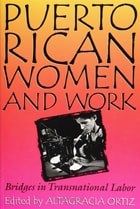
Puerto Rican Women and Work
Bridges in Transnational Laboredited by Altagracia Ortiz
Temple University Press, 1996
Puerto Rican Women and Work: Bridges in Transnational Labor is the only comprehensive study of the role of Puerto Rican women workers in the evolution of a transnational labor force in the twentieth century.
This book examines Puerto Rican women workers, both in Puerto Rico and on the U.S. mainland. It contains a range of information--historical, ethnographic, and statistical. The contributors provide insights into the effects of migration and unionization on women's work, taking into account U.S. colonialism and globalization of capitalism throughout the century as well as the impact of Operation Bootstrap. The essays are arranged in chronological order to reveal the evolutionary nature of women's work and the fluctuations in migration, technology, and the economy. This one-of-a-kind collection will be a valuable resource for those interested in women's studies, ethnic studies, and Puerto Rican and Latino studies, as well as labor studies.
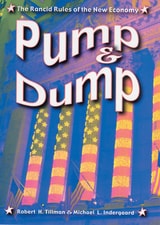
Pump and Dump
The Rancid Rules of the New EconomyTillman, Robert H
Rutgers University Press, 2005
In Pump and Dump: The Rancid Rules of the New Economy,Robert H. Tillman and Michael L. Indergaard argue that these scandals are symptoms of a corporate governance problem that began in the 1990s as New Economy pundits claimed that advances in technology and forms of business organization were changing the rules. A decade later, it looked more like a case of no rules. Endless revelations of fraud in the wake of corporate bankruptcies left ordinary investors bewildered and employees out of work with little or nothing.
Tillman and Indergaard observe that victims were taken in by organized behavior that calls to mind “pump and dump” schemes where shadowy swindlers push penny stocks. Yet, in the 1990s it was high-profile firms and high-status accomplices (financial analysts, bankers, and accountants) who used powerful institutional levers to pump the value of stock—duping investors while insiders sold their holdings for fantastic profits before the crash.
The authors explain how it was that so much of corporate America came to resemble a two-bit securities scam by focusing on the rules that mattered in three critical industries—energy trading, telecommunications, and dot-coms. Free-market hype and policies at the national level set the tone. While Wall Street wrapped itself in star-spangled packaging and celebrated its purported “democratization,” in the real halls of democracy congressional allies of business gutted protections for ordinary investors. In the regulatory vacuum that resulted, business professionals who were supposed to watch corporations instead promoted New Economy doctrines and worked with executives to tout their firms as New Economy contenders. Ringleaders in the inner circles that committed fraud made their own rules, which they enforced through a mix of bribery and bullying.
At a time when there is growing debate about proposals to privatize programs like Social Security and to promote an “ownership society,” Pump and Dump offers a path-breaking analysis of America’s most urgent economic problem: a system that relies on self-regulation and the rancid politics that continue to support the short-term interests of financial elites over the long-term interests of most Americans.

Purchasing Population Health
Paying for ResultsDavid A. Kindig
University of Michigan Press, 1997

Pure Adulteration
Cheating on Nature in the Age of Manufactured FoodBenjamin R. Cohen
University of Chicago Press, 2019
In the latter nineteenth century, extraordinary changes in food and agriculture gave rise to new tensions in the ways people understood, obtained, trusted, and ate their food. This was the Era of Adulteration, and its concerns have carried forward to today: How could you tell the food you bought was the food you thought you bought? Could something manufactured still be pure? Is it okay to manipulate nature far enough to produce new foods but not so far that you question its safety and health? How do you know where the line is? And who decides?
In Pure Adulteration, Benjamin R. Cohen uses the pure food crusades to provide a captivating window onto the origins of manufactured foods and the perceived problems they wrought. Cohen follows farmers, manufacturers, grocers, hucksters, housewives, politicians, and scientific analysts as they struggled to demarcate and patrol the ever-contingent, always contested border between purity and adulteration, and as, at the end of the nineteenth century, the very notion of a pure food changed.
In the end, there is (and was) no natural, prehuman distinction between pure and adulterated to uncover and enforce; we have to decide. Today’s world is different from that of our nineteenth-century forebears in many ways, but the challenge of policing the difference between acceptable and unacceptable practices remains central to daily decisions about the foods we eat, how we produce them, and what choices we make when buying them.

Purple on the Inside
How J.B. Hunt Transport Set Itself Apart in a Field Full of Brown CowsKirk Thompson
Epic Books, 2019
J.B. Hunt’s triumphs and struggles provide a fascinating case study of how business theory, leadership, culture, and organizational best-practices have combined to create one of the most successful companies in American history. Kirk Thompson, with more than forty years of experience inside the company, gives a CEO’s account of the company’s evolution, while Matt Waller connects the leadership decisions to business theories that are transferrable to other leaders and industries.
Purple on the Inside is more than a corporate history or business management primer. It’s a practical case study that illustrates what Seth Godin described in Purple Cow, his best-selling book that considers what characteristics make for a remarkable business. It’s the story of leaders and team members who tap into their founder’s spirit for innovation while maintaining the focus and high level of performance needed to grow. It’s a story about developing partnerships, technologies, and expertise that others can’t easily duplicate. And it’s a story of overcoming disheartening setbacks and cultivating the purple cows that have allowed J.B. Hunt Transport to do what many experts said was impossible—stand out from its competition in an industry full of brown cows.

Pushing Cool
Big Tobacco, Racial Marketing, and the Untold Story of the Menthol CigaretteKeith Wailoo
University of Chicago Press, 2021
Police put Eric Garner in a fatal chokehold for selling cigarettes on a New York City street corner. George Floyd was killed by police outside a store in Minneapolis known as “the best place to buy menthols.” Black smokers overwhelmingly prefer menthol brands such as Kool, Salem, and Newport. All of this is no coincidence. The disproportionate Black deaths and cries of “I can’t breathe” that ring out in our era—because of police violence, COVID-19, or menthol smoking—are intimately connected to a post-1960s history of race and exploitation.
In Pushing Cool, Keith Wailoo tells the intricate and poignant story of menthol cigarettes for the first time. He pulls back the curtain to reveal the hidden persuaders who shaped menthol buying habits and racial markets across America: the world of tobacco marketers, consultants, psychologists, and social scientists, as well as Black lawmakers and civic groups including the NAACP. Today most Black smokers buy menthols, and calls to prohibit their circulation hinge on a history of the industry’s targeted racial marketing. In 2009, when Congress banned flavored cigarettes as criminal enticements to encourage youth smoking, menthol cigarettes were also slated to be banned. Through a detailed study of internal tobacco industry documents, Wailoo exposes why they weren’t and how they remain so popular with Black smokers.

Pushing the Envelope
The American Aircraft IndustryDonald M. Pattillo
University of Michigan Press, 2001
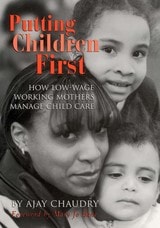
Putting Children First
How Low-Wage Working Mothers Manage Child CareAjay Chaudry
Russell Sage Foundation, 2004
Putting Faith in Partnerships
Welfare-to-Work in Four CitiesStephen V. Monsma
University of Michigan Press, 2004
In this groundbreaking study of a politically controversial topic---the debut offering in Alan Wolfe's Contemporary Political and Social Issues series---author Stephen Monsma avoids overheated rhetoric in favor of a careful, critical analysis of the hard evidence on whether public-private partnerships really work.
The book is based on in-depth studies of social service programs in Los Angeles, Chicago, Philadelphia, and Dallas. By examining public-private partnerships between government offices and nonprofit organizations, Monsma seeks to understand how these partnerships affect the balance between government's efforts to deal with social problems and the rights of individual citizens to control their own lives.
Putting Faith in Partnerships answers many previously unanswered questions in what may be the most controversial public policy debate today: about the feasibility and wisdom of government agencies forming partnerships with private organizations to provide essential public social services.
Stephen V. Monsma is Professor of Political Science at Pepperdine University. He has served as director of the Office of Quality Review in Michigan's Department of Social Services and is a widely recognized expert on the role of faith-based organizations in social service programs.
Putting Poor People to Work
How the Work-First Idea Eroded College Access for the PoorKathleen M. Shaw
Russell Sage Foundation, 2006
Putting Their Hands on Race
Irish Immigrant and Southern Black Domestic WorkersDanielle T. Phillips-Cunningham
Rutgers University Press, 2020
Putting Their Hands on Race offers an important labor history of 19th and early 20th century Irish immigrant and US southern Black migrant domestic workers. Drawing on a range of archival sources, this intersectional study explores how these women were significant to the racial labor and citizenship politics of their time. Their migrations to northeastern cities challenged racial hierarchies and formations. Southern Black migrant women resisted the gendered racism of domestic service, and Irish immigrant women strove to expand whiteness to position themselves as deserving of labor rights. On the racially fractious terrain of labor, Black women and Irish immigrant women, including Victoria Earle Matthews, the “Irish Rambler”, Leonora Barry, and Anna Julia Cooper, gathered data, wrote letters and speeches, marched, protested, engaged in private acts of resistance in the workplace, and created women’s institutions and organizations to assert domestic workers’ right to living wages and protection.
Putting the Invisible Hand to Work
Concepts and Models for Service Learning in EconomicsKimMarie McGoldrick and Andrea L. Ziegert, Editors
University of Michigan Press, 2002
The two parts of this volume provide a theoretical basis for service learning and offer lessons gleaned from applying it in the classroom. The theoretical chapters outline the learning theory and models of service learning as they can be applied in economics. Service learning is introduced here as a technique that teaches students to "do economics." Also included are specific models of service learning and an overview of assessment issues. The applications chapters detail various examples of using service to enhance learning. These range from using a single service experience in a class to courses that use service experiences as the focus and context for learning economics. Course topics cover environmental and natural resources, statistics, econometrics and research methods, principles and economic issues, labor, the economics of gender, forensic economics, and development economics. Each application provides details regarding the institutional environment in which it was implemented, type of course, enrollment, and process through which student learning was enhanced. Handouts and abbreviated syllabi are included.
Economics educators have a stake in improving their students' long-term economic literacy. Service learning offers significant benefits beyond those offered by pedagogies traditionally found in economics classrooms and should be considered as a teaching strategy by economics professors everywhere.
Kim Marie McGoldrick is Associate Professor of Economics, University of Richmond. Andrea L. Ziegert is Associate Professor of Economics, Denison University.