Results by title
1427 books match the query 'Politics' and 143 start with p
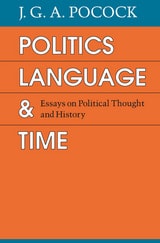
Politics, Language, and Time
Essays on Political Thought and HistoryJ. G. A. Pocock
University of Chicago Press, 1989
Pocock argues that the solution has already been approached by, first, the linguistic philosophers, with their emphasis on the importance of language study to understanding human thought, and, second, by Thomas Kuhn's The Structure of Scientific Revolutions, with its notion of controlling intellectual paradigms. Those paradigms within and through which the scientist organizes his intellectual enterprise may well be seen as analogous to the worlds of political discourse in which political problems are posed and political solutions are proffered. Using this notion of successive paradigms, Pocock demonstrates its effectiveness by analyzing a wide range of subjects, from ancient Chinese philosophy to Machiavelli, Hobbes, and Burke.
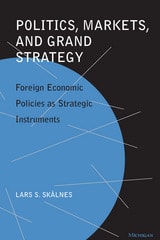
Politics, Markets, and Grand Strategy
Foreign Economic Policies as Strategic InstrumentsLars S. Skalnes
University of Michigan Press, 2000
Skålnes explains changes in foreign economic policy in terms of shifting strategic assessments regarding the importance of military support from allies. When states need military support from their allies to meet threats to their security, they will adopt discriminatory foreign economic policies in an attempt to strengthen alliance relations. When states can go it alone without military support, by contrast, they will not pursue foreign economic policies that discriminate in favor of either allies or other countries. Discriminatory policies, Skalnes argues, are important strategic instruments for several reasons. First, they can be used to tie countries to a military alliance. Second, they are useful as signals of intention. Third, discriminatory policies may strengthen an ally militarily by increasing the economic resources available for military purposes.
Skålnes provides detailed accounts of the grand strategies of Germany (1879-1914), France (1887-1914), Great Britain (1919-1939), and the United States (1945-1967).
Politics, Markets, and Grand Strategy will be important reading for scholars and students in the fields of national security studies, international political economy, and economic history, and to economists working on problems associated with foreign investment and trade generally and customs union theory and discriminatory trade agreements specifically.
Lars S. Skålnes is Associate Professor of Political Science, University of Oregon.

Politics, Metaphysics, and Death
Essays on Giorgio Agamben's Homo SaceAndrew Norris, ed.
Duke University Press, 2005
The contributors analyze Agamben’s thought from the perspectives of political theory, philosophy, jurisprudence, and the history of law. They consider his work not only in relation to that of his major interlocutors—Hannah Arendt, Michel Foucault, Carl Schmitt, Walter Benjamin, and Martin Heidegger—but also in relation to the thought of Plato, Pindar, Heraclitus, Descartes, Kafka, Bataille, and Derrida. The essayists’ approaches are varied, as are their ultimate evaluations of the cogency and accuracy of Agamben’s arguments. This volume also includes an original essay by Agamben in which he considers the relation of Benjamin’s “Critique of Violence” to Schmitt’s Political Theology. Politics, Metaphysics, and Death is a necessary, multifaceted exposition and evaluation of the thought of one of today’s most important political theorists.
Contributors: Giorgio Agamben, Andrew Benjamin, Peter Fitzpatrick, Anselm Haverkamp, Paul Hegarty, Andreas Kalyvas, Rainer Maria Kiesow , Catherine Mills, Andrew Norris, Adam Thurschwell, Erik Vogt, Thomas Carl Wall
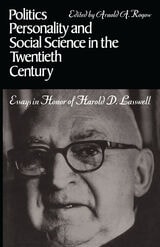
Politics, Personality, and Social Science in the Twentieth Century
Essays in Honor of Harold D. LasswellEdited by Arnold A. Rogow
University of Chicago Press, 1969
This collection of essays is the first full-scale effort to deal with the voluminous writings of Lasswell and explore his at once charming and baffling personality which is perhaps inseparable from the inventiveness, unconventionality, and unusual scope of his work.
The authors of these essays, many of whom are former students or collaborators, view their subject from a variety of perspectives. What emerges is a full assessment of Lasswell's many-faceted contribution to the social scholarship of his time.
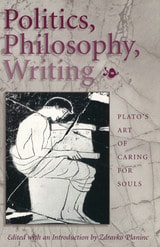
Politics, Philosophy, Writing
Plato's Art of Caring for SoulsEdited & Intro by Zdravko Planinc
University of Missouri Press, 2001
The leading scholars represented in Politics, Philosophy, Writing examine six key Platonic dialogues and the most important of the epistles, moving from Plato's most public or political writings to his most philosophical. The collection is intended to demonstrate the unity of Plato's concerns, the literary quality of his writing, and the integral relation of form and content in his work. Taken together, these essays show the consistency of Plato's understanding of the political art, the art of writing, and the philosophical life.
Studies emphasizing the unity of Plato's lifework have given way in recent scholarship to specialized and overspecialized examinations of individual dialogues. While each of the contributors to Politics, Philosophy, Writing studies one text, his or her work is oriented toward illuminating the whole of Plato's project. Each of the essays is an innovative contribution to scholarship on its topic; as a collection, they constitute a unique reading of Plato's political philosophy.
Plato scholars have generally divided themselves into two camps: those who concentrate on the analytic or logical aspects of the dialogues, and those who concentrate on the literary-critical features. In one camp are the philologists and classicists, and in the other, the writers of inventive interpretive commentaries. By avoiding distinctions between Plato the poet and Plato the philosopher, Politics, Philosophy, Writing allows a deeper exploration of the comprehensiveness of Plato's theoretical vision and illuminates the lasting challenge of his understanding of the human condition.
Politics, Policy, and Organizations
Frontiers in the Scientific Study of BureaucracyGeorge A. Krause & Kenneth J. Meier, Editors
University of Michigan Press, 2003
Politics, Process, and American Trade Policy
Sharyn O'Halloran
University of Michigan Press, 1994

Politics, Religion, and Art
Hegelian DebatesDouglas Moggach
Northwestern University Press, 2011
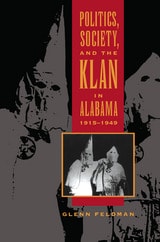
Politics, Society, and the Klan in Alabama, 1915-1949
Glenn Feldman
University of Alabama Press, 1999
This first book-length examination of the Klan in Alabama represents exhaustive research that challenges traditional interpretations.
The Ku Klux Klan has wielded considerable power both as a terrorist group and as a political force. Usually viewed as appearing in distinct incarnations, the Klans of the 20th century are now shown by Glenn Feldman to have a greater degree of continuity than has been previously suspected. Victims of Klan terrorism continued to be aliens, foreigners, or outsiders in Alabama: the freed slave during Reconstruction, the 1920s Catholic or Jew, the 1930s labor organizer or Communist, and the returning black veteran of World War II were all considered a threat to the dominant white culture. Feldman offers new insights into this "qualified continuity" among Klans of different eras, showing that the group remained active during the 1930s and 1940s when it was presumed dormant, with elements of the "Reconstruction syndrome" carrying over to the smaller Klan of the civil rights era.
In addition, Feldman takes a critical look at opposition to Klan activities by southern elites. He particularly shows how opponents during the Great Depression and war years saw the Klan as an impediment to attracting outside capital and federal relief or as a magnet for federal action that would jeopardize traditional forms of racial and social control. Other critics voiced concerns about negative national publicity, and others deplored the violence and terrorism.
This in-depth examination of the Klan in a single state, which features rare photographs, provides a means of understanding the order's development throughout the South. Feldman's book represents definitive research into the history of the Klan and makes a major contribution to our understanding of both that organization and the history of Alabama.

Politics, Writing, Mutilation
The Cases of Bataille, Blanchot, Roussel, Leiris, and PongeAllan Stoekl
University of Minnesota Press, 1985
Politics, Writing, Mutilation was first published in 1985. Minnesota Archive Editions uses digital technology to make long-unavailable books once again accessible, and are published unaltered from the original University of Minnesota Press editions.
Five twentieth-century French writers played, and continue to play, a pivotal role in the development of literary-philosophical thinking that has come to be known in the United States as post-structuralism. The work of Georges Bataille, Maurice Blanchot, Raymond Roussel, Michel Leiris, and Francis Ponge in the 1930s and 1940s amounts to a prehistory of today's theoretical debates; the writings of Foucault and Derrida in particular would have been unthinkable outside the context provided by these writers. In Politics, Writing, Mutilation,Allan Stoekl emphasizes their role as precursors, but he also makes clear that they created a distinctive body of work that must be read and evaluated on its own terms.
Stoekl's critical readings of their work—selected novels, poems, and autobiographical fragments—reveal them to be battlegrounds not only of disruptive language practices, but of conflicting political drives as well. These irreconcilable tendencies can be defined as progressive political revolution, on the one hand with its emphasis on utility, conservation, and labor; and, on the other hand, a notion of dangerous and sinister production that stresses orgiastic sexuality and delirious expenditure. Caught between these forces is the intellectual of Bataille's time (and indeed of ours), locked in impotence, self-betrayal, and automutilation.
Stoekl develops his critique through dual readings of each writer's central work—the first reading deconstructive, the second a search for the political meaning excluded by a deconstructive approach. Repeating this process on a larger scale, he shows how Derrida and Foucault are indebted to their precursors even while they have betrayed them by stripping their work of political conflict and historical specificity. And he acknowledges that one of the most painful questions faced in prewar and Occupied France—that of the unthinkable guilt and duplicity of the intellectual—may not be as remote from contemporary theoretical concerns as some would have us believe.

Polpop 2
Politics and Popular Culture in America TodayJames Combs
University of Wisconsin Press, 1991
This book takes another look at politics and popular culture. The author has tried to explain the politics of popular culture as part of historical and cultural processes, helping the reader understand not only how popular culture has affected our politics, but also where it is taking us.

Portable Borders
Performance Art and Politics on the U.S. Frontera since 1984By Ila Nicole Sheren
University of Texas Press, 2015
After World War II, the concept of borders became unsettled, especially after the rise of subaltern and multicultural studies in the 1980s. Art at the U.S.-Mexico border came to a turning point at the beginning of that decade with the election of U.S. President Ronald Reagan. Beginning with a political history of the border, with an emphasis on the Chicano movement and its art production, Ila Sheren explores the forces behind the shift in thinking about the border in the late twentieth century.
Particularly in the world of visual art, borders have come to represent a space of performance rather than a geographical boundary, a cultural terrain meant to be negotiated rather than a physical line. From 1980 forward, Sheren argues, the border became portable through performance and conceptual work. This dematerialization of the physical border after the 1980s worked in two opposite directions—the movement of border thinking to the rest of the world, as well as the importation of ideas to the border itself. Beginning with site-specific conceptual artwork of the 1980s, particularly the performances of the Border Art Workshop/Taller de Arte Fronterizo, Sheren shows how these works reconfigured the border as an active site. Sheren moves on to examine artists such as Guillermo Gómez-Peña, Coco Fusco, and Marcos Ramirez “ERRE.” Although Sheren places emphasis on the Chicano movement and its art production, this groundbreaking book suggests possibilities for the expansion of the concept of portability to contemporary art projects beyond the region.
Post-Post-Soviet?
Art, Politics and Society in Russia at the Turn of the DecadeEdited by Marta Dziewanska, Ekaterina Degot, and Ilya Budratskis
Museum of Modern Art in Warsaw, 2013
Post-Racial or Most-Racial?
Race and Politics in the Obama EraMichael Tesler
University of Chicago Press, 2016
Michael Tesler shows how, in the years that followed the 2008 election—a presidential election more polarized by racial attitudes than any other in modern times—racial considerations have come increasingly to influence many aspects of political decision making. These range from people’s evaluations of prominent politicians and the parties to issues seemingly unrelated to race like assessments of public policy or objective economic conditions. Some people even displayed more positive feelings toward Obama’s dog, Bo, when they were told he belonged to Ted Kennedy. More broadly, Tesler argues that the rapidly intensifying influence of race in American politics is driving the polarizing partisan divide and the vitriolic atmosphere that has come to characterize American politics.
One of the most important books on American racial politics in recent years, Post-Racial or Most-Racial? is required reading for anyone wishing to understand what has happened in the United States during Obama’s presidency and how it might shape the country long after he leaves office.
Postcolonial Disaster
Narrating Catastrophe in the Twenty-First CenturyPallavi Rastogi
Northwestern University Press, 2020
Rastogi creates a narratology for postcolonial disaster fiction and brings concepts from Disaster Studies into the realm of literary analysis.
Postmodern Education
Politics, Culture, and Social CriticismStanley Aronowitz
University of Minnesota Press, 1991
This book offers and opinionated analysis of today’s polemics surrounding the topic of education and society. Aronowitz and Giroux present a conceptual framework for charting the future directions educational theory and practice might take and continue the debate begun in their previous book, Education Under Siege, which was named one of the most significant books in education by the American Educational Studies Association in 1986.
"In Postmodern Education Aronowitz and Giroux are architects of the imagination, presenting essays of political, social, and cultural criticism aimed at altering the ways we understand the existing social order and act to change the conditions of our lives.” Afterimage
Postmodernism and Politics
Jonathon Arac
University of Minnesota Press, 1986
In eight essays, the contributors reach out to explore cinema and photography, psychology and ethics, social theory and economic reform. Taken together, the essays provide fresh perspectives on the problem of representation in many areas, from the constitution of the individual subject, through the status of the image, to the formation and transmission of social and moral knowledge.
The contributors: Paul A. Bove, Mary Louise Pratt, Dana Polan, Andrew Parker, Rainer Nagele, John Higgins, Cornel West, and Bruce Robbins.
Pot Roast, Politics, and Ants in the Pantry
Missouri's Cookbook HeritageCarol Fisher & John Fisher
University of Missouri Press, 2008
When is a cookbook more than just a cookbook? When it’s a gateway to our culinary heritage. For well over a hundred years, Missouri’s cookbooks have helped readers serve up tasty dishes to the state’s tables, but these publications also document the evolution of our kitchens and households.
Pot Roast,Politics, and Ants in the Pantry, a treasure trove of anecdotes and nuggets of historical information about cookery in the Show-Me State, draws from more than 150 publications to reveal Missouri’s cookbook heritage and to deliver a generous sampling of recipes. Carol Fisher and John Fisher look back to manuscript cookbooks from 1821 St. Louis, then progress through the years and around Missouri before arriving at today’s online recipes. Along the way, they dish out servings of kitchen medicine, household hints, and cookbook literature gleaned from the state’s cache of culinary gems.
From handwritten family recipe collections and mimeographed publications to glossy color editions, the texts the Fishers have obtained from libraries and historical societies as well as their own extensive cookbook collection include such curiosities as the Julia Clark Household Memoranda Book from the William Clark papers, an 1880 production by the Ladies of St. Louis called My Mother’s Cookbook, Mary Foote Henderson’s Practical Cooking and Dinner Giving, and Albert E. Brumley’s All-Day Singin’ and Dinner on the Ground. They tell how various ethnic communities raised money by creating cookbooks, how the state’s Beef Council and Pork Association put recipes on the Internet, and how restaurants like the Blue Owl in Kimmswick and Stephenson’s Apple Farm Restaurant near Kansas City enhanced their reputations with their own cookbooks. Festival cookbooks, company cookbooks, even cookbooks tied to world events—they’re all here in one delightful book.
In this vastly entertaining review, readers will learn where to find recipes for dandelion wine, mock turtle soup (requiring a large calf’s head split open by the butcher), and vinegar pie—as well as the curative properties of potato water, tips for raising chickens in the basement, and even “how to cook a husband.” An extensive bibliography includes information to help readers track down the books discussed and also those on their own wish lists.
Pot Roast, Politics, and Ants in the Pantry: Missouri’s Cookbook Heritage shows how, instead of being just collections of recipes, cookbooks provide history lessons, document changing food ways, and demonstrate the cultural diversity of the state. From Julia Clark’s simple frontier recipes for puddings and preserves to Irma Rombauer’s encyclopedic Joy of Cooking—originally self-published in Missouri—Carol Fisher and John Fisher have laid out a smorgasbord of reading pleasure for cookbook collectors, nostalgia buffs, and gourmands alike.
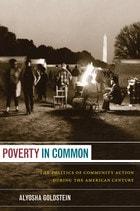
Poverty in Common
The Politics of Community Action during the American CenturyAlyosha Goldstein
Duke University Press, 2012
Power Moves
Transportation, Politics, and Development in HoustonBy Kyle Shelton
University of Texas Press, 2017
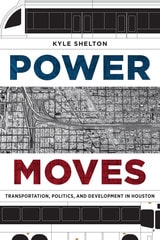
Since World War II, Houston has become a burgeoning, internationally connected metropolis—and a sprawling, car-dependent city. In 1950, it possessed only one highway, the Gulf Freeway, which ran between Houston and Galveston. Today, Houston and Harris County have more than 1,200 miles of highways, and a third major loop is under construction nearly thirty miles out from the historic core. Highways have driven every aspect of Houston’s postwar development, from the physical layout of the city to the political process that has transformed both the transportation network and the balance of power between governing elites and ordinary citizens.
Power Moves examines debates around the planning, construction, and use of highway and public transportation systems in Houston. Kyle Shelton shows how Houstonians helped shape the city’s growth by attending city council meetings, writing letters to the highway commission, and protesting the destruction of homes to make way for freeways, which happened in both affluent and low-income neighborhoods. He demonstrates that these assertions of what he terms “infrastructural citizenship” opened up the transportation decision-making process to meaningful input from the public and gave many previously marginalized citizens a more powerful voice in civic affairs. Power Moves also reveals the long-lasting results of choosing highway and auto-based infrastructure over other transit options and the resulting challenges that Houstonians currently face as they grapple with how best to move forward from the consequences and opportunities created by past choices.

Power and Its Disguises
Anthropological Perspectives on PoliticsJohn Gledhill
Pluto Press, 2000
Practically Invisible
Coastal Ecuador, Tourism, and the Politics of AuthenticityKimbra Smith
Vanderbilt University Press, 2015
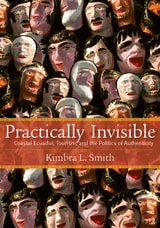
Thus came a nearly inevitable shock, as the daily rhythms of life--rising before dawn to prepare for a long day of maintaining livestock and crops; returning for a late lunch and siesta; joining in a game of soccer followed by dinner in the evening--transformed forever in favor of a new tourist industry and the compromises required to support it. As Practically Invisible demonstrates, for Agua Blancans, becoming a supposedly "authentic" version of their own indigenous selves required performing their culture for outsiders, thus becoming these performances within the minds of these visitors. At the heart of this story, then, is a delicate balancing act between tradition and survival, a performance experienced by countless indigenous groups.
Pragmatic Liberation and the Politics of Puerto Rican Diasporic Drama
Jon D. Rossini
University of Michigan Press, 2024
2025 ATHE Outstanding Book Award Finalist
- 2025 ATDS John W. Frick Book Award Finalist
- 2025 MLA Prize in U.S. Latina and Latino and Chicana and Chicano Literary and Cultural Studies Honorable Mention
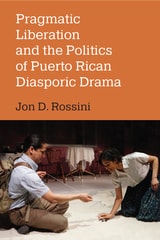
Pragmatic Liberation and the Politics of Puerto Rican Diasporic Drama explores the work of a unique group of playwrights—Puerto Rican dramatists writing in the United States—who offer a model of political engagement. As members of the Puerto Rican diaspora, they have a heightened awareness of the systematic discrimination and the colonial citizenship created by Puerto Rico’s territorial status. Pragmatic Liberation analyzes the work of established playwrights as well as work that has previously received little attention in the world of theater studies, including René Marqués’s Palm Sunday. The book demonstrates the strategies these playwrights use to model a nuanced way of moving toward liberation while being sensitive to the potential impact these actions might have on those closest to us. This is a crucially important model that needs more attention in our currently polarized political moment.
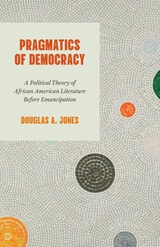
Pragmatics of Democracy
A Political Theory of African American Literature Before EmancipationDouglas A. Jones
University of Chicago Press, 2025
Douglas A. Jones’s Pragmatics of Democracy reads African American literature, from its beginnings through the mid-nineteenth century, to theorize how we have come to regard democracy as the most excellent form of political life. Jones notes that the aims of democracy, especially consent of the governed and equality under the law, can seem like tenets of governance that humans desire instinctively. But human nature does not correlate absolutely to politics. Jones argues that political selfhood is formed by “bodily events.” He proposes a typology of such experiences that dispose persons toward democratic subjectivity: ecstasy, impersonality, violence, respectability, and care.
African American literature before Emancipation reveals the democratic features of these categories that conventional political philosophy ignores or obscures. Given their lives as enslaved persons or the descendants of enslaved persons, early black writers crafted narratives about achieving democratic subjectivity that were missing in other Anglo-American canons. Pragmatics of Democracy discusses the works of well-known figures such as Phillis Wheatley, Harriet E. Wilson, and Frederick Douglass as well as those of more neglected writers such as Richard Allen, Peter Paul Simmons, James McCune Smith, and Frank J. Webb.
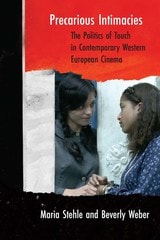
Precarious Intimacies
The Politics of Touch in Contemporary Western European CinemaMaria Stehle and Beverly Weber
Northwestern University Press, 2020
Twenty-first-century Europe is undergoing dramatic political and economic transformations that produce new forms of transnational contact as well as new regimes of exclusion and economic precarity. These political and economic shifts both circumscribe and enable new possibilities for intimacy. Many European films of the last two decades depict experiences of political and economic vulnerability in narratives of precarious intimacies. In these films, stories of intimacy, sex, love, and friendship are embedded in violence and exclusion, but, as Maria Stehle and Beverly Weber show, the politics of touch and connection also offers avenues to theorize forms of attention and affection that challenge exclusive notions of race, citizenship, and belonging.
Precarious Intimacies examines the aesthetic strategies that respond to this tension and proposes a politics of interpretation that identifies the potential and possibility of intimacy.
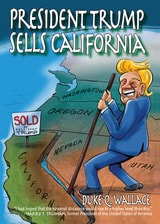
President Trump Sells California
Duke Q. Wallace
Parkhurst Brothers, Inc., 2016
A short political satire in which a President Trump nationalizes the Girl Scouts, privatizes the Supreme Court, and sells the state of California—his way of paying off the Federal debt. Nine brief chapters, each one resolving a real national issue with an excess of creativity and zeal. What happens when the zeal is spent?
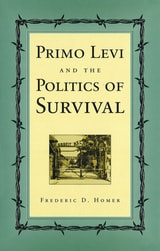
Primo Levi and the Politics of Survival
Frederic D. Homer
University of Missouri Press, 2001
At the age of twenty-five, Primo Levi was sent to Hell. Levi, an Italian chemist from Turin, was one of many swept up in the Holocaust of World War II and sent to die in the German concentration camp in Auschwitz. Of the 650 people transported to the camp in his group, only 15 men and 9 women survived. After Soviet liberation of the camp in 1945, Levi wrote books, essays, short stories, poetry, and a novel, in which he painstakingly described the horrors of his experience at Auschwitz. He also spent the rest of his life struggling with the fact that he was not among those who were killed.
In Primo Levi and the Politics of Survival, Frederic D. Homer looks at Primo Levi's life but, more important, shows him to be a significant political philosopher. In the course of his writings, Levi asked and answered his most haunting question: can someone be brutalized by a terrifying experience and, upon return to "ordinary life," recover from the physical and moral destruction he has suffered? Levi used this question to develop a philosophy positing that although man is no match for life, he can become better prepared to contend with the tragedies in life.
According to Levi, the horrors of the world occur because of the strength of human tendencies, which make relationships between human beings exceedingly fragile. He believed that we are ill-constituted beings who have tendencies toward violence and domination, dividing ourselves into Us and Them, with very shallow loyalties. He also maintained that our only refuge is in education and responsibility, which may counter these tendencies. Homer calls Levi's philosophy "optimistic pessimism."
As Homer demonstrates, Levi took his past experiences into account to determine that goodwill and democratic institutions do not come easily to people. Liberal society is to be earned through discipline and responsibility toward our weaknesses. Levi's answer is "civilized liberalism." To achieve this we must counter some of our most stubborn tendencies.
Homer also explores the impact of Levi's death, an apparent suicide, on the way in which his work and theories have been perceived. While several critics discount Levi's work because of the nature of his death, Homer argues that his death is consistent with his philosophy. A book rich in brutally honest philosophy, Primo Levi and the Politics of Survival compels one to look at serious questions about life, tragedy, optimism, solidarity, violence, and human nature.

Professional Wrestling
Politics and PopulismEdited by Sharon Mazer, Heather Levi, Eero Laine, and Nell Haynes
Seagull Books, 2020
This edited volume asks how professional wrestling is implicated in the current resurgence of populist politics, whether right-wing and Trump–inflected, or leftist and socialist. How might it do more than reflect and, in so doing, reaffirm the status quo? While provoked by the disruptive performances of Trump as candidate and president, and mindful of his longstanding ties to the WWE, this timely volume looks more broadly and internationally at the infusion of professional wrestling’s worldview into the twinned discourses of politics and populism. The contributors are scholars from a wide range of disciplines: theater and performance studies; cultural, media, and communication studies; anthropology and sociology; and gender and sexuality studies. Together they argue that the game’s popularity and its populist tendencies open it to the left as well as to the right, to contestation as well as to conformity, making it an ideal site for working on feminist and activist projects and ideas.
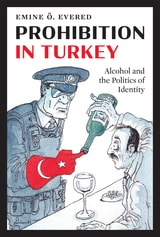
Prohibition in Turkey
Alcohol and the Politics of IdentityEmine Ö. Evered
University of Texas Press, 2024
A social history of alcohol, identity, secularism, and modernization from the late Ottoman and early Turkish republican eras to the present day.
Prohibition in Turkey investigates the history of alcohol, its consumption, and its proscription as a means to better understand events and agendas of the late Ottoman and early Turkish republican eras. Through a comprehensive examination of archival, literary, popular culture, media, and other sources, it unveils a traditionally overlooked—and even excluded—aspect of human history in a region that many do not associate with intoxicants, inebriation, addiction, and vigorous wet-dry debates.
Historian Emine Ö. Evered’s account uniquely chronicles how the Turko-Islamic Ottoman Empire developed strategies for managing its heterogeneous communities and their varied rights to produce, market, and consume alcohol, or to simply abstain. The first author to reveal this experience’s connections with American Prohibition, she demonstrates how—amid modernization, sectarianism, and imperial decline—drinking practices reflected, shifted, and even prompted many of the changes that were underway and that hastened the empire’s collapse. Ultimately, Evered’s book reveals how Turkey’s alcohol question never went away but repeatedly returns in the present, in matters of popular memory, public space, and political contestation.
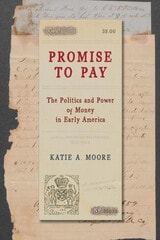
Promise to Pay
The Politics and Power of Money in Early AmericaKatie A. Moore
University of Chicago Press, 2024
Promise to Pay follows America’s first paper money—the “bills of credit” of British North America—from its seventeenth-century origins as a means of war finance to its pivotal role in catalyzing the American Revolution. Katie A. Moore combs through treasury records, account books, and the bills themselves to tell a new story of money’s origins that challenges economic orthodoxy and mainstream histories. Promise to Pay shows how colonial governments imposed paper bills on settler communities through existing labor and kinship relations, their value secured by thousands of individual claims on the public purse—debts—and the state’s promise to take them back as payment for taxes owed. Born into a world of hierarchy and deference, early American money eroded old social ties and created new asymmetries of power, functioning simultaneously as a ticket to the world of goods, a lifeline for those on the margins, and a tool of imperial domination.
Grounded in sustained engagement with scholarship from multiple disciplines, Promise to Pay breathes new life into old debates and offers an incisive account of the centrality of money in the politics and conflicts of empire, community, and everyday life.
Promise to Pay
The Politics and Power of Money in Early AmericaKatie A. Moore
University of Chicago Press, 2024
An incisive account of the crucial role money played in the formation and development of British North America.
Promise to Pay follows America’s first paper money—the “bills of credit” of British North America—from its seventeenth-century origins as a means of war finance to its pivotal role in catalyzing the American Revolution. Katie A. Moore combs through treasury records, account books, and the bills themselves to tell a new story of money’s origins that challenges economic orthodoxy and mainstream histories. Promise to Pay shows how colonial governments imposed paper bills on settler communities through existing labor and kinship relations, their value secured by thousands of individual claims on the public purse—debts—and the state’s promise to take them back as payment for taxes owed. Born into a world of hierarchy and deference, early American money eroded old social ties and created new asymmetries of power, functioning simultaneously as a ticket to the world of goods, a lifeline for those on the margins, and a tool of imperial domination.
Grounded in sustained engagement with scholarship from multiple disciplines, Promise to Pay breathes new life into old debates and offers an incisive account of the centrality of money in the politics and conflicts of empire, community, and everyday life.

Proper Women
Feminism and the Politics of Respectability in IranFae Chubin
Temple University Press, 2024
Chubin brings attention to the varying class, ethnic, religious, and national identities of NGO staff and clients that shaped their differing understandings of oppression and justice. Her examination of the tensions within the organization reveals why the efforts of the NGO workers failed to gain purchase among the intended beneficiaries.
Proper Women concludes by encouraging feminist activists to not only examine the role of local politics and transnational connections in shaping their definitions of empowerment, but also consider the advantages of a justice-enhancing practice as opposed to justice monism for their target populations.
Prophecy in Politics
Or, the Wigram AspectKenneth Weisbrode
Haus Publishing, 2026
Ralph Wigram was a minor British bureaucrat who is known to a small part of posterity only because Winston Churchill paid tribute to him as the man who warned of the Nazi threat with such persistence, conviction, and hard evidence that Churchill had the wherewithal to make the case to the British people. Wigram died at the end of 1936, just before the war he warned against had begun. He might have changed the course of history—if only people had believed him.
Prophets like Wigram are a permanent fixture of a world without certainty. Oracles, shamans, wiseacres, astrologers, and swamis of all shades populate our myths, legends, and Bibles. Today, our lives are inundated with the wisdom of professional forecasters, intelligence analysts, and threat mongers. Why do many of us, and especially our leaders, find it so difficult to heed warnings? We tend to underreact to some, overreact to others, and then point fingers when what “nobody ever anticipated” comes to pass. Why is prophecy so dogged?
Prophecy in Politics takes up a vast, complex, and well-worn subject—the future—and reduces it to its most essential aspects, especially belief. It revisits a half-dozen familiar and not-so-familiar incidents of prophecy, from the warnings given to Stalin about Operation Barbarossa to those given to Bill Clinton and George W. Bush about “terrorism,” to the Cassandras periodically promising collapse in the financial markets, to uncover a pattern of complacency and neglect. Finally, Ken Weisbrode proposes what all of us might do to overcome complacency and make prophecy work better for us. This is not a handbook or an attempt to stand in the vanguard of political or strategic thought on futurism, futures studies, or futurology; rather, it is a concise overview and an idiosyncratic but nevertheless useful guide to thinking about the past and present condition of prophecy.
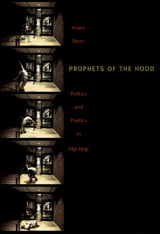
Prophets of the Hood
Politics and Poetics in Hip HopImani Perry
Duke University Press, 2004
Perry offers detailed readings of the lyrics of many hip hop artists, including Ice Cube, Public Enemy, De La Soul, krs-One, OutKast, Sean “Puffy” Combs, Tupac Shakur, Lil’ Kim, Biggie Smalls, Nas, Method Man, and Lauryn Hill. She focuses on the cultural foundations of the music and on the form and narrative features of the songs—the call and response, the reliance on the break, the use of metaphor, and the recurring figures of the trickster and the outlaw. Perry also provides complex considerations of hip hop’s association with crime, violence, and misogyny. She shows that while its message may be disconcerting, rap often expresses brilliant insights about existence in a society mired in difficult racial and gender politics. Hip hop, she suggests, airs a much wider, more troubling range of black experience than was projected during the civil rights era. It provides a unique public space where the sacred and the profane impulses within African American culture unite.
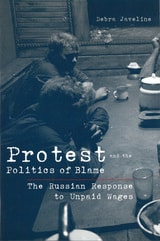
Protest and the Politics of Blame
The Russian Response to Unpaid WagesDebra Javeline
University of Michigan Press, 2003

Protestantism and Politics in Eastern Europe and Russia
The Communist and Post-Communist ErasSabrina P. Ramet, ed.
Duke University Press, 1993
Based on extensive field research, including interviews with notable figures in the Protestant churches in the region, the essays in this volume address broad topics such as the church's involvment in environmentalism, pacifism, and other dissident movements, as well as issues particular to Russia, Poland, Czechoslovakia, East Germany, (1949–1989), Hungary, Yugoslavia (1945-1991), Bulgaria, and Romania. The final volume in the three-volume work "Christianity Under Stress," Protestantism and Politics in Eastern Europe and Russia will prove invaluable to anyone hoping to understand not only the workings of religion under Communism, but the historical and contemporary interactions of church and state in general.
Contributors. Paul Bock, Lawrence Klippenstein, Paul Mojzes, Earl A. Pope, Joseph Pungur, Sabrina Petra Ramet, Walter Sawatsky, N. Gerald Shenk, Gerd Stricker, Sape A. Zylstra

Provincialising nature
multidisciplinary approaches to the politics of the environment in Latin AmericaEdited by Michela Coletta and Malayna Raftopoulos
University of London Press, 2016
Psychology and Politics
Intersections of Science and Ideology in the History of Psy-SciencesFerenc Eros
Central European University Press, 2019
Psy-sciences (psychology, psychiatry, psychoanalysis, pedagogy, criminology, special education, etc.) have been connected to politics in different ways since the early twentieth century. Here in twenty-two essays scholars address a variety of these intersections from a historical perspective.
The chapters include such diverse topics as the cultural history of psychoanalysis, the complicated relationship between psychoanalysis and the occult, and the struggles for dominance between the various schools of psychology. They show the ambivalent positions of the "psy" sciences in the dictatorships and authoritarian regimes of Nazi Germany, East European communism, Latin-American military dictatorships, and South African apartheid, revealing the crucial role of psychology in legitimating and "normalizing" these regimes.
The authors also discuss the ideological and political aspects of mental health and illness in Hungary, Germany, post-WW1 Transylvania, and Russia. Other chapters describe the attempt by critical psychology to understand the production of academic, therapeutic, and everyday psychological knowledge in the context of the power relations of modern capitalist societies.
Psychopathology and Politics
Harold D. Lasswell
University of Chicago Press, 1986
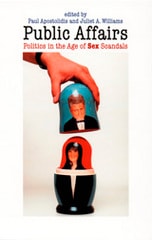
Public Affairs
Politics in the Age of Sex ScandalsPaul Apostolidis and Juliet A. Williams, eds.
Duke University Press, 2004
The essays in Public Affairs reflect on a number of sex scandals while emphasizing the Clinton/Lewinsky affair, certainly the most avidly followed and momentous sex scandal in American political history. Leading scholars situate contemporary public affairs in the context not only of earlier sex scandals in American politics (such as Thomas Jefferson’s and Sally Hemings’s affair), but also of more purely political scandals (including Teapot Dome and Watergate) and sex scandals centered around public figures other than politicians (such as the actor Hugh Grant and the minister Jimmy Swaggart). Some essays consider the Clinton affair in light of feminist and anti-racist politics, while others discuss the dynamics of scandals as major media events. By charting a critical path through the muck of scandal rather than around it, Public Affairs illuminates why sex scandals have become such a prominent feature of American public life.
Contributors. Paul Apostolidis, Jodi Dean, Joshua Gamson, Theodore J. Lowi, Joshua D. Rothman, George Shulman, Anna Marie Smith, Jeremy Varon, Juliet A. Williams
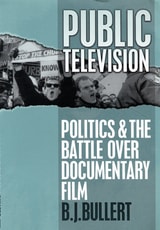
Public Television
Politics and the Battle over Documentary FilmBullert, B.J.
Rutgers University Press, 1997
Through detailed chronologies, B. J. Bullert traces how independently produced documentaries pushed the limits of public television between 1985 and 1993. She interviews the key players, film makers, programmers, journalists, and representatives of interest groups to illuminate how together they sought to frame and constrain viewers on perceptions of provocative works. Their stories are set against the backdrop of a larger story about the relationship between federal funding for the arts and public broadcasting and the promise of a democratic society. Bullert brings to light the subtle forces and interests that effectively control the style and content of documentaries that have been broadcast with the PBS logo.
When film makers brought uncommon realities to the public television airwaves, a complex collective response from station programmers, interest groups, journalists, and viewers ensued. Public Television charts the communication process through which visions of reality deemed threatening to some are packaged to make them more palatable for public television viewers.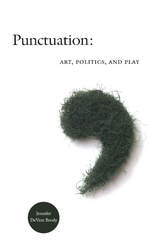
Punctuation
Art, Politics, and PlayJennifer DeVere Brody
Duke University Press, 2008
Brody provides a playful, erudite meditation on punctuation’s power to direct discourse and, consequently, to shape human subjectivity. Her analysis ranges from a consideration of typography as a mode for representing black subjectivity in Ralph Ellison’s Invisible Man to a reflection on hyphenation and identity politics in light of Strunk and White’s prediction that the hyphen would disappear from written English. Ultimately, Brody takes punctuation off the “stage of the page” to examine visual and performance artists’ experimentation with non-grammatical punctuation. She looks at different ways that punctuation performs as gesture in dances choreographed by Bill T. Jones, in the hybrid sculpture of Richard Artschwager, in the multimedia works of the Japanese artist Yayoi Kusama, and in Miranda July’s film Me and You and Everyone We Know. Brody concludes with a reflection on the future of punctuation in the digital era.
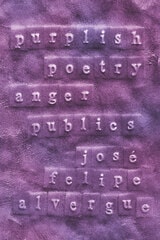
purplish
poetry anger publicsJosé Felipe Alvergue
University of Iowa Press, 2025
purplish challenges the idea of an objective or unbiased cultural rationale to purple regions in America by historicizing how anger has been systemically cleansed from the collective sentiments regarding nation-building throughout key moments of our national heritage.