Results by title
4030 books match the query 'Language Arts & Disciplines' and 204 start with p
Principles of Grammar and Learning
William O'Grady
University of Chicago Press, 1987
To support this thesis, O'Grady develops a well-articulated, single level, categorial-type grammar that he uses to analyze syntactic categories, extraction, anaphora, extraposition, and quantifier placement in English and other languages. He shows that such grammars can be constructed via general learning strategies from notions such as dependency, adjacency, precedence, and continuity, and that the available acquisition data points to the emergence of the principles he proposes.
While exploratory, this book provides one of the few serious attempts to develop a theory of grammar and learning that does not posit faculty-specific innate principles. Principles of Grammar and Learning is an exemplary attempt to bring together issues and data from syntactic theory, language acquisition, and the more general study of the human mind.
Principles of Knowledge Representation
Gerhard Brewka
CSLI, 1996
Print Passages
Colonial Book Culture in the Dutch East IndiesLisa Kuitert
National University of Singapore Press, 2026
Although printed material has become intertwined with everyday life in the twenty-first century, book culture has not always been ubiquitous. Print Passages researches the history of the arrival of the printed book in Indonesia, and the consequences this new technology brought with it. The introduction of the printing press during the Dutch occupation of the archipelago (then the Dutch East Indies) laid the foundation for a flourishing cultural and intellectual life centered on books and printed materials, especially after 1816. Though printed matter was used to colonize and control the land, it also gave the resistance a voice.
Through an exploration of selected themes, author Lisa Kuitert answers practical questions such as how Dutch language researchers and printers found their way to and within Indonesia, while also diving into the parallel printing culture that was entirely run by Indonesians, often with a Chinese background.

Privacy & Confidentiality Perspectives
Archivists & Archival RecordsMenzi L. Behrnd-Klodt
American Library Association, 2009
Privacy Matters
Conversations about Surveillance within and beyond the ClassroomEstee Beck
Utah State University Press, 2020
This collection offers practical analyses of surveillance and privacy as they occur within classrooms and communities. Organized by themes—surveillance and classrooms, surveillance and bodies, surveillance and culture—Privacy Matters provides writing, rhetoric, and communication scholars and teachers with specific approaches, methods, inquiries, and examinations into the impact tracking and monitoring has upon people’s habits, bodies, and lived experiences.
While each chapter contributes a new perspective in the discipline and beyond, Privacy Matters affirms that these analyses remain inconclusive. This collection is a call for scholars, researchers, activists, and educators within rhetoric and composition to continue the scholarly conversation because privacy matters to all of us.
Contributors: Christina Cedillo, Jenae Cohn, Dànielle Nicole DeVoss, Dustin Edwards, Norah Fahim, Ann Hill Duin, Gavin P. Johnson, John Peterson, Santos Ramos, Colleen A. Reilly, Jennifer Roth Miller, Jason Tham, Stephanie Vie
Privacy and Freedom of Information in 21st-Century Libraries
Jason Griffey
American Library Association, 2010
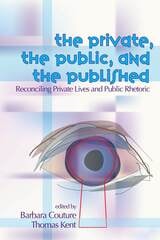
Private, the Public, and the Published
Reconciling Private Lives and Public Rhetoricedited by Barbara Couture & Thomas Kent
Utah State University Press, 2004
At the 2003 "Rock the Vote" debate, one of the questions posed by a student to the eight Democratic candidates for the presidential nomination was "have you ever used marijuana?" Amazingly, all but one of the candidates voluntarily answered the question. Add to this example the multiple ways in which we now see public intrusion into private lives (security cameras, electronic access to personal data, scanning and "wanding" at the airport) or private self-exposure in public forums (cell phones, web cams, confessional talk shows, voyeuristic "reality" TV). That matters so private could be treated as legitimate--in some cases even vital--for public discourse indicates how intertwined the realms of private and public have become in our era. Reverse examples exist as well. Around the world, public authorities look the other way while individual rights are abused--calling it a private matter--or officials appeal to sectarian morés to justify discrimination in public policies.
The authors of The Private, the Public, and the Published feel that scholarship needs to explore and understand this phenomenon, and needs to address it in the college classroom. There are consequences of conflating public and private, they argue--consequences that have implications especially for what is known as the public good. The changing distinctions between "private" and "public," and the various practices of private and public expression, are explored in these essays with an eye toward what they teach us about those consequences and implications.
Privatizing Libraries
Jane Jerrard
American Library Association, 2012
Probabilistic Approaches to Linguistic Theory
Edited by Jean-Philippe Bernardy, Rasmus Blanck, Stergios Chatzikyriakidis, Shalom Lappin, and Aleksandre Maskharashvili
CSLI, 2022
During the last two decades, computational linguists, in concert with other researchers in AI, have turned to machine learning and statistical techniques to capture features of natural language and aspects of the learning process that are not easily accommodated in classical algebraic frameworks. These developments are producing a revolution in linguistics in which traditional symbolic systems are giving way to probabilistic and deep learning approaches. This collection features articles that provide background to these approaches, and their application in syntax, semantics, pragmatics, morphology, psycholinguistics, neurolinguistics, and dialogue modeling. Each chapter provides a self-contained introduction to the topic that it covers, making this volume accessible to graduate students and researchers in linguistics, NLP, AI, and cognitive science.
Problem with Education Technology (Hint
It's Not the Technology)Ben Fink
Utah State University Press, 2016
Education is in crisis—at least, so we hear. And at the center of this crisis is technology. New technologies like computer-based classroom instruction, online K–12 schools, MOOCs (massive open online courses), and automated essay scoring may be our last great hope—or the greatest threat we have ever faced.
In The Problem with Education Technology, Ben Fink and Robin Brown look behind the hype to explain the problems—and potential—of these technologies. Focusing on the case of automated essay scoring, they explain the technology, how it works, and what it does and doesn’t do. They explain its origins, its evolution (both in the classroom and in our culture), and the controversy that surrounds it. Most significantly, they expose the real problem—the complicity of teachers and curriculum-builders in creating an education system so mechanical that machines can in fact often replace humans—and how teachers, students, and other citizens can work together to solve it.
Offering a new perspective on the change that educators can hope, organize, and lobby for, The Problem with Education Technology challenges teachers and activists on “our side,” even as it provides new evidence to counter the profit-making, labor-saving logics that drive the current push for technology in the classroom.
Process This
Undergraduate Writing in Composition StudiesNancy C. DeJoy
Utah State University Press, 2004
In Process This, Nancy DeJoy argues that even recent revisions to composition studies, cultural studies, service learning, and social process movements--continue to repress the subjects and methodologies that should be central, especially at the level of classroom practice. Designed to move student discourses beyond the classroom, these approaches nonetheless continue to position composition students (and teachers) as mere consumers of the discipline. This means that the subjects, methodologies, and theory/practice relationships that define the field are often absent in composition classrooms.
Arguing that the world inside and outside of the academy cannot be any different if the profession stays the same, DeJoy creates a pedagogy and a plan for faculty development that revisions the prewrite/write/rewrite triad to open spaces for participation and contribution to all members of first-year writing classrooms.
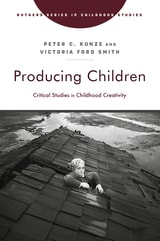
Producing Children
Critical Studies in Childhood CreativityPeter C. Kunze
Rutgers University Press, 2025
Professional Academic Writing in the Humanities and Social Sciences
Susan Peck MacDonald
Southern Illinois University Press, 1994
In Professional Academic Writing in the Humanities and Social Sciences, Susan Peck MacDonald tackles important and often controversial contemporary questions regarding the rhetoric of inquiry, the social construction of knowledge, and the professionalization of the academy. MacDonald argues that the academy has devoted more effort to analyzing theory and method than to analyzing its own texts. Professional texts need further attention because they not only create but are also shaped by the knowledge that is special to each discipline. Her assumption is that knowledge-making is the distinctive activity of the academy at the professional level; for that reason, it is important to examine differences in the ways the professional texts of subdisciplinary communities focus on and consolidate knowledge within their fields.
Throughout the book, MacDonald stresses her conviction that academics need to do a better job of explaining their text-making axioms, clarifying their expectations of students at all levels, and monitoring their own professional practices. MacDonald’s proposals for both textual and sentence-level analysis will help academic professionals better understand how they might improve communication within their professional communities and with their students.
Professional Autonomy in Video Relay Service Interpreting
Erica Alley
Gallaudet University Press, 2019
Alley considers the question of how VRS fits into the professional field of interpreting, and discovers that—regardless of the profit-focused mentality of VRS providers—interpreters make decisions with the goal of creating quality customer service experiences for deaf consumers, even if it means “breaking the rules.” Her findings shed light on the decision-making process of interpreters and how their actions are governed by principles of self-care, care for colleagues, and concern for the quality of services provided. Professional Autonomy in Video Relay Service Interpreting is essential reading in interpreter education courses and interpreter training programs.
Professional Liability Issues for Librarians and Information Professionals
American Library Association, 2008
Professionalizing Multimodal Composition
Santosh Khadka
Utah State University Press, 2023
Academic leaders, scholars, and faculty who have successfully designed and launched academic programs or faculty development initiatives discuss the theoretical and logistical questions considered in their design, the outcomes they achieved, and how others can emulate them. This exchange of knowledge, insight, experiences, and lessons learned among community members is critical for enabling or inspiring other programs, departments, and institutions to conceive, design, and launch academic programs or faculty development initiatives for their own faculty.
The larger goal of professionalizing is to work with teaching faculty to increase their interactional expertise with multimodal composition, and this collection offers a set of models for how faculty can do that at their own institutions and in their own programs.
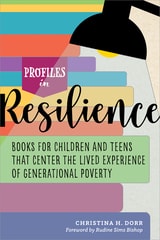
Profiles in Resilience
Books for Children and Teens That Center the Lived Experience of Generational PovertyChristina H. Dorr
American Library Association, 2021
—from the Foreword by Dr. Rudine Sims Bishop, Professor Emeritus, The Ohio State University
Drawing from her own lived experience, in this guide Dorr shines a light on some of the cultural values that exist across both rural and urban poverty, inviting teachers, librarians, and others who work with children from low-income families to see them in their cultural context and appreciate the values they bring to the classroom or library. She spotlights a range of books for children and teens that offer literary mirrors to low-income children, as well as windows to more economically privileged readers, enabling all young readers to celebrate our common humanity. And she also shares the work of ten authors and illustrators familiar with poverty, offering insights into the sources of their stories and the ways storytellers’ lived experience can influence their creative works and make their characters more authentic. You will discover
- an introduction which explores what it’s like to grow up in generational poverty, including its long-term effects on children, the roles played by intersectional and institutional racism, the power of family, and how reading can act as powerful catalyst;
- biographical sketches of Elizabeth Acevedo, Jason Reynolds, Cynthia Rylant, Kelly Yang, and other authors and illustrators;
- inspiring profiles and books spanning age ranges, genres, and formats that chronicle the lives of Ruth Bader Ginsberg, Kareem Abdul-Jabbar, Sonia Sotomayor, John Lewis, Wilma Mankiller, and other people who were raised in generational poverty; and
- four appendixes which spotlight even more stories of resilient individuals and fictional characters.
Programming for Children and Teens with Autism Spectrum Disorder
Barbara Klipper
American Library Association, 2014
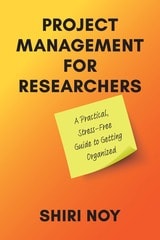
Project Management for Researchers
A Practical, Stress-Free Guide to Getting OrganizedShiri Noy
University of Michigan Press, 2024
Project Management for Researchers tackles the how, what, and why of project management. It offers step-by-step guidance on choosing tools and developing a personalized system that will help the reader manage and organize their research so that steps and decisions are documented for accountability and reproducibility. Readers will find worksheets they can adapt to their own needs, priorities, and research as well as practical tips on issues ranging from emails to scheduling. Suitable for work across methods, experience levels, and disciplines and adaptable for those working alone, with others, or as team managers, this book will guide readers between various research stages–from planning, to execution, to adjustment of research projects big and small.
Project Management in Libraries
On Time, On Budget, On TargetCarly Wiggins Searcy
American Library Association, 2018
Projecting Morphology
Edited by Louisa Sadler and Andrew Spencer
CSLI, 2003
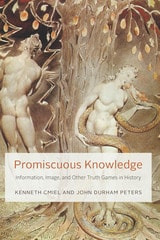
Promiscuous Knowledge
Information, Image, and Other Truth Games in HistoryKenneth Cmiel and John Durham Peters
University of Chicago Press, 2020

Promoting Individual and Community Health at the Library
Mary Grace Flaherty
American Library Association, 2018
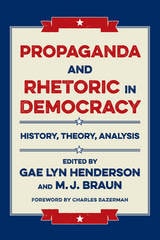
Propaganda and Rhetoric in Democracy
History, Theory, AnalysisEdited by Gae Lyn Henderson and M. J. Braun Foreword by Charles Bazerman
Southern Illinois University Press, 2016
Propaganda and Rhetoric in Democracy offers new perspectives on the history of propaganda, explores how it has evolved during the twentieth and twenty-first centuries, and advances a much more nuanced understanding of what it means to call discourse propaganda.
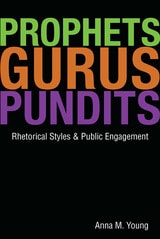
Prophets, Gurus, and Pundits
Rhetorical Styles and Public EngagementAnna M. Young
Southern Illinois University Press, 2014
In Prophets, Gurus, and Pundits, author Anna M. Young proposes that the difficulty of bridging the gap between intellectuals and the public is not a failure of ideas; rather, it is an issue of rhetorical strategy. By laying a rhetorical foundation and presenting analytical case studies of contemporary “public intellectuals,” Young creates a training manual for intellectuals who seek to connect with a public audience and effect change writ large.
Young begins by defining key aspects of rhetorical style before moving on to discuss the specific ways in which intellectuals may present ideas to a general audience in order to tackle large-scale social problems. Next, she defines the ways in which five crucial turning points in our nation—the rise of religious fundamentalism, a growing lack of trust in our institutions, the continued destruction of the environment, the ubiquity of media and information in our daily lives, and the decline of evidence-based reasoning—have set the stage for opportunities in the current public-intellectual dialogue.
Via case studies of such well-known personalities as Deepak Chopra and Professor Cornel West, Young goes on to reveal the six types of public intellectuals who achieve success in presenting scholarly ideas to audiences at large:
The Prophet presents the public’s sins for contemplation, then offers a path to redemption.
The Guru shepherds his or her flock to enlightenment and a higher power.
The Sustainer draws upon our natural and human resources to proffer solutions for social, political, and ecological systems.
The Pundit utilizes wit and brevity to bring crucial issues to the attention of the public.
The Narrator combines a variety of perspectives to create a story the average person can connect with and understand.
The Scientist taps into the dreams of the public to offer ideas from above and beyond the typical scope of public discourse.
At once a rallying cry and roadmap, The Politics of Thinking Out Loud draws upon rhetorical expertise and analysis of contemporary public intellectuals to offer a model for scholars to effectively engage the public—and in doing so, perhaps forever change the world in which we live.
Prose Styles
Five Primary TypesHuntington Brown
University of Minnesota Press, 1966
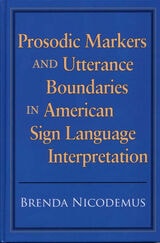
Prosodic Markers and Utterance Boundaries in American Sign Language Interpretation
Brenda Nicodemus
Gallaudet University Press, 2009
The Fifth Volume in the Studies in Interpretation Series
In interpreting, professionals must be able to convey to their clients the rhythm, stress, and length of phrases used by the communicating parties to indicate their respective emotional states. Such subtleties, which can signal sarcasm and irony or whether a statement is a question or a command, are defined in linguistics as prosody. Brenda Nicodemus’s new volume, the fifth in the Studies in Interpretation series, discusses the prosodic features of spoken and signed languages, and reports the findings of her groundbreaking research on prosodic markers in ASL interpretation.
In her study, Nicodemus videotaped five highly skilled interpreters as they interpreted a spoken English lecture into ASL. Fifty Deaf individuals viewed the videotaped interpretations and indicated perceived boundaries in the interpreted discourse. These identified points were then examined for the presence of prosodic markers that might be responsible for the perception of a boundary. Prosodic Markers and Utterance Boundaries reports on the characteristics of the ASL markers, including their frequency, number, duration, and timing. Among other findings, the results show that interpreters produce an average of seven prosodic markers at each boundary point. The markers are produced both sequentially and simultaneously and under conditions of highly precise timing. Further, the results suggest that the type of prosodic markers used by interpreters are both systematic and stylistic.
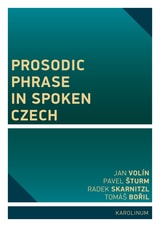
Prosodic Phrase in Spoken Czech
Jan Volín, Pavel Šturm, Radek Skarnitzl, and Tomáš Boril
Karolinum Press, 2025
The prosodic phrase is a crucial element in the sound structure of the Czech language, though oft overlooked. The properties of prosodic phrases, such as stress, intonation, and tonal pattern, show typical characteristics of prose. Prosodic Phrase in Spoken Czech provides a source for this missing information in an approachable format for all manner of readers. The core of the study draws on authentic speech material—storytelling, news reading, and poetry recitation—where prosodic phrases are analyzed in terms of their phonetic structure, acoustic characteristics, and associated syntactic features. Supported by the presentation of original perception experiments, this monograph delves into the perceptual significance of prosodic phrasing. Beyond offering intriguing insights into this core aspect of prosodic structure, it serves as a valuable resource for designing future experiments in natural language processing.
Protecting Intellectual Freedom in Your Public Library
American Library Association, 2012
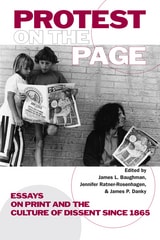
Protest on the Page
Essays on Print and the Culture of Dissent since 1865Edited by James L. Baughman, Jennifer Ratner-Rosenhagen, and James P. Danky
University of Wisconsin Press, 2015
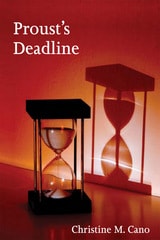
Proust's Deadline
Christine M. Cano
University of Illinois Press, 2006
Marcel Proust’s multivolume masterpiece, À la recherche du temps perdu, began to appear in 1913. Over the next fifty years, it gained a reputation as one of the greatest literary works of the twentieth century. But the novel’s classic image as a completed work was later shattered by the discovery of unpublished drafts, and the “war of the Prousts” has kept scholars arguing over its definitive form ever since.
Christine M. Cano’s Proust’s Deadline presents a concise history of the publishing and reception of À la recherche du temps perdu, and sorts out the most important issues that have arisen from the ensuing debates about the text. She ultimately shows how this quintessential “book about time” tells another story about time’s passage: the story of Proust’s mortal confrontation with the temporality of writing, publishing, and reading.
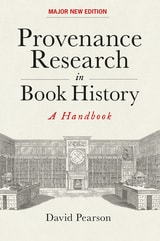
Provenance Research in Book History
A HandbookDavid Pearson is a leading expert on provenance and historic books. He retired in 2017 from a career in libraries and now writes and teaches on book history.
Bodleian Library Publishing, 2019
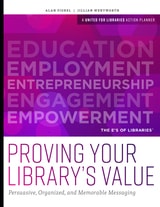
Proving Your Library's Value
Persuasive, Organized, and Memorable MessagingAlan Fishel
American Library Association, 2020
You know the value of your library, but elected officials, donors, community leaders, funders, and other important stakeholders may not. How can you make the library a priority for these groups, who may have preconceived notions about what the library does, as you compete with other important community organizations for funding? In this book from United for Libraries, you’ll learn how to use The E’s of Libraries® (Education, Employment, Entrepreneurship, Engagement, and Empowerment) to quickly demonstrate why your library is essential and worthy of funding, using messaging that is organized, persuasive, and memorable. With the help of worksheets, charts, and prompts, you will learn how to
- use language designed to win over stakeholders, funders, and partners;
- craft custom messaging in several formats that is easily accessible and memorable, including elevator speeches, budget presentations, and annual appeals; and
- create presentations and other materials tailored to any audience based on the sample documents included.
This book's innovative framework can be used by any size or type of library, and by any library advocate, including Friends groups, library staff, trustees, and foundations.
Provocations of Virtue
Rhetoric, Ethics, and the Teaching of WritingJohn Duffy
Utah State University Press, 2018
Drawing upon Aristotle’s Nicomachean Ethics and the branch of philosophical inquiry known as “virtue ethics,” Provocations of Virtue calls for the reclamation of “rhetorical virtues” as a core function in the writing classroom. Duffy considers what these virtues actually are, how they might be taught, and whether they can prepare students to begin repairing the broken state of public argument. In the discourse of the virtues, teachers and scholars of writing are offered a common language and a shared narrative—a story that speaks to the inherent purpose of the writing class and to what is at stake in teaching writing in the twenty-first century.
This book is a timely and historically significant contribution to the field and will be of major interest to scholars and administrators in writing studies, rhetoric, composition, and linguistics as well as philosophers and those exploring ethics.
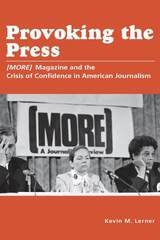
Provoking the Press
(MORE) Magazine and the Crisis of Confidence in American JournalismKevin M. Lerner
University of Missouri Press, 2023
Two of these new journalists, a Pulitzer Prize—winning, Harvard-educated New York Times reporter named J. Anthony Lukas, and a former Newsweek media writer named Richard Pollak, founded a journalism review called (MORE) in 1971, with its pilot issue appearing the same month that the Times began publishing the Pentagon Papers. (MORE) covered the press with a critical attitude that blended seriousness and satire—part New York Review of Books, part underground press. In the eight years that it published, (MORE) brought together nearly every important American journalist of the 1970s, either as a writer, a subject of its critical eye, or as a participant in its series of raucous "A.J. Liebling Counter-Conventions"—meetings named after the outspoken press critic—the first of which convened in 1974. In issue after issue the magazine considered and questioned the mainstream press's coverage of explosive stories of the decade, including the Watergate scandal; the "seven dirty words" obscenity trial; the debate over a reporter's constitutional privilege; the rise of public broadcasting; the struggle for women and minorities to find a voice in mainstream newsrooms; and the U.S. debut of press baron Rupert Murdoch.
In telling the story of (MORE) and its legacy, Kevin Lerner explores the power of criticism to reform and guide the institutions of the press and, in turn, influence public discourse.
Public Debate in the Civil War Era
A Rhetorical History of the United States, Volume IVDavid Zarefsky
Michigan State University Press, 2023

Public Lettering
Script, Power, and CultureArmando Petrucci
University of Chicago Press, 1993
buildings, commercial graphics, signs, epitaphs on tombstones,
graffiti—is a fixture of urban life. In Public
Lettering, Armando Petrucci reconstructs the history of
public writing in the West and traces its social functions
from the eleventh century through the modern period.
Taking the city of Rome as a case study, Petrucci begins
with a consideration of the first civic inscriptions after
ancient times. Substantial chapters on the uses of public
writing in the industrial revolution and the early twentieth
century prepare the way for his provocative discussions of
public lettering in the the contexts of fascism, post-war
radicalism, and the student revolutions of 1968 and 1977.
Throughout, Petrucci is concerned with the relations
between the functions and styles of letters and the places
where they appear. Writing, he argues, is one of the
instruments of public power; display lettering is often the
image and mirror of power itself, making the social use of
written forms a type of conquest. Because of Rome's role as
a “World-City,” Petrucci's interdisciplinary study has
wide-ranging implications for our understanding of the social
function of graphic design.
Public Libraries Going Green
Kathryn American Library Association
American Library Association, 2010
Public Libraries and Internet Service Roles
American Library Association, 2009
Public Libraries and Resilient Cities
Michael Dudley
American Library Association, 2012
Public Library Services for the Poor
Doing All We CanGlen E. Holt
American Library Association, 2010
Public Library Start-Up Guide
Christine Lind Hage
American Library Association, 2004
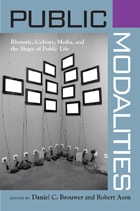
Public Modalities
Edited by Daniel C. Brouwer and Robert Asen
University of Alabama Press, 2010
A bold rethinking of public discourse, Public Modalities explores how people shape civic life through protest, media, and identity in an ever-evolving public sphere.
This book explores the ways that scholars, journalists, politicians, and citizens conceive of “the public” or “public life,” and how those entities are defined and invented. For decades, scholars have used the metaphors of spheres, systems, webs, or networks to talk about, describe, and map various practices. This volume proposes a new metaphor—modalities—to suggest that publics are forever in flux, and much more fluid and dynamic than the static models of systems or spheres would indicate—especially in the digital age, where various publics rapidly evolve and dissipate.
Contributors to the volume—employing approaches from the fields of communication studies, English, sociology, psychology, and history—explore a broad range of texts and artifacts that give rise to publics, and discuss what they reveal about conceptualizations of social space. By focusing on process in public engagement, these scholars highlight questions of how people advance their interests and identities, and how they adapt to situational constraints.
Bringing together scholars in rhetorical, cultural, and media studies, this collection of new case studies illustrates a modalities approach to the study of publics. These case studies explore the implications of different ways of forming publics, including alternative means of expression (protests, culture jamming); the intersection of politics and consumerism (how people express their identities and interests through their consumer behavior); and online engagement (blogs as increasingly important public fora). In doing so, they raise important questions of access, community, and political efficacy
Public Relations and Marketing for Archives
A How-To-Do-It ManualRussell D. James
American Library Association, 2011
Public Scholarship in Communication Studies
Edited by Thomas J Billard and Silvio Waisbord
University of Illinois Press, 2024
Thomas J Billard and Silvio Waisbord curate essays from a wide range of specialties within the study of communication. Aimed at scholars and students alike, the contributors use approaches from critical meditations to case studies to how-to guides as they explore the possibilities of seeing shared knowledge not as a gift to be granted but as an imperative urging readers to address the problems of the world. Throughout the volume, the works show that a pivot to ideas of scholarship as public service is already underway in corners of communication studies across the country.
Visionary and provocative, Public Scholarship in Communication Studies proposes a needed reconsideration of knowledge and a roadmap to its integration with community.
Contributors: Elaine Almeida, Becca Beets, Thomas J Billard, Danielle K. Brown, Aymar Jean Christian, Stacey L. Connaughton, Paula Gardner, Larry Gross, Amy Jordan, Daniel Kreiss, Rachel Kuo, Susan Mancino, Shannon C. McGregor, Philip M. Napoli, Todd P. Newman, Srividya Ramasubramanian, Chad Raphael, Sue Robinson, Silvio Waisbord, Yidong Wang, and Holley Wilkin

Publishing
Tariq Goddard
Duke University Press, 2027
Pulitzer's Gold
Behind the Prize for Public Service JournalismRoy J. Harris, Jr.
University of Missouri Press, 2008
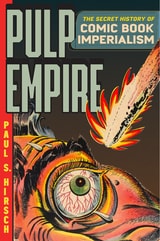
Pulp Empire
The Secret History of Comic Book ImperialismPaul S. Hirsch
University of Chicago Press, 2021
In the 1940s and ’50s, comic books were some of the most popular—and most unfiltered—entertainment in the United States. Publishers sold hundreds of millions of copies a year of violent, racist, and luridly sexual comics to Americans of all ages until a 1954 Senate investigation led to a censorship code that nearly destroyed the industry. But this was far from the first time the US government actively involved itself with comics—it was simply the most dramatic manifestation of a long, strange relationship between high-level policy makers and a medium that even artists and writers often dismissed as a creative sewer. In Pulp Empire, Paul S. Hirsch uncovers the gripping untold story of how the US government both attacked and appropriated comic books to help wage World War II and the Cold War, promote official—and clandestine—foreign policy and deflect global critiques of American racism.
As Hirsch details, during World War II—and the concurrent golden age of comic books—government agencies worked directly with comic book publishers to stoke hatred for the Axis powers while simultaneously attempting to dispel racial tensions at home. Later, as the Cold War defense industry ballooned—and as comic book sales reached historic heights—the government again turned to the medium, this time trying to win hearts and minds in the decolonizing world through cartoon propaganda.
Hirsch’s groundbreaking research weaves together a wealth of previously classified material, including secret wartime records, official legislative documents, and caches of personal papers. His book explores the uneasy contradiction of how comics were both vital expressions of American freedom and unsettling glimpses into the national id—scourged and repressed on the one hand and deployed as official propaganda on the other. Pulp Empire is a riveting illumination of underexplored chapters in the histories of comic books, foreign policy, and race.
Punctuation and Persuasion
Patrick Barry
Michigan Publishing Services, 2022
With a little knowledge and a lot of practice, you can do more than just sound more professional when you skillfully use commas, semicolons, and other forms of punctuation. You can, importantly, become more persuasive.
That’s what students who have taken Professor Patrick Barry’s classes at the University of Michigan Law School, the University of Chicago Law School, and the UCLA School of Law have learned, as have the over 100,000 people who have enrolled in his online course “Good with Words: Writing and Editing” on the educational platforms Coursera and FutureLearn.
Now, thanks to this book, you can undergo that same rhetorical transformation. Punctuation doesn’t have to be a pain point. When properly mastered, it can be a powerful tool for all kinds of advocates.
Pura Belpré Awards
Celebrating Latino Authors and IllustratorsRose Zertuche Treviño
American Library Association, 2006