Results by title
2706 books match the query 'European' and 107 start with r
READING LONDON
URBAN SPECULATION AND IMAGINATIVE GOVERNMENT EIGHTEENTH-CENTURY LITERATUREERIK BOND
The Ohio State University Press, 2007
REWRITING CHAUCER
CULTURE, AUTHORITY, AND THE IDEA OF THE AUTHENTIC TEXT, 1400–1602THOMAS A. PRENDERGAST
The Ohio State University Press, 1999
This collection of original essays examines how the idea of an authentic Chaucerian text was reimagined and reproduced by medieval and early modern scribes and editors to satisfy and shape the cultural expectations of their audiences. These “reproductions” of Chaucer’s works epitomize the tension between developing notions of what makes a text “authentic” and the cultural pressures that led scribes and editors to construct their own versions of Chaucer and his works.
The book begins by exploring medieval and early modern notions of origins and how they at once illuminate and problematize the recovery of Chaucerian texts. Essays in the second section examine how individual scribes and reading communities reshaped Chaucer’s texts. Finally, we see how the printing press—bringing with it a renewed concern about the idea of authenticity—led both to an increase in the number of works attributed to Chaucer and to increasing anxiety about their authenticity.
The focus on the ways in which Chaucer was rewritten in different cultural and aesthetic contexts will enable medieval and early modern critics to situate Chaucer more fully within his cultural milieu, while illuminating the ways in which his reputation as both a “laureate poet” and a “lewed compilator” affected rewritings of his works. Rewriting Chaucer, then, will appeal both to scholars interested in the critical juncture between manuscript and print culture and to those interested in how culture affects the reproduction of authoritative texts.
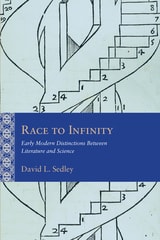
Race to Infinity
Early Modern Distinctions Between Literature and ScienceDavid L. Sedley
Northwestern University Press, 2027
Studying the early modern split between science and literature and the aftermath of their division
The conception of computers as thinking machines and literature as a social field stems from the early modern phenomenon of competing over the infinite as an object not just of contemplation but of appropriation in a race toward virtual control. The rediscovery of this origin undoes a collective forgetting of what technology and texts have in common, what they don’t, and what they can and ought to be in the future. David L. Sedley offers a new history of literature and science’s disciplinary divide—its origin and significance—tracing a series of points along the emerging frontier between these two fields. At each point there are two objects in play and two authors who push the objects in opposite directions: on the one hand, mechanical arts and the essay, probability theory and the novel, and geometry and epic; on the other, Montaigne and Bacon, Pascal and Lafayette, and Hobbes and Milton. Each of these authors, Sedley shows, tried to render an object either algorithmic or infinite to oppose the other’s efforts. Ultimately, Race to Infinity: Early Modern Distinctions Between Literature and Science illuminates the fortunes of the literary in the digital revolution and beyond.
Racine and English Classicism
By Katherine E. Wheatley
University of Texas Press, 1956
Literary historians and critics who have written on the influence of Racine in England during the neoclassical period apparently have assumed that the English translators and adapters of Racine’s plays in general succeeded in presenting the real Racine to the English public.
Katherine Wheatley here reveals the wide discrepancy between avowed intentions and actual results. Among the English plays she compares with their French originals are Otway’s Titus and Berenice, Congreve’s The Mourning Bride, and Philips’s The Distrest Mother. These comparisons, fully supported by quoted passages, reveal that those among the English public and contemporary critics who could not themselves read French had no chance whatever to know the real Racine: “The adapters and translators, so-called, had eliminated Racine from his tragedies before presenting them to the public.” Unacknowledged excisions and additions, shifts in plot, changes in dénouement, and frequent mistranslation turned Racine’s plays into “wretched travesties.” Two translations of Britannicus, intended for reading rather than for acting, are especially revealing in that they show which Racinian qualities eluded the British translators even when they were not trying to please an English theatergoing audience.
Why it is, asks the author, that no English dramatist could or would present Racine as he is to the English public of the neoclassical period? To answer this question she traces the development of Aristotelian formalism in England, showing the relation of the English theory of tragedy to French classical doctrine and the relation of the English adaptations of Racine to the English neoclassical theory of tragedy. She concludes that “deliberate alterations made by the English, far from violating classical tenets, bring Racine’s tragedies closer to the English neoclassical ideal than they were to begin with, and this despite the fact that some tenets of English doctrine came from parallel tenets widely accepted in France.” She finds that “in the last analysis, French classical doctrine was itself a barrier to the understanding of Racinian tragedy in England and an incentive to the sort of change English translators and adapters made in Racine.” This paradox she explains by the fact that Racine himself had broken with the classical tradition as represented by Corneille.
Radical Science
Plants, Agency, and Nineteenth-Century British NarrativeMary Bowden
The Ohio State University Press, 2026

Radical Tragedy
Religion, Ideology and Power in the Drama of Shakespeare and His ContemporariesJonathan Dollimore
Duke University Press, 2004
Radicalization in Theory and Practice
Understanding Religious Violence in Western EuropeThierry Balzacq and Elyamine Settoul, Editors
University of Michigan Press, 2022
Radicalization is a major challenge of contemporary global security. It conjures up images of violent ideologies, “homegrown” terrorists and jihad in both the academic sphere and among security and defense experts. While the first instances of religious radicalization were initially limited to second-generation Muslim immigrants, significant changes are currently impacting this phenomenon. Technology is said to amplify the dissemination of radicalism, though there remains uncertainty as to the exact weight of technology on radical behaviors. Moreover, far from being restricted to young men of Muslim heritage suffering from a feeling of social relegation, radicalism concerns a significant number of converted Muslims, women and more heterogeneous profiles (social, academic and geographic), as well as individuals that give the appearance of being fully integrated in the host society. These new and striking dynamics require innovative conceptual lenses.
Radicalization in Theory and Practice identifies the mechanisms that explicitly link radical religious beliefs and radical actions. It describes its nature, singles out the mechanisms that enable radicalism to produce its effects, and develops a conceptual architecture to help scholars and policy-makers to address and evaluate radicalism—or what often passes as such. A variety of empirical chapters fed by first-hand data probe the relevance of theoretical perspectives that shape radicalization studies. By giving a prominent role to first-hand empirical investigations, the authors create a new framework of analysis from the ground up. This book enhances the quality of theorizing in this area, consolidates the quality of methodological enquiries, and articulates security studies insights with broader theoretical debates in different fields including sociology, social psychology, economics, and religious studies.

Raising the Dust
The Literary Housekeeping of Mary Ward, Sarah Grand, and Charlotte Perkins GilmanBeth Sutton-Ramspeck
Ohio University Press, 2004
To Mary Augusta Ward, Sarah Grand, and Charlotte Perkins Gilman, housekeeping represented public responsibilities: making the food supply safe, reforming politics, and improving the human race itself. Raising the Dust places their writing in the context of the late-Victorian era, in particular the eugenics movement, the proliferation of household conveniences, the home economics movement, and decreased reliance on servants. These changes affected relationships between the domestic sphere and the public sphere, and hence shaped the portrayal of domesticity in the era's fiction and nonfiction.
Moreover, Ward, Grand, and Gilman articulated a domestic aesthetic that swept away boundaries. Sutton-Ramspeck uncovers a new paradigm here: literature as engaging the public realm through the devices and perspectives of the domestic. Her innovative and ambitious book also connects fixations on cleaning with the discovery of germs (the first bacterium discovered was anthrax, and knowledge of its properties increased fears of dust); analyzes advertising cards for soap; and links the mental illness in Gilman's “The Yellow Wall-Paper” to fears during the period of arsenic poisoning from wallpaper.

Rape Of Clarissa
Writing, Sexuality, and Class Struggle in Samuel RichardsonTerry Eagleton
University of Minnesota Press, 1982
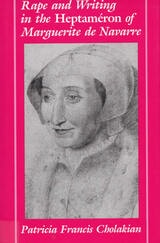
Rape and Writing in the Heptameron of Marguerite de Navarre
Patricia Francis Cholakian
Southern Illinois University Press, 1991
Marguerite de Navarre (1492–1549), the sister of the French king François I, composed the Heptaméron as a complex collection of seventy-two novellas, creating one of the first examples of realistic, psychological fiction in French literature. These novellas, framed by debates among ten storytellers, all noble lords and ladies, reveal the author’s desire to depart from the purely masculine voice of the age.
Cholakian contends that this Renaissance text is characterized by feminine writing. She reads the text as the product of the author’s personal experience. Beginning her study with the rape narrative in the autobiographical novella 4, she examines how the Heptaméron interacts with male literary traditions and narrative conventions about gender relations. She analyzes such words as rape, and honor, noting how they are defined differently by men and women and how these differences in perception affect the development of both plot and character.
Rationality of Irrationality
Political Determinants and Effects of Party Position BlurringKyung Joon Han
University of Michigan Press, 2022
Citizens in democracies complain that political parties’ positions on major issues are too ambiguous for them to confidently understand. Why is party position ambiguity so common? Are party positions ambiguous because political parties fail in forming clear policies or because they deliberately blur their positions? Rationality of Irrationality argues that political parties are motivated to strategically blur their position on an issue when they struggle with a certain disadvantage in the issue. Specifically, political parties present an ambiguous position when their own supporters are divided in their stances on the issue. A political party also blurs position stances when voters do not acknowledge that the party has the ability and integrity to solve problems related to the issue. Political parties blur their position in these cases because ambiguous party positions divert voters’ attention from the issue. Voters support a political party whose policy positions on major issues are close to their own stances. However, voters cannot confidently and exactly estimate party positions on an issue when they are only ambiguous.
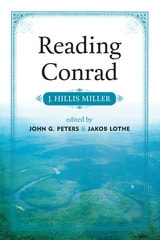
Reading Conrad
Edited by John G. Peters and Jakob Lothe
The Ohio State University Press, 2017
Reading Conrad by J. Hillis Miller demonstrates a surprising cohesiveness across Miller’s career as well as the richness of Conrad’s fiction, which affords varied opportunities for critical approaches as different as phenomenology, new criticism, deconstruction, narrative theory, and narrative ethics. Miller’s analyses emphasize literature’s rhetorical and performative power, ultimately suggesting that while narrative fiction is an effect of a series of complex phenomena in society and in the human psyche, as literary language it can also refer to the external world indirectly and contribute to the formation of history from within.
Reading Proust
In Search of Wolf-FishMaria Paganini
University of Minnesota Press, 1994
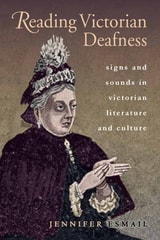
Reading Victorian Deafness
Signs and Sounds in Victorian Literature and CultureJennifer Esmail
Ohio University Press, 2013
Winner of the 2013 Sonya Rudikoff Award for best first book in Victorian Studies
Short-listed for the 2013 British Society for Literature and Science Book Prize.
Reading Victorian Deafness is the first book to address the crucial role that deaf people, and their unique language of signs, played in Victorian culture. Drawing on a range of works, from fiction by Charles Dickens and Wilkie Collins, to poetry by deaf poets and life writing by deaf memoirists Harriet Martineau and John Kitto, to scientific treatises by Alexander Graham Bell and Francis Galton, Reading Victorian Deafness argues that deaf people’s language use was a public, influential, and contentious issue in Victorian Britain.
The Victorians understood signed languages in multiple, and often contradictory, ways: they were objects of fascination and revulsion, were of scientific import and literary interest, and were considered both a unique mode of human communication and a vestige of a bestial heritage. Over the course of the nineteenth century, deaf people were increasingly stripped of their linguistic and cultural rights by a widespread pedagogical and cultural movement known as “oralism,” comprising mainly hearing educators, physicians, and parents.
Engaging with a group of human beings who used signs instead of speech challenged the Victorian understanding of humans as “the speaking animal” and the widespread understanding of “language” as a product of the voice. It is here that Reading Victorian Deafness offers substantial contributions to the fields of Victorian studies and disability studies. This book expands current scholarly conversations around orality, textuality, and sound while demonstrating how understandings of disability contributed to Victorian constructions of normalcy. Reading Victorian Deafness argues that deaf people were used as material test subjects for the Victorian process of understanding human language and, by extension, the definition of the human.
Reading With Clarice Lispector
Helene Cixous
University of Minnesota Press, 1990
Reading at the Limits of Poetic Form
Dematerialization in Adorno, Blanchot, and CelanJacob McGuinn
Northwestern University Press, 2024
How does literary objecthood contend with the challenge of writing objects that emerge at an extreme limit of material presence? Jacob McGuinn delves into the ways literature writes this indeterminate presence in the context of pre- and post-’68 Paris, a vital moment in the history of criticism. The works of poet Paul Celan, philosopher Theodor Adorno, and writer Maurice Blanchot highlight how the complexities of reading such a dematerialized object are part of the indeterminacy of material itself. Indeterminate objects—glass, snow, walls, screens—are subjects Celan describes as existing in “meridian” space, while for Adorno and Blanchot, criticism not only responds to this indeterminacy but also takes it as its condition. Reading at the Limits of Poetic Form: Dematerialization in Adorno, Blanchot, and Celan shows how these readings simultaneously limit the object of criticism and outline alternative ways of thinking that lie between the models of critical formalism and historicism, ultimately revealing the possible materiality of literature in unrealized history, incomplete politics, and nondetermining thinking.
Reading for Health
Medical Narratives and the Nineteenth-Century NovelErika Wright
Ohio University Press, 2016
In Reading for Health: Medical Narratives and the Nineteenth-Century Novel, Erika Wright argues that the emphasis in Victorian Studies on disease as the primary source of narrative conflict that must be resolved has obscured the complex reading practices that emerge around the concept of health. By shifting attention to the ways that prevention of illness and the preservation of well-being operate in fiction, both thematically and structurally, Wright offers a new approach to reading character and voice, order and temporality, setting and metaphor. As Wright reveals, while canonical works by Austen, Brontë, Dickens, Martineau, and Gaskell register the pervasiveness of a conventional “therapeutic” form of action and mode of reading, they demonstrate as well an equally powerful investment in the achievement and maintenance of “health”—what Wright refers to as a “hygienic” narrative—both in personal and domestic conduct and in social interaction of the individual within the community.
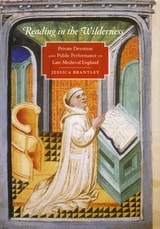
Reading in the Wilderness
Private Devotion and Public Performance in Late Medieval EnglandJessica Brantley
University of Chicago Press, 2007
Drawing on the work of W. J. T. Mitchell, Michael Camille, and others working at the image-text crossroads, Reading in the Wilderness addresses the manuscript’s texts and illustrations to examine connections between reading and performance within the solitary monk’s cell and also outside. Brantley reimagines the medieval codex as a site where the meanings of images and words are performed, both publicly and privately, in the act of reading.
Reading the East India Company 1720-1840
Colonial Currencies of GenderBetty Joseph
University of Chicago Press, 2003
Drawing on the British East India Company's records as well as novels, memoirs, portraiture and guidebooks, Joseph shows how the company's economic and archival practices intersected to produce colonial "fictions" or "truth-effects" that strictly governed class and gender roles—in effect creating a "grammar of power" that kept the far-flung empire intact. And while women were often excluded from this archive, Joseph finds that we can still hear their voices at certain key historical junctures. Attending to these voices, Joseph illustrates how the writing of history belongs not only to the colonial project set forth by British men, but also to the agendas and mechanisms of agency—of colonized Indian, as well as European women. In the process, she makes a valuable and lasting contribution to gender studies, postcolonial theory, and the history of South Asia.
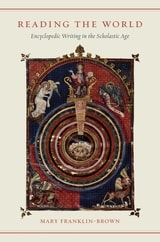
Reading the World
Encyclopedic Writing in the Scholastic AgeMary Franklin-Brown
University of Chicago Press, 2012
Reading with Jane Austen
Elaine Bander
Bucknell University Press, 2026
Jane Austen has more readers today than at any time in history. Many of Austen’s legions of fans, however, came to her novels after first seeing films or other adaptations made for twenty-first-century audiences. Austen herself conversely spent her literary career undermining romantic clichés and rethinking novel conventions. Confident that she and her contemporaries shared a common reading culture, Austen deliberately constructed her novels to set readerly expectations, only to disrupt or confound those expectations by challenging her readers’ assumptions and values. In Reading with Jane Austen, Elaine Bander carefully rereads the great author’s novels—beginning with her late work of juvenilia, “Catharine, or The Bower,” and ending with her final fragment, “Sanditon”—against the rich context of late Georgian literary and intellectual culture. In doing so, Bander invites us into the transformative experience that Austen intentionally designed for her earliest readers, adding new layers of appreciation for those who love her work.
Published by Bucknell University Press. Distributed worldwide by Rutgers University Press.
Elaine Bander speaking at the Atwater Library in Quebec (https://youtu.be/UeEjFOfp9cQ?si=Wv2hsLxkGK157WZI)
Readings
The Poetics of Blanchot, Joyce, Kakfa, Kleist, Lispector, and TsvetayevaHelene Cixous
University of Minnesota Press, 1991
Readings: The Poetics of Blanchot, Joyce, Kafka, Kleist, Lispector, and Tsvetayeva offers striking and novel textual studies of major literary figures and emergent authors. Selected from Cixous’s seminars taught between 1980 and 1986 at the Universite de Paris VII (Saint-Denis) and at the College International de Philosophie, the texts chronicle the French intellectual scene with its shifting tastes over the decade following May 1986.
In their simple and accessible language, the texts can be read as inspiration for Cixous’s fictional and critical practices. They not only introduce readers to emergent texts from Brazil and Russia, such as Clarice Lispector’s “Foreign Legion” and Marina Tsvetayeva’s “Mother and Music,” but also give new, incisive insights into Joyce’s Portrait of the Artist and Kafka’s “Before the Law.” Drawing from philosophy and psychoanalysis, Readings: The Poetics of Blanchot, Joyce, Kafka, Kleist, Lispector, and Tsvetayeva can be read side-by-side with Reading with Clarice Lispector, as an ongoing meditation on ethics and poetics.Also from MinnesotaReading with Clarice LispectorHelene CixousEdited, translated, and introduced by Verena Andermatt ConleyFor Cixous, Lispector’s work represents one of the finest examples of ecriture feminine in that she practices, in writing, what Cixous is searching for in her theoretical practice: the giving, spending, and inscribing of pleasure; an apprenticeship in the lessons of life.Theory and History of Literature, volume 73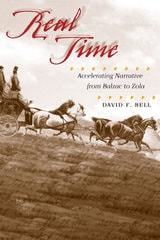
Real Time
Accelerating Narrative from Balzac to ZolaDavid F. Bell
University of Illinois Press, 2003
Nineteenth-century technological advances radically altered the infrastructure of France, changing the ways ordinary citizens–-and literary characters--viewed time, space, distance, and speed. The most influential of these advances included the improvement of the stagecoach, the growth of road and canal networks leading to the advent of the railway, and the increasing use of mail, and of the optical telegraph. Citing examples from a wide range of novels and stories, Bell demonstrates the numerous ways in which these trends of acceleration became not just literary devices and themes but also structuring principles of the novels themselves.
Beginning with both the provincial and the Parisian communications networks of Balzac, Bell proceeds to discuss the roles of horses and optical telegraphs in Stendhal and the importance of domination of communication channels to the characters of Dumas, whose Count of Monte-Cristo might be seen as the ultimate fictional master of this accelerated culture. Finally, Bell analyzes the cinematic vision created by the arrival of the railroad, as depicted by Zola in La Bète Humaine.
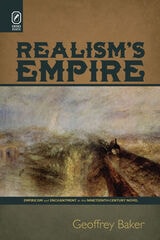
Realism's Empire
Empiricism and Enchantment in the Nineteenth-Century NovelGeoffrey Baker
The Ohio State University Press, 2009
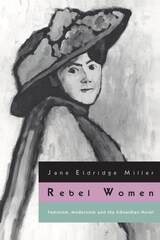
Rebel Women
Feminism, Modernism and the Edwardian NovelJane Eldridge Miller
University of Chicago Press, 1996
"Miller's is the best account we have, not only of Edwardian women novelists, but of early 20th-century women novelists; the measure of her achievement is that the distinction no longer seems workable." —David Trotter, The London Review of Books
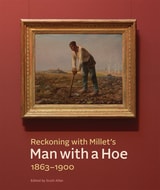
Reckoning with Millet's "Man with a Hoe," 1863–1900
Scott Allan
J. Paul Getty Trust, The, 2023
A monumentalizing portrayal of a peasant bowed over by brutal toil, Man with a Hoe (1860–62) by Jean-François Millet (1814–1875) is arguably the most art historically significant painting in the J. Paul Getty Museum’s collection of nineteenth-century European art. This volume situates the work in the arc of Millet’s career and traces its fascinating and contentious reception, from its scandalous debut at the 1863 Paris Salon to the years following its acquisition by American collectors in the 1890s. The essays examine the painting’s tumultuous public life, beginning in France, where critics attacked it on aesthetic and political grounds as a radical realist provocation; through its transformative movement in the art market during the remaining years of the artist’s life and following his death; to its highly publicized arrival in California as a celebrated masterpiece. In the United States it was enlisted to serve philanthropic interests, became the subject of a popular poem, and once again became embroiled in controversy, in this case one that was strongly inflected by American racial politics. This is the first publication dedicated to the work since its acquisition by the Getty Museum in 1985.
This volume is published to accompany an exhibition on view at the J. Paul Getty Museum at the Getty Center from September 12 to December 10, 2023.
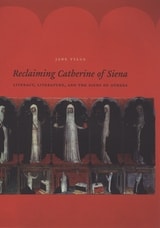
Reclaiming Catherine of Siena
Literacy, Literature, and the Signs of OthersJane Tylus
University of Chicago Press, 2009
Jane Tylus charts here the contested struggles of scholars over the centuries to situate Catherine in the history of Italian culture in early modernity. But she mainly focuses on Catherine’s works, calling attention to the interplay between orality and textuality in the letters and demonstrating why it was so important for Catherine to envision herself as a writer. Tylus argues for a reevalution of Catherine as not just a medieval saint, but one of the major figures at the birth of the Italian literary canon.
Recognizing Reality
German Realism and the Mediation of PresenceJessica C. Resvick
Northwestern University Press, 2026
Reveals how literary scenes of recognition stage the process of coming to know reality
In this deeply researched and thought-provoking study, Jessica C. Resvick traces nineteenth-century German realist writing’s paradoxical investment in mediated accounts of the world and the direct, unfiltered experience of reality. Focusing on the motif and operation of recognition in its Aristotelean sense, Resvick examines self-reflexive narratives in which the authors struggle to resolve this tension between the media they choose and the immediacy they hope to create.
Through close readings of key works by canonical authors such as E. T. A. Hoffmann, Annette von Droste-Hülshoff, Adalbert Stifter, Gottfried Keller, and Wilhelm Raabe, Resvick demonstrates the medially influenced and historically contingent ways in which they represent reality. Each chapter focuses on a different form of recognition, reconstructing the techniques that allow these authors to generate an effect of presence. Exploring the history and poetics of knowledge exchange, Recognizing Reality: German Realism and the Mediation of Presence expands on recent media histories of realism, examining the material bases for realist aesthetics while also investigating media’s epistemological accomplishments, and astutely elaborates the role of recognition as a medium-specific tool.
Reconstruction Fiction
Housing and Realist Literature in Postwar BritainPaula Derdiger
The Ohio State University Press, 2020
Recovering Disability in Early Modern England
Edited by Allison P. Hobgood and David Houston Wood
The Ohio State University Press, 2013
Recursive Desire
Rereading Epic TraditionJeremy M. Downes
University of Alabama Press, 1997
A groundbreaking rethinking of epic tradition through recursive literary analysis.
Epic has often been seen as a dead genre, intrinsically patriarchal and nationalistic. Furthermore, the psychological model most frequently applied to the relations between poets has been a violent one--the Freudian masterplot of Oedipus slaying the father to possess the mother. The limited usefulness of such simplistic explanations of epic is readily apparent when confronted with the continuing production of epic poetry long after its so-called death; when confronted with the contemporary drive toward epic among women poets, people of color, and postcolonial poets; and when faced with epic's fundamentally recursive desire--obvious in oral epic, but common to the entire genre--to repeat rather than to kill or evade its precursors.
Recursive desire, rooted in more basic preoedipal negotiations of union and separation rather than in Oedipal conflict, provides an elegant and far more useful explanation. By rereading and substantially redefining epic in this way, this book recognizes and reinvests with meaning the vital recursive qualities of the genre. Examining a diverse array of texts from the Epic of Gilgamesh to Derek Walcott's Osmeros, from the Homeric epics to H.D.'s Helen in Egypt. The book develops a broadened, inclusive, and living tradition of epic poetry, demonstrating the continuities of that tradition across dramatic discontinuities in time, place, worldview, and technology.
Recursive Desire rereads epic tradition and specific epic poems in ways that challenge traditional notions of the genre and open up unexplored fields of endeavor to students of epic, of poetry, and of narrative. With its more powerful and comprehensive psychological model of poetic relations, the book provides readers with a new understanding of epic poetry and its vital, shifting, polyvocal array (and disarray) of textual forces.
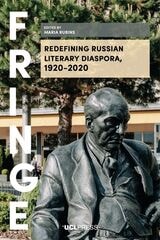
Redefining Russian Literary Diaspora, 1920–2020
Edited by Maria Rubins
University College London, 2021
Since the start of the massive post-revolutionary exodus, Russian literature has thrived in multiple locations around the globe—but what happens to cultural vocabularies, politics of identity, literary canon, and language when writers transcend the metropolitan and national boundaries? This volume sets a new agenda for the study of Russian diaspora writing, reorienting the field from an excessive emphasis on the homeland to an analysis of transnational circulations that shape extraterritorial cultural practices. Integrating a variety of conceptual perspectives, ranging from diaspora and postcolonial studies to the theories of translation and self-translation, world literature, and evolutionary literary criticism, the contributors argue for a distinct nature of diasporic literary expression predicated on hybridity, ambivalence, and a sense of multiple belonging. As the complementary case studies demonstrate, diaspora narratives consistently recode historical memory, contest the mainstream discourses of Russianness, rewrite received cultural tropes, and explore topics that have remained marginal or taboo in the homeland.
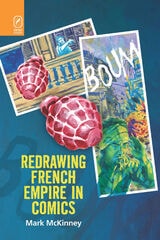
Redrawing French Empire in Comics
Mark McKinney
The Ohio State University Press, 2020
Reflections on Beckett
A Centenary CelebrationAnna McMullan and S. E. Wilmer, Editors. Foreword by Dennis Kennedy
University of Michigan Press, 2009
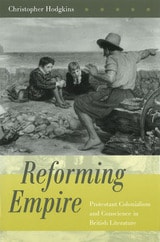
Reforming Empire
Protestant Colonialism and Conscience in British LiteratureChristopher Hodgkins
University of Missouri Press, 2002
“The strength of Empire,” wrote Ben Jonson, “is in religion.” In Reforming Empire, Christopher Hodgkins takes Jonson’s dictum as his point of departure, showing how for more than four centuries the Protestant imagination gave the British Empire its main paradigms for dominion and also, ironically, its chief languages of anti-imperial dissent. From Edmund Spenser’s Faerie Queene to Rudyard Kipling’s “The Man Who Would Be King,” English literature about empire has turned with strange constancy to themes of worship and idolatry, atrocity and deliverance, slavery and service, conversion, prophecy, apostasy, and doom.
Focusing on the work of the Protestant imagination from the Renaissance origins of English overseas colonization through the modern end of England’s colonial enterprise, Hodgkins organizes his study around three kinds of religious binding—unification, subjugation, and self-restraint. He shows how early modern Protestants like Hakluyt and Spenser reformed the Arthurian chronicles and claimed to inherit Rome’s empire from the Caesars: how Ralegh and later Cromwell imagined a counterconquest of Spanish America, and how Milton’s Satan came to resemble Cortés; how Drake and the fictional Crusoe established their status as worthy colonial masters by refusing to be worshiped as gods; and how seventeenth-century preachers, poets, and colonists moved haltingly toward a racist metaphysics—as Virginia began by celebrating the mixed marriage of Pocahontas but soon imposed the draconian separation of the Color Line.
Yet Hodgkins reveals that Tudor-Stuart times also saw the revival of Augustinian anti-expansionism and the genesis of Protestant imperial guilt. From the start, British Protestant colonialism contained its own opposite: a religion of self-restraint. Though this conscience often was co-opted or conscripted to legitimize conquests and pacify the conquered, it frequently found memorable and even fierce literary expression in writers such as Shakespeare, Daniel, Herbert, Swift, Johnson, Burke, Blake, Austen, Browning, Tennyson, Conrad, Forster, and finally the anti-Protestant Waugh. Written in a lively and accessible style, Reforming Empire will be of interest to all scholars and students of English literature.
Regulating Confusion
Samuel Johnson and the CrowdThomas Reinert
Duke University Press, 1996
Ambivalent about the disruption, confusion, perplexity, and boundless variety apparent in the London of his day, Johnson was committed to the conventions of moral reflection but also troubled by the pressure to adopt the perspective of the crowd and the language of social theory. Regulating Confusion explores the consequences of his ambivalence and his attempt to order the chaos. It discusses his critique of moral generalizations, concept of moral reflection as a symbolic gesture, and account of what happens to the notion of character when individuals, having lost the support of moral convention, become faces in a crowd. Reflecting generally on the relationship between skepticism and political ideology, Reinert also discusses Johnson’s political skepticism and the forms of speculation and action it authorized.
Challenging prevalent psychologizing and humanistic interpretations, Regulating Confusion leaves behind the re-emergent view of Johnson as a reactionary ideologue and presents him in a theoretically sophisticated context. It offers his style of skepticism as a model of poise in the face of confusion about the nature of political truth and personal responsibility and demonstrates his value as a resource for students of culture struggling with contemporary debates about the relationship between literature and politics.
Religion and Spanish Film
Luis Buñuel, the Franco Era, and Contemporary DirectorsElizabeth Scarlett
University of Michigan Press, 2014
Religious Imaginaries
The Liturgical and Poetic Practices of Elizabeth Barrett Browning, Christina Rossetti, and Adelaide ProcterKaren Dieleman
Ohio University Press, 2012
Explores liturgical practice as formative for how three Victorian women poets imagined the world and their place in it and, consequently, for how they developed their creative and critical religious poetics.
This new study rethinks several assumptions in the field: that Victorian women’s faith commitments tended to limit creativity; that the contours of church experiences matter little for understanding religious poetry; and that gender is more significant than liturgy in shaping women’s religious poetry.
Exploring the import of bodily experience for spiritual, emotional, and cognitive forms of knowing, Karen Dieleman explains and clarifies the deep orientations of different strands of nineteenth-century Christianity, such as Congregationalism’s high regard for verbal proclamation, Anglicanism’s and Anglo-Catholicism’s valuation of manifestation, and revivalist Roman Catholicism’s recuperation of an affective aesthetic. Looking specifically at Elizabeth Barrett Browning, Christina Rossetti, and Adelaide Procter as astute participants in their chosen strands of Christianity, Dieleman reveals the subtle textures of these women’s religious poetry: the different voices, genres, and aesthetics they create in response to their worship experiences. Part recuperation, part reinterpretation, Dieleman’s readings highlight each poet’s innovative religious poetics.
Dieleman devotes two chapters to each of the three poets: the first chapter in each pair delineates the poet’s denominational practices and commitments; the second reads the corresponding poetry. Religious Imaginaries has appeal for scholars of Victorian literary criticism and scholars of Victorian religion, supporting its theoretical paradigm by digging deeply into primary sources associated with the actual churches in which the poets worshipped, detailing not only the liturgical practices but also the architectural environments that influenced the worshipper’s formation. By going far beyond descriptions of various doctrinal positions, this research significantly deepens our critical understanding of Victorian Christianity and the culture it influenced.
Remaining Relevant after Communism
The Role of the Writer in Eastern EuropeAndrew Baruch Wachtel
University of Chicago Press, 2005
According to Andrew Baruch Wachtel, the fall of the Berlin Wall and the creation of fledgling societies in Eastern Europe brought an end to the conditions that put the region's writers on a pedestal. In the euphoria that accompanied democracy and free markets, writers were liberated from the burden of grandiose political expectations. But no group is happy to lose its influence: despite recognizing that their exalted social position was related to their reputation for challenging political oppression, such writers have worked hard to retain their status, inventing a series of new strategies for this purpose. Remaining Relevant after Communism considers these strategies—from pulp fiction to public service—documenting what has happened on the East European scene since 1989.
Rembrandt's Jews
Steven Nadler
University of Chicago Press, 2004
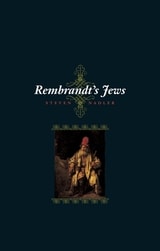
Rembrandt's Jews puts this myth to the test as it examines both the legend and the reality of Rembrandt's relationship to Jews and Judaism. In his elegantly written and engrossing tour of Jewish Amsterdam—which begins in 1653 as workers are repairing Rembrandt's Portuguese-Jewish neighbor's house and completely disrupting the artist's life and livelihood—Steven Nadler tells us the stories of the artist's portraits of Jewish sitters, of his mundane and often contentious dealings with his neighbors in the Jewish quarter of Amsterdam, and of the tolerant setting that city provided for Sephardic and Ashkenazic Jews fleeing persecution in other parts of Europe. As Nadler shows, Rembrandt was only one of a number of prominent seventeenth-century Dutch painters and draftsmen who found inspiration in Jewish subjects. Looking at other artists, such as the landscape painter Jacob van Ruisdael and Emmanuel de Witte, a celebrated painter of architectural interiors, Nadler is able to build a deep and complex account of the remarkable relationship between Dutch and Jewish cultures in the period, evidenced in the dispassionate, even ordinary ways in which Jews and their religion are represented—far from the demonization and grotesque caricatures, the iconography of the outsider, so often found in depictions of Jews during the Middle Ages and the Renaissance.
Through his close look at paintings, etchings, and drawings; in his discussion of intellectual and social life during the Dutch Golden Age; and even through his own travels in pursuit of his subject, Nadler takes the reader through Jewish Amsterdam then and now—a trip that, under ever-threatening Dutch skies, is full of colorful and eccentric personalities, fiery debates, and magnificent art.
Rembrandt's Late Religious Portraits
Arthur K. Wheelock Jr.
University of Chicago Press, 2005
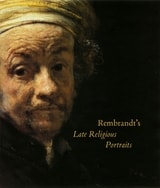
An exhibition by the National Gallery of Art and this accompanying catalog assemble seventeen of the paintings for the first time, finally giving the powerful images their due. Many of these subtle and wondrous paintings have been identified as images of apostles and evangelists, but among them are also representations of Christ, the Virgin, and still-unidentified saints and monks. In Rembrandt's typical fashion, the men and women in these portraits peer out of the dark recesses of dimly lit interiors as though burdened by the weight of their spiritual and emotional concerns. Yet recent archival research has raised questions about their attribution, the relationships among the paintings, and, in a broader sense, Rembrandt's life and career—issues addressed by the contributors to this volume. With its lavish color images and state-of-the-field research, Rembrandt's Late Religious Portraits will make a profound contribution to the understanding of this unique and provocative body of work.
Remembering 1989
Future Archives of Public ProtestAnke Pinkert
University of Chicago Press, 2024
For many, 1989 is an iconic date, one we associate with the fall of the Berlin Wall and the end of the Cold War. The year prompts some to rue the defeat of socialism in the East, while others celebrate a victory for democracy and capitalism in the reunified Germany. Remembering 1989 focuses on a largely forgotten interregnum: the months between the outbreak of protests in the German Democratic Republic in 1989 and its absorption by the West in 1990. Anke Pinkert, who herself participated in those protests, recalls these months as a volatile but joyous “laboratory of radical democracy,” and tells the story of how and why this “time out of joint” has been erased from Germany’s national memory.
Remembering 1989 argues that in order to truly understand Germany’s historic transformation, we must revisit protesters’ actions across a wide range of minor, vernacular, and often transient sources. Drawing on rich archives including videotapes of untelevised protests, illegally printed petitions by Church leaders, audio recordings of dissident meetings, and interview footage with military troops, Pinkert opens the discarded history of East European social uprisings to new interpretations and imagines alternatives to Germany’s neoliberal status quo. The result is a vivid, unexpected contribution to memory studies and European history.

Remembering Paris in Text and Film
Echoes of Baudelaire in Text and on ScreenEdited by Alistair Rolls and Marguerite Johnson
Intellect Books, 2021
Experiencing urban space conjures visions of the past alongside contemplation of the present. This edited volume investigates this feeling of seeing double by investigating Paris—a city that has come to embody the tension of this sensation—through a dual lens of nostalgia and modernity.
Contributors survey Paris in film, poetry, and prose in the nineteenth and twentieth centuries, presenting the city as both a concrete reality and as a collection of the myths associated with it. Interdisciplinary and deeply researched, the essays distill complex concepts of the urban, the textual, and the modern for a wide readership.

Remembering and Repeating
On Milton's Theology and PoeticsRegina M. Schwartz
University of Chicago Press, 1993
"A brilliant study that quietly but powerfully recharacterizes many of the contexts of discussion in Milton criticism. Particularly noteworthy is Schwartz's ability to introduce advanced theoretical perspectives without ever taking the focus of attention away from the dynamics and problematics of Milton's poem."—Stanley Fish
Renaissance Beasts
Of Animals, Humans, and Other Wonderful CreaturesEdited by Erica Fudge
University of Illinois Press, 2004
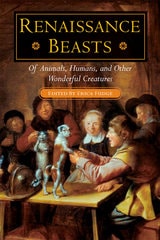
Taking as its starting point the popularity of speaking animals in sixteenth-century literature and ending with the decline of the imperial Ménagerie during the French Revolution, Renaissance Beasts uses the lens of human-animal relationships to view issues as diverse as human status and power, diet, civilization and the political life, religion and anthropocentrism, spectacle and entertainment, language, science and skepticism, and domestic and courtly cultures.
Within these pages scholars from a variety of disciplines discuss numerous kinds of texts--literary, dramatic, philosophical, religious, political--by writers including Calvin, Montaigne, Sidney, Shakespeare, Descartes, Boyle, and Locke. Through analysis of these and other writers, Renaissance Beasts uncovers new and arresting interpretations of Renaissance culture and the broader social assumptions glimpsed through views on matters such as pet ownership and meat consumption.
Renaissance Beasts is certainly about animals, but of the many species discussed, it is ultimately humankind that comes under the greatest scrutiny.
Renaissance Self-Fashioning
From More to ShakespeareStephen Greenblatt
University of Chicago Press, 1983
"No one who has read [Greenblatt's] accounts of More, Tyndale, Wyatt, and others can fail to be moved, as well as enlightened, by an interpretive mode which is as humane and sympathetic as it is analytical. These portraits are poignantly, subtly, and minutely rendered in a beautifully lucid prose alive in every sentence to the ambivalences and complexities of its subjects."—Harry Berger Jr., University of California, Santa Cruz
Renaissance Self-Fashioning
From More to ShakespeareStephen Greenblatt
University of Chicago Press, 2005
"No one who has read [Greenblatt's] accounts of More, Tyndale, Wyatt, and others can fail to be moved, as well as enlightened, by an interpretive mode which is as humane and sympathetic as it is analytical. These portraits are poignantly, subtly, and minutely rendered in a beautifully lucid prose alive in every sentence to the ambivalences and complexities of its subjects."—Harry Berger Jr., University of California, Santa Cruz
Renaissance Shakespeare/Shakespeare Renaissances
Proceedings of the Ninth World Shakespeare CongressMartin Procházka
University of Delaware Press, 2014
Published by University of Delaware Press. Distributed worldwide by Rutgers University Press.
Renaissance Transactions
Ariosto and TassoValeria Finucci, ed.
Duke University Press, 1999
Resituating these writers’ works in the context of the Renaissance while also offering appraisals of their uncanny “postmodernity,” the contributors to this volume focus primarily on Ariosto’s Orlando furioso and Tasso’s Gerusalemme liberata. Essays center on questions of national and religious identity, performative representation, and the theatricality of literature. They also address subjects regarding genre and gender, social and legal anthropology, and reactionary versus revolutionary writing. Finally, they advance the historically significant debate about what constitutes modern literature by revisiting with new perspective questions first asked centuries ago: Did Ariosto invent a truly national, and uniquely Italian, literary genre—the chivalric romance? Or did Tasso alone, by equaling the epic standards of Homer and Virgil, make it possible for a literature written in Italian to attain the status of its classical Greek and Latin antecedents?
Arguing that Ariosto and Tasso are still central to the debate on what constitutes modern narrative, this collection will be invaluable to scholars of Italian literature, literary history, critical theory, and the Renaissance.
Contributors. Jo Ann Cavallo, Valeria Finucci, Katherine Hoffman, Daniel Javitch, Constance Jordan, Ronald L. Martinez, Eric Nicholson, Walter Stephens, Naomi Yavneh, Sergio Zatti
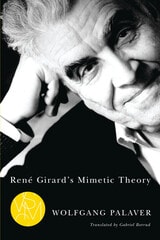
René Girard's Mimetic Theory
Wolfgang Palaver
Michigan State University Press, 2013