Results by title
618 books match the query 'Motion pictures' and 17 start with r
Racial Blackness and Indian Ocean Slavery
Iran's Cinematic ArchiveParisa Vaziri
University of Minnesota Press, 2023
Rethinking the history of African enslavement in the western Indian Ocean through the lens of Iranian cinema
From the East African and Red Sea coasts to the Persian Gulf ports of Bushihr, Kish, and Hurmuz, sailing and caravan networks supplied Iran and the surrounding regions with African slave labor from antiquity to the nineteenth century. This book reveals how Iranian cinema preserves the legacy of this vast and yet long-overlooked history that has come to be known as Indian Ocean slavery.
How does a focus on blackness complicate traditional understandings of history and culture? Parisa Vaziri addresses this question by looking at residues of the Indian Ocean slave trade in Iranian films from the second half of the twentieth century. Revealing the politicized clash between commercial cinema (fīlmfārsī) and alternative filmmaking (the Iranian New Wave), she pays particular attention to the healing ritual zār, which is both an African slave descendent practice and a constitutive element of Iranian culture, as well as to cinematic sīyāh bāzī (Persian black play). Moving beyond other studies on Indian Ocean and trans-Saharan slavery, Vaziri highlights the crystallization of a singular mode of historicity within these cinematic examples—one of “absence” that reflects the relative dearth of archival information on the facts surrounding Indian Ocean slavery.
Bringing together cinema studies, Middle East studies, Black studies, and postcolonial theory, Racial Blackness and Indian Ocean Slavery explores African enslavement in the Indian Ocean through the revelatory and little-known history of Iranian cinema. It shows that Iranian film reveals a resistance to facticity representative of the history of African enslavement in the Indian Ocean and preserves the legacy of African slavery’s longue durée in ways that resist its overpowering erasure in the popular and historical imagination.
Retail e-book files for this title are screen-reader friendly with images accompanied by short alt text and/or extended descriptions.
Re-takes
Postcoloniality and Foreign Film LanguagesJohn Mowitt
University of Minnesota Press, 2005
Red, White & Black
Cinema and the Structure of U.S. AntagonismsFrank B. Wilderson III
Duke University Press, 2010
Wilderson provides detailed readings of two films by Black directors, Antwone Fisher (Denzel Washington) and Bush Mama (Haile Gerima); one by an Indian director, Skins (Chris Eyre); and one by a White director, Monster’s Ball (Marc Foster). These films present Red and Black people beleaguered by problems such as homelessness and the repercussions of incarceration. They portray social turmoil in terms of conflict, as problems that can be solved (at least theoretically, if not in the given narratives). Wilderson maintains that at the narrative level, they fail to recognize that the turmoil is based not in conflict, but in fundamentally irreconcilable racial antagonisms. Yet, as he explains, those antagonisms are unintentionally disclosed in the films’ non-narrative strategies, in decisions regarding matters such as lighting, camera angles, and sound.
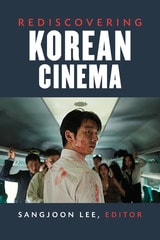
Rediscovering Korean Cinema
Sangjoon Lee, Editor
University of Michigan Press, 2019
This groundbreaking collection of thirty-five essays by a wide range of academic specialists situates current scholarship on Korean cinema within the ongoing theoretical debates in contemporary global film studies. Chapters explore key films of Korean cinema, from Sweet Dream, Madame Freedom, The Housemaid, and The March of Fools to Oldboy, The Host, and Train to Busan, as well as major directors such as Shin Sang-ok, Kim Ki-young, Im Kwon-taek, Bong Joon-ho, Hong Sang-soo, Park Chan-wook, and Lee Chang-dong. While the chapters provide in-depth analyses of particular films, together they cohere into a detailed and multidimensional presentation of Korean cinema’s cumulative history and broader significance.
With its historical and critical scope, abundance of new research, and detailed discussion of important individual films, Rediscovering Korean Cinema is at once an accessible classroom text and a deeply informative compendium for scholars of Korean and East Asian studies, cinema and media studies, and communications. It will also be an essential resource for film industry professionals and anyone interested in international cinema.
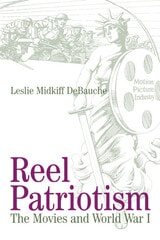
Reel Patriotism
The Movies and World War ILeslie Midkiff DeBauche
University of Wisconsin Press, 1997
Leslie Midkiff DeBauche shows how the United States government’s need to garner public support for the war, conserve food, raise money, and enlist soldiers was met by the film industry. Throughout the nineteen months of American involvement in World War I, film studios supported the war effort through the production of short instructional films, public speaking activities of movie stars, the civic forum provided by movie theaters, and the National Association of the Motion Picture Industry’s provision of administrative personnel to work directly with government agencies. While feature films about the war itself never dominated the release schedules of film distributors, they did become a staple film industry offering throughout the late 1910s and 1920s.
The film industry had much to gain, DeBauche demonstrates, from working closely with the U.S. government. Though the war posed a direct challenge to the conduct of business as usual, the industry successfully weathered the war years. After the war, film producers, distributors, and exhibitors were able to capitalize on the good will of the movie-goer and the government that the industry’s war work created. It provided a buffer against national censorship when movie stars became embroiled in scandal, and it served as a selling point in the 1920s when major film companies began to trade their stock on Wall Street.

Reel Power
Hollywood Cinema and American SupremacyMatthew Alford
Pluto Press, 2010
Hollywood is often characterised as a stronghold of left-liberal ideals. In Reel Power, Matthew Alford shows that it is in fact deeply complicit in serving the interests of the most regressive US corporate and political forces.
Films like Transformers, Terminator: Salvation and Black Hawk Down are constructed with Defence Department assistance as explicit cheerleaders for the US military, but Matthew Alford also emphasises how so-called 'radical' films like Three Kings, Hotel Rwanda and Avatar present watered-down alternative visions of American politics that serve a similar function.
Reel Power is the first book to examine the internal workings of contemporary Hollywood as a politicised industry as well as scores of films across all genres. No matter what the progressive impulses of some celebrities and artists, Alford shows how they are part of a system that is hard-wired to encourage American global supremacy and frequently the use of state violence.
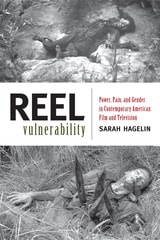
Reel Vulnerability
Power, Pain, and Gender in Contemporary American Film and TelevisionHagelin, Sarah
Rutgers University Press, 2013
The book examines the shifting constructions of vulnerability in the wake of the cultural upheavals of World War II, the Cold War, and 9/11, placing defenseless male bodies onscreen alongside representations of the female body in the military, in the interrogation room, and on the margins. Sarah Hagelin challenges the ways film theory and cultural studies confuse vulnerability and femaleness. Such films as G.I. Jane and Saving Private Ryan, as well as such post-9/11 television shows as Battlestar Galactica and Deadwood, present vulnerable men who demand our sympathy, abused women who don’t want our pity, and images of the body in pain that do not portray weakness.
Hagelin’s intent is to help scholarship catch up to the new iconographies emerging in theaters and in living rooms—images that offer viewers reactions to the suffering body beyond pity, identification with the bleeding body beyond masochism, and feminist images of the female body where we least expect to find them.
Reel World
An Anthropology of CreationAnand Pandian
Duke University Press, 2015
Refiguring Spain
Cinema/Media/RepresentationMarsha Kinder, ed.
Duke University Press, 1997
These essays consider a diverse array of texts, ranging from recent films by Almodóvar, Saura, Erice, Miró, Bigas Luna, Gutiérrez Aragón, and Eloy de la Iglesia to media coverage of the 1993 elections. Francoist cinema and other popular media are examined in light of strategies used to redefine Spain’s cultural identity. The importance of the documentary, the appropriation of Hollywood film, and the significance of gender and sexuality in Spanish cinema are also discussed, as is the discourse of the Spanish media star—whether involving film celebrities like Rita Hayworth and Antonio Banderas or historical figures such as Cervantes. The volume concludes with an investigation of larger issues of government policy in relation to film and media, including a discussion of the financing of Spanish cinema and an exploration of the political dynamics of regional television and art museums. Drawing on a wide range of critical discourses, including feminist, postcolonial, and queer theory, political economy, cultural history, and museum studies, Refiguring Spain is the first comprehensive anthology on Spanish cinema in the English language.
Contributors. Peter Besas, Marvin D’Lugo, Selma Reuben Holo, Dona M. Kercher, Marsha Kinder, Jaume Martí-Olivella, Richard Maxwell, Hilary L. Neroni, Paul Julian Smith, Roland B. Tolentino, Stephen Tropiano, Kathleen M. Vernon, Iñaki Zabaleta
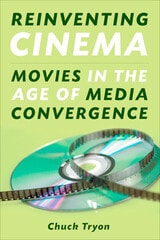
Reinventing Cinema
Movies in the Age of Media ConvergenceTryon, Chuck
Rutgers University Press, 2009
Reinventing Cinema examines film culture at the turn of this century, at the precise moment when digital media are altering our historical relationship with the movies. Spanning multiple disciplines, Chuck Tryon addresses the interaction between production, distribution, and reception of films, television, and other new and emerging media.Through close readings of trade publications, DVD extras, public lectures by new media leaders, movie blogs, and YouTube videos, Tryon navigates the shift to digital cinema and examines how it is altering film and popular culture.
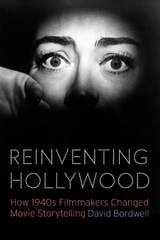
Reinventing Hollywood
How 1940s Filmmakers Changed Movie StorytellingDavid Bordwell
University of Chicago Press, 2017
If this sounds like today’s cinema, that’s because it is. In Reinventing Hollywood, David Bordwell examines the full range and depth of trends that crystallized into traditions. He shows how the Christopher Nolans and Quentin Tarantinos of today owe an immense debt to the dynamic, occasionally delirious narrative experiments of the Forties. Through in-depth analyses of films both famous and virtually unknown, from Our Town and All About Eve to Swell Guy and The Guilt of Janet Ames, Bordwell assesses the era’s unique achievements and its legacy for future filmmakers. Reinventing Hollywood is a groundbreaking study of how Hollywood storytelling became a more complex art and essential reading for lovers of popular cinema.

Religion and Spanish Film
Luis Buñuel, the Franco Era, and Contemporary DirectorsElizabeth Scarlett
University of Michigan Press, 2014
Representing The Woman
Cinema and PsychoanalysisElizabeth Cowie
University of Minnesota Press, 1996
Research Guide to Japanese Film Studies
Abé Mark Nornes and Aaron Gerow
University of Michigan Press, 2009
Revisiting Women's Cinema
Feminism, Socialism, and Mainstream Culture in Modern ChinaLingzhen Wang
Duke University Press, 2021
Rites of Realism
Essays on Corporeal CinemaIvone Margulies, ed.
Duke University Press, 2003
By providing close readings of classic and contemporary works, Rites of Realism signals the need to return to a focus on films as the main innovators of realist representation. The collection is inspired by André Bazin's theories on film's inherent heterogeneity and unique ability to register contingency (the singular, one-time event). This volume features two new translations: of Bazin's seminal essay "Death Every Afternoon" and Serge Daney's essay reinterpreting Bazin's defense of the long shot as a way to set the stage for a clash or risky confrontation between man and animal. These pieces evince key concerns—particularly the link between cinematic realism and contingency—that the other essays explore further.
Among the topics addressed are the provocative mimesis of Luis Buñuel's Land Without Bread; the adaptation of trial documents in Carl Dreyer's Passion of Joan of Arc; the use of the tableaux vivant by Wim Wenders and Peter Greenaway; and Pier Paolo Pasolini's strategies of analogy in his transposition of The Gospel According to St. Matthew from Palestine to southern Italy. Essays consider the work of filmmakers including Michelangelo Antonioni, Maya Deren, Mike Leigh, Cesare Zavattini, Zhang Yuan, and Abbas Kiarostami.
Contributors: Paul Arthur, André Bazin, Mark A. Cohen, Serge Daney, Mary Ann Doane, James F. Lastra, Ivone Margulies, Abé Mark Normes, Brigitte Peucker, Richard Porton, Philip Rosen, Catherine Russell, James Schamus, Noa Steimatsky, Xiaobing Tang
Rubble Films
German Cinema In Shadow Of 3Rd ReichRobert R. Shandley
Temple University Press, 2001
Rubble Films is a close look at German cinema in the immediate postwar era, and a careful examination of its relationship to Allied occupation. Shandley reveals how German film borrowed -- both literally and figuratively -- from its Nazi past, and how the occupied powers (specifically the US) used its position as victor to open Europe to Hollywood movie products and aesthetics.
Incorporating a careful reading of several important postwar films, Shandley also discusses how the German studio system operated immediately after the war, in the east and the west, giving special focus on DEFA, the east German studio that rose during Soviet occupation.
Pathbreaking in its research, Rubble Films sheds new light on a significant moment of German cultural rebirth, and adds a new dimension to the study of the history of film.