Results by title
3785 books match the query 'Poetry' and 163 start with r

RAG
Julie Carr
Omnidawn, 2014
RESPECT
The Poetry of Detroit MusicJim Daniels
Michigan State University Press, 2019
Rabbits Could Sing
PoemsAmber Flora Thomas
University of Alaska Press, 2012
The poems included in The Rabbits Could Sing delve farther into territory that Amber Flora Thomas visited in her prize-winning book Eye of Water, showing even more clearly how “the seam has been pulled so far open on the past” that “the dress will never close.” Here, the poem acts not as a body in itself but as a garb drawn around the here and now. Loss, longing, and violation are sustenance to a spirit jarred from its animal flesh and torn apart, unsettling the reader with surprising images that are difficult to forget. The poems in The Rabbits Could Sing invite the reader into a world thick with the lush bounty of summer in the far north, where the present is never far from the shadow of the past.
Race and Time
American Women's Poetics from Antislavery to Racial ModernityJanet Gray
University of Iowa Press, 2004
Gray clarifies the cultural roles women’s poetry played in the nineteenth-century United States and also reveals that these poems offer a fascinating, dynamic, and diverse field for students of social and cultural history. Gray’s readings provide a rich sense of the contexts in which this poetry is embedded and examine its aesthetic and political vitality in meticulous detail, linking careful explication of the texts with analysis of the history of poetry, canons, literacy, and literary authority.
Race and Time distinguishes itself from other critical studies not only through its searching, in-depth readings but also through its sustained attention to less known poets and its departure from a Dickinson-centered model. Most significantly, it offers a focus on race, demonstrating how changes in both the U.S. racial structure and women’s place in public culture set the terms for change in how women poets envisioned the relationship between poetry and social power.
Gray’s work makes contributions to several fields of study: poetry, U.S. literary history and American studies, women’s studies, African American studies and whiteness studies, children’s literature, and cultural studies. While placing the works of figures who have been treated elsewhere (e.g., Dickinson and Harper) into revealing new relationships, Race and Time does much to open interdisciplinary discussion of unfamiliar works.
Radical Affections
Essays on the Poetics of OutsideMiriam Nichols
University of Alabama Press, 2011
In 1950 the poet Charles Olson published his influential essay “Projective Verse” in which he proposed a poetry of “open field” composition—to replace traditional closed poetic forms with improvised forms that would reflect exactly the content of the poem.
The poets and poetry that have followed in the wake of the “projectivist” movement—the Black Mountain group, the New York School, the San Francisco Renaissance, and the Language poets—have since been studied at length. But more often than not they have been studied through the lens of continental theory with the effect that these highly propositional, pragmatic, and adaptable forms of verse were interpreted in very cramped, polemical ways.
Miriam Nichols highlights many of the impulses original to the thinking and methods of each poet: appeals to perceptual experience, spontaneity, renewed relationships with nature, engaging the felt world—what Nichols terms a “poetics of outside”—focusing squarely on experiences beyond the self-regarding self. As Nichols states, these poets may well “represent the last moment in recent cultural history when a serious poet could write from perception or pursue a visionary poetics without irony or quotation marks and expect serious intellectual attention.”
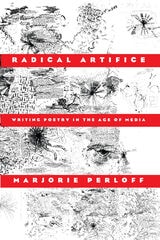
Radical Artifice
Writing Poetry in the Age of MediaMarjorie Perloff
University of Chicago Press, 1992
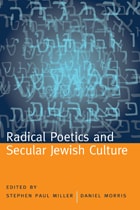
Radical Poetics and Secular Jewish Culture
Edited by Stephen Paul Miller and Daniel Morris
University of Alabama Press, 2009
--Franz Kafka
Kafka's quip--paradoxical, self-questioning, ironic--highlights vividly some of the key issues of identity and self-representation for Jewish writers in the 20th century. No group of writers better represents the problems of Jewish identity than Jewish poets writing in the American modernist tradition--specifically secular Jews: those disdainful or suspicious of organized religion, yet forever shaped by those traditions.
This collection of essays is the first to address this often obscured dimension of modern and contemporary poetry: the secular Jewish dimension. Editors Daniel Morris and Stephen Paul Miller asked their contributors to address what constitutes radical poetry written by Jews defined as "secular," and whether or not there is a Jewish component or dimension to radical and modernist poetic practice in general. These poets and critics address these questions by exploring the legacy of those poets who preceded and influenced them--Stein, Zukofsky, Reznikoff, Oppen, and Ginsberg, among others.
While there is no easy answer for these writers about what it means to be a Jew, in their responses there is a rich sense of how being Jewish reflects on their aesthetics and practices as poets, and how the tradition of the avant-garde informs their identities as Jews. Fragmented identities, irony, skepticism, a sense of self as "other" or "outsider," distrust of the literal, and belief in a tradition that questions rather than answers--these are some of the qualities these poets see as common to themselves, the poetry they make, and the tradition they work within.
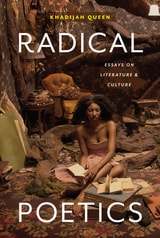
Radical Poetics
Essays on Literature & CultureKhadijah Queen
University of Michigan Press, 2025
Instead of operating from a base of unquestioned thought and systemic tradition, Radical Poetics presents more inclusive and accurate ways of contemplating literary work. Building on ideas and theoretical practices from Édouard Glissant, Toni Morrison, bell hooks, Saidiya Hartman, and Kimberlé Crenshaw, Queen reads for where love is present as well as for where it is absent—tracing systems of thought and aesthetic choices to track how characters are portrayed in terms of race, gender, class, and disability. She analyzes short stories, novels, nonfiction narratives, poetry, and a play from authors such as Herman Melville, Kate Chopin, Dionne Brand, Frances Ellen Watkins Harper, Ma-ka-tai-me-she-kia-kiak, Sor Juana Inés de la Cruz, Natasha Trethewey, and Muriel Rukeyser. Queen’s essays offer shifts in thinking about language—beyond calling out the ways language punishes vulnerability, entrenches harm, and suppresses true intercultural communication. Her intuitive approach aims to correct inaccuracies that have served as a foundation for the discriminatory thinking that undergirds American institutions and culture, particularly the continued glorification of violence. Radical Poetics makes a case for the imperative and practical value of understanding poetics beyond artistic and academic spaces and into everyday life.
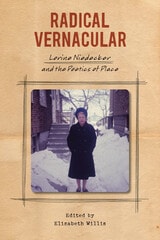
Radical Vernacular
Lorine Niedecker and the Poetics of PlaceElizabeth Willis
University of Iowa Press, 2008
Aesthetically linked with the New York Objectivist poets, Niedecker remained committed to her community in rural Wisconsin despite the grinding poverty that dogged her throughout her life. Largely self-taught, Niedecker formed attachments through her voracious reading and correspondence, but she also delighted in the disruptive richness of vernacular usage and in the homegrown, improvisational aesthetics that thrived within her immediate world. Niedecker wrote from a highly attenuated concern with biological, cultural, and political sustainability and, in her stridently modernist poems, anticipated many of the most urgent concerns in twenty-first-century poetics. In Radical Vernacular, Elizabeth Willis collects essays by leading poets and scholars that make a major contribution to the study of an important but long overlooked American poet.
This pathbreaking volume contains essays by seventeen leading scholars: Rae Armantrout, Glenna Breslin, Michael Davidson, Rachel Blau DuPlessis, Ruth Jennison, Peter Middleton, Jenny Penberthy, Mary Pinard, Patrick Pritchett, Peter Quartermain, Lisa Robertson, Elizabeth Robinson, Eleni Sikelianos, Jonathan Skinner, Anne Waldman, Eliot Weinberger, and Elizabeth Willis.
Radical as Reality
Form and Freedom in American PoetryPeter Campion
University of Chicago Press, 2019
Through close readings of the great modernists, midcentury objectivists, late twentieth-century poets, his contemporaries, and more, Campion unearths an American poetic landscape that is subtler and more varied than most critics have allowed. He discovers commonalities among poets considered opposites, dramatizes how form and history are mutually entailing, and explores how the conventions of poetry, its inheritance, and its inventions sprang from the tensions of ordinary life. At its core, this is a book about poetic making, one that reveals how the best poets not only receive but understand and adapt what comes before them, reinterpreting the history of their art to create work that is, indeed, radical as reality.
Radicals, Volume 1
Fiction, Poetry, and Drama: Audacious Writings by American Women, 1830-1930Meredith Stabel and Zachary Turpin
University of Iowa Press, 2021
In Volume 1: Fiction, Poetry, and Drama, selections span from early works like Sarah Louise Forten’s anti-slavery poem “The Grave of the Slave” (1831) and Fanny Fern’s Ruth Hall (1855), a novel about her struggle to break into the male-dominated field of journalism, to Charlotte Perkins Gilman’s revenge fantasy, “When I Was a Witch” (1910) and Georgia Douglas Johnson’s poem on the fraught nature of African American motherhood, “Maternity” (1922). In between, readers will discover many vibrant and challenging lesser-known texts that are rarely collected today. Some, indeed, have been out of print for more than a century.
Unique among anthologies of American literature, Radicals undoes such silences by collecting the underrepresented, the uncategorizable, the unbowed—powerful writings by American women of genius and audacity who looked toward, and wrote toward, what Charlotte Perkins Gilman called “a lifted world.”
Radioapocrypha
BK Fischer
The Ohio State University Press, 2018

Radium Girl
Celeste Lipkes
University of Wisconsin Press, 2023
The poems in Radium Girl hold dual citizenship in the land of the sick and the kingdom of the well. The point where illusion ends and reality begins is never clear, as Celeste Lipkes evokes saints, magicians, scientists, and caregivers in the process of surviving both medical illness and medical training. Slippery metaphors of rabbits in hats, doves in cages, and elaborate escapes explore the inhabitation of a female body as a kind of powerful and violent performance—where the magician’s trick of cutting a woman in half is never as far away as we’d like.
With humor (“When the doctor says, ‘We found something,’ / I don’t say: ‘no shit’ or ‘oh thank God, / I’ve been looking for that sweater everywhere,’”) and heartbreak (“Every evening I count the dwindling brass coins / of my patient’s platelets while his wife ices / cups of ginger ale he will never drink”), Lipkes reminds us what it means to feel human, to feel afraid, to feel hopeful, to feel.
I am the magician, even,
some nights alone,
finding inside the darkness
a small, trembling thing
I won’t acknowledge as my own.
This is someone else’s rabbit,
I say, and the silence nods back.
—Excerpt from “Rabbit”
Radium of the Word
A Poetics of MaterialityCraig Dworkin
University of Chicago Press, 2020
Radium of the Word takes its title from Mina Loy’s poem for Gertrude Stein, which hails her as the Madame “Curie / of the laboratory / of vocabulary.” In this spirit, Dworkin considers prose as a dynamic literary form, characterized by experimentation. Dworkin draws on examples from writers as diverse as Lyn Hejinian, William Faulkner, and Joseph Roth. He takes up the status of the proper name in Modernism, with examples from Stein, Loy, and Guillaume Apollinaire, and he offers in-depth analyses of individual authors from the counter-canon of the avant-garde, including P. Inman, Russell Atkins, N. H. Pritchard, and Andy Warhol. The result is an inspiring intervention in contemporary poetics.
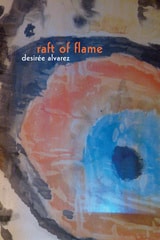
Raft of Flame
Desirée Alvarez
Omnidawn, 2019
In Raft of Flame, Alvarez constructs and fleshes out a fantastic narrative of personal and cultural history, offering glimpses into the art, history, and land that comprise her story. Her narrative explores how both nature and human populations continue to be trapped in the violence of colonialism. Vivid lyrics interrogate the complexities of mixed race, digging the dualities, upheavals, and casts of characters that underly Alvarez’s identity.
Raft of Flame won Omnidawn's 2018 Lake Merritt Prize.
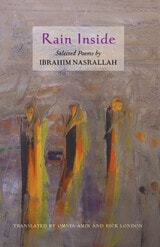
Rain Inside
Ibrahim Nasrallah
Northwestern University Press, 2009
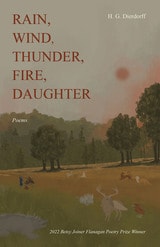
Rain, Wind, Thunder, Fire, Daughter
PoemsH. G. Dierdorff
University of Nevada Press, 2024
Rain, Wind, Thunder, Fire, Daughter is a story about leaving religion and coming of age in a world of accelerating climate apocalypses and environmental loss. In her debut collection of poems, H. G. Dierdorff interweaves an investigation of wildfires in Eastern Washington with a personal account of growing up in Christian fundamentalism, calling our attention to the violent histories undergirding both.
“I want you to touch the fire / sparking from my lips” the opening sonnet commands, daring the reader to abandon the safety of analytical distance and draw near to the moment of ignition itself. The voice that emerges is incessant, ecstatic, explosive. Fire erupts from every page, multiplying into rage, desire, judgement, responsibility, and renewal.
A love song to the forests of the Pacific Northwest, a dramatic portrait of a daughter struggling to find her place in her family, and a philosophical exploration of the limits of language and belief, this collection demands the necessity of both pleasure and grief as responses to a world on fire.
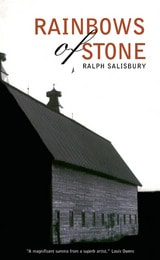
Rainbows of Stone
Ralph Salisbury
University of Arizona Press, 2000
Son of a Cherokee-English father and an Irish mother, Ralph Salisbury grew up among storytellers and has shared his family's tales and experiences in seven previous books of prose and poetry. Now in Rainbows of Stone he returns with a striking collection of poems that interweaves family tales with personal and tribal history.
Salisbury conjures images that define his life, from the vanishing farming and hunting traditions with which he was raised to his experiences in World War II as a member of a bomber crew. He writes of himself and of Indian people as Vanishing Americans—vanishing into the mingling of races—and sees himself as a pacifistic patriot concerned that we not continue the destructive reliance on war that marks our history.
Writing as one who is "not part Indian, part white, but wholly both," Salisbury has produced a haunting, powerful work that expresses his devotion to the Cherokee religion, its fidelity to its forebears, and its harmony with the forces of Nature. For all concerned with ecology, social justice, and peace, Rainbows of Stone conveys a growing awareness of the world and a sense of how each individual connects with the universal and timeless realities of every other human being.

Rainer Maria Rilke
The Ring of FormsFrank Wood
University of Minnesota Press, 1958
Rainer Maria Rilke was first published in 1958. Minnesota Archive Editions uses digital technology to make long-unavailable books once again accessible, and are published unaltered from the original University of Minnesota Press editions.
The German poet Rainer Maria Rilke died in 1926, and interest in his poetry has been mounting ever since. The winds of fashion, taste, or personal bias have shifted several times to affect his audience of readers. There have been, according to previous Rilke criticism, not one but many Rilkes. Thus the critics have pointed to the "early Rilke" and the "late Rilke," to the Prague poet, the Paris poet, and the Muzot poet.
Now, in a fresh approach yet one which takes full cognizance of the varying viewpoints and conflicting purposes of earlier criticism, Professor Wood carefully examines Rilke's entire poetic output. The major concern here is with the poetry itself rather than with the biographical, psychological, or philosophical questions which have dominated most previous criticism.
Through a close textual analysis of the poems, Professor Wood demonstrates that the whole body of Rilke's writing, from beginning to end, is thoroughly interrelated and interdependent. As he points out, many more published materials, both posthumous verse and correspondence, are available now than in the earlier periods of Rilke's fame, a situation which adds significance to this new evaluation.
In addition to analyzing Rilke's own poetry, Professor Wood shows the links between Rilke and such contemporary poets and writers as Gide, Proust, T.S. Eliot, and Yeats.
The excerpts quoted from Rilke's poetry are given both in the original German text and in standard English translation.
Raising the Tents
Francis Payne Adler
Calyx, 1993
Rank
Aaron McCollough
University of Iowa Press, 2015
In language that is dense, allusive, by turns trancelike and mordantly funny, McCollough descends into the ranks of disintegrating organic life and finds elemental processes of regeneration underway, “ivy suckers climbing / the knock kneed craning bridge / to that bright food.” This is work that emerges in the aftermath of declining systems of hierarchy and order, a site marked by the overlapping of occult practices and postmodern physics, tense meditation, and economic anonymity. McCollough gives rise to a voice that is as much vegetative as human, as deeply embedded in the loam of cultural memory as it is new, original, and lavishly daring.
Raptor
Andrew Feld
University of Chicago Press, 2012

Rapture & the Big Bam
Poems (Snowbound Chapbook Award)Matt Donovan
Tupelo Press, 2017
Rara Avis
Blas Falconer
Four Way Books, 2024
Regally bearing its Latin title, Rara Avis captures in sparse, moving verse both the splendor and the loneliness of what it means to be exceptional — a rarified specimen, a strange bird. A son, a husband, and now a father, seasoned poet Blas Falconer explores the relationships among men — between peers, lovers, parents and children — to consider and question existing models of authority and power. Falconer’s lucid but feeling gaze reveals social complexities with searing and graceful imagery, asking what it means to live outside the heteronormative experience while existing as a man, simultaneously a casualty and a participant in the project of masculinity.
These poems carefully delineate the casual cruelties of queer youth and the beautiful and bitter revelations of adulthood. The wisdom propelling Rara Avis is the knowledge that we are each of us that rare bird; we share our singularity. Everyone has a pancreas, but only one organ matters when Falconer learns his father is afflicted. Alchemized by love, one thing, unlike any other, becomes all things. “All day, everything, / no matter how / small, makes me // think of it” … The bee / crawling in / blossoms // scattered on / the glass/tabletop. The sound of // a pitcher fill- / ing slowly / with water.”
Rare High Meadow of Which I Might Dream
Connie Voisine
University of Chicago Press, 2008
There are some bodies that emerge
into desire as a god
rises from the sea, emotion and
memory hang like dripping clothes—this
want is like
entering that heated red
on the mouth of a Delacroix lion,
stalwart, always that red
which makes
my teeth ache and my skin feel
a hand that has never touched me,
the tree groaning outside becomes
a man who knocks on my bedroom window,
edge of red on gold fur,
the horse, the wild
flip of its head, the rake of claws
across its back, the unfocussed,
swallowed eye.
Rare High Meadow of Which I Might Dream is a book haunted by the afterlife of medieval theology and literature yet grounded in distinctly modern quandaries of desire. Connie Voisine’s female speakers reverberate with notes of Marie de France’s tragic heroines, but whereas Marie’s poems are places where women’s longings quickly bloom and die in captivity—in towers and dungeons—Voisine uses narrative to suspend the movement of storytelling. For Voisine, poems are occasions for philosophical wanderings, extended lyrics that revolve around the binding and unbinding of desire, with lonely speakers struggling with the impetus of wanting as well as the necessity of a love affair’s end. With fluency, intelligence, and deeply felt emotional acuity, Rare High Meadow of Which I Might Dream navigates the heady intersection of obsessive love and searing loss.
Praise for Cathedral of the North
“Voisine’s poetry is wholly unsentimental, tactile, and filled with unexpected beauty. She is political in the best sense. . . . A dazzling, brave, and surprising first book.”—Denise Duhamel, Ploughshares
Rational Anthem
Casey Thayer
University of Arkansas Press, 2022
Finalist, 2022 Miller Williams Poetry Prize
In a voice at times electrified by caustic cynicism, at other times stripped bare by grief, Casey Thayer’s Rational Anthem offers wry tribute to “the greatest country God could craft with the mules he had / on hand.” In seeking to tell the story of the ragged world around him, Thayer examines the links among flag-waving populism, religious fervor, and toxic masculinity. Here male intimacy—among childhood friends, between father and son, and in the tenuous bonds between young adults—generally finds acceptance only when expressed through a shared passion for guns and hunting: “I helped my father clean his hands with field grass, / convinced we had shared a moment / in rolling the internal organs out of the abdomen.”
In “How-To,” the book’s closer—a mash-up of instructions from active-shooter trainings attended by the poet—Thayer grasps at strategies for surviving a world where we have come to see school shootings as routine: “Grab a textbook, they instructed my child, and hug it to your chest over your heart.”
Formally deft and lyrically dense, Rational Anthem asks why we find it so hard to change the stories we keep repeating.
Raven Eye
Margo Tamez
University of Arizona Press, 2007
These complex and necessary themes are at the heart of award-winning poet Margo Tamez’s second book of poetry. Her poems bring forth experiences of a raced and gendered life along the border. Tamez engages the experiences of an indigenous life, refusing labels of Mexican or Native American as social constructs of a colonized people. This book is a challenging cartography of colonialism, poverty, and issues of Native identity and demonstrates these as threats to the environment, both ecological and social, in the borderlands. Each poem is crafted as if it were a minute prayer, dense with compassion and unerring optimism.
But the hope that Tamez serves is not blind. In poem after poem, she draws us into a space ruled by mythic symbolism and the ebb and flow of the landscape—a place where comfort is compromised and where we must work to relearn the nature of existence and the value of life.
Raven on the Moaners' Bench
Gary Copeland Lilley
Four Way Books, 2025
Raven on the Moaners' Bench writes into grace, opening an exit from a violent cycle, making possible a lighter future while refusing to forget this country's incalculable debt. The inward searching and cross-country migration that Lilley's family, and many other African Americans, have experienced several times in their own histories form the desire for a livable place where safety and opportunity coincide. Jeff walked across America, all the way to the Pacific Ocean, only to die sleeping outside in Los Angeles; this book bears witness to that desperate pilgrimage. Addressing Jeff, Lilley pens a requiem for roadkill he encountered "in a Northwest pathway of [his] own / migration, far from [their] Southern roots": "I offer up the sacrifice of one doe sprawled / in the what-was-left-of-her on the pathway / where I had to meet her and bring her away / to show you I understood something of how / you bore a terrible cost for our family, / for this unholy country, a cost for which / I won't allow any repayment / by words, not mine or anyone's, / on any unstained page."
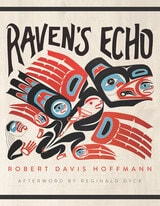
Raven's Echo
Robert Davis Hoffmann, Afterword by Reginald Dyck
University of Arizona Press, 2022
Raven’s Echo is divided into two books, “SoulCatcher” and “Reconstruction.” “SoulCatcher” artfully explores human alienation and spiritual longing through poems that describe the speaker’s enduring struggle to find a place in Tlingit tribal history and contemporary experience. It takes up topics like colonialism, government subordination, painful acculturation, assimilation, and an array of other challenges, while it also addresses human loneliness in a world of spirits who often elude rather than nurture. The poems in “Reconstruction” present ways of integrating traditional Tlingit culture into contemporary life by honoring the significance of the land, subsistence fishing, warrior identity, and the role of elders. The two books are woven together by the constant thread of finding a way to live humanely in a world that is historically fractured yet spiritually inviting.
Hoffmann’s poetry is acutely aware of economic, political, and social tensions, while still highlighting the joy of traditions and the beauty of Alaskan nature throughout the collection. The destructiveness of colonialism brings a profound darkness to some of the poems in Raven’s Echo, but the collection also explores the possibility of finding spiritual healing in the face of historical and contemporary traumas. As Hoffman’s poetry grapples with reconstructing a life within Tlingit tradition and history, the speaker urges that the importance of honoring and remembering traditions through art is ever present: “Listen, I’m trying to say something— / always our stories have lived through paintings, / always our stories stayed alive through retelling.” Raven’s Echo may tell stories about living in a world of guns and horsepower, global warming, cops, and drunks—but Raven always lurks in the background.
Raw Goods Inventory
Emily Rosko
University of Iowa Press, 2006
Raw Silk
PoemsMeena Alexander
Northwestern University Press, 2004
A deeply moving collection from a poet who crosses borders
New York City poet Meena Alexander was born in Allahabad, India and divided her childhood between India and the Sudan. From her cross-cultural perspective, Alexander writes with moving intensity of post-September 11 events as she evokes violence and civil strife, love, despair, and a hard-won hope. This autobiographical cycle of poems reflects the surrealism of such a life, and is shot through with the frissons of pleasure and pain, of beauty and tension, that mark a truly global identity.
Re Verse
Essays on Poetry and PoetsDavid R. Slavitt
Northwestern University Press, 2009
Combining personal reminiscence with deft literary analysis, incisive biographical sketches, and, sometimes, literary gossip, these essays give new perspectives on the famous--such as Harold Bloom, Robert Penn Warren, Robert Frost, and Stephen Spender--and recover the charms of the near-forgotten--such as Dudley Fitts, Winfield Townley Scott, Merrill Moore and John Hall Wheelock. Slavitt writes with self-deprecating humor of his own literary education, and uses his impressive experience and erudition to illuminate the whims of poetic influence, passion, and reputation. With a refreshing honesty and considerable poise, he gives readers an enlightening view of the vast and ever-changing literary universe.
Reactor
Judith Vollmer
University of Wisconsin Press, 2004
Reading "The Waste Land"
Modernism and the Limits of InterpretationJewel Spears Brooker
University of Massachusetts Press, 1990
This study of T.S. Eliot's The Waste Land guides the reader through the poem line by line, taking into account a number of previous interpretations. Aims to offer a part-by-part analysis of the poem with periodic summations and a meditation on the limits of interpretation and the problematic nature of reading in the late 20th century.
Reading Duncan Reading
Robert Duncan and the Poetics of DerivationStephen Collis
University of Iowa Press, 2012
In part two, the volume turns to examinations of poets who can be seen to in some way derive from Duncan—and so in turn reveals another angle of Duncan’s derivative poetics. J. P. Craig traces Nathaniel MacKey’s use of Duncan’s “would-be shaman,” Catherine Martin sees Duncan’s influence in Susan Howe’s “development of a poetics where the twin concepts of trespass and ‘permission’ hold comparable sway,” and Ross Hair explores poet Ronald Johnson’s “reading to steal.” These and other essays collected here trace paths of poetic affiliation and affinity and hold them up as provocative possibilities in Duncan’s own inexhaustible work.
Reading Emily Dickinson's Letters
Critical EssaysJane Donahue Eberwein
University of Massachusetts Press, 2009
Emily Dickinson, who regarded a letter as “a joy of Earth,” was herself a gifted epistolary artist—cryptic and allusive in style, dazzling in verbal effects, and sensitively attuned to the recipients of her many letters. In this volume, distinguished literary scholars focus intensively on Dickinson's letter-writing and what her letters reveal about her poetics, her personal associations, and her self-awareness as a writer.
Although Dickinson's letters have provided invaluable perspective for biographers and lovers of poetry since Mabel Loomis Todd published the first selection in 1894, today's scholarly climate opens potential for fresh insights drawn from new theoretical approaches, informed cultural contextualizations, and rigorous examination of manuscript evidence. Essays in this collection explore ways that Emily Dickinson adapted nineteenth-century epistolary conventions of women's culture, as well as how she directed her writing to particular readers, providing subtly tactful guidance to ways of approaching her poetics.
Close examination of her letters reveals the conscious artistry of Dickinson's writing, from her auditory effects to her experiments with form and tone. Her well-known correspondences with Thomas Wentworth Higginson, Susan Dickinson, Helen Hunt Jackson, and Otis Phillips Lord are examined here, but so too are previously neglected family communications with her aunt Kate Sweetser and cousin Eugenia Montague. Contributors find in these various letters evidence of Dickinson's enthusiastic participation in a sort of epistolary book club involving multiple friends, as well as her loving attentiveness to individuals in times of both suffering and joy. These inquiries highlight her thoughts on love, marriage, gender roles, art, and death, while unraveling mysteries ranging from legal discourse to Etruscan smiles.
In addition to a foreword by Marietta Messmer, the volume includes essays by Paul Crumbley, Karen Dandurand, Jane Donahue Eberwein, Judith Farr, James Guthrie, Ellen Louise Hart, Eleanor Heginbotham, Cindy MacKenzie, Martha Nell Smith, and Stephanie Tingley.
Reading Homer's Iliad
Kostas Myrsiades
Bucknell University Press, 2023
Reading Homer’s Odyssey
Kostas Myrsiades
Bucknell University Press, 2019
Homer’s Odyssey is the first great travel narrative in Western culture. A compelling tale about the consequences of war, and about redemption, transformation, and the search for home, the Odyssey continues to be studied in universities and schools, and to be read and referred to by ordinary readers. Reading Homer’s Odyssey offers a book-by-book commentary on the epic’s themes that informs the non-specialist and engages the seasoned reader in new perspectives. Among the themes discussed are hospitality, survival, wealth, reputation and immortality, the Olympian gods, self-reliance and community, civility, behavior, etiquette and technology, ease, inactivity and stagnation, Penelope’s relationship with Odysseus, Telemachus’ journey, Odysseus’ rejection of Calypso’s offer of immortality, Odysseus’ lies, Homer’s use of the House of Atreus and other myths, the cinematic qualities of the epic’s structure, women’s role in the epic, and the Odyssey’s true ending. Footnotes clarify and elaborate upon myths that Homer leaves unfinished, explain terms and phrases, and provide background information. The volume concludes with a general bibliography of work on the Odyssey, in addition to the bibliographies that accompany each book’s commentary.
Published by Bucknell University Press. Distributed worldwide by Rutgers University Press.
Reading Sand
Selected Desert Poems, 1976-2000William L. Fox
University of Nevada Press, 2002
Reading the Difficulties
Dialogues with Contemporary American Innovative PoetryThomas Fink
University of Alabama Press, 2013
New Strategies for Reading the Most Innovative Poetry of Our Time.
Definitions of what constitutes innovative poetry are innumerable and are offered from every quarter. Some critics and poets argue that innovative poetry concerns free association (John Ashbery), others that experimental poetry is a “re-staging” of language (Bruce Andrews) or a syntactic and cognitive break with the past (Ron Silliman and Lyn Hejinian). The tenets of new poetry abound.
But what of the new reading that such poetry demands? Essays in Reading the Difficulties ask what kinds of stances allow readers to interact with verse that deliberately removes many of the comfortable cues to comprehension—poetry that is frequently nonnarrative, nonrepresentational, and indeterminate in subject, theme, or message.
Some essays in Thomas Fink and Judith Halden-Sullivan’s collection address issues of reader reception and the way specific stances toward reading support or complement the aesthetic of each poet. Others suggest how we can be open readers, how innovative poetic texts change the very nature of reader and reading, and how critical language can capture this metamorphosis. Some contributors consider how the reader changes innovative poetry, what language reveals about this interaction, which new reading strategies unfold for the audiences of innovative verse, and what questions readers should ask of innovative verse and of events and experiences that we might bring to reading it.
Reading the Fascicles of Emily Dickinson
Dwelling in PossibilitiesEleanor Elson Heginbotham
The Ohio State University Press, 2020
We cannot know why Dickinson compiled the books or what she thought of them, but we can observe what she left in them. What she left is visible only by noting the way the poem answers in a dialogue across the pages, the way lines spilling onto a second page introduce the next poem, the way openings suggest image clusters so that each book has its own network of concerns and language—not a story or philosophical preachment but an aesthetic wholeness.
This book is the first to demonstrate that Dickinson’s poetic and philosophical creativity is most startling when the reader observes the individual lyric in the poet’s own, and only, context for them. For teacher, student, scholar, and poetry lover, Heginbotham creates an important new framework for understanding one of the most complex, clever, and profound U.S. poets.
Reading the Illegible
Rainer Rumold
Northwestern University Press, 2003
In his scrutiny of selected works, and with reference to a rich variety of textual materials--from popular and scientific texts to visual art, political and cultural theories, and experimental films--Dworkin proposes a new way of apprehending the radical formalism of so-called unreadable texts. Dworkin unveils what he describes as "the politics of the poem"--what is signified by its form, enacted by its structures, and implicit in the philosophy of language; how it positions its reader; and other questions relating to the poem as material object. In doing so, he exposes the mechanics and function of truly radical formalism as a practice that move beyond aesthetic considerations into the realms of politics and ideology. Reading the Illegible asks us to reconsider poetry as a physical act, and helps us to see how the range of a text's linguistic and political maneuvers depends to a great extent on the material conditions of reading and writing as well as the mechanics of reproduction.
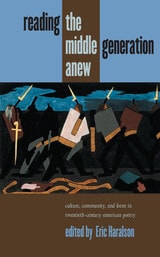
Reading the Middle Generation Anew
Culture, Community, and Form in Twentieth-Century American PoetryEric Haralson
University of Iowa Press, 2006
In addition to having worked during the broad middle of the last century, these poets constitute the center of twentieth-century American poetry in the larger sense, refuting invidious connotations of “middle” as coming after the great moderns and being superseded by a proliferating postmodern experimentation. This middle generation mediates the so-called American century and its prodigious body of poetry, even as it complicates historical and aesthetic categorizations.
Taking diverse formal and thematic angles on these poets—deconstructionist, biographical-historical, and more formalist accounts—this book re-examines their between-ness and ambivalence: their various positionings and repositionings in aesthetic, political, and personal matters. The essays study the interplay between these writers and such shifting formations as religious discourse, consumerism, militarism and war, the ideology of America as “nature’s nation,” and U.S. race relations and ethnic conflicts. Reading the Middle Generation Anew also shows the legacy of the middle generation, the ways in which their lives and writings continue to be a shaping force in American poetry. This fresh and invigorating collection will be of great interest to literary scholars and poets.
Reading the Underthought
Jewish Hermeneutics and the Christian Poetry of Hopkins and EliotKinereth Meyer
Catholic University of America Press, 2010
Readings
The Poetics of Blanchot, Joyce, Kakfa, Kleist, Lispector, and TsvetayevaHelene Cixous
University of Minnesota Press, 1991
Readings: The Poetics of Blanchot, Joyce, Kafka, Kleist, Lispector, and Tsvetayeva offers striking and novel textual studies of major literary figures and emergent authors. Selected from Cixous’s seminars taught between 1980 and 1986 at the Universite de Paris VII (Saint-Denis) and at the College International de Philosophie, the texts chronicle the French intellectual scene with its shifting tastes over the decade following May 1986.
In their simple and accessible language, the texts can be read as inspiration for Cixous’s fictional and critical practices. They not only introduce readers to emergent texts from Brazil and Russia, such as Clarice Lispector’s “Foreign Legion” and Marina Tsvetayeva’s “Mother and Music,” but also give new, incisive insights into Joyce’s Portrait of the Artist and Kafka’s “Before the Law.” Drawing from philosophy and psychoanalysis, Readings: The Poetics of Blanchot, Joyce, Kafka, Kleist, Lispector, and Tsvetayeva can be read side-by-side with Reading with Clarice Lispector, as an ongoing meditation on ethics and poetics.Also from MinnesotaReading with Clarice LispectorHelene CixousEdited, translated, and introduced by Verena Andermatt ConleyFor Cixous, Lispector’s work represents one of the finest examples of ecriture feminine in that she practices, in writing, what Cixous is searching for in her theoretical practice: the giving, spending, and inscribing of pleasure; an apprenticeship in the lessons of life.Theory and History of Literature, volume 73
Real Life
An InstallationJulie Carr
Omnidawn, 2018
Reality Checkmate
Daniel Ruiz
Four Way Books, 2025
Realizing Metaphors
Alexander Pushkin and the Life of the PoetDavid M. Bethea
University of Wisconsin Press, 1998
Readers often have regarded with curiosity the creative life of the poet. In this passionate and authoritative new study, David Bethea illustrates the relation between the art and life of nineteenth-century poet Alexander Pushkin, the central figure in Russian thought and culture. Bethea shows how Pushkin, on the eve of his two-hundredth birthday, still speaks to our time. He indicates how we as modern readers might "realize"— that is, not only grasp cognitively, but feel, experience—the promethean metaphors central to the poet's intensely "sculpted" life. The Pushkin who emerges from Bethea's portrait is one who, long unknown to English-language readers, closely resembles the original both psychologically and artistically.
Bethea begins by addressing the influential thinkers Freud, Bloom, Jakobson, and Lotman to show that their premises do not, by themselves, adequately account for Pushkin's psychology of creation or his version of the "life of the poet." He then proposes his own versatile model of reading, and goes on to sketches the tangled connections between Pushkin and his great compatriot, the eighteenth-century poet Gavrila Derzhavin. Pushkin simultaneously advanced toward and retreated from the shadow of his predecessor as he created notions of poet-in-history and inspiration new for his time and absolutely determinative for the tradition thereafter.
Rebel Poet
More Stories from a 21st Century IndianLouis V. Clark (Two Shoes)
Wisconsin Historical Society Press, 2019
Rebellion Is the Circle of a Lover's Hands/Rebelió
Martín Espada
Northwestern University Press, 1995