Results by title
1066 books match the query 'Political' and 47 start with r
RSF
The Russell Sage Foundation Journal of the Social Sciences: The Social, Political, and Economic Effects of the Affordable Care ActAndrea Campbell
Russell Sage Foundation, 2020
This journal issue explores the political dimensions of the rollout of the ACA and the attendant backlash. Contributors Helen Levy, Andrew Ying, and Nicholas Bagley argue that despite repeated efforts at repeal, over 80 percent of the Act has been implemented as it was originally intended. Julianna Pacheco, Jake Haselswerdt, and Jamila Michener show that when Republican governors support Medicaid expansion, Republican voters become more favorable toward the ACA, and polarization between Republican and Democrat voters decreases. Yet Charles Courtemanche, James Marton, and Aaron Yelowitz find little impact of the ACA on voter participation. Lisa Beauregard and Edward Miller examine states’ adoption of the ACA’s home and community-based care services for the elderly and people with disabilities, finding that states with more liberal elected officials and more fiscal capacity were more likely to adopt these provisions. Paul Shafer, David Anderson, Seciah Aquino, Laura Baum, Erika Franklin Fowler, and Sarah Gollust probe the role of different types of health insurance and political advertising on insurance enrollment. Richard Fording and Dana Patton explain the emergence of contentious Medicaid work requirements and patient co-pays that limit access to Medicaid.
Other contributors address how the ACA affects marginalized populations. Carrie Fry, Thomas McGuire, and Richard Frank link Medicaid expansion to lower rates of recidivism among the formerly incarcerated. Radhika Gore, Ritu Dhar, Sadia Mohaimin, Priscilla Lopez, Anna Divney, Jennifer Zanowiak, Lorna Thorpe, and Nadia Islam study primary care practices serving South Asian immigrants in New York City and highlight the importance of social context and organizational constraints in designing population health interventions. The issue also examines the economic effects of the ACA, especially on access to private and public health insurance. Both Mark Hall and Jean Abraham study instability in ACA health insurance markets, with Hall focusing on uncertainty arising from political factors and Abraham examining the factors that lead local markets to face high premiums and low insurer participation. Philip Rocco and Andrew Kelly explore the mechanisms included in the ACA to try to spur innovations in care delivery that both improve health and generate long-term cost savings.
As the COVID-19 pandemic affects healthcare in unprecedented ways, affordable healthcare access is critical. This RSF journal issue offers a timely, thoughtful consideration of one of the most pressing issues in American life.
Radical Utu
Critical Ideas and Ideals of Wangari Muta MaathaiBesi Brillian Muhonja
Ohio University Press, 2020
Raising Hell for Justice
The Washington Battles of a Heartland ProgressiveDavid R. Obey
University of Wisconsin Press, 2007
Here, in his autobiography, Obey looks back on his journey in politics beginning with his early years in the Wisconsin Legislature, when Wisconsin moved through eras of shifting balance between Republicans and Democrats. On a national level Obey traces, as few others have done, the dramatic changes in the workings of the U.S. Congress since his first election to the House in 1969. He discusses his own central role in the evolution of Congress and ethics reforms and his view of the recent Bush presidency—crucial chapters in our democracy, of interest to all who observe politics and modern U.S. history.
Ralph Johnson Bunche
Public Intellectual and Nobel Peace LaureateEdited by Beverly Lindsay; Foreword by John Hope Franklin
University of Illinois Press, 2007
Nobel Peace Prize winner Ralph Johnson Bunche (1904-71) was one of the twentieth century’s foremost diplomats and intellectuals. In the wake of centennial celebrations of his birth, leading scholars and diplomats assess Bunche’s historical importance and enduring impact on higher education, public policy, and international politics. Their essays reveal not only the breadth of Bunche’s influence, such as his United Nations work to broker peace during times of civil war in Africa, the Middle East, and Asia, but also the depth of his intellectual perspectives on race, civil rights, higher education, and international law. Probing his publications, speeches, and public policy initiatives, the volume offers telling insights into the critical roles of universities, public intellectuals, and diplomats in working together to find solutions to domestic and international problems through public and scholarly engagement. In this way, the volume highlights the very connections that Bunche exhibited as an academic, intellectual, and diplomat.
Contributors include Lorenzo DuBois Baber, John Hope Franklin, Jonathan Scott Holloway, Charles P. Henry, Ben Keppel, Beverly Lindsay, Princeton Lyman, Edwin Smith, and Hanes Walton Jr.
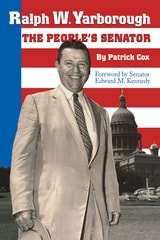
Ralph W. Yarborough, the People's Senator
By Patrick L. Cox
University of Texas Press, 2002
Semifinalist, 22nd Annual Robert F. Kennedy Book Award, 2002
Finalist, Spur Award in western nonfiction biography, Western Writers of America, 2002
Revered by many Texans and other Americans as "the People's Senator," Ralph Webster Yarborough (1903-1996) fought for "the little people" in a political career that places him in the ranks of the most influential leaders in Texas history. The only U. S. Senator representing a former Confederate state to vote for every significant piece of modern civil rights legislation, Yarborough became a cornerstone of Lyndon Johnson's Great Society programs in the areas of education, environmental preservation, and health care. In doing so, he played a major role in the social and economic modernization of Texas and the American South. He often defied conventional political wisdom with his stands against powerful political interests and with his vocal opposition to the Vietnam War. Yet to this day, his admirers speak of Yarborough as an inspiration for public service and a model of political independence and integrity.
This biography offers the first in-depth look at the life and career of Ralph Yarborough. Patrick L. Cox draws on Yarborough's personal and professional papers, as well as on extensive interviews with the Senator and his associates, to follow Yarborough from his formative years in East Texas through his legal and judicial career in the 1930s, decorated military service in World War II, unsuccessful campaigns for Texas governor in the 1950s, distinguished tenure in the United States Senate from 1957 to 1970, and return to legal practice through the 1980s.
Although Yarborough's liberal politics set him at odds with most of the Texas power brokers of his time, including Lyndon Johnson, his accomplishments have become part of the national fabric. Medicare recipients, beneficiaries of the Cold War G. I. Bill, and even beachcombers on Padre Island National Seashore all share in the lasting legacy of Senator Ralph Yarborough.
Reading Leo Strauss
Politics, Philosophy, JudaismSteven B. Smith
University of Chicago Press, 2006
Smith asserts that this philosophical skepticism defined Strauss’s thought. It was as a skeptic, Smith argues, that Strauss considered the seemingly irreconcilable conflict between reason and revelation—a conflict Strauss dubbed the “theologico-political problem.” Calling this problem “the theme of my investigations,” Strauss asked the same fundamental question throughout his life: what is the relation of the political order to revelation in general and Judaism in particular? Smith organizes his book with this question, first addressing Strauss’s views on religion and then examining his thought on philosophical and political issues.
In his investigation of these philosophical and political issues, Smith assesses Strauss’s attempt to direct the teaching of political science away from the examination of mass behavior and interest group politics and toward the study of the philosophical principles on which politics are based. With his provocative, lucid essays, Smith goes a long way toward establishing a distinctive form of Straussian liberalism.

Readings on Fascism and National Socialism
University of Colorado, Dept. of Philosophy
Ohio University Press, 1952
The catastrophe and holocaust brought about by the two powerful movements of fascism and national socialism will mark human life always. Now, as we feel our hatred for them, we find it difficult to understand how they could have been so powerful, how they could have appealed so strongly to millions of people of a modern age.
To understand our own times, it is necessary to understand these movements. And to understand them, we must read the basic philosophical and political documents which show the force of the ideas which moved a world to the brink of disaster.
This collection of readings has been selected to encourage students to clarify their thinking on social philosophy. They will accordingly need to determine whether the readings contain more or less coherent body of ideas which constitutes a social philosophy. They will also need to raise the more far-reaching question of whether the ideas are acceptable. To arrive at any satisfactory answer to this latter question, they will necessarily have to compare the ideas of fascism and their practical meanings with the alternatives, real and ideal, that are the substance of live philosophical issues.
Realism, Utopia, and the Mushroom Cloud
Four Activist Intellectuals and their Strategies for Peace, 1945-1989--Louise Weiss (France), Leo Szilard (USA), E. P. Thompson (England), Danilo Dolci (Italy)Michael Bess
University of Chicago Press, 1993
Nagasaki, and continued preparations for nuclear war illustrate the modern
world's propensity for mass destruction. . . . Yet there have been
important signs of resistance to this trend. These have included not only
the emergence of mass-based peace and disarmament movements but activist
intellectuals grappling with the growing problem posed by mass violence
among nation-states. . . . Bess examines the lives and ideas of four of
these intellectuals: Leo Szilard of Hungary and (later) the United States,
E. P. Thompson of England, Danilo Dolci of Italy, and Louise Weiss of
France. . . . Realism, Utopia, and the Mushroom Cloud is a powerful,
important scholarly work, casting new light upon some of the great issues
of modern times. Readers will learn much from it."—Lawrence S.
Wittner, Peace and Change
"Bess seeks to understand the way in which the creation of the atomic bomb
has changed the social and political situation of humankind. Are we to be
held hostage by military forces or can we transform our situation? He
describes the lives of four very different activists, each with different
views on what causes conflict and how best to address conflict. . . .
Overall, this book offers an interesting perspective on life after the
atomic bomb. . . . In asking ourselves what the possibilities of our future
are, we can turn to these lives for some guidance. . . . This book is
informative, provocative, and encourages one to consider carefully how s/he
chooses to live."—Erin McKenna, Utopian Studies
"These four lives, researched and skillfully presented by historian Michael
Bess, make fascinating stories in themselves. They also serve as useful
vehicles for examining major cross-currents of Cold War resistance. . . .
From Weiss the cynical pragmatist to Szilard the high-level fixer to
hompson the social reformer to Dolce the spiritual street organizer,
Michael Bess has woven an illuminating tapestry of human efforts to cope
with life under the mushroom cloud."—Samuel H. Day Jr., The
Progressive
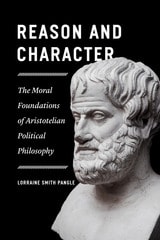
Reason and Character
The Moral Foundations of Aristotelian Political PhilosophyLorraine Smith Pangle
University of Chicago Press, 2020
A close and selective commentary on Aristotle’s Nicomachean Ethics, offering a novel interpretation of Aristotle’s teachings on the relation between reason and moral virtue.
What does it mean to live a good life or a happy life, and what part does reason play in the quest for fulfillment? Lorraine Smith Pangle shows how Aristotle’s arguments for virtue as the core of happiness and for reason as the guide to virtue emerge in response to Socrates’s paradoxical claim that virtue is knowledge and vice is ignorance.
Against Socrates, Aristotle does justice to the effectual truth of moral responsibility—that our characters do indeed depend on our own voluntary actions. But he also incorporates Socratic insights into the close interconnection of passion and judgment and the way passions and bad habits work not to overcome knowledge that remains intact but to corrupt the knowledge one thinks one has. Reason and Character presents fresh interpretations of Aristotle’s teaching on the character of moral judgment and moral choice, on the way reason finds the mean—especially in justice—and on the relation between practical and theoretical wisdom.
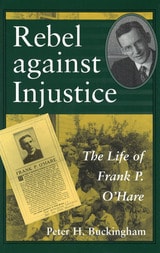
Rebel against Injustice
The Life of Frank P. O'HarePeter H. Buckingham
University of Missouri Press, 1996
Rebel against Injustice, a carefully crafted biography of Frank P. O'Hare (1877-1960), socialist, political activist, editor, and husband of prominent radical Kate Richards O'Hare, is the first study of a much-neglected but important figure of the American Left whose contributions are often referred to, in passing, in many other works.
Abandoned by his father at the age of four, O'Hare grew up in the Kerry Patch slum of St. Louis. Although he began his career in business, O'Hare turned to socialism with the sublime dream of bringing about a better world. While attending a school for Socialist organizers, he met Kate Richards, and the young couple forged a personal and professional partnership. Settling in Oklahoma, the O'Hares helped build a strong grassroots movement through grueling lecture tours and colorful camp meetings. In 1911, Frank, his wife, and their four children moved to St. Louis, where they transformed the National Rip-Saw into a popular Socialist monthly magazine. It was there that Frank found his niche as a Socialist impresario, editing the writings and arranging the tours of his "stars," Kate O'Hare and Eugene Debs.
A series of calamities, including the breakup of his marriage, brought Frank O'Hare near the edge of despair in the mid-1920s. Divorcing and remarrying, he made a new life in St. Louis. Plunging back into radical activism, he worked for the Federated Press syndicate. During the last twenty years of his life, O'Hare wrote for the St. Louis Post-Dispatch, worked as a business consultant, and continued his involvement as a community activist in St. Louis. Although Frank O'Hare has long been dismissed as a lost soul without Kate Richards O'Hare, Rebel against Injustice shows that he continued to be a presence in St. Louis and never stopped his fight against injustice. In 1958, a Teamster newspaper referred to O'Hare as "one of the truly great men of St. Louis--possibly the ONLY one."
Based upon a close study of the largely untapped Frank P. O'Hare papers, this well-written biography will enlighten readers about the organizational choices behind the success of American Socialism, while shedding new light on the lives and activities of many prominent American radicals.
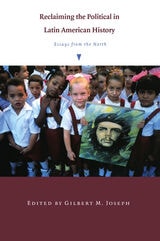
Reclaiming the Political in Latin American History
Essays from the NorthGilbert M. Joseph, ed.
Duke University Press, 2001
Taking careful stock of the state of historical writing on Latin America, the volume delineates current historiographical frontiers and suggests a series of new approaches that focus on several pivotal themes: the construction of historical narratives and memory; the articulation of class, race, gender, sexuality, and generation; and the historian’s involvement in the making of history. Although the book represents a view of the Latin American political that comes primarily from the North, the influence of Viotti da Costa powerfully marks the contributors’ engagement with Latin America’s past. Featuring a keynote essay by Viotti da Costa herself, the volume’s lively North-South encounter embodies incipient trends of hemispheric intellectual convergence.
Contributors. Jeffrey L. Gould, Greg Grandin, Daniel James, Gilbert M. Joseph, Thomas Miller Klubock, Mary Ann Mahony, Florencia E. Mallon, Diana Paton, Steve J. Stern, Heidi Tinsman, Emilia Viotti da Costa, Barbara Weinstein
Reconceiving Decision-Making in Democratic Politics
Attention, Choice, and Public PolicyBryan D. Jones
University of Chicago Press, 1994
Individuals and political systems alike, Jones argues, tend to be attentive to only one issue at a time. Using numerous examples from elections, public opinion polls, congressional deliberations, and of bureaucratic decision-making, he shows how shifting attentiveness can and does alter choices and political outcomes—even when underlying preferences remain relatively fixed. An individual, for example, may initially decide to vote for a candidate because of her stand on spending but change his vote when he learns of her position on abortion, never really balancing the two options.
Recovering Politics, Civilization, and the Soul
Essays on Pierre Manent and Roger ScrutonDaniel J. Mahoney
St. Augustine's Press, 2022
Both Scruton and Manent have repudiated the fashionable nihilism associated with the “thought of 1968” and the “Parisian nonsense machine,” and have shown that gratitude is the proper response of the human person to the “givenness of things.” Both defend the self-governing nation against reckless nationalism and the even more reckless temptation of supranational governance and post-political democracy, what Manent suggestively calls a “kratos” without a “demos.” Both defend the secular state while taking aim at a radical secularism that rejects “the Christian mark” that is at the heart of our inheritance and that sustains the rich and necessary interpenetration of truth and liberty. Scruton’s more “cultural” perspective is indebted to Burke and Kant; Manent’s more political perspective draws on Aristotle, St. Thomas, Tocqueville, and Raymond Aron, among others. By highlighting their affinities, and reflecting on their instructive differences, Mahoney shows how, together, the English man of letters Scruton, and the French political philosopher Manent, guide us to the recovery of a horizon of thought and action animated by practical reason and the wellsprings of the human soul. They show us the humanizing path forward, but first we must make the necessary spiritual decision to repudiate repudiation once and for all.
“With sophisticated and profound scholarship, Daniel Mahoney deploys his elegant style to defend the soul of civilization. Through the writings of Pierre Manent and Roger Scruton, he charts a course through the political and philosophical turmoil of the present age, providing hope and light amid the prevailing darkness.”
— Mark Dooley, Irish philosopher, writer and journalist. Author of Conversations with Roger Scruton and Sir Roger's literary executor.
“Mahoney's collection of essays does a marvelous job of contextualizing and explaining the vital work of these two philosophers. He's also an engaging and elegant writer.”
— Daniel DiSalvo, City Journal
“A series of reflective essays by Mahoney on the philosophical, theological, and political thinking of our best conservative theorists: Pierre Manent and the late Roger
Scruton. Recovering Politics, Civilization, and the Soul expresses well what we need.” — Richard M. Reinsch II, National Review
Redefining the Political
Black Feminism and the Politics of Everyday LifeAlex J. Moffett-Bateau
Temple University Press, 2024
Moffett-Bateau uses radical Black feminist political theory and develops a framework called the political possible-self, which argues that belonging to a community and developing political imagination foment change. These women employ grassroots efforts to subvert oppressive power structures by protesting institutions within their communities, addressing the benign neglect of their housing development, organizing community art shows and meals, volunteering at local public schools, and holding meetings to increase the political confidence of public-housing tenants by educating them on navigating government bureaucracies.
Ultimately, Redefining the Political shows how political engagement at both the individual and community levels can be fruitful for nontraditional political contributions.
Reflections on the Just
Paul Ricoeur
University of Chicago Press, 2007
Now in paperback, the definitive English translation of Ricoeur's second collection of essays (after The Just) about justice and law.
At the time of his death in 2005, French philosopher Paul Ricoeur was regarded as one of the great thinkers of his generation. In more than half a century of writing about the essential questions of human life, Ricoeur’s thought encompassed a vast range of wisdom and experience, and he made landmark contributions that would go on to influence later scholars in such areas as phenomenology, hermeneutics, structuralism, and theology.
Toward the end of his life, Ricoeur began to focus directly on ethical questions that he feared had been overshadowed by his other work; the result was a two-volume collection of essays on justice and the law. The University of Chicago Press published the English translation of the first volume, The Just, to great acclaim in 2000. Now this translation of the second volume, Reflections on the Just, completes the set and makes available to readers the whole of Ricoeur’s meditations on the concept.
Consisting of fifteen thematically organized essays, Reflections on the Just continues and expands on the work Ricoeur began with his “little ethics” in Oneself as Another and The Just. In the preface, he considers what revisions he would make were he to start over and how that is reflected in these essays. The opening part brings phenomenology to bear on ethics; the second group of essays comprises shorter, occasional pieces considering the concept of justice in the works of other philosophers, including Max Weber and Charles Taylor. The final part turns to the specific domains of medicine and the law, examining how concepts of right and justice operate in those realms.
Cogent, deeply considered, and fully engaged with the realities of the contemporary world, Reflections on the Just is an essential work for understanding the development of Ricoeur’s thought in his final years.
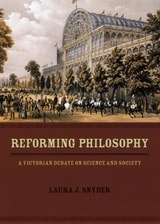
Reforming Philosophy
A Victorian Debate on Science and SocietyLaura J. Snyder
University of Chicago Press, 2006
Mill—philosopher, political economist, and Parliamentarian—remains a canonical author of Anglo-American philosophy, while Whewell—Anglican cleric, scientist, and educator—is now often overlooked, though in his day he was renowned as an authority on science. Placing their teachings in their proper intellectual, cultural, and argumentative spheres, Laura Snyder revises the standard views of these two important Victorian figures, showing that both men’s concerns remain relevant today.
A philosophically and historically sensitive account of the engagement of the major protagonists of Victorian British philosophy, Reforming Philosophy is the first book-length examination of the dispute between Mill and Whewell in its entirety. A rich and nuanced understanding of the intellectual spirit of Victorian Britain, it will be welcomed by philosophers and historians of science, scholars of Victorian studies, and students of the history of philosophy and political economy.
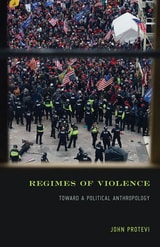
Regimes of Violence
Toward a Political AnthropologyJohn Protevi
University of Minnesota Press, 2025
A wide-ranging examination of the roots—and possible future—of violence in human societies
Is aggression inevitable among humans? In Regimes of Violence, John Protevi explores how human violence originates and exists in our societies. Taking humans as biocultural (that is, our social practices shape our bodies and minds), he shows how aggression does not arrive from any purely biological predisposition but rather occurs only in social regimes of violence that, by manipulating the ways in which culture can shape our biological inheritance of rage and aggression, condition the forms of violence able to be expressed at any one time.
Offering detailed insights into human aggression throughout history, Protevi’s analysis ranges from evolutionary psychology to affective ideology and finally to an alternate politics of joy. He examines a wide range of seemingly disparate topics, such as cooperation between early nomadic foragers, organized sports, berserkers and blackout rages, the experiences of maroons escaping slavery, the January 6 invasion of the United States Capitol building, and responses to the Covid-19 pandemic. As he entwines the philosophical with the anthropological, he asks readers to consider why humans’ capacity for cooperation and sharing is so persistently overlooked by stories that focus on aggression and warfare.
Regimes of Violence is an important contribution to studies of Deleuze and Guattari, uniquely combining cutting-edge investigations in psychology, history, evolutionary theory, cultural anthropology, and philosophy to examine the “political philosophy of the mind.” Presenting to readers a refreshingly optimistic perspective, Protevi demonstrates that we are not doomed to war and argues that humans can build a world based on antifascism, joy, and mutual empowerment.
Reimagining Livelihoods
Life beyond Economy, Society, and EnvironmentEthan Miller
University of Minnesota Press, 2019
A provocative reassessment of the concepts underlying the struggle for sustainable development
Much of the debate over sustainable development revolves around how to balance the competing demands of economic development, social well-being, and environmental protection. “Jobs vs. environment” is only one of the many forms that such struggles take. But what if the very terms of this debate are part of the problem? Reimagining Livelihoods argues that the “hegemonic trio” of economy, society, and environment not only fails to describe the actual world around us but poses a tremendous obstacle to enacting a truly sustainable future.
In a rich blend of ethnography and theory, Reimagining Livelihoods engages with questions of development in the state of Maine to trace the dangerous effects of contemporary stories that simplify and domesticate conflict. As in so many other places around the world, the trio of economy, society, and environment in Maine produces a particular space of “common sense” within which struggles over life and livelihood unfold. Yet the terms of engagement embodied by this trio are neither innocent nor inevitable. It is a contingent, historically produced configuration, born from the throes of capitalist industrialism and colonialism. Drawing in part on his own participation in the struggle over the Plum Creek Corporation’s “concept plan” for a major resort development on the shores of Moosehead Lake in northern Maine, Ethan Miller articulates a rich framework for engaging with the ethical and political challenges of building ecological livelihoods among diverse human and nonhuman communities.
In seeking a pathway for transformative thought that is both critical and affirmative, Reimagining Livelihoods provides new frames of reference for living together on an increasingly volatile Earth.
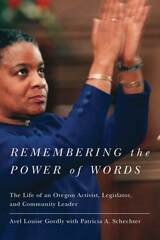
Remembering the Power of Words
The Life of an Oregon Activist, Legislator, and Community LeaderAvel Louise Gordly
Oregon State University Press, 2011
Remembering the Power of Words recounts the personal and professional journey of Avel Gordly, the first African-American woman elected to the Oregon State Senate.
The book is a brave and honest telling of Gordly’s life. She shares the challenges and struggles she faced growing up black in Portland in the 1950s and 1960s, as well as her determination to attend college, the dedication to activism that took her from Portland to Africa, and her eventual decision to run for a seat in the state legislature.
That words have power is a constant undercurrent in Gordly’s account and a truth she learned early in life. “Growing up, finding my own voice,” she writes, “was tied up with denying my voice or having it forcefully rejected and in all of that the memory of my father is very strong. To this day—and I am today a very experienced public speaker—preparation to speak takes a great deal of energy.” That this memoir has its origins as an oral history is fitting since Gordly has used her voice, out loud, to teach and inspire others for so many years.
Important as a biographical account of one significant Oregonian’s story, the book also contributes “broader narratives touching on Black history (and Oregon’s place within it), and most particularly the politics associated with being an African American woman,” according to series editor Melody Rose.
Replaying Marc Anthony
Sonic, Political, and Cultural ResonancesFrances R. Aparicio
The Ohio State University Press, 2025
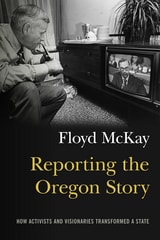
Reporting the Oregon Story
How Activists and Visionaries Transformed a StateFloyd J. McKay
Oregon State University Press, 2016
As a political reporter for The Oregon Statesman in Salem, and then as news analyst for KGW-TV in Portland, McKay was known for asking tough questions and pulling no punches. His reporting and commentaries ranged from analysis of the “Tom and Bob” rivalry, to the Vietnam War’s impact on Senators Wayne Morse and Mark Hatfield and the emergence of a new generation of Portland activists in the 1970s.
McKay and his colleagues were on the beaches as Oregon crafted its landmark Beach Bill, ensuring the protection of beaches for public use. They watched as activists turned back efforts to build a highway on the sand at Pacific City. Pitched battles over Oregon’s Bottle Bill, and the panic-inducing excitement of “Vortex”—the nation’s only state-sponsored rock festival—characterized the period. Covering the period from 1964-1986, McKay remembers the action, the players and the consequences, in this compelling and personal account.
As major actors fade from the scene and new leaders emerge, McKay casts a backwards glance at enduring Oregon legends. Half a century later, amid today’s cynicism and disillusionment with media, politics, and politicians, Reporting the Oregon Story serves as a timely reminder that charged politics and bitter rivalries can also come hand-in-hand with lasting social progress.
Reporting the Oregon Story will be relished by those who lived the history, and it will serve as a worthy introduction to Oregonians young and old who want a first-hand account of Oregon’s mid- twentieth-century political history and legislative legacy.
Representative Democracy
Principles and GenealogyNadia Urbinati
University of Chicago Press, 2006
Republicanism, Religion, and the Soul of America
Ellis Sandoz
University of Missouri Press, 2006
Resentment's Virtue
Jean Amery and the Refusal to ForgiveThomas Brudholm, Foreword by Jeffrie Murphy
Temple University Press, 2010
Most current talk of forgiveness and reconciliation in the aftermath of collective violence proceeds from an assumption that forgiveness is always superior to resentment and refusal to forgive. Victims who demonstrate a willingness to forgive are often celebrated as virtuous moral models, while those who refuse to forgive are frequently seen as suffering from a pathology. Resentment is viewed as a negative state, held by victims who are not "ready" or "capable" of forgiving and healing.
Resentment's Virtue offers a new, more nuanced view. Building on the writings of Holocaust survivor Jean Améry and the work of the South African Truth and Reconciliation Commission, Thomas Brudholm argues that the preservation of resentment can be the reflex of a moral protest that might be as permissible, humane or honorable as the willingness to forgive. Taking into account the experiences of victims, the findings of truth commissions, and studies of mass atrocities, Brudholm seeks to enrich the philosophical understanding of resentment.
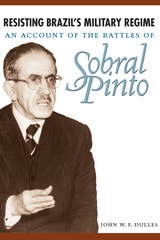
Resisting Brazil's Military Regime
An Account of the Battles of Sobral PintoBy John W. F. Dulles
University of Texas Press, 2007
Praised by his many admirers as a "courageous and fearless" defender of human rights, Heráclito Fontoura Sobral Pinto (1893-1991) was the most consistently forceful opponent of the regime of Brazilian dictator Getúlio Vargas. John W. F. Dulles chronicled Sobral's battles with the Vargas government in Sobral Pinto, "The Conscience of Brazil": Leading the Attack against Vargas (1930-1945), which History: Reviews of New Books called "a must-read for anyone wanting to understand twentieth-century Brazil."
In this second and final volume of his biography of Sobral Pinto, Professor Dulles completes the story of the fiery crusader's fight for democracy, morality, and justice, particularly for the downtrodden. Drawing on Sobral's vast correspondence, Dulles offers an extensive account of Sobral's opposition to the military regime that ruled Brazil from 1964 to 1985. He describes how Sobral Pinto defended those who had been politically influential before April, 1964, as well as other victims of the regime, including Communists, once-powerful labor leaders, priests, militant journalists, and students. Because Sobral Pinto participated in so many of the struggles against the military regime, his experiences provide vivid new insights into this important period in recent Brazilian history. They also shed light on developments in the Catholic Church (Sobral, a devout Catholic, vigorously opposed liberation theology), as well as on Sobral's key role in preserving Brazil's commission for defending human rights.
Resisting Dialogue
Modern Fiction and the Future of DissentJuan Meneses
University of Minnesota Press, 2019
A bold new critique of dialogue as a method of eliminating dissent
Is dialogue always the productive political and communicative tool it is widely conceived to be? Resisting Dialogue reassesses our assumptions about dialogue and, in so doing, about what a politically healthy society should look like. Juan Meneses argues that, far from an unalloyed good, dialogue often serves as a subtle tool of domination, perpetuating the underlying inequalities it is intended to address.
Meneses investigates how “illusory dialogue” (a particular dialogic encounter designed to secure consensus) is employed as an instrument that forestalls—instead of fostering—articulations of dissent that lead to political change. He does so through close readings of novels from the English-speaking world written in the past hundred years—from E. M. Forster’s A Passage to India and Jeanette Winterson’s The Passion to Indra Sinha’s Animal’s People and more. Resisting Dialogue demonstrates how these novels are rhetorical exercises with real political clout capable of restoring the radical potential of dialogue in today’s globalized world. Expanding the boundaries of postpolitical theory, Meneses reveals how these works offer ways to practice disagreement against this regulatory use of dialogue and expose the pitfalls of certain other dialogic interventions in relation to some of the most prominent questions of modern history: cosmopolitanism at the end of empire, the dangers of rewriting the historical record, the affective dimension of neoliberalism, the racial and nationalist underpinnings of the “war on terror,” and the visibility of environmental violence in the Anthropocene.
Ultimately, Resisting Dialogue is a complex, provocative critique that, melding political and literary theory, reveals how fiction can help confront the deployment of dialogue to preempt the emergence of dissent and, thus, revitalize the practice of emancipatory politics.
Resolving International Conflicts
Peter Hay
Central European University Press, 2009
Rethinking Open Society
CONTRIBUTORS: Anne Applebaum • Erica Benner• Dorothee Bohle • Thomas Christiano • Tim Crane • Niall Ferguson • Timothy Garton Ash • Béla Greskovits • Michael Ignatieff • Robert D. Kaplan • János Kis • Ivan Krastev • Mark Lilla • Margaret MacMillan • Jan-Werner Müller • Alina Mungiu-Pippidi • Stefan Roch • Pierre Rosanvallon • Jacques Rupnik • András Sajó • Daniela Schwarzer • Sir Roger Scruton • Stephen M. Walt
Central European University Press, 2018
Rethinking Rights
Historical, Political, and Philosophical PerspectivesEdited by Bruce P. Frohnen and Kenneth L. Grasso
University of Missouri Press, 2008
Rethinking the Political
Gender, Resistance, and the StateEdited by Barbara Laslett, Johanna Brenner, and Yesim Arat
University of Chicago Press, 1995
Section One, "Gender, Citizenship, and Collectivity," includes Nancy Frazer and Linda Gordon's critique of dependency and citizenship; Iris Young on women as a social collective; Ruth Bloch on the feminization of public virtue in revolutionary America; Trisha Franzen on feminism and lesbian community, and Sonia Kruks on de Beauvoir and contemporary feminism.
"Collective Action and Women's Resistance," Section Two, features Louis Tilly's "Paths of Proletarianization"; Temma Kaplan's "Female Consciousness and Collective Action"; and five assessments of women's collective action worldwide: Samira Haj on Palestine, Arlene McLeod on Egypt, Gay Seidman on South Africa, Nancy Sternbach et al. on Latin America, and Anne Walthall on Japan.
Concluding with a section on gender and the state, Rethinking the Political also features Bronwyn Winter on the law and cultural relativism; Sherene Razack on sexual violence; Wendy Luttrell on educational institutions; Patricia Stamp on ethnic conflict in postcolonial Kenya; Elizabeth Schmidt on patriarchy and capitalism in Zimbabwe; and Muriel Nazzari on the "woman question" in post-revolutionary Cuba.
Reticulations
Jean-Luc Nancy and the Networks of the PoliticalPhilip Armstrong
University of Minnesota Press, 2009
Revealing how networks reopen our understanding of political discourse today
Significantly advancing our notion of what constitutes a network, Philip Armstrong proposes a rethinking of political public space that specifically separates networks from the current popular discussion of globalization and information technology.
Analyzing a wide range of Jean-Luc Nancy’s works, Reticulations shows how his project of articulating the political in terms of singularities, pluralities, and multiplicities can deepen our understanding of networks and how they influence community and politics. Even more striking is the way Armstrong associates this general complex in Nancy’s writing with his concern for what Nancy calls the retreat of the political. Armstrong highlights what Nancy’s perspective on networks reveals about movement politics as seen in the 1999 protests in Seattle against the World Trade Organization, the impact of technology on citizenship, and finally how this perspective critiques the model of networked communism constructed by Hardt and Negri. Contesting the exclusive link between technology and networks, Reticulations ultimately demonstrates how network society creates an entirely new politics, one surprisingly rooted in community.
Rhetorical Knowledge in Legal Practice and Critical Legal Theory
Francis J. Mootz III
University of Alabama Press, 2006
A clear summary of contemporary rhetorical philosophy and its intersections with hermeneutics and critical theory
This book describes the significance of rhetorical knowledge for law through detailed discussions of some of the most difficult legal issues facing courts today, including affirmative action, gay rights, and assisted suicide.
Francis J. Mootz responds to both extremes, those who argue that law is merely a rhetorical mask for the exercise of power and those who demonstrate an ideological faith in law’s autonomy, and he breaks new ground by returning to modern classics in the fields of rhetoric and hermeneutics. Drawing from Chaim Perelman's "new rhetoric" and Hans-Georg Gadamer's "philosophical hermeneutics," Mootz argues that justice is a product of rhetorical knowledge. Drawing from Nietzsche, Mootz’s conception of rhetorical knowledge opens up the dynamic possibilities of critical legal theory.
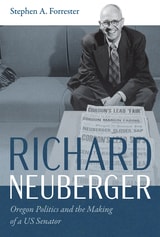
Richard Neuberger
Oregon Politics and the Making of a US SenatorStephen A. Forrester
Oregon State University Press, 2025
Richard L. Neuberger is a consequential but often forgotten figure in Oregon history, largely due to his early death at forty-seven, near the end of his only term in the United States Senate. But his life and legacy continue to inspire Oregonians and influence politicians.
In 1954, Neuberger was the first Democrat elected to the Senate from Oregon in forty years. His election moved Oregon from a solidly Republican state to one where liberal Democrats could control the legislature as well as statewide offices. He was an especially productive freshman, on both Oregon natural resource issues and national matters. Neuberger was also only the second Jewish person elected to the Senate following passage of the 17th Amendment, which required the direct election of senators.
Prior to entering politics, Neuberger was best known as a journalist. He was a prolific freelance writer, publishing 750 magazine articles and six books. In 1933, at the age of twenty-one, he visited Germany and penned the first firsthand account of Brownshirt violence written by an American; his editor at The Nation called it “an epoch-making article.”
Neuberger was ahead of his time in his advocacy of conservation, in his political partnership with his wife Maurine—who successfully ran for his Senate seat after his untimely death in 1960—and in his outspoken liberal advocacy at a time when Oregon was considerably more conservative than it is today. Tom McCall, later one of the most influential governors in the state’s history, considered Neuberger his role model as a conservationist.
In this definitive biography—more than forty years in the making—Stephen Forrester documents Neuberger’s extraordinary life and career, highlighting a legacy that includes shaping Oregon’s renowned conservation policies and developing the state’s modern Democratic party.
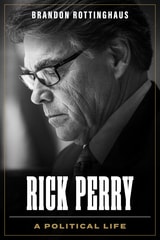
Rick Perry
A Political LifeBrandon Rottinghaus
University of Texas Press, 2024
How Rick Perry navigated and shaped Texas politics as the state’s longest serving governor.
Rick Perry, the charming rancher, pilot, and politician from West Texas who was governor from 2000 to 2015, is one of the most important but polarizing figures in the state's history. Over the nearly forty years he spent in the political arena, his political instincts served as a radar primed to sense future political opportunities. Hugging the arc of Texas political change, he shifted from a rural, “blue dog” Democrat to one of the most conservative politicians the state had elected up to that time, overseeing the enactment of controversial redistricting, voting, and abortion measures. Yet his evolution was complicated and incomplete, as his stands on such topics as immigration, vaccine requirements, and the use of state funds to attract business ran into opposition from a growing and ever-more conservative wing of the Republican Party in Texas—and the nation.
Rick Perry is both a biography of Perry as a politician and a study of the shifts in state politics that took place during his time in office. Demonstrating that Perry ranks among the most consequential governors in Texas history, Brandon Rottinghaus chronicles the profound ways he accumulated power and shaped the governorship.

Rights or Self-Government?
Recovering the Meaning of Citizenship in an Age of RightsThomas E. Schneider
St. Augustine's Press, 2026
Rise to the Challenge
A Memoir of Politics, Leadership, and LoveJohnson
University of Minnesota Press, 2024
The inspiring life story of Minnesota’s first woman lieutenant governor: breaking political ground, navigating patriarchal tradition, and persevering through great personal loss
Marking a milestone for women in state government, Marlene M. Johnson became Minnesota’s first woman lieutenant governor under Rudy Perpich’s gubernatorial administration in January 1983. That same year, she met her husband, Peter, and their deeply loving relationship profoundly sustained her for twenty-seven years. Rise to the Challenge weaves these personal and professional stories together in a courageous portrait of dedication and leadership.
Growing up in rural Minnesota, Johnson began organizing and advocating for change early, beginning with a campaign to introduce foreign languages into her high school curriculum. Pursuing a deeply felt commitment to improving the lives of others, she continued to sharpen her leadership skills throughout her life, participating in activist work in college, cofounding organizations to support women entrepreneurs and politicians, and eventually running an international education nonprofit.
A stalwart supporter, her husband gave Marlene strength and encouragement to face the challenges of the political landscape and its gender biases. Then, in 2010, he suffered a traumatic brain injury that would change both of their lives. Learning how to be a medical advocate and, eventually, facing the sorrow of Peter’s death, Marlene relied on the hard-fought resilience and belief in herself that Peter had helped her to develop.
A story of learning and leadership in politics, business, and public service, Rise to the Challenge is a moving portrayal of spirit, perseverance, and grace in the face of daunting personal challenges, supported by unwavering faith in the public good.
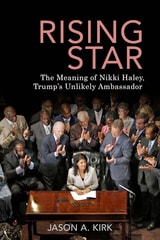
Rising Star
The Meaning of Nikki Haley, Trump’s Unlikely AmbassadorJason A. Kirk
University of Arkansas Press, 2021

Robert C. Byrd
Child of the Appalachian CoalfieldsRobert C. Byrd
West Virginia University Press, 2010
This autobiography follows United States Senator Robert C. Byrd’s experiences from his boyhood in the early 1920s to his election in 2000, which won him an unprecedented eighth term in the Senate. Along the way, Senator Byrd offers commentary on national and international events that occurred throughout his long life in public service. Senator Byrd’s journey from the hardscrabble coalfields to the marbled halls of Congress has inspired generations of people in West Virginia and throughout the nation. From reading the stories of the Founding Fathers as a young boy by the light of a kerosene lamp to the swearing of an oath for more than a half-century to guard the United States Constitution, Senator Byrd’s life is legendary. Byrd always stands by his principles, earning the affection of the people of his home state and the respect of Americans from all walks of life. With his beloved Erma ever by his side, Robert C. Byrd has never forgotten his roots, harkening back to those early lessons that he learned as a child of the Appalachian coalfields.

Robert C. Byrd
Child of the Appalachian CoalfieldsROBERT C. BYRD
West Virginia University Press, 2015
This autobiography follows West Virginia senator Robert C. Byrd’s experiences from his boyhood in the early 1920s to his election in 2000, which won him an unprecedented eighth term in the Senate. Within these pages, Senator Byrd offers commentary on national and international events that occurred throughout his long life in public service.
His journey from the hardscrabble coalfields to the marbled halls of Congress has inspired generations of people in West Virginia and throughout the nation. From reading the stories of the Founding Fathers as a young boy by the light of a kerosene lamp to the swearing of an oath for more than a half-century to guard the US Constitution, Senator Byrd’s life is legendary.
Until his death on June 28, 2010, Byrd stood by his principles, earning the affection of the people of his home state and the respect of Americans from all walks of life. With his beloved Erma ever by his side, Robert C. Byrd never forgot his roots, harkening back to those early lessons that he learned as a child of the Appalachian coalfields.
This new paperback edition includes a foreword by Gaston Caperton, governor of West Virginia from 1989–1997.
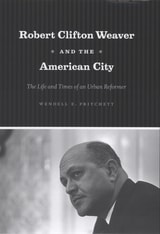
Robert Clifton Weaver and the American City
The Life and Times of an Urban ReformerWendell E. Pritchett
University of Chicago Press, 2008
Tracing Weaver’s career through the creation, expansion, and contraction of New Deal liberalism, Wendell E. Pritchett illuminates his instrumental role in the birth of almost every urban initiative of the period, from public housing and urban renewal to affirmative action and rent control. Beyond these policy achievements, Weaver also founded racial liberalism, a new approach to race relations that propelled him through a series of high-level positions in public and private agencies working to promote racial cooperation in American cities. But Pritchett shows that despite Weaver’s efforts to make race irrelevant, white and black Americans continued to call on him to mediate between the races—a position that grew increasingly untenable as Weaver remained caught between the white power structure to which he pledged his allegiance and the African Americans whose lives he devoted his career to improving.
Rosa Luxemburg
Socialism or Barbarism: Selected WritingsRosa Luxemburg
Pluto Press, 2010
Rosa Luxemburg (1871-1919) was one of the most brilliant and passionate minds drawn to the revolutionary socialist movement. An outstanding social and economic theorist of the twentieth century, and a dedicated political activist, she proved willing to go to prison and even give her life for her beliefs.
Providing an extensive overview of her writings, this volume contains a number of items never before anthologised. Her work was broad in scope tackling capitalism and socialism; globalisation and imperialism; history; war and peace; social struggles, trade unions, political parties; class, gender, race; the interconnection of humanity with the natural environment. The editors provide an extensive and informative introduction outlining and evaluating her life and thought.
This is the most comprehensive introduction to the range of Rosa Luxemburg’s thought.
Ross Sterling, Texan
A Memoir by the Founder of Humble Oil and Refining CompanyBy Ross S. Sterling and Ed Kilman
University of Texas Press, 2007
Born on a farm near Anahuac, Texas, in 1875 and possessed of only a fourth-grade education, Ross Sterling was one of the most successful Texans of his generation. Driven by a relentless work ethic, he become a wealthy oilman, banker, newspaper publisher, and, from 1931 to 1933, one-term governor of Texas. Sterling was the principal founder of the Humble Oil and Refining Company, which eventually became the largest division of the ExxonMobil Corporation, as well as the owner of the Houston Post.
Eager to "preserve a narrative record of his life and deeds," Ross Sterling hired Ed Kilman, an old friend and editorial page editor of the Houston Post, to write his biography. Though the book was nearly finished before Sterling's death in 1949, it never found a publisher due to Kilman's florid writing style and overly hagiographic portrayal of Sterling.
In this volume, by contrast, editor Don Carleton uses the original oral history dictated by Ross Sterling to Ed Kilman to present the former governor's life story in his own words. Sterling vividly describes his formative years, early business ventures, and active role in developing the Texas oil industry. He also recalls his political career, from his appointment to the Texas Highway Commission to his term as governor, ending with his controversial defeat for reelection by "Ma" Ferguson. Sterling's reminiscences constitute an important primary source not only on the life of a Texan who deserves to be more widely remembered, but also on the history of Houston and the growth of the American oil industry.
Rousseau's God
Theology, Religion, and the Natural Goodness of ManJohn T. Scott
University of Chicago Press, 2023
John T. Scott offers a comprehensive interpretation of Rousseau’s theological and religious thought, both in its own right and in relation to Rousseau’s broader oeuvre. In chapters focused on different key writings, Scott reveals recurrent themes in Rousseau’s views on the subject and traces their evolution over time. He shows that two concepts—truth and utility—are integral to Rousseau’s writings on religion. Doing so helps to explain some of Rousseau’s disagreements with his contemporaries: their different views on religion and theology stem from different understandings of human nature and the proper role of science in human life. Rousseau emphasizes not just what is true, but also what is useful—psychologically, morally, and politically—for human beings. Comprehensive and nuanced, Rousseau’s God is vital to understanding key categories of Rousseau’s thought.
Rousseau's Reader
Strategies of Persuasion and EducationJohn T. Scott
University of Chicago Press, 2020
In Rousseau’s Reader, John T. Scott looks at the different strategies Rousseau used to engage and persuade the readers of his major philosophical works, including the Social Contract, Discourse on Inequality, and Emile. Considering choice of genre; textual structure; frontispieces and illustrations; shifting authorial and narrative voice; addresses to readers that alternately invite and challenge; apostrophe, metaphor, and other literary devices; and, of course, paradox, Scott explores how the form of Rousseau’s writing relates to the content of his thought and vice versa. Through this skillful interplay of form and content, Rousseau engages in a profoundly transformative dialogue with his readers.
While most political philosophers have focused, understandably, on Rousseau’s ideas, Scott shows convincingly that the way he conveyed them is also of vital importance, especially given Rousseau’s enduring interest in education. Giving readers the key to Rousseau’s style, Scott offers fresh and original insights into the relationship between the substance of his thought and his literary and rhetorical techniques, which enhance our understanding of Rousseau’s project and the audiences he intended to reach.
Rousseau, Nietzsche, and the Image of the Human
Paul Franco
University of Chicago Press, 2021
In Rousseau, Nietzsche, and the Image of the Human, Paul Franco examines the relationship between Jean-Jacques Rousseau and Friedrich Nietzsche, arguably the two most influential shapers and explorers of the moral and cultural imagination of late modernity. Both thinkers leveled radical critiques of modern life, but those critiques differed in important respects. Whereas Rousseau focused on the growing inequality of modern society and the hypocrisy, self-division, and loss of civic virtue it spawned, Nietzsche decried the democratic equality he identified with Rousseau and the loss of individual and cultural greatness it entailed. Franco argues, however, that Rousseau and Nietzsche are more than mere critics; they both put forward powerful alternative visions of how we ought to live. Franco focuses specifically on their views of the self and its realization, their understandings of women and the relation between the sexes, and their speculative conceptions of politics. While there are many similarities in their positive visions, Franco argues that it is the differences between them from which we have most to learn.
Roy Reuther and the UAW
Fighting for Workers and Civil RightsAlan Reuther
Michigan State University Press, 2025
Many of the injustices that Reuther fought continue to plague America today. This book provides important context for the current efforts of workers to organize, for the Black Lives Matter movement, and for efforts to reform the filibuster rule and stop voter suppression. It shows how dedicated individuals can overcome enormous odds to win great victories for social justice and emphasizes the potential connections between the labor and civil rights movements, offering hope for a more just future.
Rupture
On the Emergence of the PoliticalPaul Eisenstein and Todd McGowan
Northwestern University Press, 2012