Results by title
2916 books match the query 'Politics and government' and 160 start with r
READING LONDON
URBAN SPECULATION AND IMAGINATIVE GOVERNMENT EIGHTEENTH-CENTURY LITERATUREERIK BOND
The Ohio State University Press, 2007
Race And Reconciliation
Essays From The New South AfricaDaniel Herwitz
University of Minnesota Press, 2003
A meditation on the lessons to be learned from South Africa’s transformation in the wake of apartheid
Justice, truth, and identity; race, society, and law—all come into dramatic play as South Africa makes the tumultuous transition to a post-apartheid democracy. Seeking the timeless through the timely and trying to find the deeper meaning in the sweep of events, Daniel Herwitz brings the vast resources of the philosophical essay to bear on the new realities of post-apartheid South Africa—from racial identity to truth commissions, from architecture to film and television.
A public intellectual’s reflections on public life, Herwitz’s essays question how the new South Africa has constructed its concepts of reconciliation and return and how its historical emergence has meant a rethinking, reimagining, reexperiencing, relabeling, and repoliticizing of race. Herwitz’s purpose is to give a philosophical reading of society—a society already relying on implicitly philosophical concepts in its social and political agendas. Working through these concepts, testing their relevance for reading society, his book itself becomes a part of the politics of definition and description in the new South Africa.
Race Appeal
How Candidates Invoke Race in U.S. Political CampaignsAuthored by Charlton D. McIlwain and Stephen M. Caliendo
Temple University Press, 2011
In our evolving American political culture, whites and blacks continue to respond very differently to race-based messages and the candidates who use them. Race Appeal examines the use and influence such appeals have on voters in elections for federal office in which one candidate is a member of a minority group.
Charlton McIlwain and Stephen Caliendo use various analysis methods to examine candidates who play the race card in political advertisements. They offer a compelling analysis of the construction of verbal and visual racial appeals and how the news media covers campaigns involving candidates of color.
Combining rigorous analyses with in-depth case studies-including an examination of race-based appeals in the historic 2008 presidential election—Race Appeal is a groundbreaking work that represents the most extensive and thorough treatment of race-based appeals in American political campaigns to date.
Race and Human Rights
Curtis Stokes
Michigan State University Press, 2008
The terrorist attacks against U.S. targets on September 11, 2001, and the subsequent wars in Afghanistan and Iraq, sparked an intense debate about "human rights." According to contributors to this provocative book, the discussion of human rights to date has been far too narrow. They argue that any conversation about human rights in the United States must include equal rights for all residents.
Essays examine the historical and intellectual context for the modern debate about human rights, the racial implications of the war on terrorism, the intersection of racial oppression, and the national security state. Others look at the Pinkerton detective agency as a forerunner of the Federal Bureau of Investigation, the role of Africa in post–World War II American attempts at empire-building, and the role of immigration as a human rights issue.
Race and Politics
Asian Americans, Latinos, and Whites in a Los Angeles SuburbLeland T. Saito. Foreword by Roger Daniels
University of Illinois Press, 1998
Located a mere fifteen minutes from Los Angeles, the San Gabriel Valley is an incubator for California's new ethnic politics. Here, Latinos and Asian Americans are the dominant groups. Politics are Latino-dominated, while a large infusion of Chinese immigrants and capital has made the San Gabriel Valley the center of the nation's largest Chinese ethnic economy. The white population, meanwhile, has dropped from an overwhelming majority in 1970 to a minority in 1990.
Leland T. Saito presents an insider's view of the political, economic, and cultural implications of this ethnic mix. He examines how diverse residents of the region have worked to overcome their initial antagonisms and develop new, more effective political alliances.
Tracing grassroots political organization along racial and ethnic lines, Race and Politics focuses on the construction of new identities in general and the panethnic affiliation "Asian American" in particular.
Race and the Power of Sermons on American Politics
R. Khari Brown, Ronald E. Brown, and James S. Jackson
University of Michigan Press, 2021
This book examines the intersection of race, political sermons, and social justice. Religious leaders and congregants who discuss and encourage others to do social justice embrace a form of civil religion that falls close to the covenantal wing of American civil religious thought. Clergy and members who share this theological outlook frame the nation as being exceptional in God’s sight. They also emphasize that the nation’s special relationship with the Creator is contingent on the nation working toward providing opportunities for socioeconomic well-being, freedom, and creative pursuits. God’s covenant, thus, requires inclusion of people who may have different life experiences but who, nonetheless, are equally valued by God and worthy of dignity. Adherents to such a civil religious worldview would believe it right to care for and be in solidarity with the poor and powerless, even if they are undocumented immigrants, people living in non-democratic and non-capitalist nations, or members of racial or cultural out-groups. Relying on 44 national and regional surveys conducted between 1941 and 2019, Race and the Power of Sermons on American Politics explores how racial experiences impact the degree to which religion informs social justice attitudes and political behavior. This is the most comprehensive set of analyses of publicly available survey data on this topic.
Race, Nation, and Market
Economic Culture in Porfirian MexicoRichard Weiner
University of Arizona Press, 2004
Race, Republicans, and the Return of the Party of Lincoln
Tasha S. Philpot
University of Michigan Press, 2007
Whether their slogan is “compassionate conservatism” or “hawkish liberalism,” political parties have always sought to expand their electoral coalitions by making minor adjustments to their public image. How do voters respond to these, often short-term, campaign appeals? Race, Republicans, and the Return of the Party of Lincoln is Tasha Philpot’s insightful study of how parties use racial images to shape and reshape the way citizens perceive them.
“Philpot has produced a timely, provocative, and nuanced analysis of political party image change, using the Republican Party’s attempts to recast itself as a party sensitive to issues of race with its 2000, and later 2004, national conventions as case examples. Using a mixture of experiments, focus groups, national surveys, and analyses of major national and black newspaper articles, Philpot finds that if race-related issues are important to individuals, such as blacks, the ability of the party to change its image without changing its political positions is far more difficult than it is among individuals who do not consider race-related issues important, e.g., whites. This book makes a major contribution
to our understanding of party image in general, and political parties’ use of race in particular. Bravo!”
—Paula D. McClain, Duke University
“This book does an excellent job of illuminating the linkages between racial images and partisan support. By highlighting Republican efforts to ‘play against type’ Philpot emphasizes the limits of successfully altering partisan images. That she accomplishes this in the controversial, yet salient, domain of race is no small feat. In short, by focusing on a topical issue, and by adopting a novel theoretical approach, Philpot is poised to make a significant contribution to the literatures on race and party images.”
—Vincent Hutchings, University of Michigan
Tasha S. Philpot is Assistant Professor of Government and African and African American Studies at the University of Texas at Austin.
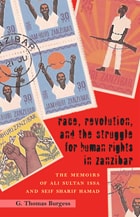
Race, Revolution, and the Struggle for Human Rights in Zanzibar
The Memoirs of Ali Sultan Issa and Seif Sharif HamadG. Thomas Burgess
Ohio University Press, 2009
Zanzibar has had the most turbulent postcolonial history of any part of the United Republic of Tanzania, yet few sources explain the reasons why. The current political impasse in the islands is a contest over the question of whether to revere and sustain the Zanzibari Revolution of 1964, in which thousands of islanders, mostly Arab, lost their lives. It is also about whether Zanzibar’s union with the Tanzanian mainland—cemented only a few months after the revolution—should be strengthened, reformed, or dissolved. Defenders of the revolution claim it was necessary to right a century of wrongs. They speak the language of African nationalism and aspire to unify the majority of Zanzibaris through the politics of race. Their opponents instead deplore the violence of the revolution, espouse the language of human rights, and claim the revolution reversed a century of social and economic development. They reject the politics of race, regarding Islam as a more worthy basis for cultural and political unity.
From a series of personal interviews conducted over several years, Thomas Burgess has produced two highly readable first-person narratives in which two nationalists in Africa describe their conflicts, achievements, failures, and tragedies. Their life stories represent two opposing arguments, for and against the revolution. Ali Sultan Issa traveled widely in the 1950s and helped introduce socialism into the islands. As a minister in the first revolutionary government he became one of Zanzibar’s most controversial figures, responsible for some of the government’s most radical policies. After years of imprisonment, he reemerged in the 1990s as one of Zanzibar’s most successful hotel entrepreneurs. Seif Sharif Hamad came of age during the revolution and became disenchanted with its broken promises and excesses. In the 1980s he emerged as a reformist minister, seeking to roll back socialism and authoritarian rule. After his imprisonment he has ever since served as a leading figure in what has become Tanzania’s largest opposition party
As Burgess demonstrates in his introduction, both memoirs trace Zanzibar’s postindependence trajectory and reveal how Zanzibaris continue to dispute their revolutionary heritage and remain divided over issues of memory, identity, and whether to remain a part of Tanzania. The memoirs explain how conflicts in the islands have become issues of national importance in Tanzania, testing that state’s commitment to democratic pluralism. They engage our most basic assumptions about social justice and human rights and shed light on a host of themes key to understanding Zanzibari history that are also of universal relevance, including the legacies of slavery and colonialism and the origins of racial violence, poverty, and underdevelopment. They also show how a cosmopolitan island society negotiates cultural influences from Africa, the Middle East, Asia, and Europe.
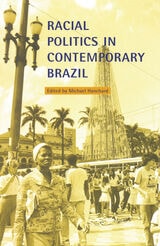
Racial Politics in Contemporary Brazil
Michael Hanchard, ed.
Duke University Press, 1999
The contributors to Racial Politics in Contemporary Brazil examine such topics as the legacy of slavery and its abolition, the historical impact of social movements, race-related violence, and the role of Afro-Brazilian activists in negotiating the cultural politics surrounding the issue of Brazilian national identity. These essays also provide comparisons of racial discrimination in the United States and Brazil, as well as an analysis of residential segregation in urban centers and its affect on the mobilization of blacks and browns. With a focus on racialized constructions of class and gender and
sexuality, Racial Politics in Contemporary Brazil reorients the direction of Brazilian studies, providing new insights into Brazilian culture, politics, and race relations.
This volume will be of importance to a wide cross section of scholars engaged with Brazil in particular, and Latin American studies in general. It will also appeal to those invested in the larger issues of political and social movements centered on the issue of race.
Contributors. Benedita da Silva, Nelson do Valle Silva, Ivanir dos Santos, Richard Graham, Michael Hanchard, Carlos Hasenbalg, Peggy A. Lovell, Michael Mitchell, Tereza Santos, Edward Telles, Howard Winant
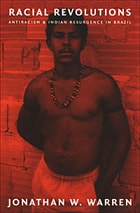
Racial Revolutions
Antiracism and Indian Resurgence in BrazilJonathan W. Warren
Duke University Press, 2001
The growing number of pardos who claim Indian identity represents a radical shift in the direction of Brazilian racial formation. For centuries, the predominant trend had been for Indians to shed tribal identities in favor of non-Indian ones. Warren argues that many factors—including the reduction of state-sponsored anti-Indian violence, intervention from the Catholic church, and shifts in anthropological thinking about ethnicity—have prompted a reversal of racial aspirations and reimaginings of Indianness. Challenging the current emphasis on blackness in Brazilian antiracist scholarship and activism, Warren demonstrates that Indians in Brazil recognize and oppose racism far more than any other ethnic group.
Racial Revolutions fills a number of voids in Latin American scholarship on the politics of race, cultural geography, ethnography, social movements, nation building, and state violence.
Designated a John Hope Franklin Center book by the John Hope Franklin Seminar Group on Race, Religion, and Globalization.
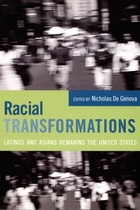
Racial Transformations
Latinos and Asians Remaking the United StatesNicholas De Genova, ed.
Duke University Press, 2006
Several contributors illuminate ways that Latinos and Asians were historically racialized: by U.S. occupiers of Puerto Rico and the Philippines at the end of the nineteenth century, by public health discourses and practices in early-twentieth-century Los Angeles, by anthropologists collecting physical data—height, weight, head measurements—from Chinese Americans to show how the American environment affected “foreign” body types in the 1930s, and by Los Angeles public officials seeking to explain the alleged criminal propensities of Mexican American youth during the 1940s. Other contributors focus on the coalitions and tensions between Latinos and Asians in the context of the fight to integrate public schools and debates over political redistricting. One addresses masculinity, race, and U.S. imperialism in the literary works of Junot Díaz and Chang-rae Lee. Another looks at the passions, identifications, and charges of betrayal aroused by the sensationalized cases of Elián González, the young Cuban boy rescued off the shore of Florida, and Wen Ho Lee, the Los Alamos physicist accused of spying on the United States. Throughout this volume contributors interrogate many of the assumptions that underlie American and ethnic studies even as they signal the need for a research agenda that expands the purview of both fields.
Contributors. Nicholas De Genova, Victor Jew, Andrea Levine, Natalia Molina, Gary Y. Okihiro, Crystal Parikh, Greg Robinson, Toni Robinson, Leland T. Saito
Racialized Politics
The Debate about Racism in AmericaEdited by David O. Sears, James Sidanius, and Lawrence Bobo
University of Chicago Press, 1999
In Racialized Politics, political scientists, sociologists, and psychologists explore the current debate surrounding the sources of racism in America. Published here for the first time, the essays represent three major approaches to the topic. The social psychological approach maintains that prejudice socialized early in life feeds racial stereotypes, while the social structural viewpoint argues that behavior is shaped by whites' fear of losing their privileged status. The third perspective looks to non-racially inspired ideology, including attitudes about the size and role of government, as the reason for opposition to policies such as affirmative action. Timely and important, this collection provides a state-of-the-field assessment of the current issues and findings on the role of racism in mass politics and public opinion.
Contributors are Lawrence Bobo, Gretchen C. Crosby, Michael C. Dawson, Christopher Federico, P. J. Henry, John J. Hetts, Jennifer L. Hochschild, William G. Howell, Michael Hughes, Donald R. Kinder, Rick Kosterman, Tali Mendelberg, Thomas F. Pettigrew, Howard Schuman, David O. Sears, James Sidanius, Pam Singh, Paul M. Sniderman, Marylee C. Taylor, and Steven A. Tuch.
Radical American Partisanship
Mapping Violent Hostility, Its Causes, and the Consequences for DemocracyNathan P. Kalmoe and Lilliana Mason
University of Chicago Press, 2022
Political violence is rising in the United States, with Republicans and Democrats divided along racial and ethnic lines that spurred massive bloodshed and democratic collapse earlier in the nation’s history. The January 6, 2021 insurrection and the partisan responses that ensued are a vivid illustration of how deep these currents run. How did American politics become so divided that we cannot agree on how to categorize an attack on our own Capitol?
For over four years, through a series of surveys and experiments, Nathan P. Kalmoe and Lilliana Mason have been studying radicalism among ordinary American partisans. In this groundbreaking book, they draw on new evidence—as well as insights from history, psychology, and political science—to put our present partisan fractiousness in context and to explain broad patterns of political and social change. Early chapters reveal the scope of the problem, who radical partisans are, and trends over time, while later chapters identify the conditions that partisans say justify violence and test how elections, political violence, and messages from leaders enflame or pacify radical views. Kalmoe and Mason find that ordinary partisanship is far more dangerous than pundits and scholars have recognized. However, these findings are not a forecast of inevitable doom; the current climate also brings opportunities to confront democratic threats head-on and to create a more inclusive politics. Timely and thought-provoking, Radical American Partisanship is vital reading for understanding our current political landscape.
Radical Territories in the Brazilian Amazon
The Kayapó’s Fight for Just LivelihoodsLaura Zanotti
University of Arizona Press, 2016
Radical Territories in the Brazilian Amazon sheds light on the creative and groundbreaking efforts Kayapó peoples deploy to protect their lands and livelihoods. Now at the front lines of cultivating diversified strategies for resistance, the Kayapó are creating a powerful activist base, experimenting with nontimber forest projects, and forging strong community conservation partnerships. Tracing the complex politics of the Kayapó’s homeland, Laura Zanotti advances approaches to understanding how indigenous peoples cultivate self-determination strategies in conflict-ridden landscapes.
Kayapó peoples are providing a countervision of what Amazonia can look like in the twenty-first century, dominated neither by agro-industrial interests nor by uninhabited protected landscapes. Instead, Kayapó peoples see their homeland as a living landscape where indigenous vision engages with broader claims for conservation and development in the region.
Weaving together anthropological and ethnographic research with personal interactions with the Kayapó, Zanotti tells the story of activism and justice in the Brazilian Amazon, and how Kayapó communities are using diverse pathways to make a sustainable future for their peoples and lands. The author interweaves Kayapó perspectives with a political ecology framework to show how working with indigenous peoples is vital to addressing national and global challenges in the present time, when many environmentally significant conditions and processes are profoundly altered by human activities.
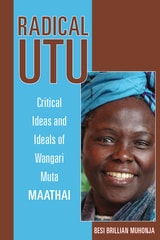
Radical Utu
Critical Ideas and Ideals of Wangari Muta MaathaiBesi Brillian Muhonja
Ohio University Press, 2020
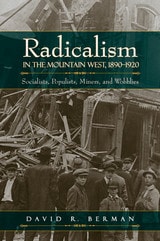
Radicalism in the Mountain West, 1890-1920
Socialists, Populists, Miners, and WobbliesDavid R. Berman
University Press of Colorado, 2013
Focusing on the populist and socialist movements, David R. Berman sheds light on American radicalism with this study of a region that epitomized its rise and fall. As the frontier industrialized, self-reliant pioneers and prospectors transformed into wage- laborers for major corporations with government, military, and church ties. Economically and politically stymied, westerners rallied around homegrown radicals such as William "Big Bill" Haywood and Vincent "the Saint" St. John and touring agitators such as Eugene Debs and Mary "Mother" Jones. Radicalism in the Mountain West tells how volleys of strikes, property damage, executions, and deportations ensued in the absence of negotiation.
Drawing on years of archival research and diverse materials such as radical newspapers, reports filed by labor spies and government agents, and records of votes, subscriptions, and memberships, Berman offers Western historians and political scientists an unprecedented view into the region's radical past.

Radicalism in the States
The Minnesota Farmer-Labor Party and the American Political EconomyRichard M. Valelly
University of Chicago Press, 1989
Richard M. Valelly treats in detail the political economy of the Minnesota Farmer-Labor Party (1918-1944), the most successful radical, state-level party in American history. With the aid of numerous interviews of surviving organizers and participants in the party's existence, Valelly recreates the party's rise to power and subsequent decline, seeking answers to some broad, developmental questions. Why did this type of politics arise, and why did it collapse when it did? What does the party's history tell us about national political change? The answers lie, Valelly argues, in America's transition from the political economy of the 1920s to the New Deal. Combining case study and comparative state politics, he reexamines America's political economy prior to the New Deal and the scope and ironies of the New Deal's reorganization of American politics. The results compellingly support his argument that the federal government's increasing intervention in the economy profoundly transformed state politics. The interplay between national economy policy-making and federalism eventually reshaped the dynamics of interest-group politics and closed off the future of "state-level radicalism." The strength of this argument is highlighted by Valelly's cross-national comparison with Canadian politics. In vivid contrast to the fate of American movements, "province level radicalism" thrived in the Canadian political environment.
In the course of analyzing one of the "supressed alternatives" of American politics, Valelly illuminates the influence of the national political economy on American political development. Radicalism in the States will interest students of economic protest, of national policy-making, of interest-group politics and party politics.
Radicals, Reformers, and Reactionaries
The Prisoner's Dilemma and the Collapse of Democracy in Latin AmericaYoussef Cohen
University of Chicago Press, 1994
Focusing on the experiences of Chile and Brazil, Cohen argues that what thwarted democratic reforms in Latin America was a classic case of prisoner's dilemma. Moderates on the left and the right knew the benefits of coming to a mutual agreement on socio-economic reforms. Yet each feared that, if it cooperated, the other side could gain by colluding with the radicals. Unwilling to take this risk, moderate groups in both countries splintered and joined the extremists. The resulting disorder opened the way for military control.
Cohen further argues that, in general, structural explanations of political phenomena are inherently flawed; they incorrectly assume that beliefs, preferences, and actions are caused by social, political, and economic structures. One cannot explain political outcomes, Cohen argues, without treating beliefs and preferences as partly independent from structures, and as having a causal force in their own right.

Ralph J. Bunche
Selected Speeches and WritingsCharles P. Henry, Editor
University of Michigan Press, 1996
Bunche was a pioneer in every sense of the word. The first black American to hold a doctorate in political science, Bunche established the political science department at Howard University and co-founded the National Negro Congress. He served as the first African- American section head in the Office of Strategic Services and later moved to the State Department. He played a major part in the delegation that established the United Nations and, when he retired as Under Secretary General, was the highest- ranking black in that organization. In 1950, he was awarded the Nobel Peace Prize and thus became the first black Nobel laureate.
Bunche's thinking and writing was broad, ranging from the political left to the center. Early works flirt with socialist or even Bolshevist ideas, while later works maintained that a flawed American democracy was better than an impending threat of Nazi-influenced fascism. Bunche was one of the first African Americans to do academic work in Africa, forcing him to think through notions of colonialism and class that would influence his work at the United Nations. Although his passion for peace and civil rights never faltered, his relationship with American black movements vascillated from an early embrace of radicalism to a significant distancing during the mid-sixties to a final rapprochement during the last years of his life. A monumental contribution, Ralph J. Bunche: Selected Speeches and Writings reasserts the thinking of a great American whose views are entirely relevant to a generation still striving for the world Bunche envisioned.
Charles P. Henry is Associate Professor of African American Studies at the University of California, Berkeley.
From the book:
"I abhor racism as a dangerous virus, whether it is spread by white or black peoples. I seek total integration, which to me means the Negro taking his place in the very mainstream of American life . . . . My ancestors have contributed very much to the development of this country and therefore I have a vested interest in it that I intend to realize and protect."
"It seems painfully clear to me that there is no possibility in the affluent, highly industrialized and technological white-majority American society for anyone to be at once black, separate and equal."
"The colonial system in its modern version, implicitly arrogant and self-serving, was instituted and perpetuated chiefly by self-righteous and superior- minded Europeans. Its positive achievements notwithstanding, colonialism's evil legacies will bedevil the world for years to come."
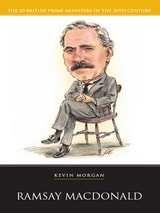
Ramsay Macdonald
Kevin Morgan
Haus Publishing, 2006
Rationality and Power
Democracy in PracticeBent Flyvbjerg
University of Chicago Press, 1997
In the Enlightenment tradition, rationality is considered well-defined, independent of context; we know what rationality is, and its meaning is constant across time and space. Bent Flyvbjerg shows that rationality is context-dependent and that the crucial context is determined by decision-makers' power. Power blurs the dividing line between rationality and rationalization. The result is a rationality that is often as imaginary as the time in Little Town, yet with very real social and environmental consequences.
Flyvbjerg takes us behind the scenes to uncover the real politics—and real rationality—of policy-making, administration, and planning in an internationally acclaimed project for environmental improvement, auto traffic reduction, land use, and urban renewal. The action takes place in the Danish city of Aalborg, but it could be anywhere. Aalborg is to Flyvbjerg what Florence was to Machiavelli: a laboratory for understanding power and what it means for our more general concerns of social and political organization. Policy-making, administration, and planning are examined in ways that allow a rare, in-depth understanding. The reader is a firsthand witness to the classic, endless drama that defines what democracy and modernity are, and what they can be.
The result is a fascinating narrative that is both concrete and general, current and timeless. Drawing on the ideas of Machiavelli, Nietzsche, Foucault, and Habermas, Flyvbjerg reads the Aalborg case as a metaphor of modernity and of modern politics, administration, and planning. Flyvbjerg uncovers the interplay of power and rationality that distorts policy deliberation. He demonstrates that modern "rationality" is but an ideal when confronted with the real rationalities involved in decision making by central actors in government, economy, and civil society. Flyvbjerg then elaborates on how this problem can be dealt with so that more fruitful deliberation and action can occur.
If the new millennium marks a recurrence of the real, Flyvbjerg's Rationality and Power epitomizes this development, setting new standards for social and political inquiry. Richly informed, powerfully argued, and clearly written, this is a book that no one trying to understand policy-making, administration, and planning can afford to overlook.
"Flyvbjerg employs a wide-ranging intellect, an enthusiastic and persuasive voice, academic rigor, and great discipline to distill years of research into an outstanding and accessible 250-page civics lesson. It begs for a readership outside academic and professional circles . . . Rationality and Power's value is undeniable as a handbook and forensic tool for anyone seeking a better understanding of and access to the democratic process."—Arkansas Democrat-Gazette
"It makes an extremely strong, and to the reviewer's mind incontrovertible, argument for placing the analysis of planning within the context of power relations. As a result it will also make a significant mark on the development of planning theory."—Geographical Journal
"A book that is to be recommended doubly, first to all those engaged in planning and implementation in a democratic context, and also to all those interested in empirical power research. Rationality and Power is rewarding even enthralling reading, a seminal contribution to its field."—European Societies
"This book is a must for anyone interested in how planning works . . . a reality shock . . . excellent and illuminating."—International Planning Studies
Reaching for a New Deal
Ambitious Governance, Economic Meltdown, and Polarized Politics in Obama's First Two YearsTheda Skocpol
Russell Sage Foundation, 2011
Readings in Arkansas Politics and Government
Janine A. Parry
University of Arkansas Press, 2009
Readings in Arkansas Politics and Government
Kim U. Hoffman
University of Arkansas Press, 2020
Ready-Made Democracy
A History of Men's Dress in the American Republic, 1760-1860Michael Zakim
University of Chicago Press, 2003
By the early nineteenth century, homespun began to disappear from the American material landscape. Exhortations of industry and modesty, however, remained a common fixture of public life. In fact, they found expression in the form of the business suit. Here, Zakim traces the evolution of homespun clothing into its ostensible opposite—the woolen coats, vests, and pantaloons that were "ready-made" for sale and wear across the country. In doing so, he demonstrates how traditional notions of work and property actually helped give birth to the modern industrial order. For Zakim, the history of men's dress in America mirrored this transformation of the nation's social and material landscape: profit-seeking in newly expanded markets, organizing a waged labor system in the city, shopping at "single-prices," and standardizing a business persona.
In illuminating the critical links between politics, economics, and fashion in antebellum America, Ready-Made Democracy will prove essential to anyone interested in the history of the United States and in the creation of modern culture in general.
Reagan and Public Discourse in America
Michael Weiler
University of Alabama Press, 1992
The authors show that more than any president since John F. Kennedy, Reagan’s influence flowed from his rhetorical practices. And he is remembered as having reversed certain trends and cast the U.S. on a new course. The contributors to this insightful collection of essays show that Reagan’s rhetorical tactics were matters of primary concern to his administration’s chief political strategists.
Realignment in American Politics
Toward a TheoryEdited by Bruce A. Campbell and Richard J. Trilling
University of Texas Press, 1980
Reassessing Communism
Concepts, Culture, and Society in Poland 1944–1989Instytutem Badan Literackich PAN Chmielewska
Central European University Press, 2021
The thirteen authors of this collective work undertook to articulate matter-of-fact critiques of the dominant narrative about communism in Poland while offering new analyses of the concept, and also examining the manifestations of anticommunism. Approaching communist ideas and practices, programs and their implementations, as an inseparable whole, they examine the issues of emancipation, upward social mobility, and changes in the cultural canon.
The authors refuse to treat communism in Poland in simplistic categories of totalitarianism, absolute evil and Soviet colonization, and similarly refuse to equate communism and fascism. Nor do they adopt the neoliberal view of communism as a project doomed to failure. While wholly exempt from nostalgia, these essays show that beyond oppression and bad governance, communism was also a regime in which people pursued a variety of goals and sincerely attempted to build a better world for themselves.
The book is interdisciplinary and applies the tools of social history, intellectual history, political philosophy, anthropology, literature, cultural studies, and gender studies to provide a nuanced view of the communist regimes in east-central Europe.

Rebellion or Revolution?
Harold Cruse
University of Minnesota Press, 2009
A classic work of African American cultural, social, and political thought by a forerunner of the Black Power movement
One of the leading writers of African American intellectual life in the second half of the twentieth century, Harold Cruse first came to international attention in 1967 with the publication of his influential and inflammatory book, The Crisis of the Negro Intellectual. This fiercely opinionated and deeply informed critique of both integrationism and black nationalism established Cruse as a bold new voice on race and resistance in America.
First published in the wake of The Crisis of the Negro Intellectual’s success, Rebellion or Revolution? collects reviews and essays Cruse wrote between 1950 and 1966, examining the relevance of such figures as James Baldwin, Booker T. Washington, Albert Camus, and Josephine Baker, as well as such subjects as Marxism and the African American community, the economics of black nationalism, and the emerging Black Power movement. Rebellion or Revolution? contains a number of significant writings not available elsewhere.Now, with a new foreword by Cedric Johnson, this work finally emerges as both an essential document from a crucial moment in African American history and a road map to the origins and evolution of Cruse’s critical thought, asserting its importance in today’s debates on race in America.
Rebellious Civil Society
Popular Protest and Democratic Consolidation in Poland, 1989-1993Grzegorz Ekiert and Jan Kubik
University of Michigan Press, 2001
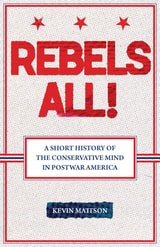
Rebels All!
Rebels All! A Short History of the Conservative Mind in Postwar AmericaMattson, Kevin
Rutgers University Press, 2008
Outstanding Academic Title of 2008
Do you ever wonder why conservative pundits drop the word “faggot” or talk about killing and then Christianizing Muslims abroad? Do you wonder why the right’s spokespeople seem so confrontational, rude, and over-the-top recently? Does it seem strange that conservative books have such apocalyptic titles? Do you marvel at why conservative writers trumpeted the “rebel” qualities of George W. Bush just a few years back?
There is no doubt that the style of the political right today is tough, brash, and by many accounts, not very conservative sounding. After all, isn’t conservatism supposed to be about maintaining standards, upholding civility, and frowning upon rebellion? Historian Kevin Mattson explains the apparent contradictions of the party in this fresh examination of the postwar conservative mind. Examining a big cast of characters that includes William F. Buckley, Whittaker Chambers, Norman Podhoretz, Irving Kristol, Kevin Phillips, David Brooks, and others, Mattson shows how right-wing intellectuals have always, but in different ways, played to the populist and rowdy tendencies in America’s political culture. He boldly compares the conservative intellectual movement to the radical utopians among the New Left of the 1960s and he explains how conservatism has ingested central features of American culture, including a distrust of sophistication and intellectualism and a love of popular culture, sensation, shock, and celebrity.
Both a work of history and political criticism, Rebels All! shows how the conservative mind made itself appealing, but also points to its endemic problems. Mattson’s conclusion outlines how a recast liberalism should respond to the conservative ascendancy that has marked our politics for the last thirty years.
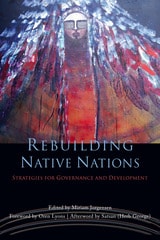
Rebuilding Native Nations
Strategies for Governance and DevelopmentEdited by Miriam Jorgensen; Foreword by Oren Lyons; Afterword by Satsan (Herb George)
University of Arizona Press, 2007
Produced by the Native Nations Institute for Leadership, Management, and Policy at the University of Arizona and the Harvard Project on American Indian Economic Development, this book traces the contours of that revolution as Native nations turn the dream of self-determination into a practical reality. Part report, part analysis, part how-to manual for Native leaders, it discusses strategies for governance and community and economic development being employed by American Indian nations and First Nations in Canada as they move to assert greater control over their own affairs.
Rebuilding Native Nations provides guidelines for creating new governance structures, rewriting constitutions, building justice systems, launching nation-owned enterprises, encouraging citizen entrepreneurs, developing new relationships with non-Native governments, and confronting the crippling legacies of colonialism. For nations that wish to join that revolution or for those who simply want to understand the transformation now underway across Indigenous North America, this book is a critical resource.
CONTENTS
Foreword by Oren Lyons
Editor's Introduction
Part 1
Starting Points
1. Two Approaches to the Development of Native Nations: One Works, the Other Doesn't
Stephen Cornell and Joseph P. Kalt
2. Development, Governance, Culture: What Are They and What Do They Have to Do with Rebuilding Native Nations?
Manley A. Begay, Jr., Stephen Cornell, Miriam Jorgensen, and Joseph P. Kalt
Part 2
Rebuilding the Foundations
3. Remaking the Tools of Governance: Colonial Legacies, Indigenous Solutions
Stephen Cornell
4. The Role of Constitutions in Native Nation Building: Laying a Firm Foundation
Joseph P. Kalt
5 . Native Nation Courts: Key Players in Nation Rebuilding
Joseph Thomas Flies-Away, Carrie Garrow, and Miriam Jorgensen
6. Getting Things Done for the Nation: The Challenge of Tribal Administration
Stephen Cornell and Miriam Jorgensen
Part 3
Reconceiving Key Functions
7. Managing the Boundary between Business and Politics: Strategies for Improving the Chances for Success in Tribally Owned Enterprises
Kenneth Grant and Jonathan Taylor
8. Citizen Entrepreneurship: An Underutilized Development Resource
Stephen Cornell, Miriam Jorgensen, Ian Wilson Record, and Joan Timeche
9. Governmental Services and Programs: Meeting Citizens' Needs
Alyce S. Adams, Andrew J. Lee, and Michael Lipsky
10. Intergovernmental Relationships: Expressions of Tribal Sovereignty
Sarah L. Hicks
Part 4
Making It Happen
11. Rebuilding Native Nations: What Do Leaders Do?
Manley A. Begay, Jr., Stephen Cornell, Miriam Jorgensen, and Nathan Pryor
12. Seizing the Future: Why Some Native Nations Do and Others Don't
Stephen Cornell, Miriam Jorgensen, Joseph P. Kalt, and Katherine Spilde Contreras
Afterword by Satsan (Herb George)
References
About the Contributors
Index
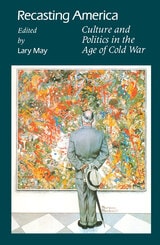
Recasting America
Culture and Politics in the Age of Cold WarEdited by Lary May
University of Chicago Press, 1989
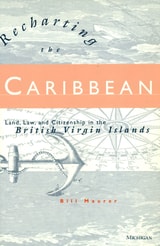
Recharting the Caribbean
Land, Law, and Citizenship in the British Virgin IslandsBill Maurer
University of Michigan Press, 2000
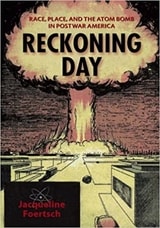
Reckoning Day
Race, Place, and the Atom Bomb in Postwar AmericaJacqueline Foertsch
Vanderbilt University Press, 2013
Foertsch also examines the location of African American characters in novels, science fiction, and survivalist nonfiction such as government-sponsored forecasts regarding post-nuclear survival. In these, black characters are often displaced or absented entirely: in doomsday narratives they are excluded from executive decision-making and the stories' often triumphant conclusions; in the nonfiction, they are rarely envisioned amongst the "typical American" survivors charged with rebuilding US society. Throughout Reckoning Day, issues of placement and positioning provide the conceptual framework: abandoned at "ground zero" (America's inner cities) during the height of the atomic threat, African Americans were figured in white-authored survival fiction as compliant servants aiding white victory over atomic adversity, while as historical figures they were often perceived as "elsewhere" (indifferent) to the atomic threat. In fact, African Americans' "position" on the bomb was rarely one of silence or indifference. Ranging from appreciation to disdain to vigorous opposition, atomic-era African Americans developed diverse and meaningful positions on the bomb and made essential contributions to a remarkably American dialogue.
Reckoning
The Ends of War in GuatemalaDiane M. Nelson
Duke University Press, 2009
Nelson brings together stories of human rights activism, Mayan identity struggles, coerced participation in massacres, and popular entertainment—including traditional dances, horror films, and carnivals—with analyses of mass-grave exhumations, official apologies, and reparations. She discusses the stereotype of the Two-Faced Indian as colonial discourse revivified by anti-guerrilla counterinsurgency and by the claims of duplicity leveled against the Nobel laureate Rigoberta Menchú, and she explores how duplicity may in turn function as a survival strategy for some. Nelson examines suspicions that state power is also two-faced, from the left’s fears of a clandestine para-state behind the democratic façade, to the right’s conviction that NGOs threaten Guatemalan sovereignty. Her comparison of antimalaria and antisubversive campaigns suggests biopolitical ways that the state is two-faced, simultaneously giving and taking life. Reckoning is a view from the ground up of how Guatemalans are finding creative ways forward, turning ledger books, technoscience, and even gory horror movies into tools for making sense of violence, loss, and the future.
Reclaiming Basque
Language, Nation, and Cultural ActivismJacqueline Urla
University of Nevada Press, 2015
Reclaiming Indigenous Governance
Reflections and Insights from Australia, Canada, New Zealand, and the United StatesEdited by William Nikolakis, Stephen Cornell, and Harry W. Nelson; Foreword by Sophie Pierre and Gwen Phillips
University of Arizona Press, 2019
Indigenous governance is dynamic, an ongoing relationship between Indigenous peoples and settler-states. The relationship may be vigorously contested, but it is often fragile—one that ebbs and flows, where hard-won gains can be swiftly lost by the policy reversals of central governments. The legacy of colonial relationships continues to limit advances in self-government.
Yet Indigenous peoples in the CANZUS countries are no strangers to setbacks, and their growing movement provides ample evidence of resilience, resourcefulness, and determination to take back control of their own destiny. Demonstrating the struggles and achievements of Indigenous peoples, the chapter authors draw on the wisdom of Indigenous leaders and others involved in rebuilding institutions for governance, strategic issues, and managing lands and resources.
This volume brings together the experiences, reflections, and insights of practitioners confronting the challenges of governing, as well as researchers seeking to learn what Indigenous governing involves in these contexts. Three things emerge: the enormity of the Indigenous governance task, the creative agency of Indigenous peoples determined to pursue their own objectives, and the diverse paths they choose to reach their goal.
Reconceiving Decision-Making in Democratic Politics
Attention, Choice, and Public PolicyBryan D. Jones
University of Chicago Press, 1994
Individuals and political systems alike, Jones argues, tend to be attentive to only one issue at a time. Using numerous examples from elections, public opinion polls, congressional deliberations, and of bureaucratic decision-making, he shows how shifting attentiveness can and does alter choices and political outcomes—even when underlying preferences remain relatively fixed. An individual, for example, may initially decide to vote for a candidate because of her stand on spending but change his vote when he learns of her position on abortion, never really balancing the two options.

Reconciling Rwanda
Unity, Nationality and State ControlJennifer Melvin
University of London Press, 2015
Reconsidering Parties and Partisanship
Edited by Christopher F. Karpowitz and Jeremy C. Pope
University of Michigan Press, 2026
The scholars here approach parties from the standpoint of partisan and social identities, polarization, the prevalence of independents (and pseudo-independents), political campaigns, and more. In linking the different faces or levels—party-in-the-electorate, party-in-government, and party-as-an-organization—the chapters provide a wide-ranging set of theories and ideas to consider. Through this exploration, Reconsidering Parties and Partisanship provides a valuable road map for partisanship in our current era.
Readers will learn
- How conditional party government seems to work in this highly partisan era
- How donors and pressure groups have taken ownership over campaigns
- How independents are often undercover partisans, but who also feel repelled by the existing parties—even the one they typically support
- How various identities converge to produce partisan affection (when that exists)
- How partisanship relates to ideology.
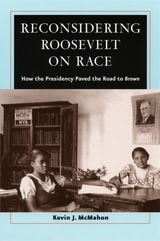
Reconsidering Roosevelt on Race
How the Presidency Paved the Road to BrownKevin J. McMahon
University of Chicago Press, 2003
McMahon shows how FDR's attempt to strengthen the presidency and undermine the power of conservative Southern Democrats dovetailed with his efforts to seek racial equality through the federal courts. By appointing a majority of rights-based liberals deferential to presidential power, Roosevelt ensured that the Supreme Court would be receptive to civil rights claims, especially when those claims had the support of the executive branch.
Reconstituting Whiteness
The Mississippi State Sovereignty CommissionJenny Irons
Vanderbilt University Press, 2010
Going far beyond a mere institutional history, however, Irons uses the commission as a tool to explore the intersection of state-organized defense of white supremacy and the dramatically shifting racial constructs of the civil rights era. Ultimately, the commission failed to protect segregation, but as a state entity, it adapted racism in new terms.
Reconstituting Whiteness is an insightful study of the methods Mississippi state government used to move the goal posts of what was considered "decent" and "acceptable" white supremacy and racism, as it raced against time to define whiteness while the boundaries of segregation fell all around it.
Reconstituting the American Renaissance
Emerson, Whitman, and the Politics of RepresentationJay Grossman
Duke University Press, 2003
Reconstituting the American Renaissance describes how Emerson and Whitman came into the period of their greatest productivity with different conceptions of the functions and political efficacy of the word in the world. It challenges Emerson’s position as Whitman’s necessary precursor and offers a cultural history that emphasizes the two writers’ differences in social class, cultural experience, and political perspective. In their writings between 1830 and 1855, the book finds contrasting conceptions of the relations between the “representative man” and the constituencies to whom, and for whom, he speaks. Reconstituting the American Renaissance opens up the canonical relationship between Emerson and Whitman and multiplies the historical and discursive contexts for understanding their published and unpublished works.

Reconstructing Chinatown
Ethnic Enclave, Global ChangeJan Lin
University of Minnesota Press, 1998
An exploration of this fascinating community as a window on globalization.
In the American popular imagination, Chinatown is a mysterious and dangerous place, clannish and dilapidated, filled with sweatshops, vice, and organized crime. In this well-written and engaging volume, Jan Lin presents a real-world picture of New York City’s Chinatown, countering this “orientalist” view by looking at the human dimensions and the larger forces of globalization that make this vital neighborhood both unique and broadly instructive.
Using interviews with residents, firsthand observation, archival research, and U.S. census data, Lin delivers an informed, reliable picture of Chinatown today. Lin claims that to understand contemporary ethnic neighborhoods like this one we must dispense with notions of monolithic “community.” When he looks at Chinatown, Lin sees a neighborhood that is being rebuilt, both literally and economically. Rather than a clannish and unified peer group, he sees substantial class inequality and internal social conflict. There is also social change, most visibly manifested in dramatic episodes of collective action by sweatshop workers and community activists and in the growing influence of Chinatown’s denizens in electoral politics. Popular portrayals of Chinatown also reflect a new global reality: as American cities change with the international economy, traditional assumptions about immigrant incorporation into U.S. society alter as well. Lin describes the public disquiet and official response regarding immigration, sweatshops, and the influx of Asian capital. He outlines the ways that local, state, and federal governments have directed and gained from globalization in Chinatown through banking deregulation and urban redevelopment policy. Finally, Lin puts forth Chinatown as a central enclave in the “world city” of New York, arguing that globalization brings similar structural processes of urban change to diverse locations. In the end, Lin moves beyond the myth of Chinatown, clarifying the meaning of globalization and its myriad effects within the local context.
Reconstructing Tascalusa's Chiefdom
Pottery Styles and the Social Composition of Late Mississippian Communities along the Alabama RiverAmanda L. Regnier
University of Alabama Press, 2014
Reconstructing the Commercial Republic
Constitutional Design after MadisonStephen L. Elkin
University of Chicago Press, 2006
The deficiencies Elkin points out provide the starting point for his own constitutional theory of the republic—a theory that, unlike Madison’s, lays out a substantive conception of the public interest that emphasizes the power of institutions to shape our political, economic, and civic lives. Elkin argues that his theory should guide us toward building a commercial republic that is rooted in a politics of the public interest and the self-interest of the middle class. He then recommends specific reforms to create this kind of republic, asserting that Americans today can still have the lives a commercial republic is intended to promote: lives with real opportunities for economic prosperity, republican political self-government, and individual liberty.
Reconstruction Politics in a Deep South State
Alabama, 1865–1874William Warren Rogers Jr.
University of Alabama Press, 2021
The battle for democracy in reconstruction-era Alabama.
Following the end of the Civil War, white Southerners were forced to concede equal rights to those who had been enslaved, ushering in a new and ruthless brand of politics. Suddenly, the status and place of some four million former slaves dominated the national and regional political dialogue. In Alabama, the Republican Party established itself quickly and powerfully with the participation of a newly freed constituency, firmly aligned against the Democratic Party that had long dictated the governance of the state. Well-heeled planters, merchants, and bankers, joined by yeoman farmers, staged a counterrevolution by gravitating strongly to the Democratic Party and its unabashedly white supremacist measures. The ensuing power struggle in the birthplace of the Confederacy is at the heart of Reconstruction Politics in a Deep South State: Alabama, 1865–1874.
What emerges in William Warren Rogers Jr.’s comprehensive study of the era is a detailed examination of Reconstruction politics, particularly in Alabama. This book explores an explosive and unpredictable political environment that a few years earlier would have been inconceivable. A vivid picture emerges of courthouse rallies and bitter infighting in legislative circles. Rogers’s narrative ventures into darker places as well: to the Tennessee Valley and the Black Belt regions of Alabama, where Klan nightriders used violence against an enemy and ideology they could not abide.
The attempt to capture and account for the unforgiving political landscape created by the extraordinary circumstances of Reconstruction constitutes this study’s most central contribution. Rogers often quotes black and white citizens, Democrats and Republicans. Drawn from newspapers, correspondence, and various federal investigations, these firsthand voices are passionate, unvarnished, and filled with conviction. They offer a startling immediacy and illustrate the temper—or distemper—of the times. Readers are treated to a panoramic unveiling of Reconstruction Alabama politics that provides a sense of what was truly at stake: the values by which a region and the nation as a whole would chart its future for the century to come.
Reconstruction in Texas
By Charles William Ramsdell
University of Texas Press, 1970
A reprint of the 1910 study, Reconstruction in Texas examines the events that still impact upon Texas and the South.