Results by title
386 books match the query 'Russia' and 40 start with r
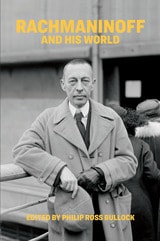
Rachmaninoff and His World
Edited by Philip Ross Bullock
University of Chicago Press, 2022
One of the most popular classical composers of all time, Sergei Rachmaninoff (1873–1943) has often been dismissed by critics as a conservative, nostalgic holdover of the nineteenth century and a composer fundamentally hostile to musical modernism. The original essays collected here show how he was more responsive to aspects of contemporary musical life than is often thought, and how his deeply felt sense of Russianness coexisted with an appreciation of American and European culture. In particular, the essays document his involvement with intellectual and artistic circles in prerevolutionary Moscow and how the form of modernity they promoted shaped his early output. This volume represents one of the first serious explorations of Rachmaninoff’s successful career as a composer, pianist, and conductor, first in late Imperial Russia, and then after emigration in both the United States and interwar Europe. Shedding light on some unfamiliar works, especially his three operas and his many songs, the book also includes a substantial number of new documents illustrating Rachmaninoff’s celebrity status in America.
Readings in Russian Civilization Volume I
Russia before Peter the Great, 900-1700Edited by Thomas Riha
University of Chicago Press, 1969
"The bibliographical headnotes have been enlarged, with the result that there are now approximately twice as many entries as in the old edition. New citations include not only works which have appeared since 1963, but also older books and articles which have come to the editor's attention."—From the Editor's Preface
". . . a judicious combination of seminal works and more recent commentaries that achieves the editor's purpose of stimulating curiosity and developing a point of view."—C. Bickford O'Brien, The Russian Review
"These three volumes cover quite well the main periods of Russian civilization. The choice of the articles and other material is made by a competent and unbiased scholar."—Ivan A. Lopatin, Professor of Asian and Slavic Studies, University of Southern California
Readings in Russian Civilization Volume II
Imperial Russia, 1700-1917Edited by Thomas Riha
University of Chicago Press, 1969
"The bibliographical headnotes have been enlarged, with the result that there are now approximately twice as many entries as in the old edition. New citations include not only works which have appeared since 1963, but also older books and articles which have come to the editor's attention."—From the Editor's Preface
". . . a judicious combination of seminal works and more recent commentaries that achieves the editor's purpose of stimulating curiosity and developing a point of view."—C. Bickford O'Brien, The Russian Review
"These three volumes cover quite well the main periods of Russian civilization. The choice of the articles and other material is made by a competent and unbiased scholar."—Ivan A. Lopatin, Professor of Asian and Slavic Studies, University of Southern California
Readings in Russian Civilization Volume III
Soviet Russia, 1917-1963Edited by Thomas Riha
University of Chicago Press, 1969
"The bibliographical headnotes have been enlarged, with the result that there are now approximately twice as many entries as in the old edition. New citations include not only works which have appeared since 1963, but also older books and articles which have come to the editor's attention."—From the Editor's Preface
". . . a judicious combination of seminal works and more recent commentaries that achieves the editor's purpose of stimulating curiosity and developing a point of view."—C. Bickford O'Brien, The Russian Review
"These three volumes cover quite well the main periods of Russian civilization. The choice of the articles and other material is made by a competent and unbiased scholar."—Ivan A. Lopatin, Professor of Asian and Slavic Studies, University of Southern California
Reconnoitring Russia
Mapping, Exploring and Describing Early Modern Russia, 1613–1825Denis J. B. Shaw
University College London, 2024
Focusing on geographical practices—such as exploring, observing, describing, and mapping—Reconnoitring Russia explains how Russia’s rulers and public came to understand the expanse of their territory. It adopts a broad chronological framework and compares the Russian experience to the concurrent realities of other European countries between 1613, the emergence of the Romanov dynasty, and 1825, the conclusion of Alexander I’s reign.
Red Leviathan
The Secret History of Soviet WhalingRyan Tucker Jones
University of Chicago Press, 2022
The Soviet Union killed over six hundred thousand whales in the twentieth century, many of them illegally and secretly. That catch helped bring many whale species to near extinction by the 1970s, and the impacts of this loss of life still ripple through today’s oceans. In this new account, based on formerly secret Soviet archives and interviews with ex-whalers, environmental historian Ryan Tucker Jones offers a complete history of the role the Soviet Union played in the whales’ destruction. As other countries—especially the United States, Great Britain, Japan, and Norway—expanded their pursuit of whales to all corners of the globe, Stalin determined that the Soviet Union needed to join the hunt. What followed was a spectacularly prodigious, and often wasteful, destruction of humpback, fin, sei, right, and sperm whales in the Antarctic and the North Pacific, done in knowing violation of the International Whaling Commission’s rules. Cold War intrigue encouraged this destruction, but, as Jones shows, there is a more complex history behind this tragic Soviet experiment. Jones compellingly describes the ultimate scientific irony: today’s cetacean studies benefited from Soviet whaling, as Russian scientists on whaling vessels made key breakthroughs in understanding whale natural history and behavior. And in a final twist, Red Leviathan reveals how the Soviet public began turning against their own country’s whaling industry, working in parallel with Western environmental organizations like Greenpeace to help end industrial whaling—not long before the world’s whales might have disappeared altogether.
Reframing Russian Modernism
Edited by Irina Shevelenko
University of Wisconsin Press, 2018
Expanding upon prior studies that focus more specifically on literary manifestations of the movement, Reframing Russian Modernism features original research that ranges broadly, from political aesthetics to Darwinism to yoga. These unique complementary perspectives counter reductionism of any kind, integrating the study of Russian modernism into the larger body of humanistic scholarship devoted to modernity.
Regionalism without Regions
Reconceptualizing Ukraine's HeterogeneityUlrich Schmid
Central European University Press, 2019
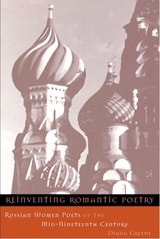
Reinventing Romantic Poetry
Russian Women Poets of the Mid-Nineteenth CenturyDiana Greene
University of Wisconsin Press, 2003
Reinventing Romantic Poetry offers a new look at the Russian literary scene in the nineteenth century. While celebrated poets such as Aleksandr Pushkin worked within a male-centered Romantic aesthetic—the poet as a bard or sexual conqueror; nature as a mother or mistress; the poet’s muse as an idealized woman—Russian women attempting to write Romantic poetry found they had to reinvent poetic conventions of the day to express themselves as women and as poets. Comparing the poetry of fourteen men and fourteen women from this period, Diana Greene revives and redefines the women’s writings and offers a thoughtful examination of the sexual politics of reception and literary reputation.
The fourteen women considered wrote poetry in every genre, from visions to verse tales, from love lyrics to metaphysical poetry, as well as prose works and plays. Greene delves into the reasons why their writing was dismissed, focusing in particular on the work of Evdokiia Rostopchina, Nadezhda Khvoshchinskaia, and Karolina Pavlova. Greene also considers class as a factor in literary reputation, comparing canonical male poets with the work of other men whose work, like the women’s, was deemed inferior at the time. The book also features an appendix of significant poems by Russian women discussed in the text. Some, found in archival notebooks, are published here for the first time, and others are reprinted for the first time since the mid-nineteenth century.
Religion and Jewish Identity in the Soviet Union, 1941–1964
Mordechai Altshuler
Brandeis University Press, 2012
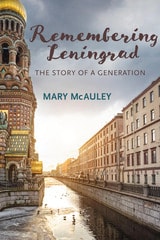
Remembering Leningrad
The Story of a GenerationMary McAuley
University of Wisconsin Press, 2019
Remembering Leningrad captures the story of a beautiful city and lifelong friendships. We follow McAuley as she walks through the streets downtown and examines politics in the 1960s, describes the hazards of furnishing an apartment in the 1990s, and learns about the challenges her friends have faced during these turbulent years. By weaving history and anecdotes to create a picture of Russia’s cultural center, McAuley underscores the impact of time and place on the Russian intelligentsia who lived through the transition from Soviet to post-Soviet life. The result is a remarkable group portrait of a generation.
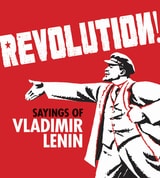
Revolution!
Sayings of Vladimir LeninEdited by the Bodleian Library
Bodleian Library Publishing, 2017
Revolution! Sayings of Vladimir Lenin is a compilation of Lenin’s most famous sayings, taken from speeches, lectures, letters, and recorded conversations. Together, they show his views on topics ranging from democracy to terrorism, from religion to Stalin’s untrustworthiness, and from education to music. Accompanied by a range of striking images, including contemporary propaganda posters, photographs, portraits, illustrations, and Soviet art, these aphoristic proclamations offer an insight into the atmosphere of pre- and post-revolutionary Russia and the mind of one of the twentieth century’s most defining political figures.
Revolutions in Verse
The Medium of Russian ModernismIsobel Palmer
Northwestern University Press, 2025
How modernist interartistic experimentation and the proliferation of new media technologies inspired fresh insights into poetry
Isobel Palmer spotlights Russian modernist poets’ and formalist theorists’ conscious engagement with formal convention, showing how their efforts were tied up with broader attempts in the early Soviet era to understand and articulate the nature of poetry and its most characteristic devices. Returning to critical debates around poetic encounters with three key aesthetic categories—rhythm, image, and voice—Palmer unpacks the period’s deeper interest in the material bases of poetic speech itself. Through fresh, incisive readings of canonical poets and theorists, from Andrei Bely and Vladimir Mayakovsky to Yury Tynianov and Viktor Shklovsky, Revolutions in Verse: The Medium of Russian Modernism explores the proliferation of interartistic experiments and the emergence of new media technologies that made poetry visible as a medium in its own right.
Riddle, Mystery, and Enigma
Two Hundred Years of British–Russian RelationsDavid Owen
Haus Publishing, 2022
With Riddle, Mystery, and Enigma, statesman and author David Owen tells the story of Britain’s relationship with Russia, which has been surprisingly underexplored. Through his characteristic insight and expertise, he depicts a relationship governed by principle as often as by suspicion, expediency, and necessity.
When the two nations formed a pragmatic alliance and fought together at the Battle of Navarino in Greece in 1827, it was overwhelmingly the work of the British prime minister, George Canning. His death brought about a drastic shift that would see the countries fighting on opposite sides in the Crimean War and jostling for power during the Great Game. It was not until the Russian Revolution of 1917 that another statesman had a defining impact on relations between Britain and Russia: Winston Churchill, who opposed Bolshevism yet never stopped advocating for diplomatic and military engagement with Russia. In the Second World War, he recognized early on the necessity of allying with the Soviets against the menace of Nazi Germany. Bringing us into the twenty-first century, Owen chronicles how both countries have responded to their geopolitical decline. Drawing on both imperial and Soviet history, he explains the unique nature of Putin’s autocracy and addresses Britain’s return to “blue water” diplomacy. Newly revised, this paperback edition features extended chapters on Putin’s Russia and the future of British–Russian relations after the Russo-Ukrainian War.

Rimsky-Korsakov's Harmonic Theory
Practical Manual of Harmony, Its Sources, History, and TraditionsLarisa P. Jackson
University of North Texas Press, 2022
Rites of Place
Public Commemoration in Russia and Eastern EuropeJulie Buckler and Emily D Johnson
Northwestern University Press, 2013
Ranging widely across time and geography, Rites of Place is to date the most comprehensive and diverse example of memory studies in the field of Russian and East European studies. Leading scholars consider how public rituals and the commemoration of historically significant sites facilitate a sense of community, shape cultural identity, and promote political ideologies. The aims of this volume take on unique importance in the context of the tumultuous events that have marked Eastern European history—especially the revolutions of 1905 and 1917, World War II, and the collapse of the Soviet Union. With essays on topics such as the founding of St. Petersburg, the battle of Borodino, the Katyn massacre, and the Lenin cult, this volume offers a rich discussion of the uses and abuses of memory in cultures where national identity has repeatedly undergone dramatic shifts and remains riven by internal contradictions.
Roll Over, Tchaikovsky!
Russian Popular Music and Post-Soviet HomosexualityStephen Amico
University of Illinois Press, 2017
Centered on the musical experiences of homosexual men in St. Petersburg and Moscow, this ground-breaking study examines how post-Soviet popular music both informs and plays off of a corporeal understanding of Russian male homosexuality.
Drawing upon ethnography, musical analysis, and phenomenological theory, Stephen Amico offers an expert technical analysis of Russian rock, pop, and estrada music, dovetailing into an illuminating discussion of homosexual men's physical and bodily perceptions of music. He also outlines how popular music performers use song lyrics, drag, physical movements, images of women, sexualized male bodies, and other tools and tropes to implicitly or explicitly express sexual orientation through performance. Finally, Amico uncovers how such performances help homosexual Russian men to create their own social spaces and selves, in meaningful relation to others with whom they share a "nontraditional orientation."
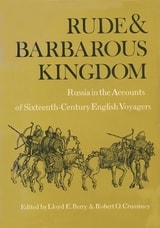
Rude and Barbarous Kingdom
Russia in the Accounts of Sixteenth-Century English VoyagersEdited by Lloyd E. Berry and Robert O. Crummey
University of Wisconsin Press, 1972
Lloyd E. Berry and Robert O. Crummey offer edited accounts of six English voyagers and their experiences in Muscovy Russia between 1553 and 1600. With modernized spelling and presentation, these accounts are accompanied by a glossary of Russian terms, introductions of their authors, and annotations that help put the travelers’ narratives into perspective.
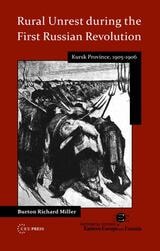
Rural Unrest during the First Russian Revolution
Kursk Province, 1905-1906Burton Richard Miller
Central European University Press, 2013
Russia Reads Rousseau, 1762-1825
Thomas Barran
Northwestern University Press, 2002

Russia Under Yeltsin and Putin
Neo-Liberal AutocracyBoris Kagarlitsky
Pluto Press, 2002
Kagarlitsky shows how to understand these changes, and how to characterise the complex process of reform, revolution and counter revolution.
Looking in detail at the nature of Russian society and politics since 1990, Kagarlitsky offers an introductory political analysis of the major political and economic developments that have taken place under President Yeltsin, and the legacy he bequeathed so unexpectedly to his successor Putin. He focuses on the role of the media in post-Soviet Russia, corporate structures and their influence on social conflict, the formation of the oligarchy and the role of the left in modern Russia.

Russia Under the Last Tsar
Theofanis George Stavrou, Editor
University of Minnesota Press, 1969
Russia Under the Last Tsar was first published in 1969. Minnesota Archive Editions uses digital technology to make long-unavailable books once again accessible, and are published unaltered from the original University of Minnesota Press editions.
The reign of Russia's last tsar, Nicholas II, from 1894 to 1917, constitutes a period of continuing controversy among historians. Interesting in its own right, it is also a time of great importance to an understanding of the cataclysmic events which followed in Russian history.
In this volume eight scholars contribute interpretive essays on some of the most significant forces and issues in Imperial Russia during the two decades before the revolutions. Professor Stavrou writes an introductory essay. The other essays and authors are: "on Interpreting the Fate of Imperial Russia" by Arthur Mendel, University of Michigan; "Russian Conservative Thought before the Revolution" by Robert F. Brynes, Indiana University; "Russian Radical Thought, 1894–1917" by Donald W. Treadgold, University of Washington; "Russian Constitutional Developments" by Thomas Riha, University of Colorado; "Problems of Industrialization in Russia" by Theodore Von Laue, Washington University; "Politics, Universities, and Science" by Alexander Vucinich, University of Illinois; "The Cultural Renaissance" by Gleb Struve, formerly of the University of California, Berkeley; and "Some Imperatives of Russian Foreign Policy" by Roderick E. McGrew, Temple University. The book is illustrated with photographs of some of the principal figures in the history of the period, and there are a bibliography and index.
As Professor Stavrou points out in his preface, the contributors did not consult with one another before preparing their respective essays, and the various approaches are refreshingly different in their assessments of the period. The book as a whole provides a panoramic view of the fascinating Russia of Nicholas and Alexandra. It will be interesting to general readers and especially useful as a textbook for courses in Russian or modern European history.
Russia and Iran, 1780-1828
Muriel Atkin
University of Minnesota Press, 1980
Russia and Iran, 1780–1828 was first published in 1980. Minnesota Archive Editions uses digital technology to make long-unavailable books once again accessible, and are published unaltered from the original University of Minnesota Press editions.
Modern Russo-Iranian relations date from the late eighteenth century, when after several centuries of commercial and diplomatic contact, the two nations entered a period of extended warfare for possession of the Caucasian borderlands, disputed territory that eventually fell to Russia. In her history of that struggle, Muriel Atkin reasseses the motives of major figures on both sides and views the Iranians with more sympathy than Western and Russian historians have usually accorded them. Russia embarked on her course in the Caucasus for reasons connected with defense or trade, and with a longterm imperial goal based on uncritical acceptance of prevailing European doctrines of empire. The new dynasty in Iran, on the other hand, had to fend off Russian attack and secure the borderlands in order to justify its basic claim to power. In the end, the wars brought major disruption to the already unstable borderlands, and left Iran with a discredited government and a controversy over reforms and relations with the West that would continue to cause turmoil in subsequent generations.
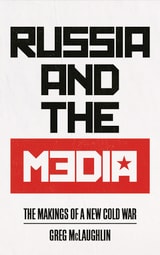
Russia and the Media
The Makings of a New Cold WarGreg McLaughlin
Pluto Press, 2020
But recent propaganda images that define public debate around growing tensions with Russia are not new or arbitrary. Russia and the Media asks, what is the role of Western journalism in constructing a new kind of Cold War with Russia? Focusing on British and US media coverage of moments of crisis and of co-operation between the West and Russia, McLaughlin exposes how such a Cold War framework shapes public perceptions of a major, hostile power reasserting itself on the world stage.
Scrutinizing events such as the Ukraine/Crimea crisis, the Skripal Poisoning and Russia's military intervention in Syria - as well as analyzing media coverage of the 2018 Russian presidential election and build up to the 2018 World Cup - Russia and the Media makes a landmark intervention at the intersection of media studies and international relations.

Russia and the United States
Nikolai V. Sivachev and Nikolai N. Yakovlev
University of Chicago Press, 1979
Sivachev and Yakolev trace the course of the U.S.-Russian relations from the years preceding the American Revolution to the 1970s, when human rights issues began to cause friction. Those relations, the authors believe, were characterized by America's repeated failure to take advantage of opportunities to improve them. Recognizing the controversial nature of the book, Sivachev said in an interview with the New York Times: "We did not set out to please the American reader, nor did the University of Chicago Press ask us to. On the contrary, they recommended that we should feel free to present our own views."
"Scholars and students of American foreign policy . . . are likely to be alternatively interested, intrigued, angered, and sometimes illuminated by some of the interpretations found in this work."—Perspective
"An American reader should not prejudge this book as simply another dreary contribution to the rhetoric of Soviet propaganda. It is more than this. The book is an expression of a view of the world that is truly and strikingly different from an American one and it is important to understand that it is a theory of reality that is shared by most, if not all, Soviet intellectuals who study America and its foreign policy. It is not enough simply to establish the inaccuracies and misrepresentations contained in such a view. One must go further and understand that such a view of reality is sincerely deeply held and that it is a part of a larger belief system that gives the authors' scholarly work coherence and meaning."—Boston Sunday Globe
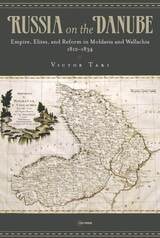
Russia on the Danube
Empire, Elites, and Reform in Moldavia and Wallachia, 1812–1834Victor Taki
Central European University Press, 2021
One of the goals of Russia’s Eastern policy was to turn Moldavia and Wallachia, the two Romanian principalities north of the Danube, from Ottoman vassals into a controllable buffer zone and a springboard for future military operations against Constantinople. Russia on the Danube describes the divergent interests and uneasy cooperation between the Russian officials and the Moldavian and Wallachian nobility in a key period between 1812 and 1834. Victor Taki’s meticulous examination of the plans and memoranda composed by Russian administrators and the Romanian elite underlines the crucial consequences of this encounter. The Moldavian and Wallachian nobility used the Russian-Ottoman rivalry in order to preserve and expand their traditional autonomy. The comprehensive institutional reforms born out of their interaction with the tsar’s officials consolidated territorial statehood on the lower Danube, providing the building blocks of a nation state.
The main conclusion of the book is that although Russian policy was driven by self-interest, and despite the Russophobia among a great part of the Romanian intellectuals, this turbulent period significantly contributed to the emergence, several decades later, of modern Romania.
Russia's Imperial Endeavor and Its Geopolitical Consequences
The Russia-Ukraine War, Volume TwoBálint Madlovics
Central European University Press, 2024
Aside from the near-complete devastation of a sovereign state and reversal of the global balance of power, the Russian invasion of Ukraine in 2022 is leading to a radical transformation in the Eastern European and Eurasian regions – including Russia itself.
The 13 chapters in this volume examine the main geopolitical consequences of the resurgent imperialist aspirations of the Russian Federation. They examine the ideological tools of history falsification as an integral part of hybrid warfare. Turning to the economy, the book discusses how the war and economic sanctions imposed on Russia are redrawing the geopolitical map and how economic relations would change following a regime transformation. The book discusses the reactions of members of the international community to the invasion, whether threatened or neutral parties or allies. The collection therefore offers a comprehensive picture of the main consequences of the resurgent imperialist aspirations of the Russian Federation. Equipped with the conceptual tools of the analysis with a focus on the patronal features of the political-economic system, the book considers the aftermath of the war. This collection complements the book entitled Ukraine. Patronal Democracy and the Russian Invasion.
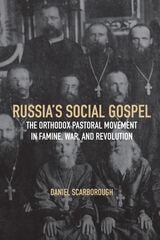
Russia's Social Gospel
The Orthodox Pastoral Movement in Famine, War, and RevolutionDaniel Scarborough
University of Wisconsin Press, 2023
This volume draws upon extensive archival research to examine the effects of the pastoral movement on Russian society and the Orthodox Church. Scarborough argues that the social work of parish clergymen shifted the focus of Orthodox practice in Russia toward cooperative social activism as a devotional activity. He furthers our understanding of Russian Orthodoxy by illuminating the difficult position of parish priests, who were charged with both spiritual and secular responsibilities but were supported by neither church nor state. His nuanced look at the pastorate shows how social and historical traumas shifted perceptions of what being religious meant, in turn affecting how the Orthodox Church organized itself, and contributed to Russia’s modernization.

Russia, Freaks and Foreigners
Three Performance TextsJames MacDonald
Intellect Books, 2008
Russian Dramatic Theory from Pushkin to the Symbolists
An AnthologyTranslated and edited by Laurence P. Senelick
University of Texas Press, 1981
Although younger than most European theatrical traditions, the Russian professional theater has generated an exciting body of criticism and theory which until recently has remained unknown or nearly inaccessible in the West. This anthology presents a selection of important Russian writing on the aesthetics of drama and the theater from 1828 to 1914.
The focus of these essays, most published here for the first time in English, is on the so-called Crisis in the Theater of 1904 to 1914, a lively debate between the symbolists and the naturalists that evoked brilliant polemic writing from Meyerhold, Bely, Bryusov, and others. Along with Chekhov's amusing critique of Sarah Bernhardt ("monstrously facile!") and Ivanov's abstruse analysis of the essence of tragedy, the essays form a running commentary on the development of the Russian theater: Pushkin on his predecessors, Gogol on his own work, Belinsky on Gogol, Sleptsov on Ostrovsky and Leskov, Bely on Chekhov's The Cherry Orchard ("enervated people, trying to forget the terror of life"), the symbolists on one another.
Each selection is printed in its entirety, with extensive notes, and a lengthy introduction places all the pieces within their historical and cultural contexts to comprise a brief history of Russian dramatic theory before the revolution. This volume is essential reading for all who wish to extend their knowledge of the Russian contribution to theatrical history, theory, and criticism.
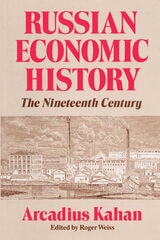
Russian Economic History
The Nineteenth CenturyArcadius Kahan
University of Chicago Press, 1989
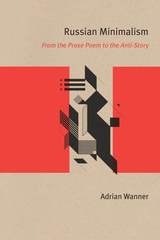
Russian Minimalism
From the Prose Poem to the Anti-StoryAdrian Wanner
Northwestern University Press, 2003
The paradoxical genre of the prose poem, developed by the French poet Charles Baudelaire, provides Wanner with an overarching theoretical rubric for a variety of works of Russian literature, ranging from Ivan Turgenev's "Poems in Prose" to a host of decadent, symbolist, realist, and futurist miniatures, including Fedor Sologub's "Little Fairy Tales," Aleksei Remizov's dreams, Vasilii Kandinskii's prose poems, and Daniil Kharms' absurdist ministories. His book demonstrates how the negativity inherent in the form of the prose poem transformed the overwrought lyricism of fin de siècle prose into the ascetic starkness of the twentieth-century minimalist anti-story.
Russian Orthodoxy under the Old Regime
Robert L. Nichols and Theofanis George Stavrou, Editors
University of Minnesota Press, 1978
Russian Orthodoxy under the Old Regime was first published in 1978. Minnesota Archive Editions uses digital technology to make long-unavailable books once again accessible, and are published unaltered from the original University of Minnesota Press editions.
In this book, which is especially suitable for course use, eleven scholars examine one of the most important institutions of imperial Russia, the Orthodox church in the two centuries before the Russian revolution. The material is arranged in two sections, the first devoted to Orthodoxy's role in Russian social and cultural life and the second dealing with the church's relationship to the tsarist regime.
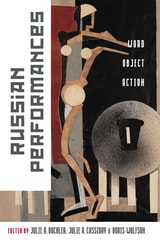
Russian Performances
Word, Object, ActionEdited by Julie A. Buckler, Julie A. Cassiday, and Boris Wolfson
University of Wisconsin Press, 2018
Challenging the primacy of the written word in this field, the volume fosters a larger intellectual community informed by theories and practices of performance from anthropology, art history, dance studies, film studies, cultural and social history, literary studies, musicology, political science, theater studies, and sociology.
Russian Religious Thought
Edited by Judith Deutsch Kornblatt and Richard F. Gustafson
University of Wisconsin Press, 1996
As Russia entered the modern age in the nineteenth century, many Russian intellectuals combined the study of European philosophy with a return to their own traditions, culminating in the novels of Tolstoy and Dostoevsky and in the religious philosophy of their younger contemporary, Vladimir Soloviev. This book explores central issues of modern Russian religious thought by focusing on the work of Soloviev and three religious philosophers who further developed his ideas in the early twentieth century: P. A. Florensky, Sergei Bulgakov, and S. L. Frank. The essays place these thinkers in the contexts of both Western philosophy and Eastern Orthodoxy, presenting a substantially new perspective on Russian religious thought.
The work of these four philosophers, this volume demonstrates, influenced virtually all aspects of twentieth-century Russian culture, and indeed, many aspects of Soviet culture as well, but also represents a rich philosophical tradition devoted to issues of divinity, community, and humanity that transcend national boundaries and historical eras.
Included in Russian Religious Thought is an introduction, brief biographical information on Soloviev, Florensky, Bulgakov, and Frank, and an Afterword by scholar James Scanlan, who elaborates on the volume’s aim to provide a thoughtful corrective, both to unexamined assumptions of past scholarship and to nationalist readings currently popular in post-Soviet Russia.
"Russian religious philosophy, banned under the Soviets, has been marginalized in the Western academy as well. This interdisciplinary volume helps explain why this body of thought has remained for so long at the center of Russian culture."—Caryl Emerson, Princeton University
Russian Style
Performing Gender, Power, and PutinismJulie A. Cassiday
University of Wisconsin Press, 2023
Russian-American Dialogue on Cultural Relations, 1776-1914
Edited by Norman E. Saul & Richard D. McKinzie
University of Missouri Press, 1996
Russian-American Dialogue on Cultural Relations, 1776-1914, the third volume in the Russian-American Dialogues series, provides English translations of the best Russian scholarship on cultural relations. Each essay originally appeared as an article in the former Soviet Union. Five issues are discussed: the contributions that each country made to the cultural life of the other; the correspondence and interactions between scientists, writers, and others from the two nations; the development of public perceptions and how these changed over time; the "American focus" in Russian periodicals during the nineteenth century; and the significant roles of Russians and the Russian presence in American history. The Russian articles on each of these subjects are followed by comments from American historians.
The articles by the Russian scholars make extensive use of and liberally cite material from Russian archives and publications. As a result, they provide American readers with new scientific exchanges, personalities, and points of view. The result is a plethora of new material for Western historians of Russia as well as of the United States. The book provides an opportunity for scholars to examine more thoroughly the relevant issues of Russian-American cultural relations.
An important scholarly contribution, Russian-American Dialogue on Cultural Relations, 1776-1914 brings a new dimension to the relationship between the United States and Russia before 1914. It will be of interest not only to historians of this period but to all historians and students of international cultural relations.
Russian-Ottoman Borderlands
The Eastern Question ReconsideredEdited by Lucien J. Frary and Mara Kozelsky
University of Wisconsin Press, 2014
The contributors address ethnicity, religion, popular attitudes, violence, dislocation and mass migration, economic rivalry, and great-power diplomacy. Through a variety of fresh approaches, they examine the consequences of the Eastern Question in the lives of those peoples it most affected, the millions living in the Russian and Ottoman Empires and the borderlands in between.

Russians in Alaska
1732-1867Lydia Black
University of Alaska Press, 2004
Black's work challenges the standard perspective on the Russian period in Alaska as a time of unbridled exploitation of Native inhabitants and natural resources. Without glossing over the harsher aspects of the period, Black acknowledges the complexity of relations between Russians and Native peoples.
She chronicles the lives of ordinary men and women, the merchants and naval officers, laborers and clergy, who established Russian outposts in Alaska. These early colonists carried with them the Orthodox faith and the Russian language; their legacy endures in architecture and place names from Baranof Island to the Pribilofs.
This deluxe volume features fold-out maps and color illustrations of rare paintings and sketches from Russian, American, Japanese, and European sources, many have never before been published. An invaluable source for historians and anthropologists, this accessible volume brings to life a dynamic period in Russian and Alaskan history. A tribute to Black's life as a scholar and educator, Russians in Alaska will become a classic in the field.

Russia’s Black Genius
A Sourcebook on the African Heritage of Alexander PushkinEdited by Emily Wang and Korey Garibaldi
Amherst College Press, 2027
Russia’s Black Genius: A Sourcebook on the African Heritage of Alexander Pushkin brings together primary sources related to the racialization of Russian poet Alexander Pushkin and his Afro-Russian great-grandfather, the military engineer and general Abram Petrovich Gannibal. While Pushkin is a canonical figure and renowned to this day as Russia’s national poet, his African heritage is often overlooked or poorly understood; meanwhile Gannibal, despite his compelling life story, has become a relatively obscure figure outside of Russia. Yet over the course of the nineteenth and twentieth centuries, it was common to find discussions of Pushkin’s Black and multiracial ancestry in books and periodicals on both sides of the Atlantic. Building on the work of a small but influential cohort of scholars and intellectuals who have illuminated the racial dimensions of Pushkin’s legacy, this volume makes primary and source materials available, often for the first time, to readers who are not fluent in the Russian language. Ranging from US criticism and English translations of Russian, German, and French texts to numerous accounts of Pushkin’s life and works penned by Black Americans, the texts in this sourcebook expand and complicate the historical reception of Pushkin in Europe and the United States. Through translation and interdisciplinary dialogue, Russia’s Black Genius brings one of Russia’s—and the world’s— foremost poets into conversation with a broader swath of global readers.