Results by title
22279 books match the query 'Social Science' and 1072 start with r

Regulating Menstruation
Beliefs, Practices, InterpretationsEdited by Etienne van de Walle and Elisha P. Renne
University of Chicago Press, 2001
Originating from an Internet conference held in February 1998, this volume contains fourteen papers that have been revised and updated to cover everything from the impact of the birth control pill to contemporary views on reproduction to the pharmacological properties of various herbal substances, reflecting the historical, contemporary, and anthropological perspectives of this timely and complex issue.
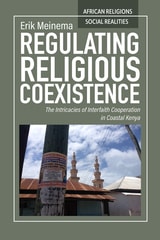
Regulating Religious Coexistence
The Intricacies of Interfaith Cooperation in Coastal KenyaErik Meinema
Ohio University Press, 0
Regulating Religious Coexistence offers a compelling ethnographic analysis of how Muslims, Christians, and practitioners of indigenous African religions negotiate coexistence in Kenya’s coastal region. The book conceptualizes religious diversity as a dynamic field shaped by multiple partly intersecting and partly conflicting models of interaction. These include the political secularism promoted by the Kenyan state and civil society organizations focused on interfaith harmony, forms of competition between religious groups, and pluralistic practices in which individuals draw on multiple traditions to meet spiritual needs.
Through a close examination of civil society initiatives funded by Western donors to foster peacebuilding and to counter violent extremism, the book investigates how these models for coexistence are negotiated and contested and how they intersect with historical and contemporary patterns. It demonstrates that modes of religious coexistence in coastal Kenya have been shaped by colonial and postcolonial governance, transregional connections, and interactions between Christians, Muslims, and Traditionalists across time.
As one of the few monographs on political secularism in an African context, Regulating Religious Coexistence makes a significant contribution to scholarship on religious diversity and coexistence. It situates Christianity, Islam, and indigenous African traditions within a single conceptual framework, broadening earlier studies that mostly treated them in isolation. This book is essential reading for scholars of religion, anthropology, African studies, and political theory, offering fresh insights into the complex realities of religious diversity in Africa and beyond.
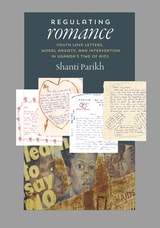
Regulating Romance
Youth Love Letters, Moral Anxiety, and Intervention in Uganda’s Time of AIDSShanti Parikh
Vanderbilt University Press, 2016
Parikh also examines the unintended consequences of Uganda's aggressive HIV campaigns that thrust sexuality and anxieties about it into the public sphere. In a context of economic precarity and generational tension that constantly complicates young people's notions of consumption-based romance, communities experience the dilemmas of protecting and policing young people from reputational and health dangers of sexual activity. "They arrested me for loving a school girl" is the title of a chapter on controlling delinquent daughters and punishing defiant boyfriends for attempting to undermine patriarchal authority by asserting their adolescent romantic agency. Sex education programs struggle between risk and pleasure amidst morally charged debates among international donors and community elders, transforming the youthful female body into a platform for public critique and concern. The many sides of this research constitute an eloquently executed critical anthropology of intervention.

Regulating the Press
Tom O'Malley and Clive Soley
Pluto Press, 2000
Regulatory Justice
Implementing a Wage-Price FreezeRobert A. Kagan
Russell Sage Foundation, 1978
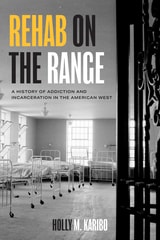
Rehab on the Range
A History of Addiction and Incarceration in the American WestHolly M. Karibo
University of Texas Press, 2024
2026 Texas Christian University (TCU) Texas Book Award Winner
2025 Coral Horton Tullis Memorial Prize, Texas State Historical Association
2025 Outstanding Academic Title, CHOICE
The first study of the Fort Worth Narcotic Farm, an institution that played a critical role in fusing the War on Drugs, mass incarceration, and public health in the American West.
In 1929, the United States government approved two ground-breaking and controversial drug addiction treatment programs. At a time when fears about a supposed rise in drug use reached a fevered pitch, the emergence of the nation’s first “narcotic farms” in Fort Worth, Texas, and Lexington, Kentucky, marked a watershed moment in the treatment of addiction. Rehab on the Range is the first in-depth history of the Fort Worth Narcotic Farm and its impacts on the American West. Throughout its operation from the 1930s to the 1970s, the institution was the only federally funded drug treatment center west of the Mississippi River. Designed to blend psychiatric treatment, physical rehabilitation, and vocational training, the Narcotic Farm, its proponents argued, would transform American treatment policies for the better. The reality was decidedly more complicated.
Holly M. Karibo tells the story of how this institution—once framed as revolutionary for addiction care—ultimately contributed to the turn towards incarceration as the solution to the nation’s drug problem. Blending an intellectual history of addiction and imprisonment with a social history of addicts’ experiences, Rehab on the Range provides a nuanced picture of the Narcotic Farm and its cultural impacts. In doing so, it offers crucial historical context that can help us better understand our current debates over addiction, drug policy, and the rise of mass incarceration.
Rehabilitative Postsocialism
Disability, Sex, and Race in Eastern EuropeKaterina Kolárová
University of Michigan Press, 2025
Winner of the 2019 Tobin Siebers Prize for Disability Studies in the Humanities
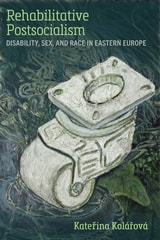
Kateřina Kolářová’s Rehabilitative Postsocialism offers a timely interdisciplinary and intersectional analysis of how disability, race, class, and gender operate as ideological tools within the postsocialist Czech Republic (formerly Czechoslovakia). Kolářová presents postsocialism as an analytic that can and should be brought to bear to understand cultural politics, economic formations, and state politics through the present day.
Rehabilitative Postsocialism names disability, sexuality, and race as central yet invisible to negotiations of the postsocialist consensus. Drawing from a rich and varied archive, Rehabilitative Postsocialism maps the formation of new structures of inequalities and social imaginaries of wellness, merit, and justice in order to understand current articulations of global disenchantment with democracy, social justice, and solidarity. The book also makes clear that disability, race, and ethnicity continue to circulate in depictions of Eastern Europe as suspended in a chronic developmental “delay.” Rehabilitative Postsocialism both situates this positioning within its political and historical formation and offers the analytical tools to challenge its continued deployment.

Reichsrock
The International Web of White-Power and Neo-Nazi Hate MusicDyck, Kirsten
Rutgers University Press, 2016
Reign of Virtue
Mobilizing Gender in Vichy FranceMiranda Pollard
University of Chicago Press, 1998
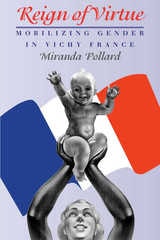
Drawing on governmental archives, historical texts, and propaganda, Pollard explores what most historians have ignored: the many ways in which Vichy's politicians used gendered images of work, family, and sexuality to restore and maintain political and social order. She argues that Vichy wanted to return France to an illustrious and largely mythical past of harmony, where citizens all knew their places and fulfilled their responsibilities, where order prevailed. The National Revolution, according to Pollard, replaced the ideals of liberty, equality, and fraternity with work, family, and fatherland, making the acceptance of traditional masculine and feminine roles a key priority. Pollard shows how Vichy's policies promoted the family as the most important social unit of a new France and elevated married mothers to a new social status even as their educational, employment, and reproductive rights were strictly curtailed.
Reigning the River
Urban Ecologies and Political Transformation in KathmanduAnne M. Rademacher
Duke University Press, 2011
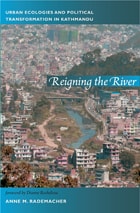
Rademacher conducted research during a volatile period in Nepal’s political history. As clashes between Maoist revolutionaries and the government intensified, the riverscape became a site of competing claims to a capital city that increasingly functioned as a last refuge from war-related violence. In this time of intense flux, efforts to ensure, create, or imagine ecological stability intersected with aspirations for political stability. Throughout her analysis, Rademacher emphasizes ecology as an important site of dislocation, entitlement, and cultural meaning.
Reimaging Britain
500 Years of Black and Asian HistoryRon Ramdin
Pluto Press, 1999
Blacks and Asians have a long history in the British Isles. Ramdin illustrates this by covering a 500-year period, from 1500 to the present day. He recounts the major historical episodes and covers all the major figures, including Ottobah Cugoano, William Cuffay, William Davidson, George Padmore, Mary Seacole, C.L.R. James, V.S. Naipaul, Sam Selvon, Walter Tull, Shirley Bassey, Bill Morris, Salman Rushdie, Hanif Kureshi and Bernie Grant.
In bringing the largely hidden histories of these immigrant communities to the fore, Ron Ramdin’s wide-ranging study challenges conventional histories of the British Isles. Reimaging Britain will lead to a reappraisal of how ‘British’ history is written in the future.
Reimagining "To Kill a Mockingbird"
Family, Community, and the Possibility of Equal Justice under LawAustin Sarat
University of Massachusetts Press, 2013
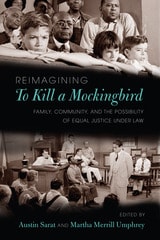
The readings in this volume peel back the film's visual representation of the many-layered social world of Maycomb, Alabama, offering sometimes counterintuitive insights through the prism of a number of provocative contemporary theoretical and interpretive questions. What, they ask, is the relationship between the subversion of social norms and the doing of justice or injustice? Through what narrative and visual devices are some social hierarchies destabilized while others remain hegemonic? How should we understand the sacrifices characters make in the name of justice, and comprehend their failures in achieving it?
Asking such questions casts light on the film's eccentricities and internal contradictions and suggests the possibility of new interpretations of a culturally iconic text. The book examines the context that gave meaning to the film's representation of race and how debates about family, community, and race are played out and reframed in law.
Contributors include Colin Dayan, Thomas L. Dumm, Susan Sage Heinzelman, Linda Ross Meyer, Naomi Mezey, Imani Perry, and Ravit Reichman.
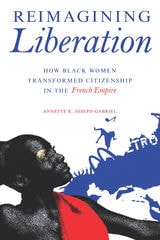
Reimagining Liberation
How Black Women Transformed Citizenship in the French EmpireAnnette K. Joseph-Gabriel
University of Illinois Press, 2019
Reimagining Livelihoods
Life beyond Economy, Society, and EnvironmentEthan Miller
University of Minnesota Press, 2019
A provocative reassessment of the concepts underlying the struggle for sustainable development
Much of the debate over sustainable development revolves around how to balance the competing demands of economic development, social well-being, and environmental protection. “Jobs vs. environment” is only one of the many forms that such struggles take. But what if the very terms of this debate are part of the problem? Reimagining Livelihoods argues that the “hegemonic trio” of economy, society, and environment not only fails to describe the actual world around us but poses a tremendous obstacle to enacting a truly sustainable future.
In a rich blend of ethnography and theory, Reimagining Livelihoods engages with questions of development in the state of Maine to trace the dangerous effects of contemporary stories that simplify and domesticate conflict. As in so many other places around the world, the trio of economy, society, and environment in Maine produces a particular space of “common sense” within which struggles over life and livelihood unfold. Yet the terms of engagement embodied by this trio are neither innocent nor inevitable. It is a contingent, historically produced configuration, born from the throes of capitalist industrialism and colonialism. Drawing in part on his own participation in the struggle over the Plum Creek Corporation’s “concept plan” for a major resort development on the shores of Moosehead Lake in northern Maine, Ethan Miller articulates a rich framework for engaging with the ethical and political challenges of building ecological livelihoods among diverse human and nonhuman communities.
In seeking a pathway for transformative thought that is both critical and affirmative, Reimagining Livelihoods provides new frames of reference for living together on an increasingly volatile Earth.
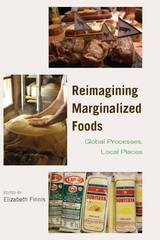
Reimagining Marginalized Foods
Global Processes, Local PlacesEdited by Elizabeth Finnis
University of Arizona Press, 2012
With globalization has come an increased focus on food—where it comes from, how it is transported, who eats it, and what cultural significance it has. This volume brings together ethnographically based anthropological analyses of shifting meanings and representations associated with the foods, ingredients, and cooking practices of marginalized and/or indigenous cultures. Contributors are particularly interested in how these foods intersect with politics, nationhood and governance, identity, authenticity, and conservation.
The chapters cover diverse locales, issues, and foods: the cultural meanings of sinonggi, a thick sago porridge from Sulawesi, Indonesia; the significance of pom, a Surinam dish popular in the Netherlands; the transformation of alpaca meat in Peru; the impact of culinary tourism on indigenous cuisine in Mexico; the re-presenting of minor millets in South India; and the development of cheeses in the Italian Alps. A conceptual essay on food and social boundaries rounds out the collection.
Throughout, the contributors address important questions, including: How are traditional foods “repackaged” in the process of mainstreaming access? What does this repackaging mean for the ways local or indigenous peoples view their traditional food practices? How are local cuisines mobilized in movements to create national images and identities? What tensions emerge between new representations of foods and local cultural meanings?
Together the contributors provide a thoughtful inquiry into what happens when food and culinary practices are moved from the cultural or physical margins, and how such movements can be shaped by—and employed in the pursuit of—political, social, and cultural goals.
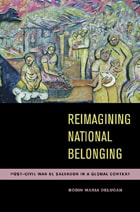
Reimagining National Belonging
Post-Civil War El Salvador in a Global ContextRobin Maria DeLugan
University of Arizona Press, 2012
Examining events that unfolded between 1992 and 2011, DeLugan both illustrates the idiosyncrasies of state and society in El Salvador and opens a larger portal into conditions of constructing a state in the present day around the globe—particularly the process of democratization in an age of neoliberalism. She demonstrates how academics, culture experts, popular media, and the United Nations and other international agencies have all helped shape ideas about national belonging in El Salvador. She also reveals the efforts that have been made to include populations that might have been overlooked, including indigenous people and faraway citizens not living inside the country’s borders. And she describes how history and memory projects have begun to recall the nation’s violent past with the goal of creating a more just and equitable nation.
This illuminating case study fills a gap in the scholarship about culture and society in contemporary El Salvador, while offering an “ethnography of the state” that situates El Salvador in a global context.
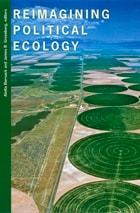
Reimagining Political Ecology
Aletta Biersack and James B. Greenberg, eds.
Duke University Press, 2006
Aletta Biersack’s introduction takes stock of where political ecology has been, assesses the field’s strengths, and sets forth a bold research agenda for the future. Two essays offer wide-ranging critiques of modernist ecology, with its artificial dichotomy between nature and culture, faith in the scientific management of nature, and related tendency to dismiss local knowledge. The remaining eight essays are case studies of particular constructions and appropriations of nature and the complex politics that come into play regionally, nationally, and internationally when nature is brought within the human sphere. Written by some of the leading thinkers in environmental anthropology, these rich ethnographies are based in locales around the world: in Belize, Papua New Guinea, the Gulf of California, Iceland, Finland, the Peruvian Amazon, Malaysia, and Indonesia. Collectively, they demonstrate that political ecology speaks to concerns shared by geographers, sociologists, political scientists, historians, and anthropologists alike. And they model the kind of work that this volume identifies as the future of political ecology: place-based “ethnographies of nature” keenly attuned to the conjunctural effects of globalization.
Contributors. Eeva Berglund, Aletta Biersack, J. Peter Brosius, Michael R. Dove, James B. Greenberg, Søren Hvalkof, J. Stephen Lansing, Gísli Pálsson, Joel Robbins, Vernon L. Scarborough, John W. Schoenfelder, Richard Wilk
Reimagining the American Pacific
From South Pacific to Bamboo Ridge and BeyondRob Wilson
Duke University Press, 2000
Wilson begins by tracing the arrival of American commerce and culture in the Pacific through missionary and imperial forces in the nineteenth century and the parallel development of Asia/Pacific as an idea. Using an impressive range of texts—from works by Herman Melville, James Michener, Maori and Western Samoan novelists, and Bamboo Ridge poets to Baywatch, films and musicals such as South Pacific and Blue Hawaii, and native Hawaiian shark god poetry—Wilson illustrates what it means for a space to be “regionalized.” Claiming that such places become more open to transnational flows of information, labor, finance, media, and global commodities, he explains how they then become isolated, their borders simultaneously crossed and fixed. In the case of Hawai’i, Wilson argues that culturally innovative, risky forms of symbol making and a broader—more global—vision of local plight are needed to counterbalance the racism and increasing imbalance of cultural capital and goods in the emerging postplantation and tourist-centered economy.
Reimagining the American Pacific leaves the reader with a new understanding of the complex interactions of global and local economies and cultures in a region that, since the 1970s, has been a leading trading partner of the United States. It is an engaging and provocative contribution to the fields of Asian and American studies, as well as those of cultural studies and theory, literary criticism, and popular culture.
Reinventing Care
Assisted Living in New York CityDavid Barton Smith
Vanderbilt University Press, 2003
In Reinventing Care, David Barton Smith offers brilliant insights into those questions by examining the realities of assisted living in New York City. Encompassing the largest, most concentrated population of elderly in the United States, New York spends more per person caring for its seniors than any other urban center. Yet, while the size of the city's care system boggles the mind, it nevertheless contains the same elements that exist in other metropolitan areas and thus provides valuable lessons for the nation as a whole.
Smith's study draws on twenty-five years of research, including hundreds of interviews and visits to representative facilities. He provides a succinct overview of how care is presently organized for New York's aging population and traces the history of the system up to the present. Among the key issues he addresses are the role of market forces and government regulation, the impact of class differences on access to quality care, and the ways in which perceptions of community affect the creation and management of assisted living programs. At the heart of the book are ten fascinating case studies, half of them focused on private-pay facilities and the other half on public-pay institutions.
While finding that the actualities of assisted living rarely match the rhetoric of its proponents, Smith sees much to admire in its goals. He suggests tactics and strategies--such as promoting family- and community-based models of assisted living and adopting a standard of licensure for certain facilities--that could point the way to a better future.
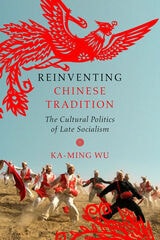
Reinventing Chinese Tradition
The Cultural Politics of Late SocialismKa-ming Wu
University of Illinois Press, 2015
Ka-ming Wu's ethnographic account of contemporary Yan'an documents how people have reworked the revival of three rural practices--paper-cutting, folk storytelling, and spirit cults--within (and beyond) the socialist legacy. Moving beyond dominant views of Yan'an folk culture as a tool of revolution or object of market reform, Wu reveals how cultural traditions become battlegrounds where conflicts among the state, market forces, and intellectuals in search of an authentic China play out. At the same time, she shows these emerging new dynamics in the light of the ways rural residents make sense of rapid social change.
Alive with details, Reinventing Chinese Tradition is an in-depth, eye-opening study of an evolving culture and society within contemporary China.
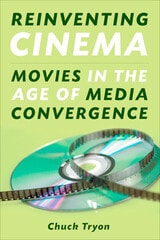
Reinventing Cinema
Movies in the Age of Media ConvergenceTryon, Chuck
Rutgers University Press, 2009
Reinventing Cinema examines film culture at the turn of this century, at the precise moment when digital media are altering our historical relationship with the movies. Spanning multiple disciplines, Chuck Tryon addresses the interaction between production, distribution, and reception of films, television, and other new and emerging media.Through close readings of trade publications, DVD extras, public lectures by new media leaders, movie blogs, and YouTube videos, Tryon navigates the shift to digital cinema and examines how it is altering film and popular culture.
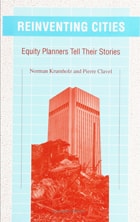
Reinventing Cities
Equity Planners Tell Their StoriesNorman Krumholz and Pierre Clavel
Temple University Press, 1994
Reinventing Cities emphasizes the extraordinary accomplishments of eleven urban planners who work for the needs of low income and working class people. Through the voices of equity planners who have worked "in the trenches" of city halls, Norman Krumholz and Pierre Clavel explore the inner dimensions of social change, economic development, community organizing, and the dynamics of implementing and producing fair housing. Preceded by "snapshots" that describe the demographics, politics, and economics of each specific city or region, the editors' interviews with these leading progressive planners highlight productive strategies, disquieting failures, and the cities in which the fought for equity.
Included are conversations with Rick Cohen, former director of Jersey City's Department of Housing and Economic Development; Dale F. Bertsch, former first director of the Miami Valley Regional Planning Commission, Dayton, Ohio; Robert Mier, former commissioner of the Department of Economic Development (DED); Kari J. Moe, former deputy commissioner of Research and Development, DED'; Arturo Vazquez, former director of Mayor Washington's Office of Employment and Training, Chicago; Margaret D. Strachan, former city commissioner, Portland, Oregon; Peter Dreier, former housing director, Boston Redevelopment Authority, and policy aide to Mayor Raymond Flynn; Billie Bramhall, planning staff, Mayor Federico Pena, Denver, Colorado; Howard Stanback, city manager, Hartford, Connecticut; Derek Shearer, former Planning Commission chairman, Santa Monica, California; and Kenneth Grimes, senior planning analyst, San Diego Housing Commission.
In the series Conflicts in Urban and Regional Development, edited by John R. Logan and Todd Swanstrom.
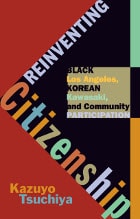
Reinventing Citizenship
Black Los Angeles, Korean Kawasaki, and Community ParticipationKazuyo Tsuchiya
University of Minnesota Press, 2014
In the 1960s and 1970s, the United States and Japan went through massive welfare expansions that sparked debates about citizenship. At the heart of these disputes stood African Americans and Koreans. Reinventing Citizenship offers a comparative study of African American welfare activism in Los Angeles and Koreans’ campaigns for welfare rights in Kawasaki. In working-class and poor neighborhoods in both locations, African Americans and Koreans sought not only to be recognized as citizens but also to become legitimate constituting members of communities.
Local activists in Los Angeles and Kawasaki ardently challenged the welfare institutions. By creating opposition movements and voicing alternative visions of citizenship, African American leaders, Tsuchiya argues, turned Lyndon B. Johnson’s War on Poverty into a battle for equality. Koreans countered the city’s and the nation’s exclusionary policies and asserted their welfare rights. Tsuchiya’s work exemplifies transnational antiracist networking, showing how black religious leaders traveled to Japan to meet Christian Korean activists and to provide counsel for their own struggles.
Reinventing Citizenship reveals how race and citizenship transform as they cross countries and continents. By documenting the interconnected histories of African Americans and Koreans in Japan, Tsuchiya enables us to rethink present ideas of community and belonging.
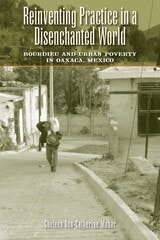
Reinventing Practice in a Disenchanted World
Bourdieu and Urban Poverty in Oaxaca, MexicoBy Cheleen Ann-Catherine Mahar
University of Texas Press, 2010
Colonia Hermosa, now considered a suburb of Oaxaca, began as a squatter settlement in the 1950s. The original residents came in search of transformation from migrants to urban citizens, struggling from rural poverty for the chance to be part of the global economy in Oaxaca.
Cheleen Ann-Catherine Mahar charts the lives of a group of residents in Colonia Hermosa over a period of thirty years, as Mexico became more closely tied into the structures of global capital, and the residents of Colonia Hermosa struggled to survive. Residents shape their discussions within a larger narrative, and their talk is the language of the heroic individual, so necessary to the ideology and the functioning of capital. However, this logic only tenuously connects to the actual material circumstances of their lives.
Mahar applies the theories of French sociologist Pierre Bourdieu to her data from Mexico in order to examine the class trajectories of migrant families over more than three decades. Through this investigation, Mahar adds an important intergenerational study to the existing body of literature on Oaxaca, particularly concerning the factors that have reshaped the lives of urban working poor families and have created a working-class fraction of globalized citizenship.

Reinventing Public Service Television for the Digital Future
Mary Debrett
Intellect Books, 2010
Since the 1980s there has been much speculation about the demise of public service television, initially because of the advent of cable and satellite television and the variety of entertainment channels they offer. While the proliferation of global niche media might seem to accelerate the demise of public television, in reality, public broadcasters are undergoing a reinvention. Reinventing Public Service Television for the Digital Future draws on fifty interviews with media industry and academic specialists from four countries to discuss on how public service broadcasting institutions are responding to the changes in digital media. This seminal work offers superior insights into the constraints and possibilities of the public service system and its prospects for survival in the age of on-demand media.
Reinventing the Austin City Council
Ann O'M. Bowman
Temple University Press, 2020
Reinventing the Austin City Council explores the puzzle that was Austin’s reluctance to alter its at-large system and establish a geographically-based, single-member district system. Ann Bowman chronicles the repeated attempts to change the system, the eventual decision to do so, and the consequences of that change. In the process, she explores the many twists and turns that occurred in Austin as it struggled to design a fair system of representation. Reinventing the Austin City Council assesses the impact of the new district system since its inception in 2014.
Austin’s experience ultimately offers a political lesson for creating institutional change.
Reinventing the Good Life
An Empirical Contribution to the Philosophy of CareJeannette Pols
University College London, 2023
Ever since Adam Smith’s musings on “the invisible hand” became more famous than his work on moral sentiments, social theorists started to pay less attention to everyday ethics and aesthetics. Smith’s metaphor of the invisible hand posits that social outcomes emerge by dint of the behaviors of individuals rather than their intentions or virtues.
Modernist and scientific approaches to determining the common good or good forms of governance have increasingly relied on techniques of generalization, rationalization, and universalization. Everyday ethics and aesthetics—and recently also matters of truth—came to be regarded as individual matters of taste. This shift, however, has meant that we no longer comprehend why and how people display a deep concern with everyday life values in their social practices. People continue to enact these values and live by them while academics lack the vocabulary and methods to grasp them.
By reconstructing the history of ideas about everyday-life values, and by analyzing the role of such values in contemporary care practices for patients with chronic disease in the Netherlands, Reinventing the Good Life seeks to explore new ways to study the values of everyday life, particularly in situations where the achievement of a clear-cut or uniform good is unlikely. The book presents a practice-based epistemology and methodology for studying everyday care practices and supporting their goodness. This analytical approach ultimately aims to generate ideas that will allow us to relate in more imaginative ways to the many pressing concerns that we are forced to live with today.
Reinventing the State
Economic Strategy and Institutional Change in PeruCarol Wise
University of Michigan Press, 2003
Reinvention and History Making in Huarochirí
A Local Narrative of Colonialism in the Peruvian AndesCarla Hernández Garavito
University of Arizona Press, 2026
Using archaeological and historical datasets and spatial modeling, this book centers on local memory and experience throughout colonized landscapes as the thread that connects the long history of Indigenous engagement with expanding colonial empires and the emergent Peruvian nation. The author builds on Andean epistemological frameworks to argue that in the face of drastic sociopolitical changes, the people of Huarochirí turned to their own history. They created analogies and shared spaces between local and Inka landscapes and materiality and incorporated written representations and ideas of settled lives to validate their claims.
This exciting new work moves the field of Andean archaeology into conversations with decolonial and decolonizing methodologies and shows how Indigenous communities captured and made sense of their long history, reframing colonialism as a local experience.
Rejuvenating the Humanities
Ray B. Browne
University of Wisconsin Press, 1992
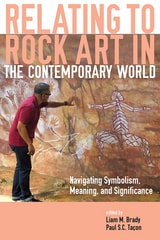
Relating to Rock Art in the Contemporary World
Navigating Symbolism, Meaning, and SignificanceLiam M. Brady
University Press of Colorado, 2016
One of the most visually striking forms of material culture embedded in landscapes, rock art is ascribed different meanings by diverse groups of people including indigenous peoples, governments, tourism offices, and the general public, all of whom relate to images and sites in unique ways. In this volume, leading scholars from around the globe shift the discourse from a primarily archaeological basis to one that examines the myriad ways that symbolism, meaning, and significance in rock art are being renegotiated in various geographical and cultural settings, from Australia to the British Isles. They also consider how people manage the complex meanings, emotions, and cultural and political practices tied to rock art sites and how these factors impact processes relating to identity construction and reaffirmation today.
Richly illustrated and geographically diverse, Relating to Rock Art in the Contemporary World connects archaeology, anthropology, and heritage studies. The book will appeal to students and scholars of archaeology, anthropology, heritage, heritage management, identity studies, art history, indigenous studies, and visual theory, as well as professionals and amateurs who have vested or avocational interests in rock art.
Contributors: Agustín Acevedo, Manuel Bea, Jutinach Bowonsachoti, Gemma Boyle, John J. Bradley, Noelene Cole, Inés Domingo, Kurt E. Dongoske, Davida Eisenberg-Degen, Dánae Fiore, Ursula K. Frederick, Kelley Hays-Gilpin, Catherine Namono, George H. Nash, John Norder, Marianna Ocampo, Joshua Schmidt, Duangpond Singhaseni, Benjamin W. Smith, Atthasit Sukkham, Noel Hidalgo Tan, Watinee Tanompolkrang, Luke Taylor, Dagmara Zawadzka
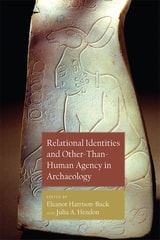
Relational Identities and Other-than-Human Agency in Archaeology
Eleanor Harrison-Buck
University Press of Colorado, 2020
Relational Identities and Other-than-Human Agency in Archaeology explores the benefits and consequences of archaeological theorizing on and interpretation of the social agency of nonhumans as relational beings capable of producing change in the world. The volume cross-examines traditional understanding of agency and personhood, presenting a globally diverse set of case studies that cover a range of cultural, geographical, and historical contexts.
Agency (the ability to act) and personhood (the reciprocal qualities of relational beings) have traditionally been strictly assigned to humans. In case studies from Ghana to Australia to the British Isles and Mesoamerica, contributors to this volume demonstrate that objects, animals, locations, and other nonhuman actors also potentially share this ontological status and are capable of instigating events and enacting change. This kind of other-than-human agency is not a one-way transaction of cause to effect but requires an appropriate form of reciprocal engagement indicative of relational personhood, which in these cases, left material traces detectable in the archaeological record.
Modern dualist ontologies separating objects from subjects and the animate from the inanimate obscure our understanding of the roles that other-than-human agents played in past societies. Relational Identities and Other-than-Human Agency in Archaeology challenges this essentialist binary perspective. Contributors in this volume show that intersubjective (inherently social) ways of being are a fundamental and indispensable condition of all personhood and move the debate in posthumanist scholarship beyond the polarizing dichotomies of relational versus bounded types of persons. In this way, the book makes a significant contribution to theory and interpretation of personhood and other-than-human agency in archaeology.
Contributors:
Susan M. Alt, Joanna Brück, Kaitlyn Chandler, Erica Hill, Meghan C. L. Howey, Andrew Meirion Jones, Matthew Looper, Ian J. McNiven, Wendi Field Murray, Timothy R. Pauketat, Ann B. Stahl, Maria Nieves Zedeño

Relations
An Anthropological AccountMarilyn Strathern
Duke University Press, 2020
Relationship
The Heart of Helping PeopleHelen Harris Perlman
University of Chicago Press, 1979
Relative Races
Genealogies of Interracial Kinship in Nineteenth-Century AmericaBrigitte Fielder
Duke University Press, 2020

Relative Values
Reconfiguring Kinship StudiesSarah Franklin and Susan McKinnon, eds.
Duke University Press, 2001
Ideas about kinship are vital not only to understanding but also to forming many of the practices and innovations of contemporary society. How do the cultural logics of contemporary biopolitics, commodification, and globalization intersect with kinship practices and theories? In what ways do kinship analogies inform scientific and clinical practices; and what happens to kinship when it is created in such unfamiliar sites as biogenetic labs, new reproductive technology clinics, and the computers of artificial life scientists? How does kinship constitute—and get constituted by—the relations of power that draw lines of hierarchy and equality, exclusion and inclusion, ambivalence and violence? The contributors assess the implications for kinship of such phenomena as blood transfusions, adoption across national borders, genetic support groups, photography, and the new reproductive technologies while ranging from rural China to mid-century Africa to contemporary Norway and the United States. Addressing these and other timely issues, Relative Values injects new life into one of anthropology's most important disciplinary traditions.
Posing these and other timely questions, Relative Values injects an important interdisciplinary curiosity into one of anthropology’s most important disciplinary traditions.
Contributors. Mary Bouquet, Janet Carsten, Charis Thompson Cussins, Carol Delaney, Gillian Feeley-Harnik, Sarah Franklin, Deborah Heath, Stefan Helmreich, Signe Howell, Jonathan Marks, Susan McKinnon, Michael G. Peletz, Rayna Rapp, Martine Segalen, Pauline Turner Strong, Melbourne Tapper, Karen-Sue Taussig, Kath Weston, Yunxiang Yan
Religion and Adaptation
William Adams
CSLI, 2004
The volume uses a wide variety of ethnographic and historical sources to support its analysis, beginning with two detailed case studies of the religions practiced by Navajo Indians and Arab villagers. An intriguing comparison of these two systems of faith reveals the difficulty of finding one definition of religion. William Adams explores this problem of definition, suggesting that religion and science actually share the role of providing logical explanations in human society. In subsequent chapters, he considers the development of religious systems, the growth of religious consciousness in the individual, and the dynamics of religious change. The book ultimately aims to be a purely empirical study that probes the reasons for the existence of religion and its role as a moral and stabilizing force in human societies.
Religion and Jewish Identity in the Soviet Union, 1941–1964
Mordechai Altshuler
Brandeis University Press, 2012
Religion and Social Justice For Immigrants
Hondagneu-Sotelo, Pierrette
Rutgers University Press, 2006
Religion has jumped into the sphere of global and domestic politics in ways that few would have imagined a century ago. Some expected that religion would die as modernity flourished. Instead, it now stares at us almost daily from the front pages of newspapers and television broadcasts. Although it is usually stories about the Christian Right or conservative Islam that grab headlines, there are many religious activists of other political persuasions that are working quietly for social justice. This book examines how religious immigrants and religious activists are working for equitable treatment for immigrants in the United States.
The essays in this book analyze the different ways in which organized religion provides immigrants with an arena for mobilization, civic participation, and solidarity. Contributors explore topics including how non-Western religious groups such as the Vietnamese Caodai are striving for community recognition and addressing problems such as racism, economic issues, and the politics of diaspora; how interfaith groups organize religious people into immigrant civil rights activists at the U.S.–Mexican border; and how Catholic groups advocate governmental legislation and policies on behalf of refugees.

Religion and Spanish Film
Luis Buñuel, the Franco Era, and Contemporary DirectorsElizabeth Scarlett
University of Michigan Press, 2014
Religion and Spirituality in Korean America
Edited by David K. Yoo and Ruth H. Chung
University of Illinois Press, 2007
Contributors: Ruth H. Chung, Jae Ran Kim, Jung Ha Kim, Rebecca Kim, Sharon Kim, Okyun Kwon, Sang Hyun Lee, Anselm Kyongsuk Min, Sharon A. Suh, Sung Hyun Um, and David K. Yoo
Religion and the Culture of Print in Modern America
Edited by Charles L. Cohen and Paul S. Boyer
University of Wisconsin Press, 2008
Religion and the Politics of Time
Noah Shusterman
Catholic University of America Press, 2010
Religion and the Social Sciences
Basic and Applied Research PerspectivesJeff Levin
Templeton Press, 2018
To give this research the attention it deserves, editor Jeff Levin assembled a panel of preeminent social scientists and gave them a single directive: write the ultimate statement on religion from within their respective social science discipline or field. The result is this single volume, “state-of-the-science” compendium—a first of its kind for the study of religion.
Composed of ten essays, this book details the study of religion within nine basic and applied areas of social science. Along with a critical introduction to this subject, these essays include the expert contributions of:
- Kenneth I. Pargament & Julie J. Exline on psychology
- Anthony Gill on political science
- Charles M. North on economics
- Barry Hankins on history
- Annette Mahoney on family studies
- Byron R. Johnson on criminology
- Linda K. George on gerontology
- William H. Jeynes on education
- Jeff Levin on epidemiology
- An introduction to the history of the discipline’s or field’s religious research, as well as its most important people and published works.
- A comprehensive overview of key research findings and theories.
- A detailed research agenda to guide future scholars.
- An annotated bibliography of seminal works for the reader’s further consideration.
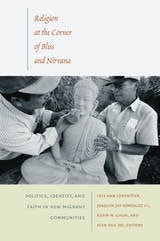
Religion at the Corner of Bliss and Nirvana
Politics, Identity, and Faith in New Migrant CommunitiesLois Ann Lorentzen, Joaquin Jay Gonzalez III, Kevin M. Chun and Hien Duc Do, eds.
Duke University Press, 2009
As they conducted research, the contributors not only visited churches and temples but also single-room-occupancy hotels, brothels, tattoo-removal clinics, and the streets of San Francisco, El Salvador, Mexico, and Vietnam. Their essays include an exploration of how faith-based organizations can help LGBT migrants surmount legal and social complexities, an examination of transgendered sex workers’ relationship with the unofficial saint Santisima Muerte, a comparison of how a Presbyterian mission and a Buddhist temple in San Francisco help Chinese immigrants to acculturate, and an analysis of the transformation of baptismal rites performed by Mayan migrants. The voices of gang members, Chinese and Vietnamese Buddhist nuns, members of Pentecostal churches, and many others animate this collection. In the process of giving voice to these communities, the contributors interrogate theories about acculturation, class, political and social capital, gender and sexuality, the sociology of religion, transnationalism, and globalization. The collection includes twenty-one photographs by Jerry Berndt.
Contributors. Luis Enrique Bazan, Kevin M. Chun, Hien Duc Do, Patricia Fortuny Loret de Mola, Joaquin Jay Gonzalez III, Sarah Horton, Cymene Howe, Mimi Khúc, Jonathan H. X. Lee, Lois Ann Lorentzen, Andrea Maison, Dennis Marzan, Rosalina Mira, Claudine del Rosario, Susanna Zaraysky
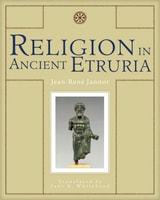
Religion in Ancient Etruria
Jean-René Jannot, Translated by Jane K. Whitehead
University of Wisconsin Press, 2005
Provocative insights and thoughtful discussions contribute to an understanding of the prophetic nature of Etruscan culture. Jannot investigates the elaborate systems of defining space and time that so distinctly characterize this ancient society. Religion in Ancient Etruria offers a unique perspective that illuminates the origins of some of our own "modern" religious beliefs.
This updated edition includes more than 100 illustrations that demonstrate early temples, statues, mirrors, tablets, and sculptures.
1998 French edition, Picard

Religion is Not about God
How Spiritual Traditions Nurture our Biological Nature and What to Expect When They FailLoyal Rue
Rutgers University Press, 2006
Thousands of religious traditions have appeared over the course of human history but only a relative few have survived. Some speak of a myriad of gods, others of only one, and some recognize no gods at all. Volumes have been written attempting to prove the existence or nonexistence of supernatural being(s). So, if religion is not about God, then what is it about?
In this provocative book, Loyal Rue contends that religion, very basically, is about us. Successful religions are narrative (myth) traditions that influence human nature so that we might think, feel, and act in ways that are good for us, both individually and collectively. Through the use of images, symbols, and rituals, religion promotes reproductive fitness and survival through the facilitation of harmonious social relations. Drawing on examples from the major traditions—Judaism, Christianity, Islam, Hinduism, and Buddhism—Rue shows how each religion, in its own way, has guided human behavior to advance the twin goals of personal fulfillment and social coherence.
As all faiths are increasingly faced with a crisis of intellectual plausibility and moral relevance, this book presents a compelling and positive view of the centrality and meaning of religion.

Religion is Not about God
How Spiritual Traditions Nurture our Biological Nature and What to Expect When They FailLoyal Rue
Rutgers University Press, 2006
2006 Choice Outstanding Academic Title
Thousands of religious traditions have appeared over the course of human history but only a relative few have survived. Some speak of a myriad of gods, others of only one, and some recognize no gods at all. Volumes have been written attempting to prove the existence or nonexistence of supernatural being(s). So, if religion is not about God, then what is it about?
In this provocative book, Loyal Rue contends that religion, very basically, is about us. Successful religions are narrative (myth) traditions that influence human nature so that we might think, feel, and act in ways that are good for us, both individually and collectively. Through the use of images, symbols, and rituals, religion promotes reproductive fitness and survival through the facilitation of harmonious social relations. Drawing on examples from the major traditions—Judaism, Christianity, Islam, Hinduism, and Buddhism—Rue shows how each religion, in its own way, has guided human behavior to advance the twin goals of personal fulfillment and social coherence.
As all faiths are increasingly faced with a crisis of intellectual plausibility and moral relevance, this book presents a compelling and positive view of the centrality and meaning of religion.
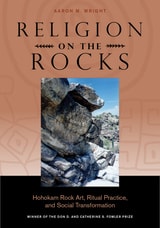
Religion on the Rocks
Hohokam Rock Art, Ritual Practice, and Social TransformationAaron M. Wright
University of Utah Press, 2014
We are nearly all intrigued by the petroglyphs and pictographs of the American Southwest, and we commonly ask what they “mean”. Religion on the Rocks redirects our attention to the equally important matter of what compelled ancient peoples to craft rock art in the first place. To examine this question, Aaron Wright presents a case study from Arizona's South Mountains, an area once flanked by several densely populated Hohokam villages. Synthesizing results from recent archaeological surveys, he explores how the mountains' petroglyphs were woven into the broader cultural landscape and argues that the petroglyphs are relics of a bygone ritual system in which people vied for prestige and power by controlling religious knowledge. The features and strategic placement of the rock art suggest this dimension of Hohokam ritual was participatory and prominent in village life. Around AD 1100, however, petroglyph creation and other ritual practices began to wane, denoting a broad transformation of the Hohokam social world. Wright’s examination of the South Mountains petroglyphs offers a novel narrative of how Hohokam villagers negotiated a concentration of politico-religious authority around platform mounds. Readers will come away with a better understanding of the Hohokam legacy and a greater appreciation for rock art's value to anthropology.
Religion or Ethnicity?
Jewish Identities in EvolutionGitelman, Zvi
Rutgers University Press, 2009
In Religion or Ethnicity? fifteen leading scholars trace the evolution of Jewish identity. The book examines Judaism from the Greco-Roman age, through medieval times, modern western and eastern Europe, to today. Jewish identity has been defined as an ethnicity, a nation, a culture, and even a race. Religion or Ethnicity? questions what it means to be Jewish. The contributors show how the Jewish people have evolved over time in different ethnic, religious, and political movements. In his closing essay, Gitelman questions the viability of secular Jewishness outside Israel but suggests that the continued interest in exploring the relationship between Judaism's secular and religious forms will keep the heritage alive for generations to come.