Results by title
2728 books match the query 'Education' and 151 start with r
Recommended Principles to Guide Academy-Industry Relationships
American Association of University Professors
University of Illinois Press, 2014
• Preserving the integrity of research and public respect for higher education
• Eliminating and managing individual and institutional financial conflicts of interest
• Maintaining unbiased hiring and recruitment policies
• Establishing grievance procedures and due process rights for faculty, graduate students, and academic professionals
• Mastering the complications of negotiations over patents and copyright
• Assuring the ethics of research involving human subjects.
In a time of dynamic change Recommended Principles to Guide Academy-Industry Relationships offers an indispensable and authoritative guide to sustaining integrity and tradition while achieving great things in twenty-first century academia.
Reconceptualizing Response
Using Instructor Feedback to Promote Linguistic JusticeKelly Blewett
Utah State University Press, 2026
Reconceptualizing Response reframes instructor feedback, one of the most consequential practices in rhetoric and writing studies, as a site of linguistic justice. Instructor response is not merely technical commentary; it is contested terrain where students’ identities, experiences, and language varieties must be named, supported, and celebrated.
Contributors represent a wide range of institutional contexts—including two-year colleges, four-year universities, HBCUs, HSIs, SLACs, and PWIs—and write from diverse positionalities, amplifying current debates and productive tensions in the field. Organized around four key moves—looking back, looking within, looking up, and looking around—the book invites readers to critically examine the ideologies underlying feedback practices; recognize how instructors' positionality, values, and beliefs are communicated through feedback; align feedback with students’ needs; and reconsider the broader classroom ecology required for justice. Bridging linguistic justice and feedback studies, this collection provides concrete tools and frameworks, as well as sample rubrics, course policies, and fresh approaches to assessment.
Ideal for graduate students, writing program administrators, faculty teaching future writing instructors, and anyone seeking to transform classroom practice, Reconceptualizing Response offers guiding questions for reflection and practical strategies for change. This volume reimagines instructor response as a catalyst for equity, consciousness-raising, and transformation, calling instructors not only to comment on writing but also to use feedback to dismantle oppressive logics and foster linguistic justice.
Reconstructing Response to Student Writing
A National Study from across the CurriculumDan Melzer
Utah State University Press, 2023
Presenting the results of a national study of teacher and peer response and student self-assessment at institutions of higher education across the United States, Melzer analyzes teacher and peer response to over 1,000 pieces of student writing as well as 128 student portfolio reflection essays. He draws on his analysis and on a comprehensive review of the literature on response to introduce a constructivist heuristic for response aimed at both composition instructors and instructors across disciplines. Melzer argues that teachers and researchers should focus less on teacher response to individual pieces of student writing and more on engaging in dialogue with student self-assessment and peer response, focusing on growth and transfer rather than products and grades.
Reconstructing Response to Student Writing, especially when taken together with Melzer’s previous book Assignments across the Curriculum, provides a comprehensive and large-scale view of college writing and responding across the curriculum in the United States.
Reconstructing the Academy
Women's Education and Women's StudiesEdited by Elizabeth Minnich, Jean F. O'Barr, and Rachel A. Rosenfeld
University of Chicago Press, 1988
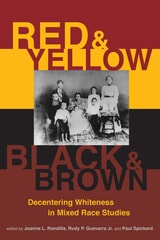
Red and Yellow, Black and Brown
Decentering Whiteness in Mixed Race StudiesRondilla, Joanne L
Rutgers University Press, 2017
Redefining Geek
Bias and the Five Hidden Habits of Tech-Savvy TeensCassidy Puckett
University of Chicago Press, 2022
A surprising and deeply researched look at how everyone can develop tech fluency by focusing on five easily developed learning habits.
Picture a typical computer geek. Likely white, male, and someone you’d say has a “natural instinct” for technology. Yet, after six years teaching technology classes to first-generation, low-income middle school students in Oakland, California, Cassidy Puckett has seen firsthand that being good with technology is not something people are born with—it’s something they learn. In Redefining Geek, she overturns the stereotypes around the digitally savvy and identifies the habits that can help everyone cultivate their inner geek.
Drawing on observations and interviews with a diverse group of students around the country, Puckett zeroes in on five technology learning habits that enable tech-savvy teens to learn new technologies: a willingness to try and fail, management of frustration and boredom, use of models, and the abilities to use design logic and identify efficiencies. In Redefining Geek, she shows how to measure and build these habits, and she demonstrates how many teens historically marginalized in STEM are already using these habits and would benefit from recognition for their talent, access to further learning opportunities, and support in career pathways. She argues that if we can develop, recognize, and reward these technological learning habits in all kids—especially girls and historically marginalized racial and ethnic groups—we can address many educational inequities and disparities in STEM.
Revealing how being good with technology is not about natural ability but habit and persistence, Redefining Geek speaks to the ongoing conversation on equity in technology education and argues for a more inclusive technology learning experience for all students.
Redefining Roles
The Professional, Faculty, and Graduate Consultant’s Guide to Writing CentersMegan Swihart Jewell
Utah State University Press, 2021
Thirty-two authors, consultants, and administrators from diverse centers—from large public four-year institutions to a private, online for-profit university—provide both theoretical frameworks and practical applications in eighteen chapters. Ten chapters focus on graduate consultants and address issues of authority, training, professional development, and mentoring, and eight focus on professional and faculty consultant training as well as specific issues of identity and authority. By sharing these voices, Redefining Roles broadens the very idea of writing centers while opening the door to more dialogue on the important role these practitioners play.
Redefining Roles is designed for writing center practitioners, scholars, and staff. It is also a necessary addition to help campus administrators in the ongoing struggle to validate the intellectually complex work that such staff performs.
Contributors: Fallon N. Allison, Vicki Behrens, Cassie J. Brownell, Matt Burchanoski, Megan Boeshart Burelle, Danielle Clapham, Steffani Dambruch, Elise Dixon, Elizabeth Festa, Will Fitzsimmons, Alex Frissell, Alex Funt, Genie Giaimo, Amanda Gomez, Lisa Lamson, Miriam E. Laufer, Kristin Messuri, Rebecca Nowacek, Kimberly Fahle Peck, Mark Pedretti, Irina Ruppo, Arundhati Sanyal, Anna Scanlon, Matthew Sharkey-Smith, Kelly A. Shea, Anne Shiell, Anna Sicari, Catherine Siemann, Meagan Thompson, Lisa Nicole Tyson, Marcus Weakley, Alex Wulff
Redefining Success in America
A New Theory of Happiness and Human DevelopmentMichael Kaufman
University of Chicago Press, 2019
Returning to the legendary Harvard Student Study of undergraduates from the 1960s and interviewing participants almost fifty years later, Kaufman shows that formative experiences in family, school, and community largely shape a future adult’s worldview and well-being by late adolescence, and that fundamental change in adulthood, when it occurs, is shaped by adult family experiences, not by ever-greater competitive success. Published research on general samples shows that these patterns, and the book’s findings generally, are broadly applicable to demographically varied populations in the United States.
Leveraging biography-length clinical interviews and quantitative evidence unmatched even by earlier landmark studies of human development, Redefining Success in America redefines the conversation about the nature and origins of happiness, and about how adults develop. This longitudinal study pioneers a new paradigm in happiness research, developmental science, and personality psychology that will appeal to scholars and students in the social sciences, psychotherapy professionals, and serious readers navigating the competitive journey.
Refiguring Prose Style
Possibilities For Writing Pedagogyedited by T. R. Johnson & Thomas Pace
Utah State University Press, 2005
For about two decades, say Johnson and Pace, the discussion of how to address prose style in teaching college writing has been stuck, with style standing in as a proxy for other stakes in the theory wars.
The traditional argument is evidently still quite persuasive to some—that teaching style is mostly a matter of teaching generic conventions through repetition and practice. Such a position usually presumes the traditional view of composition as essentially a service course, one without content of its own. On the other side, the shortcomings of this argument have been much discussed—that it neglects invention, revision, context, meaning, even truth; that it is not congruent with research; that it ignores 100 years of scholarship establishing composition's intellectual territory beyond "service."
The discussion is stuck there, and all sides have been giving it a rest in recent scholarship. Yet style remains of vital practical interest to the field, because everyone has to teach it one way or another.
A consequence of the impasse is that a theory of style itself has not been well articulated. Johnson and Pace suggest that moving the field toward a better consensus will require establishing style as a clearer subject of inquiry.
Accordingly, this collection takes up a comprehensive study of the subject. Part I explores the recent history of composition studies, the ways it has figured and all but effaced the whole question of prose style. Part II takes to heart Elbow's suggestion that composition and literature, particularly as conceptualized in the context of creative writing courses, have something to learn from each other. Part III sketches practical classroom procedures for heightening students' abilities to engage style, and part IV explores new theoretical frameworks for defining this vital and much neglected territory.
The hope of the essays here—focusing as they do on historical, aesthetic, practical, and theoretical issues—is to awaken composition studies to the possibilities of style, and, in turn, to rejuvenate a great many classrooms.
Refiguring Rhetorical Education
Women Teaching African American, Native American, and Chicano/a Students, 1865-1911Jessica Enoch
Southern Illinois University Press, 2008
Refiguring Rhetorical Education: Women Teaching African American, Native American, and Chicano/a Students, 1865-1911 examines the work of five female teachers who challenged gendered and cultural expectations to create teaching practices that met the civic and cultural needs of their students.
The volume analyzes Lydia Maria Child’s The Freedmen’s Book, a post–Civil War educational textbook for newly freed slaves; Zitkala Ša’s autobiographical essays published in the Atlantic Monthly in 1900 that questioned the work of off-reservation boarding schools for Native American students; and Jovita Idar, Marta Peña, and Leonor Villegas de Magnón’s contributions to the Spanish-language newspaper La Crónica in 1910 and 1911—contributions that offered language and cultural instruction their readers could not receive in Texas public schools.
Author Jessica Enoch explores the possibilities and limitations of rhetorical education by focusing on the challenges that Child, Zitkala Ša, Idar, Peña, and Villegas made to dominant educational practices. Each of these teachers transformed their seemingly apolitical occupation into a site of resistance, revising debilitating educational methods to advance culture-based and politicized teachings that empowered their students to rise above their subjugated positions.
Refiguring Rhetorical Education considers how race, culture, power, and language are both implicit and explicit in discussions of rhetorical education for marginalized students and includes six major tenets to guide present-day pedagogies for civic engagement.
Reflection In The Writing Classroom
Kathleen Blake Yancey
Utah State University Press, 1998
Yancey explores reflection as a promising body of practice and inquiry in the writing classroom. Yancey develops a line of research based on concepts of philosopher Donald Schon and others involving the role of deliberative reflection in classroom contexts. Developing the concepts of reflection-in-action, constructive reflection, and reflection-in-presentation, she offers a structure for discussing how reflection operates as students compose individual pieces of writing, as they progress through successive writings, and as they deliberately review a compiled body of their work-a portfolio, for example. Throughout the book, she explores how reflection can enhance student learning along with teacher response to and evaluation of student writing.
Reflection in the Writing Classroom will be a valuable addition to the personal library of faculty currently teaching in or administering a writing program; it is also a natural for graduate students who teach writing courses, for the TA training program, or for the English Education program.
Reflections on the Pandemic
COVID and Social Crises in the Year Everything ChangedTeresa Politano
Rutgers University Press, 2024
Contributors include: Patricia Akhimie, Marc Aronson, Ulla D. Berg, Stephanie Bonne, Stephanie Boyer, Kimberly Camp, Jordan Casteel, Kelly-Jane Cotter, Mark Doty, David Dreyfus, Adrienne E. Eaton, Katherine C. Epstein, Leah Falk, Paul G. Falkowski, Rigoberto González, James Goodman, David Greenberg, Angelique Haugerud, Grace Lynne Haynes, Leslieann Hobayan, Jonathan Holloway, James W. Hughes, Naomi Jackson, Amy Jordan, Vikki Katz, Mackenzie Kean, Robert E. Kopp, Christian Lighty, Stephen Masaryk, Louis P. Masur, Revathi V. Machan, Yalidy Matos, Belinda McKeon, Susan L. Miller, Yehoshua November, Joyce Carol Oates, Mary E. O’Dowd, Katherine Ognyanova, David Orr, Gregory Pardlo, Steve Pikiell, Teresa Politano, en Purkert, Nick Romanenko, Evie Shockley, Caridad Svich, and Didier William.
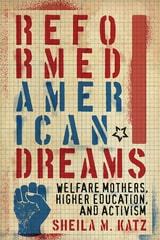
Reformed American Dreams
Welfare Mothers, Higher Education, and ActivismSheila M. Katz
Rutgers University Press, 2019
Reformers, Teachers, Writers
Curricular and Pedagogical InquiriesNeal Lerner
Utah State University Press, 2019
Lerner’s mixed-methods approach—quantitative, qualitative, textual, historical, narrative, and theoretical—reflects the importance and effects of curriculum in a wide variety of settings, whether in writing centers, writing classrooms, or students’ out-of-school lives, as well as the many methodological approaches available to understand curriculum in writing studies. The richness of this approach allows for multiple considerations of the distinction and relationship between pedagogy and curriculum. Chapters are grouped into three parts: disciplinary inquiries, experiential inquiries, and empirical inquiries, exploring the presence and effect of curriculum and its relationship to pedagogy in multiple sites, both historical and contemporary, and for multiple stakeholders.
Reformers, Teachers, Writers calls out writing studies’ inattention to curriculum, which hampers efforts to enact meaningful reform and to have an impact on larger conversations about education and writing. The book will be invaluable to scholars, teachers, and administrators interested in rhetoric and composition, writing studies, and education.
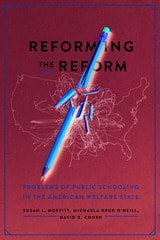
Reforming the Reform
Problems of Public Schooling in the American Welfare StateSusan L. Moffitt, Michaela Krug O'Neill, and David K. Cohen
University of Chicago Press, 2023
School reform is almost always born out of big dreams and well-meaning desires to change the status quo. But between lofty reform legislation and the students whose education is at stake, there are numerous additional policies and policymakers who determine how reforms operate. Even in the best cases, school reform initiatives can perpetuate problems created by earlier reforms or existing injustices, all while introducing new complications. In Reforming the Reform, political scientist Susan L. Moffitt, education policy scholar Michaela Krug O’Neill, and the late policy and education scholar David K. Cohen take on a wide-ranging examination of the many intricacies of school reform.
With a particular focus on policymakers in the spaces between legislation and implementation, such as the countless school superintendents and district leaders tasked with developing new policies in the unique context of their district or schools, the authors identify common problems that arise when trying to operationalize ambitious reform ideas. Their research draws on more than 250 interviews with administrators in Tennessee and California (chosen as contrasts for their different political makeup and centralization of the education system) and is presented here alongside survey data from across the United States as well as archival data to demonstrate how public schools shoulder enormous responsibilities for the American social safety net. They provide a general explanation for problems facing social policy reforms in federalist systems (including healthcare) and offer pathways forward for education policy in particular.

Reframing Failure in Digital Scholarship
Edited by Anna-Maria Sichani and Michael Donnay
University of London Press, 2025
Failure is ordinary. From technological failures and computational obsolescence to rejected applications and challenging collaborations, failure is an unavoidable part of any scholarly endeavor. This is especially true for digital scholarship, as the everyday risk of failure is compounded by the challenges of interdisciplinary research and the fragility of digital technology.
Reframing Failure in Digital Scholarship brings together a diverse, interdisciplinary, and international group of scholars and practitioners who each offer short personal and professional reflections on the failed, broken, or challenging aspects of scholarly practice. It provides a critical perspective on the ways institutional and material conditions are intractably linked to approaches to digital research and how those conditions differ within and across national contexts.
In creating a critical, constructive, and compassionate vocabulary for failure, this book normalizes failure as an object of inquiry, asking what value exists in failure in digital scholarship and how we can create the space to fail better.
Reframing Writing Assessment to Improve Teaching and Learning
Linda Adler-Kassner
Utah State University Press, 2010
Adler-Kassner and O'Neill show writing faculty and administrators how to frame discussions of writing assessment so that they accurately represent research-based practices, and promote assessments that are valid, reliable, and discipline-appropriate.
Public discourse about writing instruction is currently driven by ideas of what instructors and programs “need to do,” “should do,” or “are not doing,” and is based on poorly informed concepts of correctness and unfounded claims about a broad decline in educational quality. This discussion needs to be reframed, say Adler-Kassner and O'Neill, to help policymakers understand that the purpose of writing instruction is to help students develop critical thinking, reading, and writing strategies that will form the foundation for their future educations, professional careers, and civic engagement.
Reframing Writing Assessment to Improve Teaching and Learning is grounded in the best of writing assessment research, and focuses on how to communicate it effectively to publics beyond academe.
Refugee Students
What Every ESL Teacher Needs to KnowJeffra Flaitz
University of Michigan Press, 2018
Regimens of the Mind
Boyle, Locke, and the Early Modern Cultura Animi TraditionSorana Corneanu
University of Chicago Press, 2011
Regional Perspectives on Learning by Doing
Stories from Engaged Universities around the WorldLorlene Hoyt
Michigan State University Press, 2017
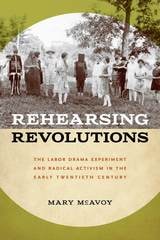
Rehearsing Revolutions
The Labor Drama Experiment and Radical Activism in the Early Twentieth CenturyMary McAvoy
University of Iowa Press, 2019
Choice Outstanding Academic Title, 2019
George Freedley Memorial Award Finalist, 2020
Between the world wars, several labor colleges sprouted up across the U.S. These schools, funded by unions, sought to provide members with adult education while also indoctrinating them into the cause. As Mary McAvoy reveals, a big part of that learning experience centered on the schools’ drama programs. For the first time, Rehearsing Revolutions shows how these left-leaning drama programs prepared American workers for the “on-the-ground” activism emerging across the country. In fact, McAvoy argues, these amateur stages served as training grounds for radical social activism in early twentieth-century America.Using a wealth of previously unpublished material such as director’s reports, course materials, playscripts, and reviews, McAvoy traces the programs’ evolution from experimental teaching tool to radically politicized training that inspired overt—even militant—labor activism by the late 1930s. All the while, she keeps an eye on larger trends in public life, connecting interwar labor drama to post-war arts-based activism in response to McCarthyism, the Cold War, and the Civil Rights movement. Ultimately, McAvoy asks: What did labor drama do for the workers’ colleges and why did they pursue it? She finds her answer through several different case studies in places like the Portland Labor College and the Highlander Folk School in Tennessee.
Reimagining Nabokov
Pedagogies for the 21st CenturyJosé Vergara
Amherst College Press, 2022
“It is both timely and refreshing to have an influx of teacher-scholars who engage Nabokov from a variety of perspectives… this volume does justice to the breadth of Nabokov’s literary achievements, and it does so with both pedagogical creativity and scholarly integrity."—Dana Dragunoiu, Carleton University
"[A] valuable study for any reader, teacher, scholar, or student of Nabokov. Amongst specific and urgent insights on the potential for digital methods, the relevance of Nabokov for students today, and how to reconcile issues of identity with an author who disavowed history and politics, are much wider and timeless questions of authorial control and the ability to access reality."—Anoushka Alexander-Rose, Nabokov Online Journal
Contributions by Galya Diment, Tim Harte, Robyn Jensen, Sara Karpukhin, Yuri Leving, Roman Utkin, José Vergara, Meghan Vicks, Olga Voronina, Lisa Ryoko Wakamiya, and Matthew Walker.
Reimagining Popular Notions of American Intellectualism
Literacy, Education, and ClassKelly Susan Bradbury
Southern Illinois University Press, 2016
Bradbury begins by tracing the origins and evolution of the narrow views of intellectualism that are common in the United States today. Then, applying a more inclusive and egalitarian definition of intellectualism, she examines the literacy and learning practices of three nonelite sites of adult public education in the United States: the nineteenth-century lyceum, a twentieth-century labor college, and a twenty-first-century GED writing workshop. Bradbury argues that together these three case studies teach us much about literacy, learning, and intellectualism in the United States over time and place. She concludes the book with a reflection on her own efforts to aid students in recognizing and resisting the rhetoric of anti-intellectualism that surrounds them and that influences their attitudes and actions.
Drawing on case studies as well as Bradbury’s own experiences with students, Reimagining Popular Notions of American Intellectualism demonstrates that Americans have engaged and do engage in the process and exercise of intellectual inquiry, contrary to what many people believe. Addressing a topic often overlooked by rhetoric, composition, and literacy studies scholars, it offers methods for helping students reimagine what it means to be intellectual in the twenty-first century.
Reimagining the Educated Citizen
Creole Pedagogies in the Transatlantic World, 1685-1896Petra Munro Hendry
University of Michigan Press, 2023
Winner of the 2023 American Educational Research Association (AERA) Division B: Curriculum Studies Outstanding Book Award
Reimagining the Educated Citizen contends that the constructs of public education and citizenship in the struggle to constitute a U.S. national identity are inseparable from the simultaneous emergence of transatlantic constructs of an educated citizen along transnational and transracial lines. The nineteenth century is commonly understood as the age of nationalism and nation formation in which the Anglo-Protestant Common School movement takes center stage in the production of the American democratic citizen. Ironically, the argument for public, Common Schools privileged whiteness instead of equality. This book suggests that an alternative vision of the relationship between education and citizenship emerged from a larger transatlantic history. Given shape by the movement of people, ideas, commodities, and practices across the Caribbean, Africa, Europe, the Gulf of Mexico and the Mississippi Valley, this radical egalitarian vision emerged at the crossroads of the Atlantic-colonial and antebellum Louisiana.
Reinventing Public Education
How Contracting Can Transform America's SchoolsPaul Hill, Lawrence C. Pierce, and James W. Guthrie
University of Chicago Press, 1997
Reinventing Public Education shows how contracting would radically change the way we operate our schools, while keeping them public and accessible to all, and making them better able to meet standards of achievement and equity. Using public funds, local school boards would select private providers to operate individual schools under formal contracts specifying the type and quality of instruction.
In a hands-on, concrete fashion, the authors provide a thorough explanation of the pros and cons of school contracting and how it would work in practice. They show how contracting would free local school boards from operating schools so they can focus on improving educational policy; how it would allow parents to choose the best school for their children; and, finally, how it would ensure that schools are held accountable and academic standards are met.
While retaining a strong public role in education, contracting enables schools to be more imaginative, adaptable, and suited to the needs of children and families. In presenting an alternative vision for America’s schools, Reinventing Public Education is too important to be ignored.
Relating Religion
Essays in the Study of ReligionJonathan Z. Smith
University of Chicago Press, 2004
Smith first explains how he was drawn to the study of religion, outlines his own theoretical commitments, and draws the connections between his thinking and his concerns for general education. He then engages several figures and traditions that serve to define his interests within the larger setting of the discipline. The essays that follow consider the role of taxonomy and classification in the study of religion, the construction of difference, and the procedures of generalization and redescription that Smith takes to be key to the comparative enterprise. The final essays deploy features of Smith's most recent work, especially the notion of translation.
Heady, original, and provocative, Relating Religion is certain to be hailed as a landmark in the academic study and critical theory of religion.
Religion, Education and the American Experience
Reflections on Religion and the American Public LifeEdith L. Blumhofer
University of Alabama Press, 2002
This collection of provocative and timely essays addresses the ways in which religious and educational institutions have come to define one another and American culture and identity.
Education in America-public and private, from the elementary to the university level-is the subject of urgent, ongoing debates. School vouchers, home schooling, prayer in the classrooms, sex education in the schools, and evolution versus creationism are just a few of the touchstones and flashpoints that have ignited a national dialogue concerning the role of religion in U.S. educational institutions.
The ten major essays assembled here emerged from a series of conferences conducted by the Public Religion Project at the University of Chicago Divinity School, funded by a grant from The Pew Charitable Trust. Written by recognized leaders in the fields of education and religion, the essays address such issues as the role of religious studies programs in tax-supported public universities; the evolving role of the university chaplain; the impact of religious doctrine on literary scholarship and the natural sciences; the college president as a spiritual leader; the secularization of private colleges whose foundations rest in the spiritual mission of a specific church or denomination and, conversely, the obligations, if any, of colleges that have maintained distinct denominational identities toward pluralistic outreach and openness; and an examination of the home schooling movement.
A true "dialogue" designed to inspire readers to rethink, argue, act, and continually converse on the subject, Religion, Education, and the American Experience will appeal to educators, college and university administrators, and boards of trustees, as well as academic libraries and scholars of education and religious studies.
Remaking the American University
Market-Smart and Mission-CenteredZemsky, Robert
Rutgers University Press, 2005
At one time, universities educated new generations and were a source of social change. Today colleges and universities are less places of public purpose, than agencies of personal advantage. Remaking the American University provides a penetrating analysis of the ways market forces have shaped and distorted the behaviors, purposes, and ultimately the missions of universities and colleges over the past half-century.
The authors describe how a competitive preoccupation with rankings and markets published by the media spawned an admissions arms race that drains institutional resources and energies. Equally revealing are the depictions of the ways faculty distance themselves from their universities with the resulting increase in the number of administrators, which contributes substantially to institutional costs. Other chapters focus on the impact of intercollegiate athletics on educational mission, even among selective institutions; on the unforeseen result of higher education's "outsourcing" a substantial share of the scholarly publication function to for-profit interests; and on the potentially dire consequences of today's zealous investments in e-learning.
A central question extends through this series of explorations: Can universities and colleges today still choose to be places of public purpose? In the answers they provide, both sobering and enlightening, the authors underscore a consistent and powerful lesson-academic institutions cannot ignore the workings of the markets. The challenge ahead is to learn how to better use those markets to achieve public purposes.
Remembering Brown at Fifty
The University of Illinois Commemorates Brown v. Board of EducationEdited by Orville Vernon Burton and David O'Brien
University of Illinois Press, 2009
Inspired by the University of Illinois's celebration of the Brown v. Board of Education decision's fiftieth anniversary, this collection addresses the significance of Brown in the contributors' lives or work in education and civil rights. Several authors describe their personal roles in the Brown case or similar cases, while others examine and illustrate events, performances, and exhibitions that were part of the anniversary commemoration. The book not only explores the repercussions of the Brown decision, but also stands as a historic document in its own right, preserving the reactions of many prominent intellectuals, artists, and activists fifty years after the decision.
Contributors are Kal Alston, Margaret L. Andersen, Kathryn H. Anthony, Nathaniel C. Banks, Bernice McNair Barnett, Christopher Benson, Ed Blankenheim, Julian Bond, Orville Vernon Burton, Jason Chambers, Constance Curry, Joseph A. De Laine Jr., Mary L. Dudziak, Joe R. Feagin, John Hope Franklin, Ophelia De Laine Gona, Lani Guinier, Darlene Clark Hine, Freeman A. Hrabowski III, John Jennings, Ralph Lemon, George Lipsitz, Jim Loewen, Laughlin McDonald, David O'Brien, James C. Onderdonk, Sekou Sundiata, Christopher Teal, Nicholas Watkins, Carrie Mae Weems, Juan Williams, and Joy Ann Williamson.
Remembering and Forgetting in the Age of Technology
Teaching, Learning, and the Science of Memory in a Wired WorldMichelle D Miller
West Virginia University Press, 2022
Human minds are made of memories, and today those memories have competition. Biological memory capacities are being supplanted, or at least supplemented, by digital ones, as we rely on recording—phone cameras, digital video, speech-to-text—to capture information we’ll need in the future and then rely on those stored recordings to know what happened in the past. Search engines have taken over not only traditional reference materials but also the knowledge base that used to be encoded in our own brains. Google remembers, so we don’t have to. And when we don’t have to, we no longer can. Or can we?
Remembering and Forgetting in the Age of Technology offers concise, nontechnical explanations of major principles of memory and attention—concepts that all teachers should know and that can inform how technology is used in their classes. Teachers will come away with a new appreciation of the importance of memory for learning, useful ideas for handling and discussing technology with their students, and an understanding of how memory is changing in our technology-saturated world.

Remembering the University of Chicago
Teachers, Scientists, and ScholarsEdited by Edward Shils
University of Chicago Press, 1991
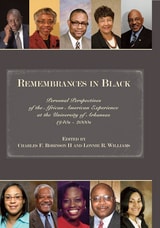
Remembrances in Black
Personal Perspectives of the African American Experience at the University of Arkansas, 1940s–2000sCharles F. Robinson II
University of Arkansas Press, 2015

Removing the Educational Silos
Models of Interdisciplinary and Multi-disciplinary EducationEdited by Wiline Pangle, et al.
Intellect Books, 2025
This book is designed as a source of inspiration, replication, and adaptation. Each chapter, in varying modalities, addresses interdisciplinary course development and implementation in institutions of higher education. The essays focus on common issues like navigating administrative systems and solving the challenges encountered when crossing departments or colleges, whether regarding course listings or the intricacies of course loads on each professor. Chapters also provide detailed information on the nuts and bolts of the specific course or courses taught, including syllabi, lesson examples, and both formal and informal assessments implemented.
Contributors candidly offer discussions of the failures and successes of their interdisciplinary collaborations, including course design, lesson planning, or complications brought in by unforeseen pandemics. Most chapters end with a summary of lessons learned, where experiences from the field provide opportunities for growth and continued exploration. An excellent resource for educators, this volume offers readers guidance and encouragement to implement the approaches described and inspiration to forge their own paths in the world of multi- and interdisciplinary teaching and research.
Renewing Catholic Schools
How to Regain a Catholic Vision for a Secular AgeR. Jared Staudt
Catholic University of America Press, 2020
Renewing the Mind
Ryan N.S. Topping
Catholic University of America Press, 2015
Representations
Doing Asian American RhetoricLuMing Mao and Morris Young
Utah State University Press, 2008
Mao, Young, and their contributors propose that Asian American discourse should be seen as a spacious form, one that deliberately and selectively incorporates Asian “foreign-ness” into the English of Asian Americans. These authors offer the concept of a dynamic “togetherness-in-difference” as a way to theorize the contact and mutual influence. Chapters here explore a rich diversity of histories, theories, literary texts, and rhetorical practices. Collectively, they move the scholarly discussion toward a more nuanced, better balanced, critically informed representation of the forms of Asian American rhetorics and the cultural work that they do.
Requirements for Certification of Teachers, Counselors, Librarians, Administrators for Elementary and Secondary Schools, 2005-2006, Seventieth Edition
Edited by Elizabeth A. Kaye
University of Chicago Press, 2005
Requirements for Certification of Teachers, Counselors, Librarians, Administrators for Elementary and Secondary Schools, Eightieth Edition, 2015-2016
Elizabeth A. Kaye
University of Chicago Press, 2015
Requirements for Certification of Teachers, Counselors, Librarians, Administrators for Elementary and Secondary Schools, Eighty-Eighth Edition, 2023-2024
Edited by Alain Park
University of Chicago Press, 2023
This annual volume offers the most complete and current listings of the requirements for certification of a wide range of educational professionals at the elementary and secondary levels. Requirements for Certification is a valuable resource, making much-needed knowledge available in one straightforward volume.
Requirements for Certification of Teachers, Counselors, Librarians, Administrators for Elementary and Secondary Schools, Eighty-Fifth Edition, 2020-2021
Edited by Colleen M. Frankhart
University of Chicago Press, 2021
Requirements for Certification of Teachers, Counselors, Librarians, Administrators for Elementary and Secondary Schools, Eighty-Fourth Edition, 2019-2020
Edited by Colleen M. Frankhart
University of Chicago Press, 2020
Requirements for Certification of Teachers, Counselors, Librarians, Administrators for Elementary and Secondary Schools, Eighty-Ninth Edition, 2024–2025
Edited by Alain Park
University of Chicago Press, 2024
This annual volume offers the most complete and current listings of the requirements for certification of a wide range of educational professionals at the elementary and secondary levels. Requirements for Certification is a valuable resource, making much-needed knowledge available in one straightforward volume.
Requirements for Certification of Teachers, Counselors, Librarians, Administrators for Elementary and Secondary Schools, Eighty-Seventh Edition, 2022-2023
Edited by Alain Park
University of Chicago Press, 2022
This annual volume offers the most complete and current listings of the requirements for certification of a wide range of educational professionals at the elementary and secondary levels. Requirements for Certification is a valuable resource, making much-needed knowledge available in one straightforward volume.
Requirements for Certification of Teachers, Counselors, Librarians, Administrators for Elementary and Secondary Schools, Eighty-Sixth Edition, 2021-2022
Edited by Alain Park
University of Chicago Press, 2021
This annual volume offers the most complete and current listings of the requirements for certification of a wide range of educational professionals at the elementary and secondary levels. Requirements for Certification is a valuable resource, making much-needed knowledge available in one straightforward volume.
Requirements for Certification of Teachers, Counselors, Librarians, Administrators for Elementary and Secondary Schools, Eighty-Third Edition, 2018–2019
Edited by Colleen M. Frankhart
University of Chicago Press, 2018
Requirements for Certification of Teachers, Counselors, Librarians, Administrators for Elementary and Secondary Schools, Eighty-first Edition, 2016-2017
Elizabeth A. Kaye
University of Chicago Press, 2016
Requirements for Certification of Teachers, Counselors, Librarians, Administrators for Elementary and Secondary Schools, Eighty-second Edition, 2017-2018
Edited by Colleen Frankhart
University of Chicago Press, 2017
Requirements for Certification of Teachers, Counselors, Librarians, Administrators for Elementary and Secondary Schools, Ninetieth Edition, 2025–2026
Edited by Alain Park
University of Chicago Press, 2025
This annual volume offers the most complete and current listings of the requirements for certification of a wide range of educational professionals at the elementary and secondary levels. Requirements for Certification is a valuable resource, making much-needed knowledge available in one straightforward volume.
Requirements for Certification of Teachers, Counselors, Librarians, Administrators for Elementary and Secondary Schools, Ninety-First Edition, 2026–2027
Edited by Alain Park
University of Chicago Press, 2026
The authoritative annual guide to the requirements for certification of teachers.
This annual volume offers the most complete and current listings of the requirements for certification of a wide range of educational professionals at the elementary and secondary levels. Requirements for Certification is a valuable resource, making much-needed knowledge available in one straightforward volume.
Requirements for Certification of Teachers, Counselors, Librarians, Administrators for Elementary and Secondary Schools, Seventy-eighth Edition, 2013-2014
Edited by Elizabeth A. Kaye
University of Chicago Press, 2013