Results by title
5448 books match the query 'History and criticism' and 301 start with r
Real Folks
Race and Genre in the Great DepressionSonnet H. Retman
Duke University Press, 2011
Real Men Don't Sing
Crooning in American CultureAllison McCracken
Duke University Press, 2015
Real Mysteries
Narrative and the UnknowableH. Porter Abbott
The Ohio State University Press, 2013
Real Sister
Stereotypes, Respectability, and Black Women in Reality TVWard, Jervette R
Rutgers University Press, 2015
The first book of scholarship devoted to the issue of how black women are depicted on reality television, Real Sister offers an even-handed consideration of the genre. The book’s ten contributors—black female scholars from a variety of disciplines—provide a wide range of perspectives, while considering everything from Basketball Wives to Say Yes to the Dress. As regular viewers of reality television, these scholars are able to note ways in which the genre presents positive images of black womanhood, even as they catalog a litany of stereotypes about race, class, and gender that it tends to reinforce.
Rather than simply dismissing reality television as “trash,” this collection takes the genre seriously, as an important touchstone in ongoing cultural debates about what constitutes “trashiness” and “respectability.” Written in an accessible style that will appeal to reality TV fans both inside and outside of academia, Real Sister thus seeks to inspire a more nuanced, thoughtful conversation about the genre’s representations and their effects on the black community.
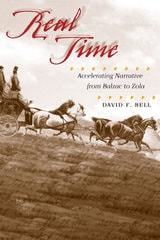
Real Time
Accelerating Narrative from Balzac to ZolaDavid F. Bell
University of Illinois Press, 2003
Nineteenth-century technological advances radically altered the infrastructure of France, changing the ways ordinary citizens–-and literary characters--viewed time, space, distance, and speed. The most influential of these advances included the improvement of the stagecoach, the growth of road and canal networks leading to the advent of the railway, and the increasing use of mail, and of the optical telegraph. Citing examples from a wide range of novels and stories, Bell demonstrates the numerous ways in which these trends of acceleration became not just literary devices and themes but also structuring principles of the novels themselves.
Beginning with both the provincial and the Parisian communications networks of Balzac, Bell proceeds to discuss the roles of horses and optical telegraphs in Stendhal and the importance of domination of communication channels to the characters of Dumas, whose Count of Monte-Cristo might be seen as the ultimate fictional master of this accelerated culture. Finally, Bell analyzes the cinematic vision created by the arrival of the railroad, as depicted by Zola in La Bète Humaine.

Realer Than Reel
Global Directions in DocumentaryBy David Hogarth
University of Texas Press, 2006
Television and globalization have transformed the traditional documentary almost beyond recognition, converting what was once a film genre devoted to public service and education into a popular televisual commodity with productions ranging from serious public affairs programming to TV "reality" shows and "docusoaps." Realer Than Reel offers a state-of-the-art overview of international documentary programming that investigates the possibilities documentary offers for local and public representation in a global age, as well as what actually constitutes documentary in a time of increasing digitalization and manipulation of visual media.
David Hogarth focuses on public affairs, nature, and reality shows from around the world, drawing upon industry data, producer interviews, analyses of selected documentary programs, and firsthand observations of market sites. He looks at how documentary has become a transnational product through exports, co-ventures, and festival contacts; how local and regional "place" is represented in global documentary, especially by producers such as Discovery Networks International and the National Geographic Channel; how documentary addresses the needs of its viewers as citizens through public service broadcasting; and how documentary is challenging accepted conventions of factuality, sense, and taste. The concluding chapter considers the future of both documentary as a genre and television as a global factual medium, asking whether TV will continue to "document" the world in any meaningful sense of the term.
Realism after the Individual
Women, Desire, and the Modern American NovelRafael Walker
University of Chicago Press, 2026
Realism after the Individual offers a new theoretical paradigm for understanding realist novels published in the United States between 1900 and 1920, a period that has been described wrongheadedly as a “gulf” or a “valley” in American literary history. In this generation of writers, only three have remained in favor among critics: Kate Chopin, Edith Wharton, and Theodore Dreiser. Others have disappeared from view altogether—writers such as Robert Grant, Robert Herrick, and Booth Tarkington, all of whom were critically acclaimed bestsellers in their day.
As Rafael Walker shows, this generation of writers deserves new attention for the way they revised many core facets of the nineteenth-century novel in response to the historical shifts around it. This generation of novelists not only rejected liberal individualism but also formulated alternative paradigms for conceptualizing selfhood. The result was a slew of woman-centered realist novels that broke with literary precedent: The novels punish characters not for desiring too much but for failing to desire enough, they depict subjectivity not as private and interior but as outward-facing, and they view closure not as the novel’s aim but as a convention to flout. Realism after the Individual both revises prevailing views of American realism and lays the foundation for an alternative account of the development of literary modernism, one that illuminates the continuity between realism and the modernism that followed it.

Realism and Naturalism in Nineteenth-Century American Literature, Revised Edition
Donald Pizer
Southern Illinois University Press, 1984
The 1966 edition of this book has become a standard work. In this new, revised edition, Pizer has dropped three chapters and has refined and extended the work by adding six: “American Literary Naturalism: An Approach Through Form,” “American Literary Naturalism: The Example of Dreiser,” “The Problem of Philosophy in the Naturalistic Novel,” “Hamlin Garland’s 1891 Main-Travelled Roads: Local Color as Art,” “Jack London: The Problem of Form,” and “Dreiser’s ‘Nigger Jeff’: The Development of an Aesthetic.”
The book contains definitions of realism and naturalism based on representative novels of the period ranging from Howells’ Rise of Silas Lapham to Crane’s Red Badge of Courage; analyses of the literary criticism of the age, stressing that of Howells, Garland, and Norris; and close readings of specific works by major figures of the period.
Realism and the American Dramatic Tradition
William W. Demastes
University of Alabama Press, 1996
This book reconsiders realism on the American stage by addressing the great variety and richness of the plays that form the American theatre canon.
Any review of 20th-century American theatre invariably leads to the term realism. Yet despite the strong tradition of theatrical realism on the American stage, the term is frequently misidentified, and the practices to which it refers are often attacked as monolithically tyrannical, restricting the potential of the American national theatre.This book reconsiders realism on the American stage by addressing the great variety and richness of the plays that form the American theatre canon. By reconsidering the form and revisiting many of the plays that contributed to the realist tradition, the authors provide the opportunity to apprise strengths often overlooked by previous critics. The volume traces the development of American dramatic realism from James A. Herne, the "American Ibsen," to currently active contemporaries such as Sam Shepard, David Mamet, and Marsha Norman. This frank assessment, in sixteen original essays, reopens a critical dialog too long closed.
Essays include:
American Dramatic Realisms, Viable Frames of Thought
The Struggle for the Real--Interpretive Conflict, Dramatic Method, and the Paradox of Realism
The Legacy of James A. Herne: American Realities and Realisms
Whose Realism? Rachel Crothers's Power Struggle in the American Theatre
The Provincetown Players' Experiments with Realism
Servant of Three Masters: Realism, Idealism, and "Hokum" in American High Comedy
Realism's Empire
Empiricism and Enchantment in the Nineteenth-Century NovelGeoffrey Baker
The Ohio State University Press, 2009
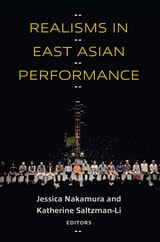
Realisms in East Asian Performance
Jessica Nakamura and Katherine Saltzman-Li, Editors
University of Michigan Press, 2023
Existing scholarly discussions of theatrical realism have been predominantly limited to 19th-century European and Russian theater, with little attention paid to wider explorations and alternative definitions of the practice. Examining theater forms and artists from China, Japan, and Korea, Realisms in East Asian Performance brings together a group of theater historians to reconsider realism through the performing arts of East Asia.
The book’s contributors emphasize trans-regional conversations and activate inter-Asian dialogues on theatrical production. Tracing historical trajectories, starting from premodern periods through today, the book seeks to understand realisms’ multiple origins, forms, and cultural significances, and examines their continuities, disruptions, and divergences. In its diversity of topics, geographic locations, and time periods, Realisms in East Asian Performance aims to globalize and de-center the dominant narratives surrounding realism in theater, and revise assumptions about the spectacular and theatrical forms of Asian performance. Understanding realism as a powerful representational style, chapters collectively reevaluate acts of representation on stage not just for East Asia, but for theater and performance studies more broadly.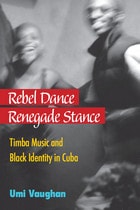
Rebel Dance, Renegade Stance
Timba Music and Black Identity in CubaUmi Vaughan
University of Michigan Press, 2013
Rebel Dance, Renegade Stanceshows how community music-makers and dancers take in all that is around them socially and globally, and publicly and bodily unfold their memories, sentiments, and raw responses within open spaces designated or commandeered for local popular dance. Umi Vaughan, an African American anthropologist, musician, dancer, and photographer "plantao" in Cuba—planted, living like a Cuban—reveals a rarely discussed perspective on contemporary Cuban society during the 1990s, the peak decade of timba, and beyond, as the Cuban leadership transferred from Fidel Castro to his brother. Simultaneously, the book reveals popular dance music in the context of a young and astutely educated Cuban generation of fierce and creative performers.
By looking at the experiences of black Cubans and exploring the notion of "Afro Cuba," Rebel Dance, Renegade Stanceexplains timba's evolution and achieved significance in the larger context of Cuban culture. Vaughan discusses a maroon aesthetic extended beyond the colonial era to the context of contemporary society; describes the dance spaces of Cuba; and examines the performance of identity and desire through the character of the "especulador." This book will find an audience with musicians, anthropologists, ethnomusicologists, interdisciplinary specialists in performance studies, cultural studies, and Latin American and Caribbean studies, as well as laypeople who are interested in Atlantic/African and African American/Africana studies and/or Cuban culture.
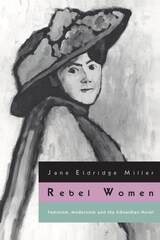
Rebel Women
Feminism, Modernism and the Edwardian NovelJane Eldridge Miller
University of Chicago Press, 1996
"Miller's is the best account we have, not only of Edwardian women novelists, but of early 20th-century women novelists; the measure of her achievement is that the distinction no longer seems workable." —David Trotter, The London Review of Books
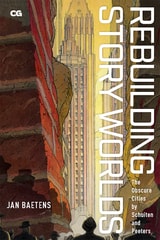
Rebuilding Story Worlds
The Obscure Cities by Schuiten and PeetersJan Baetens
Rutgers University Press, 2020
Rebuilding Story Worlds offers the first full-length study of this seminal series, exploring both the artistic traditions from which it emerges and the innovative ways it plays with genre, gender, and urban space. Comics scholar Jan Baetens examines how Schuiten’s work as an architectural designer informs the series’ concerns with the preservation of historic buildings. He also includes an original interview with Peeters, which reveals how poststructuralist critical theory influenced their construction of a rhizomatic fictional world, one which has made space for fan contributions through the Alta Plana website.
Synthesizing cutting-edge approaches from both literary and visual studies, Rebuilding Story Worlds will give readers a new appreciation for both the aesthetic ingenuity of The Obscure Cities and its nuanced conception of politics.

Recalcitrance Faulkner Professors
A Critical FictionAustin M. Wright
University of Iowa Press, 1990
Recalcitrance, Faulkner, and the Professors is a wonderfully fetching book of criticism that presents fairly, coherently, and forcefully the major critical viewpoints operating in literature studies today and puts them into an invigorating conflict. In the framework of a deliberately artificial plot, characters at an imaginary university present a variety of theoretical and critical points of view in a four-day round table discussion. Centering on Faulker's As I Lay Dying, the discussion has at stake the hand of Eve Birdsong, a student whose distress with the conflicts among her professors had inspired these proceedings. The cast also includes a young hero—assistant professor Charlie Mercer—professors representing a variety of contemporary critical positions, and several extraordinary students.
The discussion, presented in turn by speeches, exchanges in dialogue, and short papers, focuses on the concept of recalcitrance in fiction: the resistance that texts offer to the development of formal structures. Recalcitrance, Faulkner, and the Professors is, variously, a pedagogical text, a critical theory text, and a text about a single novel. But Wright's volume breaks the rules of categorization: it refuses to sit neatly in any genre.
Recalling the Wild
Naturalism and the Closing of the American WestLawlor, Mary
Rutgers University Press, 2000
Ever since the first interactions between Europeans and Native Americans, the “West” has served as a site of complex geographical, social and cultural transformation. American literature is defined, in part, by the central symbols derived from these points of contact. By the end of the nineteenth century, the Western frontier was declared “closed,” a demise solidified by Frederick Jackson Turner’s influential essay “The Significance of the Frontier in American History (1893). At the same time, “naturalism” was popularized by the writings of Frank Norris, Stephen Crane, Jack London, Willa Cather, and the photographs of Edward Curtis. Though very different artists, they were united by their common attraction to the mythic American West.
As she investigates the interactions of representations of the West, Lawlor effortlessly melds literary studies, American studies, and history. She traces the cultural conception of the American West through its incarnations in the “westernism” of Daniel Boone and James Fenimore Cooper and the romanticism of the expansive frontier they helped formulate. Simultaneously, however, the influence of evolutionism and the styles of French naturalism began to challenge this romantic idiom. This naturalistic discourse constructed the West as a strictly material place, picturing a limited and often limiting geography that portrayed regional identity as the product of material “forces” rather than of individualistic enterprise.
With subtle, probing language, Lawlor explains how literary and artistic devices helped shape the idea of the American West and the changing landscape of the continent at the turn of the last century.
Recasting Folk in the Himalayas
Indian Music, Media, and Social MobilityStefan Fiol
University of Illinois Press, 2017
Reciprocity, Truth, and Gender in Pindar and Aeschylus
Arum Park
University of Michigan Press, 2023
Reckoning Day
Race, Place, and the Atom Bomb in Postwar AmericaJacqueline Foertsch
Vanderbilt University Press, 2013
Foertsch also examines the location of African American characters in novels, science fiction, and survivalist nonfiction such as government-sponsored forecasts regarding post-nuclear survival. In these, black characters are often displaced or absented entirely: in doomsday narratives they are excluded from executive decision-making and the stories' often triumphant conclusions; in the nonfiction, they are rarely envisioned amongst the "typical American" survivors charged with rebuilding US society. Throughout Reckoning Day, issues of placement and positioning provide the conceptual framework: abandoned at "ground zero" (America's inner cities) during the height of the atomic threat, African Americans were figured in white-authored survival fiction as compliant servants aiding white victory over atomic adversity, while as historical figures they were often perceived as "elsewhere" (indifferent) to the atomic threat. In fact, African Americans' "position" on the bomb was rarely one of silence or indifference. Ranging from appreciation to disdain to vigorous opposition, atomic-era African Americans developed diverse and meaningful positions on the bomb and made essential contributions to a remarkably American dialogue.
Reckoning with Restorative Justice
Hawai'i Women's Prison WritingLeanne Trapedo Sims
Duke University Press, 2023
Reckoning with the World
South Korean Television and the Latin American ImaginaryBenjamin M. Han
Temple University Press, 2026
Historical dramas like The Land of Humans, about Korean migrants in Mexico, consider diasporic identity and nationalism, while the fantasy series Secret Garden explores issues of modernity. In addition, the TV drama Encounter and the entertainment show Traveler contrast the cultures of global Korea with Cuba. As these programs create appealing storytelling, characters, and aesthetics, they inspire and resonate with audiences and fans across the globe. However, Korean television’s imaginary of Latin America is not about its investment in fostering greater interculturality with Latin American nations and their cultures but instead projects a façade of progressive racial and cultural politics shaping Korea’s reckoning with the world.
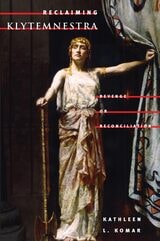
Reclaiming Klytemnestra
REVENGE OR RECONCILIATIONKathleen L. Komar
University of Illinois Press, 2003
By slaying her husband, Klytemnestra exposed the competing ethics of motherhood and matrimony at the beginnings of the Western tradition. In this interdisciplinary study, Kathleen L. Komar first examines the classical archetype of Klytemnestra established by writers such as Aeschylus, Sophocles, and Euripides. Turning to the twentieth century, she investigates the work of modern writers who, since the 1960s, have reconceptualized Klytemnestra’s actions and motivations in the contemporary contexts of dance, fiction, drama, poetry, and the Internet. These revisions include a Martha Graham ballet; a performance piece by multiple authors; a play by Dacia Maraini; novels by Christa Reinig, Nancy Bogen, Christa Wolf, and Marie Cardinal; a short story by Christine Brückner; a poem by Laura Kennelly; a mixed-genre piece by Séverine Auffret; and two Internet presentations.
Eloquent, provocative, and richly detailed, Reclaiming Klytemnestra asks us to reassess the roles women were assigned at the beginnings of Western culture and to reenvision how those roles might be changed in the new millennium.
Reclaiming the Author
Figures and Fictions from Spanish AmericaLucille Kerr
Duke University Press, 1992
By focusing on works by well-known Spanish American authors—Cortazar, Donoso, Fuentes, Poniatowska, Puig, and Vargas Llosa—Kerr shows how the Spanish Americans have formed a radical poetics of the author. Her readings demonstrate how exemplary Spanish American texts, such as Rayuela, Terra nostra, and El hablador, call into question the author as a unitary or uniform, and therefore unproblematical, figure. Individually and together, Kerr's readings reclaim "the author" as a complex critical concept encompassing diverse, conflicting, even competitive roles.
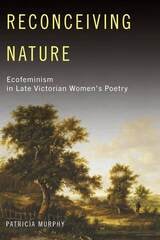
Reconceiving Nature
Ecofeminism in Late Victorian Women's PoetryPatricia Murphy
University of Missouri Press, 2019
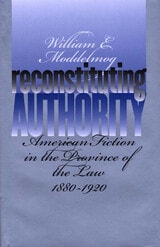
Reconstituting Authority
American Fiction in the Province of the Law, 1880-1920William E. Moddelmog
University of Iowa Press, 2000
The second half of the book turns from the rule of law to the issue of property, specifically the Lockean version of the self that tied identity to legal conceptions of property and economic value. In separate discussions of Charles Chesnutt, Edith Wharton, and Theodore Dreiser, Reconstituting Authority reveals authors as closely engaged with those changing perspectives on property and identity, in ways that challenged the racial, gendered, and economic consequences of America's possessive individualism.
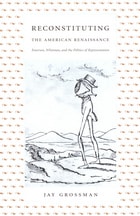
Reconstituting the American Renaissance
Emerson, Whitman, and the Politics of RepresentationJay Grossman
Duke University Press, 2003
Reconstituting the American Renaissance describes how Emerson and Whitman came into the period of their greatest productivity with different conceptions of the functions and political efficacy of the word in the world. It challenges Emerson’s position as Whitman’s necessary precursor and offers a cultural history that emphasizes the two writers’ differences in social class, cultural experience, and political perspective. In their writings between 1830 and 1855, the book finds contrasting conceptions of the relations between the “representative man” and the constituencies to whom, and for whom, he speaks. Reconstituting the American Renaissance opens up the canonical relationship between Emerson and Whitman and multiplies the historical and discursive contexts for understanding their published and unpublished works.
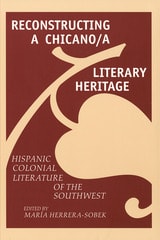
Reconstructing a Chicano/a Literary Heritage
Hispanic Colonial Literature of the SouthwestEdited by María Herrera-Sobek
University of Arizona Press, 1993
Contributors:
Juan Bruce-Novoa
Ramón Gutiérrez
María Herrera-Sobek
Enrique Lamadrid
Luis Leal
Francisco A. Lomelí
Genaro Padilla
Tey Diana Rebolledo
Tino Villanueva
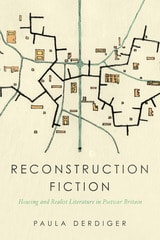
Reconstruction Fiction
Housing and Realist Literature in Postwar BritainPaula Derdiger
The Ohio State University Press, 2020
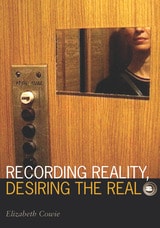
Recording Reality, Desiring the Real
Elizabeth Cowie
University of Minnesota Press, 2010
Cowie claims that, as a radical film form, documentary has been a way for filmmakers to acknowledge historical and contemporary realities by presenting images of these realities. If documentary is the desire to know reality through its images and sounds, she asks, what kind of speaking (and speaking about) emerges in documentary, and how are we engaged by it? In considering this and other questions, Cowie examines a range of noteworthy films, including Spike Lee’s When the Levees Broke, John Huston’s Let There Be Light, and Milica Tomic’s Portrait of My Mother.
Recording Reality, Desiring the Real stakes documentary’s central place in cinema as both an art form and a form of social engagement, which together create a new understanding of spectatorship.
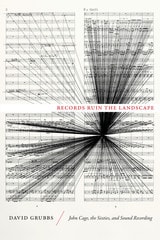
Records Ruin the Landscape
John Cage, the Sixties, and Sound RecordingDavid Grubbs
Duke University Press, 2014
In their day, few of these works circulated in recorded form. By contrast, contemporary listeners can encounter this music not only through a flood of LP and CD releases of archival recordings but also in even greater volume through Internet file sharing and online resources. Present-day listeners are coming to know that era's experimental music through the recorded artifacts of composers and musicians who largely disavowed recordings. In Records Ruin the Landscape, Grubbs surveys a musical landscape marked by altered listening practices.
Records of Reward
Essays on Literature and ValueFrances Ferguson
University of Chicago Press, 2026
A selection of essays revealing the singular brilliance of Ferguson’s critical writing over four decades.
Ranging across literature, philosophy, and social thought, Frances Ferguson asks how forms—whether aesthetic, legal, or bureaucratic—help to assign value and thereby organize our relations as well as our personal identities. Ferguson is a literary critic who takes her lead, unexpectedly, from Jeremy Bentham, showing how modernity tracks and makes perceptible the values of a host of human activities—the knowledge that comes from early learning exercises, the specialized knowledge that funds particular professions, and the exacting if unspecialized knowledge of the social world of courtship or hanging out.
Gathering Ferguson’s most influential and still timely essays, Records of Reward includes, among others, “The Nuclear Sublime,” in which Ferguson turns to Mary Shelley’s Frankenstein to examine how the aesthetic logic of the sublime obscures the claims of domesticity and the beautiful; “Rape and the Rise of the Novel,” which examines the history of rape law to highlight the importance of Samuel Richardson’s foregrounding of consent in Clarissa; “Pornography, the Theory,” where she explores the threshold between speech and action to identify environments—such as schools and workplaces—in which pornographic expression can be harmfully potentiated; and “Jane Austen, Emma, and the Impact of Form,” in which she analyzes Austen’s use of free indirect style to depict both her protagonist and her reader engaged in acts of “over-knowing” others in everyday life. Most unexpectedly, perhaps, the collection also includes an essay analyzing Bitcoin as a small language model that exerts enormous affective pressure on its partisans.
A vivid demonstration of the enduring rewards of theory and close reading alike, Records of Reward will be essential reading across the fields of literary studies, cultural studies, and political thought.
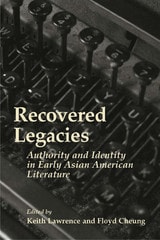
Recovered Legacies
Authority And Identity In Early Asian Amer Litedited by Keith Lawrence and Floyd Cheung
Temple University Press, 2005
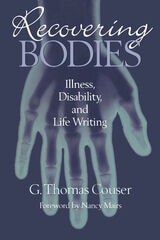
Recovering Bodies
Illness, Disability, and Life WritingG. Thomas Couser
University of Wisconsin Press, 1997
Responding to the recent growth of illness and disability narratives in the United States—such works as Juliet Wittman’s Breast Cancer Journal, John Hockenberry’s Moving Violations, Paul Monette’s Borrowed Time: An AIDS Memoir, and Lou Ann Walker’s A Loss for Words: The Story of Deafness in a Family—Couser addresses questions of both poetics and politics. He examines why and under what circumstances individuals choose to write about illness or disability; what role plot plays in such narratives; how and whether closure is achieved; who assumes the prerogative of narration; which conditions are most often represented; and which literary conventions lend themselves to representing particular conditions. By tracing the development of new subgenres of personal narrative in our time, this book explores how explicit consideration of illness and disability has enriched the repertoire of life writing. In addition, Couser’s discussion of medical discourse joins the current debate about whether the biomedical model is entirely conducive to humane care for ill and disabled people.
With its sympathetic critique of the testimony of those most affected by these conditions, Recovering Bodies contributes to an understanding of the relations among bodily dysfunction, cultural conventions, and identity in contemporary America.
Recovering Disability in Early Modern England
Edited by Allison P. Hobgood and David Houston Wood
The Ohio State University Press, 2013
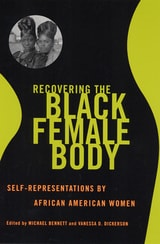
Recovering the Black Female Body
Self-Representation by African American WomenEdited by Michael Bennett and Vanessa D Dickerson
Rutgers University Press, 2000
Despite the recent flood of scholarly work investigating the interrelated issues of race, gender, and representation, little has been written about black women’s depictions of their own bodies. Both past and present-day American cultural discourse has attempted either to hypereroticize the black female body or make it a site of impropriety and crime.
The essays in this volume focus on how African American women, from the nineteenth century to the present, have represented their physical selves in opposition to the distorted vision of others. Contributors attempt to “recover” the black female body in two ways: they explore how dominant historical images have mediated black female identity, and they analyze how black women have resisted often demeaning popular cultural perceptions in favor of more diverse, subtle presentations of self.
The pieces in this book—all of them published here for the first time—address a wide range of topics, from antebellum American poetry to nineteenth-century African American actors, and twentieth-century pulp fiction.
Recovering the Black Female Body recognizes the pressing need to highlight through scholarship the vibrant energy of African American women’s attempts to wrest control of the physical and symbolic construction of their bodies away from the distortions of others.
Contributors are Margaret Bass, Dorri Rabung Beam, Michael Bennett, Jacqueline E. Brady, Daphne A. Brooks, Vanessa D. Dickerson, Meredith Goldsmith, Yvette Louis, Ajuan Maria Mance, Noliwe Rooks, Mark Winokur, and Doris Witt. This book also contains a foreword by Carla L. Peterson and an afterword by Deborah E. McDowell.
Recursive Desire
Rereading Epic TraditionJeremy M. Downes
University of Alabama Press, 1997
A groundbreaking rethinking of epic tradition through recursive literary analysis.
Epic has often been seen as a dead genre, intrinsically patriarchal and nationalistic. Furthermore, the psychological model most frequently applied to the relations between poets has been a violent one--the Freudian masterplot of Oedipus slaying the father to possess the mother. The limited usefulness of such simplistic explanations of epic is readily apparent when confronted with the continuing production of epic poetry long after its so-called death; when confronted with the contemporary drive toward epic among women poets, people of color, and postcolonial poets; and when faced with epic's fundamentally recursive desire--obvious in oral epic, but common to the entire genre--to repeat rather than to kill or evade its precursors.
Recursive desire, rooted in more basic preoedipal negotiations of union and separation rather than in Oedipal conflict, provides an elegant and far more useful explanation. By rereading and substantially redefining epic in this way, this book recognizes and reinvests with meaning the vital recursive qualities of the genre. Examining a diverse array of texts from the Epic of Gilgamesh to Derek Walcott's Osmeros, from the Homeric epics to H.D.'s Helen in Egypt. The book develops a broadened, inclusive, and living tradition of epic poetry, demonstrating the continuities of that tradition across dramatic discontinuities in time, place, worldview, and technology.
Recursive Desire rereads epic tradition and specific epic poems in ways that challenge traditional notions of the genre and open up unexplored fields of endeavor to students of epic, of poetry, and of narrative. With its more powerful and comprehensive psychological model of poetic relations, the book provides readers with a new understanding of epic poetry and its vital, shifting, polyvocal array (and disarray) of textual forces.
Red Land, Red Power
Grounding Knowledge in the American Indian NovelSean Kicummah Teuton
Duke University Press, 2008
While engaging a wide spectrum of Native American writing, Teuton focuses on three of the most canonized and, he contends, most misread novels of the era—N. Scott Momaday’s House Made of Dawn (1968), James Welch’s Winter in the Blood (1974), and Leslie Marmon Silko’s Ceremony (1977). Through his readings, he demonstrates the utility of tribal realism as an interpretive framework to explain social transformations in Indian Country during the Red Power era and today. Such transformations, Teuton maintains, were forged through a process of political awakening that grew from Indians’ rethought experience with tribal lands and oral traditions, the body and imprisonment, in literature and in life.
Red On Red
Native American Literary SeparatismCraig S. Womack
University of Minnesota Press, 1999
An entertaining and enlightening proposal for a new way to read Native American literature.
An entertaining and enlightening proposal for a new way to read Native American literature.
How can a square peg fit into a round hole? It can’t. How can a door be unlocked with a pencil? It can’t. How can Native literature be read applying conventional postmodern literary criticism? It can’t.That is Craig Womack’s argument in Red on Red. Indian communities have their own intellectual and cultural traditions that are well equipped to analyze Native literary production. These traditions should be the eyes through which the texts are viewed. To analyze a Native text with the methods currently dominant in the academy, according to the author, is like studying the stars with a magnifying glass.In an unconventional and piercingly humorous appeal, Womack creates a dialogue between essays on Native literature and fictional letters from Creek characters who comment on the essays. Through this conceit, Womack demonstrates an alternative approach to American Indian literature, with the letters serving as a “Creek chorus” that offers answers to the questions raised in his more traditional essays. Topics range from a comparison of contemporary oral versions of Creek stories and the translations of those stories dating back to the early twentieth century, to a queer reading of Cherokee author Lynn Riggs’s play The Cherokee Night.Womack argues that the meaning of works by Native peoples inevitably changes through evaluation by the dominant culture. Red on Red is a call for self-determination on the part of Native writers and a demonstration of an important new approach to studying Native works-one that engages not only the literature, but also the community from which the work grew.ISBN 0-8166-3022-4 Cloth £33.50 $47.95xxISBN 0-8166-3023-2 Paper £13.00 $18.95x288 Pages 5 7/8 x 9 November Translation inquiries: University of Minnesota Press
Red River Blues
The Blues Tradition in the SoutheastBruce Bastin
University of Illinois Press, 1986
A Classic of Blues Literature inductee into the Blues Foundation's Blues Hall of Fame
Drawing on archives and interviews with musicians, Red River Blues remains an acclaimed work of blues scholarship. Bruce Bastin traces the origins of the music to the turn of the twentieth century, when African Americans rejected slave songs, worksongs, and minstrel music in favor of a potent new vehicle for secular musical expression. Bastin looks at the blues' early emerging popularity and its spread via the Great Migration, delves into a wealth of field recordings, and looks at the careers of Brownie McGhee, Blind Boy Fuller, Curly Weaver, Sonny Terry, and many other foundational artists.
Red Virgin Soil
Soviet Literature in the 1920'sRobert A. Maguire
Northwestern University Press, 2000

Red, Black, and Jew
New Frontiers in Hebrew LiteratureBy Stephen Katz
University of Texas Press, 2009
Between 1890 and 1924, more than two million Jewish immigrants landed on America's shores. The story of their integration into American society, as they traversed the difficult path between assimilation and retention of a unique cultural identity, is recorded in many works by American Hebrew writers. Red, Black, and Jew illuminates a unique and often overlooked aspect of these literary achievements, charting the ways in which the Native American and African American creative cultures served as a model for works produced within the minority Jewish community.
Exploring the paradox of Hebrew literature in the United States, in which separateness, and engagement and acculturation, are equally strong impulses, Stephen Katz presents voluminous examples of a process that could ultimately be considered Americanization. Key components of this process, Katz argues, were poems and works of prose fiction written in a way that evoked Native American forms or African American folk songs and hymns. Such Hebrew writings presented America as a unified society that could assimilate all foreign cultures. At no other time in the history of Jews in diaspora have Hebrew writers considered the fate of other minorities to such a degree. Katz also explores the impact of the creation of the state of Israel on this process, a transformation that led to ambivalence in American Hebrew literature as writers were given a choice between two worlds.
Reexamining long-neglected writers across a wide spectrum, Red, Black, and Jew celebrates an important chapter in the history of Hebrew belles lettres.
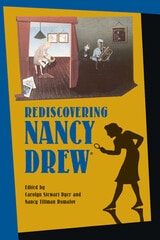
Rediscovering Nancy Drew
Carolyn Stewart Dyer
University of Iowa Press, 1995
Rediscovering The New World
Inter-American LiteratureEarl E. Fitz
University of Iowa Press, 1991
The concept of "American" literature is not the exclusive province of any one nation. Thanks to the historical circumstances that governed the European conquest and settlement of the Americas, we can and should approach the writings of English and French Canada, the United States, Spanish America, and Brazil as a cohesive group of American literature, worthy of study without constant reference to European texts. Now, Rediscovering the New World makes a timely addition to this expanding field on Inter-American scholarship that should help lead tothe formation of a new canon.
This adventurous and ambitious work begins with an examination of Pre-Columbian literature (and shows that his powerful tradition remains alive and well in the twentieth century), then confronts the narratives of discovery and conquest, the New World epic, identity as the Ur-theme of American literature, miscegenation as another integral theme, and regionalism as a shaping force. Other striking these and juxtapositions include a comparison of Henry James and Machado de Assis as the first two great New World novelists, modernism as both a distinct literary movement and an amorphous body of aesthetic principles, and the conflict between "civilization" and "barbarism."
More in the exploratory spirit of the French Canadian voyageur than in the spirit of the conquistador, Rediscovering the New World is the first scholarly work in English to integrate an international set of American literary cultures. It should inspire other explorers as the field of Inter-American literary relations continues to evolve.
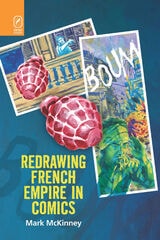
Redrawing French Empire in Comics
Mark McKinney
The Ohio State University Press, 2020

Redrawing the Lines
Analytic Philosophy, Deconstruction, and Literary TheoryReed Way Dasenbrock, Editor
University of Minnesota Press, 1989
Redrawing the Lines was first published in 1989. Minnesota Archive Editions uses digital technology to make long-unavailable books once again accessible, and are published unaltered from the original University of Minnesota Press editions.
Since 1970 literary theory has experienced a period of rich interaction with both Anglo-American analytic and Continental philosophy, particularly deconstruction. Yet these two philosophical schools have regarded each other with hostility, if at all, as in the 1977 exchange between John Searle and Jacques Derrida over the work of J. L. Austin. Since then, the two philosophical traditions have begun to interact as each has influenced literary theory, and some suggest that they are not diametrically opposed.
Redrawing the Lines,the first book to focus on that interaction, brings together ten essays by key figures who have worked to connect literary theory and philosophy and to reassess the relationship between analytic and Continental philosophy. The editor's introduction establishes the debate's historical context, and his annotated bibliography directs the interested reader to virtually everything written on this issue.
The contributors: Reed Way Dasenbrock, Henry Staten, Michael Fischer, Charles Altieri, Richard Shusterman, Samuel C. Wheeler III, Jules David Law, Steven Winspur, Christopher Norris, Richard Rorty, and Anthony J. Cascardi.
Reed Way Dasenbrock is associate professor of English at New Mexico State University. He is the author of The Literary Vorticism of Ezra Pound and Wyndham Lewis: Toward the Condition of Painting.
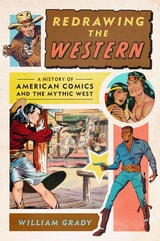
Redrawing the Western
A History of American Comics and the Mythic WestWilliam Grady
University of Texas Press, 2024
2025 Best Single Author Book, Midwest Popular Culture Association
2025 Longlist, Reading the West Book Award in Nonfiction, Mountains & Plains Independent Booksellers Association
A history of American Western genre comics and how they interacted with contemporaneous political and popular culture.
Redrawing the Western charts a history of the Western genre in American comics from the late 1800s through the 1970s and beyond. Encompassing the core years in which the genre was forged and prospered in a range of popular media, Grady engages with several key historical timeframes, from the origins of the Western in the nineteenth-century illustrated press; through fin de siècle anxieties with the closing of the frontier, and the centrality of cowboy adventure across the interwar, postwar, and high Cold War years; to the revisions of the genre in the wake of the Vietnam War and the Western’s continued vitality in contemporary comics storytelling.
In its study of stories about vengeance, conquest, and justice on the contested frontier, Redrawing the Western highlights how the “simplistic” conflicts common in Western adventure comics could disguise highly political undercurrents, providing young readers with new ways to think about the contemporaneous social and political milieu. Besides tracing the history, forms, and politics of American Western comics in and around the twentieth century, William Grady offers an original reassessment of the important role of comics in the development of the Western genre, ranking them alongside popular fiction and film in the process.
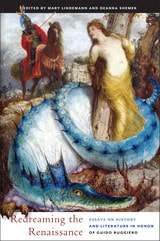
Redreaming the Renaissance
Essays on History and Literature in Honor of Guido RuggieroMary Lindemann
University of Delaware Press, 2024
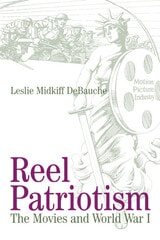
Reel Patriotism
The Movies and World War ILeslie Midkiff DeBauche
University of Wisconsin Press, 1997
Leslie Midkiff DeBauche shows how the United States government’s need to garner public support for the war, conserve food, raise money, and enlist soldiers was met by the film industry. Throughout the nineteen months of American involvement in World War I, film studios supported the war effort through the production of short instructional films, public speaking activities of movie stars, the civic forum provided by movie theaters, and the National Association of the Motion Picture Industry’s provision of administrative personnel to work directly with government agencies. While feature films about the war itself never dominated the release schedules of film distributors, they did become a staple film industry offering throughout the late 1910s and 1920s.
The film industry had much to gain, DeBauche demonstrates, from working closely with the U.S. government. Though the war posed a direct challenge to the conduct of business as usual, the industry successfully weathered the war years. After the war, film producers, distributors, and exhibitors were able to capitalize on the good will of the movie-goer and the government that the industry’s war work created. It provided a buffer against national censorship when movie stars became embroiled in scandal, and it served as a selling point in the 1920s when major film companies began to trade their stock on Wall Street.

Refiguring Race and Risk
Counternarratives of Care in the US Security StateRoberta Wolfson
The Ohio State University Press, 2024
Reflections of Romanity
Discourses of Subjectivity in Imperial RomeRichard Alston
The Ohio State University Press, 2011