Results by title
4030 books match the query 'Language Arts & Disciplines' and 235 start with r
Rhetorical Knowledge in Legal Practice and Critical Legal Theory
Francis J. Mootz III
University of Alabama Press, 2006
A clear summary of contemporary rhetorical philosophy and its intersections with hermeneutics and critical theory
This book describes the significance of rhetorical knowledge for law through detailed discussions of some of the most difficult legal issues facing courts today, including affirmative action, gay rights, and assisted suicide.
Francis J. Mootz responds to both extremes, those who argue that law is merely a rhetorical mask for the exercise of power and those who demonstrate an ideological faith in law’s autonomy, and he breaks new ground by returning to modern classics in the fields of rhetoric and hermeneutics. Drawing from Chaim Perelman's "new rhetoric" and Hans-Georg Gadamer's "philosophical hermeneutics," Mootz argues that justice is a product of rhetorical knowledge. Drawing from Nietzsche, Mootz’s conception of rhetorical knowledge opens up the dynamic possibilities of critical legal theory.
Rhetorical Listening
Identification, Gender, WhitenessKrista Ratcliffe
Southern Illinois University Press, 2005
Extending the feminist rhetorical project to define and model rhetorical listening
Long-ignored within rhetoric and composition studies, listening has returned to the disciplinary radar. Rhetorical Listening: Identification, Gender, Whiteness argues that rhetorical listening facilitates conscious identifications needed for cross-cultural communication.
Krista Ratcliffe establishes eavesdropping, listening metonymically, and listening pedagogically as approaches to rhetorical listening. She defines and models rhetorical listening, addressing identifications with gender and whiteness within public debates, scholarship, and pedagogy. Offering an approach grounded in classical rhetorical theory, Heideggerian theory, feminist theory, and critical race theory, Ratcliffe presents rhetorical listening as an invention tactic that engages spoken and written texts and supplements reading, writing, speaking, and silence as a rhetorical art.
Theorizing intersections of gender and whiteness, Rhetorical Listening examines how whiteness functions as an "invisible" racial category and provides disciplinary and cultural reasons for the displacement of listening and for the use of rhetorical listening as a code of cross-cultural conduct. Ratcliffe presents rhetorical listening in terms of cultural logics, stances, and dominant interpretive tropes. She highlights the modern identification theory of Kenneth Burke and the postmodern identification and disidentification theory of Diana Fuss and presents nonidentification as a more productive site for rhetorical listening.
Rhetorical Machines
Writing, Code, and Computational EthicsEdited by John Jones and Lavinia Hirsu
University of Alabama Press, 2019
Rhetorical Machines addresses new approaches to studying computational processes within the growing field of digital rhetoric. While computational code is often seen as value-neutral and mechanical, this volume explores the underlying, and often unexamined, modes of persuasion this code engages. In so doing, it argues that computation is in fact rife with the values of those who create it and thus has powerful ethical and moral implications. From Socrates’s critique of writing in Plato’s Phaedrus to emerging new media and internet culture, the scholars assembled here provide insight into how computation and rhetoric work together to produce social and cultural effects.
This multidisciplinary volume features contributions from scholar-practitioners across the fields of rhetoric, computer science, and writing studies. It is divided into four main sections: “Emergent Machines” examines how technologies and algorithms are framed and entangled in rhetorical processes, “Operational Codes” explores how computational processes are used to achieve rhetorical ends, “Ethical Decisions and Moral Protocols” considers the ethical implications involved in designing software and that software’s impact on computational culture, and the final section includes two scholars’ responses to the preceding chapters. Three of the sections are prefaced by brief conversations with chatbots (autonomous computational agents) addressing some of the primary questions raised in each section.
At the heart of these essays is a call for emerging and established scholars in a vast array of fields to reach interdisciplinary understandings of human-machine interactions. This innovative work will be valuable to scholars and students in a variety of disciplines, including but not limited to rhetoric, computer science, writing studies, and the digital humanities.
Rhetorical Mediator
Understanding Agency in Indigenous Translation and Interpretation through Indigenous Approaches to UXNora K. Rivera
Utah State University Press, 2023
In places where Indigenous language translation and interpretation are greatly needed, Indigenous language mediators often lack adequate systems to professionalize their field while withstanding Western practices that do not align with their worldviews. Through a “design thinking” methodology based on her work organizing and participating in an Indigenous-focused interpreter and translator conference, Rivera examines testimonios and semi-structured interviews conducted with Indigenous interpreters and translators to emphasize dialogue and desahogo (emotional release) as Indigenous communication practices.
The Rhetorical Mediator advocates for Indigenous language practices that have been sidelined by Western scholarship and systems, helping to create more equitable processes to directly benefit Indigenous individuals and other underrepresented groups. This book benefits specialists, including UX researchers, technical and professional communicators, interpreters and translators, and Indigenous professionals, as well as academics teaching graduate and undergraduate methods, Indigenous rhetoric and translation, and UX courses.
Rhetorical Memory
A Study of Technical Communication and Information ManagementStewart Whittemore
University of Chicago Press, 2015
In Rhetorical Memory, Stewart Whittemore demonstrates that strategies we use to manage information—techniques often acquired through trial and error, rarely studied, and generally invisible to us—are as important to our success as the end products of our work. First, he situates information management within the larger field of rhetoric, showing that both are tied to purpose, audience, and situation. He then dives into an engaging and tightly focused workplace study, presenting three cases from a team of technical communicators making use of organizational memory during their everyday work. By examining which techniques succeed and which fail, Whittemore illuminates the challenges faced by technical communicators. He concludes with a number of practical strategies to better organize information, that will help employees, managers, and anyone else suffering from information overload.

Rhetorical Questions
Studies of Public DiscourseEdwin Black
University of Chicago Press, 1992
Locating rhetorical studies at the confluence of literature and politics, Black focuses on the ideological component of seemingly literary texts and the use of literary devices to advance political advocacy. The essays collected here range in subject matter from nineteenth-century oratory to New York Times editorials to the rhetoric of Richard Nixon. Unifying the collection are the concerns of secrecy and disclosure, identity, opposition, the scope of argument in public persuasion, and the historical mutability of rhetorical forms.
Rhetorical Refusals
Defying Audiences' ExpectationsJohn Schilb
Southern Illinois University Press, 2007
The first book to explore rhetorical refusals—instances in which speakers and writers deliberately flout the conventions of rhetoric and defy their audiences’ expectations— Rhetorical Refusals: Defying Audiences’ Expectations challenges the reader to view these acts of academic rebellion as worthy of deeper analysis than they are commonly accorded, as rhetorical refusals can simultaneously reveal unspoken assumptions behind the very conventions they challenge, while also presenting new rhetorical strategies.
Through a series of case studies, John Schilb demonstrates the deeper meanings contained within rhetorical refusals: when dance critic Arlene Croce refused to see a production that she wrote about; when historian Deborah Lipstadt declined to debate Holocaust deniers; when President Bill Clinton denied a grand jury answers to their questions; and when Frederick Douglass refused to praise Abraham Lincoln unequivocally. Each of these unexpected strategies revealed issues of much greater importance than the subjects at hand. By carefully laying out an underlying framework with which to evaluate these acts, Schilb shows that they can variously point to the undue privilege of authority; the ownership of truth; the illusory divide between public and private lives; and the subjectivity of honor.
According to Schilb, rhetorical refusals have the potential to help political discourse become more inventive. To demonstrate this potential, Schilb looks at some notable cases in which invitations have led to unexpected results: comedian Stephen Colbert’s brazen performance at the White House Press Association dinner; poet Sharon Olds’s refusal to attend the White House Book Fair, and activist Cindy Sheehan’s display of an anti-war message at the 2006 State of the Union Address.
Rhetorical Refusals explores rhetorical theories in accessible language without sacrificing complexity and nuance, revealing the unspoken implications of unexpected deviations from rhetorical norms for classic political concepts like free debate and national memory. With case studies taken from art, politics, literature, and history, this book will appeal to scholars and students of English, communication studies, and history.
Rhetorical Renaissance
The Mistress Art and Her MasterworksKathy Eden
University of Chicago Press, 2022
Kathy Eden explores the intersection of early modern literary theory and practice. She considers the rebirth of the rhetorical art—resulting from the rediscovery of complete manuscripts of high-profile ancient texts about rhetoric by Plato, Aristotle, Cicero, Quintilian, and Tacitus, all unavailable before the early fifteenth century—and the impact of this art on early modern European literary production. This profound influence of key principles and practices on the most widely taught early modern literary texts remains largely and surprisingly unexplored.
Devoting four chapters to these practices—on status, refutation, similitude, and style—Eden connects the architecture of the most widely read classical rhetorical manuals to the structures of such major Renaissance works as Petrarch’s Secret, Castiglione’s Book of the Courtier, Erasmus’s Antibarbarians and Ciceronianus, and Montaigne’s Essays. Eden concludes by showing how these rhetorical practices were understood to work together to form a literary masterwork, with important implications for how we read these texts today.
Rhetorical Secrets
Mapping Gay Identity and Queer Resistance in Contemporary AmericaDavin Allen Grindstaff
University of Alabama Press, 2006
Exploring how language shapes sexuality, power, and belonging.
Davin Allen Grindstaff, through a series of close textual analyses examining public discourse, uncovers the rhetorical modes of persuasion surrounding the construction of gay male sexual identity. In Part One, Grindstaff establishes his notion of the "rhetorical secret" central to constructions of gay male identity: the practice of sexual identity as a secret, its promise of a coherent sexual self, and the perpetuation of secrecy as a product and strategy of heteronormative discourse.
Grindstaff continues in Part Two to examine major issues related to contemporary conceptions of gay male identity: overturning sodomy laws; public debates over same-sex marriages; medical and social responses to the HIV/AIDS crisis; the rhetorical power of hyper-masculine body images and homoeroticism to creative communities; and, finally, what Grindstaff considers to be the most mysterious and significant rhetorical practice of all: coming out of the closet.
By investigating the public discourse--texts and images that circulate, produce knowledge, and become means of persuasion--surrounding the constructions of sexual identity, Grindstaff challenges heteronormative concepts of sexuality itself, thus creating new maps of social power and new paths of resistance.
Rhetorical Speculations
The Future of Rhetoric, Writing, and TechnologyScott Sundvall
Utah State University Press, 2019
Rhetoric and writing studies often engages technological shifts reactively, after the production and reception of rhetoric and writing has changed. This collection allows rhetoric and writing scholars to explore modes of critical speculation into the transformative effect of emerging technologies, particularly as a means to speculate on future shifts in the intellectual, pedagogical, and institutional frameworks of the field. In doing so, the project repositions rhetoric and writing scholars as proprietors of our technological future to come rather than as secondary receivers, critics, and adjusters of the technological present.
Major and emerging voices in the field offer a range of styles that include pragmatic, technical, and philosophical approaches to the issue of speculative rhetoric, exploring what new media/writing studies could be—theoretically, pedagogically, and institutionally—as future technologies begin to impinge on the work of writing. Rhetorical Speculations is at the cutting edge of the subject of futures thinking and will have broad appeal to scholars of rhetoric, literacy, futures studies, and material and popular culture.
Contributors:
Bahareh Brittany Alaei, Sarah J. Arroyo, Kristine L. Blair, Geoffrey V. Carter, Sid Dobrin, Kristie S. Fleckenstein, Steve Holmes, Kyle Jensen, Halcyon Lawrence, Alexander Monea, Sean Morey, Alex Reid, Jeff Rice, Gregory L. Ulmer, Anna Worm
Rhetorical Strategies and Genre Conventions in Literary Studies
Teaching and Writing in the DisciplinesLaura Wilder
Southern Illinois University Press, 2012
Laura Wilder fills a gap in the scholarship on writing in the disciplines and writing across the curriculum with this thorough study of the intersections between scholarly literary criticism and undergraduate writing in introductory literature courses. Rhetorical Strategies and Genre Conventions in Literary Studies is the first examination of rhetorical practice in the research and teaching of literary study and a detailed assessment of the ethics and efficacy of explicit instruction in the rhetorical strategies and genre conventions of the discipline.
Using rhetorical analysis, ethnographic observation, and individual interviews, Wilder demonstrates how rhetorical conventions play a central, although largely tacit, role in the teaching of literature and the evaluation of student writing. Wilder follows a group of literature majors and details their experiences. Some students received experimental, explicit instruction in the special topoi, while others received more traditional, implicit instruction.
Arguing explicit instruction in disciplinary conventions has the potential to help underprepared students, Wilder explores how this kind of instruction may be incorporated into literature courses without being overly reductive. Taking into consideration student perspectives, Wilder makes a bold case for expanding the focus of research in writing in the disciplines and writing across the curriculum in order to grasp the full complexity of disciplinary discourse.
Rhetorics of Exile
Emergent Cartographies of LiberationKate Siegfried
The Ohio State University Press, 2027
Rhetorics of Exile forwards the concept of rhetorical cartographies of liberation to offer an alternative history of the Cold War period. Exile, Kate Siegfried argues, is used as a powerful rhetorical practice that reveals alternative maps of power, resistance, and liberation. Drawing on archival research, she reveals how political insurgents from Paul Robeson to Gerry Adams leveraged experiences of exile and containment to advocate for the eradication of colonialism, imperialism, racialization, and global capitalism and to advance a vision of transnational solidarity that defied the hegemonic political and geographic binaries of the time. Examining movements and political figures across the globe, from Cuba to the American Black Belt, through southern Africa’s colonial borders, to China, Ireland, and elsewhere, Rhetorics of Exile reveals how seemingly disparate political ruptures during the second half of the twentieth century shaped an emergent world system. Siegfried not only broadens our view of Cold War–era social movements but also adapts rhetorical cartography to better account for racialized power dynamics—showing its applicability to understanding activism today.
Rhetorics of Motherhood
Lindal Buchanan
Southern Illinois University Press, 2013
Becoming a mother profoundly alters one’s perception of the world, as Lindal Buchanan learned firsthand when she gave birth. Suddenly attentive to representations of mothers and mothering in advertisements, fiction, film, art, education, and politics, she became intrigued by the persuasive force of the concept of motherhood, an interest that unleashed a host of questions: How is the construct defined? How are maternal appeals crafted, presented, and performed? What do they communicate about gender and power? How do they affect women? Her quest for answers has produced Rhetorics of Motherhood, the first book-length consideration of the topic through a feminist rhetorical lens.
Although both male and female rhetors employ motherhood to promote themselves and their agendas, Buchanan argues it is particularly slippery terrain for women—on the one hand, affording them authority and credibility but, on the other, positioning them disadvantageously within the gendered status quo. Rhetorics of Motherhood investigates that paradox by detailing the cultural construction and performance of the Mother in American public discourse, tracing its use and impact in three case studies, and by theorizing how, when, and why maternal discourses work to women’s benefit or detriment. In the process, the reader encounters a fascinating array of issues—including birth control, civil rights, and abortion—and rhetors, ranging from Diane Nash and Margaret Sanger to Sarah Palin and Michelle Obama.
As Buchanan makes clear, motherhood is a rich site for investigating the interrelationships among gender, power, and public discourse. Her latest book contributes to the discipline of rhetoric by attending to and making a convincing case for the significance of this understudied subject. With its examination of timely controversies, contemporary and historical figures, and powerful women, Rhetorics of Motherhood will appeal to a wide array of readers in rhetoric, communications, American studies, women’s studies, and beyond.
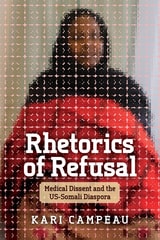
Rhetorics of Refusal
Medical Dissent and the US-Somali DiasporaKari Campeau
The Ohio State University Press, 2025
Rhetorics of Refusal focuses on a recent public health crisis—Minnesota’s 2017 measles outbreak—to recast vaccine refusals less as products of poor health literacy or disinformation and more as strategic and generative acts of noncompliance. The outbreak, which primarily affected unvaccinated Somali children, occurred at the nexus of declining vaccination rates, spiking autism concerns, antivaccination predation, and a fraying public health infrastructure. However, during a year-long ethnographic study at a Somali health center, Kari Campeau found that personal stories from parents offered a much different picture of vaccine refusal than the one painted by news media. Tracking refusals across four sites, Campeau argues for the importance of approaching refusals as rhetorical and participatory strategies that hold institutions accountable, press for change, and practice care within emergent biosocial communities. Moreover, she views refusal as necessary and potentially transformative in situations where refusers have little access to power or platform. By contextualizing refusals in longer cultural and political histories, Campeau unsettles traditional narratives of medical dissent while offering new entry points into discussions on racialized biopolitics, care, disability, and public health.
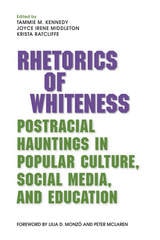
Rhetorics of Whiteness
Postracial Hauntings in Popular Culture, Social Media, and EducationEdited by Tammie M. Kennedy, Joyce Irene Middleton, Krista Ratcliffe, with a foreword by Lilia D. Monzó and Peter McLaren
Southern Illinois University Press, 2017
With the election of our first black president, many Americans began to argue that we had finally ended racism, claiming that we now live in a postracial era. Yet near-daily news reports regularly invoke white as a demographic category and recount instances of racialized violence as well as an increased sensitivity to expressions of racial unrest. Clearly, American society isn’t as color-blind as people would like to believe. In Rhetorics of Whiteness: Postracial Hauntings in Popular Culture, Social Media, and Education, contributors reveal how identifications with racialized whiteness continue to manifest themselves in American culture.
The sixteen essays that comprise this collection not only render visible how racialized whiteness infiltrates new twenty-first-century discourses and material spaces but also offer critical tactics for disrupting this normative whiteness. Specifically, contributors examine popular culture (novels, films, TV), social media (YouTube, eHarmony, Facebook), education (state law, the textbook industry, dual credit programs), pedagogy (tactics for teaching via narratives, emotional literacy, and mindfulness) as well as cultural theories (concepts of racialized space, anti-dialogicism, and color blindness). Offering new approaches to understanding racialized whiteness, this volume emphasizes the importance of a rhetorical lens for employing whiteness studies’ theories and methods to identify, analyze, interpret, and interrupt representations of whiteness.
Although whiteness studies has been waning as an active research field for the past decade, the contributors to Rhetorics of Whiteness assert that it hasn’t lost its relevancy because racialized whiteness and issues of systemic racism persist in American society and culture today. Few whiteness studies texts have been published in rhetoric and composition in the past decade, so this collection should quickly become mandatory reading. By focusing on common, yet often overlooked, contemporary examples of how racialized whiteness haunts U.S. society, Rhetorics of Whiteness serves as a valuable text for scholars in the field as well as anyone else interested in the topic.
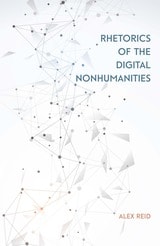
Rhetorics of the Digital Nonhumanities
Alex Reid
Southern Illinois University Press, 2021
In Rhetorics of the Digital Nonhumanities, author Alex Reid fashions a potent vocabulary from new materialist theory, media theory, postmodern theory, and digital rhetoric to rethink the connections between humans and digital media. Addressed are the familiar concerns that scholars have with digital culture: how technologies affect attention spans, how digital media are used to compose, and how digital rhetoric is taught.
Rhetoric is now regularly defined as including human and nonhuman actors. Each actor influences the thoughts, arguments, and sentiments that journey through systems of processors, algorithms, humans, air, and metal. The author’s arguments, even though they are unnerving, orient rhetorical practices to a more open, deliberate, and attentive awareness of what we are truly capable of and how we become capable. This volume moves beyond viewing digital media as an expression of human agency. Humans, formed into new collectives of user populations, must negotiate rather than command their way through digital media ecologies.
Chapters centralize the most pressing questions: How do social media algorithms affect our judgment? How do smart phones shape our attention? These questions demand scholarly practice for attending the world around us. They explore attention and deliberation to embrace digital nonhuman composition. Once we see this brave new world, Reid argues, we are compelled to experiment.
Richer Entanglements
Essays and Notes on Poetry and PoemsGregory Orr
University of Michigan Press, 1993

Right On?
Political Change and Continuity in George W. Bush's AmericaEdited by Iwan Morgan, Philip D. Davies
University of London Press, 2006
Contributors include John Dumbrell (University of Leicester, UK), Martin Durham (University of Wolverhampton, UK), Godfrey Hodgson (Rothermere American Institute, Oxford University, UK), Steven Hurst (Manchester Metropolitan University, UK), Klaus Larres (Royal Holloway College, University of London, UK), Bob McKeever (University of Reading, UK), John Owens (University of Westminster, UK), Rob Singh (Birkbeck College, University of London, UK), and Alex Waddan (University of Sunderland, UK).

Rightsizing the Academic Library Collection
Suzanne M. Ward and Mary E. Miller
American Library Association, 2021
Honored with many accolades, including a starred review in Library Journal, the first edition of this book demonstrated the power and flexibility of “rightsizing,” an approach that applies a scalable, rule-based strategy to help academic libraries balance stewardship of spaces and the collection. In the five years since Ward’s first edition, the shared print infrastructure has grown in leaps and bounds, as has coordination among programs. With this revision, Miller addresses new options as well as the increasing urgency to protect at-risk titles as you reduce your physical collection. Readers will feel confident rightsizing their institution’s own collections with this book’s expert guidance on
- the concept of rightsizing, a strategic and largely automated approach that uses continuous assessment to identify the no- and low-use materials in the collection, and its five core elements;
- crafting a rightsizing plan, from developing withdrawal criteria and creating discard lists to managing workflow and disposing of withdrawn materials, using a project-management focus;
- moving toward a “facilitated collection” with a mix of local, external, and collaborative services;
- six discussion areas for decisions on participating in a shared print program;
- factors in choosing a collection decision support tool;
- relationships with stakeholders;
- how to handle print resources after your library licenses perpetual access rights to the electronic equivalent; and
- future directions for rightsizing

Rightsizing the Academic Library Collection
Suzanne M. Ward
American Library Association, 2014
Risk Communication and Miscommunication
Case Studies in Science, Technology, Engineering, Government, and Community OrganizationsCarolyn Boiarsky
University Press of Colorado, 2016
Drawing from research in rhetoric, linguistics, technical communication, educational psychology, and web design, Boiarsky provides a new way to look at risk communication. She shows how failing to consider the readers’ needs or the rhetorical context in which one writes can be catastrophic and how anticipating those needs can enhance effectiveness and prevent disaster. She examines the communications and miscommunications of original e-mails, memos, and presentations about various environmental disasters, including the Columbia space shuttle explosion and the BP/Deepwater Horizon oil rig explosion, and successes, such as the Enbridge pipeline expansion and the opening of the Mississippi Spillway, and offers recommendations for effective communication.
Taking into account the growing need to communicate complex and often controversial issues across vast geographic and cultural spaces with an ever-expanding array of electronic media, Risk Communication and Miscommunication provides strategies for clear communication of data, ideas, and procedures to varied audiences to prevent or minimize damage from environmental incidents.

Risk and Insurance Management Manual for Libraries
American Library Association, 2005
Risk and Insurance Management Manual for Libraries, Updated
Sally Alexander
American Library Association, 2021
Risky Business
Taking and Managing Risks in Library Services for TeensLinda W. American Library Association
American Library Association, 2010
Risky Rhetoric
AIDS and the Cultural Practices of HIV TestingJ. Blake Scott
Southern Illinois University Press, 2003
Risky Rhetoric: AIDS and the Cultural Practices of HIV Testing is the first book-length study of the rhetoric inherent in and surrounding HIV testing. In addition to providing a history of HIV testing in the United States from 1985 to the present, J. Blake Scott explains how faulty arguments about testing’s power and effects have promoted unresponsive and even dangerous testing practices for so-called healthy subjects as well as those deemed risky.A new afterword to the paperback edition discusses changes in testing technology, treatments, and public health responses in the last ten years. The ultimate goal of Risky Rhetoric is to offer strategies to policy makers, HIV educators and test counselors, and other rhetors for developing more responsive and egalitarian testing-related rhetorics and practices.

Rogues, Widows and Orphans
Mischief and Misadventures in the World of BooksRebecca Lee
Brandeis University Press, 2026
A publishing industry insider reveals the hilarious and fascinating mishaps, hoaxes, and gaffes behind your favorite books.
It’s a long journey from a writer’s mind to a finished book, and a lot needs to go right along the way. But isn’t it more interesting when things go wrong?
Rebecca Lee, a senior editorial manager at Penguin Random House, guides readers through the secrets of the book industry, a world fizzing with scandals, rivalries, catastrophes, and con jobs. Lee demonstrates how the tiniest of typos can have oversized consequences, unearths horrifying examples of bad taste and worse style, and peeks into tales of forgeries and feuds as dramatic as any thriller. She unredacts the most egregious cases of censorship, exposes hoarders and thieves, and asks whether AI is really an existential threat to the literary universe—or if we are our own worst enemies.
An irresistible tour of mistakes and misbehavior, Rogues, Widows and Orphans will make you cringe, crack you up, and renew your appreciation for the hard work of making books—and all the ways it can go sidewise.
Romance Reader's Advisory
The Librarian's Guide to Love in the StacksAmerican Library Association, 2000
Romance in HPSG
Edited by Sergio Balari and Luca Dini
CSLI, 1997

Rooted Resistance
Agrarian Myth in Modern AmericaNorie R. Singer
University of Arkansas Press, 2020
Through a careful examination of several case studies, Rooted Resistance traverses the ground of agrarian myth in modern America. The authors investigate key figures and movements in the history of modern agrarianism, including the World War I victory garden efforts, the postwar Country Life movement for the vindication of farmers’ rights, the Southern Agrarian critique of industrialism, and the practical and spiritual prophecy of organic farming put forth by J. I. Rodale. This critical history is then brought up to date with recent examples such as the contested South Central Farm in urban Los Angeles and the spectacular rise and fall of the Chipotle “Food with Integrity” branding campaign.
By examining a range of case studies, Singer, Grey, and Motter aim for a deeper critical understanding of the many applications of agrarian myth and reveal why it can help provide a pathway for positive systemic change in the food system.
Rousseau and the Spirit of Revolt
A Psychological StudyWilliam H. Blanchard
University of Michigan Press, 1967
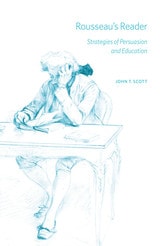
Rousseau's Reader
Strategies of Persuasion and EducationJohn T. Scott
University of Chicago Press, 2020
In Rousseau’s Reader, John T. Scott looks at the different strategies Rousseau used to engage and persuade the readers of his major philosophical works, including the Social Contract, Discourse on Inequality, and Emile. Considering choice of genre; textual structure; frontispieces and illustrations; shifting authorial and narrative voice; addresses to readers that alternately invite and challenge; apostrophe, metaphor, and other literary devices; and, of course, paradox, Scott explores how the form of Rousseau’s writing relates to the content of his thought and vice versa. Through this skillful interplay of form and content, Rousseau engages in a profoundly transformative dialogue with his readers.
While most political philosophers have focused, understandably, on Rousseau’s ideas, Scott shows convincingly that the way he conveyed them is also of vital importance, especially given Rousseau’s enduring interest in education. Giving readers the key to Rousseau’s style, Scott offers fresh and original insights into the relationship between the substance of his thought and his literary and rhetorical techniques, which enhance our understanding of Rousseau’s project and the audiences he intended to reach.
Running a Small Library
John A. Moorman
American Library Association, 2015
Running the Digital Branch
Guidelines for Operating the Library WebsiteDavid Lee American Library Association
American Library Association, 0
Rural Literacies
Kim Donehower, Charlotte Hogg, and Eileen Schell
Southern Illinois University Press, 2006
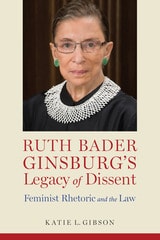
Ruth Bader Ginsburg’s Legacy of Dissent
Feminist Rhetoric and the LawKatie L. Gibson
University of Alabama Press, 2018
A rhetorical analysis of Justice Ruth Bader Ginsburg’s feminist jurisprudence.
Ruth Bader Ginsburg’s lifelong effort to reshape the language of American law has had profound consequences: she has shifted the rhetorical boundaries of jurisprudence on a wide range of fundamental issues from equal protection to reproductive rights. Beginning in the early 1970s, Ginsburg led a consequential attack on sexist law in the United States. By directly confronting the patriarchal voice of the law, she pointedly challenged an entrenched genre of legal language that silenced the voices and experiences of American women and undermined their status as equal citizens. On the United States Supreme Court, Justice Ginsburg continues to challenge the traditional scripts of legal discourse to insist on a progressive vision of the Constitution and to demand a more inclusive and democratic body of law.
This illuminating work examines Justice Ruth Bader Ginsburg’s contributions in reshaping the rhetoric of the law (specifically through the lens of watershed cases in women’s rights) and describes her rhetorical contributions—beginning with her work in the 1970s as a lawyer and an advocate for the ACLU’s Women’s Rights Project through her tenure as a Supreme Court justice. Katie L. Gibson examines Ginsburg’s rhetoric to argue that she has dramatically shifted the boundaries of legal language. Gibson draws from rhetorical theory, critical legal theory, and feminist theory to describe the law as a rhetorical genre, arguing that Ginsburg’s jurisprudence can appropriately be understood as a direct challenge to the traditional rhetoric of the law.
Ruth Bader Ginsburg stands as an incredibly important figure in late twentieth- and early twenty-first-century feminism. While a growing number of admirers celebrate Justice Ginsburg’s voice of dissent today, Ginsburg’s rhetorical legacy reveals that she has long articulated a sharp and strategic voice of judicial dissent. This study contributes to a more complete understanding of her feminist legacy by detailing the unique contributions of her legal rhetoric.