Results by title
18284 books match the query 'United States' and 833 start with r
Reading Southern History
Essays on Interpreters and InterpretationsGlenn Feldman
University of Alabama Press, 2001
This collection of essays examines the contributions of some of the most notable interpreters of southern history and culture, furthering our understanding of the best historical work produced on the region.
Historian Glenn Feldman gathers together a group of essays that examine the efforts of important scholars to discuss and define the South's distinctiveness. The volume includes 18 chapters on such notable historians as John Hope Franklin, Anne Firor Scott, Frank L. Owsley, W. J. Cash, and C. Vann Woodward, written by 19 different researchers, both senior historians and emerging scholars, including Jacquelyn Dowd Hall, John Shelton Reed, Bruce Clayton, and Ted Ownby. The essays examine the major work or works of each scholar under consideration as well as that scholar's overall contribution to the study of southern history.
Reading Southern History will enlighten readers on the more compelling themes currently and traditionally explored by southern historians. It will appeal greatly to professors and students as a valuable multidisciplinary introduction to the study of southern history, since several of the essays are on scholars who are working outside the discipline of history proper, in the fields of political science, sociology, journalism, and economics. Feldman's collection, therefore, sheds light on a broad spectrum of themes important in southern history, including the plight of poor whites, race, debates over race and class, the "reconstruction syndrome," continuity versus discontinuity in relation to blacks and whites, and regional culture and distinctiveness.
Reading Southern History will be valuable to students and scholars of women's studies, African American history, working-class history, and ethnic studies, as well as traditional southern history. Most important, the publication makes a significant contribution to the development and ongoing study of the historiography of the South.
Reading Together, Reading Apart
Identity, Belonging, and South Asian American CommunityTamara Bhalla
University of Illinois Press, 2016
Tamara Bhalla blends a case study with literary and textual analysis to illuminate this phenomenon. Her fascinating investigation considers institutions from literary reviews to the marketplace to social media and other technologies, as well as traditional forms of literary discussion like book clubs and academic criticism. Throughout, Bhalla questions how her subjects' circumstances, desires, and shared race and class, limit the values they ascribe to reading. She also examines how ideology circulating around a body of literature or a self-selected, imagined community of readers shapes reading itself and influences South Asians' powerful, if contradictory, relationship with ideals of cultural authenticity.
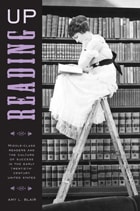
Reading Up
Middle-Class Readers and the Culture of Success in the Early Twentieth-Century United StatesAmy Blair
Temple University Press, 2011
A person who reads a book for self-improvement rather than aesthetic pleasure is “reading up.” Reading Up is Amy Blair's engaging study of popular literary critics who promoted reading generally and specific books as vehicles for acquiring cultural competence and economic mobility. Combining methodologies from the history of the book and the history of reading, to mass-cultural studies, reader-response criticism, reception studies, and formalist literary analysis, Blair shows how such critics influenced the choices of striving readers and popularized some elite writers.
Framed by an analysis of Hamilton Wright Mabie's role promoting the concept of “reading up” during his ten-year stint as the cultivator of literary taste for the highly popular Ladies' Home Journal, Reading Up reveals how readers flocked to literary works that they would be expected to dislike. Blair shows that while readers could be led to certain books by a trusted adviser, they frequently followed their own path in interpreting them in unexpected ways.
Reading With Lincoln
Robert Bray
Southern Illinois University Press, 2010
Through extensive reading and reflection, Abraham Lincoln fashioned a mind as powerfully intellectual and superlatively communicative as that of any other American political leader. Reading with Lincoln uncovers the how of Lincoln’s inspiring rise to greatness by connecting the content of his reading to the story of his life.
At the core of Lincoln’s success was his self-education, centered on his love of and appreciation for learning through books. From his early studies of grammar school handbooks and children’s classics to his interest in Shakespeare’s Macbeth and the Bible during his White House years, what Lincoln read helped to define who he was as a person and as a politician. This unique study delves into the books, pamphlets, poetry, plays, and essays that influenced Lincoln’s thoughts and actions.
Exploring in great depth and detail those readings that inspired the sixteenth president, author Robert Bray follows Lincoln’s progress closely, from the young teen composing letters for illiterate friends and neighbors to the politician who keenly employed what he read to advance his agenda. Bray analyzes Lincoln’s radical period in New Salem, during which he came under the influence of Anglo-American and French Enlightenment thinkers such as Thomas Paine, C. F. Volney, and Voltaire, and he investigates Lincoln’s appreciation of nineteenth-century lyric poetry, which he both read and wrote. Bray considers Lincoln’s fascination with science, mathematics, political economics, liberal social philosophy, theology, and the Bible, and devotes special attention to Lincoln’s enjoyment of American humor. While striving to arrive at an understanding of the role each subject played in the development of this remarkable leader, Bray also examines the connections and intertextual relations between what Lincoln read and how he wrote and spoke.
This comprehensive and long-awaited book provides fresh insight into the self-made man from the wilderness of Illinois. Bray offers a new way to approach the mind of the political artist who used his natural talent, honed by years of rhetorical study and practice, to abolish slavery and end the Civil War.
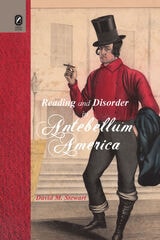
Reading and Disorder in Antebellum America
David M. Stewart
The Ohio State University Press, 2011
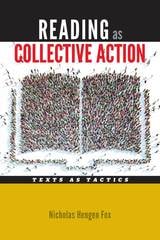
Reading as Collective Action
Text as TacticsNicholas Hengen Fox
University of Iowa Press, 2017
Reading as Collective Action shifts our focus outward, to another of literature’s powers: the power to reshape our world in very public, very active ways. In this book, you will encounter readers who criticized the Bush administration’s war on terror by republishing poems by writers ranging from Shakespeare to Amiri Baraka everywhere from lampposts to the New York Times. You will read about people in Michigan and Tennessee, who leveraged a community reading program on John Steinbeck’s The Grapes of Wrath to organize support for those in need during the Great Recession and to engage with their neighbors about immigration. You will meet a pair of students who took to public transit to talk with strangers about working-class literature and a trio who created a literary website that reclaimed the working-class history of the Pacific Northwest.
This book challenges dominant academic modes of reading. For adherents of the “civic turn,” it suggests how we can create more politically effective forms of service learning and community engagement grounded in a commitment to tactical, grassroots actions. Whether you’re a social worker or a student, a zine-maker, a librarian, a professor, or just a passionate reader with a desire to better your community, this book shows that when we read texts as tactics, “that book changed my life” can become “that book changed our lives.”
Reading as Therapy
What Contemporary Fiction Does for Middle-Class AmericansTimothy Aubry
University of Iowa Press, 2011
@font-face { font-family: "Myriad Pro";}p.MsoNormal, li.MsoNormal, div.MsoNormal { margin: 0in 0in 0.0001pt; font-size: 12pt; font-family: "Times New Roman"; }div.Section1 { page: Section1; }Why do Americans read contemporary fiction? This question seems simple, but is it? Do Americans read for the purpose of aesthetic appreciation? To satisfy their own insatiable intellectual curiosities? While other forms of media have come to monopolize consumers’ leisure time, in the past two decades book clubs have proliferated, Amazon has sponsored thriving online discussions, Oprah Winfrey has inspired millions of viewers to read both contemporary works and classics, and novels have retained their devoted following within middlebrow communities.
In Reading as Therapy, Timothy Aubry argues that contemporary fiction serves primarily as a therapeutic tool for lonely, dissatisfied middle-class American readers, one that validates their own private dysfunctions while supporting elusive communities of strangers unified by shared feelings. Aubry persuasively makes the case that contemporary literature’s persistent appeal depends upon its capacity to perform a therapeutic function.
Reading as Therapy traces the growth and proliferation of psychological concepts focused on the subjective interior within mainstream, middle-class society and the impact this has had on contemporary fiction. The prevailing tendency among academic critics has been to decry the personal emphasis of contemporary fiction as complicit with the rise of a narcissistic culture, the ascendency of liberal individualism, and the breakdown of public life. Reading as Therapy, by contrast, underscores the varied ideological effects that therapeutic culture can foster.
To uncover the many unpredictable ways in which contemporary literature answers the psychological needs of its readers, Aubry considers several different venues of reader-response—including Oprah’s Book Club and Amazon customer reviews—the promotional strategies of publishing houses, and a variety of contemporary texts, ranging from Khaled Hosseini’s The Kite Runner to Anita Shreve’s The Pilot’s Wife to David Foster Wallace’s Infinite Jest. He concludes that, in the face of an atomistic social landscape, contemporary fiction gives readers a therapeutic vocabulary that both reinforces the private sphere and creates surprising forms of sympathy and solidarity among strangers.
Reading for Realism
The History of a U.S. Literary Institution, 1850–1910Nancy Glazener
Duke University Press, 1997
Combining reception theory with a materialist analysis of the social formations in which realist reading practices circulated, Glazener’s study reveals the elitist underpinnings of literary realism. At the book’s center is the Atlantic group of magazines, whose influence was part of the cultural machinery of the Northeastern urban bourgeoisie and crucial to the development of literary realism in America. Glazener shows how the promotion of realism by this group of publications also meant a consolidation of privilege—primarily in terms of class, gender, race, and region—for the audience it served. Thus American realism, so often portrayed as a quintessentially populist form, actually served to enforce existing structures of class and power.
Reading for Reform
The Social Work of Literature in the Progressive EraLaura R. Fisher
University of Minnesota Press, 2019
An unprecedented examination of class-bridging reform and U.S. literary history at the turn of the twentieth century
Reading for Reform rewrites the literary history of late nineteenth and early twentieth century America by putting social reform institutions at the center of literary and cultural analysis. Examining the vibrant, often fractious literary cultures that developed as part of the Progressive mandate to uplift the socially disadvantaged, it shows that in these years reformers saw literature as a way to combat the myriad social problems that plagued modern U.S. society. As they developed distinctly literary methods for Americanizing immigrants, uplifting and refining wage-earning women, and educating black students, their institutions gave rise to a new social purpose for literature.
Class-bridging reform institutions—the urban settlement house, working girls’ club, and African American college—are rarely addressed in literary history. Yet, Laura R. Fisher argues, they engendered important experiments in the form and social utility of American literature, from minor texts of Yiddish drama and little-known periodical and reform writers to the fiction of Edith Wharton and Nella Larsen. Fisher delves into reform’s vast and largely unexplored institutional archives to show how dynamic sites of modern literary culture developed at the margins of social power.
Fisher reveals how reformist approaches to race, class, religion, and gender formation shaped American literature between the 1880s and the 1920s. In doing so, she tells a new story about the fate of literary practice, and the idea of literature’s practical value, during the very years that modernist authors were proclaiming art’s autonomy from concepts of social utility.
Reading in Time
Emily Dickinson in the Nineteenth CenturyCristanne Miller
University of Massachusetts Press, 2012
Before 1865, Dickinson at least ambivalently considered publication, circulated relatively few poems, and saved almost everything she wrote in organized booklets. After this date, she wrote far fewer poems, circulated many poems without retaining them, and took less interest in formally preserving her work. Yet, Miller argues, even when circulating relatively few poems, Dickinson was vitally engaged with the literary and political culture of her day and, in effect, wrote to her contemporaries. Unlike previous accounts placing Dickinson in her era, Reading in Time demonstrates the extent to which formal properties of her poems borrow from the short-lined verse she read in schoolbooks, periodicals, and single-authored volumes. Miller presents Dickinson's writing in relation to contemporary experiments with the lyric, the ballad, and free verse, explores her responses to American Orientalism, presents the dramatic lyric as one of her preferred modes for responding to the Civil War, and gives us new ways to understand the patterns of her composition and practice of poetry.
Reading the Middle Generation Anew
Culture, Community, and Form in Twentieth-Century American PoetryEric Haralson
University of Iowa Press, 2006
In addition to having worked during the broad middle of the last century, these poets constitute the center of twentieth-century American poetry in the larger sense, refuting invidious connotations of “middle” as coming after the great moderns and being superseded by a proliferating postmodern experimentation. This middle generation mediates the so-called American century and its prodigious body of poetry, even as it complicates historical and aesthetic categorizations.
Taking diverse formal and thematic angles on these poets—deconstructionist, biographical-historical, and more formalist accounts—this book re-examines their between-ness and ambivalence: their various positionings and repositionings in aesthetic, political, and personal matters. The essays study the interplay between these writers and such shifting formations as religious discourse, consumerism, militarism and war, the ideology of America as “nature’s nation,” and U.S. race relations and ethnic conflicts. Reading the Middle Generation Anew also shows the legacy of the middle generation, the ways in which their lives and writings continue to be a shaping force in American poetry. This fresh and invigorating collection will be of great interest to literary scholars and poets.
Reading the Rabbit
Explorations in Warner Bros. AnimationSandler, Kevin S
Rutgers University Press, 1998
"A wide-ranging inquiry into an important area of contemporary scholarly interest, and also an engaging, well written and intelligently conceived collection." -Eric Smoodin, author of Animating Culture: Hollywood Cartoons From the Sound Era
Despite the success of Bugs Bunny, Daffy Duck, and their Looney cohorts, Warner Bros. animation worked in the shadow of Disney for many years. The past ten years have seen a resurgence in Warner Bros. animation as they produce new Bugs Bunny cartoons and theatrical features like Space Jam as well as television shows like Tiny Toon Adventures and Animaniacs. While Disney's animation plays it safe and mirrors traditional cinema stories, Warner Bros. is known for a more original and even anarchistic style of narration, a willingness to take risks in story construction, a fearlessness in crossing gender lines with its characters, and a freedom in breaking boundaries. This collection of essays looks at the history of Warner Bros. animation, compares and contrasts the two studios, charts the rise and fall of creativity and daring at Warner's, and analyzes the ways in which the studio was for a time transgressive in its treatment of class, race, and gender. It reveals how safety and commercialization have, in the end, triumphed at Warner Bros. just as they much earlier conquered Disney.
The book also discusses fan parodies of Warner Bros. animation on the Internet today, the Bugs Bunny cross-dressing cartoons, cartoons that were censored by the studio, and the merchandising and licensing strategies of the Warner Bros. studio stores. Contributors are Donald Crafton, Ben Fraser, Michael Frierson, Norman M. Klein, Terry Lindvall, Bill Mikulak, Barry Putterman, Kevin S. Sandler, Hank Sartin, Linda Simensky, Kirsten Moana Thompson, Gene Walz, and Timothy R. White.
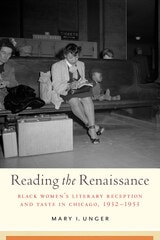
Reading the Renaissance
Black Women's Literary Reception and Taste in Chicago, 1932-1953Mary I. Unger
University of Massachusetts Press, 2025
From 1932 to 1953, during the Black Chicago Renaissance, numerous literary events were held within and for the city’s Black community. In book clubs, public forums, print reviews, little magazines, local programming, and other public venues, Black women in particular debated the role of literature in racial uplift efforts, set literary standards, and acted as community gatekeepers for cultural production during a time known as the Black Chicago Renaissance. Through these inspiring efforts, a mix of publishers, well-known authors, and everyday readers significantly fostered a robust literary culture in the Windy City.
Reading the Renaissance constructs a reception history of the Black women who read and reviewed, published and promoted, and collected and curated literature of the era. Mary Unger interprets how local figures such as Vivian G. Harsh, Ora Morrow, Gwendolyn Brooks, Alice Browning, Fern Gayden, and Margaret Walker cultivated particular literary tastes through collective acts of reading and reception. She does so by recovering a network of readers, book clubs, literary magazines, civic programs, and book businesses that Black women created, led, and transformed during the early 1930s through the early 1950s in Bronzeville, Chicago’s predominantly Black South Side neighborhood.
This illuminating work includes close readings of texts alongside letters, scrapbooks, meeting minutes, reviews, and other ephemera of local reading practices to show how Black women facilitated diverse strategies of reading while instructing community members how to engage a variety of print cultures at the time. Unger demonstrates how Black women readers influenced individual authors as well as the norms and expectations of African American literature more broadly, becoming important (yet too often overlooked) players in American literary history.
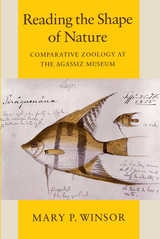
Reading the Shape of Nature
Comparative Zoology at the Agassiz MuseumMary P. Winsor
University of Chicago Press, 1991
In 1859, Louis Agassiz established the Museum of Comparative Zoology to house research on the ideal types that he believed were embodied in all living forms. Agassiz's vision arose from his insistence that the order inherent in the diversity of life reflected divine creation, not organic evolution. But the mortar of the new museum had scarcely dried when Darwin's Origin was published. By Louis Agassiz's death in 1873, even his former students, including his son Alexander, had defected to the evolutionist camp. Alexander, a self-made millionaire, succeeded his father as director and introduced a significantly different agenda for the museum.
To trace Louis and Alexander's arguments and the style of science they established at the museum, Winsor uses many fascinating examples that even zoologists may find unfamiliar. The locus of all this activity, the museum building itself, tells its own story through a wonderful series of archival photographs.
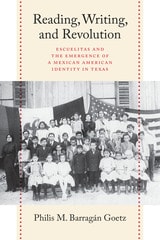
Reading, Writing, and Revolution
Escuelitas and the Emergence of a Mexican American Identity in TexasBy Philis M. Barragán Goetz
University of Texas Press, 2020
2022 National Association for Chicana and Chicano Studies Book Award
Tejas Foco Non-fiction Book Award, National Association for Chicana and Chicano Studies
2021 Tejano Book Prize, Tejano Genealogy Society of Austin
2021 Jim Parish Award for Documentation and Publication of Local and Regional History, Webb County Heritage Foundation
2021 Runner-up, Ramirez Family Award for Most Significant Scholarly Book
The first book on the history of escuelitas, Reading, Writing, and Revolution examines the integral role these grassroots community schools played in shaping Mexican American identity.
Language has long functioned as a signifier of power in the United States. In Texas, as elsewhere in the Southwest, ethnic Mexicans’ relationship to education—including their enrollment in the Spanish-language community schools called escuelitas—served as a vehicle to negotiate that power. Situating the history of escuelitas within the contexts of modernization, progressivism, public education, the Mexican Revolution, and immigration, Reading, Writing, and Revolution traces how the proliferation and decline of these community schools helped shape Mexican American identity.
Philis M. Barragán Goetz argues that the history of escuelitas is not only a story of resistance in the face of Anglo hegemony but also a complex and nuanced chronicle of ethnic Mexican cultural negotiation. She shows how escuelitas emerged and thrived to meet a diverse set of unfulfilled needs, then dwindled as later generations of Mexican Americans campaigned for educational integration. Drawing on extensive archival, genealogical, and oral history research, Barragán Goetz unravels a forgotten narrative at the crossroads of language and education as well as race and identity.
Readings In American Health Care
Current Issues In Socio-Historical PerspectiveWilliam G. Rothstein
University of Wisconsin Press, 1995
• Basic Concepts: mortality trends, concepts of disease, changes in medical therapy
• Public Health: AIDS, cigarette smoking, preventive medicine, fluoridation
• Health Care Professions: cardiology, pathology, women in medicine, nursing, podiatry, midwives
• Health Care Organizations: hospitals, HMOs
• Mental Illness
• Financing Health Care
• Medical Education
• Issues: abortion, ethical issues, cancer control, prenatal care, home care, the pharmaceutical industry
• Background Readings: American medicine from 1920 to midcentury.
The readings were chosen especially for course use in history, sociology, public health, and related fields, but can also provide useful background reading for anyone interested or involved in American health care. Each selection includes an introduction, questions for the reader, and a bibliography. Scholars and students alike will find the book an invaluable resource.
Readings in Arkansas Politics and Government
Kim U. Hoffman
University of Arkansas Press, 2020
Ready for Air
A Journey through Premature MotherhoodKate Hopper
University of Minnesota Press, 2013
For Kate Hopper, pregnancy is downright unpleasant. She is tired and heavy and worried, and she wants her wine and caffeine back. But then, at a routine checkup, her doctor frowns at her chart and says, “I’m worried about a couple of things”—and unpleasant suddenly seems like paradise. What follows is a harrowing, poignant, and occasionally hysterical journey through premature motherhood, from the starting point of “leaking a little protein” to the early delivery of her tiny daughter because of severe preeclampsia and the beginning of a new chapter of frightful, lifelong love.
Half a million babies are born prematurely in the United States every year—almost one every minute—each with a unique story, and Hopper eloquently gives a voice to what their parents share: the shock, the scares, the lonely nights in the neonatal intensive care unit, the fierce attention to detail that makes for sanity and craziness, the light of faith, the warmth of family, and the terrifying attachment. Through it all runs the power of words to connect us to one another, as Hopper draws on her gifts as a writer first to help her navigate this uncertain territory and then to tell her story. With candor, grace, and a healthy dose of humor, she takes us into the final weeks of her pregnancy, the this-was-not-part-of-the-plan first weeks of little Stella’s life, and the isolated world she and her husband inhabited when they took their daughter home at the onset of a cold Minnesota winter. Finally, frankly, Hopper ventures into the complicated question of whether to have another child. Down-to-earth and honest about the hard realities of having a baby, as well as the true joys, Ready for Air is a testament to the strength of motherhood—and stories—to transform lives.
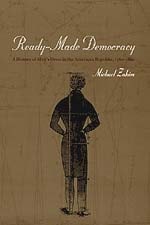
Ready-Made Democracy
A History of Men's Dress in the American Republic, 1760-1860Michael Zakim
University of Chicago Press, 2003
By the early nineteenth century, homespun began to disappear from the American material landscape. Exhortations of industry and modesty, however, remained a common fixture of public life. In fact, they found expression in the form of the business suit. Here, Zakim traces the evolution of homespun clothing into its ostensible opposite—the woolen coats, vests, and pantaloons that were "ready-made" for sale and wear across the country. In doing so, he demonstrates how traditional notions of work and property actually helped give birth to the modern industrial order. For Zakim, the history of men's dress in America mirrored this transformation of the nation's social and material landscape: profit-seeking in newly expanded markets, organizing a waged labor system in the city, shopping at "single-prices," and standardizing a business persona.
In illuminating the critical links between politics, economics, and fashion in antebellum America, Ready-Made Democracy will prove essential to anyone interested in the history of the United States and in the creation of modern culture in general.
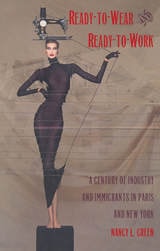
Ready-to-Wear and Ready-to-Work
A Century of Industry and Immigrants in Paris and New YorkNancy L. Green
Duke University Press, 1997
Green focuses on issues of fashion and fabrication as they involve both the production and consumption of clothing. Traditionally, much of the urban garment industry has been organized around small workshops and flexible homework, and Green emphasizes the effect this labor organization had on the men and mostly women who have sewn the garments. Whether considering the immigrant Jews, Italians, Puerto Ricans, Dominicans, and Chinese in New York or the Chinese-Cambodians, Turks, Armenians, and Russian, Polish, and Tunisian Jews in Paris, she outlines similarities of social experience in the shops and the unions, while allowing the voices of the workers, in all their diversity to be heard.
A provocative examination of gender and ethnicity, historical conflict and consensus, and notions of class and cultural difference, Ready-to-Wear and Ready-to-Work breaks new ground in the methodology of comparative history.
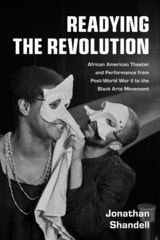
Readying the Revolution
African American Theater and Performance from Post-World War II to the Black Arts MovementJonathan Shandell
University of Michigan Press, 2025
2026 American Theatre and Drama Society John W. Frick Book Award Winner
Starting in 1966, African American activist Stokely Carmichael and other political leaders adopted the phrase "Black Power!" The slogan captured a militant, revolutionary spirit that was already emerging in the work of playwrights, poets, musicians, and visual artists throughout the Black Arts movement of the mid-1960s. But the story of those theater artists and performers whose work helped bring about the Black Arts revolution has not fully been told. Readying the Revolution: African American Theater and Performance from Post-World War II to the Black Arts Movement explores the dynamic era of Black culture between the end of World War II and the start of the Black Arts Movement (1946-1964) by illuminating how artists and innovators such as Jackie Robinson, Lorraine Hansberry, Ossie Davis, Nina Simone, and others helped radicalize Black culture and Black political thought. In doing so, these artists defied white cultural hegemony in the United States, and built the foundation for the revolutionary movement in Black theater that followed in the mid 1960s. Through archival research, close textual reading, and an analysis of performance artifacts, Shandell demonstrates how these artists negotiated a space on the public stage for cultivating radical Black aesthetics and built the foundation for the revolutionary movement in Black theater that followed in the mid-1960s.
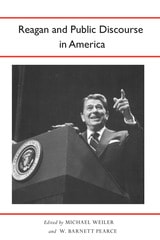
Reagan and Public Discourse in America
Michael Weiler
University of Alabama Press, 1992
The authors show that more than any president since John F. Kennedy, Reagan’s influence flowed from his rhetorical practices. And he is remembered as having reversed certain trends and cast the U.S. on a new course. The contributors to this insightful collection of essays show that Reagan’s rhetorical tactics were matters of primary concern to his administration’s chief political strategists.
Real American Ethics
Taking Responsibility for Our CountryAlbert Borgmann
University of Chicago Press, 2006
America is a wonderful and magnificent country that affords its citizens the broadest freedoms and the greatest prosperity in the world. But it also has its share of warts. It is embroiled in a war that many of its citizens consider unjust and even illegal. It continues to ravage the natural environment and ignore poverty both at home and abroad, and its culture is increasingly driven by materialism and consumerism. But America, for better or for worse, is still a nation that we have built. So why then, asks Albert Borgmann in this most timely and urgent work, are we failing to take responsibility for it?
In Real American Ethics, Borgmann asks us to reevaluate our role in the making of American values. Taking his cue from Winston Churchill—who once observed that we shape our buildings, and then our buildings shape us—Borgmann considers the power of our most enduring institutions and the condition of our present moral makeup to propose inspired new ways in which we, as ordinary citizens, can act to improve our country. This, he shows, includes everything from where we choose to live and what we spend our money on to daunting tasks like the reshaping of our cities—habits and actions that can guide us to more accomplished and virtuous lives. Using prose that is easy and direct throughout, Borgmann’s position is grounded neither by conservative nor liberal ideology, but in his understanding that he is a devoted citizen among many.
In an age in which the blame game is the only game in town, this patriotic book is an eloquent reminder of the political strength we all wield when we work together.
Real Emotional Logic
Film and Television Docudrama as Persuasive PracticeSteven N. Lipkin
Southern Illinois University Press, 2002
Analyzing docudrama as a mode of argument, Steven N. Lipkin explores the ethical, historical, and ideological functions of docudrama to discover why these films based on true stories offer such appealing story lines. That appeal, Lipkin discovers, is rooted in docudrama’s representation of actual people and events by means of melodramatic narrative structures that play on the emotions of the viewer.
The dual nature of docudramas—blending narrative and documentary style— argues for a moral view of reality-based subject matter. The ethics, the ideology, the very presence of docudrama on television and the range of topics and problems that appear in contemporary feature film docudramas indicate how this form of presentation appeals to its audience. Docudrama offers a warranted, rational view of what the story material might suggest initially to be an irrational world. Through its moral agenda, docudrama ultimately allows the possibilities of understanding, optimism, and hope to emerge from “real stories.”
Real Emotional Logic traces the development of docudramas into contemporary movies of the week and feature films, including Schindler’s List, Amistad, JFK, The Killing Fields, Quiz Show, A League of Their Own, In the Name of the Father, Call Northside 777, 13 Rue Madeleine, Cheerleader Mom, Shine, Rosewood, A Civil Action, and October Sky.
Lipkin provides further insight into the genre by identifying and describing the commonalities connecting ostensibly different docudramas through their shared themes and narrative techniques. In doing so, he exposes the persuasive rhetorical strategies at the heart of docudramas and reveals the constructed emotional appeal inherent in films “based on a true story.”
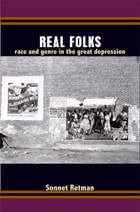
Real Folks
Race and Genre in the Great DepressionSonnet H. Retman
Duke University Press, 2011
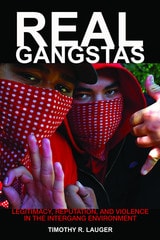
Real Gangstas
Legitimacy, Reputation, and Violence in the Intergang EnvironmentLauger, Timothy R
Rutgers University Press, 2012
Street gangs are a major concern for residents in many inner-city communities. However, gangs’ secretive and, at times, delinquent tendencies limit most people’s exposure to the realities of gang life. Based on eighteen months of qualitative research on the streets of Indianapolis, Real Gangstas provides a unique and intimate look at the lives of street gang members as they negotiate a dangerous peer environment in a major midwestern city.
Timothy R. Lauger interviewed and observed a mix of fifty-five gang members, former gang members, and non-gang street offenders. He spent much of his fieldwork time in the company of a particular gang, the “Down for Whatever Boyz,” who allowed him to watch and record many of their day-to-day activities and conversations. Through this extensive research, Lauger is able to understand and explain the reasons for gang membership, including a chaotic family life, poverty, and the need for violent self-assertion in order to foster the creation of a personal identity.
Although the book exposes many troubling aspects of gang life, it is not a simple descriptive or a sensationalistic account of urban despair and violence. Steeped in the tradition of analytical ethnography, the study develops a central theoretical argument: combinations of street gangs within cities shape individual gang member behavior within those urban settings. Within Indianapolis, members of rival gangs interact on a routine basis within an ambiguous and unstable environment. Participants believe that many of their contemporaries claiming gang affiliations are not actually “real” gang members, but instead are imposters who gain access to the advantages of gang membership through fraud and pretense. Consequently, the ability to discern “real” gang members—or to present oneself successfully as a real gang member—is a critical part of gangland Indianapolis.
Real Gangstas offers an objective and fair characterization of active gang members, successfully balancing the seemingly conflicting idea that they generally seem like normal teenagers, yet are abnormally concerned with—and too often involved in—violence. Lauger takes readers to the edge of an actual gang conflict, providing a rare and up-close look at the troubling processes that facilitate hostility and violence.
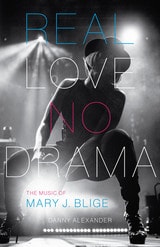
Real Love, No Drama
The Music of Mary J. BligeBy Danny Alexander
University of Texas Press, 2016
Mary J. Blige is an icon who represents the political consciousness of hip hop and the historical promise of soul. She is an everywoman, celebrated by Oprah Winfrey and beloved by pop music fans of all ages and races. Blige has sold over fifty million albums, won numerous Grammys, and even played at multiple White House events, as well as the 2013 Nobel Peace Prize ceremony. Displaying astonishing range and versatility, she has recorded everything from Broadway standards to Led Zeppelin anthems and worked with some of popular music’s greatest artists—Aretha Franklin, Eric Clapton, Elton John, Whitney Houston, Sting, U2, and Beyoncé, among them.
Real Love, No Drama: The Music of Mary J. Blige tells the story of one of the most important artists in pop music history. Danny Alexander follows the whole arc of Blige’s career, from her first album, which heralded the birth of “hip hop soul,” to her critically praised 2014 album, The London Sessions. He highlights the fact that Blige was part of the historically unprecedented movement of black women onto pop radio and explores how she and other women took control of their careers and used their music to give voice to women’s (and men’s) everyday struggles and dreams. This book adds immensely to the story of both black women artists and artists rooted in hip hop and pays tribute to a musician who, by expanding her reach and asking tough questions about how music can and should evolve, has proven herself an artistic visionary.
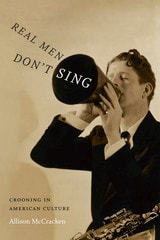
Real Men Don't Sing
Crooning in American CultureAllison McCracken
Duke University Press, 2015
Real Philly History, Real Fast
Fascinating Facts and Interesting Oddities about the City's Heroes and Historic SitesJim Murphy
Temple University Press, 2021
Philadelphia is known as the home of vibrant colonial history: the Liberty Bell, the Betsy Ross House, and Independence Hall. But the City of Brotherly Love is also home to—and less well known for—its quirky history. The country’s first quarantine station was located here. One of Philly’s clocks has a face larger than Big Ben’s in London. And a unique skill of Black abolitionist James Forten saved him from a life of West Indian servitude (and “Forten” was not even his real name).
In Real Philly History, Real Fast, Jim Murphy provides an original tour of the city. He highlights artistic gems including the Dream Garden Tiffany mosaic and Isaiah Zagar’s glittering Magic Gardens. He profiles intriguing historical figures from military leader Commodore Barry to civil rights heroes like Lucretia Mott. Murphy also explores neighborhoods from Chinatown to the Italian Market and the unique architectural details of Carpenters’ Hall and the PSFS building.
Each chapter provides a pithy story about a historical person or site, along with bullet points featuring interesting oddities, and nearby attractions along with fun facts such as: Why there are so many churches? What is the Philadelphia Eagles’ connection to the U.S. Custom House? Which famous artist may have been Philadelphia’s first nude model? And where was the Liberty Bell secretly damaged? (We didn’t do it!)
This is Philly history in bites that are as digestible as a soft pretzel with mustard.
Real Places
An Unconventional Guide to America's Generic LandscapeGrady Clay
University of Chicago Press, 1994
"This book provides a language for the architecture of everyday life."—Ross Miller, Chicago Tribune
"Spirited observations and capsule histories."—Suzanne Stephens, New York Times Book Review
"Compelling. . . . Included here are many nuggets of insight and illumination."—Brad Knickerbocker, Christian Science Monitor
"An amusing and touching book about the reality we Americans have captured in our language."—Boston Sunday Globe
Real Role Models
Successful African Americans Beyond Pop CultureBy Joah Spearman and Louis Harrison, Jr.
University of Texas Press, 2010
All young people need good role models, and black youth especially need positive and real examples beyond the famous and wealthy people they see on SportsCenter highlights and MTV Cribs. While success as a celebrity athlete or entertainer may seem like an achievable dream, the reality is that young African Americans have a much greater chance of succeeding in the professions through education and hard work—and a mentor to show them the path. Real Role Models introduces high school and college-age African Americans to twenty-three black professionals who have achieved a high level of success in their chosen fields and who tell their stories to inspire young people to pursue a professional career and do the work necessary to achieve their dreams.
Some of the individuals profiled by Joah Spearman and Louis Harrison, Jr., include Leonard Pitts, Pulitzer Prize–winning columnist for the Miami Herald; Melody Barnes, Director of the White House Domestic Policy Council; Danyel Smith, editor-in-chief of Vibe; and Dr. Tim George, Chief of Pediatric Neuroscience at Dell Children's Medical Center of Central Texas. They and other interviewees describe their backgrounds, career paths, and desire to give back by helping others reach their goals. Representing a wide range of occupations, these real role models prove to African American youths that a whole world of successful, rewarding careers awaits them.
The Real Role Models
- Rufus Cormier, JD, Partner at the Baker Botts Law Firm, Houston, Texas
- Melody Barnes, Director of the White House Domestic Policy Council, Washington, D.C.
- Eric Motley, PhD, Managing Director of the Aspen Institute's Henry Crown Fellowship Program, Aspen, Colorado
- James McIntyre, Spokesman for the Federal Emergency Management Agency, Washington, D.C.
- Tracie Hall, Assistant Dean and Librarian at Dominican University, River Forest, Illinois
- Kimberlydawn Wisdom, MD, Surgeon General of the State of Michigan, Lansing, Michigan
- Timothy George, MD, Chief of Pediatric Neuroscience at Dell Children's Medical Center, Austin, Texas
- Victoria Holloway Barbosa, MD, Ethnic Dermatologist and Former Executive for L'Oreal, Chicago, Illinois
- Bill Douglas, White House Correspondent for McClatchy Newspapers, Washington, D.C.
- Leonard Pitts, Jr., Columnist for the Miami Herald, Miami, Florida
- Danyel Smith, Editor of Vibe Magazine, New York, New York
- Ed Stewart, Managing Director of External Communications for Delta Airlines, Atlanta, Georgia
- Lynn Tyson, Vice President of Investor Relations for Dell, Austin, Texas
- Willie Miles, Jr., Founder and CEO of Miles Wealth Management, Houston, Texas
- Horace Allen, Founder and CEO of TeamPact, Atlanta, Georgia
- Deavra Daughtry, President and CEO of Excellent Care Management, Houston, Texas
- Je'Caryous Johnson, Founder and CEO of I'm Ready Productions, Houston, Texas
- Steve Jones, Cofounder of a graphic design company, Oakland, California
- Isiah Warner, PhD, Chemistry Professor at Louisiana State University, Baton Rouge, Louisiana
- Gloria Ladson-Billings, PhD, Professor of Education at the University of Wisconsin, Madison, Wisconsin
- Bernard Muir, Athletic Director at Georgetown University, Washington, D.C.
- Craig Littlepage, Athletic Director at the University of Virginia, Charlottesville, Virginia
- Beverly Kearney, Women's Track Coach at the University of Texas at Austin, Austin, Texas
Real Sister
Stereotypes, Respectability, and Black Women in Reality TVWard, Jervette R
Rutgers University Press, 2015
The first book of scholarship devoted to the issue of how black women are depicted on reality television, Real Sister offers an even-handed consideration of the genre. The book’s ten contributors—black female scholars from a variety of disciplines—provide a wide range of perspectives, while considering everything from Basketball Wives to Say Yes to the Dress. As regular viewers of reality television, these scholars are able to note ways in which the genre presents positive images of black womanhood, even as they catalog a litany of stereotypes about race, class, and gender that it tends to reinforce.
Rather than simply dismissing reality television as “trash,” this collection takes the genre seriously, as an important touchstone in ongoing cultural debates about what constitutes “trashiness” and “respectability.” Written in an accessible style that will appeal to reality TV fans both inside and outside of academia, Real Sister thus seeks to inspire a more nuanced, thoughtful conversation about the genre’s representations and their effects on the black community.
Real to Reel
Lidia Yuknavitch
University of Alabama Press, 2003

Real-World Teen Services
Jennifer Velásquez
American Library Association, 2015
Realignment in American Politics
Toward a TheoryEdited by Bruce A. Campbell and Richard J. Trilling
University of Texas Press, 1980
Reality Bites
Rhetoric and the Circulation of Truth Claims in U.S. Political CultureDana L. Cloud
The Ohio State University Press, 2018
Reality Squared
Televisual Discourse on the RealFriedman, James
Rutgers University Press, 2002
“Reality Squared develops the scholarly discussion of the aesthetic of realism, documentary conventions, and modes of television broadcasting, in sophisticated new directions. Friedman’s historical perspective is especially valuable since so much discussion of the new aesthetic of realism on television fails to take into account similar trends throughout television history.”—Ellen Seiter, professor of communication, University of California at San Diego
“Reality Squared offers a rich variety of insights into the way television and new media make us believe in the worlds they represent. Spanning across the decades of early live TV to contemporary digital culture, this volume is an important history, not only of media but alsoof our perception of reality itself.”—Lynn Spigel, University of Southern California and author of Welcome to the Dreamhouse
Through the 1980s and 1990s, the television industry and its critics have identified and promoted the re-emergence of “reality-based” television. During the past two decades, this type of programming has come to play a major role in both production decisions and network strategy. At the beginning of the twenty-first century, viewers’ desire for “reality TV” shows no signs of diminishing, as evidenced by the meteoric rise of shows such as Who Wants to be a Millionaire, Survivor, and MTV’s Real World.
Although debates concerning the relationship between representational media and reality have occupied scholars and artists for quite some time, a surprisingly small number of books have examined this subject. As the title suggests, Reality Squared examines the representation of reality within the squared televisual viewing frame, as
well as the exponential growth of these representational programs on broadcast, cable TV, and even beyond, to the worldwide web. The contributors approach the issues surrounding television and reality from a wide range of theoretical and methodological perspectives. Topics include: the internet, the impact of global news events, weather predictions on the Weather Channel, and the representation of criminality on America’s
Most Wanted. This diverse volume contributes to the ongoing conversation about reality and representation, history and fiction, text and context, and the “inside” and “outside” of that box we call television.
Realizing Educational Rights
Advancing School Reform through Courts and CommunitiesAnne Newman
University of Chicago Press, 2013
Newman argues that an adequate K–12 education is the right of all citizens, as a matter of equality, and emphasizes that this right must be shielded from the sway of partisan and majoritarian policy making far more than it currently is. She then examines how educational rights are realized in our current democratic structure, offering two case studies of leading types of rights-based activism: school finance litigation on the state level and the mobilization of citizens through community-based organizations. Bringing these case studies together with rich philosophical analysis, Realizing Educational Rights advances understanding of the relationships among moral and legal rights, education reform, and democratic politics.
Reason in Law, Tenth Edition
Lief H. Carter, Thomas F. Burke and Jessica Silbey
University of Chicago Press, 2026
An indispensable introduction to legal reasoning, updated for today’s political and legal environment.
Since it was first published nearly five decades ago, Reason in Law has become the starting point for understanding legal reasoning, a critical component of the rule of law. The editors show how judges can integrate all the elements of a case to persuasively explain their rulings—and, even more importantly, why they sometimes fail to do so. Drawing on cases old and new, Reason in Law enables readers to become sophisticated “judges of judging.”
Now in its tenth edition, Reason in Law includes a new chapter on the increasingly contentious and politically consequential field of administrative law and addresses recent developments in the American legal landscape, including growing conservatism in the federal judiciary and the flood of lawsuits brought against the second Trump administration. It also analyzes new cases on the First Amendment rights of high schoolers, transgender civil rights, the responsibilities universities have for student safety, Donald Trump’s sweeping claims of executive power, and historic Supreme Court decisions expanding the rights of gun owners and allowing states to criminalize abortion. As always, Reason in Law connects legal theory with empirical research on the American judicial system, showing how trustworthy legal reasoning helps preserve social peace and the rule of law.
Reason in Law
Ninth EditionLief H. Carter and Thomas F. Burke
University of Chicago Press, 2016
Rebecca Harding Davis
A Life Among WritersSharon M. Harris
West Virginia University Press, 2019
2018 Choice Outstanding Academic Title
This accessible treatment of Davis’s life, based on deep research in archival sources, provides new perspective on topics ranging from sectional tensions in the border South to the gendered world of nineteenth-century publishing. It promises to be the authoritative treatment of an important figure in the literary history of West Virginia and the wider world.
Rebecca Harding Davis
Writing Cultural AutobiographyJanice Milner Lasseter
Vanderbilt University Press, 2001
Rebel Bulldog
The Story of One Family, Two States, and the Civil WarJason Lantzer
Indiana Historical Society Press, 2017
Rebel Imaginaries
Labor, Culture, and Politics in Depression-Era CaliforniaElizabeth E. Sine
Duke University Press, 2021
Rebel Poet
More Stories from a 21st Century IndianLouis V. Clark (Two Shoes)
Wisconsin Historical Society Press, 2019
Rebel Private Front and Rear
By William Andrew Fletcher
University of Texas Press, 1954
Rebel Private Front and Rear is a line soldier’s account of the Civil War without heroics. Private Fletcher tells how at Gettysburg he was overcome by a “bad case of cowardly horror” when an order came on the third day to get ready to charge. “I tried to force manhood to the front, but fright would drive it back with a shudder,” he confessed. The attack of jitters lasted about fifteen minutes, and then he fell asleep while awaiting the order to advance.
But Fletcher could be brave to a fault. He was restless and venturesome and during the lulls between fighting would sometimes ask for permission to go on dangerous scouts into enemy territory. Once, just before Fredericksburg, he slipped out to a haystack in the no-man’s-land near the Rappahannock so that he could watch the Yankees build a bridge. And in his last fight at Bentonville he risked his life on a rash and futile impulse to capture a whole squad of Federals. At Second Manassas, Fletcher was struck by a bullet that grazed his bowels and lodged in his hip. His detailed description of his subsequent sensations and experiences is one of the most interesting portions of his narrative. He begged the surgeons to operate, but when they started cutting he howled so profanely that they threatened to abandon him. His reply was: “It don’t hurt as badly when I am cursing.”
Wounded again at Chickamauga, Fletcher was incapacitated for further infantry service and was transferred to Company E, Eighth Texas Cavalry, and served with Terry’s Rangers until the end of the war. In north Georgia he participated in a number of thrilling skirmishes with mounted forces of Sherman’s command, and in one of these encounters he lost his horse. A short time later, in a daring effort to capture a mount from the Yankees, he was taken prisoner. The story of the forming and execution of his plan to escape by jumping from a moving boxcar is full of suspense and excitement.
Rebel Private also reveals Fletcher as something of a philosopher. The narrative is sprinkled with dissertations on unexpected subjects, such as God, justice, and war. He reflects on the rightness and the necessity of “foraging,” in home as well as enemy territory, but he tells with evident relish how he and his “pard” of the occasion “pressed” whiskey, honey, and chickens.
Fletcher set down his experiences some forty years after the close of the Civil War. His story is told with the artlessness of the natural raconteur. Though the style is unpolished, the memoir makes lively reading because of the author’s eye for detail, his straightforward language, and his sense of humor. One of the most frequently cited narratives written by soldiers of Lee’s army, it derives its value as a historical source mainly from Fletcher’s honesty, his close observations, the richness and variety of his experiences, and the sharpness of his memory.
Rebel against Injustice
The Life of Frank P. O'HarePeter H. Buckingham
University of Missouri Press, 1996
Rebel against Injustice, a carefully crafted biography of Frank P. O'Hare (1877-1960), socialist, political activist, editor, and husband of prominent radical Kate Richards O'Hare, is the first study of a much-neglected but important figure of the American Left whose contributions are often referred to, in passing, in many other works.
Abandoned by his father at the age of four, O'Hare grew up in the Kerry Patch slum of St. Louis. Although he began his career in business, O'Hare turned to socialism with the sublime dream of bringing about a better world. While attending a school for Socialist organizers, he met Kate Richards, and the young couple forged a personal and professional partnership. Settling in Oklahoma, the O'Hares helped build a strong grassroots movement through grueling lecture tours and colorful camp meetings. In 1911, Frank, his wife, and their four children moved to St. Louis, where they transformed the National Rip-Saw into a popular Socialist monthly magazine. It was there that Frank found his niche as a Socialist impresario, editing the writings and arranging the tours of his "stars," Kate O'Hare and Eugene Debs.
A series of calamities, including the breakup of his marriage, brought Frank O'Hare near the edge of despair in the mid-1920s. Divorcing and remarrying, he made a new life in St. Louis. Plunging back into radical activism, he worked for the Federated Press syndicate. During the last twenty years of his life, O'Hare wrote for the St. Louis Post-Dispatch, worked as a business consultant, and continued his involvement as a community activist in St. Louis. Although Frank O'Hare has long been dismissed as a lost soul without Kate Richards O'Hare, Rebel against Injustice shows that he continued to be a presence in St. Louis and never stopped his fight against injustice. In 1958, a Teamster newspaper referred to O'Hare as "one of the truly great men of St. Louis--possibly the ONLY one."
Based upon a close study of the largely untapped Frank P. O'Hare papers, this well-written biography will enlighten readers about the organizational choices behind the success of American Socialism, while shedding new light on the lives and activities of many prominent American radicals.
Rebellion and Realignment
Arkansas's Road to SecessionJames M. Woods
University of Arkansas Press, 1987
Arkansas, the Old South’s last frontier, was forced, after the election of Lincoln, to face the issue of secession. A decade earlier, the state had spurned all efforts from within to withdraw from the Union, but the following ten years drew Arkansas deeper into the economic and cultural community that bound it to the other slaveholding states. Now rumblings of secession were heard even before the president-elect assumed office on March 4, 1861. The question was asked on street corners, in offices, barbershops and living rooms: Would Arkansas leave the Union?
Answers to that question caused a fundamental realignment of politics in Arkansas during the winter of 1860–61. The former political coalition of Democrat and Whig fell away in a geographical split between the uplands and the lowlands. In this important and exciting book, the first to tell the story of Arkansas’s road to secession, James Woods examines the differences between uplanders, whose mountain regions offered little useful farmland for any crop, and lowlanders, whose vast deltas were ideally suited for cotton farming. The southern portion of the state began to rely increasingly upon slavery as it became linked to the economy of cotton and Southern antebellum values, but the northern region of the state did not. Woods focuses upon the resulting social, economic, and geographic divisions that grew within Arkansas before and during the secession crisis. He captures the political struggles of the state as it tore away from the nation, and as it threatened, in so doing, to tear itself apart.
Rebellion in the Backlands
Euclides da Cunha
University of Chicago Press, 1957
Euclides da Cunha's classic account of the brutal campaigns against religious mystic Antonio Conselheiro has been praised by readers around the world as perhaps the greatest book ever written about Brazil. An epic of nonfiction that reads like a novel, it has been hailed by the likes of Stefan Zweig and Elizabeth Hardwick for its prose and its insights into the character of Brazil as the nation was being formed. Da Cunha tells the story of a guerrilla rebellion in the remote village of Canudos that fought the central government from 1893 to 1897, of the challenging conditions that led the people to revolt, and of the violent repression that resulted. A national epic like no other, Rebellion in the Backlands is a lasting classic, a book that has been handed from reader to reader for decades.
Rebellion in the Ranks
Mutinies of the American RevolutionJohn A. Nagy
Westholme Publishing, 2007
How General Washington Avoided the Peril From Within His Own Forces
"It gives me great pain to be obliged to solicit the attention of the honorable Congress to the state of the army...the greater part of the army is in a state not far from mutiny...I know not to whom to impute this failure, but I am of the opinion, if the evil is not immediately remedied and more punctuality observed in future, the army must absolutely break up."—George Washington, September 1775
Mutiny has always been a threat to the integrity of armies, particularly under trying circumstances, and since Concord and Lexington, mutiny had been the Continental Army's constant traveling companion. It was not because the soldiers lacked resolve to overturn British rule or had a lack of faith in their commanders. It was the scarcity of food—during winter months it was not uncommon for soldiers to subsist on a soup of melted snow, a few peas, and a scrap of fat—money, clothing, and proper shelter, that forced soldiers to desert or organize resistance. Mutiny was not a new concept for George Washington. During his service in the French and Indian War he had tried men under his command for the offense and he knew that disaffection and lack of morale in an army was a greater danger than an armed enemy.
In Rebellion in the Ranks: Mutinies of the American Revolution, John A. Nagy provides one of the most original and valuable contributions to American Revolutionary War history in recent times. Mining previously ignored British and American primary source documents and reexamining other period writings, Nagy has corrected misconceptions about known events, such as the Pennsylvania Line Mutiny, while identifying for the first time previously unknown mutinies. Covering both the army and the navy, Nagy relates American officers' constant struggle to keep up the morale of their troops, while highlighting British efforts to exploit this potentially fatal flaw.