Results by title
402 books match the query 'American poetry' and 26 start with s

Saga / Circus
Lyn Hejinian
Omnidawn, 2008
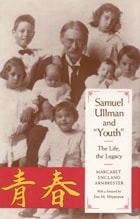
Samuel Ullman and "Youth"
The Life, the LegacyMargaret E. Armbrester
University of Alabama Press, 2009
Thousands of wonderful and sometimes strange fads have captured the public fancy in the almost five decades since the end of World War II. Most have been short-lived and soon faded away. There is, however, a poem that has not only withstood the vicissitudes of time, but has spread around the world like the waves lapping at a beach. This is the poem "Youth," by Samuel Ullman.
In December 1945, the Reader’s Digest published the poem and reported that General Douglas MacArthur, Commander of the Allied Forces, Far East, kept a copy of the poem near his desk.
Around that time, Yoshio Okada, a Japanese businessman, bought a copy of that December 1945 edition of the Reader's Digest, read the poem and was deeply affected by it. He translated it into Japanese and displayed it in his office as a guiding inspiration. Many of Okada's friends read the poem and were fascinated by its beauty. It began to receive national publicity through newspapers and magazines and became popular throughout Japan, especially among the intellectual community. Part of the reason for this widespread popularity is the excellence of the translation. Yoshio Okada, a man of noble character, gifted with a profound philosophy of life and literary talent, translated the poem into a beautiful, soulstirring Japanese version.
Samuel Ullman's “Youth” reflects the truth of life, and his outcry of spirituality touches the intrinsic nature of man.
See You Soon
PoemsLaura McKee
University of Arkansas Press, 2016
Finalist, 2016 Miller Williams Poetry Prize
The poems in See You Soon explore the limits of metaphor and language as their voices speak from the beauty and strangeness of daily experience, testing how we make sense of ourselves to ourselves and to one another. There is love in these poems, there is failure and absurdity. The characters, in their various situations and guises, find themselves outside of time, space, and identity—at sunset, in an airport, outside a hookah lounge, as a birthday party clown, after a flood. Its message is the invitation of the title. See You Soon is a statement of the complexity of our mutual direction in time, of camaraderie along the way.

Shadeland
Andrew Grace
The Ohio State University Press, 2008
Shadowed Dreams
Women's Poetry of the Harlem RenaissanceMcKay, Nellie
Rutgers University Press, 2006
The first edition of Shadowed Dreams was a groundbreaking anthology that brought to light the contributions of women poets to the Harlem Renaissance. This revised and expanded version contains twice the number of poems found in the original, many of them never before reprinted, and adds eighteen new voices to the collection to once again strike new ground in African American literary history. Also new to this edition are nine period illustrations and updated biographical introductions for each poet.
Shadowed Dreams features new poems by Gwendolyn Bennett, Anita Scott Coleman, Mae Cowdery, Blanche Taylor Dickinson, Alice Dunbar-Nelson, Jessie Fauset, Angelina Weld Grimké, Gladys Casely Hayford (a k a Aquah Laluah), Virginia Houston, Georgia Douglas Johnson, Helene Johnson, Effie Lee Newsome, Esther Popel, and Anne Spencer, as well as writings from newly discovered poets Carrie Williams Clifford, Edythe Mae Gordon, Alvira Hazzard, Gertrude Parthenia McBrown, Beatrice Murphy, Lucia Mae Pitts, Grace Vera Postles, Ida Rowland, and Lucy Mae Turner, among others.
Covering the years 1918 through 1939 and ranging across the period’s major and minor journals, as well as its anthologies and collections, Shadowed Dreams provides a treasure trove of poetry from which to mine deeply buried jewels of black female visions in the early twentieth century.
Shedding Skins
Four Sioux PoetsAdrian C. Louis
Michigan State University Press, 2008
Here's the myth: Native Americans are people of great spiritual depth, in touch with the rhythms of the earth, rhythms that they celebrate through drumming and dancing. They love the great outdoors and are completely in tune with the natural world. They can predict the weather by glancing at the sky, or hearing a crow cry, or somehow. Who knows exactly how? The point of the myth is that Indians are, well, special. Different from white people, but in a good way.
The four young male Native American poets whose work is brought together in this startling collection would probably raise high their middle fingers in salute to this myth. These guys and "guys" they are—don't buy into the myth. Their poems aren't about hunting and fishing or bonding with animal spirits. Their poems are about urban decay and homelessness, about loneliness and despair, about Payday Loans and 40-ounce beers, about getting enough to eat and too much to drink. And there is nothing romantic about their poetry, either. It is written in the vernacular of mean streets: often raw and coarse and vulgar, just like the lives it describes. Sure, they write about life on the reservation. However, for the Indians in their poems, life on the reservation is a lot like life in the city, but without the traffic. These poets are sick to death of the myth. You can feel it in their poems.
These poets are bound by a common attitude as well as a common heritage. All four—Joel Waters, Steve Pacheco, Luke Warm Water, and Trevino L. Brings Plenty—are Sioux, and all four identify themselves as "Skins" (as in "Redskins"). In their poems, they grapple with their heritage, wrestling with what it means to be a Sioux and a Skin today. It's a fight to the finish.
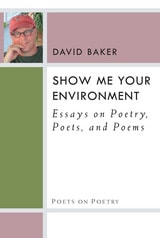
Show Me Your Environment
Essays on Poetry, Poets, and PoemsDavid Baker
University of Michigan Press, 2014
In Show Me Your Environment, a penetrating yet personable collection of critical essays, David Baker explores how a poem works, how a poet thinks, and how the art of poetry has evolved—and is still evolving as a highly diverse, spacious, and inclusive art form. The opening essays offer contemplations on the “environment” of poetry from thoughts on physical places and regions as well as the inner aesthetic environment. Next, Baker looks at the highly distinctive achievements and styles of poets ranging from George Herbert and Emily Dickinson through poets writing today. Finally, he takes joy in reading individual poems—from the canonical to the contemporary; simply and closely.
Simulcast
Four Experiments in CriticismBenjamin Friedlander
University of Alabama Press, 2004
A provocative overview of avant-garde American poetry of the past 25 years that raises important questions about the practice of criticism.
Simulcast offers long overdue, highly opinionated, and penetrating examinations of a flourishing movement in American letters by one of its most perceptive practitioners. The four “experiments” in literary criticism gathered in this volume vary in style and point of view. Taken together, they reassess the fundamental relationship between poetry and criticism.
“The Anti-Hegemony Project” is a satire, employing the rhetoric of journalism and the colloquial exchanges of online fan groups to analyze one of the earliest appearances of a poetry community on the World Wide Web: the “Poetics List” maintained at the State University of New York, Buffalo. “Poe’s Poetics and Selected Essays” is a collection of polemical essays on subjects ranging from modernism to language poetry. The third experiment, “The Literati of San Francisco,” is a detailed portrait of the figures and ideas at the heart of an important literary scene a decade after language poetry’s inception. The final essay, “A Short History of Language Poetry,” provides a less polemical, more sober and even-handed analysis of that movement from its origins to the present and its prospects for the future.
These critical interventions and essays are important studies of an evolving poetic field, but they also represent an evolution in criticism itself. Friedlander’s unorthodox methodology is to create a critical text by rewriting prior examples of criticism, among them Jean Wahl’s A Short History of Existentialism and Edgar Allan Poe’s "Literati of New York City." The resulting critiques are themselves a kind of poetry. They explore the issues of style versus substance, artifice versus authenticity, and plausibility versus truth, while the shifts in perspective call into question the authority of any one critical account.
Sing
Poetry from the Indigenous AmericasEdited by Allison Adelle Hedge Coke
University of Arizona Press, 2011
They write from disparate zones and parallel experience, from lands of mounded earthwork long-since paved, from lands of ancient ball courts and the first great cities on the continents, from places of cold, from places of volcanic loam, from zones of erased history and ongoing armed conflict, where “postcolonial” is not an academic concept but a lived reality. As befits a volume of such geographical inclusivity, many poems here appear in multiple languages, translated by fellow poets and writers like Juan Felipe Herrera and Cristina Eisenberg.
Hedge Coke’s thematic organization of the poems gives them an added resonance and continuity, and readers will appreciate the story of the genesis of this project related in Hedge Coke’s deeply felt introduction, which details her experiences as an invited performer at several international poetry festivals. Sing is a journey compelled by the exploration of kinship and the desire for songs that open “pathways of return.”
Singing the Chaos
Madness and Wisdom in Modern PoetryWilliam Pratt
University of Missouri Press, 1996
Singing the Chaos: Madness and Wisdom in Modern Poetry combines both a historical and a critical approach toward the works of major British, American, French, German, and Russian poets. Comprehensive in scope and arranged chronologically to survey a century of high poetic achievement, the study is unified by Pratt's overriding argument that "modern poets have endowed a disintegrating civilization with humane wisdom by 'singing the chaos' that surrounds them, making ours a great age in spite of itself."
In developing this central theme, Pratt brings alive the energy, the freshness, and the originality of technique that made Baudelaire, Pound, Yeats, Rilke, Eliot, and others the initiators of the revolution in poetry. He brings a more complete, clearer perspective to other major themes: modernism as an age of irony; poets as both madmen and geniuses; the modern poet as tragic hero; the dominance of religious or visionary truths over social or political issues; and the combination of radical experiments in poetic form with an apocalyptic view of Western civilization. His detailed treatment of the Fugitive poets and his recognition of their prominent role in twentieth-century literature constitute an important historical revision.
Brilliantly informed, insightful, and, above all, accurately sympathetic to the points of view of the poets Pratt presents, Singing the Chaos is that rare book that belongs on all shelves devoted to modernist poetry.
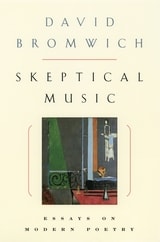
Skeptical Music
Essays on Modern PoetryDavid Bromwich
University of Chicago Press, 2001
The two general essays that frame Skeptical Music make Bromwich's aesthetic commitments clear. In "An Art without Importance," published here for the first time, Bromwich underscores the trust between author and reader that gives language its subtlety and depth, and makes the written word adequate to the reality that poetry captures. For Bromwich, understanding the work of a poet is like getting to know a person; it is a kind of reading that involves a mutual attraction of temperaments. The controversial final essay, "How Moral Is Taste?," explores the points at which aesthetic and moral considerations uneasily converge. In this timely essay, Bromwich argues that the wish for excitement that poetry draws upon is at once primitive and irreducible.
Skeptical Music most notably offers incomparable readings of individual poets. An essay on the complex relationship between Hart Crane and T. S. Eliot shows how the delicate shifts of tone and shading in their work register both affinity and resistance. A revealing look at W. H. Auden traces the process by which the voice of a generation changed from prophet to domestic ironist. Whether discussing heroism in the poetry of Wallace Stevens, considering self-reflection in the poems of Elizabeth Bishop, or exploring the battle between the self and its images in the work of John Ashbery, Skeptical Music will make readers think again about what poetry is, and even more important, why it still matters.

Slick Like Dark
Meg Wade
Tupelo Press, 2020
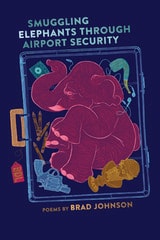
Smuggling Elephants through Airport Security
Brad Johnson
Michigan State University Press, 2020
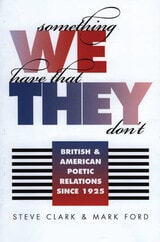
Something We Have That They Don't
British and American Poetic Relations since 1925Steve & Mark Clark & Ford
University of Iowa Press, 2004
(I like the way the English spell it
They’re so clever about some things
Probably smarter generally than we are
Although there is supposed to be something
We have that they don’'t—'don’t ask me
What it is. . . .)
—John Ashbery, “Tenth Symphony”
Something We Have That They Don’t presents a variety of essays on the relationship between British and American poetry since 1925. The essays collected here all explore some aspect of the rich and complex history of Anglo-American poetic relations of the last seventy years. Since the dawn of Modernism poets either side of the Atlantic have frequently inspired each other’s developments, from Frost’s galvanizing advice to Edward Thomas to rearrange his prose as verse, to Eliot’s and Auden’s enormous influence on the poetry of their adopted nations (“whichever Auden is,” Eliot once replied when asked if he were a British or an American poet, “I suppose, I must be the other”); from the impact of Charles Olson and other Black Mountain poets on J. H. Prynne and the Cambridge School, to the widespread influence of Frank O'Hara and Robert Lowell on a diverse range of contemporary British poets. Clark and Ford’s study aims to chart some of the currents of these ever-shifting relations. Poets discussed in these essays include John Ashbery, W. H. Auden, Elizabeth Bishop, T. S. Eliot, Mark Ford, Robert Graves, Thom Gunn, Lee Harwood, Geoffrey Hill, Michael Hofmann, Susan Howe, Robert Lowell, and W. B. Yeats.
“Poetry and sovereignty,” Philip Larkin remarked in an interview of 1982, “are very primitive things”: these essays consider the ways in which even seemingly very “unprimitive” poetries can be seen as reflecting and engaging with issues of national sovereignty and self-interest, and in the process they pose a series of fascinating questions about the national narratives that currently dominate definitions of the British and American poetic traditions.
This innovative and exciting new collection will be of great interest to students and scholars of British and American poetry and comparative literature.
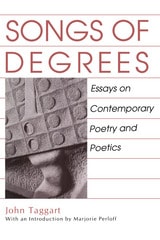
Songs of Degrees
Essays on Contemporary Poetry and PoeticsJohn Taggart
University of Alabama Press, 1994
Sound and Form in Modern Poetry
Second EditionHarvey Gross and Robert McDowell
University of Michigan Press, 1996
Poet, critic, and editor Robert McDowell has updated this classic text in the light of the poetic and critical developments of the last three decades. Segments on Dickinson, Robinson, Frost, Jeffers, and Lowell, among other poets, have been greatly expanded, and Ashbery, Creeley, Ginsberg, Hall, Kees, Kumin, Levertov, Levine, O'Hara, Plath, Rich, Simpson, and Wilbur added, among others. The epilogue discusses a new generation of poets whose works will likely be read well into the next century-- among others, Thomas M. Disch, Rita Dove, Dana Gioia, Emily Grosholz, Mark Jarman, Molly Peacock, Gjertrud Schnackenberg, Timothy Steele, Mary Swander, and Marilyn Nelson Waniek.
Over the last ten years, the most inspiring topic of conversation and argument among poets and their readers has been the resurgence of narrative and traditional forms. The new Sound and Form in Modern Poetry is a seminal text in this discussion, examining not only this movement but all of the important developments (Dadaism, Surrealism, Imagism, Language Poetry, and the Confessional School) that have defined our poetry in the twentieth century and have set the stage for poetry's continued life in the twenty-first. The original Sound and Form in Modern Poetry enjoyed extensive classroom use as a text; the revised version promises to be even more accessible, and more essential, for years to come.
The late Harvey Gross was Professor of Comparative Literature, State University of New York at Stony Brook.
Robert McDowell is publisher and editor of Story Line Press, and is also poet, critic, translator, fiction writer, and essayist.
Soundworks
Race, Sound, and Poetry in ProductionAnthony Reed
Duke University Press, 2021
Southbound
Interviews with Southern PoetsEdited by Ernest Suarez, T. W. Stanford III, & Amy Verner
University of Missouri Press, 1999
"There's a real flowering, I think, of southern poetry right now, . . . assembling at the edges of everything." This observation by Pulitzer Prize-winning poet Charles Wright reflects upon the continuing vibrancy and importance of the southern poetic tradition. Although the death of James Dickey in 1997 left southern poetry without a recognizably dominant voice, an array of other vibrant voices continue to be heard and recognized. Southbound: Interviews with Southern Poets provides detailed discussion of the art and craft of poetry by many writers who promise to keep southern poetry vital into the twenty-first century.
Beginning with an interview with the late literary giant James Dickey, Southbound collects the ideas and insights of both well-known and rising southern poets, including Dave Smith, Charles Wright, Ellen Bryant Voigt, Yusef Komunyakaa, and Rodney Jones. Suarez's guiding principle for conducting and revising the interviews was to let the poets express themselves as clearly and fully as possible. Each interview is ultimately defined by the poet's own personality and voice, yet all explore similar themes—the relationship between technique and subject, the nature of the southern canon and each poet's place in it, and the state of contemporary poetry. As Dave Smith relates, "My sense of appreciation of what life means or could mean, whatever I know about life, stems from a sense of place, a sense of the ghostliness of meaning." It is this sense of place and meaning that Suarez allows each poet to convey truthfully in his interviews.
Including a brief introduction to each interview and a bibliography of primary and secondary sources for each poet, Southbound is a useful tool for scholars and a springboard for casual readers. More important, this collection of interviews makes a significant contribution to the tradition of southern poetry and its most prominent voices.
Speak to Me Words
Essays on Contemporary American Indian PoetryEdited by Dean Rader and Janice Gould
University of Arizona Press, 2003
Speak to Me Words is a stimulating blend of classic articles and original pieces that reflect the energy of modern American Indian literary studies. Highlighting various aspects of poetry written by American Indians since the 1960s, it is a wide-ranging collection that balances the insights of Natives and non-Natives, men and women, old and new voices. Included here are such landmark articles as "Answering the Deer" by Paula Gunn Allen, "Herbs of Healing" by Carter Revard, and "Song, Poetry and Language—Expression and Perception" by Simon Ortiz—all pieces that have shaped how we think about Native poetry. Among the contributions appearing for the first time are Elaine Jahner writing on Paula Gunn Allen's use of formal structures; Robert Nelson addressing pan-Indian tropes of emergence, survival, return, and renewal; and Janet McAdams focusing on Carter Revard's "angled mirrors." Although many Native writers may disregard distinctions between genres, together these writings help readers see the difference between American Indian poetry and other forms of Native literature.
These essays are as broad, encompassing, and provocative as Native poetry itself, branching off from and weaving back into one another. In showing how American Indian poetry redefines our social order and articulates how Indian communities think about themselves, these writers establish a new foundation for the study—and enjoyment—of this vital art.

Spoon River America
Edgar Lee Masters and the Myth of the American Small TownJason Stacy
University of Illinois Press, 2021
A literary and cultural milestone, Spoon River Anthology captured an idea of the rural Midwest that became a bedrock myth of life in small-town America. Jason Stacy places the book within the atmosphere of its time and follows its progress as the poetry took root and thrived. Published by Edgar Lee Masters in 1915, Spoon River Anthology won praise from modernists while becoming an ongoing touchstone for American popular culture. Stacy charts the ways readers embraced, debated, and reshaped Masters's work in literary controversies and culture war skirmishes; in films and other media that over time saw the small town as idyllic then conflicted then surreal; and as the source of three archetypes—populist, elite, and exile—that endure across the landscape of American culture in the twenty-first century.
A wide-ranging reconsideration of a literary landmark, Spoon River America tells the story of how a Midwesterner's poetry helped change a nation's conception of itself.
Spring and a Thousand Years (Unabridged)
PoemsJudy Halebsky
University of Arkansas Press, 2020
A translator’s notebook, an almanac, an ecological history, Judy Halebsky’s Spring and a Thousand Years (Unabridged) moves between multiple intersections and sign systems connected in a long glossary poem that serves as the book’s guide to what is lost, erased, or disrupted in transition both from experience to written word and from one language, location, and time period to another.
Writers Li Bai, Matsuo Bashō, Sei Shōnagon, and Du Fu make frequent appearances in centuries ranging from the eighth to the twenty-first, and appear in conversation with Grace Paley, Donald Hall, and Halebsky herself, as the poet explores subjects ranging from work and marriage to environmental destruction. Asking what would happen if these poets—not just their work—appeared in California, the poems slip between different geographies, syntaxes, times, and cultural frameworks.
The role of the literary translator is to bring text from one language into another, working to at once shift and retain the context of the original—from one alphabet to another, one point in time to another. These are poems in homage to translation; they rely on concepts that can bridge time and space, and as a result are as likely to find meaning in donuts or Zumba as they are to find it in the ocean. Spring and a Thousand Years (Unabridged) finds reasons for hope not in how the world should be, but in how it has always been.
Stand Up Poetry
An Expanded AnthologyCharles Harper Webb
University of Iowa Press, 2002
Contributors:
Kim Addonizio
Dorothy Barresi
Charles Bukowski
Maxine Chernoff
Lucille Clifton
Billy Collins
Philip Dacey
Stephen Dunn
Deborah Harding
Edward Hirsch
Tony Hoagland
Allison Joseph
Jesse Lee Kercheval
Lisa Lewis
Bill Mohr
Ed Ochester
Lawrence Raab
Maureen Seaton
James Tate
Rafael Zepeda
plus many more
Witty, sexy, gritty, outrageous, emotional, hilarious, honest, courageous. What do these words describe? A growing movement in American literary circles: Stand Up Poetry.
Over twenty years ago, Charles Harper Webb discovered a vibrant and invigorating poetry scene in southern California. Featuring some of America's best contemporary poets, this scene, according to Webb, “showed insight, imagination, craft, philosophical depth, but most of all, it was funny, and it was fun.” Stand Up Poetry: The Poetry of Los Angeles and Beyond (1990) was the result of Webb's enthusiasm for this poetic genre.
A decade later, the popularity of performance poetry, poetry slams, and poetry readings is on the rise, and Webb has expanded his anthology to include a greater sampling of poets from across the country. From Charles Bukowski to Billy Collins and Allison Joseph, the poets included in this collection are popular and emerging, classical and experimental, young and old; yet all exhibit the characteristics so important to Stand Up Poetry—humor, performability, accessibility, individuality. Most important, these poems are enjoyable when read silently or aloud, on the page or on the stage.
Stand Up Poetry: An Expanded Anthology is at its core a celebration of poetry offering readers a wonderful lesson in the power of words to entertain and inspire.
Strange Good Fortune
Essays on Contemporary PoetryDavid Wojahn
University of Arkansas Press, 2000
Survival This Way
Interviews with American Indian PoetsJoseph Bruchac
University of Arizona Press, 1987
Sweeping Beauty
Contemporary Women Poets Do HouseworkPamela Gemin
University of Iowa Press, 2005
Syncopations
The Stress of Innovation in Contemporary American PoetryJed Rasula
University of Alabama Press, 2004
Syncopations is an analysis of the sustaining vitality behind contemporary American poetry from 1975 to the present day by one of the most astute observers and critics in the field. The 12 essays reflect Jed Rasula’s nearly 30 years of advocacy on behalf of “opening the field” of American poetry.
From the Beats and the Black Mountain poets in the 1950s and 1960s to the impact of language poetry, the specter of an avant-garde has haunted the administrative centers of poetic conservatism. But the very concept of avant-garde is misleading, implying organized assault. Incentives for change can be traced to other factors, including the increased participation of women, critical theory’s self-reflection, and a growing interest in the book as a unit of composition. Syncopations addresses these and other issues evident in the work of such poets and critics as Clayton Eshleman, Marjorie Perloff, Ronald Johnson, Clark Coolidge, Nathaniel Mackey, and Robin Blaser. Its chapters range in modes and include close readings, sociological analysis, philosophical-aesthetic meditations, and career appraisals.
By examining both exemplary innovators and the social context in which innovation is either resisted, acclaimed, or taken for granted, Rasula delivers an important conceptual chronicle of the promise of American poetry.