Results by title
401 books match the query 'Civil War, 1861-1865' and 29 start with s
Scarlett Doesn't Live Here Anymore
SOUTHERN WOMEN IN THE CIVIL WAR ERALaura F. Edwards
University of Illinois Press, 2000
Positing the household as the central institution of southern society, Edwards delineates the inseparable links between domestic relations and civil and political rights in ways that highlight women's active political role throughout the nineteenth century. She draws on diaries, letters, newspaper accounts, government records, legal documents, court proceedings, and other primary sources to explore the experiences and actions of individual women in the changing South, demonstrating how family, kin, personal reputation, and social context all merged with gender, race, and class to shape what particular women could do in particular circumstances.
Meet Harriet Jacobs, the escaped slave who hid in a tiny, unheated attic on her master's property for seven years until she could free her children and herself. Marion Singleton Deveaux Converse, the southern belle who leaped out a second-story window to escape her second husband's "discipline" and received temporary shelter from her slaves. Sarah Guttery, a white, poor, unwed mother of two, whose hard work and clean living earned her community's respect despite her youthful transgressions. Aunt Lucy, who led her fellow slaves in taking over her master's abandoned plantation and declared herself the new mistress.
Through vivid portraits of these and other slaves, free blacks, common whites, and the white elite, Edwards shows how women's domestic situations determined their lives before the war and their responses to secession and armed conflict. She also documents how women of various classes entered into the process of rebuilding, asserting new rights and exploring new roles after the war.
An ideal basic text on society in the Civil War era, Scarlett Doesn't Live Here Anymore demonstrates how women on every step of the social ladder worked actively throughout the period to shape southern society in ways that fulfilled their hopes for the future. They used the resources at their disposal to fashion their own positive identities, to create the social bonds that sustained them in difficult times, and to express powerful social critiques that helped them make sense of their lives.
Scarlett's Women
Gone With the Wind and Its Female FansTaylor, Helen
Rutgers University Press, 1989
Scarlett's Women
Gone With the Wind and Its Female FansTaylor, Helen
Rutgers University Press, 1969
Seeing the Elephant
RAW RECRUITS AT THE BATTLE OF SHILOHJoseph Allan Frank and George A. Reaves
University of Illinois Press, 1989
Drawing on the letters, diaries, and other reminiscences of these raw recruits on both sides of the conflict, “Seeing the Elephant” gives a vivid and valuable primary account of the terrible struggle.
From the wide range of voices included in this volume emerges a nuanced picture of the psychology and motivations of the novice soldiers and the ways in which their attitudes toward the war were affected by their experiences at Shiloh.

Seeking the One Great Remedy
Francis George Shaw and Nineteenth-Century ReformLorien Foote
Ohio University Press, 2003
A radical abolitionist and early feminist, Francis George Shaw (1809–1882) was a prominent figure in American reform and intellectual circles for five decades. He rejected capitalism in favor of a popular utopian socialist movement; during the Civil War and Reconstruction, he applied his radical principles to the Northern war effort and to freedmen’s organizations.
A partnership with Henry George in the late 1870s provided an international audience for Shaw’s alternative vision of society. Seeking the One Great Remedy is the biography of this remarkable and influential man. In compelling detail, author Lorien Foote depicts the many aspects and exploits of the Shaw family. Their activities provide a perspective on the course of American reform that calls into question previous interpretations of the reform movement of this period.
Francis George Shaw is perhaps best known as the father of Robert Gould Shaw, subject of the movie Glory. Francis and his wife, Sarah Blake Shaw, achieved considerable notoriety for their activities, including their effort to shape public opinion during the Civil War. Turning the tragic death of their son into a public relations and propaganda triumph, they altered Northern opinion about the war and shaped a historical perception of the famous Massachusetts Fifty-fourth that continues today.
Seeking the One Great Remedy argues that social radicalism was pervasive among elite reformers before and after the Civil War and finds in the dramatic story of Francis George Shaw a model of that cause.
Seven Months in the Rebel States During the North American War, 1863
Captain Justus Scheibert, with a new introduction by Robert K. Krick
University of Alabama Press, 2009
Captain Scheibert’s book was available only in German until W. S. Hoole edited the present version.
Shades of Blue and Gray
An Introductory Military History of the Civil WarHerman Hattaway
University of Missouri Press, 1997
An introductory military history of the American Civil War, Shades of Blue and Gray places the 1861-1865 conflict within the broad context of evolving warfare. Emphasizing technology and its significant impact, Hattaway includes valuable material on land and sea mines, minesweepers, hand grenades, automatic weapons, the Confederate submarine, and balloons. The evolution of professionalism in the American military serves as an important connective theme throughout. Hattaway extrapolates from recent works by revisionists William Skelton and Roy Roberts to illustrate convincingly that the development of military professionalism is not entirely a post-Civil War phenomenon.
The author also incorporates into his work important new findings of recent scholars such as Albert Castel (on the Atlanta Campaign), Reid Mitchell (on soldiers' motivation), Mark Grimsley (on "hard war"), Brooks D. Simpson (on Ulysses S. Grant), and Lauren Cook Burgess (on women who served as soldiers, disguised as men). In addition, Hattaway comments on some of the best fiction and nonfiction available in his recommended reading lists, which will both enlighten and motivate readers.
Informative and clearly written, enhanced by graceful prose and colorful anecdotes, Shades of Blue and Gray will appeal to all general readers.
Shadow of Shiloh
Major General Lew Wallace in the Civil WarGail Stephens
Indiana Historical Society Press, 2010
Sherman's Forgotten General
Henry W. SlocumBrian C. Melton
University of Missouri Press, 2007
Henry Warner Slocum, a Union major general who was a corps and army commander in the Civil War, served from the first call for troops until he stood with William Tecumseh Sherman to receive Joseph E. Johnston’s surrender after Appomattox. He saw action at Bull Run, Chancellorsville, and Gettysburg, and by the end of the war he had taken command of the Army of Georgia, yet historians have largely overlooked this key commander.
Brian Melton has written the first scholarly account of this important general—the first full-length biography in nearly a century—who as one of Sherman’s most trusted commanders exercised significant influence during the Civil War. Although Slocum is remembered primarily for his lackluster performance at Gettysburg, Melton discloses that there is more to him than current history credits, offering a holistic account of his life to show that his career was much more significant than has been supposed.
Slocum took on the characteristics of the leaders he served, and Melton reveals how Slocum’s attitudes and tactics changed dramatically between commanders to explain why he proved to be of little help to George McClellan and almost a liability while serving under “Fighting Joe” Hooker and yet was an effective commander under Sherman. Slocum became Sherman’s “left arm” and adapted so thoroughly to his style of generalship that he anticipated the general’s intentions on two important occasions, and Melton contends that Slocum was a much more important contributor to the success of Sherman’s later campaigns than has been acknowledged, becoming at times more aggressive and driving than Sherman himself.
Melton ultimately considers Slocum’s fate as one of the forgotten generals of the Civil War—brought on largely by his joining the Democratic Party in 1865—and demonstrates why previous simplistic depictions of Slocum miss the mark. By providing the first detailed look at this important second-tier commander, Sherman’s Forgotten General illuminates the influences, events, and individuals of Slocum’s career to show that, while he may not have changed the course of the war, he played a conspicuous and important role in its successful execution that has long deserved to be recognized.
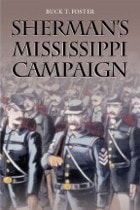
Sherman's Mississippi Campaign
Buck T. Foster
University of Alabama Press, 2006
The campaign that shaped Sherman's path to victory and changed the future of Civil War warfare.
With the fall of Vicksburg to Union forces in mid-1863, the Federals began work to extend and consolidate their hold on the lower Mississippi Valley. As a part of this plan, Major General William Tecumseh Sherman set out from Vicksburg on February 3, 1864, with an army of some 25,000 infantry and a battalion of cavalry. They expected to be joined by another Union force moving south from Memphis and supported themselves off the land as they traveled due east across Mississippi.
Sherman entered Meridian on February 14 and thoroughly destroyed its railroad facilities, munitions plants, and cotton stores, before returning to Vicksburg. Though not a particularly effective campaign in terms of enemy soldiers captured or killed, it offers a rich opportunity to observe how this large-scale raid presaged Sherman’s Atlanta and Carolina campaigns, revealing the transformation of Sherman’s strategic thinking.
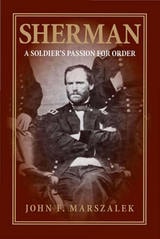
Sherman
A Soldier's Passion for OrderJohn F. Marszalek
Southern Illinois University Press, 1993
Sherman: A Soldier’s Passion for Order is the premier biography of William Tecumseh Sherman, the Civil War commander known for his “destructive war” policy against Confederates and as a consummate soldier. This updated edition of John F. Marszalek’s award-winning book presents the general as a complicated man who, fearing anarchy, searched for the order that he hoped would make his life a success.
Sherman was profoundly influenced by the death of his father and his subsequent relationship with the powerful Whig politician Thomas Ewing and his family. Although the Ewings treated Sherman as one of their own, the young Sherman was determined to make it on his own. He graduated from West Point and moved on to service at military posts throughout the South. This volume traces Sherman’s involvement in the Mexican War in the late 1840s, his years battling prospectors and deserting soldiers in gold-rush California, and his 1850 marriage to his foster sister, Ellen. Later he moved to Louisiana, and, after the state seceded, Sherman returned to the North to fight for the Union.
Sherman covers the general’s early Civil War assignments in Kentucky and Missouri and his battles against former Southern friends there, the battle at Shiloh, and his rise to become second only to Grant among the Union leadership. Sherman’s famed use of destructive war, controversial then and now, is examined in detail. The destruction of property, he believed, would convince the Confederates that surrender was their best option, and Sherman’s successful strategy became the stuff of legend.
This definitive biography, which includes forty-six illustrations, effectively refutes misconceptions surrounding the controversial Union general and presents Sherman the man, not the myth.
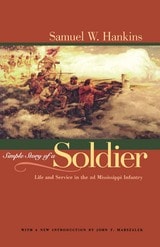
Simple Story Of A Soldier
Life And Service in the 2d Mississippi InfantrySamuel W. Hankins
University of Alabama Press, 2004
This fast-paced memoir was written in 1905 by 61-year-old Samuel W. Hankins while he was living in the Soldiers Home in Gulfport, Mississippi. It vividly details his years as a Confederate rifleman from the spring of 1861, when at a mere sixteen years of age he volunteered for the 2d Mississippi Infantry, through the end of the war in 1865, when he was just twenty years old and maimed for life.
The 2d Mississippi was part of the Army of Northern Virginia and as such saw action at Bull Run/Manassas, Seven Pines and the Peninsular Campaign, and Gettysburg. Besides being hospitalized with measles, suffering severely frostbitten feet, and being wounded by a minié ball at Railroad Cut, Hankins was captured by Federal forces and sent to a prisoner of war camp on David’s Island, New York. Later, he was transferred to a South Carolina hospital, returned home on furlough, joined a cavalry unit that fought at Atlanta. He was stationed in Selma, Alabama, when the war ended.
The strength of Hankins’s text lies in his straightforward narrative style virtually free of Lost Cause sentiment. Both Union and Confederate veterans could relate to his stories because so many of them had faced similar challenges during the war. Full of valuable information on a common soldier’s experience, the memoir still conjures the sights, sounds, and smells of warfare.
Slavery's End In Tennessee
John Cimprich
University of Alabama Press, 1985
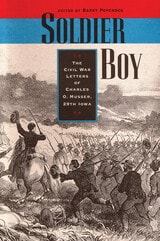
Soldier Boy
The Civil War Letters of Charles O. Musser, 29th IowaBarry Popchock
University of Iowa Press, 2008
Soldier Boy makes a significant contribution to the literature of the common soldier in the Civil War. Moreover, it takes a rare look at the Trans-Mississippi theater, which has traditionally been undervalued by historians.
Always Musser dutifully wrote and mailed his letters home. With a commendable eye for historical detail, he told of battles and marches, guerrilla and siege warfare, camp life and garrison soldiering, morale and patriotism, Copperheads and contraband, and Lincoln's reelection and assassination, creating a remarkable account of activities in this almost forgotten backwater of the war.
Southern Unionist Pamphlets and the Civil War
Edited by Jon L. Wakelyn
University of Missouri Press, 1999
During the Civil War, many southerners expressed serious opposition to secession and openly entreated their fellow southerners to maintain support for the Union. A number of these unionists actively opposed the Confederacy while remaining within its borders; others fled their homes and the South, becoming exiles in northern cities and the border slave states. The southern unionist leaders used their oral and written communication skills to proclaim their opposition to the Confederacy, often producing pamphlets that circulated in the North, in the border states, and in the heart of the Confederacy itself. Jon L. Wakelyn unites the voices of these southern unionists in the first comprehensive collection of their written arguments—Southern Unionist Pamphlets and the Civil War.
Including eighteen pamphlets and a discussion of twenty-two others, this book provides a magnificent representation of the southern unionists and their concerns. Written between 1861 and 1865, the pamphlets were compiled by local and national political leaders, including three federal congressmen and future vice president and president Andrew Johnson, as well as concerned private citizens and members of the military and clergy. Except for Florida, South Carolina, and Georgia, all Confederate and border slave states are represented in this collection.
The topics discussed and the events described in the pamphlets cover a wide range of subjects. The authors discuss their motivation to remain loyal to the union, the actions of their friends and enemies, the perilous life of unionists behind military lines, their continued support for the federal government, and their hopes for a restored Union. Aware that their northern allies would read these pamphlets, the unionists also wrote to solicit northern aid, to renew efforts to defeat the Confederacy, and to gain sympathy for the plight of their people behind enemy lines.
A remarkable collection of primary source material, Southern Unionist Pamphlets and the Civil War provides the most detailed study of the internal resistance to the Confederacy available to date. Students, scholars, and general readers alike will find this volume an invaluable resource for Civil War studies.
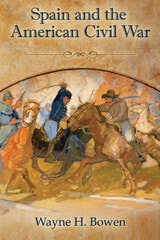
Spain and the American Civil War
Wayne H. Bowen
University of Missouri Press, 2011

Spartan Band
Burnett's 13th Texas Cavalry in the Civil WarThomas Reid
University of North Texas Press, 2005

St. Elmo
Or, Saved at LastAugusta Jane Evans
University of Alabama Press, 1992
The nineteenth-century Southern novel that transformed romance, virtue, and redemption into literary legend.
St. Elmo was the most famed and beloved novel by Augusta Jane Evans, a June 2015 inductee into the Alabama Writers Hall of Fame. First published in 1866, Evans’s rich tale of the relationship between the dashing and worldly St. Elmo and Edna Earl, an exemplar of virtuous Southern womanhood, sold over a million copies in four months and became one of the nineteenth century’s most influential novels.
This edition includes an introduction by Evans scholar Diane Roberts about the enduring relevance and legacy of St. Elmo as a work of literature as well as a reflection of gender roles and the seismic societal changes taking place in the United States in the aftermath of the Civil War.

States at War, Volume 1
A Reference Guide for Connecticut, Maine, Massachusetts, New Hampshire, Rhode Island, and Vermont in the Civil WarEdited by Richard F. Miller
University Press of New England, 2013
States at War, Volume 2
A Reference Guide for New York in the Civil WarEdited by Richard F. Miller
University Press of New England, 2014
States at War, Volume 3
A Reference Guide for Pennsylvania in the Civil WarEdited by Richard F. Miller
University Press of New England, 2014
States at War, Volume 4
A Reference Guide for Delaware, Maryland, and New Jersey in the Civil WarEdited by Richard F. Miller
University Press of New England, 2015
States at War, Volume 5
A Reference Guide for Ohio in the Civil WarEdited by Richard F. Miller
University Press of New England, 2015
States at War, Volume 6
The Confederate States Chronology and a Reference Guide for South Carolina in the Civil WarEdited by Richard F. Miller
University Press of New England, 2018
States at War
A Reference Guide for Michigan in the Civil WarRichard F. Miller
University of Michigan Press, 2020
Unlike most books about the Civil War, which address individual battles or the war at the national level, States at War: A Reference Guide for Michigan in the Civil War chronicles the actions of an individual state government and its citizenry coping with the War and its ramifications, from transformed race relations and gender roles, to the suspension of habeas corpus, to the deaths of over 10,000 Michigan fathers, husbands, sons, and brothers who had been in action. The book compiles primary source material—including official reports, legislative journals, executive speeches, special orders, and regional newspapers—to provide an exhaustive record of the important roles Michigan and Michiganders had in the War. Though not burdened by marching armies or military occupation like some states to the southeast, Michigan nevertheless had a fascinating Civil War experience that was filled with acute economic anxieties, intense political divisions, and vital contributions on the battlefield. This comprehensive volume will be the essential starting point for all future research into Michigan’s Civil War-era history.
Stealing the General
The Great Locomotive Chase and the First Medal of HonorRussell S. Bonds
Westholme Publishing, 2007
Selected by Civil War Interactive as One of the Top Civil War Books of All Time
On April 12, 1862—one year to the day after Confederate guns opened on Fort Sumter and started the Civil War—a tall, mysterious smuggler and self-appointed Union spy named James J. Andrews and nineteen infantry volunteers infiltrated north Georgia and stole a steam engine called the General. Racing northward at speeds approaching sixty miles an hour, cutting telegraph lines and destroying track along the way, Andrews planned to open East Tennessee to the Union army, cutting off men and matériel from the Confederate forces in Virginia. If they succeeded, Andrews and his raiders could change the course of the war. But the General's young conductor, William A. Fuller, chased the stolen train first on foot, then by handcar, and finally aboard another engine, the Texas. He pursued the General until, running out of wood and water, Andrews and his men abandoned the doomed locomotive, ending the adventure that would soon be famous as The Great Locomotive Chase. But the ordeal of the soldiers involved was just beginning. In the days that followed, the "engine thieves" were hunted down and captured. Eight were tried and executed as spies, including Andrews. Eight others made a daring escape to freedom, including two assisted by a network of slaves and Union sympathizers. For their actions, before a personal audience with President Abraham Lincoln, six of the raiders became the first men in American history to be awarded the Medal of Honor—the nation's highest decoration for gallantry.
Americans north and south, both at the time and ever since, have been astounded and fascinated by this daring raid. But until now, there has not been a complete history of the entire episode and the fates of all those involved. Based on eyewitness accounts, as well as correspondence, diaries, military records, newspaper reports, deposition testimony and other primary sources, Stealing the General: The Great Locomotive Chase and the First Medal of Honor by Russell S. Bonds is a blend of meticulous research and compelling narrative that is now considered to be the definitive history of "the boldest adventure of the war."
Storm of Words
Science, Religion, and Evolution in the Civil War EraMonte Harrell Hampton
University of Alabama Press, 2014
A study of the ways that southern Presbyterians in the wake of the Civil War contended with a host of cultural and theological questions
Southern Presbyterian theologians enjoyed a prominent position in antebellum southern culture. Respected for both their erudition and elite constituency, these theologians identified the southern society as representing a divine, Biblically ordained order. Beginning in the 1840s, however, this facile identification became more difficult to maintain, colliding first with antislavery polemics, then with Confederate defeat and reconstruction, and later with women’s rights, philosophical empiricism, literary criticisms of the Bible, and that most salient symbol of modernity, natural science.
As Monte Harrell Hampton shows in Storm of Words, modern science seemed most explicitly to express the rationalistic spirit of the age and threaten the Protestant conviction that science was the faithful “handmaid” of theology. Southern Presbyterians disposed of some of these threats with ease. Contemporary geology, however, posed thornier problems. Ambivalence over how to respond to geology led to the establishment in 1859 of the Perkins Professorship of Natural Science in Connexion with Revealed Religion at the seminary in Columbia, South Carolina. Installing scientist-theologian James Woodrow in this position, southern Presbyterians expected him to defend their positions.
Within twenty-five years, however, their anointed expert held that evolution did not contradict scripture. Indeed, he declared that it was in fact God’s method of creating. The resulting debate was the first extended evolution controversy in American history. It drove a wedge between those tolerant of new exegetical and scientific developments and the majority who opposed such openness. Hampton argues that Woodrow believed he was shoring up the alliance between science and scripture—that a circumscribed form of evolution did no violence to scriptural infallibility. The traditionalists’ view, however, remained interwoven with their identity as defenders of the Lost Cause and guardians of southern culture.
The ensuing debate triggered Woodrow’s dismissal. It also capped a modernity crisis experienced by an influential group of southern intellectuals who were grappling with the nature of knowledge, both scientific and religious, and its relationship to culture—a culture attempting to define itself in the shadow of the Civil War and Reconstruction.
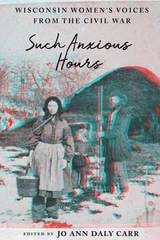
Such Anxious Hours
Wisconsin Women's Voices from the Civil WarJo Ann Daly Carr
University of Wisconsin Press, 2020
In Such Anxious Hours, Jo Ann Daly Carr places this material in historical context, detailing what was happening simultaneously in the nation, state, and local communities. Civil War history enthusiasts will appreciate these enlightening perspectives that demonstrate the variety of experiences in the Midwest during the bloody conflict.
Surveillance and Spies in the Civil War
Exposing Confederate Conspiracies in America’s HeartlandStephen E. Towne
Ohio University Press, 2015