Results by title
438 books match the query 'Hispanic & Latino' and 27 start with s

Samba Dreamers
Kathleen de Azevedo
University of Arizona Press, 2006
When José Francisco Verguerio Silva arrives at LAX, fleeing the brutal dictatorship in his native Brazil, he is determined to become Americanized at all costs. He lands a job driving a Hollywood tour bus and posing as Ricky Ricardo. He marries a blonde waitress and becomes the father of twins. Yet happiness remains elusive for Joe as he is haunted by flashbacks of prison torture. And soon a torrid affair with Rosea Socorro Katz, the crazed daughter of Hollywood’s Brazilian star Carmen Socorro, proves to be even more dangerous than the life he has fled.
Rosea spent her childhood watching her mother unravel as the celebrity system toyed with and eventually destroyed her career. Carmen had always claimed to be descended from Amazons, the woman warriors of legend, but she was tamed by Hollywood. Not Rosea. She has just finished serving jail time for setting fire to the home of her ex-husband—in an attempt to destroy his collection of Brazilian artifacts—and sets out to salvage her life.
Along the way, she manages to tear down the lives of everyone she meets. The Brazil of the imagination is shattered in this novel of two tortured souls wrestling with the myths of movies, politics, and the American Dream. Laced with fantastic tales of bird-boys and cannibal rituals, it spins a compelling story of desperation as it reminds us that American freedom and the myth of unbridled opportunity can also consume and destroy.
Scales of Captivity
Racial Capitalism and the Latinx ChildMary Pat Brady
Duke University Press, 2022
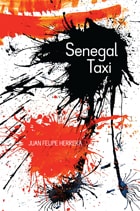
Senegal Taxi
Juan Felipe Herrera
University of Arizona Press, 2013
Unflinching in its honesty, brutality, and beauty, the collection fiercely addresses conflict and childhood, inviting readers to engage in complex and often challenging issues. Senegal Taxi weaves together verse, dialogue, and visual art created by Herrera specifically for the book. Stylistically genre-leaping, these many layers are part of the collection’s innovation. Phantom-like televisions, mud drawings, witness testimonies, insects, and weaponry are all storytellers that join the siblings for a theatrical crescendo. Each poem is told from a different point of view, which Herrera calls “mud drawings,” referring to the evocative symbols of hope the children create as they hide in a cave on their way to Senegal, where they plan to catch a boat to the United States.
This collection signals a poignant shift for Herrera as he continues to use his craft to focus attention on global concerns. In so doing, he offers an acknowledgment that the suffering of some is the suffering of all.
Shadowboxing
poems & impersonationsJoseph Rios
Omnidawn, 2017
Shakin' Up Race and Gender
Intercultural Connections in Puerto Rican, African American, and Chicano Narratives and Culture (1965–1995)By Marta E. Sánchez
University of Texas Press, 2006
The second phase of the civil rights movement (1965-1973) was a pivotal period in the development of ethnic groups in the United States. In the years since then, new generations have asked new questions to cast light on this watershed era. No longer is it productive to consider only the differences between ethnic groups; we must also study them in relation to one another and to U.S. mainstream society.
In "Shakin' Up" Race and Gender, Marta E. Sánchez creates an intercultural frame to study the historical and cultural connections among Puerto Ricans, African Americans, and Chicanos/as since the 1960s. Her frame opens up the black/white binary that dominated the 1960s and 1970s. It reveals the hidden yet real ties that connected ethnics of color and "white" ethnics in a shared intercultural history. By using key literary works published during this time, Sánchez reassesses and refutes the unflattering portrayals of ethnics by three leading intellectuals (Octavio Paz, Daniel Patrick Moynihan, and Oscar Lewis) who wrote about Chicanos, African Americans, and Puerto Ricans. She links their implicit misogyny to the trope of La Malinche from Chicano culture and shows how specific characteristics of this trope—enslavement, alleged betrayal, and cultural negotiation—are also present in African American and Puerto Rican cultures. Sánchez employs the trope to restore the agency denied to these groups. Intercultural contact—encounters between peoples of distinct ethnic groups—is the theme of this book.
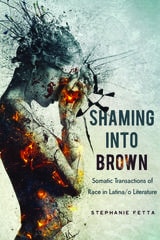
Shaming into Brown
Somatic Transactions of Race in Latina/o LiteratureStephanie Fetta
The Ohio State University Press, 2018
In Shaming into Brown: Somatic Transactions of Race in Latina/o Literature, Stephanie Fetta asserts that our bodies are fundamental to how we live and how we make meaning. Anchored by two psychoanalytic theories, bioenergetic analysis developed by Alexander Lowen and affect theory put forth by Silvan Tomkins, Fetta examines Latinx fiction to draw attention to the cultural role of the intelligent, emotional, and communicative body—the soma—in relation to shame. She argues that we bring the soma—the physical, emotive, and social register of our subjectivity—to the text as we do to our lives,proposing that the power of racialization operates at the level of somatic expression and reception through habituated, socially cued behaviors that are not readily subject to intentional control.
Fetta examines shame beyond individual experiences, looking at literary renderings of the cultural practice of racial shaming that are deeply embedded into our laws, hiring practices, marketing strategies, and more. Grounding her analysis in the works of Gloria Anzaldúa and Cherríe Moraga, Shaming into Brown focuses on exposing the underpinnings of racialized shame and does so through analyzing “scenes of racialization” in prominent works by authors such as Junot Díaz, Sandra Cisneros, and Oscar Zeta Acosta.
Simone
A NovelEduardo Lalo
University of Chicago Press, 2015
A tale of alienation, love, suspense, imagination, and literature set on the streets of San Juan, Puerto Rico, Simone tells the story of a self-educated Chinese immigrant student courting (and stalking) a disillusioned, unnamed writer who is struggling to make a name for himself in a place that is not exactly a hotbed of literary fame. By turns solipsistic and political, romantic and dark, Simone begins with the writer’s frustrated, satiric observations on his native city and the banal life of the university where he teaches—forces utterly at odds with the sensuality of his writing. But, as mysterious messages and literary clues begin to appear—scrawled on sidewalks and walls, inside volumes set out in bookstores, left on his answering machine and under his windshield wiper—Simone progresses into a cat-and-mouse game between the writer and his mystery stalker. When the eponymous Simone’s identity is at last revealed, the writer finds in the life of this Chinese immigrant a plight not unlike his own. Traumatized and lonely, the pair moves towards bittersweet collaborations in passion, grief, and art.
Sites of Translation
What Multilinguals Can Teach Us about Digital Writing and RhetoricLaura Gonzales
University of Michigan Press, 2018
Winner of the 2016 Sweetland Digital Rhetoric Collaborative Book Prize
Sites of Translation illustrates the intricate rhetorical work that multilingual communicators engage in as they translate information for their communities. Blending ethnographic and empirical methods from multiple disciplines, Laura Gonzales provides methodological examples of how linguistic diversity can be studied in practice, both in and outside the classroom, and provides insights into the rhetorical labor that is often unacknowledged and made invisible in multilingual communication. Sites of Translation is relevant to researchers and teachers of writing as well as technology designers interested in creating systems, pedagogies, and platforms that will be more accessible and useful to multilingual audiences. Gonzales presents multilingual communication as intellectual labor that should be further valued in both academic and professional spaces, and supported by multilingual technologies and pedagogies that center the expertise of linguistically diverse communicators.

Sky Below
Selected WorksRaul Zurita; Translated from the Spanish and with an introduction by Anna Deeny Morales
Northwestern University Press, 2016

Smiling in the Darkness
Adelaide Freitas, Translated by Katharine F. Baker, with Bobby J. Chamberlain, Reinaldo F. Silva, and Emanuel Melo
Tagus Press, 2020
Many people of Portuguese descent take pride in claiming that the word “saudade” is untranslatable. In reality, we come close with a melding of bittersweet nostalgia, bone-deep longing, and an endless yearning for what one can never have again—or indeed may never have had. Adelaide Freitas dipped her pen in saudade to tell of family separation and bonds that never loosen. In her authentic Azorean voice, she recounts the immigrant experience and centrifugal impulses that force people apart in spite of their desperation to cling to one another. In their sensitive rendering, the translators have captured the nuances of Freitas's novel Smiling in the Darkness, with special care for those who have her native language in their heritage and heartfelt saudade for its loss.
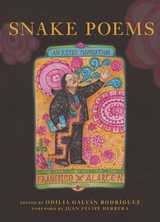
Snake Poems
An Aztec InvocationFrancisco X. Alarcón; Edited by Odilia Galván Rodríguez; Foreword by Juan Felipe Herrera; Translated by David Bowles and Xánath Caraza
University of Arizona Press, 2019
Alarcón was a stalwart student, researcher, and specialist on the lost teachings of his Indigenous ancestors. He first found their wisdom in the words of his Mexica (Aztec) grandmother and then by culling through historical texts. During a Fulbright fellowship to Mexico, Alarcón uncovered the writings of zealously religious Mexican priest Hernando Ruiz de Alarcón (1587–1646), who collected (often using extreme measures), translated, and interpreted Nahuatl spells and invocations.
In Snake Poems Francisco Alarcón offered his own poetic responses, reclaiming the colonial manuscript and making it new. This special edition is a tender tribute to Alarcón, who passed away in 2016, and includes Nahuatl, Spanish, and English renditions of the 104 poems based on Nahuatl invocations and spells that have survived more than three centuries. The book opens with remembrances and testimonials about Alarcón’s impact as a writer, colleague, activist, and friend from former poet laureate Juan Felipe Herrera and poet and activist Odilia Galván Rodríguez, who writes, “This book is another one of those doors that [Francisco] opened and invited us to enter. Here we get to visit a snapshot in time of an ancient place of Nahuatl-speaking ancestors, and Francisco’s poetic response to what he saw through their eyes.”
Snapping Lines
Jack Lopez
University of Arizona Press, 2001
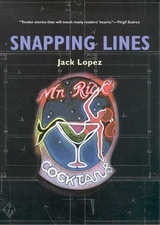
A couple searches for a lost dog along the beach because the dog is more important than their relationship . . .
A drunken man picks up a girl hitchhiker and remembers what it once felt like to have feelings for someone else . . .
What does it mean to be male in a world in which old borders no longer exist? How can a man have a relationship if he doesn't even know who he is—and what better way to find out than by committing to a woman? Snapping Lines brings familiar and new stories together in a collection that explores the lives of loners searching for love. Jack Lopez writes about people who have adopted a stoical indifference to a world in which they always seem to find themselves on the losing end. These stories explore Latino male identity and the forces that shape it: friends, family, and lovers; culture, place, and relationships. They focus on men—often working men in the building trades—who construct their lives through their work and live in perpetual limbo because they don't know who they are. Men who stumble onto the relationships they need almost by accident. Men who try to control their relationships but fail.
Written in spare, electric language and energized by memorable scenes, these stories enlighten as much as they entertain. When you have read Snapping Lines, you will come to see the faces of strangers in new and familiar ways.
Some Final Beauty and Other Stories
Lisa Alvarez
University of Nevada Press, 2025
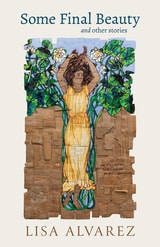
From the vibrant streets of Southern California to the arid Nevada Nuclear Test Site, these thematically linked stories explore self-discovery, rebellion, and solidarity as complex personalities and values meet at the intersection of art, love, relationships, activism, and identity. A Mexican American returns from WWII to encounter Paul Robeson. A Spanish Civil War veteran befriends a recovering addict. Young 1980s female activists take to the streets. A big-city Latino mayor discovers the limits of ambition. A grieving aunt confronts her dead niece’s toxic lover.
Both the author and her characters interrogate finality while insisting on the beauty of everyday human engagement, often steeped in Hispanic culture, and stubbornly demanding joyful civic participation. Alvarez constructs more than a sharp, empathetic and funny sociological survey of experiences. She crafts a chronicle of lives lived with purpose, resilience, and the hope of a better future.

Someone Else's Hunger
Isabella DeSendi
Four Way Books, 2025
The expansive mercy of DeSendi's breath-taking images is never more apparent than the moment they turn, as when she heralds the avian frenzy "in the moment right after a purge": "always the miracle of birds arriving," "a messy flurry…curious if any piece of me could be salvaged, was still good enough to be taken home to the other starlings to eat." This speaker's ability to see the tenacious tenderness that drives the scavenger, to recognize its creative intelligence for nourishment, belies the resuscitative artistry that never abandons her as she turns carrion into continuance, coming alive again. Someone Else's Hunger subverts the revenge to recovery plot, arguing that the truest testament to the speaker's inner strength is the resilience it took to survive. DeSendi formally moves between restraint and excess, illustrating the great courage required to relinquish the control she won back when she became the master of her suffering. But the reward of risking exposure, daring to open herself to the world and let herself feed off it? Abundance. The arrival of spring and "with it the audacious dirt," this realization that "sometimes / in the breaking I am bettering / and in the bettering I am free."

Somewhere
A NovelBy Paloma Vidal, translated by Jordan B. Jones
Amherst College Press, 2026
Somos Tejanas!
Chicana Identity and Culture in TexasEdited by Jody A. Marín and Norma E. Cantú
University of Texas Press, 2025
2026 Outstanding Book Award for Non-Fiction, National Association for Chicana and Chicano Studies (NACCS) Tejas Foco
2026 Silver Medal for the Dolores Huerta Best Cultural & Community Themed Book – English, Conference on Latin American History (CLAH)
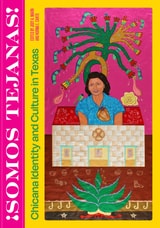
An expansive volume on Tejana identity and Tejanidad told through personal narratives, poetry, and essays.
Being Tejanx is different than just being from Texas. Being Tejanx means you are a border subject. Being Tejanx means living in and from a certain history of oppression, possibility, activism, and cultural-linguistic hybridity arising within the US-Mexico borderland that is home. And being Tejanx means something in particular if you are a woman.
In ¡Somos Tejanas!, editors Norma E. Cantú and Jody A. Marín assemble contemporary Tejanx writers who provide firsthand accounts of their experience of identity, enriching the field of Tejanx studies through an encounter with gender and sexuality. The contributions, including personal and scholarly essays, poems, criticism, and artworks, explore the heterogeneity of Tejana identity and the sociopolitical movements, stories, dances, music, and athletic feats that mark Tejanidad. Authors contemplate the history and memory of segregation in Texas, the struggles of surviving the unnatural disaster and blackouts of 2021 amid the global pandemic of COVID-19, and the drug-war violence and ever-tightening immigration restrictions that strangle a transborder way of life shared by millions. An unrepentant act of expression from women under attack by state policymakers, this collection dispels the silence imposed by colonial erasure.

Song of the Simple Truth
The Complete Poems of Julia de BurgosJulia de Burgos
Northwestern University Press, 1995
Soul Over Lightning
Ray Gonzalez
University of Arizona Press, 2014
Gonzalez shows his profound respect for other people, species, places, elements, and histories. Illusions to religious imagery knock against those of the natural world—feathers and rocks—creating a complex tableau of objects and feelings. Employing the image-driven approach for which he is renowned, in this collection Gonzalez is taut, using poetics that are fully formed. Even as the poems weave together highly intellectual, refined subject matter, the language remains accessible.
The book is divided into three parts. The first section offers Gonzalez’s most personal work yet, meditating on aging, forgetting, and the reader. The next section is more outward looking, as Gonzalez takes on great artists from both Old World and New World traditions. Finally, in the last section, Gonzalez opens himself up, reflecting in very personal ways on the everyday, such as a return from a hospital stay or a visit to the doctor.
Soul Over Lightning weaves together elements of Native American and Chicano/a narratives, inspired by the landscape of the desert Southwest and the experience of living on the border. It offers a new supernarrative that lifts spirits and yet remains grounded in a timeless search for home and truth.
Southwest Asia
The Transpacific Geographies of Chicana/o LiteratureJayson Gonzales Sae-Saue
Rutgers University Press, 2016
Spanish American Women's Use of the Word
Colonial through Contemporary NarrativesStacey Schlau
University of Arizona Press, 2001
Spatial and Discursive Violence in the US Southwest
Rosaura Sánchez and Beatrice Pita
Duke University Press, 2020
Speaking Chicana
Voice, Power, and IdentityD. Letticia Galindo
University of Arizona Press, 1999
Part 1. Reconstruction: Language Varieties, Language Use, and Language Attitudes
1. Crossing Social and Cultural Borders: The Road to Language Hybridity, María Dolores Gonzales
2. Fighting Words: Latina Girls, Gangs, and Language Attitudes, Norma Mendoza-Denton
Part 2. Reflection: Testimonios
3. Speaking as a Chicana: Tracing Cultural Heritage through Silence and Betrayal, Jacqueline M. Martínez
4. The Power of Language: From the Back of the Bus to the Ivory Tower, Christine Marín
5. Challenging Tradition: Opening the Headgate, Ida M. Luján
6. Mexican Blood Runs through My Veins, Aurora E. Orozco
Part 3. Innovation: Speaking Creatively/Creatively Speaking
7. Searching for a Voice: Ambiguities and Possibilities, Erlinda Gonzales-Berry
8. Sacred Cults, Subversive Icons: Chicanas and the Pictorial Language of Catholicism, Charlene Villaseñor Black
9. Caló and Taboo Language Use among Chicanas: A Description of Linguistic Appropriation and Innovation, D. Letticia Galindo
10. Máscaras, Trenzas, y Greñas: Un/Masking the Self While Un/Braiding Latina Stories and Legal Discourse, Margaret E. Montoya
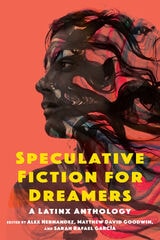
Speculative Fiction for Dreamers
A Latinx AnthologyEdited by Alex Hernandez, Matthew David Goodwin, and Sarah Rafael García with a Preface by Frederick Luis Aldama
The Ohio State University Press, 2021
Finalist, 2022 World Fantasy Awards
Finalist, 2022 Ignyte Awards
Finalist, 2022 Utopia Awards
In a tantalizing array of new works from some of the most exciting Latinx creators working in the speculative vein today, Speculative Fiction for Dreamers extends the project begun with a previous anthology, Latinx Rising (The Ohio State University Press, 2020), to showcase a new generation of writers. Spanning diverse forms, settings, perspectives, and styles, but unified by their drive to imagine new Latinx futures, these stories address the breadth of contemporary Latinx experiences and identities while exuberantly embracing the genre’s ability to entertain and surprise. With new work for new audiences in their teens and up, and especially for Latinx people navigating their identities in the ever-shifting, sometimes perilous, but always promising cultural landscape of the US, this book is for dreamers—and DREAMers—everywhere.
Contributors: Grisel Y. Acosta, Stephanie Adams-Santos, Frederick Luis Aldama, William Alexander, Nicholas Belardes, Louangie Bou-Montes, Lisa M. Bradley, Eliana Buenrostro, Diana Burbano, Pedro Cabiya, Steve Castro, Fernando de Peña, Scott Russell Duncan, Samy Figaredo, Tammy Melody Gomez, J. M. Guzman, Ernest Hogan, Pedro Iniguez, Ezzy G. Languzzi, Patrick Lugo, Roxanne Ocasio, Daniel Parada, Stephanie Nina Pitsirilos, Reyes Ramirez, Julia Rios, Sara Daniele Rivera, Roman Sanchez, Tabitha Sin, Alex Temblador, Rodrigo Vargas, Laura Villareal, Sabrina Vourvoulias, Karlo Yeager Rodriguez
Spilling the Beans in Chicanolandia
Conversations with Writers and ArtistsBy Frederick Luis Aldama
University of Texas Press, 2006
Since the 1980s, a prolific "second wave" of Chicano/a writers and artists has tremendously expanded the range of genres and subject matter in Chicano/a literature and art. Building on the pioneering work of their predecessors, whose artistic creations were often tied to political activism and the civil rights struggle, today's Chicano/a writers and artists feel free to focus as much on the aesthetic quality of their work as on its social content. They use novels, short stories, poetry, drama, documentary films, and comic books to shape the raw materials of life into art objects that cause us to participate empathetically in an increasingly complex Chicano/a identity and experience.
This book presents far-ranging interviews with twenty-one "second wave" Chicano/a poets, fiction writers, dramatists, documentary filmmakers, and playwrights. Some are mainstream, widely recognized creators, while others work from the margins because of their sexual orientations or their controversial positions. Frederick Luis Aldama draws out the artists and authors on both the aesthetic and the sociopolitical concerns that animate their work. Their conversations delve into such areas as how the artists' or writers' life experiences have molded their work, why they choose to work in certain genres and how they have transformed them, what it means to be Chicano/a in today's pluralistic society, and how Chicano/a identity influences and is influenced by contact with ethnic and racial identities from around the world.
Spiral of Silence
A NovelElvira Sánchez-Blake; Translated from the Spanish by Lorena Terando; Foreword by Debra A. Castillo
Northwestern University Press, 2019
A multigenerational epic, Spiral of Silence (Espiral de Silencios) opens in the early 1980s, as peace and amnesty agreements spark optimism and hope. We meet Norma, a privileged, upper-class woman who is married to an army general; Maria Teresa (Mariate), a young rebel who loves a guerrilla fighter and navigates commitments to motherhood and revolutionary activism; and Amparo, a woman who comes of age later, and carries the confusion and dislocation of a younger generation. Each contends with the consequences of war and violence on her life; each is empowered through community-building and working for change.
Few authors have considered the role of women in Colombia during this wartime period, and Sánchez-Blake's nuanced exploration of gender and sexism—framed by conflict and social upheaval—distinguishes the novel. Drawing on stories from women who have worked within organizations in Colombia to end state violence, Spiral of Silence celebrates resistance, reinvention, and how women create and protect their families and communities.
Strategic Occidentalism
On Mexican Fiction, the Neoliberal Book Market, and the Question of World LiteratureIgnacio M. Sánchez Prado
Northwestern University Press, 2018
In the course of this analysis, Ignacio M. Sánchez Prado engages with theories of world literature, proposing that “world literature” is a construction produced at various levels, including the national, that must be studied from its material conditions of production in specific sites. In particular, he argues that Mexican writers have engaged in a “strategic Occidentalism” in which their idiosyncratic connections with world literature have responded to dynamics different from those identified by world-systems or diffusionist theorists.
Strategic Occidentalism identifies three scenes in which a cosmopolitan aesthetics in Mexican world literature has been produced: Sergio Pitol’s translation of Eastern European and marginal British modernist literature; the emergence of the Crack group as a polemic against the legacies of magical realism; and the challenges of writers like Carmen Boullosa, Cristina Rivera Garza, and Ana García Bergua to the roles traditionally assigned to Latin American writers in world literature.
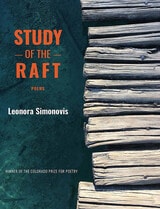
Study of the Raft
Leonora Simonovis
University Press of Colorado, 2021
In Study of the Raft, Leonora Simonovis’s poems weave the outer world of a failed political revolution in her native country, Venezuela, with an inner journey into the memories of migration and exile, of a home long gone, and of family relations, especially among womxn. The collection explores the consequences of colonization, starting with “Maps,” a poem that speaks of loss and uprootedness, recalling a time when indigenous lands were stolen and occupied, where stories were lost as new languages and beliefs were imposed on people. The politics of the present are also the politics of the past, not just in the Venezuelan context, but in many other Latin American and Caribbean countries. It is the reality of all indigenous people. Simonovis’s poems question the capacity of language to represent the complexity of lived experience, especially when it involves living from more than one language and culture. These poems wrestle with questions of life and death, of what remains after what and whom we know are no longer with us, and how we, as humans, constantly change and adjust in the face of uncertainty.