Results by title
1031 books match the query 'Intellectual life' and 67 start with s

SCHOLAR ADVENTURERS
Richard D. Altick
The Ohio State University Press, 1987

SOS-Calling All Black People
A Black Arts Movement ReaderBracey John H.
University of Massachusetts Press, 0
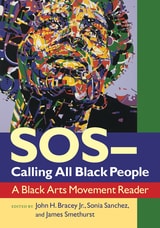
SOS—Calling All Black People
A Black Arts Movement ReaderJohn H. Bracey
University of Massachusetts Press, 2014
Many of the movement's leading artists, including Ed Bullins, Nikki Giovanni, Woodie King, Haki Madhubuti, Sonia Sanchez, Askia Touré, and Val Gray Ward remain artistically productive today. Its influence can also be seen in the work of later artists, from the writers Toni Morrison, John Edgar Wideman, and August Wilson to actors Avery Brooks, Danny Glover, and Samuel L. Jackson, to hip hop artists Mos Def, Talib Kweli, and Chuck D.
SOS—Calling All Black People includes works of fiction, poetry, and drama in addition to critical writings on issues of politics, aesthetics, and gender. It covers topics ranging from the legacy of Malcolm X and the impact of John Coltrane's jazz to the tenets of the Black Panther Party and the music of Motown. The editors have provided a substantial introduction outlining the nature, history, and legacy of the Black Arts Movement as well as the principles by which the anthology was assembled.
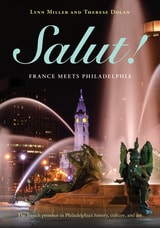
Salut!
France Meets PhiladelphiaLynn Miller and Therese Dolan
Temple University Press, 2021
One highly visible example of French influence on the city of Philadelphia is the Benjamin Franklin Parkway, modeled on the Champs-Élysées. In Salut!, Lynn Miller and Therese Dolan trace the fruitful, three-centuries-long relationship between the City of Brotherly Love and France. This detailed volume illustrates the effect of Huguenots settling in Philadelphia and 18-year-old William Penn visiting Paris, all the way up through more recent cultural offerings that have helped make the city the distinctive urban center it is today.
Salut! provides a magnifique history of Philadelphia seen through a particular cultural lens. The authors chronicle the French influence during colonial and revolutionary times. They highlight the contributions of nineteenth-century French philanthropists, such as Stephen Girard and the Dupont family. And they showcase the city’s vibrant visual arts community featuring works from the Philadelphia Museum of Art, the Rodin Museum, the Barnes Foundation, and the Joan of Arc sculpture, as well as studies of artists Thomas Eakins, Mary Cassatt, and Henry Ossawa Tanner. There is also a profile of renowned Le Bec-Fin chef Georges Perrier, who made Philadelphia a renowned culinary destination in the twentieth century.
With lavish illustrations and enthusiastic text, Salut!celebrates a potpourri of all things French in the Philadelphia region.
Samurai in the Land of the Gaucho
Transpacific Modernity and Nikkei Literature in ArgentinaKoichi Hagimoto
Vanderbilt University Press, 2023
In the early twentieth century, historical imaginings of Japan contributed to the Argentine vision of “transpacific modernity." Intellectuals such as Eduardo Wilde and Manuel Domecq García celebrated Japanese customs and traditions as important values that can be integrated into Argentine society. But a new generation of Nikkei or Japanese Argentines is rewriting this conventional narrative in the twenty-first century. Nikkei writers such as Maximiliano Matayoshi and Alejandra Kamiya are challenging the earlier, unapologetic view of Japan based on their own immigrant experiences.
Compared to the experience of political persecution against Japanese immigrants in Brazil and Peru, the Japanese in Argentina generally lived under a more agreeable sociopolitical climate. In order to understand the "positive" perception of Japan in Argentine history and literature, Samurai in the Land of the Gaucho turns to the current debate on race in Argentina, particularly as it relates to the discourse of whiteness. One of the central arguments is that Argentina's century-old interest in Japan represents a disguised method of (re)claiming its white, Western identity.
Through close readings of diverse genres (travel writing, essay, novel, short story, and film) Samurai in the Land of the Gaucho yields a multi-layered analysis in order to underline the role Japan has played in both defining and defying Argentine modernity from the twentieth century to the present.

Saxony in German History
Culture, Society, and Politics, 1830-1933James Retallack, Editor
University of Michigan Press, 2000
Focusing on the east German state of Saxony, the contributors to this volume refuse easy resolution of that tension, seeking instead to illustrate how local, regional, and national cultures commingled, diverged, and influenced each other over time. By considering both the erosion and the persistence of traditional identities and regional boundaries, these essays help to restore an appreciation of regional "ways of seeing," suggesting they really did matter--in their own right, and for the nation as a whole.
Topics considered include the expansion of a German reading public, Jewish emancipation, the formation of socio-moral milieus, working-class leisure, the expansion of the public sphere, the rise of consumer co-operatives, gendered attempts to fashion the "new" liberal man, and degradation rituals in the 1920s. Presenting to English-reading audiences the fruits of cutting-edge research conducted in Saxon archives since 1989, the contributors offer innovative ways to reassess the larger sweep of German history.
This book serves as a how-to guide for the study of any region in history. Beyond its primary appeal to European historians, it will also speak to students and scholars in comparative politics and sociology.
James Retallack is Professor of History, University of Toronto.

Scarring the Black Body
Race and Representation in African American LiteratureCarol E. Henderson
University of Missouri Press, 2002

Science in the Marketplace
Nineteenth-Century Sites and ExperiencesEdited by Aileen Fyfe and Bernard Lightman
University of Chicago Press, 2007
Science in the Marketplace reveals this other side of Victorian scientific life by placing the sciences in the wider cultural marketplace, ultimately showing that the creation of new sites and audiences was just as crucial to the growing public interest in science as were the scientists themselves. By focusing attention on the scientific audience, as opposed to the scientific community or self-styled popularizers, Science in the Marketplace ably links larger societal changes—in literacy, in industrial technologies, and in leisure—to the evolution of “popular science.”

Seamus Heaney
Searches For AnswersEugene O'Brien
Pluto Press, 2003
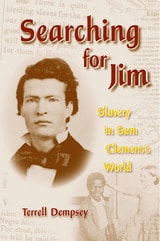
Searching for Jim
Slavery in Sam Clemens's WorldTerrell Dempsey
University of Missouri Press, 2005
During Sam’s earliest years, his father, John Marshall Clemens, had significant interaction with slaves. Newly discovered court records show the senior Clemens in his role as justice of the peace in Hannibal enforcing the slave ordinances. With the death of his father, young Sam was apprenticed to learn the printing and newspaper trade. It was in the newspaper that slaves were bought and sold, masters sought runaways, and life insurance was sold on slaves. Stories the young apprentice typeset helped Clemens learn to write in black dialect, a skill he would use throughout his writing, most notably in Huckleberry Finn.
Missourians at that time feared abolitionists across the border in Illinois and Iowa. Slave owners suspected every traveling salesman, itinerant preacher, or immigrant of being an abolition agent sent to steal slaves. This was the world in which Sam Clemens grew up. Dempsey also discusses the stories of Hannibal’s slaves: their treatment, condition, and escapes. He uncovers new information about the Underground Railroad, particularly about the role free blacks played in northeast Missouri.
Carefully reconstructed from letters, newspaper articles, sermons, speeches, books, and court records, Searching for Jim offers a new perspective on Clemens’s writings, especially regarding his use of race in the portrayal of individual characters, their attitudes, and worldviews. This fascinating volume will be valuable to anyone trying to measure the extent to which Clemens transcended the slave culture he lived in during his formative years and the struggles he later faced in dealing with race and guilt. It will forever alter the way we view Sam Clemens, Hannibal, and Mark Twain.
Secretaries of the Moon
The Letters of Wallace Stevens and José Rodriguez FeoBeverly Coyle and Alan Filreis, eds.
Duke University Press, 1986
Coyle and Filreis present the entire extant correspondence between the two men. The fifty-one Rodriguez Feo letters and ten of the numerous Stevens letters are printed here for the first time, and the exchange between the two is unusually complete. The work includes a critical introduction and complete annotation of the letters.
Secularism and Its Ambiguities
Four Case StudiesCarlo Ginzburg
Central European University Press, 2023
In the best micro-historical tradition, Carlo Ginzburg, himself one of the founders and icons of this genre of historiography, dissects four moments of European intellectual history. This book relives the experience that participants in the Natalie Zemon Davis Lecture Series at the Budapest campus of Central European University had in 2019 listening to Ginzburg's eloquent and engaging discourses. For the purposes of this volume he has re-edited and completed the leporello of cases charged with the inherent ambiguity between secularism and religions.
Secularism is often identified with rejection or at least distancing from the sacred. However, if one assumes that secularism also appropriates and reworks the sacred, its ambiguities come to the fore. The dilemma accompanies the reception of La Boétie's Servitude volontaire between 1574 and today. Before Walter Benjamin, the lesser-known 19th-century Léon de Laborde defended the profanity of reproducing the arts. The tension around the secular pervades the case of the College de Sociologie (Paris, 1937-1939), an attempt to analyze the ideological components of fascism. The fourth lecture approaches a much-discussed contemporary phenomenon – fake news – from a long-term perspective. To what extent are some disturbing features of the world we live in the result of a long, tortuous, unpredictable trajectory?

Seeing New Worlds
Henry David Thoreau and Nineteenth-Century Natural ScienceLaura Dassow Walls
University of Wisconsin Press, 1995
Thoreau was a poet, a naturalist, a major American writer. Was he also a scientist? He was, Laura Dassow Walls suggests. Her book, the first to consider Thoreau as a serious and committed scientist, will change the way we understand his accomplishment and the place of science in American culture.
Walls reveals that the scientific texts of Thoreau’s day deeply influenced his best work, from Walden to the Journal to the late natural history essays. Here we see how, just when literature and science were splitting into the “two cultures” we know now, Thoreau attempted to heal the growing rift. Walls shows how his commitment to Alexander von Humboldt’s scientific approach resulted in not only his “marriage” of poetry and science but also his distinctively patterned nature studies. In the first critical study of his “The Dispersion of Seeds” since its publication in 1993, she exposes evidence that Thoreau was using Darwinian modes of reasoning years before the appearance of Origin of Species.
This book offers a powerful argument against the critical tradition that opposes a dry, mechanistic science to a warm, “organic” Romanticism. Instead, Thoreau’s experience reveals the complex interaction between Romanticism and the dynamic, law-seeking science of its day. Drawing on recent work in the theory and philosophy of science as well as literary history and theory, Seeing New Worlds bridges today’s “two cultures” in hopes of stimulating a fuller consideration of representations of nature.
Seeing Red
Anger, Sentimentality, and American IndiansCari M. Carpenter
The Ohio State University Press, 2008
Seems Like Murder Here
Southern Violence and the Blues TraditionAdam Gussow
University of Chicago Press, 2002
Seems Like Murder Here offers a revealing new account of the blues tradition. Far from mere laments about lost loves and hard times, the blues emerge in this provocative study as vital responses to spectacle lynchings and the violent realities of African American life in the Jim Crow South. With brilliant interpretations of both classic songs and literary works, from the autobiographies of W. C. Handy, David Honeyboy Edwards, and B. B. King to the poetry of Langston Hughes and the novels of Zora Neale Hurston, Seems Like Murder Here will transform our understanding of the blues and its enduring power.

Selected Philosophical, Scientific, and Autobiographical Writings
Marie-Geneviève-Charlotte Thiroux d’Arconville
Iter Press, 2018
Edited and translated by Julie Candler Hayes
The Other Voice in Early Modern Europe: The Toronto Series, volume 58
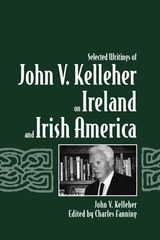
Selected Writings of John V. Kelleher on Ireland and Irish America
John V. Kelleher. Edited by Charles Fanning
Southern Illinois University Press, 2002
A collection of eighteen critical essays and twenty-six translations spanning the career of one of the founding intellects of Irish Studies, the Selected Writings of John V. Kelleher on Ireland and Irish America consists of five accessible sections. The first gathers Kelleher’s essays on the most widely known Irish cultural phenomenon—the literary renaissance of the early twentieth century. Part two contains his judicious assessments of Irish literature in its post-Revolutionary phase. The third section includes Kelleher’s insightful essays on the experience of the Irish in America. The fourth section contains essays that examine early Irish literature and culture, opening with a benchmark essay for Irish Studies, “Early Irish History and Pseudo-History,” which was read at the inaugural meeting of the American Conference for Irish Studies in 1961. The collection concludes with Kelleher’s translations and adaptations of poems in Old, Middle, and Modern Irish, illustrating his command of the language at every stage.
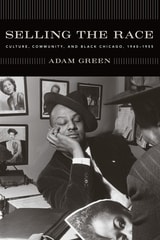
Selling the Race
Culture, Community, and Black Chicago, 1940-1955Adam Green
University of Chicago Press, 2006
In Selling the Race, Adam Green tells the story of how black Chicagoans were at the center of a national movement in the 1940s and ’50s, a time when African Americans across the country first started to see themselves as part of a single culture. Along the way, he offers fascinating reinterpretations of such events as the 1940 American Negro Exposition, the rise of black music and the culture industry that emerged around it, the development of the Associated Negro Press and the founding of Johnson Publishing, and the outcry over the 1955 lynching of Emmett Till.
By presenting African Americans as agents, rather than casualties, of modernity, Green ultimately reenvisions urban existence in a way that will resonate with anyone interested in race, culture, or the life of cities.

Sergei Dovlatov and His Narrative Masks
Jekaterina Young
Northwestern University Press, 2012
This book provides an introduction to Sergei Dovlatov (1941–1990) that is closely attentive to the details of his life and work, their place in the history of Soviet society and literature, and of émigré culture during this turbulent period. A journalist, newspaper editor, and prose writer, Dovlatov is most highly regarded for his short stories, which draw heavily on his experiences in Russia before 1979, when he was forced out of the country. During compulsory military service, before becoming a journalist, he worked briefly as a prison camp guard—an experience that gave him a unique perspective on the operations of the Soviet state. After moving to New York, Dovlatov published works (in the New Yorker and elsewhere) that earned him considerable renown in America and back in Russia. Young’s book presents a valuable critical overview of the prose of a late twentieth-century master within the context of the prevailing Russian and larger literary culture.
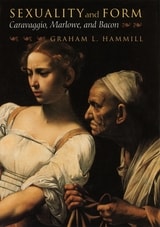
Sexuality and Form
Caravaggio, Marlowe, and BaconGraham Hammill
University of Chicago Press, 2000
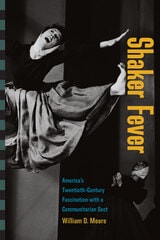
Shaker Fever
America's Twentieth-Century Fascination with a Communitarian SectWilliam D. Moore
University of Massachusetts Press, 2020
This interdisciplinary study places the activities of individuals—including Doris Humphrey, Charles Sheeler, Laura Bragg, Juliana Force, and Edward Deming Andrews—within the larger cultural and historical contexts of nationalism, modernism, and cultural resource management. Taking up previously unexamined primary sources and cultural productions that include the first scholarly studies of the faith, material culture and visual arts, stage performances, and museum exhibitions, Shaker Fever compels a reconsideration of this religious group and its place within American memory. It is sure to delight enthusiasts, public historians, museum professionals, furniture collectors, and anyone interested in the dynamics of cultural appropriation and stewardship.
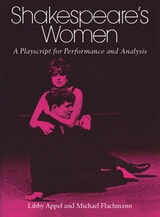
Shakespeare's Women
A Playscript for Performance and AnalysisLibby Appel and Michael Flachmann
Southern Illinois University Press, 1986
Serves both as a script for performance and as a text for high school and college theater and English classes.
This self-contained script brings together different scenes from Shakespeare’s plays to portray women “in all their infinite variety.” Two narrators, a man and a woman, introduce and comment on these scenes, weaving together the different characters and situations.
This book combines literary and theatrical techniques in examining Shakespeare’s women. Its promptbook format provides clear, helpful stage directions on pages facing each of the scenes. Also helpful are concise glosses and footnotes to define difficult words and phrases plus a commentary to explain each scene in its dramatic context.
Other features include sheet music for each song in the play, a bibliography on the topic of women in Shakespeare’s plays, and suggestions for directors who wish to stage the play.

Shakin' Up Race and Gender
Intercultural Connections in Puerto Rican, African American, and Chicano Narratives and Culture (1965–1995)By Marta E. Sánchez
University of Texas Press, 2006
The second phase of the civil rights movement (1965-1973) was a pivotal period in the development of ethnic groups in the United States. In the years since then, new generations have asked new questions to cast light on this watershed era. No longer is it productive to consider only the differences between ethnic groups; we must also study them in relation to one another and to U.S. mainstream society.
In "Shakin' Up" Race and Gender, Marta E. Sánchez creates an intercultural frame to study the historical and cultural connections among Puerto Ricans, African Americans, and Chicanos/as since the 1960s. Her frame opens up the black/white binary that dominated the 1960s and 1970s. It reveals the hidden yet real ties that connected ethnics of color and "white" ethnics in a shared intercultural history. By using key literary works published during this time, Sánchez reassesses and refutes the unflattering portrayals of ethnics by three leading intellectuals (Octavio Paz, Daniel Patrick Moynihan, and Oscar Lewis) who wrote about Chicanos, African Americans, and Puerto Ricans. She links their implicit misogyny to the trope of La Malinche from Chicano culture and shows how specific characteristics of this trope—enslavement, alleged betrayal, and cultural negotiation—are also present in African American and Puerto Rican cultures. Sánchez employs the trope to restore the agency denied to these groups. Intercultural contact—encounters between peoples of distinct ethnic groups—is the theme of this book.
Shifting Borders and a Tattered Passport
Intellectual Journeys of a Mormon AcademicArmand L. Mauss
University of Utah Press, 2012
The life of a Mormon intellectual in the secular academic community is likely to include some contradictions between belief, scholarship, and the changing times. In his memoir, Armand L. Mauss recounts his personal and intellectual struggles—inside and outside the LDS world—from his childhood to his days as a graduate student at UC Berkeley in the 1960s through his many years as a professor.
As an important and influential observer and author in the Mormon intellectual world, Mauss has witnessed how, in attempting to suppress independent and unsponsored scholarship during the final decades of the twentieth century, LDS leaders deliberately marginalized important intellectual support and resources that could have helped, in the twenty-first century, to refurbish the public image of the church. As a sociologist, he notes how the LDS Church, as a large, complex organization, strives to adjust its policies and practices in order to maintain an optimal balance between unique, appealing claims on the one hand and public acceptance on the other. He also discusses national and academic controversies over the New Religious Movements of the 1960s and 1970s. Writing in clear language, Mauss shows how he has navigated the boundaries where his faith and academic life intersect, and reveals why a continuing commitment to the LDS Church must be a product of choice more than of natural or supernatural “proof.”
Signs and Cities
Black Literary PostmodernismMadhu Dubey
University of Chicago Press, 2003
Dubey shows how black novelists from the last three decades have reconsidered the modern urban legacy and thus articulated a distinctly African-American strain of postmodernism. She argues that novelists such as Octavia Butler, Samuel Delany, Toni Morrison, Gloria Naylor, Ishmael Reed, Sapphire, and John Edgar Wideman probe the disillusionment of urban modernity through repeated recourse to tropes of the book and scenes of reading and writing. Ultimately, she demonstrates that these writers view the book with profound ambivalence, construing it as an urban medium that cannot recapture the face-to-face communities assumed by oral and folk forms of expression.
Sistuhs in the Struggle
An Oral History of Black Arts Movement Theater and PerformanceLa Donna L. Forsgren
Northwestern University Press, 2021
Outstanding Academic Title, CHOICE
The first oral history to fully explore the contributions of black women intellectuals to the Black Arts Movement, Sistuhs in the Struggle reclaims a vital yet under-researched chapter in African American, women’s, and theater history. This groundbreaking study documents how black women theater artists and activists—many of whom worked behind the scenes as directors, designers, producers, stage managers, and artistic directors—disseminated the black aesthetic and emboldened their communities.
Drawing on nearly thirty original interviews with well-known artists such as Ntozake Shange and Sonia Sanchez as well as less-studied figures including distinguished lighting designer Shirley Prendergast, dancer and choreographer Halifu Osumare, and three-time Tony-nominated writer and composer Micki Grant, La Donna L. Forsgren centers black women’s cultural work as a crucial component of civil rights and black power activism. Sistuhs in the Struggle is an essential collection for theater scholars, historians, and students interested in learning how black women’s art and activism both advanced and critiqued the ethos of the Black Arts and Black Power movements.
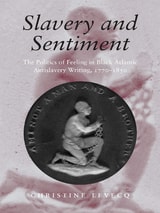
Slavery and Sentiment
The Politics of Feeling in Black Atlantic Antislavery Writing, 1770-1850Christine Levecq
University of New Hampshire Press, 2008
Levecq examines liberalism and republicanism, the main Anglo-American political ideologies of the period, in the antislavery texts of a range of African-American and Afro-British authors. Disclosing the political content hitherto unexamined in this kind of writing, she shows that while the overall story is one of increased liberalization of ideology on both sides of the Atlantic, the republican ideal persisted, particularly among black authors with transatlantic connections.
Demonstrating that such writers as Phillis Wheatley, Ignatius Sancho, Olaudah Equiano, Frederick Douglass, and Mary Prince were men and women of their times, Levecq provides valuable new insight into the ideological world of black Atlantic writers and puts them, for the first time, on modernity’s political map.
Slavery
A Problem in American Institutional and Intellectual LifeStanley M. Elkins
University of Chicago Press, 1987
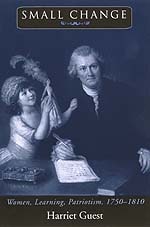
Small Change
Women, Learning, Patriotism, 1750-1810Harriet Guest
University of Chicago Press, 2000
During the second half of the eighteenth century, the social role of educated women and the nature of domesticity were the focus of widespread debate in Britain. The emergence of an identifiably feminist voice in that debate is the subject of Harriet Guest's new study, which explores how small changes in the meaning of patriotism and the relations between public and private categories permitted educated British women to imagine themselves as political subjects.
Small Change considers the celebration of learned women as tokens of national progress in the context of a commercial culture that complicates notions of gender difference. Guest offers a fascinating account of the women of the bluestocking circle, focusing in particular on Elizabeth Carter, hailed as the paradigmatic learned and domestic woman. She discusses the importance of the American war to the changing relation between patriotism and gender in the 1770s and 1780s, and she casts new light on Mary Wollstonecraft's writing of the 1790s, considering it in relation to the anti-feminine discourse of Hannah More, and the utopian feminism of Mary Hays.
Snapshots of Intellectual Life in Contemporary PR China, Volume 35
Arif Dirlik, special issue editor
Duke University Press, 0
Contributors: Chris King Chi Chan, Chu Yiu-Wai, Alexander Day, Arif Dirlik, Han Shaogong, Pun Ngai, Fengzhen Wang, Wang Hui, Wang Shaoguang, Shaobo Xie, Yu Keping

So Unimaginable a Price
Baldwin and the Black AtlanticJohn E. Drabinski
Northwestern University Press, 2026
James Baldwin’s nonfiction offers some of the most important and challenging thinking on the experience of race, history, and memory in the Black Atlantic world. Yet much of the scholarly literature on Baldwin’s writing reads his work from inside the sociocultural context of the United States, alongside key interlocutors like Richard Wright, Ralph Ellison, and Lorraine Hansberry. So Unimaginable a Price: Baldwin and the Black Atlantic shifts the critical frame, examining Baldwin’s work as part of a midcentury moment across the wider Atlantic world and tying his reflections to those of thinkers in the Caribbean and Africa to underscore the widening sense, as well as the particularity, of his critical claims. Who is Baldwin to the Atlantic world? And who, then, is Baldwin to the United States? John E. Drabinski recasts Baldwin as a Black Atlantic writer whose unique qualities as a thinker are enhanced by their similarities and differences with fellow writers of liberation in the global Black world.
Sociability and Its Enemies
German Political Theory After 1945Jakob Norberg
Northwestern University Press, 2014

Society, Culture, and the State in Germany, 1870-1930
Geoff Eley, Editor
University of Michigan Press, 1997
Sodomy in Reformation Germany and Switzerland, 1400-1600
Helmut Puff
University of Chicago Press, 2003
Written with precision and meticulously researched, this revealing study will interest historians of gender, sexuality, and religion, as well as scholars of medieval and early modern history and culture.
Soldiers Once and Still
Ernest Hemingway, James Salter, and Tim O'BrienAlex Vernon
University of Iowa Press, 2007
Hemingway, Salter, and O’Brien form the core of Soldiers Once and Still because each represents a different warring generation of twentieth-century America: World War I with Hemingway, World War II and Korea with Salter, and Vietnam with O’Brien. Each author also represents a different literary voice of the twentieth century, from modern to mid-century to postmodern, and each presents a different battlefield experience: Hemingway as noncombatant, Salter as air force fighter pilot, and O’Brien as army grunt.
War’s pervasive influence on the individual means that, for veterans-turned-writers like Hemingway, Salter, and O’Brien, the war experience infiltrates their entire body of writing—their works can be seen not only as war literature but also as veterans’ literature. As such, their entire postwar oeuvre, regardless of whether an individual work explicitly addresses the war or the military, is open to Vernon’s exploration of war, society, gender, and literary history.
Vernon’s own experiences as a soldier, a veteran, a writer, and a critic inform this enlightening critique of American literature, offering students and scholars of American literature and war studies an invaluable tool for understanding war’s effects on the veteran writer and his society.
Some Intellectual Consequences of the English Revolution
Christopher Hill
University of Wisconsin Press, 1980
In Some Intellectual Consequences of the English Revolution, Christopher Hill takes up themes that have emerged from a lifetime’s investigation into the causes of the English Revolution. However, Hill does more than analyze the origins of the Revolution. He examines the ways the seeds of change sown during the revolution, grew into transformative politics in the period following the restoration of the monarchy in 1660.
Hill argues that the intellectual heritage of the English Revolution was mixed. While he acknowledges its achievements, he also depicts some of its failings. Consequently, he challenges the view that radical notions faded with the Restoration, suggesting instead, that they continued in pervasive and subtle ways throughout the course of English and American history. The apparent similarity between the England of 1640 and that of 1660 is shown to be illusory. Each period’s institutions survived but the social context had changed. In this way, Hill demonstrates how intellectual consequences cannot be separated from the social and economic factors of the nation that produced them. He concludes that historians should turn their attention to the “unofficial” radical heritage that is less easy to comprehend, though no less important.
This is a highly readable and provocative account by one of the world’s foremost historians.
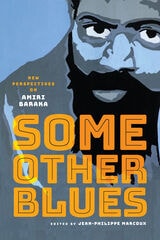
Some Other Blues
New Perspectives on Amiri BarakaEdited by Jean-Philippe Marcoux
The Ohio State University Press, 2021
(Include contributors if space allows) Contributors: Tony Bolden, Jeremy Glick, William J. Harris, Benjamin Lee, Aidan Levy, John Lowney, Jean-Philippe Marcoux, Kim McMillon, Fred Moten, Michael New, Aldon Lynn Nielsen, Amy Abugo Ongiri, Gregory Pierrot, Howard Rambsy II, Emily Ruth Rutter, Anthony Reed, Lauri Scheyer, Kathy Lou Schultz, Michael Simanga, James Smethurst, Laura Vrana, Tyrone Williams, Kalamu ya Salaam.
Something and Nothingness
The Fiction of John Updike and John FowlesJohn Neary
Southern Illinois University Press, 1992
John Neary shows that the theological dichotomy of via negativa (which posits the authentic experience of God as absence, darkness, silence) and via affirmativa (which emphasizes presence, images, and the sounds of the earth) is an overlooked key to examining and comparing the works of John Fowles and John Updike.
Drawing on his extensive knowledge of both Christian and secular existentialism within the modern theology of Barth and Levinas and the contemporary critical theory of Derrida and J. Hillis Miller, Neary demonstrates the ultimate affinity of these authors who at first appear such opposites. He makes clear that Fowles’s postmodernist, metafictional experiments reflect the stark existentialism of Camus and Sartre while Updike’s social realism recalls Kierkegaard’s empirical faith in a generous God within a kind of Christian deconstructionism.
Neary’s perception of uncanny similarities between the two authors—whose respective careers are marked by a series of novels that structurally and thematically parallel each other—and the authors’ shared long-term interest in existentialism and theology support both his critical comparison and his argument that neither author is "philosophically more sophisticated nor aesthetically more daring."
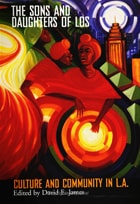
Sons And Daughters Of Los
Culture And Community In L.A.David James
Temple University Press, 2003
Soul Power
Culture, Radicalism, and the Making of a U.S. Third World LeftCynthia A. Young
Duke University Press, 2006
Young analyzes a range of U.S. figures and organizations, examining how each deployed Third World discourse toward various cultural and political ends. She considers a trip that LeRoi Jones, Harold Cruse, and Robert F. Williams made to Cuba in 1960; traces key intellectual influences on Angela Y. Davis’s writing; and reveals the early history of the hospital workers’ 1199 union as a model of U.S. Third World activism. She investigates Newsreel, a late 1960s activist documentary film movement, and its successor, Third World Newsreel, which produced a seminal 1972 film on the Attica prison rebellion. She also considers the L.A. Rebellion, a group of African and African American artists who made films about conditions in the Watts neighborhood of Los Angeles. By demonstrating the breadth, vitality, and legacy of the work of U.S. Third World Leftists, Soul Power firmly establishes their crucial place in the history of twentieth-century American struggles for social change.
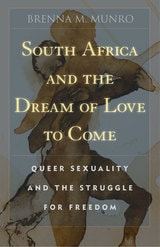
South Africa and the Dream of Love to Come
Queer Sexuality and the Struggle for FreedomBrenna M. Munro
University of Minnesota Press, 2012
After apartheid, South Africa established a celebrated new political order that imagined the postcolonial nation as belonging equally to the descendants of indigenous people, colonizing settlers, transported slaves, indentured laborers, and immigrants. Its constitution, adopted in 1996, was the first in the world to include gays and lesbians as full citizens. Brenna M. Munro examines the stories that were told about sexuality, race, and nation throughout the struggle against apartheid in order to uncover how these narratives ultimately enabled gay people to become imaginable as fellow citizens. She also traces how the gay, lesbian, or bisexual person appeared as a stock character in the pageant of nationhood during the transition to democracy. In the process, she offers an alternative cultural history of South Africa.
Munro asserts that the inclusion of gay people made South Africans feel “modern”—at least for a while. Being gay or being lesbian was reimagined in the 1990s as distinctly South African, but the “newness” that made these sexualities apt symbols for a transformed nation can also be understood as foreign and un-African. Indeed, a Western-style gay identity is often interpreted through the formula “gay equals modernity equals capitalism.” As South Africa’s reentrance into the global economy has failed to bring prosperity to the majority of its citizens, homophobic violence has been on the rise.
Employing a wide array of texts—including prison memoirs, poetry, plays, television shows, photography, political speeches, and the postapartheid writings of Nobel Laureates Nadine Gordimer and J. M. Coetzee—Munro reports on how contemporary queer activists and artists are declining to remain ambassadors for the “rainbow nation” and refusing to become scapegoats for the perceived failures of liberation and liberalism.
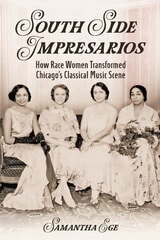
South Side Impresarios
How Race Women Transformed Chicago's Classical Music SceneSamantha Ege
University of Illinois Press, 2024
Ege focuses on composers like Florence Price, Nora Holt, and Margaret Bonds not as anomalies but as artists within an expansive cultural flowering. Overcoming racism and sexism, Black women practitioners instilled others with the skill and passion to make classical music while Race women like Maude Roberts George, Estella Bonds, Neota McCurdy Dyett, and Beulah Mitchell Hill built and fostered institutions central to the community. Ege takes readers inside the backgrounds, social lives, and female-led networks of the participants while shining a light on the scene’s audiences, supporters, and training grounds. What emerges is a history of Black women and classical music in Chicago and the still-vital influence of the world they created.
A riveting counter to a history of silence, South Side Impresarios gives voice to an overlooked facet of the Black Chicago Renaissance.
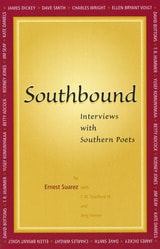
Southbound
Interviews with Southern PoetsEdited by Ernest Suarez, T. W. Stanford III, & Amy Verner
University of Missouri Press, 1999
"There's a real flowering, I think, of southern poetry right now, . . . assembling at the edges of everything." This observation by Pulitzer Prize-winning poet Charles Wright reflects upon the continuing vibrancy and importance of the southern poetic tradition. Although the death of James Dickey in 1997 left southern poetry without a recognizably dominant voice, an array of other vibrant voices continue to be heard and recognized. Southbound: Interviews with Southern Poets provides detailed discussion of the art and craft of poetry by many writers who promise to keep southern poetry vital into the twenty-first century.
Beginning with an interview with the late literary giant James Dickey, Southbound collects the ideas and insights of both well-known and rising southern poets, including Dave Smith, Charles Wright, Ellen Bryant Voigt, Yusef Komunyakaa, and Rodney Jones. Suarez's guiding principle for conducting and revising the interviews was to let the poets express themselves as clearly and fully as possible. Each interview is ultimately defined by the poet's own personality and voice, yet all explore similar themes—the relationship between technique and subject, the nature of the southern canon and each poet's place in it, and the state of contemporary poetry. As Dave Smith relates, "My sense of appreciation of what life means or could mean, whatever I know about life, stems from a sense of place, a sense of the ghostliness of meaning." It is this sense of place and meaning that Suarez allows each poet to convey truthfully in his interviews.
Including a brief introduction to each interview and a bibliography of primary and secondary sources for each poet, Southbound is a useful tool for scholars and a springboard for casual readers. More important, this collection of interviews makes a significant contribution to the tradition of southern poetry and its most prominent voices.
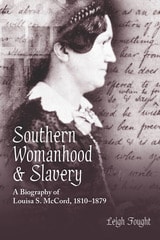
Southern Womanhood and Slavery
A Biography of Louisa S. McCord, 1810-1879Leigh Fought
University of Missouri Press, 2018
Southern Womanhood and Slavery is the first full-length biography of Louisa S. McCord, one of the most intriguing intellectuals in antebellum America. The daughter of South Carolina planter and politician Langdon Cheves, and an essayist in her own right, McCord supported unregulated free trade and the perpetuation of slavery and opposed the advancement of women’s rights. This study examines the origins of her ideas.
Leigh Fought constructs an exciting narrative that follows McCord from her childhood as the daughter of a state representative and president of the Bank of the United States through her efforts to accept her position as wife and mother, her career as an author and plantation mistress, and the Union invasion of South Carolina during the Civil War, to the end of her life in the emerging New South. Fought analyzes McCord’s poetry, letters, and essays in an effort to comprehend her acceptance of slavery and the submission of women. Fought concludes that McCord came to a defense of slavery through her experience with free labor in the North, which also reinforced her faith in the paternalist model for preserving social order.
McCord’s life as a writer on “unfeminine” subjects, her reputation as strong-minded and masculine, her late marriage, her continued ownership of her plantation after marriage, and her position as the matron of a Civil War hospital contradicted her own philosophy that women should remain the quiet force behind their husbands. She lived during a time of social flux in which free labor, slavery, and the role of women underwent dramatic changes, as well as a time that enabled her to discover and pursue her intellectual ambitions. Fought examines the conflict that resulted when those ambitions clashed with McCord’s role as a woman in the society of the South.
McCord’s voice was an interesting, articulate, and necessary feminine addition to antebellum white ideology. Moreover, her story demonstrates the ways in which southern women negotiated through patriarchy without surrendering their sense of self or disrupting the social order. Engaging and very readable, Southern Womanhood and Slavery will be of special interest to students of southern history and women’s studies, as well as to the general reader.
Southern Women Playwrights
New Essays in History and CriticismEdited by Robert McDonald and Linda Rohrer Paige
University of Alabama Press, 2001
This timely collection addresses the neglected state of scholarship on southern women dramatists by bringing together the latest criticism on some of the most important playwrights of the 20th century.
Coeditors Robert McDonald and Linda Rohrer Paige attribute the neglect of southern women playwrights in scholarly criticism to "deep historical prejudices" against drama itself and against women artists in general, especially in the South. Their call for critical awareness is answered by the 15 essays they include in Southern Women Playwrights, considerations of the creative work of universally acclaimed playwrights such as Beth Henley, Marsha Norman, and Lillian Hellman (the so-called "Trinity") in addition to that of less-studied playwrights, including Zora Neale Hurston, Carson McCullers, Alice Childress, Naomi Wallace, Amparo Garcia, Paula Vogel, and Regina Porter.
This collection springs from a series of associated questions regarding the literary and theatrical heritage of the southern woman playwright, the unique ways in which southern women have approached the conventional modes of comedy and tragedy, and the ways in which the South, its types and stereotypes, its peculiarities, its traditions-both literary and cultural-figure in these women's plays. Especially relevant to these questions are essays on Lillian Hellman, who resisted the label "southern writer," and Carson McCullers, who never attempted to ignore her southernness.
This book begins by recovering little-known or unknown episodes in the history of southern drama and by examining the ways plays assumed importance in the lives of southern women in the early 20th century. It concludes with a look at one of the most vibrant, diverse theatre scenes outside New York today-Atlanta.

Southwell's Sphere
The Influence of England's Secret PoetGary M. Bouchard
St. Augustine's Press, 2016
Sovereign Acts
Performing Race, Space, and Belonging in Panama and the Canal ZoneZien, Katherine A.
Rutgers University Press, 2017
Winner of the 2017 Annual Book Prize from the Canadian Association of Latin American and Caribbean Studies (CALACS)
Sovereign Acts explores how artists, activists, and audiences performed and interpreted sovereignty struggles in the Panama Canal Zone, from the Canal Zone’s inception in 1903 to its dissolution in 1999. In popular entertainments and patriotic pageants, opera concerts and national theatre, white U.S. citizens, West Indian laborers, and Panamanian artists and activists used performance as a way to assert their right to the Canal Zone and challenge the Zone’s sovereignty, laying claim to the Zone’s physical space and imagined terrain.
By demonstrating the place of performance in the U.S. Empire’s legal landscape, Katherine A. Zien transforms our understanding of U.S. imperialism and its aftermath in the Panama Canal Zone and the larger U.S.-Caribbean world.
Speak to Me Words
Essays on Contemporary American Indian PoetryEdited by Dean Rader and Janice Gould
University of Arizona Press, 2003
Speak to Me Words is a stimulating blend of classic articles and original pieces that reflect the energy of modern American Indian literary studies. Highlighting various aspects of poetry written by American Indians since the 1960s, it is a wide-ranging collection that balances the insights of Natives and non-Natives, men and women, old and new voices. Included here are such landmark articles as "Answering the Deer" by Paula Gunn Allen, "Herbs of Healing" by Carter Revard, and "Song, Poetry and Language—Expression and Perception" by Simon Ortiz—all pieces that have shaped how we think about Native poetry. Among the contributions appearing for the first time are Elaine Jahner writing on Paula Gunn Allen's use of formal structures; Robert Nelson addressing pan-Indian tropes of emergence, survival, return, and renewal; and Janet McAdams focusing on Carter Revard's "angled mirrors." Although many Native writers may disregard distinctions between genres, together these writings help readers see the difference between American Indian poetry and other forms of Native literature.
These essays are as broad, encompassing, and provocative as Native poetry itself, branching off from and weaving back into one another. In showing how American Indian poetry redefines our social order and articulates how Indian communities think about themselves, these writers establish a new foundation for the study—and enjoyment—of this vital art.
Speaking for the Generations
Native Writers on WritingEdited by Simon J. Ortiz
University of Arizona Press, 1997
Of varied backgrounds, the writers represent Indian heritages and cultures from the Pacific Northwest to the northern plains, from Canada to Guatemala. They are poets, novelists, and playwrights. And although their backgrounds are different and their statements intensely personal, they share common themes of their relationship to the land, to their ancestors, and to future generations of their people. From Gloria Bird's powerful recounting of personal and family history to Esther Belin's vibrant tale of her urban Native homeland in Los Angeles, these writers reveal the importance of place and politics in their lives. Leslie Marmon Silko calls upon the ancient tradition of Native American storytelling and its role in connecting the people to the land. Roberta J. Hill and Elizabeth Woody ponder some of the absurdities of contemporary Native life, while Guatemalan Victor Montejo takes readers to the Mayan world, where a native culture had writing and books long before Europeans came.
Together these pieces offer an inspiring portrait of what it means to be a Native writer in the twentieth century. With passion and urgency, these writers are speaking for themselves, for their land, and for the generations.
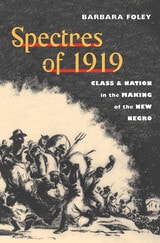
Spectres of 1919
Class and Nation in the Making of the New NegroBarbara Foley
University of Illinois Press, 2002
A look at the violent “Red Summer of 1919” and its intersection with the highly politicized New Negro movement and the Harlem Renaissance
With the New Negro movement and the Harlem Renaissance, the 1920s was a landmark decade in African American political and cultural history, characterized by an upsurge in racial awareness and artistic creativity. In Spectres of 1919 Barbara Foley traces the origins of this revolutionary era to the turbulent year 1919, identifying the events and trends in American society that spurred the black community to action and examining the forms that action took as it evolved.
Unlike prior studies of the Harlem Renaissance, which see 1919 as significant mostly because of the geographic migrations of blacks to the North, Spectres of 1919 looks at that year as the political crucible from which the radicalism of the 1920s emerged. Foley draws from a wealth of primary sources, taking a bold new approach to the origins of African American radicalism and adding nuance and complexity to the understanding of a fascinating and vibrant era.