Results by title
254 books match the query 'Sex' and 63 start with s
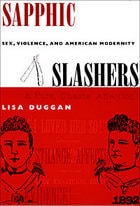
Sapphic Slashers
Sex, Violence, and American ModernityLisa Duggan
Duke University Press, 2000
Situating this story alongside simultaneously circulating lynching narratives (and its resistant versions, such as those of Memphis antilynching activist Ida B. Wells) Duggan reveals how stories of sex and violence were crucial to the development of American modernity. While careful to point out the differences between the public reigns of terror that led to many lynchings and the rarer instances of the murder of one woman by another privately motivated woman, Duggan asserts that dominant versions of both sets of stories contributed to the marginalization of African Americans and women while solidifying a distinctly white, male, heterosexual form of American citizenship. Having explored the role of turn-of-the-century print media—and in particular their tendency toward sensationalism—Duggan moves next to a review of sexology literature and to novels, most notably Radclyffe Hall’s The Well of Loneliness. Sapphic Slashers concludes with two appendices, one of which presents a detailed summary of Ward’s murder, the trial, and Mitchell’s eventual institutionalization. The other presents transcriptions of letters exchanged between the two women prior to the crime.
Combining cultural history, feminist and queer theory, narrative analysis, and compelling storytelling, Sapphic Slashers provides the first history of the emergence of the lesbian in twentieth-century mass culture.
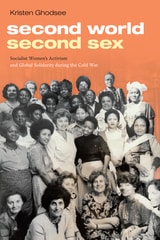
Second World, Second Sex
Socialist Women's Activism and Global Solidarity during the Cold WarKristen Ghodsee
Duke University Press, 2019
Secret Body
Erotic and Esoteric Currents in the History of ReligionsJeffrey J. Kripal
University of Chicago Press, 2017
Kripal tells his story, biographically, historically and politically contextualizing each of the six books of his Chicago corpus, from Kali’s Child to Mutants and Mystics, all the while answering his censors and critics and exploring new implications of his thought. In the process, he begins to sketch out a speculative “new comparativism” in twenty theses. The result is a new vision for the study of religion, one that takes in the best of the past, engages with outside critiques from the sciences and the humanities, and begins to blaze a new positive path forward. A major work decades in the making, Secret Body will become a landmark in the study of religion.
Secrets, Sex, and Spectacle
The Rules of Scandal in Japan and the United StatesMark D. West
University of Chicago Press, 2006
A leader of a global superpower is betrayed by his mistress, who makes public the sordid details of their secret affair. His wife stands by as he denies the charges. Debates over definitions of moral leadership ensue. Sound familiar? If you guessed Clinton and Lewinsky, try again. This incident involved former Japanese prime minister Sosuke Uno and a geisha.
In Secrets, Sex, and Spectacle, Mark D. West organizes the seemingly random worlds of Japanese and American scandal—from corporate fraud to baseball cheaters, political corruption to celebrity sexcapades—to explore well-ingrained similarities and contrasts in law and society. In Japan and the United States, legal and organizational rules tell us what kind of behavior is considered scandalous. When Japanese and American scandal stories differ, those rules—rules that define what’s public and what’s private, rules that protect injuries to dignity and honor, and rules about sex, to name a few—often help explain the differences. In the cases of Clinton and Uno, the rules help explain why the media didn’t cover Uno’s affair, why Uno’s wife apologized on her husband’s behalf, and why Uno—and not Clinton—resigned.
Secrets, Sex, and Spectacle offers a novel approach to viewing the phenomenon of scandal—one that will be applauded by anyone who has obsessed over (or ridiculed) these public episodes.

Sex And Money
Feminism and Political Economy in the MediaEileen R. Meehan
University of Minnesota Press, 2001
A revelatory look at the ways that gender, power, and the media are intertwined.
It all comes down to sex and money: how the media are organized, how they work, what they say, who gets to say it and to whom. That is the message this book delivers—and then parses for its meaning to society and culture. Forcefully and persuasively, this groundbreaking volume uses the media to show how questions of gender and economics are inextricably linked to issues of power in Western capitalist societies. Integrating political economy and feminism, it offers a new understanding of communication at the personal, experiential, institutional, and structural levels-and exposes all the subtle and complex ways in which sex and money are sutured into individuals’ daily lives.
Contributors: Robin Andersen, Fordham U; Ellen Balka, Simon Fraser U; Amy Beer; Carolyn M. Byerly, Ithaca College; Ramona Curry, U of Illinois; Fred Fejes, Florida Atlantic U; Nancy Hauserman, U of Iowa; Michèle Martin, Carleton U, Canada; Stana Martin, Central Missouri State U; Lisa McLaughlin, Miami U, Ohio; Roopali Mukherjee, Indiana U; Angela R. Record; Karen Ross, Coventry U; H. Leslie Steeves, U of Oregon; Angharad N. Valdivia, U of Illinois; Janet Wasko, U of Oregon; and Justin Wyatt.
Sex Panic Rhetorics, Queer Interventions
Ian Barnard
University of Alabama Press, 2020
Analyzes the rhetoric of contemporary sex panics to expose how homophobia, heterosexism, and transphobia define public, political, and scholarly preoccupations with sexuality and gender
In Sex Panic Rhetorics, Queer Interventions, Ian Barnard makes the counter-intuitive argument that contemporary “sex panics” are undergirded by queerphobia, even when the panics in question don’t appear to have much to do with queerness. Barnard presents six case studies that treat a wide range of sex panic rhetorics around child molesters, sex trafficking, transgenderism, incest, queer kids, and pedagogy to demonstrate this argument. By using examples from academic scholarship, political discourse, and popular culture, including the Kevin Spacey scandal and the award-winning film Moonlight, Barnard shows how homophobia and transphobia continue to pervade contemporary Western culture.
Barnard is concerned not so much with looking at the overt homophobia and transphobia that are the more obvious objects of antihomophobic and antitransphobic critique. The author’s focus, rather, is on excavating the significant traces of these panics in a neoliberal culture that has supposedly demonstrated its civility by its embrace of diversity, renunciation of its homophobic past, and attentiveness to the transgender revolution that has swept popular media and political culture in the United States and elsewhere. During a time of increasing conservative backlashes against advancing LGBTQ rights and human rights discourses in general, this book shows why it is important to attend to the liberal covers for sex panics that are not too far removed from their rhetorically conservative cousins.

Sex and Death on the Western Emigrant Trail
The Biology of Three American TragediesDonald K. Grayson
University of Utah Press, 2018
The plights of these emigrant groups have been addressed by different historians in different ways; this book is the first to examine the tragedies in terms of biology. Grayson shows that who lived or died can largely be explained by age, sex, and family ties. His investigation reveals what happens when our cultural mechanisms for dealing with famine and extreme cold are reduced to only what our bodies can provide within structured social contexts. His results are surprising and not always intuitive as he investigates who survived in these life threatening situations.

Sex and Death
An Introduction to Philosophy of BiologyKim Sterelny and Paul E. Griffiths
University of Chicago Press, 1999
Informed answers to questions like these, critical to our understanding of ourselves and the world around us, require both a knowledge of biology and a philosophical framework within which to make sense of its findings. In this accessible introduction to philosophy of biology, Kim Sterelny and Paul E. Griffiths present both the science and the philosophical context necessary for a critical understanding of the most exciting debates shaping biology today. The authors, both of whom have published extensively in this field, describe the range of competing views—including their own—on these fascinating topics.
With its clear explanations of both biological and philosophical concepts, Sex and Death will appeal not only to undergraduates, but also to the many general readers eager to think critically about the science of life.
Sex and Disability
Robert McRuer and Anna Mollow, eds.
Duke University Press, 2012
Contributors. Chris Bell, Michael Davidson, Lennard J. Davis, Michel Desjardins, Lezlie Frye, Rachael Groner, Kristen Harmon, Michelle Jarman, Alison Kafer, Riva Lehrer, Nicole Markotić, Robert McRuer, Anna Mollow, Rachel O’Connell, Russell Shuttleworth, David Serlin, Tobin Siebers, Abby L. Wilkerson
Sex and Drugs before Rock 'n' Roll
Youth Culture and Masculinity during Holland's Golden AgeBenjamin B. Roberts
Amsterdam University Press, 2012

Sex and Isolation
And Other EssaysBruce Benderson; Foreword by Catherine Texier
University of Wisconsin Press, 2007
In Sex and Isolation, readers will encounter eccentric street people, Latin American literary geniuses, a French cabaret owner, a transvestite performer, and many other unusual characters; they’ll visit subcultures rarely described in writing and be treated to Benderson’s iconoclastic opinions about culture in former and contemporary urban society. Whether proposing new theories about the relationship between art, entertainment, and sex, analyzing the rise of the Internet and the disappearance of public space, or considering how religion and sexual identity interact, each essay demonstrates sharp wit, surprising insight and some startling intellectual positions.
This is the first American volume of Benderson’s collected essays, featuring both new work and some of his best-known writings, including his famous essay “Toward the New Degeneracy.”
Sex and Religion
Teachings and Taboos in the History of World FaithsDag Ølstein Endsjø
Reaktion Books, 2011
Sex and religion are inevitably and intricately linked. There are few realms of human experience other than sex in which religion has greater reach and influence. The role of religion, of any faith, to prohibit, regulate, condemn, and reward, is unavoidably prominent in questions of sex—namely with whom, when, how, and why. In Sex and Religion, Dag Øistein Endsjø examines the myriad and complex religious attitudes towards sex in cultures throughout the world.
Endsjø reflects on some of the most significantly problematic areas in the relationship between sex and religion—from sex before or outside of marriage to homosexuality. Through many examples from world religions, he outlines what people mean by sex in a religious context, with whom it’s permissible to have sex, how sex can be a directly religious experience, and what consequences there are for deviance, for both the individual and society. As Endsjø explains, while Buddhist monks call attention to gay sex as a holy mystery, the Christian church questions a homosexual’s place in the church. Some religions may believe that promiscuity leads to hurricanes and nuclear war, and in others God condemns interracial marriage. Sex and Religion reveals there is nothing natural or self-evident about the ways in which various religions prescribe or proscribe and bless or condemn different types of sexuality. Whether sex becomes sacred or abhorrent depends entirely on how a religion defines it.
Sex and Religion is a fascinating investigation of mores, meanings, rituals, and rules in many faiths around the globe, and will be of interest to anyone curious about the intersection of these fundamental aspects of human history and experience.
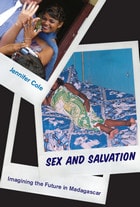
Sex and Salvation
Imagining the Future in MadagascarJennifer Cole
University of Chicago Press, 2010
Sex and Salvation chronicles the coming of age of a generation of women in Tamatave in the years that followed Madagascar’s economic liberalization. Eager to forge a viable future amid poverty and rising consumerism, many young women have entered the sexual economy in hope of finding a European husband. Just as many Westerners believe that young people break with the past as they enter adulthood, Malagasy citizens fear that these women have severed the connection to their history and culture.
Jennifer Cole’s elegant analysis shows how this notion of generational change is both wrong and consequential. It obscures the ways young people draw on long-standing ideas of gender and sexuality, it ignores how urbanites relate to their rural counterparts, and it neglects the relationship between these husband-seeking women and their elders who join Pentecostal churches. And yet, as talk about the women circulates through the city’s neighborhoods, bars, Internet cafes, and churches, it teaches others new ways of being.
Cole’s sophisticated depiction of how a generation’s coming of age contributes to social change eschews a narrow focus on crisis. Instead, she reveals how fantasies of rupture and conceptions of the changing life course shape the everyday ways that people create the future.
Sex and Scientific Inquiry
Edited by Sandra Harding and Jean F. O'Barr
University of Chicago Press, 1987
Sex and Virtue
An Introduction to Sexual Ethics (Catholic Moral Thought, Volume 2)John S. Grabowski
Catholic University of America Press, 2003

Sex and the Founding Fathers
The American Quest for a Relatable PastThomas A. Foster
Temple University Press, 2016
Biographers, journalists, and satirists have long used the subject of sex to define the masculine character and political authority of America's Founding Fathers. Tracing these commentaries on the Revolutionary Era's major political figures in Sex and the Founding Fathers, Thomas Foster shows how continual attempts to reveal the true character of these men instead exposes much more about Americans and American culture than about the Founders themselves.
Sex and the Founding Fathers examines the remarkable and varied assessments of the intimate lives of George Washington, Thomas Jefferson, John Adams, Benjamin Franklin, Alexander Hamilton, and Gouverneur Morris from their own time to ours. Interpretations can change radically; consider how Jefferson has been variously idealized as a chaste widower, condemned as a child molester, and recently celebrated as a multicultural hero.
Foster considers the public and private images of these generally romanticized leaders to show how each generation uses them to reshape and reinforce American civic and national identity.

Sex and the Gender Revolution, Volume 1
Heterosexuality and the Third Gender in Enlightenment LondonRandolph Trumbach
University of Chicago Press, 1998
In Sex and the Gender Revolution, Randolph Trumbach reconstructs the worlds of eighteenth-century prostitution, illegitimacy, sexual violence, and adultery. In those worlds the majority of men became heterosexuals by avoiding sodomy and sodomite behavior.
As men defined themselves more and more as heterosexuals, women generally experienced the new male heterosexuality as its victims. But women—as prostitutes, seduced servants, remarrying widows, and adulterous wives— also pursued passion. The seamy sexual underworld of extramarital behavior was central not only to the sexual lives of men and women, but to the very existence of marriage, the family, domesticity, and romantic love. London emerges as not only a geographical site but as an actor in its own right, mapping out domains where patriarchy, heterosexuality, domesticity, and female resistance take vivid form in our imaginations and senses.
As comprehensive and authoritative as it is eloquent and provocative, this book will become an indispensable study for social and cultural historians and delightful reading for anyone interested in taking a close look at sex and gender in eighteenth-century London.
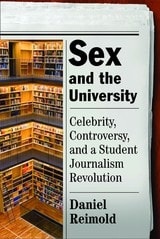
Sex and the University
Celebrity, Controversy, and a Student Journalism RevolutionReimold, Daniel
Rutgers University Press, 2010
Daniel Reimold gives readers of all generations an inside look at this phenomenon. Student sex columnists and sex magazine editors are both celebrities on their home campuses. One columnist, echoing the sentiments of many, said he became an overnight rock star golden child of journalism. But, with celebrity comes controversy. These columns and magazines have sparked contentious and far-reaching legal, religious, and intergenerational debates about sex, the student press, and the place of both within higher education. They are also the most prominent modern student press combatants in the fight for free speech. And they have blurred journalistic boundaries between what is considered public and private, art and pornography, and gossip and news.
Sex and the University explores the celebrity status that student sex columnists and magazine editors have received, the controversies they have caused, and the sexual generation and student journalism revolution they represent. Complete with a sexicon of slang, this book also dives into the columns and magazines themselves, sharing for the first time what modern students are saying about their sex and love lives, in their own words.
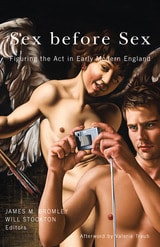
Sex before Sex
Figuring the Act in Early Modern EnglandJames M. Bromley
University of Minnesota Press, 2013
What is sex exactly? Does everyone agree on a definition? And does that definition hold when considering literary production in other times and places? Sex before Sex makes clear that we cannot simply transfer our contemporary notions of what constitutes a sex act into the past and expect them to be true for the people who were then reading literature and watching plays. The contributors confront how our current critical assumptions about definitions of sex restrict our understanding of representations of sexuality in early modern England.
Drawing attention to overlooked forms of sexual activity in early modern culture, from anilingus and interspecies sex to “chin-chucking” and convivial drinking, Sex before Sex offers a multifaceted view of what sex looked like before the term entered history. Through incisive interpretations of a wide range of literary texts, including Romeo and Juliet, The Comedy of Errors, Paradise Lost, the figure of Lucretia, and pornographic poetry, this collection queries what might constitute sex in the absence of a widely accepted definition and how a historicized concept of sex affects the kinds of arguments that can be made about early modern sexualities.
Contributors: Holly Dugan, George Washington U; Will Fisher, CUNY–Lehman College; Stephen Guy-Bray, U of British Columbia; Melissa J. Jones, Eastern Michigan U; Thomas H. Luxon, Dartmouth College; Nicholas F. Radel, Furman U; Kathryn Schwarz, Vanderbilt U; Christine Varnado, U of Buffalo–SUNY.
Sex in Development
Science, Sexuality, and Morality in Global PerspectiveVincanne Adams and Stacy Leigh Pigg, eds.
Duke University Press, 2005
Sex in Development combines the cultural analysis of sexuality, critiques of global development, and science and technology studies. Whether considering the resistance encountered by representatives of an American pharmaceutical company attempting to teach Russian doctors a “value free” way to offer patients birth control or the tension between Tibetan Buddhist ideas of fertility and the modernization schemes of the Chinese government, these essays show that attempts to make sex a universal moral object to be managed and controlled leave a host of moral ambiguities in their wake as they are engaged, resisted, and reinvented in different ways throughout the world.
Contributors. Vincanne Adams, Leslie Butt, Lawrence Cohen, Heather Dell, Vinh-Kim Nguyen, Shanti Parikh, Heather Paxson, Stacy Leigh Pigg, Michele Rivkin-Fish

Sex in Middlesex
Popular Mores in a Massachusetts County, 1649-1699Roger Thompson
University of Massachusetts Press, 1986
Drawing on an extraordinary wealth of court records from Middlesex County of the Colony and Province of Massachusetts Bay, Sex in Middlesex offers a richly revisionist account of social and moral life in seventeenth-century New England. Social historian Roger Thompson brings to life the forgotten men and women of colonial Massachusetts to challenge some of the most entrenched assumptions about Puritan society. Examining cases of fornication, adultery, breach of promise, premarital pregnancy, and sexual deviance recorded between 1649 and 1699, Thompson argues that the Puritan social system was far less rigid, and the relations between the sexes far less coercively regulated, than the dominant historiographical tradition, shaped by scholars such as Perry Miller and Lawrence Stone, has suggested.
Rather than a community defined by patriarchal tyranny and punitive moral control, Thompson discovers in the Middlesex records a society characterized by a striking degree of tolerance, mutual regard, and practical common sense, animated by a genuinely popular Puritan piety. The goal of the courts was not punishment and exclusion, but confession, reform, and the reintegration of offenders into the community. Structured with methodological rigor and written with narrative verve, Sex in Middlesex is at once a work of quantitative social history and a gallery of vivid individual portraits.
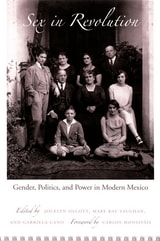
Sex in Revolution
Gender, Politics, and Power in Modern MexicoJocelyn Olcott, Mary Kay Vaughan, and Gabriela Cano, eds.
Duke University Press, 2006
Concentrating on episodes and phenomena that occurred between 1915 and 1950, the contributors deftly render experiences ranging from those of a transgendered Zapatista soldier to upright damas católicas and Mexico City’s chicas modernas pilloried by the press and male students. Women refashioned their lives by seeking relief from bad marriages through divorce courts and preparing for new employment opportunities through vocational education. Activists ranging from Catholics to Communists mobilized for political and social rights. Although forced to compromise in the face of fierce opposition, these women made an indelible imprint on postrevolutionary society.
These essays illuminate emerging practices of femininity and masculinity, stressing the formation of subjectivity through civil-society mobilizations, spectatorship and entertainment, and locales such as workplaces, schools, churches, and homes. The volume’s epilogue examines how second-wave feminism catalyzed this revolutionary legacy, sparking widespread, more radically egalitarian rural women’s organizing in the wake of late-twentieth-century democratization campaigns. The conclusion considers the Mexican experience alongside those of other postrevolutionary societies, offering a critical comparative perspective.
Contributors. Ann S. Blum, Kristina A. Boylan, Gabriela Cano, María Teresa Fernández Aceves, Heather Fowler-Salamini, Susan Gauss, Temma Kaplan, Carlos Monsiváis, Jocelyn Olcott, Anne Rubenstein, Patience Schell, Stephanie Smith, Lynn Stephen, Julia Tuñón, Mary Kay Vaughan

Sex in an Age of Technological Reproduction
<i>ICSI<i/> and <i>Taboos<i/>Carl Djerassi
University of Wisconsin Press, 2008

Sex in the Middle East and North Africa
L. L. Wynn
Vanderbilt University Press, 2022
The book is organized into three sections: Single and Dating, Engaged and Married, and It's Complicated. The allusion to categories of relationship status on social media is at once a nod to the compulsion to categorize, recognition of the many ways that categorization is rarely straightforward, and acknowledgment that much of the intimate lives described by the contributors is mediated by online technologies.

Sex on Stage
Gender and Sexuality in Post-War British TheatreAndrew Wyllie
Intellect Books, 2009

Sex on the Kitchen Table
The Romance of Plants and Your FoodNorman C. Ellstrand
University of Chicago Press, 2018
In Sex on the Kitchen Table, Norman C. Ellstrand takes us on a vegetable-laced tour of this entire sexual adventure. Starting with the love apple (otherwise known as the tomato) as a platform for understanding the kaleidoscopic ways that plants can engage in sex, successive chapters explore the sex lives of a range of food crops, including bananas, avocados, and beets, finally ending with genetically engineered squash—a controversial, virus-resistant vegetable created by a process that involves the most ancient form of sex. Peppered throughout are original illustrations and delicious recipes, from sweet and savory tomato pudding to banana puffed pancakes, avocado toast (of course), and both transgenic and non-GMO tacos.
An eye-opening medley of serious science, culinary delights, and humor, Sex on the Kitchen Table offers new insight into fornicating flowers, salacious squash, and what we owe to them. So as we sit down to dine and ready for that first bite, let us say a special grace for our vegetal vittles: let’s thank sex for getting them to our kitchen table.
Sex with Strangers
Michael Lowenthal
University of Wisconsin Press, 2021
Recognizing that any partner is unknowable on some level, Michael Lowenthal writes about how intimacy can make strangers of us all. A newly ordained priest struggles with guilt and longing when he runs into his ex-girlfriend. A woman weighs the cost of protecting her daughter from a man they both adore. A teenage busboy has a jolting brush with a famous musician. A young man tries to salvage a long-distance relationship while caring for his mentor, an erotic writer dying of AIDS.
In edgy, disquieting stories, Lowenthal traces the paths that attraction and erotic encounters take, baffling and rueful as often as electrifying. This fraught and funny volume forces us to grapple with our own subconscious desires and question how well we can ever really know ourselves.

Sex, Brains, and Video Games
Information and Inspiration for Youth Services LibrariansJennifer Burek Pierce
American Library Association, 2017
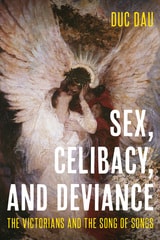
Sex, Celibacy, and Deviance
The Victorians and the Song of SongsDuc Dau
The Ohio State University Press, 2024
Sex, Celibacy, and Deviance is the first major study to explore the Song of Songs (or Song of Solomon) in Victorian literature and art. As the Bible’s only erotic poem, the Song of Songs is the canonical Judeo-Christian book about love, furnishing the Victorians with an authoritative and literary language for love, marriage, sex, mourning, and religious celibacy.
Duc Dau adopts a queer and feminist lens to consider how Victorians employed and interpreted the Song of Songs in their work. How did writers and artists fashion and, most importantly, challenge the norms of gender, romantic love, and marriage? Spanning the early Victorian era through the first two decades of the twentieth century, Sex, Celibacy, and Deviance considers the works of Charlotte Brontë, Thomas Hardy, Christina Rossetti, John Gray, Michael Field, Edward Burne-Jones, and Simeon Solomon alongside two lesser-known figures: Irish-born Scottish artist Phoebe Anna Traquair and the Catholic religious leader Augusta Theodosia Drane. By addressing the relevance of the Song of Songs in light of shifting and conflicting religious and social contexts, Dau provides a fresh perspective on Victorian literature, religion, and culture.
Sex, Christ, and Embodied Cognition
Paul's Wisdom for CorinthRobert H. von Thaden Jr.
SBL Press, 2017
A sociorhetorical analysis of First Corinthians
Robert H. von Thaden Jr.'s sociorhetorical analysis examines Paul's construction of sexual Christian bodies in First Corinthians by utilizing new insights from conceptual integration (blending) theory about the embodied processes of meaning making. Paul's teaching about proper sexual behavior in this letter is best viewed as an example of early Christian wisdom discourse. This discourse draws upon apocalyptic and priestly cognitive frames to increase the rhetorical force of the argument. Reading Paul's argument through the lens of rhetorical invention, von Thaden demonstrates that Paul first attempts to show the Corinthians why sexual immorality is the worst of all bodily sins before shifting rhetorical focus to explain to them how they can best avoid this infraction against the body of Christ.
Features:
- A programmatic application of conceptual integration theory using a sociorhetorical mode of interpretation
- A vivid account of key aspects of conceptual integration theory and how they function in sociorhetorical interpretation
- A detailed application of these strategies to interpret 1 Corinthians 1-4; 6:12-7:7

Sex, Death, and Minuets
Anna Magdalena Bach and Her Musical NotebooksDavid Yearsley
University of Chicago Press, 2019
Sex, Death, and Minuets offers the first in-depth study of these notebooks and their owner, reanimating Anna Magdalena as a multifaceted historical subject—at once pious and bawdy, spirited and tragic. In these pages, we follow Magdalena from young and flamboyant performer to bereft and impoverished widow—and visit along the way the coffee house, the raucous wedding feast, and the family home. David Yearsley explores the notebooks’ more idiosyncratic entries—like its charming ditties on illicit love and searching ruminations on mortality—against the backdrop of the social practices and concerns that women shared in eighteenth-century Lutheran Germany, from status in marriage and widowhood, to fulfilling professional and domestic roles, money, fashion, intimacy and sex, and the ever-present sickness and death of children and spouses. What emerges is a humane portrait of a musician who embraced the sensuality of song and the uplift of the keyboard, a sometimes ribald wife and oft-bereaved mother who used her cherished musical notebooks for piety and play, humor and devotion—for living and for dying.
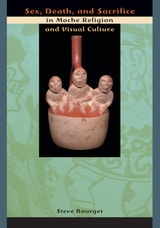
Sex, Death, and Sacrifice in Moche Religion and Visual Culture
By Steve Bourget
University of Texas Press, 2006
The Moche people who inhabited the north coast of Peru between approximately 100 and 800 AD were perhaps the first ancient Andean society to attain state-level social complexity. Although they had no written language, the Moche created the most elaborate system of iconographic representation of any ancient Peruvian culture. Amazingly realistic figures of humans, animals, and beings with supernatural attributes adorn Moche pottery, metal and wooden objects, textiles, and murals. These actors, which may have represented both living individuals and mythological beings, appear in scenes depicting ritual warfare, human sacrifice, the partaking of human blood, funerary rites, and explicit sexual activities.
In this pathfinding book, Steve Bourget raises the analysis of Moche iconography to a new level through an in-depth study of visual representations of rituals involving sex, death, and sacrifice. He begins by drawing connections between the scenes and individuals depicted on Moche pottery and other objects and the archaeological remains of human sacrifice and burial rituals. He then builds a convincing case for Moche iconography recording both actual ritual activities and Moche religious beliefs regarding the worlds of the living, the dead, and the afterlife. Offering a pioneering interpretation of the Moche worldview, Bourget argues that the use of symbolic dualities linking life and death, humans and beings with supernatural attributes, and fertility and social reproduction allowed the Moche to create a complex system of reciprocity between the world of the living and the afterworld. He concludes with an innovative model of how Moche cosmological beliefs played out in the realms of rulership and political authority.
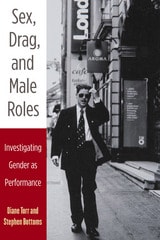
Sex, Drag, and Male Roles
Investigating Gender as PerformanceDiane Torr and Stephen Bottoms
University of Michigan Press, 2010
"Few books blend the critical and creative approaches to drag performance this provocatively and engagingly, and none provides both the historical and the personal perspectives so effectively. Torr and Bottoms fundamentally challenge many long-standing ideas about drag kings and the performance of masculinity."
---Sarah Bay-Cheng, University at Buffalo
"This book brings the reader inside an artist's creative imagination and intellect, showing us Diane Torr's work in a detailed, thoughtful, and engaging way. We discover how Torr uses different physical disciplines to explore how gender is constructed, interpreted, and expressed. Along the way---by taking us into various venues in which she performed---she evokes the lively, dynamic scene in New York in the '80s and '90s."
---Alisa Solomon, Columbia University
Why would women want to perform as men? Why is gender crossing so compelling, whether it happens onstage or in everyday life? What can drag performance teach, and what aesthetic, political, and personal questions does it raise?
Performance artist Diane Torr has been experimenting with the performance of gender for thirty years---exploring everything from feminist go-go dancing to masculine power play. One of the key pioneers of "drag king" performance, Torr has been celebrated internationally for her gender transformation workshops, in which she has taught hundreds of ordinary women how to pass as men on city streets around the world. This cultural subterfuge appeals to participants for many different reasons: personal confidence-building, sexual frisson, gender subversion, trans-curiosity, or simply the appeal of disguise and role play.
Sex, Drag, and Male Roles documents the evolution of Torr's work by blending first-person memoir and commentary from Torr with critical reflections and contextualization from leading performance critic Stephen J. Bottoms. The book includes a consideration of the long cultural history of female-to-male cross-dressing and concludes with Torr's "Do-It-Yourself" guide to becoming a "Man for a Day."
Diane Torr developed her cross-disciplinary art in the downtown New York art scene from 1976 to 2002. Now living in Scotland, Torr has earned an international reputation for her performances and gender transformation workshops (featured on HBO, BBC, and This American Life on NPR, among others). Her work is the focus of a feature film, Man for a Day.
Stephen J. Bottoms is Wole Soyinka Professor of Drama and Theatre Studies at the University of Leeds. His books include Playing Underground: A Critical History of the 1960s Off-Off-Broadway Movement and Small Acts of Repair: Performance, Ecology, and Goat Island.
Cover: Diane Torr walks the streets of London, 1995. Photo by Debbie Humphreys.
Sex, Drugs and Rock 'n' Roll in the Dutch Golden Age
Benjamin B. Roberts
Amsterdam University Press, 2018
With his engaging storytelling style and humorous anecdotes, Roberts convincingly reveals that deviant male youth behavior is common to all times, especially periods when youngsters have too much money and too much free time on their hands.
Sex, Drugs and Rock ’n’ Roll in Rembrandt’s Time
Benjamin B. Roberts
Amsterdam University Press, 2024
With his engaging storytelling-style filled with humorous anecdotes, Roberts convincingly shows how deviant male youth behavior is a feature of all ages, especially in periods when youngsters have too much free time and money.

Sex, Drugs, and Sea Slime
The Oceans' Oddest Creatures and Why They MatterEllen Prager
University of Chicago Press, 2011
When viewed from a quiet beach, the ocean, with its rolling waves and vast expanse, can seem calm, even serene. But hidden beneath the sea’s waves are a staggering abundance and variety of active creatures, engaged in the never-ending struggles of life—to reproduce, to eat, and to avoid being eaten.
With Sex, Drugs, and Sea Slime, marine scientist Ellen Prager takes us deep into the sea to introduce an astonishing cast of fascinating and bizarre creatures that make the salty depths their home. From the tiny but voracious arrow worms whose rapacious ways may lead to death by overeating, to the lobsters that battle rivals or seduce mates with their urine, to the sea’s masters of disguise, the octopuses, Prager not only brings to life the ocean’s strange creatures, but also reveals the ways they interact as predators, prey, or potential mates. And while these animals make for some jaw-dropping stories—witness the sea cucumber, which ejects its own intestines to confuse predators, or the hagfish that ties itself into a knot to keep from suffocating in its own slime—there’s far more to Prager’s account than her ever-entertaining anecdotes: again and again, she illustrates the crucial connections between life in the ocean and humankind, in everything from our food supply to our economy, and in drug discovery, biomedical research, and popular culture.
Written with a diver’s love of the ocean, a novelist’s skill at storytelling, and a scientist’s deep knowledge, Sex, Drugs, and Sea Slime enchants as it educates, enthralling us with the wealth of life in the sea—and reminding us of the need to protect it.

Sex, France, and Arab Men, 1962–1979
Todd Shepard
University of Chicago Press, 2017
Sex, France, and Arab Men is a history of how and why—from the upheavals of French Algeria in 1962 through the 1970s—highly sexualized claims about Arabs were omnipresent in important public French discussions, both those that dealt with sex and those that spoke of Arabs. Shepard explores how the so-called sexual revolution took shape in a France profoundly influenced by the ongoing effects of the Algerian revolution. Shepard’s analysis of both events alongside one another provides a frame that renders visible the ways that the fight for sexual liberation, usually explained as an American and European invention, developed out of the worldwide anticolonial movement of the mid-twentieth century.
Sex, Identity, Aesthetics
The Work of Tobin Siebers and Disability StudiesJina B. Kim, Joshua Kupetz, Crystal Yin Lie, and Cynthia Wu, Editors
University of Michigan Press, 2021
Sex, Love, and Health in America
Private Choices and Public PoliciesEdited by Edward O. Laumann and Robert T. Michael
University of Chicago Press, 2000
Sixteen researchers have contributed essays to this collection that explore controversial topics, including teenage sexuality, sexual contact between children and adults, abortion, the role of cohabitation in the sexual satisfaction of couples, and how sexual behavior has changed in response to AIDS, as well as a widely heralded examination of circumcision, reported in the New York Times, which discusses the effects of the procedure on disease transmission and the preference for certain sexual practices. In its analysis, policy recommendations, and revelations about private practices, Sex, Love, and Health in America will, like the earlier volume, have a major role in shaping the discussion about American sexual behavior.
Sex, Power, and Slavery
Gwyn Campbell
Ohio University Press, 2014
Sexual exploitation was and is a critical feature of enslavement. Across many different societies, slaves were considered to own neither their bodies nor their children, even if many struggled to resist. At the same time, paradoxes abound: for example, in some societies to bear the children of a master was a potential route to manumission for some women. Sex, Power, and Slavery is the first history of slavery and bondage to take sexuality seriously.
Twenty-six authors from diverse scholarly backgrounds look at the vexed, traumatic intersections of the histories of slavery and of sexuality. They argue that such intersections mattered profoundly and, indeed, that slavery cannot be understood without adequate attention to sexuality. Sex, Power, and Slavery brings into conversation historians of the slave trade, art historians, and scholars of childhood and contemporary sex trafficking. The book merges work on the Atlantic world and the Indian Ocean world and enables rich comparisons and parallels between these diverse areas.
Contributors: David Brion Davis, Martin Klein, Richard Hellie, Abdul Sheriff, Griet Vankeerberghen, E. Ann McDougall, Matthew S. Hopper, Marie Rodet, George La Rue, Ulrike Schmieder, Tara Iniss, Mariana Candido, James Francis Warren, Johanna Ransmeier, Roseline Uyanga with Marie-Luise Ermisch, Francesca Ann Louise Mitchell, Shigeru Sato, Gabeba Baderoon, Charmaine Nelson, Ana Lucia Araujo, Brian Lewis, Ronaldo Vainfas, Salah Trabelsi, Joost Coté, Sandra Evers, and Subho Basu

Sex, Race, and Merit
Debating Affirmative Action in Education and EmploymentFaye J. Crosby and Cheryl VanDeVeer, Editors
University of Michigan Press, 2000

Sex, Sexuality, and the Anthropologist
Edited by Fran Markowitz and Michael Ashkenazi
University of Illinois Press, 1999
Sex, Sexuality, and the Anthropologist recounts the real-life experiences of anthropologists who are forced to acknowledge that their hosts in the field view them as gendered beings in a social context, not as asexual, objective observers. Far from controlling the research environment and defining the terms of interviewer-informant relationships, these researchers find they must engage in a process of negotiating their position—including their sexual position—within the communities they study.
Ranging from public baths in Austria to lesbian bars in Taiwan and from Mexico to Nigeria to Finland to Japan, Sex, Sexuality, and the Anthropologist raises critical questions about ethnographers' reflexivity, subjectivity, and detachment, confronting the challenge of a holistic approach to the anthropological enterprise.
Sex, Shame, and Violence
A Revolutionary Practice of Public Storytelling in Poor CommunitiesKathleen Cash
Vanderbilt University Press, 2016
For more than three decades, Kathleen Cash has lived and worked with impoverished people, learning about their lives. Listening to them talk about their feelings of shame, Cash heard how people suffered from being unable to change what was happening to them--HIV infection, sexual and domestic violence, violence toward children, and environmental degradation. She saw that many interventions lacked emotional and cultural integrity and thus did little to alleviate these hardships. So Cash went outside the conventional approaches to health promotion and social justice and devised a community narrative practice, a strategy for engaging people through storytelling. From numerous ethnographic interviews, she pieced together cultural stories in a way that resonated with community people and revealed the paradoxes in their suffering. Cash recruited local artists to illustrate the stories in a form resembling a graphic novel and distributed these booklets for community discussion. (This book includes excerpts from these illustrated stories.)
In Thailand, Bangladesh, Haiti, Uganda, and the United States, people learned to talk about forbidden subjects and say what they could never say before. They stood up to each other, reconciled, and made health-seeking decisions. By helping others, they repaired themselves. In cathartic conversations they acknowledged shame, which led to acts of courage and generosity.
Sex, Sickness, and Slavery
Illness in the Antebellum SouthMarli F. Weiner with Mazie Hough
University of Illinois Press, 2014
Sex, Skulls, and Citizens
Gender and Racial Science in Argentina (1860-1910)Ashley Elizabeth Kerr
Vanderbilt University Press, 2020
PROSE Awards Subject Category Finalist—Biological Anthropology, Ancient History, and Archaeology, 2021
Best Nineteenth-Century Book Award, Latin American Studies Association Nineteenth-Century Section, 2021
Analyzing a wide variety of late-nineteenth-century sources, Sex, Skulls, and Citizens argues that Argentine scientific projects of the era were not just racial encounters, but were also conditioned by sexual relationships in all their messy, physical reality.
The writers studied here (an eclectic group of scientists, anthropologists, and novelists, including Estanislao Zeballos, Lucio and Eduarda Mansilla, Ramón Lista, and Florence Dixie) reflect on Indigenous sexual practices, analyze the advisability and effects of interracial sex, and use the language of desire to narrate encounters with Indigenous peoples as they try to scientifically pinpoint Argentina's racial identity and future potential.
Kerr's reach extends into history of science, literary studies, and history of anthropology, illuminating a scholarly time and place in which the lines betwixt were much blurrier, if they existed at all.
Sex, Society, and the Making of Pornography
The Pornographic Object of KnowledgeJeffrey Escoffier
Rutgers University Press, 2021

Sex, or the Unbearable
Lauren Berlant and Lee Edelman
Duke University Press, 2014
Through virtuoso interpretations of works of cinema, photography, critical theory, and literature, including Lydia Davis's story "Break It Down" (reprinted in full here), Berlant and Edelman explore what it means to live with negativity, with those divisions that may be irreparable. Together, they consider how such negativity affects politics, theory, and intimately felt encounters. But where their critical approaches differ, neither hesitates to voice disagreement. Their very discussion—punctuated with moments of frustration, misconstruction, anxiety, aggression, recognition, exhilaration, and inspiration—enacts both the difficulty and the potential of encounter, the subject of this unusual exchange between two eminent critics and close friends.

Sex-Life
A Critical Commentary on the History of SexualityDon Milligan
Pluto Press, 1993

Sexology and Translation
Cultural and Scientific Encounters across the Modern WorldHeike Bauer
Temple University Press, 2015
Sexology and Translation is the first study of the contemporaneous emergence of sexology in Europe, Asia, and the Middle East. Heike Bauer and her contributors—historians, literary and cultural critics, and translation scholars—address the intersections between sexuality and modernity in a range of contexts during the period from the 1880s to the 1930s.
From feminist sexualities in modern Japan to Magnus Hirschfeld’s affective sexology, this book offers compelling new insights into how sexual ideas were formed in different contexts via a complex process of cultural negotiation. By focusing on issues of translation—the dynamic process by which ideas are produced and transmitted—the essays in Sexology and Translation provide an important corrective to the pervasive idea that sexuality is a “Western” construct that was transmitted around the world.
This volume deepens understanding of how the intersections between national and transnational contexts, between science and culture, and between discourse and experience, shaped modern sexuality.
Sexual Fields
Toward a Sociology of Collective Sexual LifeEdited by Adam Isaiah Green
University of Chicago Press, 2013
To build on the sexual fields framework, Green has gathered a distinguished group of scholars who together make a strong case for sexual field theory as the first systematic theoretical innovation since queer theory in the sociology of sexuality. Expanding on the work of Bourdieu, Green and contributors develop this distinctively sociological approach for analyzing collective sexual life, where much of the sexual life of our society resides today. Coupling field theory with the ethnographic and theoretical expertise of some of the most important scholars of sexual life at work today, Sexual Fields offers a game-changing approach that will revolutionize how sociologists analyze and make sense of contemporary sexual life for years to come.