Results by title
1861 books match the query 'Social life and customs' and 147 start with s

Saamaka Dreaming
Richard Price and Sally Price
Duke University Press, 2017
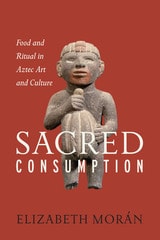
Sacred Consumption
Food and Ritual in Aztec Art and CultureBy Elizabeth Morán
University of Texas Press, 2016
Making a foundational contribution to Mesoamerican studies, this book explores Aztec painted manuscripts and sculptures, as well as indigenous and colonial Spanish texts, to offer the first integrated study of food and ritual in Aztec art.
Aztec painted manuscripts and sculptural works, as well as indigenous and Spanish sixteenth-century texts, were filled with images of foodstuffs and food processing and consumption. Both gods and humans were depicted feasting, and food and eating clearly played a pervasive, integral role in Aztec rituals. Basic foods were transformed into sacred elements within particular rituals, while food in turn gave meaning to the ritual performance.
This pioneering book offers the first integrated study of food and ritual in Aztec art. Elizabeth Morán asserts that while feasting and consumption are often seen as a secondary aspect of ritual performance, a close examination of images of food rites in Aztec ceremonies demonstrates that the presence—or, in some cases, the absence—of food in the rituals gave them significance. She traces the ritual use of food from the beginning of Aztec mythic history through contact with Europeans, demonstrating how food and ritual activity, the everyday and the sacred, blended in ceremonies that ranged from observances of births, marriages, and deaths to sacrificial offerings of human hearts and blood to feed the gods and maintain the cosmic order. Morán also briefly considers continuities in the use of pre-Hispanic foods in the daily life and ritual practices of contemporary Mexico. Bringing together two domains that have previously been studied in isolation, Sacred Consumption promises to be a foundational work in Mesoamerican studies.
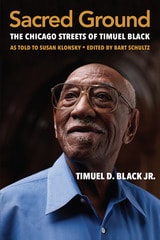
Sacred Ground
The Chicago Streets of Timuel BlackTimuel D. Black Jr., as told to Susan Klonsky, edited by Bart Schultz
Northwestern University Press, 2019
Sacred Ground opens in 1919, during the summer of the Chicago race riot, when infant Black and his family arrive in Chicago from Birmingham, Alabama, as part of the first Great Migration. He recounts in vivid detail his childhood and education in the Black Metropolis of Bronzeville and South Side neighborhoods that make up his "sacred ground."
Revealing a priceless trove of experiences, memories, ideas, and opinions, Black describes how it felt to belong to this place, even when stationed in Europe during World War II. He relates how African American soldiers experienced challenges and conflicts during the war, illuminating how these struggles foreshadowed the civil rights movement. A labor organizer, educator, and activist, Black captures fascinating anecdotes and vignettes of meeting with famous figures of the times, such as Duke Ellington and Martin Luther King Jr., but also with unheralded people whose lives convey lessons about striving, uplift, and personal integrity.
Rounding out this memoir, Black reflects on the legacy of his friend and mentee, Barack Obama, as well as on his public works and enduring relationships with students, community workers, and some very influential figures in Chicago and the world.
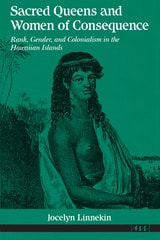
Sacred Queens and Women of Consequence
Rank, Gender, and Colonialism in the Hawaiian IslandsJocelyn Linnekin
University of Michigan Press, 1990
Sacred Queens and Women of Consequence is a pathbreaking examination of the contact encounter in Hawaii from the perspective of Hawaiian women. Jocelyn Linnekin offers a reconstruction of Hawaiian women's authority and status before contact with the West and examines changes in their cultural valuation and social position during the first century of Western contact. Through a detailed analysis of women's roles in exchange, production, kinship, and politics during the political and economic transformations of the nineteenth century, Linnekin challenges the view that Polynesian women were doomed to a peripheral status by the ritual logic of pollution. She demonstrates how Hawaiian women maintained their position as points of access to land and power, while frequently resisting the constraints of the tabu system as well as later Western-influenced attempts to abridge their authority.This book is a unique and important contribution to the scholarship on Hawaiian history as well as to the growing literature on women and colonialism and women and social stratification. It will appeal to scholars and students who work in the areas of gender studies, social stratification, cultural change, Oceania, and historical anthropology.
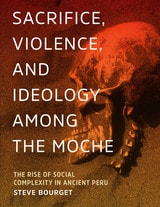
Sacrifice, Violence, and Ideology Among the Moche
The Rise of Social Complexity in Ancient PeruBy Steve Bourget
University of Texas Press, 2016
In a special precinct dedicated to ritual sacrifice at Huaca de la Luna on the north coast of Peru, about seventy-five men were killed and dismembered, their remains and body parts then carefully rearranged and left on the ground with numerous offerings. The discovery of this large sacrificial site—one of the most important sites of this type in the Americas—raises fundamental questions. Why was human sacrifice so central to Moche ideology and religion? And why is sacrifice so intimately related to the notions of warfare and capture?
In this pioneering book, Steve Bourget marshals all the currently available information from the archaeology and visual culture of Huaca de la Luna as he seeks to understand the centrality of human sacrifice in Moche ideology and, more broadly, the role(s) of violence in the development of social complexity. He begins by providing a fully documented account of the archaeological contexts, demonstrating how closely interrelated these contexts are to the rest of Moche material culture, including its iconography, the regalia of its elite, and its monumental architecture. Bourget then probes the possible meanings of ritual violence and human sacrifice and their intimate connections with concepts of divinity, ancestry, and foreignness. He builds a convincing case that the iconography of ritual violence and the practice of human sacrifice at all the principal Moche ceremonial centers were the main devices used in the establishment and development of the Moche state.
Saints Observed
Studies of Mormon Village Life, 1850-2005Howard M. Bahr
University of Utah Press, 2014
Salmon Is Everything
Community-Based Theatre in the Klamath WatershedTheresa May with Susanne Burcell, Kathleen McCovey, and Jean O'Hara
Oregon State University Press, 2014
Salmon Is Everything simultaneously illuminates the logistics of a crisis in the third largest watershed in the Pacific Northwest—the premature death of more than 30,000 salmon on the Lower Klamath River in 2002—and documents what happened when one community decided to use art to amplify the experiences of its members. The fish kill had unprecedented impact throughout the watershed, and for many tribal communities it signified an ongoing loss of traditional cultural practices. But in the political and ecological upheaval that followed, the role of salmon in tribal life went largely unacknowledged, which inspired the collaboration between May and members of the Yurok, Hoopa Valley, and Karuk tribes, as well as farmers, ranchers, and others invested in the Klamath watershed.
Salmon is Everything will appeal to readers interested in the environmental and cultural history of the Pacific Northwest and the ecological and civil challenges its communities face. For artists and activists, it’s a useful case study. Salmon is Everything offers a unique interdisciplinary resource for high school and college level courses in environmental studies, Native American studies, and theatre arts education.
Salmon is Everything
Community-Based Theatre in the Klamath WatershedTheresa May with Susanne Burcell, Kathleen McCovey, and Jean O'Hara
Oregon State University Press, 2018
Salmon Is Everything simultaneously illuminates the logistics of a crisis in the third largest watershed in the Pacific Northwest—the premature death of more than 30,000 salmon on the Lower Klamath River in 2002—and documents what happened when one community decided to use art to amplify the experiences of its members. The fish kill had unprecedented impact throughout the watershed, and for many tribal communities it signified an ongoing loss of traditional cultural practices. But in the political and ecological upheaval that followed, the role of salmon in tribal life went largely unacknowledged, which inspired the collaboration between May and members of the Yurok, Hoopa Valley, and Karuk tribes, as well as farmers, ranchers, and others invested in the Klamath watershed.
Salmon is Everything will appeal to readers interested in the environmental and cultural history of the Pacific Northwest and the ecological and civil challenges its communities face. For artists and activists, it’s a useful case study. Salmon is Everything offers a unique interdisciplinary resource for high school and college level courses in environmental studies, Native American studies, and theatre arts education.
New materials in this second edition include additional essays by Native faculty and actors, an updated introduction by the author, minor textual corrections throughout, and a new online resource guide.
Sambia Sexual Culture
Essays from the FieldGilbert Herdt
University of Chicago Press, 1999
Over the course of 20 years, Herdt made 13 field trips to live with the Sambia in order to understand sexuality and ritual in the context of warfare and gender segregation. Herdt's essays examine Sambia fetish and fantasy, ritual nose-bleeding, the role of homoerotic insemination, the role of the father and mother in the process of identity formation, and the creation of a "third sex" in nature and culture. He also discusses the representation of homosexuality in cross-cultural literature on premodern societies, arguing that scholars have long viewed desires through the tropes of negative western models. Herdt asks us to reconsider the realities and subjective experiences of desires in their own context, and to rethink how the homoerotic is expressed in radically divergent sexual cultures.

Sampling and Remixing Blackness in Hip-Hop Theater and Performance
Nicole Hodges Persley
University of Michigan Press, 2021
Sampling and Remixing Blackness is a timely and accessible book that examines the social ramifications of cultural borrowing and personal adaptation of Hip-hop culture by non-Black and non-African American Black artists in theater and performance. In a cultural moment where Hip-hop theater hits such as Hamilton offer glimpses of Black popular culture to non-Black people through musical soundtracks, GIFs, popular Hip-hop music, language, clothing, singing styles and embodied performance, people around the world are adopting a Blackness that is at once connected to African American culture--and assumed and shed by artists and consumers as they please. As Black people around the world live a racial identity that is not shed, in a cultural moment of social unrest against anti-blackness, this book asks how such engagements with Hip-hop in performance can be both dangerous and a space for finding cultural allies. Featuring the work of some of the visionaries of Hip-hop theater including Lin-Manuel Miranda, Sarah Jones and Danny Hoch, this book explores the work of groundbreaking Hip-hop theater and performance artists who have engaged Hip-hop's Blackness through popular performance. The book challenges how we understand the performance of race, Hip-hop and Blackness in the age of Instagram, TikTok and Facebook. In a cultural moment where racial identity is performed through Hip-hop culture's resistance to the status quo and complicity in maintaining it, Hodges Persley asks us to consider who has the right to claim Hip-hop's blackness when blackness itself is a complicated mixtape that offers both consent and resistance to transgressive and inspiring acts of performance.

Sandal and the Cave, The
The Indians of OregonLuther Cressman
Oregon State University Press, 2005
Luther Cressman's 1938 discovery of a 9,000-year-old sandal in Fort Rock Cave revolutionized accepted theories of western prehistory. The recovery of the woven sagebrush-bark sandal, found buried under a layer of volcanic ash from the eruption of Mount Mazama, established a human presence in the Oregon Country much earlier than previously thought.
Through six decades of scientific investigation, Cressman worked to uncover the history of the first Oregonians. In The Sandal and the Cave, he offers a brief, lucid introduction to the prehistory of Oregon Indians. Cressman describes their diverse cultures, highlighting similarities and differences between the peoples of various regions: the Oregon Coast, the Klamath Highland, the Northern Great Basin, and the Columbia Plateau.
In a new introduction to Cressman's classic work, Dennis Jenkins provides a short biographical profile of the "father of Oregon archaeology" and discusses the importance of Cressman's excavation results and interpretations. Jenkins also offers a concise summary of recent archaeological research in the Northern Great Basin, bringing readers the most up-to-date information about the oldest known sites in Oregon.
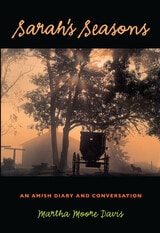
Sarah's Seasons
An Amish Diary and ConversationMartha Moore Davis
University of Iowa Press, 1997
Sarah's brief daily notations, recorded on a calendar throughout 1976 and 1977, reveal an ongoing account of her seasonal routine. In many ways the straightforward simplicity of her writing is a reflection of her life near rural Kalona, Iowa, a life filled with what Martha Davis calls look-easy tasks undertaken without the conveniences of electricity, phones, or automobiles. For Sarah, diaries are a record. “A diary can settle a question, a disagreement,” she tells Martha. “You look back and see what took place. That's history.”
Through their conversations, Martha soon discovered she had more in common with Sarah than diary writing. Though Davis lived in the mainstream culture, an “English” person as the Amish say, like Sarah she grew up on a farm in rural Iowa during the 1950s and 1960s. Like Martha, Sarah had spent several years as a teacher.
In Sarah's Seasons Martha Davis shares their common experiences and common interests—gardening, quilting, and cooking. Alongside Sarah's diary, Martha presents their shared recipes and conversations as well as reflections on her own more modern existence. Because of her friendship with Sarah, the author found a new sense of belonging to and purpose in the mainstream world. In the end, Sarah's diary becomes for Martha a meditation on time and community.

Sarajevo
A Bosnian KaleidoscopeFran Markowitz
University of Illinois Press, 2010
This fascinating urban anthropological analysis of Sarajevo and its cultural complexities examines contemporary issues of social divisiveness, pluralism, and intergroup dynamics in the context of national identity and state formation. Rather than seeing Bosnia-Herzegovina as a volatile postsocialist society, the book presents its capital city as a vibrant yet wounded center of multicultural diversity, where citizens live in mutual recognition of difference while asserting a lifestyle that transcends boundaries of ethnicity and religion. It further illuminates how Sarajevans negotiate group identity in the tumultuous context of history, authoritarian rule, and interactions with the built environment and one another.
As she navigates the city, Fran Markowitz shares narratives of local citizenry played out against the larger dramas of nation and state building. She shows how Sarajevans' national identities have been forged in the crucible of power, culture, language, and politics. Sarajevo: A Bosnian Kaleidoscope acknowledges this Central European city's dramatic survival from the ravages of civil war as it advances into the present-day global arena.

Sardinian Chronicles
Bernard Lortat-Jacob
University of Chicago Press, 1995
Through his sensitive portraits of music makers and their families, Lortat-Jacob overcomes some of the epistemological and methodological dilemmas facing his field today, while also giving the general reader a sense of the multiple and idiosyncratic ways that music is involved in everyday life. With a foreword by Michel Leiris and a compact disc containing samples of the music being discussed, this book constitutes a breakthrough in ethnomusicology that will also interest many in Mediterranean studies and European anthropology.

Satyr Square
A Year, a Life in RomeLeonard Barkan
Northwestern University Press, 2008
Part memoir, part literary criticism, part culinary and aesthetic travelogue, this loving reflection is a poignant, funny narrative about an American professor spending a year in Rome. A scarred veteran of academic culture wars retreating to a cradle of culture, Barkan is at first hungry, lonely, and uncertain of his intellectual mission. But soon he is appointed unofficial mascot of an eccentric community of gastronomes, becomes virtually bilingual, and falls in love. As the year progresses, he finds his voice as a writer, loses his lover, and definitively returns to America with heart, mind, and body. His memoir is the celebration of a life lived in the uncanny spaces where art and real people intersect.
Barkan’s reminiscence is not just about the Renaissance and ancient statuary, or Shakespeare and Mozart, Charles Bukowski and Paul de Man, eggplant antipasto and Brunello di Montalcino, foot fetishism and sulfur baths. At the heart of the narrative—beneath that beguiling surface of irony, humor, and misdirection—is a man of genuine ardor, struggling with what it means to be a homosexual and a Jew, trying to rediscover or reinvent his own intellectual passions. Hilarious, erudite, and lusciously rendered, Satyr Square gives us the whole of a life made up from fragments of Italy, art, food, and longing.
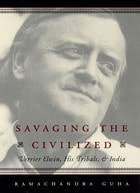
Savaging the Civilized
Verrier Elwin, His Tribals, and IndiaRamachandra Guha
University of Chicago Press, 1999
Described by his contemporaries as a cross between Albert Schweitzer and Paul Gauguin, Elwin was a man of contradictions, at times taking on the role of evangelist, social worker, political activist, poet, government worker, and more. He rubbed elbows with the elite of both Britain and India, yet found himself equally at home among the impoverished and destitute. Intensely political, the Oxford-trained scholar tirelessly defended the rights of the indigenous and, despite the deep religious influences of St. Francis and Mahatma Gandhi on his early career, staunchly opposed Hindu and Christian puritans in the debate over the future of India's tribals. Although he was ordained as an Anglican priest, Elwin was married twice to tribal women and enthusiastically (and publicly) extolled the tribals' practice of free sex. Later, as prime minister Nehru's friend and advisor in independent India, his compelling defense of tribal hedonism made him at once hugely influential, extremely controversial, and the polemical focal point of heated discussions on tribal policy and economic development.
Savaging the Civilized is both biography and history, an exploration through Elwin's life of some of the great debates of the twentieth century: the future of development, cultural assimilation versus cultural difference, the political practice of postcolonial as opposed to colonial governments, and the moral practice of writers and intellectuals.
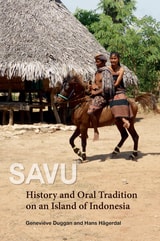
Savu
History and Oral Tradition on an Island of IndonesiaGeneviève Duggan and Hans Hägerdal
National University of Singapore Press, 2018

Saxony in German History
Culture, Society, and Politics, 1830-1933James Retallack, Editor
University of Michigan Press, 2000
Focusing on the east German state of Saxony, the contributors to this volume refuse easy resolution of that tension, seeking instead to illustrate how local, regional, and national cultures commingled, diverged, and influenced each other over time. By considering both the erosion and the persistence of traditional identities and regional boundaries, these essays help to restore an appreciation of regional "ways of seeing," suggesting they really did matter--in their own right, and for the nation as a whole.
Topics considered include the expansion of a German reading public, Jewish emancipation, the formation of socio-moral milieus, working-class leisure, the expansion of the public sphere, the rise of consumer co-operatives, gendered attempts to fashion the "new" liberal man, and degradation rituals in the 1920s. Presenting to English-reading audiences the fruits of cutting-edge research conducted in Saxon archives since 1989, the contributors offer innovative ways to reassess the larger sweep of German history.
This book serves as a how-to guide for the study of any region in history. Beyond its primary appeal to European historians, it will also speak to students and scholars in comparative politics and sociology.
James Retallack is Professor of History, University of Toronto.
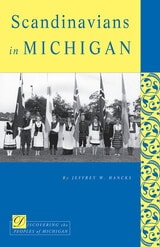
Scandinavians in Michigan
Jeffrey W. Hancks
Michigan State University Press, 2006
The Scandinavian countries, Denmark, Norway, and Sweden, are commonly grouped together by their close historic, linguistic, and cultural ties. Their age-old bonds continued to flourish both during and after the period of mass immigration to the United States in the nineteenth and early twentieth centuries. Scandinavians felt comfortable with each other, a feeling forged through centuries of familiarity, and they usually chose to live in close proximity in communities throughout the Upper Midwest of the United States.
Beginning in the middle of the nineteenth century and continuing until the 1920s, hundreds of thousands left Scandinavia to begin life in the United States and Canada. Sweden had the greatest number of its citizens leave for the United States, with more than one million migrating between 1820 and 1920. Per capita, Norway was the country most affected by the exodus; more than 850,000 Norwegians sailed to America between 1820 and 1920. In fact, Norway ranks second only to Ireland in the percentage of its population leaving for the New World during the great European migration. Denmark was affected at a much lower rate, but it too lost more than 300,000 of its population to the promise of America. Once gone, the move was usually permanent; few returned to live in Scandinavia. Michigan was never the most popular destination for Scandinavian immigrants. As immigrants began arriving in the North American interior, they settled in areas to the west of Michigan, particularly in Wisconsin, Minnesota, Illinois, Iowa, and North and South Dakota. Nevertheless, thousands pursued their American dream in the Great Lakes State. They settled in Detroit and played an important role in the city’s industrial boom and automotive industry. They settled in the Upper Peninsula and worked in the iron and copper mines. They settled in the northern Lower Peninsula and worked in the logging industry. Finally, they settled in the fertile areas of west Michigan and contributed to the state’s burgeoning agricultural sector. Today, a strong Scandinavian presence remains in town names like Amble, in Montcalm County, and Skandia, in Marquette County, and in local culinary delicacies like æbleskiver, in Greenville, and lutefisk, found in select grocery stores throughout the state at Christmastime.
Scenes from the High Desert
JULIAN STEWARD'S LIFE AND THEORYVirginia Kerns
University of Illinois Press, 2002

Schneider on Schneider
The Conversion of the Jews and Other Anthropological StoriesDavid M. Schneider, as told to Richard Handler
Duke University Press, 1995
In this work, based on conversations with Richard Handler, Schneider tells the story of his days devoted to anthropology—as a student of Clyde Kluckhohn and Talcott Parsons and as a writer and teacher whose work on kinship and culture theory revolutionized the discipline. With a master’s sense of the telling anecdote, he describes his education at Cornell, Yale, and Harvard, his fieldwork on the Micronesian island of Yap and among the Mescalero Apache, and his years teaching at the London School of Economics, Berkeley, and the University of Chicago. Musing on the current state and the future of anthropology, Schneider’s cast of characters reads like a who’s who of postwar social science. His reflections on anthropological field research and academic politics address some of the most pressing ethical and epistemological issues facing scholars today, while yielding tales of unexpected amusement.
With its humor and irony, its wealth of information and searching questions about the state of anthropology, Schneider on Schneider not only provides an important resource for the history of twentieth-century social science, but also brings to life the entertaining voice of an engaging storyteller.
Schoolcraft's Ojibwa Lodge Stories
Life on the Lake Superior FrontierPhilip P. Mason
Michigan State University Press, 1997

Scribbling Women
Short Stories by 19th-Century American WomenShowalter, Elaine
Rutgers University Press, 1997
Showalter, a highly regarded critic known for her provocative and strongly held opinions, has here established a compelling new Who's Who of women's thought. Certain to spark controversy, the omission of such feminist perennials as Gloria Steinem, Susan B. Anthony, Robin Morgan, Eleanor Roosevelt, and Virginia Woolf will surprise and shock the conventional wisdom.
Sculpting Quito
Religious Art across Domestic SpacesLeslie E. Todd
University of Texas Press, 2026
A study of domestic religious sculptures in Quito.
During the eighteenth century, the colonial capital of Quito established itself as a prolific producer of wooden polychrome sculpture. With large glass eyes, smooth shiny surfaces, and minute attention to detail, the sculptures possessed an artistic refinement that enchanted contemporaries. While these objects depicted Christian sacred personages, they were not always sequestered in churches and shrines. They filled domestic spaces, becoming signifiers not only of holiness but also of a distinctive Quitenian culture.
Devotional sculpture was, on its face, an aesthetic reifiction of the colonial project, commissioned by creole elites. However, drawing on published accounts and archival evidence, including wills and dowries, Leslie Todd shows that sculpture was diffused across society, contributing to a complex localized identity. As makers, viewers, and owners of sculpture, Quiteños of Indigenous and mixed heritage and varying socioeconomic backgrounds took active roles in creating the city’s visual culture. In doing so, Todd argues, they simultaneously underscored and challenged colonial class and power systems, investing a European form with styles that revealed and reinforced specifically Spanish American subjectivity.
Searching for Fannie Quigley
A Wilderness Life in the Shadow of Mount McKinleyJane G. Haigh
Ohio University Press, 2007
At the age of 27, Fannie Sedlacek left her Bohemian homestead in Nebraska to join the gold rush to the Klondike. From the Klondike to the Tanana, Fannie continued north, finally settling in Katishna near Mount McKinley. This woman, later known as Fannie Quigley, became a prospector who staked her own claims and a cook who ran a roadhouse. She hunted and trapped and thrived for nearly forty years in an environment that others found unbearable.
Her wilderness lifestyle inspired many of those who met her to record their impressions of this self-sufficient woman, who died in 1944. To many of the 700,000 annual visitors to Denali National Park she is a symbol of the enduring spirit of the original pioneers.
Searching for Fannie Quigley: A Wilderness Life in the Shadow of Mount McKinley goes beyond the mere biographical facts of this unique woman’s journey. It also tells historian Jane G. Haigh’s own story of tracking and tracing the many paths that Fannie Quigley’s intriguing life took. Uncovering remote clues, digging through archives, and listening to oral accounts from a wide array of sources, Haigh has fashioned this rich lode into a compelling narrative.
In Searching for Fannie Quigley, Haigh separates fact from fiction to reveal the true story of this highly mythologized pioneer woman.
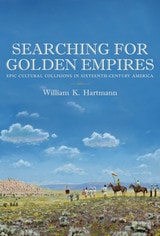
Searching for Golden Empires
Epic Cultural Collisions in Sixteenth-Century AmericaWilliam K. Hartmann
University of Arizona Press, 2014
Recounting eyewitness experiences that the Spaniards recorded in letters and memoirs, Hartmann describes ancient lifeways from Mexico to the western United States; Aztec accounts of the conquest; discussions between Aztec priests and Spanish priests about the nature of the universe; Cortés’s lifelong relationship with his famous Native mistress, Malinche (not to mention the mysterious fate of his wife); lost explorers who wandered from Florida to Arizona; and Marcos de Niza’s controversial reports of the “Seven Cities of Cíbola.”
Searching for Golden Empires describes how, even after the conquest of Mexico, Cortés remained a “wildcat” competitor with Coronado in a race to see who could find the “next golden empire,” believed to lie in the north. It is an exciting history of the shared story of the United States and Mexico, unveiling episodes both tragic and uplifting.
Seasons of Plenty
Amana Communal CookingEmilie Hoppe
University of Iowa Press, 2008
Seasons of Plenty provides colorful descriptions, folk stories, appealing photgraphs and illustrations, excerpts from journals and ledgers, recipes for good food like savory dumpling soup, mashed potatoes with browned bread crumbs, Sauerbraten, and feather light apple fritters.
Secrecy and Cultural Reality
Utopian Ideologies of the New Guinea Men's HouseGilbert Herdt
University of Michigan Press, 2003

Secrets and Rivals
Wartime Letters and the Parents I Never KnewR. Bruce Larson
University of Missouri Press, 2015
Reading through the letters, he is drawn into his parents’ courtship amid the hardships of separation and war. Beyond the tumultuous romance, Larson finds that he barely recognizes his father, whom he knew only as distant and impassive. He uncovers shocking truths about his mother, Ruth, whom family lore had pigeonholed as sweetly pious.
At the time of the letters, Bob is a young Coast Guard clerk fighting off depression with thoughts of his dream girl back home. Back in Minnesota, Ruth passes the days adrift in romantic fantasies and liaisons with local admirers. Bob’s suspicions about Ruth and his obsession with her from afar threaten the young man’s fragile hold on his sanity, but he will not give her up. Decades later, their son comes to feel a tenderness for both his parents and to understand how their losses, fears, and reluctance can transform and refashion family bonds.

Secrets, Sex, and Spectacle
The Rules of Scandal in Japan and the United StatesMark D. West
University of Chicago Press, 2006
A leader of a global superpower is betrayed by his mistress, who makes public the sordid details of their secret affair. His wife stands by as he denies the charges. Debates over definitions of moral leadership ensue. Sound familiar? If you guessed Clinton and Lewinsky, try again. This incident involved former Japanese prime minister Sosuke Uno and a geisha.
In Secrets, Sex, and Spectacle, Mark D. West organizes the seemingly random worlds of Japanese and American scandal—from corporate fraud to baseball cheaters, political corruption to celebrity sexcapades—to explore well-ingrained similarities and contrasts in law and society. In Japan and the United States, legal and organizational rules tell us what kind of behavior is considered scandalous. When Japanese and American scandal stories differ, those rules—rules that define what’s public and what’s private, rules that protect injuries to dignity and honor, and rules about sex, to name a few—often help explain the differences. In the cases of Clinton and Uno, the rules help explain why the media didn’t cover Uno’s affair, why Uno’s wife apologized on her husband’s behalf, and why Uno—and not Clinton—resigned.
Secrets, Sex, and Spectacle offers a novel approach to viewing the phenomenon of scandal—one that will be applauded by anyone who has obsessed over (or ridiculed) these public episodes.
Seductive Journey
American Tourists in France from Jefferson to the Jazz AgeHarvey Levenstein
University of Chicago Press, 2000
Levenstein begins in 1786, when Thomas Jefferson instructed young upper-class American men to travel overseas for self-improvement rather than debauchery. Inspired by these sentiments, many men crossed the Atlantic to develop "taste" and refinement. However, the introduction of the transatlantic steamship in the mid-nineteenth century opened France to people further down the class ladder. As the upper class distanced themselves from the lower-class travelers, tourism in search of culture gave way to the tourism of "conspicuous leisure," sex, and sensuality. Cultural tourism became identified with social-climbing upper-middle-class women. In the 1920s, prohibition in America and a new middle class intent on "having fun" helped make drunken sprees in Paris more enticing than trudging through the Louvre. Bitter outbursts of French anti-Americanism failed to jolt the American ideal of a sensual, happy-go-lucky France, full of joie de vivre. It remained Americans' favorite overseas destination.
From Fragonard to foie gras, the delicious details of this story of how American visitors to France responded to changing notions of leisure and blazed the trail for modern mass tourism makes for delightful, thought-provoking reading.
"...a thoroughly readable and highly likable book."—Deirdre Blair, New York Times Book Review
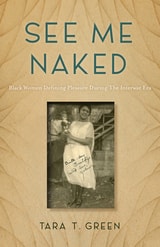
See Me Naked
Black Women Defining Pleasure in the Interwar EraTara T. Green
Rutgers University Press, 2022
Seedtime on the Cumberland
Harriette Simpson Arnow
Michigan State University Press, 2013
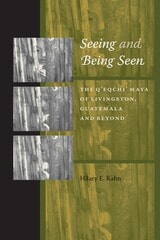
Seeing and Being Seen
The Q'eqchi' Maya of Livingston, Guatemala, and BeyondBy Hilary E. Kahn
University of Texas Press, 2006
The practice of morality and the formation of identity among an indigenous Latin American culture are framed in a pioneering ethnography of sight that attempts to reverse the trend of anthropological fieldwork and theory overshadowing one another.
In this vital and richly detailed work, methodology and theory are treated as complementary partners as the author explores the dynamic Mayan customs of the Q'eqchi' people living in the cultural crossroads of Livingston, Guatemala. Here, Q'eqchi', Ladino, and Garifuna (Caribbean-coast Afro-Indians) societies interact among themselves and with others ranging from government officials to capitalists to contemporary tourists.
The fieldwork explores the politics of sight and incorporates a video camera operated by multiple people—the author and the Q'eqchi' people themselves—to watch unobtrusively the traditions, rituals, and everyday actions that exemplify the long-standing moral concepts guiding the Q'eqchi' in their relationships and tribulations. Sharing the camera lens, as well as the lens of ethnographic authority, allows the author to slip into the world of the Q'eqchi' and capture their moral, social, political, economic, and spiritual constructs shaped by history, ancestry, external forces, and time itself.
A comprehensive history of the Q'eqchi' illustrates how these former plantation laborers migrated to lands far from their Mayan ancestral homes to co-exist as one of several competing cultures, and what impact this had on maintaining continuity in their identities, moral codes of conduct, and perception of the changing outside world.
With the innovative use of visual methods and theories, the author's reflexive, sensory-oriented ethnographic approach makes this a study that itself becomes a reflection of the complex set of social structures embodied in its subject.

Selling the Race
Culture, Community, and Black Chicago, 1940-1955Adam Green
University of Chicago Press, 2006
In Selling the Race, Adam Green tells the story of how black Chicagoans were at the center of a national movement in the 1940s and ’50s, a time when African Americans across the country first started to see themselves as part of a single culture. Along the way, he offers fascinating reinterpretations of such events as the 1940 American Negro Exposition, the rise of black music and the culture industry that emerged around it, the development of the Associated Negro Press and the founding of Johnson Publishing, and the outcry over the 1955 lynching of Emmett Till.
By presenting African Americans as agents, rather than casualties, of modernity, Green ultimately reenvisions urban existence in a way that will resonate with anyone interested in race, culture, or the life of cities.
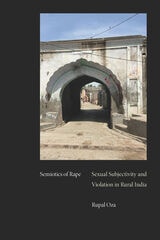
Semiotics of Rape
Sexual Subjectivity and Violation in Rural IndiaRupal Oza
Duke University Press, 2023

Sensual Relations
Engaging the Senses in Culture and Social TheoryDavid Howes
University of Michigan Press, 2003
David Howes is Professor of Anthropology, Concordia University, Montreal, Quebec.
Sentimental Materialism
Gender, Commodity Culture, and Nineteenth-Century American LiteratureLori Merish
Duke University Press, 2000
The phenomenon of female consumption was capitalism’s complement to male production: It created what Merish calls the “Other Protestant Ethic,”a feminine and sentimental counterpart to Max Weber’s ethic of hard work, economic rationality, and self-control. In addition, driven by the culture’s effort to civilize the “cannibalistic” practices of ethnic, class, and national otherness, appropriate female consumerism, marked by taste and refinement, identified certain women and their families as proper citizens of the United States. The public nature of consumption, however, had curiously conflicting effects: While the achievement of cultured material circumstances facilitated women’s civic agency, it also reinforced stereotypes of domestic womanhood.
Sentimental Materialism’s inquiry into middle-class consumption and accompanying ideals of womanhood will appeal to readers in a variety of disciplines, including American studies, cultural studies, feminist theory, and cultural history.
Serbians in Michigan
Paul Lubotina
Michigan State University Press, 2014
Settlement, Subsistence, and Change Among the Labrador Inuit
David Natcher
University of Manitoba Press, 2012

Seventeen Syllables and Other Stories
Yamamoto, Hisaye
Rutgers University Press, 2001
In addition to the contents of the original volume, this edition brings back into print the following works:
- Death Rides the Rails to Poston
- Eucalyptus
- A Fire in Fontana
- Florentine Gardens

Seventeen Syllables and Other Stories
Yamamoto, Hisaye
Rutgers University Press, 2001
Seventeen Years in Alaska
A Depiction of Life Among the Indians of YakutatAlbin Johnson
University of Alaska Press, 2014
Seventeen Years in Alaska is Johnson’s eyewitness account of this tumultuous time. It is a captivating narrative of an ancient people facing rapid change and of the missionaries working to stem a corrupting tide. His journals offer a candid look at the beliefs and lives of missionaries, and they ultimately reveal the profound effect that he and other missionaries had on the Tlingit. Tracing nearly two decades of spiritual hopes and earthbound failures, Johnson’s memoir is a fascinating portrait of a rapidly changing world in one of the most far-flung areas of the globe.

Sex and Drugs before Rock 'n' Roll
Youth Culture and Masculinity during Holland's Golden AgeBenjamin B. Roberts
Amsterdam University Press, 2012
Sex and the Gender Revolution, Volume 1
Heterosexuality and the Third Gender in Enlightenment LondonRandolph Trumbach
University of Chicago Press, 1998
In Sex and the Gender Revolution, Randolph Trumbach reconstructs the worlds of eighteenth-century prostitution, illegitimacy, sexual violence, and adultery. In those worlds the majority of men became heterosexuals by avoiding sodomy and sodomite behavior.
As men defined themselves more and more as heterosexuals, women generally experienced the new male heterosexuality as its victims. But women—as prostitutes, seduced servants, remarrying widows, and adulterous wives— also pursued passion. The seamy sexual underworld of extramarital behavior was central not only to the sexual lives of men and women, but to the very existence of marriage, the family, domesticity, and romantic love. London emerges as not only a geographical site but as an actor in its own right, mapping out domains where patriarchy, heterosexuality, domesticity, and female resistance take vivid form in our imaginations and senses.
As comprehensive and authoritative as it is eloquent and provocative, this book will become an indispensable study for social and cultural historians and delightful reading for anyone interested in taking a close look at sex and gender in eighteenth-century London.
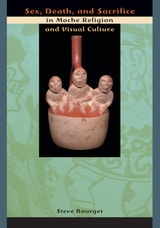
Sex, Death, and Sacrifice in Moche Religion and Visual Culture
By Steve Bourget
University of Texas Press, 2006
The Moche people who inhabited the north coast of Peru between approximately 100 and 800 AD were perhaps the first ancient Andean society to attain state-level social complexity. Although they had no written language, the Moche created the most elaborate system of iconographic representation of any ancient Peruvian culture. Amazingly realistic figures of humans, animals, and beings with supernatural attributes adorn Moche pottery, metal and wooden objects, textiles, and murals. These actors, which may have represented both living individuals and mythological beings, appear in scenes depicting ritual warfare, human sacrifice, the partaking of human blood, funerary rites, and explicit sexual activities.
In this pathfinding book, Steve Bourget raises the analysis of Moche iconography to a new level through an in-depth study of visual representations of rituals involving sex, death, and sacrifice. He begins by drawing connections between the scenes and individuals depicted on Moche pottery and other objects and the archaeological remains of human sacrifice and burial rituals. He then builds a convincing case for Moche iconography recording both actual ritual activities and Moche religious beliefs regarding the worlds of the living, the dead, and the afterlife. Offering a pioneering interpretation of the Moche worldview, Bourget argues that the use of symbolic dualities linking life and death, humans and beings with supernatural attributes, and fertility and social reproduction allowed the Moche to create a complex system of reciprocity between the world of the living and the afterworld. He concludes with an innovative model of how Moche cosmological beliefs played out in the realms of rulership and political authority.
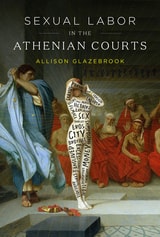
Sexual Labor in the Athenian Courts
Allison Glazebrook
University of Texas Press, 2021
Oratory is a valuable source for reconstructing the practices, legalities, and attitudes surrounding sexual labor in classical Athens. It provides evidence of male and female sex laborers, sex slaves, brothels, sex traffickers, the cost of sex, contracts for sexual labor, and manumission practices for sex slaves. Yet the witty, wealthy, and independent hetaira, well-known from other genres, does not feature. Its detailed narratives and character portrayals provide a unique discourse on sexual labor and reveal the complex relationship between such labor and Athenian society.
Through a holistic examination of five key speeches, Sexual Labor in the Athenian Courts considers how portrayals of sex laborers intersected with gender, the body, sexuality, the family, urban spaces, and the polis in the context of the Athenian courts. Drawing on gender theory and exploring questions of space, place, and mobility, Allison Glazebrook shows how sex laborers represented a diverse set of anxieties concerning social legitimacy and how the public discourse about them is in fact a discourse on Athenian society, values, and institutions.
Shadow of the Hunter
Richard K. Nelson
University of Chicago Press, 1983

Shake Terribly the Earth
Stories from an Appalachian FamilySarah Beth Childers
Ohio University Press, 2013
In a thoughtful, humorous voice born of Appalachian storytelling, Childers brings to life in these essays events that affected the entire region: large families that squeezed into tiny apartments during the Great Depression, a girl who stepped into a rowboat from a second-story window during Huntington’s 1937 flood, brothers who were whisked away to World War II and Vietnam, and a young man who returned home from the South Pacific and worked his life away as a railroad engineer.
Childers uses these family tales to make sense of her personal journey and find the joy and clarity that often emerge after the earth shakes terribly beneath us.
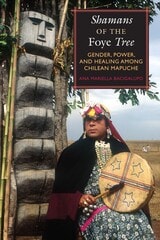
Shamans of the Foye Tree
Gender, Power, and Healing among Chilean MapucheBy Ana Mariella Bacigalupo
University of Texas Press, 2007
Drawing on anthropologist Ana Mariella Bacigalupo's fifteen years of field research, Shamans of the Foye Tree: Gender, Power, and Healing among Chilean Mapuche is the first study to follow shamans' gender identities and performance in a variety of ritual, social, sexual, and political contexts.
To Mapuche shamans, or machi, the foye tree is of special importance, not only for its medicinal qualities but also because of its hermaphroditic flowers, which reflect the gender-shifting components of machi healing practices. Framed by the cultural constructions of gender and identity, Bacigalupo's fascinating findings span the ways in which the Chilean state stigmatizes the machi as witches and sexual deviants; how shamans use paradoxical discourses about gender to legitimatize themselves as healers and, at the same time, as modern men and women; the tree's political use as a symbol of resistance to national ideologies; and other components of these rich traditions.
The first comprehensive study on Mapuche shamans' gendered practices, Shamans of the Foye Tree offers new perspectives on this crucial intersection of spiritual, social, and political power.