Results by title
8113 books match the query 'Literary Criticism' and 542 start with s

Stick Houses
StoriesMatthew L.M. Fletcher
Michigan State University Press, 2025
These stories explore themes of home and belonging, and how Native people are not just one thing; they are both Native and non-Native blood. Some are deeply connected to their Anishinaabe heritage, while others have suffered a complete loss of their culture. Many Native people are conflicted about their background and suffer intergenerational trauma. These stories originate in dynamic environments and situations such as airports, college, Indian lawyering, and high school baseball games.
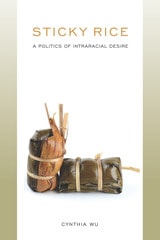
Sticky Rice
A Politics of Intraracial DesireCynthia Wu
Temple University Press, 2018
Cynthia Wu’s provocative Sticky Rice examines representations of same-sex desires and intraracial intimacies in some of the most widely read pieces of Asian American literature. Analyzing canonical works such as John Okada’s No-No Boy, Monique Truong’s The Book of Salt, H. T. Tsiang’s And China Has Hands, and Lois-Ann Yamanaka’s Blu’s Hanging, as well as Philip Kan Gotanda’s play, Yankee Dawg You Die, Wu considers how male relationships in these texts blur the boundaries among the homosocial, the homoerotic, and the homosexual in ways that lie beyond our concepts of modern gay identity.
The “sticky rice” of Wu’s title is a term used in gay Asian American culture to describe Asian American men who desire other Asian American men. The bonds between men addressed in Sticky Rice show how the thoughts and actions founded by real-life intraracially desiring Asian-raced men can inform how we read the refusal of multiple normativities in Asian Americanist discourse. Wu lays bare the trope of male same-sex desires that grapple with how Asian America’s internal divides can be resolved in order to resist assimilation.
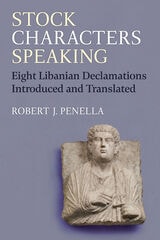
Stock Characters Speaking
Eight Libanian Declamations Introduced and TranslatedRobert J. Penella
University of Michigan Press, 2023
Declamations were composed and orally delivered in the Roman Empire by sophists, or teachers of rhetoric, of whom the Greek-speaking Libanius was one of the most distinguished. Stock Characters Speaking may be thought of as emerging from three developments of recent decades: an explosive interest in late antiquity, a newly sympathetic interest in rhetoric (including ancient declamation), and a desire to bring Libanius’s massive corpus into English and other modern languages.
In this book, author Robert J. Penella translates eight of Libanius’s declamations: 29, 30, 34, 35, 37, 45, 46, 47, and, in an appendix, the thirteenth-century Gregory of Cyprus’s response to Declamation 34. Each translation is accompanied by an introduction, in which Penella examines the themes, structure, and the stasis, or key issue, of the declamations. Figures who appear in the translated declamations include a parasite who has lost his patron, a man envious of his rich neighbor, a miser’s son, a poor man willing to die for his city, a rich war-hero accused of aiming at tyranny, and a convict asking for exile. Three of these declamations have appeared in German; otherwise, these translations are the first into a modern language.
Stolen Life
Fred Moten
Duke University Press, 2018
In Stolen Life—the second volume in his landmark trilogy consent not to be a single being—Fred Moten undertakes an expansive exploration of blackness as it relates to black life and the collective refusal of social death. The essays resist categorization, moving from Moten's opening meditation on Kant, Olaudah Equiano, and the conditions of black thought through discussions of academic freedom, writing and pedagogy, non-neurotypicality, and uncritical notions of freedom. Moten also models black study as a form of social life through an engagement with Fanon, Hartman, and Spillers and plumbs the distinction between blackness and black people in readings of Du Bois and Nahum Chandler. The force and creativity of Moten's criticism resonate throughout, reminding us not only of his importance as a thinker, but of the continued necessity of interrogating blackness as a form of sociality.

Stone
An Ecology of the InhumanJeffrey Jerome Cohen
University of Minnesota Press, 2015
Stone maps the force, vivacity, and stories within our most mundane matter, stone. For too long stone has served as an unexamined metaphor for the “really real”: blunt factuality, nature’s curt rebuke. Yet, medieval writers knew that stones drop with fire from the sky, emerge through the subterranean lovemaking of the elements, tumble along riverbeds from Eden, partner with the masons who build worlds with them. Such motion suggests an ecological enmeshment and an almost creaturely mineral life.
Although geological time can leave us reeling, Jeffrey Jerome Cohen argues that stone’s endurance is also an invitation to apprehend the world in other than human terms. Never truly inert, stone poses a profound challenge to modernity’s disenchantments. Its agency undermines the human desire to be separate from the environment, a bifurcation that renders nature “out there,” a mere resource for recreation, consumption, and exploitation.
Written with great verve and elegance, this pioneering work is notable not only for interweaving the medieval and the modern but also as a major contribution to ecotheory. Comprising chapters organized by concept —“Geophilia,” “Time,” “Force,” and “Soul”—Cohen seamlessly brings together a wide range of topics including stone’s potential to transport humans into nonanthropocentric scales of place and time, the “petrification” of certain cultures, the messages fossils bear, the architecture of Bordeaux and Montparnasse, Yucca Mountain and nuclear waste disposal, the ability of stone to communicate across millennia in structures like Stonehenge, and debates over whether stones reproduce and have souls.
Showing that what is often assumed to be the most lifeless of substances is, in its own time, restless and forever in motion, Stone fittingly concludes by taking us to Iceland⎯a land that, writes the author, “reminds us that stone like water is alive, that stone like water is transient.”

Stoppard's Theatre
Finding Order amid ChaosBy John Fleming
University of Texas Press, 2001
With a thirty-year run of award-winning, critically acclaimed, and commercially successful plays, from Rosencrantz and Guildenstern Are Dead (1967) to The Invention of Love (1997), Tom Stoppard is arguably the preeminent playwright in Britain today. His popularity also extends to the United States, where his plays have won three Tony awards and his screenplay for Shakespeare in Love won the 1998 Academy Award for Best Original Screenplay.
John Fleming offers the first book-length assessment of Stoppard's work in nearly a decade. He takes an in-depth look at the three newest plays (Arcadia,Indian Ink, and The Invention of Love) and the recently revised versions of Travesties and Hapgood, as well as at four other major plays (Rosencrantz,Jumpers,Night and Day, and The Real Thing). Drawing on Stoppard's personal papers at the University of Texas Harry Ransom Humanities Research Center (HRHRC), Fleming also examines Stoppard's previously unknown play Galileo, as well as numerous unpublished scripts and variant texts of his published plays.
Fleming also mines Stoppard's papers for a fuller, more detailed overview of the evolution of his plays. By considering Stoppard's personal views (from both his correspondence and interviews) and by examining his career from his earliest scripts and productions through his most recent, this book provides all that is essential for understanding and appreciating one of the most complex and distinctive playwrights of our time.

Stories Of Raymond Carver
A Critical StudyKirk Nesset
Ohio University Press, 1994
In this comprehensive study of Carver, Nesset discusses the relationship of minimalism and postmodern trends and the rise of new realism. By locating Carver in the gallery of American letters, Nesset shows him to be at once more simple and more complex than we might have believed, skillfully laying the groundwork for Carver studies to come.
Stories Through Theories/ Theories Through Stories
North American Indian Writing, Storytelling, and CritiqueGordon D. Henry Jr.
Michigan State University Press, 2009
Stories Through Theories/Theories Through Stories explores the uneasy relations—often contentious, sometimes complicit—between American Indian Literature and literary theory. Some of the essays in this book open American Indian narratives to theoretical critique based on "western depth models." Others work from a very different direction, finding critique in storytelling and processes of narrative production, thereby exposing dimensions of literary theory that grow from the indigenous ground of Native stories themselves.
This collection of essays—sometimes playfully but always insistently—changes our readings of Native works and challenges our roles as intellectual guides until we step deeper into the ambiguous territories where writer, listener, reader, and critic intersect.
Taken together, these essays provide compelling evidence for looking at primary Native cultures, authors, and histories as enrichments of Native literature.

Storm Warnings
Science Fiction Confronts the FutureGeorge E Slusser
Southern Illinois University Press, 1987
These 17 original essays, written for the sixth Eaton Conference on Fantasy and Science Fiction, explore the uses, origins, and forms of future fiction. The contributors are George E. Slusser, Paul Alkon, Marie-Hélène Huet, Howard V. Hendrix, Bradford Lyau, Gregory Benford, José Manuel Mota, Frederik Pohl, George Hay, Colin Greenland, John Huntington, Elizabeth Maslen, W. M. S. and Claire Russell, T. A. Shippey, Kenneth V. Bailey, Gary Kern, and Frank McConnell.
The essays address the question “Do we call up images of future societies in order to prepare for them, or to forestall their ever coming into existence?”
Storming the Reality Studio
A Casebook of Cyberpunk & Postmodern Science FictionLarry McCaffery, ed.
Duke University Press, 1992
By bringing together original fiction by well-known contemporary writers (William Burroughs, Thomas Pynchon, Don DeLillo, Kathy Acker, J. G. Ballard, Samuel R. Delany), critical commentary by some of the major theorists of postmodern art and culture (Jacques Derrida, Fredric Jameson, Timothy Leary, Jean-François Lyotard), and work by major practitioners of cyberpunk (William Gibson, Rudy Rucker, John Shirley, Pat Cadigan, Bruce Sterling), Storming the Reality Studio reveals a fascinating ongoing dialog in contemporary culture.
What emerges most strikingly from the colloquy is a shared preoccupation with the force of technology in shaping modern life. It is precisely this concern, according to McCaffery, that has put science fiction, typically the province of technological art, at the forefront of creative explorations of our unique age.
A rich opporunity for reading across genres, this anthology offers a new perspective on the evolution of postmodern culture and ultimately shows how deeply technological developments have influenced our vision and our art.
Selected Fiction contributors: Kathy Acker, J. G. Ballard, William S. Burroughs, Pat Cadigan, Samuel R. Delany, Don DeLillo, William Gibson, Harold Jaffe, Richard Kadrey, Marc Laidlaw, Mark Leyner, Joseph McElroy, Misha, Ted Mooney, Thomas Pynchon, Rudy Rucker, Lucius Shepard, Lewis Shiner, John Shirley, Bruce Sterling, William Vollman
Selected Non-Fiction contributors: Jean Baudrillard, Jacques Derrida, Joan Gordon, Veronica Hollinger, Fredric Jameson, Arthur Kroker and David Cook, Timothy Leary, Jean-François Lyotard, Larry McCaffery, Brian McHale, Dave Porush, Bruce Sterling, Darko Suvin, Takayuki Tatsumi
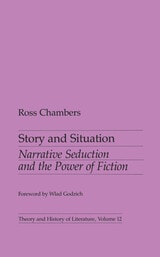
Story and Situation
Narrative Seduction and the Power of FictionRoss Chambers
University of Minnesota Press, 1984
Ross Chambers shifs the emphasis to precisely the play of authority and mastery by focusing on the narrative situation or the “point” of telling a story in given context. He studies the relation between teller and listener in a set of French, English, and American short stories from the nineteenth and early twentieth centuries and detects in that relationship the key to the power of fiction. In each of these stories, the author identifies the narrative situation by recourse to the metaphor of seduction, a phenomenon Chambers finds characteristic of literary production in the modern period.
“Story and Situation is a powerful work of criticism, the best work in short narrative I know, and will redirect critics’ attention to a form which has always engaged readers but has recently been neglected by literary theorists. . . . It is clear, assured, and intelligently paced.”-Jonathan Culler, Cornell University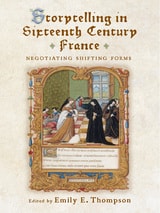
Storytelling in Sixteenth-Century France
Negotiating Shifting FormsEmily E. Thompson
University of Delaware Press, 2022
Published by the University of Delaware Press. Distributed worldwide by Rutgers University Press.
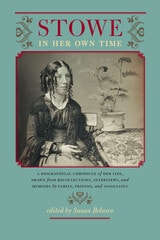
Stowe in Her Own Time
A Biographical Chronicle of Her Life, Drawn from Recollections, Interviews, and Memoirs by Family, FSusan Belasco
University of Iowa Press, 2009
One of the first celebrity authors, Harriet Beecher Stowe (1811–1896) became famous almost overnight when Uncle Tom’s Cabin—which sold more than 300,000 copies in its first year of publication—appeared in 1852. Known by virtually all famous writers in the United States and many in England and regarded by many women writers as a role model because of her influence in the literary marketplace, Stowe herself was the subject of many books, articles, essays, and poems during her lifetime.
This volume brings together for the first time a range of primary materials about Stowe’s private and public life written by family members, friends, and fellow writers who knew or were influenced by her before and after Uncle Tom’s Cabin catapulted her to fame. Included are periodical articles by Fanny Fern and Charles Dudley Warner; biographical essays by Sarah Josepha Hale and Rose Terry Cooke; letters by Oliver Wendell Holmes, Elizabeth Barrett Browning, and Harriet Jacobs; recollections by Frederick Douglass, Annie Adams Fields, Isabella Beecher Hooker, and Charles Beecher; and poems by Paul Laurence Dunbar and John Greenleaf Whittier. An introduction at the beginning of each essay connects it to its historical and cultural context, explanatory notes provide information about people and places, and the book includes a detailed introduction and a chronology of Stowe’s life.
The thirty-eight recollections gathered in Stowe in Her Own Time form a biographical narrative designed to provide several perspectives on the famous author, sometimes in conflict and sometimes in agreement but always perceptive. The figure who emerges from this insightful, analytical collection is far more complex than the image she helped construct in her lifetime.
Strained Sisterhood
Gender and Class in the Boston Female Anti-Slavery SocietyDebra Gold Hansen
University of Massachusetts Press, 1993
Debra Gold Hansen explores the origins of the equality-versus-difference debate by examining the Boston Female Anti-Slavery Society, which disbanded in 1840 over this very issue. After establishing a historical framework for women's lives in early nineteenth-century Boston, Hansen analyzes the membership of the Society along the lines of race, religion, and socioeconomic status. Through her findings, she concludes that many of the issues that estranged female abolitionists in antebellum Boston continue to divide women today, testifying not to the strength of the bonds between women but to the fragility of those ties.
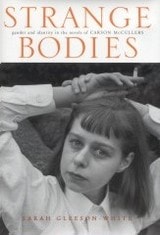
Strange Bodies
Gender and Identity in the Novels of Carson McCullersSarah Gleeson-White
University of Alabama Press, 2003
Adapts Mikhail Bakhtin's theory of the grotesque, as well as the latest in gender and psychoanalytic theory, to the major works of acclaimed southern writer Carson McCullers.
This innovative reconsideration of the themes of Carson McCullers's fiction argues that her work has heretofore suffered under the pall of narrow gothic interpretations, obscuring a more subversive agenda. By examining McCullers’s major novels—The Heart is a Lonely Hunter, Reflections in a Golden Eye, The Member of the Wedding, and The Ballad of the Sad Café—Gleeson-White locates a radical and specific form of the grotesque in the author's fiction: the liberating and redemptive possibilities of errant gender roles and shifting sexuality. She does this by employing Bakhtin's theory of the grotesque, which is both affirming and revolutionary, and thereby moves McCullers's texts beyond the 'gloom and doom' with which they have been charged for over fifty years.
The first chapter explores female adolescence by focusing on McCullers's tomboys in the context of oppressive southern womanhood. The second chapter analyzes McCullers's fascinating struggle to depict homosexual desire outside of traditional stereotypes. Gleeson-White then examines McCullers's portrayals of feminine and masculine gender through the tropes of cross-dressing, transvestism, and masquerade. The final chapter takes issue with earlier readings of androgyny in the texts to suggest a more useful concept McCullers herself called "the hybrid." Underpinning the whole study is the idea of a provocative, dynamic form of the grotesque that challenges traditional categories of normal and abnormal.
Because the characters and themes of McCullers's fiction were created in the 1940s and 1950s, a time of tension between the changing status of women and the southern ideal of womanhood, they are particularly fertile ground for a modern reexamination of this nature. Gleeson-White's study will be valued by scholars of American literature and gender and queer studies, by students of psychology, by academic libraries, and by readers of Carson McCullers. Strange Bodies is a thoughtful, highly credible analysis that adds dimension to the study of southern literature.
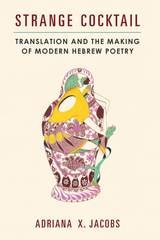
Strange Cocktail
Translation and the Making of Modern Hebrew PoetryAdriana X. Jacobs
University of Michigan Press, 2018
For centuries, poets have turned to translation for creative inspiration. Through and in translation, poets have introduced new poetic styles, languages, and forms into their own writing, sometimes changing the course of literary history in the process. Strange Cocktail is the first comprehensive study of this phenomenon in modern Hebrew literature of the late nineteenth century to the present day. Its chapters on Esther Raab, Leah Goldberg, Avot Yeshurun, and Harold Schimmel offer close readings that examine the distinct poetics of translation that emerge from reciprocal practices of writing and translating. Working in a minor literary vernacular, the translation strategies that these poets employed allowed them to create and participate in transnational and multilingual poetic networks. Strange Cocktail thereby advances a comparative and multilingual reframing of modern Hebrew literature that considers how canons change and are undone when translation occupies a central position—how lines of influence and affiliation are redrawn and literary historiographies are revised when the work of translation occupies the same status as an original text, when translating and writing go hand in hand.
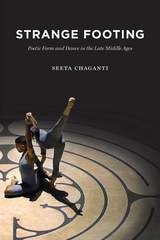
Strange Footing
Poetic Form and Dance in the Late Middle AgesSeeta Chaganti
University of Chicago Press, 2018
Exploring the complex relationship between medieval dance and medieval poetry, Strange Footing argues that the intersection of texts and dance produced an experience of poetic form based in disorientation, asymmetry, and even misstep. Medieval dance guided audiences to approach poetry not in terms of the body’s regular marking of time and space, but rather in the irregular and surprising forces of virtual motion around, ahead of, and behind the dancing body. Reading medieval poems through artworks, paintings, and sculptures depicting dance, Seeta Chaganti illuminates texts that have long eluded our full understanding, inviting us to inhabit their strange footings askew of conventional space and time.
Strange Footing deploys the motion of dance to change how we read medieval poetry, generating a new theory of poetic form for medieval studies and beyond.
Strange Gourmets
Sophistication, Theory, and the NovelJoseph Litvak
Duke University Press, 1997
Though commonly thought of as a kind of worldliness at its best and an elitist snobbery at its worst, sophistication, Litvak reminds us, remains tied to its earlier, if forgotten, meaning of "perversion"—a perversion whose avatars are the homosexual and the intellectual. Proceeding with his investigations from a specifically gay academic perspective, Litvak presents thoroughly inventive readings of novels by Austen, Thackeray, and Proust, and of theoretical works by Adorno and Barthes, each text epitomizing sophistication in one of its more familiar modes. Among the issues he explores are the ways in which these texts teach sophistication, the embarrassment that sophistication causes the sophisticated, and how the class politics of sophistication are inseparable from its sexual politics. Helping gay, queer, feminist, and other provocative critics to make the most of their bad publicity, Litvak mindfully celebrates sophistication’s economy of taste and pleasure.
Strange Likeness
Description and the Modernist NovelDora Zhang
University of Chicago Press, 2020
Description is the novelistic technique charged with establishing a common world, but in the early twentieth century, there was little agreement about how a common world could be known and represented. Zhang argues that the protagonists in her study responded by shifting description away from visualizing objects to revealing relations—social, formal, and experiential—between disparate phenomena. In addition to shedding new light on some of the best-known works of modernism, Zhang opens up new ways of thinking about description more broadly. She moves us beyond the classic binary of narrate-or-describe and reinvigorates our thinking about the novel. Strange Likeness will enliven conversations around narrative theory, affect theory, philosophy and literature, and reading practices in the academy.
Strange Meetings
Anglo-German Literary Encounters from 1910 to 1960Peter Edgerly Firchow
Catholic University of America Press, 2008
Strange Natures
Futurity, Empathy, and the Queer Ecological ImaginationNicole Seymour
University of Illinois Press, 2013
Strange Science
Investigating the Limits of Knowledge in the Victorian AgeEdited by Lara Karpenko and Shalyn Claggett
University of Michigan Press, 2017
Strangers in Berlin
Modern Jewish Literature between East and West, 1919–1933Rachel Seelig
University of Michigan Press, 2016
Author Rachel Seelig portrays Berlin during the Weimar Republic as a “threshold” between exile and homeland in which national and artistic commitments were reexamined, reclaimed, and rebuilt. In the pulsating yet precarious capital of Germany’s first fledgling democracy, the collision of East and West engendered a broad spectrum of poetic styles and Jewish national identities.
Strategic Occidentalism
On Mexican Fiction, the Neoliberal Book Market, and the Question of World LiteratureIgnacio M. Sánchez Prado
Northwestern University Press, 2018
In the course of this analysis, Ignacio M. Sánchez Prado engages with theories of world literature, proposing that “world literature” is a construction produced at various levels, including the national, that must be studied from its material conditions of production in specific sites. In particular, he argues that Mexican writers have engaged in a “strategic Occidentalism” in which their idiosyncratic connections with world literature have responded to dynamics different from those identified by world-systems or diffusionist theorists.
Strategic Occidentalism identifies three scenes in which a cosmopolitan aesthetics in Mexican world literature has been produced: Sergio Pitol’s translation of Eastern European and marginal British modernist literature; the emergence of the Crack group as a polemic against the legacies of magical realism; and the challenges of writers like Carmen Boullosa, Cristina Rivera Garza, and Ana García Bergua to the roles traditionally assigned to Latin American writers in world literature.
Stray Truths
Selected Poems of Euphrase KezilahabiAnnmarie Drury
Michigan State University Press, 2015
Street Fight
The Politics of Mobility in San FranciscoJason Henderson
University of Massachusetts Press, 2013
Faced with intolerable congestion and noxious pollution, cities around the world are rethinking their reliance on automobiles. In the United States a loosely organized livability movement seeks to reduce car use by reconfiguring urban space into denser, transit-oriented, walkable forms, a development pattern also associated with smart growth and new urbanism. Through a detailed case study of San Francisco, Jason Henderson examines how this is not just a struggle over what type of transportation is best for the city, but a series of ideologically charged political fights over issues of street space, public policy, and social justice.
Historically San Francisco has hosted many activist demonstrations over its streets, from the freeway revolts of the 1960s to the first Critical Mass bicycle rides decades later. Today the city's planning and advocacy establishment is changing zoning laws to limit the number of parking spaces, encouraging new car-free housing near transit stations, and applying “transit first” policies, such as restricted bus lanes. Yet Henderson warns that the city's accomplishments should not be romanticized. Despite significant gains by livability advocates, automobiles continue to dominate the streets, and the city's financially strained bus system is slow and often unreliable.
Both optimistic and cautionary, Henderson argues that ideology must be understood as part of the struggle for sustainable cities and that three competing points of view—progressive, neoliberal, and conservative—have come to dominate the contemporary discourse about urban mobility. Consistent with its iconic role as an incubator of environmental, labor, civil rights, and peace movements, San Francisco offers a compelling example of how the debate over sustainable urban transportation may unfold both in the United States and globally.
Street Players
Black Pulp Fiction and the Making of a Literary UndergroundKinohi Nishikawa
University of Chicago Press, 2018
Kinohi Nishikawa contends that black pulp fiction was built on white readers’ fears of the feminization of society—and the appeal of black masculinity as a way to counter it. In essence, it was the original form of blaxploitation: a strategy of mass-marketing race to suit the reactionary fantasies of a white audience. But while chauvinism and misogyny remained troubling yet constitutive aspects of this literature, from 1973 onward, Holloway House moved away from publishing sleaze for a white audience to publishing solely for black readers. The standard account of this literary phenomenon is based almost entirely on where this literature ended up: in the hands of black, male, working-class readers. When it closed, Holloway House was synonymous with genre fiction written by black authors for black readers—a field of cultural production that Nishikawa terms the black literary underground. But as Street Players demonstrates, this cultural authenticity had to be created, promoted, and in some cases made up, and there is a story of exploitation at the heart of black pulp fiction’s origins that cannot be ignored.
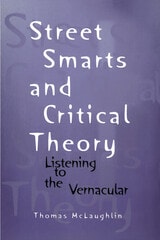
Street Smarts and Critical Theory
Listening to the VernacularThomas McLaughlin
University of Wisconsin Press, 1996
Everybody’s got a theory . . . or do they?
Thomas McLaughlin argues that critical theory—raising serious, sustained questions about cultural practice and ideology—is practiced not only by an academic elite but also by savvy viewers of sitcoms and TV news, by Elvis fans and Trekkies, by labor organizers and school teachers, by the average person in the street.
Like academic theorists, who are trained in a tradition of philosophical and political skepticism that challenges all orthodoxies, the vernacular theorists McLaughlin identifies display a lively and healthy alertness to contradiction and propaganda. They are not passive victims of ideology but active questioners of the belief systems that have power over their lives. Their theoretical work arises from the circumstances they confront on the job, in the family, in popular culture. And their questioning of established institutions, McLaughlin contends, is essential and healthy, for it energizes other theorists who clarify the purpose and strategies of institutions and justify the existence of cultural practices.
Street Smarts and Critical Theory leads us through eye-opening explorations of social activism in the Southern Christian anti-pornography movement, fan critiques in the ‘zine scene, New Age narratives of healing and transformation, the methodical manipulations of the advertising profession, and vernacular theory in the whole-language movement. Emphasizing that theory is itself a pervasive cultural practice, McLaughlin calls on academic institutions to recognize and develop the theoretical strategies that students bring into the classroom.
“This book demystifies the idea of theory, taking it out of the hands of a priestly caste and showing it as the democratic endowment of the people.”—Daniel T. O’Hara, Temple University, author of Radical Parody: American Culture and Critical Agency after Foucault and Lionel Trilling: The Work of Liberation.
“McLaughlin takes seriously the critical and theoretical activity of everyday people and does so in a way that will empower these very populations to take seriously their own activities as theorists. . . . A manifesto that is sure to be heard by the younger generation of thinkers in American cultural studies.”—Henry Jenkins, MIT, author of Textual Poachers: Television Fans and Participatory Culture
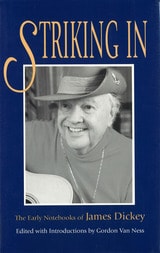
Striking In
The Early Notebooks of James DickeyEdited & Intro by Gordon Van Ness
University of Missouri Press, 1996
Striking In provides the first detailed look at the artistic beginnings of one of America's most accomplished writers. Chronicling James Dickey's close scrutiny of a wide variety of literary, philosophical, and anthropological works, his extensive experimentation with the possibilities of language, and his projected outlines for poems, stories, and novels, the notebooks serve as a critical tool in understanding Dickey's literary apprenticeship during the fifties.
Although the notebooks identify the influence of writers such as George Barker, Hart Crane, and Dylan Thomas, they primarily present a man endeavoring to chart his own artistic course or destination. The entries depict the process by which Dickey developed the ideas and images that characterize what he himself has labeled his "early motion," revealing the origin of Into the Stone, Drowning with Others, and Helmets, his first three published books of poetry, and suggesting the material and techniques of later volumes.
The introductions by Gordon Van Ness place each notebook in a biographical context and assess its individual significance, and an appendix lists all of Dickey's poems published in the fifties. Extensive footnotes provide further information on many of the specific references within Dickey's entries. Of special importance is the inclusion of ten never-before-published poems as well as fourteen others never collected in Dickey's books.
These notebooks show a young man obsessively committed to improving his creative and critical practice. By providing a direct glimpse into Dickey's mind before he achieved notoriety, Striking In sheds important new light on Dickey's struggle to discover a style and subject matter uniquely his own and will be essential reading for anyone interested in the complexities of Dickey's literary career.

Strindberg's Letters
August Strindberg
University of Chicago Press, 1992
Strindberg's plays, novels, and short stories, which influenced film and theatre artists from Artaud and the German Expressionists to Ingmar Bergman and Woody Allen, chart an artistic evolution from Naturalism to the revolt against realism that issued in Expressionist drama. These letters help to explain Strindberg's seminal force and testify to the broad range of his interests, energies, and imaginative instincts. An essential part of their author's oeuvre, the letters provide invaluable insight into Strindberg the artist, the political thinker, and the person, and were regarded by Strindberg himself as an integral component of his autobiographical project.
The letters, some of them published here for the first time, have been meticulously edited and are supported by an extensive introduction and notes.
Strindberg's Letters, Volume 1
1862-1892August Strindberg
University of Chicago Press, 1992
Strindberg's Letters, Volume 2
1892-1912August Strindberg
University of Chicago Press, 1992
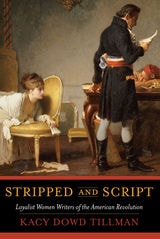
Stripped and Script
Loyalist Women Writers of the American RevolutionKacy Dowd Tillman
University of Massachusetts Press, 2019
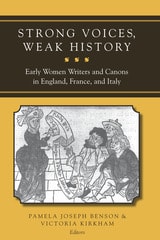
Strong Voices, Weak History
Early Women Writers and Canons in England, France, and ItalyPamela J Benson and Victoria Kirkham, Editors
University of Michigan Press, 2005

Structure of the Brothers Karamazov
Robert Belknap
Northwestern University Press, 1989

Structuring the Void
The Struggle for Subject in Contemporary American FictionJerome Klinkowitz
Duke University Press, 1992
Among the writers Klinkowitz discusses are Richard Brautigan, Kurt Vonnegut, Max Apple, Saul Bellow, Erica Jong, Susan Quist, Gerald Rosen, Rob Swigart, and Grace Paley. He shows how, in the absence of subject matter, these writers persist in the act of structuring—by organizing autobiography as a narrative device, ritualizing national history and popular culture, or formalizing a comic response to a new imaginative state, the state of California. Klinkowitz also considers subjects such as gender and war, which, though they cannot be represented, nevertheless exercise contraints on a writer’s intention to structure.
What emerges from Klinkowitz’s analysis is a clear sense of what today’s fiction—and fiction writing—is about. As such, Structuring the Void will prove invaluable to anyone with an interest in contemporary literature.
Strung Together
The Cultural Currency of String Theory as a Scientific ImaginarySean Miller
University of Michigan Press, 2013
In Strung Together: The Cultural Currency of String Theory as a Scientific Imaginary, Sean Miller examines the cultural currency of string theory, both as part of scientific discourse and beyond it. He demonstrates that the imaginative component of string theory is both integral and indispensable to it as a scientific discourse. While mathematical arguments provide precise prompts for physical intervention in the world, the imaginary that supplements mathematical argument within string theory technical discourse allows theorists to imagine themselves interacting with the cosmos as an abstract space in such a way that strings and branes as phenomena become substantiated and legitimized. And it is precisely this sort of imaginary—which Miller calls a scientific imaginary—duly substantiated and acculturated, that survives the move from string theory technical discourse to popularizations and ultimately to popular and literary discourses. In effect, a string theory imaginary legitimizes the science itself and helps to facilitate a virtual domestication of a cosmos that was heretofore remote, alien, and incomprehensible.
Stubborn Poetries
Poetic Facticity and the Avant-GardePeter Quartermain
University of Alabama Press, 2013
Studies in French-Classical Tragedy
Lacy Lockert
Vanderbilt University Press, 0
Numerous, often lengthy, quoted passages (with an English verse translation accompanying the French in every case) exemplify the achievement and exhibit the qualities of the dramas and dramatists discussed.
That portion of the author’s critical work in this field which has already appeared, as introductions in his volumes of translated plays, has been much appreciated, as witness the following brief excerpts from reviews of those books:
“The plays…are discussed with insight and enthusiasm.”—(London) Notes and Queries.
“Refreshingly original and yet free from specious pleading or naïve enthusiasm.”—Chattanooga Times.
“Thoughtful, discerning appraisals.”—Seventeenth Century News.
“An excellent critical introduction.”—The Library Journal.
“A judicious introduction.”—Arthur Knodel in The Personalist.
“The very best interpretative treatment of Corneille that has appeared.”—C. Maxwell Lancaster.
Study Without Ends
Aesthetic Education in Neoliberal Latin AmericaD. Bret Leraul
Northwestern University Press, 2026
Calls for aesthetic education to unite cultural practices of radical imagination with everyday practices of care
While Latin America was neoliberalism’s laboratory, Argentina and Chile have been crucibles for its cultural logics. In this book, D. Bret Leraul examines the rise of neoliberal culture in the Southern Cone through the educational infrastructures that disseminate and reproduce it. Leraul draws on literature and criticism, the history of higher education, and examples of recent social movements to propose a theory of cultural production for social transformation.
Study Without Ends charts the cultural consequences of introducing a neoliberal rationality into the region’s higher education landscape. The university’s increasing centrality within the literary institution and the rise of theoretical prose fiction suggest that poetics today is less about crafting literary works than instructing readers. At the same time, despite efforts to reduce education to human capital investment, it remains a process of personal and social transformation, as recent activism by Chilean students and Argentinean unemployed workers shows. In response to the compounding crises of social reproduction represented by the informal work and precarious livelihoods of people rendered surplus populations, and inspired by the decommodified labor of students, artists, women, and the unemployed, Leraul calls for a materialist aesthetic education that unites artistic culture’s practices of radical imagination and everyday culture’s practices of care.
Style and Time
Essays on the Politics of AppearanceAndrew Benjamin
Northwestern University Press, 2006
Nothing less than a rethinking of the conditions of Western art as it relates to politics, architecture, and time, this study of Walter Benjamin's modernity in temporal and spatial terms is a provocative and original work of philosophy in its own right—a work that suggests that the time has come to revise existing paradigms.
Style and the Single Girl
How Modern Women Re-Dressed the Novel, 1922–1977Hope Howell Hodgkins
The Ohio State University Press, 2016
Hodgkins delineates how in the 1920s and 1930s, popular novels by Dorothy Sayers and high-art fiction by Jean Rhys used dress to comment wittily and bitterly on gender relations. During World War II, changes in British Vogue and compromises made by the literary journal Horizon signaled the death of modernist styles, as Elizabeth Bowen’s gender-bent wartime stories show. Then demure and reserved postwar styles—Dior’s curvy New Look, the Movement’s understated literary irony—were intertwined in the fictions of Barbara Pym and Muriel Spark, who re-dressed the novel with a vengeance. Whether fashioning detective fiction, literary impressionism, or postwar comedy, these novelists used style in every sense to redefine that famous question, “What do women want?”
Style as Argument
Contemporary American NonfictionChirs Anderson
Southern Illinois University Press, 1987
Taking the position that style has a value in its own right, that language forms a major component of the story a nonfiction writer has to tell, Anderson analyzes the work of America’s foremost practitioners of New Journalism—Tom Wolfe, Truman Capote, Norman Mailer, and Joan Didion.
Anderson does for nonfiction what insightful critics have long been doing for fiction and poetry. His approach is rhetorical, and his message is that the rhetoric of Wolfe, Capote, Mailer, and Didion is a direct response to the problem of trying to convey to a general audience the sublime, inexplicable, or private and intuitive experiences that conventional rhetoric cannot evoke.
The emphasis in this book is on style, not genre, and the analysis characterizes the distinctive styles of four American writers, showing how the richness and complexity of their prose discloses an important argument about the value of language itself. Their prose is complex, nuanced, layered, affecting, always aware of itself as style. This self-consciousness, Anderson contends, prepares the reader to regard style as argument, a “tacit but powerful statement about the value of form as form, style as style.”
Stylistic and Narrative Structures in the Middle English Romances
By Susan Wittig
University of Texas Press, 1978
This volume provides a generic description, based on a formal analysis of narrative structures, of the Middle English noncyclic verse romances. As a group, these poems have long resisted generic definition and are traditionally considered to be a conglomerate of unrelated tales held together in a historical matrix of similar themes and characters. As single narratives, they are thought of as random collections of events loosely structured in chronological succession. Susan Wittig, however, offers evidence that the romances are carefully ordered (although not always consciously so) according to a series of formulaic patterns and that their structures serve as vehicles for certain essential cultural patterns and are important to the preservation of some community-held beliefs.
The analysis begins on a stylistic level, and the same theoretical principles applied to the linguistic formulas of the poems also serve as a model for the study of narrative structures. The author finds that there are laws that govern the creation, selection, and arrangement of narrative materials in the romance genre and that act to restrict innovation and control the narrative form.
The reasons for this strict control are to be found in the functional relationship of the genre to the culture that produced it. The deep structure of the romance is viewed as a problem-solving pattern that enables the community to mediate important contradictions within its social, economic, and mythic structures. Wittig speculates that these contradictions may lie in the social structures of kinship and marriage and that they have been restructured in the narratives in a “practical” myth: the concept of power gained through the marriage alliance, and the reconciliation of the contradictory notions of marriage for power’s sake and marriage for love’s sake.
This advanced, thorough, and completely original study will be valuable to medieval specialists, classicists, linguists, folklorists, and Biblical scholars working in oral-formulaic narrative structure.
Subject Without Nation
Robert Musil and the History of Modern IdentityStefan Jonsson
Duke University Press, 2001
It was to this society that Musil responded in his great work The Man Without Qualities. Exploring the nooks and crannies of this modernist classic, Jonsson shows that Musil’s narrative evolves along two axes that must be considered in tandem: Whereas the central plot portrays a Viennese elite that in 1913 attempts to restore social cohesion by gathering popular support for the cultural essence of the empire, the protagonist discovers that he lacks essence altogether and finds himself attracted by monsters, criminals, and revolutionary figures that reject the social order. In this way, Musil’s novel traces the disappearance of what Jonsson calls the expressivist paradigm—the conviction that identities such as gender, nationality, class, and social character are expressions of permanent intrinsic dispositions. This, Jonsson argues, is Musil’s great legacy. For not only did the Austrian author seek to liquidate prevailing conceptions of personal and cultural identity; he also projected “a new human being,” one who would resist assimilation into imperialist, nationalist, or fascist communities.
Subject Without Nation presents a new interpretation of Viennese modernity and uncovers the historical foundations of poststructural and postcolonial reconceptualizations of human subjectivity. Illuminating links between Musil’s oeuvre as a whole and post-war developments in critical thought, this book locates an important crossroads between literary criticism, intellectual history, and cultural theory.
Subject to Delusions
Narcissism, Modernism, GenderCaroline Rupprecht
Northwestern University Press, 2006
Because "the other," or the object, is constructed, Rupprecht finds in narcissism the possibility of rewriting notions of identity. She then pursues this possibility through modern literary texts in which narcissism acts as a structuring principle—works by the expressionist poet Henriette Hardenberg, the American avant-garde novelist Djuna Barnes, and the surrealist writer Unica Zürn—reading each within the critical framework of the evolution of the idea of narcissism in psychoanalytic theory. All written by women, these works also raise questions of gender and sexuality. Moreover, because each of these authors belonged to or was influenced by a particular literary movement, Rupprecht's analysis advances our understanding of the poetics of these movements and of the movement of modernism itself. Underlying all is a deep engagement with psychoanalytic theory. Drawing on Freud, his contemporaries and rivals, Jacques Lacan, Melanie Klein, and many other theorists, Rupprecht interrogates preconceived notions of identity and subjectivity through her readings of the "transgressive potential" of narcissism as it is enacted in the texts under study. Bringing the works of literary modernism and psychoanalysis together in an innovative and provocative way, her book succeeds in enhancing our sense of both, and in clarifying the complex role of narcissism in our cultural narrative.
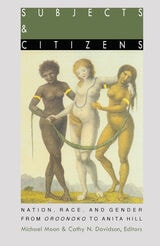
Subjects and Citizens
Nation, Race, and Gender from Oroonoko to Anita HillMichael Moon and Cathy N. Davidson, eds.
Duke University Press, 1995
Defining the landscape of the New American literary history, these essays are united by three interrelated concerns: ideas of origin (where does "American literature" begin?), ideas of nation (what does "American literature" mean?), and ideas of race and gender (what does "American literature" include and exclude and how?). Work by writers as diverse as Aphra Behn, James Fenimore Cooper, Edgar Allan Poe, Frances Harper, Harriet Beecher Stowe, Herman Melville, William Faulkner, Harriet Jacobs, Frederick Douglass, Abraham Lincoln, Bharati Mukherjee, Booker T. Washington, Mark Twain, Kate Chopin, Américo Paredes, and Toni Morrison are discussed from several theoretical perspectives, using a variety of methodologies. Issues of the "frontier" and the "border" as well as those of coloniality and postcoloniality are explored. In each case, these essays emphasize the ideological nature of national identity and, more specifically, the centrality of race and gender to our concept of nationhood.
Collected from recent issues of American Literature, with three new essays added, Subjects and Citizens charts the new directions being taken in American literary studies.
Contributors. Daniel Cooper Alarcón, Lori Askeland, Stephanie Athey, Nancy Bentley, Lauren Berlant, Michele A. Birnbaum, Kristin Carter-Sanborn, Russ Castronovo, Joan Dayan, Julie Ellison, Sander L. Gilman, Karla F. C. Holloway, Annette Kolodny, Barbara Ladd, Lora Romero, Ramón Saldívar, Maggie Sale, Siobhan Senier, Timothy Sweet, Maurice Wallace, Elizabeth Young
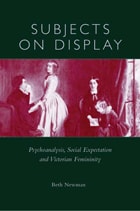
Subjects on Display
Psychoanalysis, Social Expectation, and Victorian FemininityBeth Newman
Ohio University Press, 2004
Subjects on Display explores a recurrent figure at the heart of many nineteenth-century English novels: the retiring, self-effacing woman who is conspicuous for her inconspicuousness. Beth Newman draws upon both psychoanalytic theory and recent work in social history as she argues that this paradoxical figure, who often triumphs over more dazzling, eye-catching rivals, is a response to the forces that made personal display a vexed issue for Victorian women. Chief among these is the changing socioeconomic landscape that made the ideal of the modest woman outlive its usefulness as a class signifier even as it continued to exert moral authority.
This problem cannot be grasped in its full complexity, Newman shows, without considering how the unstable social meanings of display interacted with psychical forces-specifically, the desire to be seen by others that is central to both masculine and feminine subjectivity. This desire raises an issue that feminist theorists have been reluctant to address: the importance of pleasure in being the object of the look. Their reluctance is characteristic of cultural theory, which has tended to equate subjectivity with the position of the observer rather than the observed.
Through a consideration of fiction by Charlotte Brontë, Charles Dickens, George Eliot, and Henry James, Newman shifts the inquiry toward the observed in the experience of being seen. In the process she reopens the question of the gaze and its relation to subjectivity.
Subjects on Display will appeal to scholars and students in several disciplines as it returns psychoanalysis to a central position within literary and cultural studies.
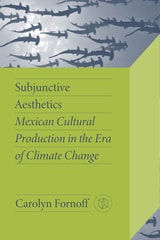
Subjunctive Aesthetics
Mexican Cultural Production in the Era of Climate ChangeCarolyn Fornoff
Vanderbilt University Press, 2024
Honorable Mention, LASA Environment Best Book Prize, Latin American Studies Association–Environment Section, 2025
During the twenty-first century, Mexico has escalated extractive concessions at the same time that it has positioned itself as an international leader in the fight against climate change. Cultural production emergent from this contradiction frames this impasse as a crisis of imagination. Subjunctive Aesthetics studies how contemporary writers, filmmakers, and visual artists grapple with the threat that climate change and extractivist policies pose to Mexico's present and future. It explores how artists rise to the challenge of envisioning alternative forms of territoriality (ways of being in relation to the environment) through strategies ranging from rewriting to counterfactual speculation.
Whereas ecocritical studies have often focused on art's evidentiary role—its ability to visualize and prove the urgency of environmental damage—author Carolyn Fornoff argues that what unites the artists under consideration is their use of more hypothetical, uncertain representational modes, or "subjunctive aesthetics." In English, the subjunctive is a grammatical mode that articulates the imagined, desired, and possible. In the Spanish language, it is even more widely used to express doubts, denials, value judgments, and emotions. Each chapter of Subjunctive Aesthetics takes up one of these modalities to examine how Mexican artists, writers, and filmmakers activate approaches to the planet not just as it is, but as it could be or should be.

Sublimity and Skepticism in Montaigne and Milton
David L. Sedley
University of Michigan Press, 2005
Sedley uses the juxtaposition of Montaigne and Milton to argue that two seminal early modern phenomena, the rise of the sublime as an aesthetic category and the emergence of skepticism as a philosophical problem, are interrelated. The comparison of these two Renaissance writers highlights the traditions that have canonized them and also complicates the canonical views: Sedley's perspective reveals how Montaigne cultivated his famous skepticism in order to produce sublimity, while Milton forged his renowned sublimity through his encounter with skepticism. Sedley's first argument is that sublimity motivated skepticism: the sense that a force existed outside the aesthetic categories conventional in the Renaissance drove authors into a skeptical frame of mind. His second argument is that skepticism created sublimity: the skeptical mind-set offered alternative resources of aesthetic power and enabled authors to fashion a sublime style. These claims revise standard views of skepticism and sublimity, suggesting a mandate for an enriched aesthetics behind late-Renaissance loss of belief and exposing the Renaissance impulse behind modern notions of sublimity.
"Sedley's work takes seriously our ongoing engagement with doubt. It is a brisk and brilliant guide to the disparate pathways through which early modern skepticism made its way to the sublime."
-Eileen Reeves, Associate Professor of Comparative Literature, Princeton University
"Sublimity and Skepticism in Montaigne and Milton is a powerful piece of revisionist intellectual history. By demonstrating the close links between the rise of skepticism and the power of the sublime, Sedley offers a welcome antidote to the heavily ideological tenor of much recent cultural studies. With clarity and elegance Sedley shows that two of the greatest writers of the late Renaissance, Montaigne and Milton, are haunted by a crisis of authority, which is accompanied by the irruption of the sublime, by an inchoate sense of being overwhelmed by the phenomenal world. Through deft and intelligent readings Sedley shows how key moments in the works of these two great authors are structured by the intersection of the sublime and the skeptical. This book should be of great interest to literary scholars, aestheticians, and intellectual historians working in several languages. It is a very fine piece of work."
-Tim Hampton, Professor of French, UC Berkeley
"A refreshingly modern and elegant understanding of Montaigne and Milton as inaugurating the sublime possibilities of the fragmentary and incomprehensible. Sedley reinserts these writers into a history of the transformation of admiration into awe, and makes us revisit the beginnings and the justifications of our own esthetics of the sublime."
-Ullrich Langer, Professor of French and Italian, University of Wisconsin