Results by title
1882 books match the query 'Criticism and interpretation' and 147 start with s
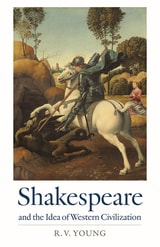
Shakespeare and the Idea of Western Civilization
R.V. Young
Catholic University of America Press, 2022
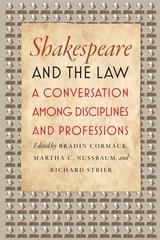
Shakespeare and the Law
A Conversation among Disciplines and ProfessionsEdited by Bradin Cormack, Martha C. Nussbaum, and Richard Strier
University of Chicago Press, 2013
The book’s opening essays offer perspectives on law and literature that emphasize both the continuities and contrasts between the two fields. The second section considers Shakespeare’s awareness of common law thinking and common law practice, while the third inquires into Shakespeare’s general attitudes toward legal systems. The fourth part of the book looks at how law enters into conversation with issues of politics and community, whether in the plays, in Shakespeare’s world, or in our own world. Finally, a colloquy among Supreme Court Justice Stephen Breyer, Judge Richard Posner, Martha C. Nussbaum, and Richard Strier covers everything from the ghost in Hamlet to the nature of judicial discretion.
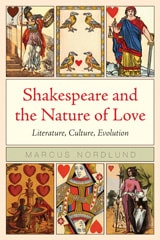
Shakespeare and the Nature of Love
Literature, Culture, EvolutionMarcus Nordlund
Northwestern University Press, 2007
After addressing critical issues about love, biology, and culture raised by his method, Nordlund considers four specific forms of love in seven of Shakespeare’s plays. Examining the vicissitudes of parental love in Titus Andronicus and Coriolanus, he argues that Shakespeare makes a sustained inquiry into the impact of culture and society upon the natural human affections. King Lear offers insight into the conflicted relationship between love and duty. In two problem plays about romantic love, Troilus and Cressida and All’s Well that Ends Well, the tension between individual idiosyncrasies and social consensus becomes especially salient. And finally, in Othello and The Winter’s Tale, Nordlund asks what Shakespeare can tell us about the dark avatar of jealousy.
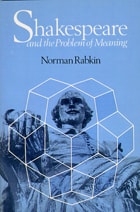
Shakespeare and the Problem of Meaning
Norman Rabkin
University of Chicago Press, 1981
"Norman Rabkin's new book is a very different kind of good book. Elegantly spare, sharp, undogmatic. . . . The relationship between the perception of unity and the perception of artistic achievement is a basic conundrum, and it is one that Mr. Rabkin has courageously placed at the center of his discussion." –G. K. Hunter, Sewanee Review
"Rabkin's book is brilliant, taut, concise, beautifully argued, and sensitively responsive to the individuality of particular Shakespeare plays." –Anne Barton, New York Review of Books
Shakespeare and the Senses
Holly E. Dugan
Arizona Center for Medieval and Renaissance Studies, 2024
Could something as seemingly natural as a smell, taste, sight, or sound be socially constructed and change over time? Shakespeare and the Senses argues that understanding the original conditions in which Shakespeare’s plays were performed allows us to explore the senses as both visceral, bodily experiences and constructed, social phenomena. As Ben Jonson famously wrote in the First Folio of 1623, Shakespeare can seem to be “not of an age, but for all time.” While this is clever marketing, Shakespeare did write his plays in a particular time and place far removed from our own. Many of his most powerful metaphors rely on sensory details—Aaron’s black hue; Cleopatra’s strange, invisible perfumes; Fluellen’s Welsh accent; Lady Macbeth’s overly scrubbed hands; Malvolio’s yellow stockings—which Elizabethan-era audiences may have understood very differently from us.
Shakespeare and the Senses draws on interdisciplinary research methods in the new field of sensory studies to expand our understanding of what Shakespeare meant to his first audiences.
Shakespeare in Theory
The Postmodern Academy and the Early Modern TheaterStephen Bretzius
University of Michigan Press, 1997
Shakespeare's Dead
Stages of Death in Shakespeare's PlayworldsSimon Palfrey and Emma Smith
Bodleian Library Publishing, 2016
Published to accompany a major exhibition at the Bodleian Library, University of Oxford, Shakespeare’s Dead documents the many ways Shakespeare’s characters meet their demise, from suicide to murder, from death by workaday dagger to the more creative method of being baked and fed to one’s family in a meat pie. Through these examples, Simon Palfrey and Emma Smith show Shakespeare’s mastery at choreographing death as a means of rediscovery. Some characters refuse to go quietly, dying in stages, as in Nick Bottom’s performance as Pyramus killing himself with much flourish in A Midsummer Night’s Dream. Others are remembered in elegies, and still others are resurrected or reappear as ghosts. Shakespeare’s death scenes also often speak to the boundaries between theater and everyday life, with funerals and scenes of mourning that are undercut by their staged inauthenticity.
Extensively illustrated with contemporary drawings and images from stage history, Shakespeare’s Dead takes readers through the playwright’s great death scenes and tragic figures, exploring in them the theme of life in death and delineating the cultural, religious, and social contexts.
Shakespeare's Freedom
Stephen Greenblatt
University of Chicago Press, 2010
Shakespeare lived in a world of absolutes—of claims for the absolute authority of scripture, monarch, and God, and the authority of fathers over wives and children, the old over the young, and the gentle over the baseborn. With the elegance and verve for which he is well known, Stephen Greenblatt, author of the best-selling Will in the World, shows that Shakespeare was strikingly averse to such absolutes and constantly probed the possibility of freedom from them. Again and again, Shakespeare confounds the designs and pretensions of kings, generals, and churchmen. His aversion to absolutes even leads him to probe the exalted and seemingly limitless passions of his lovers.
Greenblatt explores this rich theme by addressing four of Shakespeare’s preoccupations across all the genres in which he worked. He first considers the idea of beauty in Shakespeare’s works, specifically his challenge to the cult of featureless perfection and his interest in distinguishing marks. He then turns to Shakespeare’s interest in murderous hatred, most famously embodied in Shylock but seen also in the character Bernardine in Measure for Measure. Next Greenblatt considers the idea of Shakespearean authority—that is, Shakespeare’s deep sense of the ethical ambiguity of power, including his own. Ultimately, Greenblatt takes up Shakespearean autonomy, in particular the freedom of artists, guided by distinctive forms of perception, to live by their own laws and to claim that their creations are singularly unconstrained.
A book that could only have been written by Stephen Greenblatt, Shakespeare’s Freedom is a wholly original and eloquent meditation by the most acclaimed and influential Shakespearean of our time.
Shakespeare's Lyric Stage
Myth, Music, and Poetry in the Last PlaysSeth Lerer
University of Chicago Press, 2018
As Seth Lerer shows in this pioneering book, Shakespeare’s late plays invite us to contemplate that very question, offering up lyric as a displaced and sometimes desperate antidote to situations of duress or powerlessness. Lerer argues that the theme of lyric misalignment running throughout The Tempest, The Winter’s Tale, Henry VIII, and Cymbeline serves a political purpose, a last-ditch effort at transformation for characters and audiences who had lived through witch-hunting, plague, regime change, political conspiracies, and public executions.
A deep dive into the relationship between aesthetics and politics, this book also explores what Shakespearean lyric is able to recuperate for these “victims of history” by virtue of its disjointed utterances. To this end, Lerer establishes the concept of mythic lyricism: an estranging use of songs and poetry that functions to recreate the past as present, to empower the mythic dead, and to restore a bit of magic to the commonplaces and commodities of Jacobean England. Reading against the devotion to form and prosody common in Shakespeare scholarship, Lerer’s account of lyric utterance’s vexed role in his late works offers new ways to understand generational distance and cultural change throughout the playwright’s oeuvre.
Shakespeare's Once and Future Child
Speculations on SovereigntyJoseph Campana
University of Chicago Press, 2024
Politicians are fond of saying that “children are the future.” How did the child become a figure for our political hopes? Joseph Campana’s book locates the source of this idea in transformations of childhood and political sovereignty during the age of Shakespeare, changes spectacularly dramatized by the playwright himself. Shakespeare’s works feature far more child figures—and more politically entangled children—than other literary or theatrical works of the era. Campana delves into this rich corpus to show how children and childhood expose assumptions about the shape of an ideal polity, the nature of citizenship, the growing importance of population and demographics, and the question of what is or is not human. As our ability to imagine viable futures on our planet feels ever more limited, and as children take up legal proceedings to sue on behalf of the future, it behooves us to understand the way past child figures haunt our conversations about intergenerational justice. Shakespeare offers critical precedents for questions we still struggle to answer.
Shakespeare's Reformation
Christian Humanism and the Death of GodNalin Ranasinghe
St. Augustine's Press, 2022
"I will try to claim that Shakespeare offers an esoteric vindication of the human soul itself, not merely poetry, against the looming backdrop of the Counter-Reformation in Europe and the Puritan perversion of English Anglicanism. Neither the Scholasticism of the former nor the fundamentalism of the latter had any sympathy for the claims of men like Bottom or the Bastard to see beyond the confines of scripture and sacred social structures. While poetry could indulge in metaphysical fantasy, it could not take on the status quo without the assistance of more learned allies; this Shakespeare seems to do by his re-telling of Classical and English history. As disingenuous as Bottom (or Erasmus) in this artful use of ignorance and folly to conceal his serious goals, Shakespeare is thus tying poetry to history and giving us an alternate, if playful, account of Western Civilization."
Shakespeare's Rome
Republic and EmpirePaul A. Cantor
University of Chicago Press, 2017
In Shakespeare’s Rome, Cantor examines the political settings of Shakespeare’s Roman plays, Coriolanus and Antony and Cleopatra, with references as well to Julius Caesar. Cantor shows that Shakespeare presents a convincing portrait of Rome in different eras of its history, contrasting the austere republic of Coriolanus, with its narrow horizons and martial virtues, and the cosmopolitan empire of Antony and Cleopatra, with its “immortal longings” and sophistication bordering on decadence.
Shakespearean Cultures
Latin America and the Challenges of Mimesis in Non-Hegemonic CircumstancesJoão Cezar de Castro Rocha
Michigan State University Press, 2019
Shakespearean Territories
Stuart Elden
University of Chicago Press, 2018
Shakespeare’s Hand
Jonathan Goldberg
University of Minnesota Press, 2002
A provocative exploration of the relationship between gender, history, and Shakespeare’s plays.
Over the past fifteen years, Jonathan Goldberg’s wide-ranging essays have been among the most sophisticated, influential, and controversial writing about Shakespeare. He challenges the critical orthodoxy, provoking scholars to reassess both their own assumptions and those underpinning the field of Shakespeare studies. Collected in one volume for the first time, these essays offer a sustained, energetic, and rigorous examination of issues of gender and sexuality that pervade Shakespeare’s plays, as well as a road map of the shifts during the past two decades in our understanding of English literature’s most canonical figure.
Central to these essays are concerns about textuality as considered from a number of vantage points, including deconstructionist, psychoanalytic, and historicist. Goldberg studies most of Shakespeare’s plays, giving particular emphasis to Henry IV, Parts 1 and 2, and to Romeo and Juliet; he focuses throughout on the relationship between the text as material object and the reality created or reflected by that text. Among the issues he considers are the textual instability of Shakespeare’s plays and the historical instabilities of gender and sexuality depicted in those plays, the construction of gender and the dehumanization implicit in treating characters as a textual production, the function of letters and other documents within the Shakespearean texts, and the correlation of sexual politics and textual desire. Tracing a path from characters in the scriptive sense to their embodiment in characters marked by gender and sexuality, Shakespeare's Hand provides a brilliant set of inquiries into the production, critical reception, and conditions of Shakespearean texts.
Shakespeare’s Legal Ecologies
Law and Distributed SelfhoodKevin Curran
Northwestern University Press, 2017
At the center of the book is Shakespeare’s fascination with questions that are fundamental to both law and philosophy: What are the sources of agency? What counts as a person? For whom am I responsible, and how far does that responsibility extend? What is truly mine? Curran guides readers through Shakespeare’s responses to these questions, paying careful attention to both historical and intellectual contexts.
The result is a book that advances a new theory of Shakespeare’s imaginative relationship to law and an original account of law’s role in the ethical work of his plays and sonnets. Readers interested in Shakespeare, theater and philosophy, law, and the history of ideas will find Shakespeare’s Legal Ecologies to be an essential resource.
Shakespeare’s Politic Comedy
Will Morrisey
St. Augustine's Press, 2022
INTRODUCTORY NOTE: The Politic Character of Shakespeare’s Comedy
PART ONE: THREE REGIMES: OLIGARCHY, ARISTOCRACY, MONARCHY
Chapter One: Shakespearean Comedy: Two Points on the Compass
Chapter Two: Gentlemen and Gentlemanliness
Chapter Three: Royal Dreaming
PART TWO: THE RULE OF LAW
Chapter Four: Comic Errors, Legal Slapstick
Chapter Five: What Will You?
PART THREE: THE COMEDY OF MORALS
Chapter Six: Taming Our Shrewishness
Chapter Seven: What Does Shakespeare Mean When He Says, “As You Like It”?
PART FOUR: THE COMEDY OF POLITICS
Chapter Eight: Is All Well That Ends Well?
Chapter Nine: The Geopolitics of Love
Chapter Ten: The Wisest Beholder
SHAKESPEARE’S POLITIC MERRIMENT
Shakesqueer
A Queer Companion to the Complete Works of ShakespeareMadhavi Menon, ed.
Duke University Press, 2011
Contributors. Matt Bell, Amanda Berry, Daniel Boyarin, Judith Brown, Steven Bruhm, Peter Coviello, Julie Crawford, Drew Daniel, Mario DiGangi, Lee Edelman, Jason Edwards, Aranye Fradenburg, Carla Freccero, Daniel Juan Gil, Jonathan Goldberg, Jody Greene, Stephen Guy-Bray, Ellis Hanson, Sharon Holland, Cary Howie, Lynne Huffer, Barbara Johnson, Hector Kollias, James Kuzner , Arthur L. Little Jr., Philip Lorenz, Heather Love, Jeffrey Masten, Robert McRuer , Madhavi Menon, Michael Moon, Paul Morrison, Andrew Nicholls, Kevin Ohi, Patrick R. O’Malley, Ann Pellegrini, Richard Rambuss, Valerie Rohy, Bethany Schneider, Kathryn Schwarz, Laurie Shannon, Ashley T. Shelden, Alan Sinfield, Bruce Smith, Karl Steel, Kathryn Bond Stockton, Amy Villarejo, Julian Yates
Shapeshifting Subjects
Gloria Anzaldua's Naguala and Border ArteKelli D. Zaytoun
University of Illinois Press, 2022
An original and moving analysis, Shapeshifting Subjects draws on unpublished archival material to apply Anzaldúa's ideas to new areas of thought and action.
Shaping Words to Fit the Soul
The Southern Ritual Grounds of Afro-ModernismJürgen E. Grandt
The Ohio State University Press, 2009
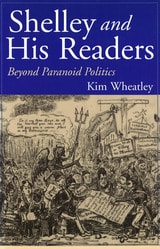
Shelley and His Readers
Beyond Paranoid PoliticsKim Wheatley
University of Missouri Press, 1999
In Shelley and His Readers, the first full-length critical analysis of the dialogue between Shelley's poetry and its contemporary reviewers, Kim Wheatley argues that Shelley's idealism can be recovered through the study of his poetry's reception. Incorporating extensive research in major early-nineteenth-century British periodicals, Wheatley integrates a reception-based methodology with careful textual analysis to demonstrate that the early reception of Shelley's work registers the immediate impact of the poet's increasingly idealistic passion for reforming the world.
Wheatley examines Shelley's poetry within the context of Romantic-era "paranoid politics," a simultaneously empowering and disabling dynamic in which the reviewers employ a heightened language of defensiveness and persecution that paints their adversaries as Satanic rebels against orthodoxy. This "paranoid style" displays a preoccupation with the efficacy of the printed word and singles out radical writers such as Shelley as sources of social contamination.
Using Shelley's Queen Mab to illustrate his early radicalism, Wheatley demonstrates that the poet, like his contemporary reviewers, is caught up in paranoid rhetoric. Failing to challenge the assumptions underlying the paranoid style-conspiracy and contagion-in this poem Shelley takes merely a defiant, oppositional stance. However, Shelley's later poems, exemplified by Prometheus Unbound and Adonais, circumvent the reviewers' rhetoric through their boldly experimental language, a process registered by the reviewers' own responses. These less explicitly political poems transcend the dynamics of cultural paranoia by shifting to an apolitical conception of the aesthetic. In collaboration with its early readers, Shelley's poetry thus moves momentarily beyond paranoid politics.
The final chapter of this study argues that the posthumous reception of Adonais uniquely replicates the elegiac moves and complex idealism of the poem, concluding with a discussion of how the Shelley circle aestheticized the poet after his death.
Shelley and His Readers offers a new approach to the question of how to recuperate Romantic idealism in the face of challenges from both deconstructive and historicist criticism. Its innovative use of reception-based analysis will make this book invaluable not only to specialists of the Romantic period but also to anyone interested in new developments in literary criticism.

Sherman Alexie
A Collection of Critical EssaysJeff Berglund
University of Utah Press, 2010
Sherman Alexie is, by many accounts, the most widely read American Indian writer in the United States and likely in the world. A literary polymath, Alexie's nineteen published books span a variety of genres and include his most recent National Book Award-winning The Absolutely True Diary of a Part-Time Indian.
Now, for the first time, a volume of critical essays is devoted to Alexie's work both in print and on the big screen. Editors Jeff Berglund and Jan Roush have assembled twelve leading scholars of American Indian literature to provide new perspectives on a writer with his finger on the pulse of America.
Interdisciplinary in their approach to Alexie's work, these essays cover the writer's entire career, and are insightful and accessible to scholars and lay readers alike. This volume is a worthy companion to the work of one of our nations's most recognized contemporary voices.
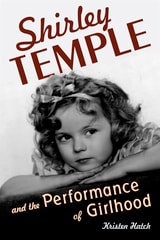
Shirley Temple and the Performance of Girlhood
Hatch, Kristen
Rutgers University Press, 2015
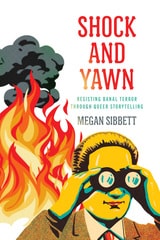
Shock and Yawn
Resisting Banal Terror Through Queer StorytellingMegan Sibbett
The Ohio State University Press, 2026
Building on queer theorists’ critiques of intimate and administrative violence, especially Gloria Anzaldúa’s “intimate terrorism,” Sibbett develops methodologies for conceptualizing and subverting violence aimed at queer, racialized, and gendered bodies in this era of surveillance and increasing authoritarianism. Sibbett addresses book bans, anti-trans legislation, idealized histories of westward expansion, and more, examining materials that include public service announcements, advertising, social media, news reports, poems, interviews, and novels. In so doing, she demonstrates the crucial role queer testimonies—and queer histories and queer futures—play in revealing systemic violence and illuminating the transformative potential of everyday resistance.
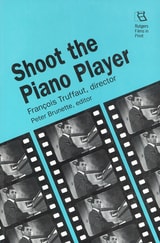
Shoot the Piano Player
Francois Truffaut, DirectorBrunette, Peter
Rutgers University Press, 1993
When it appeared in 1960, the inspired fun of François Truffaut's Shoot the Piano Player shocked and delighted critics and audiences around the world. Its sudden shifts of tone and mood, its willful play with genre stereotypes, and its hilarious in-jokes clearly signaled that Jean-Luc Godard's equally innovative Breathless was not a fluke. The two films heralded the arrival of the so-called New Wave, sharing with other New Wave films an insistence on low-budget, location shooting and, above all, on cinema as the personal statement of an author. These films had a tremendous impact on all filmmaking.
Peter Brunette's introduction to this book gives us new insight into the film, based in part on revisualizing it in terms of recent postmodern and poststructuralist thinking. He argues, in effect, that Truffaut was one of the directors who paved the way for a postmodern aesthetic. The volume also contains a complete and accurate continuity script of the film (based on the authoritative, wide-screen version), a series of interviews with Truffaut (including one by Hélène Laroche Davis, previously unpublished), a large number of reviews and essays, a filmography, and selected bibliography.
Shreds of Matter
Cormac McCarthy and the Concept of NatureJulius Greve
Dartmouth College Press, 2018
Siblings in Tolstoy and Dostoevsky
The Path to Universal BrotherhoodAnna A. Berman
Northwestern University Press, 2015
Anna A. Berman’s book brings to light the significance of sibling relationships in the writings of Tolstoy and Dostoevsky. Relationships in their works have typically been studied through the lens of erotic love in the former, and intergenerational conflict in the latter.
In close readings of their major novels, Berman shows how both writers portray sibling relationships as a stabilizing force that counters the unpredictable, often destructive elements of romantic entanglements and the hierarchical structure of generations. Power and interconnectedness are cast in a new light. Berman persuasively argues that both authors gradually come to consider siblinghood a model of all human relations, discerning a career arc in each that moves from the dynamics within families to a much broader vision of universal brotherhood.
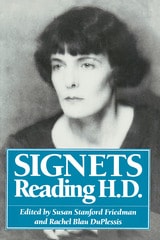
Signets
Reading H.D.Susan S. Friedman
University of Wisconsin Press, 1991
Signets brings together the best essays of H.D. (Hilda Doolittle). Susan Stanford Friedman and Rachel Blau DuPlessis have gathered the most influential and generative studies of H. D.’s work and complemented them with photobiographical, chronological, and bibliographical portraits unique to this volume.
The essays in Signets span H. D.’s career from the origins of Imagism to late modernism, from the early poems of Sea Garden to the novel HER and the epic poems Trilogy and Helen in Egypt. In addition to the editors, the contributors are Diana Collecott, Robert Duncan, Albert Gelpi, Eileen Gregory, Susan Gubar, Barbara Guest, Elizabeth A. Hirsch, Deborah Kelly Kloepfer, Cassandar Laity, Adalaide Morris, Alicia Ostriker, Cyrena N. Pondrom, Perdita Schaffner, and Louis H. Silverstein.
Signets is an essential resource for those interested in H. D., modernism, and feminist criticism and writing.
Signs of Borges
Sylvia Molloy
Duke University Press, 1994
Borges's sustained practice of the uncanny gives rise in his texts to endless tensions between illusion and meaning, and to the competing desires for fragmentation, dispersal, and stability. Molloy traces the movement of Borges's own writing by repeatedly spanning the boundaries of genre and cutting across the conventional separations of narrative, lyric and essay, fact and fiction. Rather than seeking to resolve the tensions and conflicts, she preserves and develops them, thereby maintaining the potential of these texts to disturb. At the site of these tensions, Molloy locates the play between meaning and meaninglessness that occurs in Borges's texts. From this vantage point his strategies of deception, recourse to simulacra, inquisitorial urge to unsettle binarism, and distrust of the permanent--all that makes Borges Borges--are examined with unmatched skill and acuity.
Elegantly written and translated, Signs of Borges presents a remarkable and dynamic view of one of the most international and compelling writers of this century. It will be of great interest to all students of twentieth-century literature, particularly to students of Latin American literature.
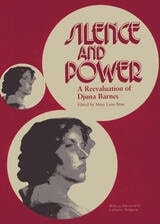
Silence and Power
A Reevaluation of Djuna BarnesEdited by Mary Lynn Broe. Afterword by Catharine Stimpson
Southern Illinois University Press, 1991
Roughly chronological, these essays explore Barnes’ early work in the New York newspaper world of the ‘teens, proceed through the 1954 publication of The Antiphon, and include several approaches to such works as Ryder, Ladies Almanack, and Nightwood. This judicious mix of essays—many of them illustrated by photographs and drawings—presents a comprehensive picture of the creative imagination of Djuna Barnes.
Essayists include Mary Lynn Broe, Nancy J. Levine, Ann Larabee, Joan Retallack, Carolyn Allen, Carolyn Burke, Sheryl Stevenson, Marie Ponsot, Frances M. Doughty, Susan Sniader Lanser, Frann Michel, Karla Jay, Jane Marcus, Judith Lee, Julie L. Abraham, Meryl Altman, Lynda Curry, Louise A. DeSalvo, and Catharine Stimpson. Individuals sharing personal recollections of Barnes are Ruth Ford, James B. Scott, Alex Gildzen, Hank O’Neal, Chester Page, Andrew Field, and Frances McCullough. Janice Thom and Kevin Engel provide an updated bibliography.
From The Book of Repulsive Women to The Antiphon, Barnes challenged old gender dichotomies as she shaped radical sociopolitical views. Her textual methods celebrated a multiplicity of voices, heterodox forms, and genres, transgressing those tenets of modernism that privilege the “high art” of a single, unified textual identity or a discrete discourse. These essays offer various critical approaches and sinuous readings of the full range of Barnes’ achievement. Interwoven through the essays and reminiscences is a lively commentary from Barnes’ friends and contemporaries as well as Barnes herself.
Silence in Catullus
Benjamin Eldon Stevens
University of Wisconsin Press, 2014
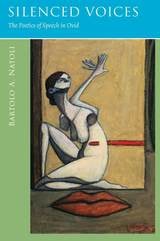
Silenced Voices
The Poetics of Speech in OvidBartolo A. Natoli
University of Wisconsin Press, 2021
Bartolo A. Natoli provides a unique cross-reading of these works. He examines how the motifs and ideas articulated in the Metamorphoses provide the template for the poet's representation of his own exile. Ovid depicts his transformation with an eye toward memory, reformulating how his exile would be perceived by his audience. His exilic poems are an attempt to recover the voice he lost and to reconnect with the community of Rome.
Sinclair Lewis Remembered
Gary Scharnhorst
University of Alabama Press, 2012
Sinclair Lewis Remembered is a collection of reminiscences and memoirs by contemporaries, friends, and associates of Lewis that offers a revealing and intimate portrait of this complex and significant Nobel Prize–winning American writer.
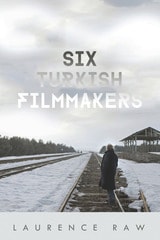
Six Turkish Filmmakers
Laurence Raw
University of Wisconsin Press, 2017
In analysis of and personal interviews with Dervis Zaim, Zeki Demirkubuz, Semih Kaplanoglu, Çagan Irmak, Tolga Örnek, and Palme d'Or winner Nuri Bilge Ceylan, Raw draws connections with Turkish theater, art, sculpture, literature, poetry, philosophy, and international cinema. A native of England and a twenty-five-year resident of Turkey, Raw interleaves his film discussion with thoughtful commentary on nationalism, gender, personal identity, and cultural pluralism.
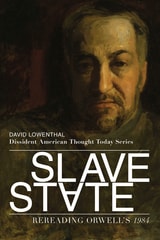
Slave State
Rereading Orwell's 1984David Lowenthal
St. Augustine's Press, 2021
There is no positive political message in 1984, argues Lowenthal, but there is positive moral message that is nearly always overlooked by commentators. “Through the movement of the novel, Orwell tries to impress on the passions, hearts and minds of his readers the most valuable lessons concerning the right and wrong way to live. With the decline of Christianity’s influence in forming the moral sense of the West and the concomitant increase in power hunger, wielding instruments born of modern enlightenment, what mankind most needed was moral guidance, conveyed not abstractly, through philosophy, but in such a way as to grip the whole soul.”
But can Orwell be trusted as a guide to the goodness in human nature? Lowenthal says he can be, and more. He gives us a sketch of the intellectual process that compels Orwell to ultimately outgrow Marxism, his detection and rejection of totalitarian regimes (above all in Communism), and in what way the principles of liberalism of his day were given warning labels by a writer who was not a formally educated political philosopher. Laced with relativism, any current of thought that does not acknowledge the proper ends of man will be effaced by the next master of the masses. Lowenthal echoes Orwell when he says, “we have abandoned inculcating good citizenship, higher ideals and a sense of personal worth in the schools, encouraging instead an aimless low-level conformist ‘individuality’ just waiting to be harnessed together and directed. Given these conditions, can we be sure we have left the conditions to the horrors of 1984 far behind as mere fiction?”
Orwell and Lowenthal are unlikely co-collaborators, unless one perceives how much alike in their exhortations to fellow man they are. The steady tenor of their hard warning is made possible by a hope-soaked confidence that, in utter sobriety, is repulsed by anything that threatens human freedom and dignity. This book is required reading for anyone who believes in the return of socialism. Indeed, any recent university graduate should be debriefed by Lowenthal before entering the real world.
Smollett's Britain
Jeremy Black
St. Augustine's Press, 2022
So Black and Blue
Ralph Ellison and the Occasion of CriticismKenneth W. Warren
University of Chicago Press, 2003
What would it mean to read Invisible Man as a document of Jim Crow America? Using Ralph Ellison's classic novel and many of his essays as starting points, Kenneth W. Warren illuminates the peculiar interrelation of politics, culture, and social scientific inquiry that arose during the post-Reconstruction era and persisted through the Civil Rights movement. Warren argues that Ellison's novel expresses the problem of who or what could represent and speak for the Negro in an age of limited political representation.
So Black and Blue shows that Ellison's successful transformation of these limits into possibilities has also, paradoxically, cast a shadow on the postsegregation world. What can be the direction of African American culture once the limits that have shaped it are stricken down? Here Warren takes up the recent, ongoing, and often contradictory veneration of Ellison's artistry by black writers and intellectuals to reveal the impoverished terms often used in discussions about the political and cultural future of African Americans. Ultimately, by showing what it would mean to take seriously the idea of American novels as creatures of their moment, Warren questions whether there can be anything that deserves the label of classic American literature.
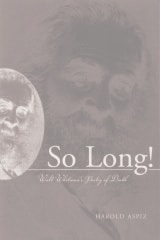
So Long! Walt Whitman's Poetry of Death
Harold Aspiz
University of Alabama Press, 2005
Walt Whitman is unquestionably a great poet of the joys of living. But as Harold Aspiz demonstrates in this study, concerns with death and dying define Whitman’s career as a thinker, a poet, and a person. Through a close reading of Leaves of Grass, its constituent poems, particularly “Song of Myself,” and Whitman’s prose and letters, Aspiz charts how the poet’s exuberant celebration of life—the cascade of sounds, sights, and smells that erupt in his verse—is a consequence of his central concern: the ever-presence of death and the prospect of an afterlife.
Until now no one has studied as systematically the degree to which mortality informs Whitman’s entire enterprise as a poet. So Long! devotes particular attention to Whitman’s language and rich artistry in the context of the poet’s social and intellectual milieus. We see Whitman (and his many personae) as a folk prophet announcing a gospel of democracy and immortality; pondering death in alternating moods of acceptance and terror; fantasizing his own dying and his postmortem selfhood; yearning for mates and lovers while conscious of fallible flesh; agonizing over the omnipresence of death in wartime; patiently awaiting death; and launching imaginary journeys toward immortality and godhood.
So Long! is valuable for American literature collections, students and scholars of Whitman and 19th-century literature, and general readers interested in Whitman and poetry. By exploring Whitman's faith in death as a meaningful experience, we may understand better how the poet—whether personified as representative man, victim, hero, lover, or visionary—lived so completely on the edge of life.
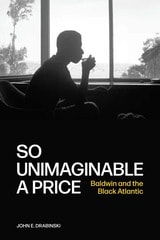
So Unimaginable a Price
Baldwin and the Black AtlanticJohn E. Drabinski
Northwestern University Press, 2026
James Baldwin’s nonfiction offers some of the most important and challenging thinking on the experience of race, history, and memory in the Black Atlantic world. Yet much of the scholarly literature on Baldwin’s writing reads his work from inside the sociocultural context of the United States, alongside key interlocutors like Richard Wright, Ralph Ellison, and Lorraine Hansberry. So Unimaginable a Price: Baldwin and the Black Atlantic shifts the critical frame, examining Baldwin’s work as part of a midcentury moment across the wider Atlantic world and tying his reflections to those of thinkers in the Caribbean and Africa to underscore the widening sense, as well as the particularity, of his critical claims. Who is Baldwin to the Atlantic world? And who, then, is Baldwin to the United States? John E. Drabinski recasts Baldwin as a Black Atlantic writer whose unique qualities as a thinker are enhanced by their similarities and differences with fellow writers of liberation in the global Black world.
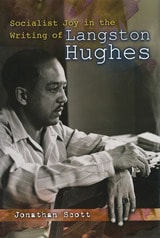
Socialist Joy in the Writing of Langston Hughes
Jonathan Scott
University of Missouri Press, 2007
Jonathan Scott has written the first book-length study to analyze the extraordinary range of Hughes’s creative output, showing that his unassailable reputation as one of America’s finest “folk poets” barely scratches the surface of his oeuvre. Scott offers a robust account of the relations between Hughes and political activism to show that Hughes’s direct involvement with the U.S. socialist movement of the 1920s and 1930s was largely responsible for the variety of his writing. Scott also contends that the goal of overthrowing white oppression produced a “socialist joy” that would express itself repeatedly in Hughes’s work during the anticommunist crusades of the 1950s and 1960s.
In his provocative study, Scott explores four areas of Hughes’s intellectual work: his relationship with Afro-Caribbean arts, Soviet Russia, and the Harlem Renaissance; his postwar newspaper writing for the African American press; his extensive cultural work as an anthologist; and his writings for young people. Through these analyses, Scott proposes the concept of “red, white, and black” as an alternative paradigm for appreciating Hughes in particular and the American scene in general.
Scott views Hughes not simply as a great author but as an American working-class intellectual trickster whose eccentric projects require a redefinition of the very concept of authorship. By focusing on Hughes’s intellectual method, Scott also contests the notion of reducing all African Americans to one undifferentiated social status beneath that of any class within the white oppressing group—a hallmark of racial oppression that has diminished, in the U.S. academy, Hughes’s international status.
As Scott persuasively argues, it is only through an understanding of Hughes’s literary method that we can undertake a thorough account of his prolific production during the cold war era. His book situates Hughes’s life and work in their proper contexts, both reconfirming Hughes’s reputation as an intellectual of the American Left and establishing his long-denied place in American studies as the most well-rounded writer of his time.

Society and its Outsiders in the Novels of Jakob Wassermann
Katharina Volckmer
University of London Press, 2016

Socrates and Aristophanes
Leo Strauss
University of Chicago Press, 1996
"Strauss gives us an impressive addition to his life's work—the recovery of the Great Tradition in political philosophy. The problem the book proposes centers formally upon Socrates. As is typical of Strauss, he raises profound issues with great courage. . . . [He addresses] a problem that has been inherent in Western life ever since [Socrates'] execution: the tension between reason and religion. . . . Thus, we come to Aristophanes, the great comic poet, and his attack on Socrates in the play The Clouds. . . [Strauss] translates it into the basic problem of the relation between poetry and philosophy, and resolves this by an analysis of the function of comedy in the life of the city." —Stanley Parry, National Review
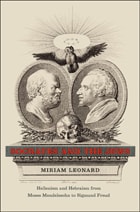
Socrates and the Jews
Hellenism and Hebraism from Moses Mendelssohn to Sigmund FreudMiriam Leonard
University of Chicago Press, 2012
"What has Athens to do with Jerusalem?” Asked by the early Christian Tertullian, the question was vigorously debated in the nineteenth century. While classics dominated the intellectual life of Europe, Christianity still prevailed and conflicts raged between the religious and the secular. Taking on the question of how the glories of the classical world could be reconciled with the Bible, Socrates and the Jews explains how Judaism played a vital role in defining modern philhellenism.
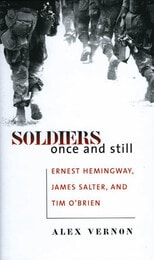
Soldiers Once and Still
Ernest Hemingway, James Salter, and Tim O'BrienAlex Vernon
University of Iowa Press, 2007
Hemingway, Salter, and O’Brien form the core of Soldiers Once and Still because each represents a different warring generation of twentieth-century America: World War I with Hemingway, World War II and Korea with Salter, and Vietnam with O’Brien. Each author also represents a different literary voice of the twentieth century, from modern to mid-century to postmodern, and each presents a different battlefield experience: Hemingway as noncombatant, Salter as air force fighter pilot, and O’Brien as army grunt.
War’s pervasive influence on the individual means that, for veterans-turned-writers like Hemingway, Salter, and O’Brien, the war experience infiltrates their entire body of writing—their works can be seen not only as war literature but also as veterans’ literature. As such, their entire postwar oeuvre, regardless of whether an individual work explicitly addresses the war or the military, is open to Vernon’s exploration of war, society, gender, and literary history.
Vernon’s own experiences as a soldier, a veteran, a writer, and a critic inform this enlightening critique of American literature, offering students and scholars of American literature and war studies an invaluable tool for understanding war’s effects on the veteran writer and his society.

Solidarity with the Other Beings on the Planet
Alice Walker, Ecofeminism, and Animals in LiteraturePamela B. June
Northwestern University Press, 2020
Grounded in ecofeminist theory, this literary analysis examines Walker’s evolving views on animals in relation to her discussions of other oppressed groups. Pamela B. June argues that Walker’s fiction can help readers understand and perhaps challenge American culture’s mistreatment of nonhuman animals. Walker has withstood criticism for her decision to abandon vegetarianism, and this book also problematizes the slippery territory of viewing writers as moral guides. Solidarity with the Other Beings on the Planet will appeal to readers in literary studies, ecofeminist studies, African American studies, and critical animal studies.
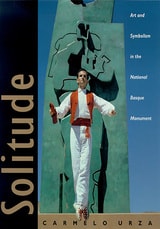
Solitude
Art And Symbolism In The National Basque MonumentCarmelo Urza
University of Nevada Press, 1993
Urza discusses the genesis of the National Basque Monument to the Basque Sheepherder that is located in Reno, Nevada. He also describes the competition held to determine the monument's design and the debates arising from the modern sculpture created by renowned Basque artist Nestor Basterrextea. Urza examines the arguments of those who favored the selection of a figurative, traditional symbol and those who preferred a modern, forward-looking symbol. He utilizes this discussion to explore the evolution of Basque ethnicity and its relationship to society.
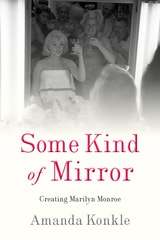
Some Kind of Mirror
Creating Marilyn MonroeKonkle, Amanda
Rutgers University Press, 2019
Some Kind of Mirror offers the first extended scholarly analysis of Marilyn Monroe’s film performances, examining how they united the contradictory discourses about women’s roles in 1950s America. Amanda Konkle suggests that Monroe’s star persona resonated with audiences precisely because it engaged with the era’s critical debates regarding femininity, sexuality, marriage, and political activism. Furthermore, she explores how Monroe drew from the techniques of Method acting and finely calibrated her performances to better mirror her audience’s anxieties and desires.
Drawing both from Monroe’s filmography and from 1950s fan magazines, newspaper reports, and archived film studio reports, Some Kind of Mirror considers how her star persona was coauthored by the actress, the Hollywood publicity machine, and the fans who adored her. It is about why 1950s America made Monroe a star, but it is also about how Marilyn defined an era.
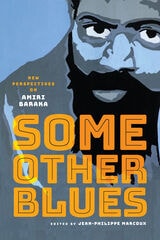
Some Other Blues
New Perspectives on Amiri BarakaEdited by Jean-Philippe Marcoux
The Ohio State University Press, 2021
(Include contributors if space allows) Contributors: Tony Bolden, Jeremy Glick, William J. Harris, Benjamin Lee, Aidan Levy, John Lowney, Jean-Philippe Marcoux, Kim McMillon, Fred Moten, Michael New, Aldon Lynn Nielsen, Amy Abugo Ongiri, Gregory Pierrot, Howard Rambsy II, Emily Ruth Rutter, Anthony Reed, Lauri Scheyer, Kathy Lou Schultz, Michael Simanga, James Smethurst, Laura Vrana, Tyrone Williams, Kalamu ya Salaam.
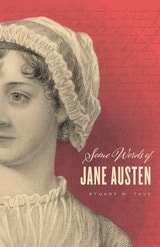
Some Words of Jane Austen
Stuart M. Tave
University of Chicago Press, 2019
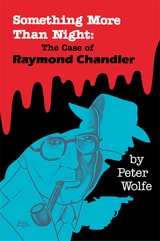
Something More than Night
The Case of Raymond ChandlerPeter Wolfe
University of Wisconsin Press, 1985