Results by title
2706 books match the query 'European' and 204 start with s
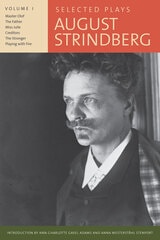
Selected Plays, Volume I
August Strindberg
University of Minnesota Press, 2012
August Strindberg is often considered the father of modern Swedish literature. His vast output of plays was innovative in style and form. Volume 1 of Selected Plays presents selections from the beginning of his career, before Strindberg’s period of psychotic attacks in the 1890s. Master Olof (1872) is a historical drama set in early Reformation Sweden, influenced by Ibsen and Shakespeare. Two of his most produced plays today, The Father (1887) and Miss Julie (1888), are examples of his naturalistic plays. Strindberg described Creditors (1888), a tragicomedy, as his “most mature work.” The Stronger (1889), a playlet, is a favorite in acting classes. Playing with Fire (1893) is one of his few comedies. These plays deal with Strindberg’s preoccupation with power struggles and sexual warfare.
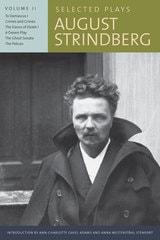
Selected Plays, Volume II
August Strindberg
University of Minnesota Press, 2012
This second volume of the great Swedish writer August Strindberg’s plays begins with To Damascus I (1898), the first of a trilogy. It mirrors his own departure from the naturalism he had explored in several of his earlier works, as he set forth on a spiritual odyssey. Crimes and Crimes (1899), from the beginning of his symbolist mode, is a lighter take on the themes in To Damascus I. The first of a two-part play, Dance of Death I (1900) depicts a dysfunctional marriage. A Dream Play (1901), which is one of Strindberg’s most influential, shows reality converted into a dream; many critics consider it his greatest play. In 1907, Strindberg founded the Intimate Theater in Stockholm; The Ghost Sonata (1907) and The Pelican (1907), which were written for its opening, are two examples of a chamber play, a genre that Strindberg helped to originate.
Selected Poems
Johann W. Goethe
Northwestern University Press, 1998
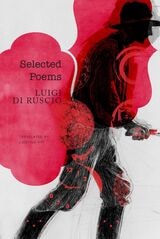
Selected Poems
Luigi Di Ruscio
Seagull Books, 2023
Born in a sub-proletarian ghetto in Italy in 1930 under the fascist regime, Luigi Di Ruscio was an urchin running wild in the countryside, a Communist with clear anarchist leanings, a jack-of-all-trades. In 1957 he emigrated to Oslo, where he worked for forty years in a steel-wire factory, spending his evenings at the typewriter, delving with furious energy into his native Italian. Di Ruscio insisted that whereas the language of power is always a contrived, one-way fabrication, the language of the underprivileged is upfront and direct, aiming straight and sharp for the truth. Caustic as a shopfloor scouring agent, exhilarating in its overabundance, humor, and outspokenness, Selected Poems stands as a testament of tenacity, a record of class struggle, and a vital presence for our times.
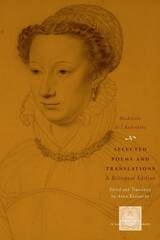
Selected Poems and Translations
A Bilingual EditionMadeleine de l'Aubespine
University of Chicago Press, 2007
Rather than adopt the conventional self-effacement that defined female poets of the time, l’Aubespine’s speakers are sexual, dominant, and defiant; and her subjects are women who are able to manipulate, rebuke, and even humiliate men.
Unavailable in English until now and only recently identified from scattered and sometimes misattributed sources, l’Aubespine’s poems and literary works are presented here in Anna Klosowska’s vibrant translation. This collection, which features one of the first French lesbian sonnets as well as reproductions of l’Aubespine’s poetic translations of Ovid and Ariosto, will be heralded by students and scholars in literature, history, and women’s studies as an important addition to the Renaissance canon.
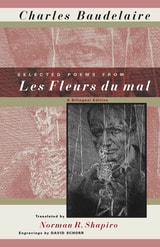
Selected Poems from Les Fleurs du mal
A Bilingual EditionCharles Baudelaire
University of Chicago Press, 1998
"A fine, formal translation of the best poems of France's founder of the symbolist movement."—St. Louis Post-Dispatch
"It's rare to find a rewarding translation of a masterwork, particularly a collection of groundbreaking poetry. . . . Through Shapiro's skillful wordsmithing, the reader can fully appreciate Baudelaire's control of the soul and the word which is the ancient and indefatigable ambition of all great poets. . . . Shapiro's interpretations set the standard for future English translations."—Virginia Quarterly Review
Selected Poems of August Strindberg
Lotta Lofgren
Southern Illinois University Press, 2002
August Strindberg (1849–1912) was one of the great innovators of modern drama as well as a novelist, poet, and master of the Swedish language. In this collection, Selected Poems of August Strindberg, editor and translator Lotta M. Löfgren has chosen poems from all three volumes of Strindberg’s verse—Poems in Verse and Prose, Sleepwalking Nights on Awake Days, and Word Play and Minor Art—to illustrate to the English-speaking reader the development, strengths, and versatility of Strindberg the poet.
Löfgren explains, “Although August Strindberg is internationally acknowledged as a pioneering realist, expressionist, and surrealist playwright, his poetry is still relatively unknown outside Sweden. The only English translation of [his] poems to date is the 1978 translation of Sleepwalking Nights by Arvid Paulson . . . that gives an incomplete and misleading picture of Strindberg’s poetry.”
Löfgren’s translation seeks to correct that picture. Strindberg’s stature as a dramatist alone may be adequate justification for offering a translation of his verse, but his poetry stands well on its own. All three volumes broke new ground and paved the way for younger generations of poets. Löfgren hopes that her translation will not only introduce Strindberg’s verse to English-speaking readers but will also inspire other scholars to revisit his poetry and give it the attention it deserves.
Selected Poems of August Strindberg received the American-Scandinavian Foundation’s Translation Prize in 2000.
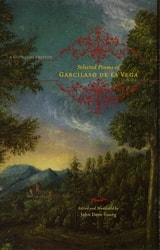
Selected Poems of Garcilaso de la Vega
A Bilingual EditionGarcilaso de la Vega
University of Chicago Press, 2009
Garcilaso de la Vega (ca. 1501–36), a Castilian nobleman and soldier at the court of Charles V, lived a short but glamorous life. As the first poet to make the Italian Renaissance lyric style at home in Spanish, he is credited with beginning the golden age of Spanish poetry. Known for his sonnets and pastorals, gracefully depicting beauty and love while soberly accepting their passing, he is shown here also as a calm student of love’s psychology and a critic of the savagery of war.
This bilingual volume is the first in nearly two hundred years to fully represent Garcilaso for an Anglophone readership. In facing-page translations that capture the music and skill of Garcilaso’s verse, John-Dent Young presents the sonnets, songs, elegies, and eclogues that came to influence generations of poets, including San Juan de la Cruz, Luis de Leon, Cervantes, and Góngora. The Selected Poems of Garcilaso de la Vega will help to explain to the English-speaking public this poet’s preeminence in the pantheon of Spanish letters.
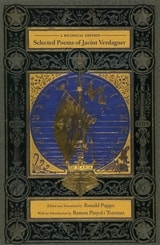
Selected Poems of Jacint Verdaguer
A Bilingual EditionJacint Verdaguer
University of Chicago Press, 2007
Selected Poems is the first book-length translation of Verdaguer’s works into English. Ronald Puppo offers readable and faithful verse adaptations of poetry from all periods of the poet-priest’s life, from his days as a seminary student and farmhand to his journeys as a ship’s chaplain and eventual spiritual crisis. These adroit translations will recover Verdaguer as a major figure in the modern literary tradition of the West, restoring him to the pantheon of world letters.
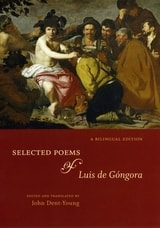
Selected Poems of Luis de Góngora
A Bilingual EditionLuis de Góngora
University of Chicago Press, 2007
Making Luis de Góngora’s work available to contemporary English-language readers without denying his historical context, Selected Poems of Luis de Góngora presents him as not only one of the greatest and most complex poets of his time, but also the funniest and most charismatic. From longer works, such as “The Fable of Polyphemus and Galatea,” to shorter ballads, songs, and sonnets, John Dent-Young’s free translations capture Góngora’s intensely musical voice and transmit the individuality and self-assuredness of the poet. Substantial introductions and extensive notes provide personal and historical context, explain the ubiquitous puns and erotic innuendo, and discuss translation choices. A significant edition of this seminal and challenging poet, Selected Poems of Luis de Góngora will find an eager audience among students of poetry and scholars studying the history and literature of Spain.
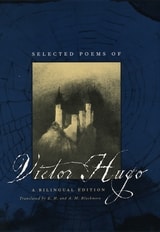
Selected Poems of Victor Hugo
A Bilingual EditionVictor Hugo
University of Chicago Press, 2001
Although best known as the author of Notre Dame de Paris and Les Misérables, Victor Hugo was primarily a poet—one of the most important and prolific in French history. Despite his renown, however, there are few comprehensive collections of his verse available and even fewer translated editions.
Translators E. H. and A. M. Blackmore have collected Victor Hugo's essential verse into a single, bilingual volume that showcases all the facets of Hugo's oeuvre, including intimate love poems, satires against the political establishment, serene meditations, religious verse, and narrative poems illustrating his mastery of the art of storytelling and his abiding concern for the social issues of his time. More than half of this volume's eight thousand lines of verse appear here for the first time in English, providing readers with a new perspective on each of the fascinating periods of Hugo's career and aspects of his style. Introductions to each section guide the reader through the stages of Hugo's writing, while notes on individual poems provide information not found in even the most detailed French-language editions.
Illustrated with Hugo's own paintings and drawings, this lucid translation pays homage to this towering figure of nineteenth-century literature by capturing the energy of his poetry, the drama and satirical force of his language, and the visionary beauty of his writing as a whole.
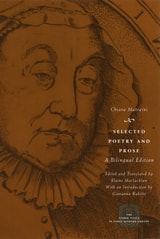
Selected Poetry and Prose
A Bilingual EditionChiara Matraini
University of Chicago Press, 2007
Mostly available in only a handful of rare book collections, her writings are now adeptly translated here for an English-speaking audience and situated historically in an introduction by noted Matraini expert Giovanna Rabitti. Selected Poetry and Prose allows the poet to finally take her place as one of the seminal authors of the Renaissance, next to her contemporaries Vittoria Colonna and Laura Battiferra, also published in the Other Voice series.
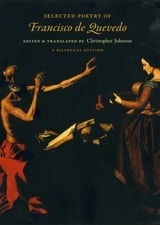
Selected Poetry of Francisco de Quevedo
A Bilingual EditionFrancisco de Quevedo
University of Chicago Press, 2009
Francisco de Quevedo (1580–1645), one of the greatest poets of the Spanish Golden Age, was the master of the baroque style known as “conceptismo,” a complex form of expression fueled by elaborate conceits and constant wordplay as well as ethical and philosophical concerns. Although scattered translations of his works have appeared in English, there is currently no comprehensive collection available that samples each of the genres in which Quevedo excelled—metaphysical and moral poetry, grave elegies and moving epitaphs, amorous sonnets and melancholic psalms, playful romances and profane burlesques.
In this book, Christopher Johnson gathers together a generous selection of forty-six poems—in bilingual Spanish-English format on facing pages—that highlights the range of Quevedo’s technical expertise and themes. Johnson’s ingenious solutions to rendering the difficult seventeenth-century Spanish into poetic English will be invaluable to students and scholars of European history, literature, and translation, as well as poetry lovers wishing to reacquaint themselves with an old master.
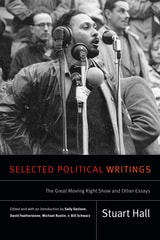
Selected Political Writings
The Great Moving Right Show and Other EssaysStuart Hall
Duke University Press, 2017
Selected Prose of N. M. Karamzin
N. M. Karamzin, translated and with an introduction by Henry M. Nebel Jr.
Northwestern University Press, 1969
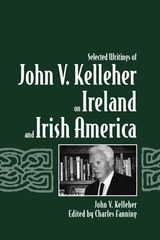
Selected Writings of John V. Kelleher on Ireland and Irish America
John V. Kelleher. Edited by Charles Fanning
Southern Illinois University Press, 2002
A collection of eighteen critical essays and twenty-six translations spanning the career of one of the founding intellects of Irish Studies, the Selected Writings of John V. Kelleher on Ireland and Irish America consists of five accessible sections. The first gathers Kelleher’s essays on the most widely known Irish cultural phenomenon—the literary renaissance of the early twentieth century. Part two contains his judicious assessments of Irish literature in its post-Revolutionary phase. The third section includes Kelleher’s insightful essays on the experience of the Irish in America. The fourth section contains essays that examine early Irish literature and culture, opening with a benchmark essay for Irish Studies, “Early Irish History and Pseudo-History,” which was read at the inaugural meeting of the American Conference for Irish Studies in 1961. The collection concludes with Kelleher’s translations and adaptations of poems in Old, Middle, and Modern Irish, illustrating his command of the language at every stage.
Selected Writings of an Eighteenth-Century Venetian Woman of Letters
Elisabetta Caminer Turra
University of Chicago Press, 2003
Bringing together Caminer's letters, poems, and journalistic writings, nearly all published for the first time here, Selected Writings offers readers an intellectual biography of this remarkable figure as well as a glimpse into her intimate correspondence with the most prominent thinkers of her day. But more important, Selected Writings provides insight into the passion that animated Caminer's fervent reflections on the complex and shifting condition of women in her society-the same passion that pushed her to succeed in the male-dominated literary professions.
Selected Writings
A Bilingual EditionMarguerite de Navarre
University of Chicago Press, 2008
Selected Writings brings together a representative sampling of Marguerite’s varied writings, most of it never before translated into English, enabling Anglophone readers to enjoy the full breadth of her work for the first time. From verse letters and fables to mythological-pastoral tales, from spiritual songs to a selection of novellas from the Heptameron, the wide range of works included here will reveal Marguerite de Navarre to be one of the most important writers—male or female—of sixteenth-century France.
Selective Affinities
Literature and New Critical TheoryRita Felski
University of Chicago Press, 2026
Rita Felski’s new work brings literary studies into conversation with more affirmative and democratic forms of critical theory.
Literary critics associate the phrase “Frankfurt School” with early twentieth-century thinkers like Adorno or Benjamin, but contemporary German critical theory remains largely unknown. In this new book, Rita Felski draws on the work of a group of important philosophers and social theorists to offer fresh readings of literary texts by Robert Walser, Didier Eribon, Zadie Smith, Magda Szabo, John Williams, and Dionne Brand.
Through five key concepts derived from her reading of German theory—disclosure, recognition, self-realization, lifeworld, and resonance—Felski asks how these literary texts articulate the relationship between intellectuals and others. Contrary to critical theories that discount everyday experience, new German thought reveals the ethical, existential, and political richness of such experience. Through this framework, Felski shows that literature, theory, and experience are not opposed but mutually constitutive.
Self and Society
Are Communal Solidarity and Individual Freedom Allies or Antagonists?Michael Amherst, David Crane, Nick Inman, Beninio McDonough-Tranza, and Tara McEvoy
Haus Publishing, 2021
Bringing together the winning and shortlisted essays from the 2020 Hubert Butler Essay Prize, Self and Society presents five fresh perspectives on the tension between individual freedom and communal solidarity, asking what we owe our communities and why it matters. With a foreword by Ireland’s President Michael D. Higgins, the book examines themes that are more pressing than ever in the age of Coronavirus and Brexit, invoking the spirit of the Irish essayist Hubert Butler to investigate whether collective and personal aims can be synergistic or are destined to remain ever in conflict.
Winner Michael Amherst takes on identity politics, questioning whether the stratification of society in the name of social justice is helpful or harmful in the pursuit of equality. Runners-up Tara McEvoy and David Crane tackle, respectively, the necessity of collective action as a response to the current pandemic and other social crises, and the role of conflicts of individual freedom in facilitating or stifling the economic liberation of refugees. Special mentions have been awarded to Nick Inman and Beninio McDonough-Tranza for their respective essays on personal responsibility and the legacy of the Polish union Solidarnosc.

Semiotics of Peasants in Transition
Slovene Villagers and Their Ethnic Relatives in AmericaIrene Portis-Winner
Duke University Press, 2002
Describing a process of continuous and enduring interaction between these geographically separate communities, Portis-Winner explains how, for instance, financial assistance from the emigrants enabled their Slovenian hometown to survive the economic depressions of the 1890s and 1930s. She also analyzes the extent to which memories, rituals, myths, and traditional activities from Slovenia have sustained their Cleveland relatives. The result is a unique anthropological investigation into the signifying practices of a strongly cohesive—yet geographically split—ethnic group, as well as an illuminating application of semiotic analyses to communities and the complex problems they face.
Senses of Style
Poetry before InterpretationJeff Dolven
University of Chicago Press, 2017
Serious Reflections During the Life and Surprising Adventures of Robinson Crusoe with his Vision of the Angelick World
The Stoke Newington EditionDaniel Defoe
Bucknell University Press, 2022
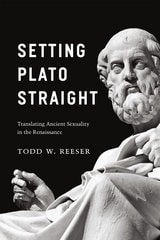
Setting Plato Straight
Translating Ancient Sexuality in the RenaissanceTodd W. Reeser
University of Chicago Press, 2015
In Setting Plato Straight, Todd W. Reeser undertakes the first sustained and comprehensive study of Renaissance textual responses to Platonic same-sex sexuality. Reeser mines an expansive collection of translations, commentaries, and literary sources to study how Renaissance translators transformed ancient eros into non-erotic, non-homosexual relations. He analyzes the interpretive lenses translators employed and the ways in which they read and reread Plato’s texts. In spite of this cleansing, Reeser finds surviving traces of Platonic same-sex sexuality that imply a complicated, recurring process of course-correction—of setting Plato straight.
Seven Faces
Brazilian Poetry Since ModernismCharles A. Perrone
Duke University Press, 1996
Perrone introduces the most important poetic themes of the second half of this century with a look back at Brazilian modernismo and the avant-garde legacy of poets of the 1920s and 30s. Brazilian poets, the author reveals, have long drawn inspiration from the other arts, experimenting with the inclusion of music, graphic arts, and other nontraditional elements within lyric forms. Relating aesthetic concerns to cultural issues, Perrone elucidates the major poetic movements in Brazil since modernismo: concretism and vanguard poetry, politically committed verse of the 60s, youth poetry of the 70s, the lyricism of Brazil’s renowned popular music, and the rethinking of poetry through postmodernism in the final decades of this century.
Providing a window on the ways in which poetry reflects a national spirit and offers a measure of the status of culture in a consumer society, Seven Faces is the only book-length study in English of contemporary Brazilian poetry. It will be welcomed by students and scholars of Latin American literature as well as by general readers interested in poetry and its influence on culture and society.
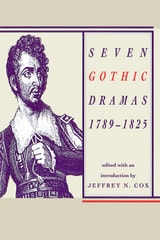
Seven Gothic Dramas, 1789–1825
1789-1825Jeffrey N. Cox
Ohio University Press, 1994
The Gothic drama came at a critical moment in the history of the theater, of British culture, and of European politics in the shadow of France’s revolution and the fall of Napoleon. It offered playwrights a medium to express the prevailing ideological tensions of romanticism and revolution, and also responded to a growing and changing theater audience.
In a wide-ranging introduction, Cox explores Gothic drama’s links with romanticism and its relation to other social and ideological shifts of the day. The texts are presented so as to reflect the dual life of dramatic works—on the stage and on the page. The plays are annotated and accompanied by biographic and bibliographic sketches.
Includes The Kentish Barons, by Francis North; Julia of Louvain; or, Monkish Cruelty, by J.C. Cross; The Castle Spectre, by Matthew G. Lewis; The Captive, by Matthew G. Lewis; De Monfort, by Joanna Baillie; Bertram; or, The Castle of St. Aldobrand, by C.R. Maturin; and Presumption; or, The Fate of Frankenstein, by R.B. Peake.
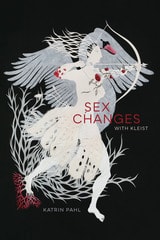
Sex Changes with Kleist
Katrin Pahl
Northwestern University Press, 2019
Focusing on the theatricality of Kleist’s interventions in the performance of gender, sexuality, and emotion and examining how his dramatic texts unhinge major tenets of classical European theater, Sex Changes with Kleist is vital reading for anyone interested in queer studies, feminist studies, performance studies, literary studies, or emotion studies. This book changes our understanding of Kleist and breathes new life into queer thought.
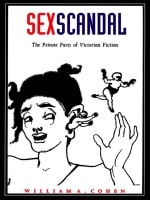
Sex Scandal
The Private Parts of Victorian FictionWilliam A. Cohen
Duke University Press, 1996
Scandal, then as now, makes public the secret indiscretions of prominent people, engrossing its audience in salacious details that violate the very code of propriety it aims to enforce. In narratives ranging from Great Expectations to the Boulton and Park sodomy scandal of 1870–71, from Eliot’s and Trollope’s novels about scandalous women to Oscar Wilde’s writing and his trials for homosexuality, Cohen shows how, in each instance, sexuality appears couched in coded terms. He identifies an assortment of cunning narrative techniques used to insinuate sex into Victorian writing, demonstrating that even as such narratives air the scandalous subject, they emphasize its unspeakable nature.
Written with an eye toward the sex scandals that still whet the appetites of consumers of news and novels, this work is suggestive about our own modes of imagining sexuality today and how we arrived at them. Sex Scandal will appeal to scholars and general readers interested in Victorian literature, the history of sexuality, gender studies, nineteenth-century Britain, and gay, lesbian, and queer studies.
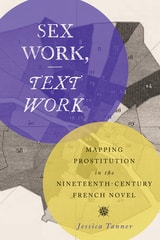
Sex Work, Text Work
Mapping Prostitution in the Nineteenth-Century French NovelJessica Tanner
Northwestern University Press, 2027
While prostitutes in nineteenth-century Paris were subject to municipal laws that policed their bodies and movements, writers of the era enlisted them to stake their own claims on both the city and the novel as literary territory. Sex Work, Text Work: Mapping Prostitution in the Nineteenth-Century French Novel explores how prostitutes depicted by Émile Zola, Joris-Karl Huysmans, Edmond de Goncourt, Adolphe Tabarant, and Charles-Louis Philippe “write back,” confounding civil and literary efforts to contain them in space and in narrative.
In city-regulated brothels, brasseries à femmes, Haussmannian boulevards, and the novel itself, working-class prostitutes served to reinforce the boundaries of social inclusion and exclusion. And yet, Jessica Tanner contends, even the novels that most explicitly aligned with the disciplinary logic of regulated prostitution make space for a distinctly literary form of resistance: these women elude or disrupt the mapping that would claim them as literary territory, revealing their authors’ failure to secure their narratives as property. Tanner pushes back against the critical tendency to attribute agency only to courtesans who became published authors and forwards a new framework for understanding the political work novels engage in as they circulate. Observing that debates about the regulation of prostitution surfaced in tandem with racialized anxieties about the boundaries of the French nation, Tanner ultimately expands that framework to the history of French colonialism and the politics of immigration in the current day. This book shows that while sex workers have been recruited to mark the borders of civic and moral life, prostitution can also make space for more inclusive forms of community, both in the novel and in the world beyond its bounds.
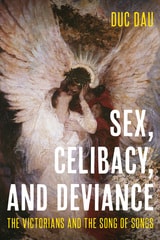
Sex, Celibacy, and Deviance
The Victorians and the Song of SongsDuc Dau
The Ohio State University Press, 2024
Sex, Celibacy, and Deviance is the first major study to explore the Song of Songs (or Song of Solomon) in Victorian literature and art. As the Bible’s only erotic poem, the Song of Songs is the canonical Judeo-Christian book about love, furnishing the Victorians with an authoritative and literary language for love, marriage, sex, mourning, and religious celibacy.
Duc Dau adopts a queer and feminist lens to consider how Victorians employed and interpreted the Song of Songs in their work. How did writers and artists fashion and, most importantly, challenge the norms of gender, romantic love, and marriage? Spanning the early Victorian era through the first two decades of the twentieth century, Sex, Celibacy, and Deviance considers the works of Charlotte Brontë, Thomas Hardy, Christina Rossetti, John Gray, Michael Field, Edward Burne-Jones, and Simeon Solomon alongside two lesser-known figures: Irish-born Scottish artist Phoebe Anna Traquair and the Catholic religious leader Augusta Theodosia Drane. By addressing the relevance of the Song of Songs in light of shifting and conflicting religious and social contexts, Dau provides a fresh perspective on Victorian literature, religion, and culture.
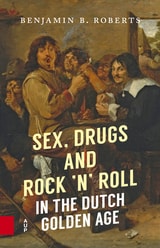
Sex, Drugs and Rock 'n' Roll in the Dutch Golden Age
Benjamin B. Roberts
Amsterdam University Press, 2018
With his engaging storytelling style and humorous anecdotes, Roberts convincingly reveals that deviant male youth behavior is common to all times, especially periods when youngsters have too much money and too much free time on their hands.
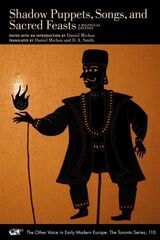
Shadow Puppets, Songs, and Sacred Feasts
Celebrations of the Indo-Portuguese Nuns in the Eighteenth-Century Real Convento de Santa Mónica, Goa, India. A Bilingual EditionEdited by Daniel Michon
Iter Press, 2025
The Entrada de Bonifrate para Festa dos Reis, a shadow puppet play for the feast of the Kings, and the Cartepaço da Muzica, a songbook for the feast of St. John, showcase the imaginative minds of the nuns at the Indo-Portuguese Real Convento de Santa Mónica, Goa, India. Composed for private convent audiences, these texts blend Portuguese and Spanish baroque elements with local Goan traditions. The uncensored verses celebrate convent life, critique local social norms, and affirm the nuns’ community identity, exhibiting the Mónicas’ musical talents and literary sensibilities.
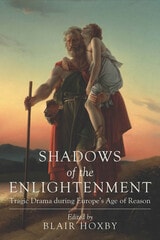
Shadows of the Enlightenment
Tragic Drama during Europe’s Age of ReasonEdited by Blair Hoxby
The Ohio State University Press, 2022
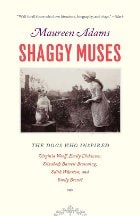
Shaggy Muses
The Dogs who Inspired Virginia Woolf, Emily Dickinson, Elizabeth Barrett Browning, Edith Wharton, and Emily BrontëMaureen Adams
University of Chicago Press, 2011
“You’ll call this sentimental—perhaps—but then a dog somehow represents the private side of life, the play side,” Virginia Woolf confessed to a friend. In this charming and engaging book, Maureen Adams celebrates this private, playful side telling readers about the relationships between five remarkable women writers and their dogs.
In Shaggy Muses, Adams explores the work and lives of these authors through the various roles played by their most devoted companions. Elizabeth Barrett Browning was rescued from a life of passivity and illness by Flush, a lively, possessive (and frequently dog-napped!) golden Cocker Spaniel. Emily Brontë’s fierce Mastiff mix, Keeper, provided a safe and loving outlet for the writer’s equally fierce spirit. Emily Dickinson found companionship with Carlo, the gentle, giant Newfoundland who soothed her emotional terrors. A troop of ever-faithful Pekingese warmed Edith Wharton’s lonely heart during her restless travels among Europe and America’s social and intellectual elite. And Virginia Woolf developed a deep attachment to Pinka, a black Cocker Spaniel who was both gift from her lover, Vita Sackville-West, and a link to her husband Leonard.
Based on diaries, letters, and other contemporary accounts—and featuring many illustrations of the writers and their dogs—these five miniature biographies allow unparalleled intimacy with women of genius in their hours of domestic ease and inner vulnerability.
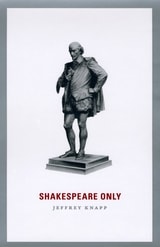
Shakespeare Only
Jeffrey Knapp
University of Chicago Press, 2009
Shakespeare and Interpretation, or What You Will
Brayton Polka
University of Delaware Press, 2011
Brayton Polka takes both a textual and theoretical approach to seven plays of Shakespeare: Macbeth, Othello, Twelfth Night, All’s Well That Ends Well, Julius Caesar, Troilus and Cressida, and Hamlet. He calls upon the Bible and the ideas of major European thinkers, above all, Kierkegaard and Spinoza, to argue that the concept of interpretation that underlies both Shakespeare’s plays and our own lives as moderns is the golden rule of the Bible: the command to love your neighbor as yourself. What you will (the alternative title of Twelfth Night ) thus captures the idea that interpretation is the very act by which we constitute our lives. For it is only in willing what others will—in loving relationships—that we enact a concept of interpretation that is adequate to our lives.
Polka argues that it is the aim of Shakespeare, when representing the ancient world in plays like Julius Caesar and Troilus and Cressida, and also in his long narrative poem “The Rape of Lucrece,” to dramatize the fundamental differences between ancient (pagan) values and modern (biblical) values or between what he articulates as contradiction and paradox. The ancients are fatally destroyed by the contradictions of their lives of which they remain ignorant. In contrast, we moderns in the biblical tradition, like those who figure in Shakespeare’s other works, are responsible for addressing and overcoming the contradictions of our lives through living the interpretive paradox of “what you will,” of treating all human beings as our neighbor. Shakespeare’s comedies and tragedies, notwithstanding their dramatically different form, share this interpretive framework of paradox. As the author shows in his book, texts without interpretation are blind and interpretation without texts is empty.
Published by University of Delaware Press. Distributed worldwide by Rutgers University Press.
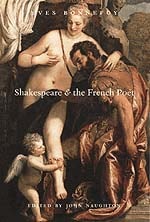
Shakespeare and the French Poet
Yves Bonnefoy
University of Chicago Press, 2004
Translated specifically for an American readership, Shakespeare and the French Poet also features a new interview with Bonnefoy. For Shakespeare scholars, Bonnefoy enthusiasts, and students of literary translation, Shakespeare and the French Poet is a celebration of the global language of poetry and the art of "making someone else's voice live again in one's own."
Shakespeare from the Margins
Language, Culture, ContextPatricia Parker
University of Chicago Press, 1996
Combining feminist and historical approaches with attention to the "matter" of language as well as of race and gender, Parker's brilliant "edification from the margins" illuminates much that has been overlooked, both in Shakespeare and in early modern culture. This book, a reexamination of popular and less familiar texts, will be indispensable to all students of Shakespeare and the early modern period.
Shakespeare in Theory
The Postmodern Academy and the Early Modern TheaterStephen Bretzius
University of Michigan Press, 1997
Shakespeare without Boundaries
Essays in Honor of Dieter MehlChrista Jansohn
University of Delaware Press, 2011
Shakespeare without Boundaries: Essays in Honor of Dieter Mehl offers a wide-ranging collection of essays written by an international team of distinguished scholars who attempt to define, to challenge, and to erode boundaries that currently inhibit understanding of Shakespeare, and to exemplify how approaches that defy traditional bounds of study and criticism may enhance understanding and enjoyment of a dramatist who acknowledged no boundaries in art.
The Volume is published in tribute to Professor Dieter Mehl, whose critical and scholarly work on authors from Chaucer through Shakespeare to D. H. Lawrence has transcended temporal and national boundaries in its range and scope, and who, as Ann Jennalie Cook writes, has contributed significantly to the erasure of political boundaries that have endangered the unity of German literary scholarship and, more broadly, through his work for the International Shakespeare Association, to the globalization of Shakespeare studies.
Published by University of Delaware Press. Distributed worldwide by Rutgers University Press.
Shakespeare's Dead
Stages of Death in Shakespeare's PlayworldsSimon Palfrey and Emma Smith
Bodleian Library Publishing, 2016
Published to accompany a major exhibition at the Bodleian Library, University of Oxford, Shakespeare’s Dead documents the many ways Shakespeare’s characters meet their demise, from suicide to murder, from death by workaday dagger to the more creative method of being baked and fed to one’s family in a meat pie. Through these examples, Simon Palfrey and Emma Smith show Shakespeare’s mastery at choreographing death as a means of rediscovery. Some characters refuse to go quietly, dying in stages, as in Nick Bottom’s performance as Pyramus killing himself with much flourish in A Midsummer Night’s Dream. Others are remembered in elegies, and still others are resurrected or reappear as ghosts. Shakespeare’s death scenes also often speak to the boundaries between theater and everyday life, with funerals and scenes of mourning that are undercut by their staged inauthenticity.
Extensively illustrated with contemporary drawings and images from stage history, Shakespeare’s Dead takes readers through the playwright’s great death scenes and tragic figures, exploring in them the theme of life in death and delineating the cultural, religious, and social contexts.
Shakespeare's Folktale Sources
Charlotte Artese
University of Delaware Press, 2015
Published by University of Delaware Press. Distributed worldwide by Rutgers University Press.
Shakespeare's Once and Future Child
Speculations on SovereigntyJoseph Campana
University of Chicago Press, 2024
Politicians are fond of saying that “children are the future.” How did the child become a figure for our political hopes? Joseph Campana’s book locates the source of this idea in transformations of childhood and political sovereignty during the age of Shakespeare, changes spectacularly dramatized by the playwright himself. Shakespeare’s works feature far more child figures—and more politically entangled children—than other literary or theatrical works of the era. Campana delves into this rich corpus to show how children and childhood expose assumptions about the shape of an ideal polity, the nature of citizenship, the growing importance of population and demographics, and the question of what is or is not human. As our ability to imagine viable futures on our planet feels ever more limited, and as children take up legal proceedings to sue on behalf of the future, it behooves us to understand the way past child figures haunt our conversations about intergenerational justice. Shakespeare offers critical precedents for questions we still struggle to answer.
Shakespeare's Reformation
Christian Humanism and the Death of GodNalin Ranasinghe
St. Augustine's Press, 2022
"I will try to claim that Shakespeare offers an esoteric vindication of the human soul itself, not merely poetry, against the looming backdrop of the Counter-Reformation in Europe and the Puritan perversion of English Anglicanism. Neither the Scholasticism of the former nor the fundamentalism of the latter had any sympathy for the claims of men like Bottom or the Bastard to see beyond the confines of scripture and sacred social structures. While poetry could indulge in metaphysical fantasy, it could not take on the status quo without the assistance of more learned allies; this Shakespeare seems to do by his re-telling of Classical and English history. As disingenuous as Bottom (or Erasmus) in this artful use of ignorance and folly to conceal his serious goals, Shakespeare is thus tying poetry to history and giving us an alternate, if playful, account of Western Civilization."
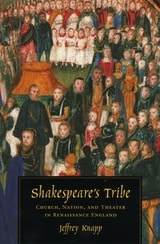
Shakespeare's Tribe
Church, Nation, and Theater in Renaissance EnglandJeffrey Knapp
University of Chicago Press, 2004
To be sure, Renaissance playwrights rarely sermonized in their plays, which seemed preoccupied with sex, violence, and crime. During a time when acting was regarded as a kind of vice, many theater professionals used their apparent godlessness to advantage, claiming that it enabled them to save wayward souls the church could not otherwise reach. The stage, they argued, made possible an ecumenical ministry, which would help transform Reformation England into a more inclusive Christian society.
Drawing on a variety of little-known as well as celebrated plays, along with a host of other documents from the English Renaissance, Shakespeare's Tribe changes the way we think about Shakespeare and the culture that produced him.
Winner of the Best Book in Literature and Language from the Association of American Publishers' Professional/Scholarly division, the Conference on Christianity and Literature Book Award, and the Roland H. Bainton Prize for Literature from the Sixteenth Century Society and Conference.
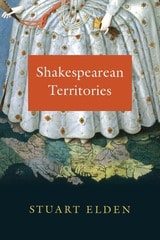
Shakespearean Territories
Stuart Elden
University of Chicago Press, 2018

Shaping Citizenship through Talk Radio
Listening to the 2024 UK ElectionStephen Coleman
Intellect Books, 2026
Can the mass media contribute to meaningful public debate in the run-up to an election?
Talk radio in the United States is said to have contributed to a political atmosphere in which the loudest, crudest, and simplest arguments prevail. Is there a different model of public talk that can contribute to a kinder, wiser, more empathetic democracy? In the run-up to the 2024 UK general election, Stephen Coleman listened to callers to the BBC’s daily phone-in show in the hope of finding answers to these questions. In this year-long study, we see the public expressing its mood, telling its stories, and testing its arguments.
Shaping Citizenship through Talk Radio argues that even in a time of democratic anxiety and rising division, people are still finding ways to talk, listen, and act together. It explains why democracies need reliable public spaces that help citizens connect and communicate across their differences. Reporting on what he found, Coleman also proposes a way forward for a more empathetic democratic discourse.
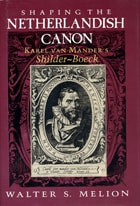
Shaping the Netherlandish Canon
Karel Van Mander's Schilder-BoeckWalter S. Melion
University of Chicago Press, 1992
of Italian art, Karel van Mander's Schilder-Boeck (or
Book on Picturing) has long been recognized for its critical
and historical influence—and yet, until now, no
comprehensive account of the book's conception, aims, and
impact has been available. In this in-depth analysis of the
content and context of Van Mander's work, Walter S. Melion
reveals the Schilder-Boeck's central importance to an
understanding of northern Renaissance and Baroque art.
By interpreting the terminology employed in the
Schilder-Boeck, Melion establishes the text's
relationship to past and contemporary art theory. Van Mander
is seen here developing his critical categories and then
applying them to Ancient, Italian, and Netherlandish artists
in order to mark changes within a culture and to characterize
excellence for each region. Thus Melion demonstrates how Van
Mander revised both the structure and critical language of
Vasari's Lives to refute the Italian's claims for the
superiority of the Tuscan style, and to clarify northern
artistic traditions and the concerns of Netherlandish
artists. A much needed corrective to the view that Dutch art
of the period was lacking in theory, Melion's work offers a
compelling account of a sixteenth- and seventeenth-century
theoretical and critical perspective and shows how this
perspective suggests a rereading of northern art.
Walter S. Melion is assistant professor of art history
at The Johns Hopkins University.
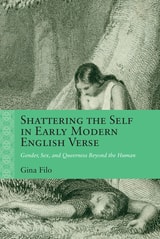
Shattering the Self in Early Modern English Verse
Gender, Sex, and Queerness Beyond the HumanGina Filo
Northwestern University Press, 2026
Rejecting the ideals of stability and sexual mastery demanded of masculine subjects, early modern English poets threw the limits of bodies and selves into question to embrace erotic experiences of genderqueer and transspecies embodiment and affiliation. Through close readings of still-canonical and lesser-read writers including William Shakespeare, John Donne, and Thomas Traherne, Gina Filo shows how these experimental encounters at the limits of the human were inextricable parts of the early modern literary and sexual imaginaries.
In its exploration of nonnormative forms of erotic attachment and embodiment, Shattering the Self in Early Modern English Verse: Gender, Sex, and Queerness Beyond the Human contributes to the burgeoning fields of early modern trans and ecocritical studies while also drawing on contemporary queer theory. Filo neither seeks to naively recuperate a fantasized past nor cedes relationality, sociality, or generativity to the normative. Instead, she shows how the embrace of erotic possibility, flexible, unstable subjectivities, and querying of the limits of “the human” were core features of early modern poetics, reconfiguring our understanding of English literary history and queer relationality today.
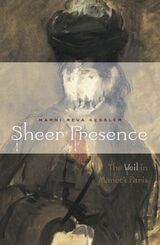
Sheer Presence
The Veil in Manet’s ParisMarni Reva Kessler
University of Minnesota Press, 2006