Results by title
22279 books match the query 'Social Science' and 1635 start with s

Staging Ageing
Theatre, Performance and the Narrative of DeclineMichael Mangan
Intellect Books, 2013
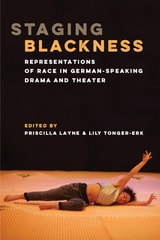
Staging Blackness
Representations of Race in German-Speaking Drama and TheaterPriscilla Dionne Layne and Lily Tonger-Erk, Editors
University of Michigan Press, 2024
Written by scholars and theater professionals with a wide variety of historical and theoretical expertise, the chapters seek to explore the connections between the German discourse on national theater and emerging ideas about race, analyze how dramaturges deal with older representations of Blackness in current productions, and discuss the contributions Black German playwrights and dramaturges have made to this discourse. Historians question how these plays were staged in their time, while cultural studies scholars contemplate how to interpret the function of race in these plays and how they can continue to be staged today.
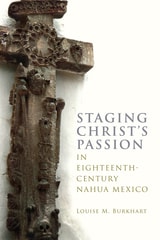
Staging Christ's Passion in Eighteenth-Century Nahua Mexico
Louise M. Burkhart
University Press of Colorado, 2023
A cast with over fifty distinct roles acted out events extending from Palm Sunday to Christ’s death on the cross. One actor became a localized embodiment of Jesus through a process of investiture and mimesis that carried aspects of pre-Columbian materialized divinity into the later colonial period. The play told afar richer version of the Passion story than what later colonial Nahuas typically learned from their priests or catechists. And by assimilating Jesus to an Indigenous, or macehualli, identity, the players enacted a protest against colonial rule.
The situation in eighteenth-century New Spain presents both a unique confrontation between Indigenous communities and Enlightenment era religious reformers and a new chapter in an age-old power game between popular practice and religious orthodoxy. By focusing on how Nahuas localized the universalizing narrative of Christ’s Passion, Staging Christ’s Passion in Eighteenth-Century Nahua Mexico offers an unusually in-depth view of religious life under colonial rule.
Burkhart’s accompanying website also makes available transcriptions and translations of the six Nahuatl-language plays, four Spanish-language plays composed in response to the suppression of the Nahuatl practice, and related documentation, providing a valuable resource for anyone interested in consulting the original material.
Comments restricted to single page
plays composed in response to the suppression of the Nahuatl practice, and related documentation,
providing a valuable resource for anyone interested in consulting the original material
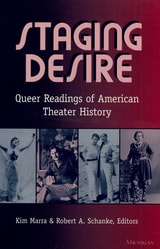
Staging Desire
Queer Readings of American Theater HistoryKim Marra and Robert A. Schanke, Editors
University of Michigan Press, 2002
Essays cover the careers of major figures Clyde Fitch, Rachel Crothers, Mercedes de Acosta, Djuna Barnes, Cole Porter, Lorenz Hart, George Kelly, William Inge, James "Acorn" Oaks, Adam "Vagabond" Badeau, Eric Bentley, Loie Fuller, Robert Edmond Jones, and Jean Rosenthal. Grounded in research into the history of sexuality, the book engages central problems of terminology and evidence in analyzing sexual practices of the past and the modes of articulation of sexuality in theater, conditioned by American culture's peculiar anxieties about both.
Kim Marra is Associate Professor of Theatre Arts, University of Iowa. Robert A. Schanke is Professor of Theatre, Central College, Iowa. They edited Passing Performances: Queer Readings of Leading Players in American Theater History, a previous volume in this series.

Staging Desire
Queer Readings of American Theater HistoryKim Marra and Robert A. Schanke, Editors
University of Michigan Press, 0
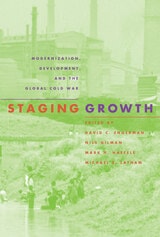
Staging Growth
Modernization, Development, and the Global Cold WarDavid C. Engerman
University of Massachusetts Press, 2003
Beginning in the 1950s, the theory of modernization emerged as the dominant paradigm of economic, social, and political development within the American foreign policy establishment. Purporting to explain the stages through which all nations pass on the road to industrial modernity, it provided a rationale for a broad range of cultural and political projects aimed at fostering Third World growth while simultaneously combating communism.
But modernization theory was more than simply an expression of Cold War ideology. As the essays in this volume show, the ideal of modernization proliferated throughout the postcolonial world and across ideological lines in places as diverse as East Asia, Southern Africa, and South Asia. Indeed, it was embraced by all who shared the American enthusiasm for the increased production and higher standards of living promised by industrialization—enemies and allies alike.
Situating modernization theory historically, Staging Growth avoids conventional chronologies and categories of analysis, particularly the traditional focus on conflicts between major powers. The contributors employ a variety of approaches—from economic and intellectual history to cultural criticism and biography—to shed fresh light on the global forces that shaped the Cold War and its legacies. Most of the pieces are comparative, exploring how different countries and cultures have grappled with the implications of modern development. At the same time, all of the essays address similar fundamental questions. Is modernization the same thing as Westernization? Is the idea of modernization universally valid? Do countries follow similar trajectories as they undertake development? Does modernization bring about globalization?
In addition to the editors and Akira Iriye, contributors include Michael Adas, Laura Belmonte, Gregg Andrew Brazinsky, Christina Klein, J. Victor Koschmann, and Michael R. Mahoney.
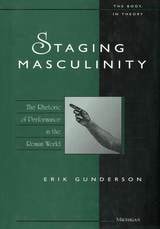
Staging Masculinity
The Rhetoric of Performance in the Roman WorldErik Gunderson
University of Michigan Press, 2000

Staging Memories
Hou Hsiao-hsien's A City of SadnessAbé Mark Nornes and Emilie Yueh-yu Yeh
Michigan Publishing Services, 2015
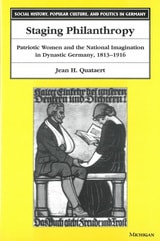
Staging Philanthropy
Patriotic Women and the National Imagination in Dynastic Germany, 1813-1916Jean H. Quataert
University of Michigan Press, 2001
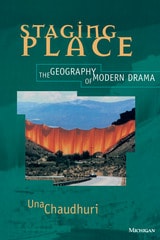
Staging Place
The Geography of Modern DramaUna Chaudhuri
University of Michigan Press, 1997
Chaudhuri starts with a discussion of a "poetics of exile" in early modern drama, where the figure of home is constructed as a locus of two conflicting impulses: the desire to find a stable site for individual identity and the desire to deterritorialize the self. By mid-century, she argues, a new discourse of "failed homecoming" begins to displace this geopathic model and replace the poetics of exile with a grim anti-poetics of immigration. She then employs postmodern and postcolonial theories of place and culture to define the emerging multiculturalism as a creative reworking of the figures of home, homecoming, homelessness, immigration and exile.
"This is a book of real originality. Its treatment of space in modern drama is elegant and powerful. . . ." --William B. Worthen, Northwestern University
"Staging Place is a powerfully written book, deft in its handling of familiar and unfamiliar plays alike and eclectic in its use of theatrical sources." --Essays in Theatre/ Études théâtrales
"This sophisticated and well-written study for graduate students and their teachers explores modern drama's preoccupation with the seemingly irreconcilable discontinuities between the notions of home and homelessness, belonging and exile. . . . The readings of individual plays are fresh and invigorating. . . ." --Choice
Una Chaudhuri is Associate Professor of English, New York University.
Staging Resistance
Essays on Political TheaterJeanne Colleran and Jenny S. Spencer, Editors
University of Michigan Press, 1998

Staging Tourism
Bodies on Display from Waikiki to Sea WorldJane C. Desmond
University of Chicago Press, 1999
Gathering together written accounts, postcards, photographs, advertisements, films, and oral histories as well as her own interpretations of these displays, Desmond gives us a vibrant account of U.S. tourism in Waikiki from 1900 to the present. She then juxtaposes cultural tourism with "animal tourism" in the United States, which takes place at zoos, aquariums, and animal theme parks. In each case, Desmond argues, the relationship between the viewer and the viewed is ultimately based on concepts of physical difference harking back to the nineteenth century.
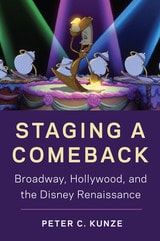
Staging a Comeback
Broadway, Hollywood, and the Disney RenaissancePeter C. Kunze
Rutgers University Press, 2023
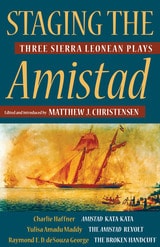
Staging the Amistad
Three Sierra Leonean PlaysCharlie Haffner
Ohio University Press, 2019

Staging the Blues
From Tent Shows to TourismPaige A. McGinley
Duke University Press, 2014
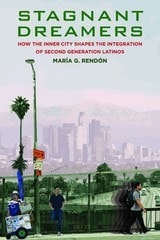
Stagnant Dreamers
How the Inner City Shapes the Integration of the Second GenerationMaria G. Rendon
Russell Sage Foundation, 2019
Winner of the 2020 Robert E. Park Award for Best Book from the Community and Urban Sociology Section of the American Sociological Association
Winner of the 2020 Distinguished Contribution to Research Award from the Latino/a Section of the American Sociological Association
Honorable Mention for the 2020 Thomas and Znaniecki Award from the International Migration Section of the American Sociological Association
A quarter of young adults in the U.S. today are the children of immigrants, and Latinos are the largest minority group. In Stagnant Dreamers, sociologist and social policy expert María Rendón follows 42 young men from two high-poverty Los Angeles neighborhoods as they transition into adulthood. Based on in-depth interviews and ethnographic observations with them and their immigrant parents, Stagnant Dreamers describes the challenges they face coming of age in the inner city and accessing higher education and good jobs, and demonstrates how family-based social ties and community institutions can serve as buffers against neighborhood violence, chronic poverty, incarceration, and other negative outcomes.
Neighborhoods in East and South Central Los Angeles were sites of acute gang violence that peaked in the 1990s, shattering any romantic notions of American life held by the immigrant parents. Yet, Rendón finds that their children are generally optimistic about their life chances and determined to make good on their parents’ sacrifices. Most are strongly oriented towards work. But despite high rates of employment, most earn modest wages and rely on kinship networks for labor market connections. Those who made social connections outside of their family and neighborhood contexts, more often found higher quality jobs. However, a middle-class lifestyle remains elusive for most, even for college graduates.
Rendón debunks fears of downward assimilation among second-generation Latinos, noting that most of her subjects were employed and many had gone on to college. She questions the ability of institutions of higher education to fully integrate low-income students of color. She shares the story of one Ivy League college graduate who finds himself working in the same low-wage jobs as his parents and peers who did not attend college. Ironically, students who leave their neighborhoods to pursue higher education are often the most exposed to racism, discrimination, and classism.
Rendón demonstrates the importance of social supports in helping second-generation immigrant youth succeed. To further the integration of second-generation Latinos, she suggests investing in community organizations, combating criminalization of Latino youth, and fully integrating them into higher education institutions. Stagnant Dreamers presents a realistic yet hopeful account of how the Latino second generation is attempting to realize its vision of the American dream.
Stained Glass Ceilings
How Evangelicals Do Gender and Practice PowerLisa Weaver Swartz
Rutgers University Press, 2023
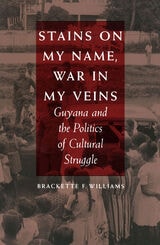
Stains on My Name, War in My Veins
Guyana and the Politics of Cultural StruggleBrackette F. Williams
Duke University Press, 1991
Drawing on oral histories and a close study of daily life in rural Guyana, Brackette E. Williams examines how and why individuals and groups in their quest for recognition as a “nation” reproduce ethnic chauvinism, racial stereotyping, and religious bigotry. By placing her ethnographic study in a broader historical context, the author develops a theoretical understanding of the relations among various dimensions of personal identity in the process of nation building.
Staking Claim
Settler Colonialism and Racialization in Hawai'iJudy Rohrer
University of Arizona Press, 2016
Author Judy Rohrer brings together an analysis of racial formation and colonization in the islands through a study of legal cases, contemporary public discourse (local media and literature), and Hawai‘i scholarship. Her analysis exposes how racialization works to obscure—with the ultimate goal of eliminating—native Hawaiian indigeneity, homeland, nation, and sovereignty.
Staking Claim argues that the dual settler colonial processes of racializing native Hawaiians (erasing their indigeneity), and indigenizing non-Hawaiians, enable the staking of non-Hawaiian claims to Hawai‘i. It encourages us to think beyond a settler-native binary by analyzing the ways racializations of Hawaiians and various non-Hawaiian settlers and arrivants bolster settler colonial claims, structures, and white supremacist ideologies.
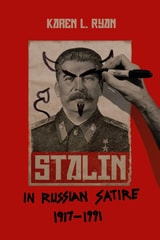
Stalin in Russian Satire, 1917–1991
Karen L. Ryan
University of Wisconsin Press, 2009
Examining works from the 1917 Revolution to the fall of the Soviet Union in 1991, Karen L. Ryan reveals how satirical treatments of Stalin often emphasize his otherness, distancing him from Russian culture. Some satirists portray Stalin as a madman. Others show him as feminized, animal-like, monstrous, or diabolical. Stalin has also appeared as the unquiet dead, a spirit that keeps returning to haunt the collective memory of the nation. While many writers seem anxious to exorcise Stalin from the body politic, for others he illuminates the self in disturbing ways. To what degree Stalin was and is “in us” is a central question of all these works. Although less visible than public trials, policy shifts, or statements of apology, Russian satire has subtly yet insistently participated in the protracted process of de-Stalinization.

Stambeli
Music, Trance, and Alterity in TunisiaRichard C. Jankowsky
University of Chicago Press, 2010
Part ethnography, part history of the complex relationship between Tunisia’s Arab and sub-Saharan populations, Stambeli will be welcomed by scholars and students of ethnomusicology, anthropology, African studies, and religion.

Stamford '76
A True Story of Murder, Corruption, Race, and Feminism in the 1970sJoeAnn Hart
University of Iowa Press, 2019
Looking back at what might have happened in 1976, the author discovers a Bicentennial year steeped in recession, racism, and unrelenting violence. It was also a time of flourishing second-wave feminism, when young women were encouraged to do anything, if only they knew how. Stamford was in the midst of urban renewal, destroying historically black neighborhoods to create space for corporations escaping a bankrupt and dangerous New York City, just forty miles away. Organized crime followed the money, infiltrating Stamford at all levels. The author reveals how racism, misogyny, the economy, and corruption affected the young people’s daily lives, and helped lead Margo and Howie to their deaths.

Stamped and Inscribed Objects from Seleucia on the Tigris
Robert Harbold McDowell
University of Michigan Press, 1935
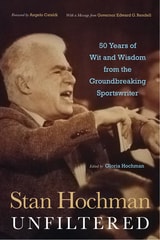
Stan Hochman Unfiltered
50 Years of Wit and Wisdom from the Groundbreaking SportswriterGloria Hochman
Temple University Press, 2020
The late Philadelphia Daily News sportswriter Stan Hochman was known for his many zingers, such as “Harry Litwack, the stoic Temple coach, stalks the sidelines like a blind man at a nudist colony.” As a reporter, he was more interested in how athletes felt, what their values were, how they lived their lives, or what made them tick than he was about how many runs they scored or punches they landed.
In Stan Hochman Unfiltered, his wife Gloria collects nearly 100 of his best columns from the Daily News about baseball, horse racing, boxing, football, hockey, and basketball (both college and pro), as well as food, films, and even Liz Taylor. Each section is introduced by a friend or colleague, including Garry Maddox, Bernie Parent, Larry Merchant, and Ray Didinger, among others.
Hochman penned a candid, cantankerous column about whether Pete Rose belongs in the Baseball Hall of Fame; wrote a graphic account of the Muhammad Ali and Joe Frazier fight of the century; and skewered Norman “Bottom Line” Braman, the one-time owner of the Eagles. He also wrote human-interest stories, including features about the importance of kids with special needs playing sports.
In addition to being a beloved writer, Hochman was also known for his stint on WIP’s radio as the Grand Imperial Poobah, where he would settle callers’ most pressing debates. Hochman long earned the respect and admiration of his subjects, peers, and readers throughout his career, and Stan Hochman Unfiltered is a testament to his enduring legacy.

Stand Up and Fight
Participatory Indigenismo, Populism, and Mobilization in Mexico, 1970–1984María L. O. Muñoz
University of Arizona Press, 2016
Using previously unavailable documents, María L. O. Muñoz examines the events that led to the congress, the meeting itself, and developments after the assembly. Muñoz shows how indigenous leaders working within Mexico’s Department of Colonization and Agrarian Affairs (DAAC) sidestepped state attempts to control indigenous communities, and how they made bold demands that redefined the ways federal and state governments engaged with pueblos indígenas.
Through research in previously untapped archives, Muñoz is able to trace the political history of the indigenous leaders and government officials who redefined the ways indigenous peoples engaged with governments. She illustrates the fluid and evolving power relationships of the key players with a focus on the twelve years of populism in the last decades of the twentieth century.
This book challenges the discourse of unquestioned power and hegemony of the national ruling party, the Institutional Revolutionary Party (PRI), and it illustrates how indigenous communities in Mexico reimagined their roles in the social, political, and economic life of the nation.
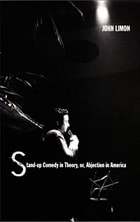
Stand-up Comedy in Theory, or, Abjection in America
John Limon
Duke University Press, 2000
Limon begins with stand-up comics in the 1950s and 1960s—Lenny Bruce, Carl Reiner, Mel Brooks, Mike Nichols, Elaine May—when the norm of the profession was the Jewish, male, heterosexual comedian. He then moves toward the present with analyses of David Letterman, Richard Pryor, Ellen DeGeneres, and Paula Poundstone. Limon incorporates feminist, race, and queer theories to argue that the “comedification” of America—stand-up comedy’s escape from its narrow origins—involves the repossession by black, female, queer, and Protestant comedians of what was black, female, queer, yet suburbanizing in Jewish, male, heterosexual comedy. Limon’s formal definition of stand-up as abject art thus hinges on his claim that the great American comedians of the 1950s and 1960s located their comedy at the place (which would have been conceived in 1960 as a location between New York City or Chicago and their suburbs) where body is thrown off for the mind and materiality is thrown off for abstraction—at the place, that is, where American abjection has always found its home.

Standardizing Sex
A History of Trans MedicineKetil Slagstad
University of Chicago Press, 2025
Standardizing Sex traces the emergence of trans medicine in Scandinavia in the twentieth century, exploring the construction and negotiation of medical expertise among medical professionals, patients, and activists in the media and government bureaucracy. The book combines the author’s analysis of medical records and other archival sources with oral history interviews with former patients, activists, doctors, psychologists, and civil servants. Physician-historian Ketil Slagstad uses the Scandinavian story of sex reassignment to anchor not only the role of the state but also bureaucracy and social rights. Scandinavian countries, he shows, played a foundational role in the emergence of trans medicine internationally. As a result, Standardizing Sex tells a transnational history of medicine that sheds light on a set of relations and problems that continue to impact discussions of trans medicine and trans rights around the world.
Slagstad’s sources offer a rare opportunity to explore the emergence of trans medicine in action in the clinic, laboratory, waiting room, and operating room, as well as in the bureaucrat’s office, on the psychologist’s couch, and in the publications and meetings of activist groups. Together, these sources allow for the analysis of the increasingly complex negotiations of nosological criteria, medical knowledge, and medical practices in a formative period for transgender medicine. More generally, the book offers a story about the reshaping of the normal and the pathological in modern societies.
Standards of Pottery Description
Benjamin March
University of Michigan Press, 1934

Standing Our Ground
Women, Environmental Justice, and the Fight to End Mountaintop RemovalJoyce M. Barry
Ohio University Press, 2012
Standing Our Ground: Women, Environmental Justice, and the Fight to End Mountaintop Removal examines women’s efforts to end mountaintop removal coal mining in West Virginia. Mountaintop removal coal mining, which involves demolishing the tops of hills and mountains to provide access to coal seams, is one of the most significant environmental threats in Appalachia, where it is most commonly practiced.
The Appalachian women featured in Barry’s book have firsthand experience with the negative impacts of Big Coal in West Virginia. Through their work in organizations such as the Coal River Mountain Watch and the Ohio Valley Environmental Coalition, they fight to save their mountain communities by promoting the development of alternative energy resources. Barry’s engaging and original work reveals how women’s tireless organizing efforts have made mountaintop removal a global political and environmental issue and laid the groundwork for a robust environmental justice movement in central Appalachia.
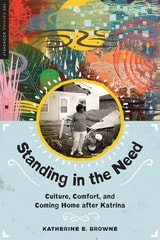
Standing in the Need
Culture, Comfort, and Coming Home After KatrinaBy Katherine E. Browne
University of Texas Press, 2015
Standing in the Need presents an intimate account of an African American family’s ordeal after Hurricane Katrina. Before the storm struck, this family of one hundred fifty members lived in the bayou communities of St. Bernard Parish just outside New Orleans. Rooted there like the wild red iris of the coastal wetlands, the family had gathered for generations to cook and share homemade seafood meals, savor conversation, and refresh their interconnected lives.
In this lively narrative, Katherine Browne weaves together voices and experiences from eight years of post-Katrina research. Her story documents the heartbreaking struggles to remake life after everyone in the family faced ruin. Cast against a recovery landscape managed by outsiders, the efforts of family members to help themselves could get no traction; outsiders undermined any sense of their control over the process. In the end, the insights of the story offer hope. Written for a broad audience and supported by an array of photographs and graphics, Standing in the Need offers readers an inside view of life at its most vulnerable.
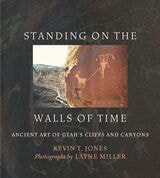
Standing on the Walls of Time
Ancient Art of Utah's Cliffs and CanyonsKevin T. Jones and Layne Miller
University of Utah Press, 2019
Miller’s photographs include many rare and relatively unknown panels and represent a lifetime of work by someone intimately familiar with the Colorado Plateau. The photos highlight the astonishing variety of rock art as well as the variability within traditions and time periods. Jones’s essays furnish general information about previous Colorado Plateau cultures and shine a light on rock art as art. The book emphasizes the exquisite artistry of these ancient works and their capacity to reach through the ages to envelop and inspire viewers.

Stanley Kubrick
New York Jewish IntellectualAbrams, Nathan
Rutgers University Press, 2018
Stanley Kubrick reexamines the director’s work in context of his ethnic and cultural origins. Focusing on several of Kubrick’s key themes—including masculinity, ethical responsibility, and the nature of evil—it demonstrates how his films were in conversation with contemporary New York Jewish intellectuals who grappled with the same concerns. At the same time, it explores Kubrick’s fraught relationship with his Jewish identity and his reluctance to be pegged as an ethnic director, manifest in his removal of Jewish references and characters from stories he adapted.
As he digs deep into rare Kubrick archives to reveal insights about the director’s life and times, film scholar Nathan Abrams also provides a nuanced account of Kubrick’s cinematic artistry. Each chapter offers a detailed analysis of one of Kubrick’s major films, including Lolita, Dr. Strangelove, 2001, A Clockwork Orange, Barry Lyndon, The Shining, Full Metal Jacket, and Eyes Wide Shut. Stanley Kubrick thus presents an illuminating look at one of the twentieth century’s most renowned and yet misunderstood directors.
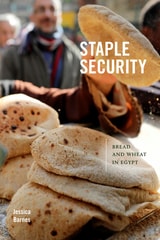
Staple Security
Bread and Wheat in EgyptJessica Barnes
Duke University Press, 2022

Star Charting
Bess Matassa
Duke University Press, 2026
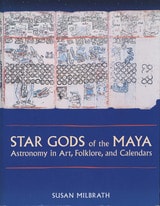
Star Gods of the Maya
Astronomy in Art, Folklore, and CalendarsBy Susan Milbrath
University of Texas Press, 2000
Observations of the sun, moon, planets, and stars played a central role in ancient Maya lifeways, as they do today among contemporary Maya who maintain the traditional ways. This pathfinding book reconstructs ancient Maya astronomy and cosmology through the astronomical information encoded in Precolumbian Maya art and confirmed by the current practices of living Maya peoples.
Susan Milbrath opens the book with a discussion of modern Maya beliefs about astronomy, along with essential information on naked-eye observation. She devotes subsequent chapters to Precolumbian astronomical imagery, which she traces back through time, starting from the Colonial and Postclassic eras. She delves into many aspects of the Maya astronomical images, including the major astronomical gods and their associated glyphs, astronomical almanacs in the Maya codices [painted books], and changes in the imagery of the heavens over time. This investigation yields new data and a new synthesis of information about the specific astronomical events and cycles recorded in Maya art and architecture. Indeed, it constitutes the first major study of the relationship between art and astronomy in ancient Maya culture.
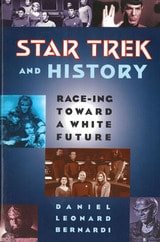
Star Trek and History
Race-ing toward a White FutureBernardi, Daniel Leonard
Rutgers University Press, 1998
Star Trek and History traces the shifting and reforming meaning of race articulated throughout the Star Trek television series, feature films, and fan community. Daniel Bernardi investigates and politicizes the presentation of race in Star Trek in the original series of the 1960s, the feature films and television spin-offs of the 1980s and 1990s, and the current fan community on the Internet. Through both critical and historical analysis, the book proposes a method of studying the framing of race in popular film and television that integrates sociology, critical theory, and cultural studies.
Bernardi examines the representational and narrative functions of race in Star Trek and explores how the meaning of race in the science fiction series has been facilitated or constrained by creative and network decision-making, by genre, by intertextuality, and by fans. He interprets how the changing social and political movements of the times have influenced the production and meaning of Trek texts and the ways in which the ongoing series negotiated and reflected these turbulent histories. Most significantly, Bernardi tells us why is it important for readers to better understand the articulation of race in this enduring icon of American popular culture.

Star Wars Multiverse
Carmelo Esterrich
Rutgers University Press, 2021
Star Wars may have started out as a film about a Manichean battle between good and evil, but as countless filmmakers, novelists, animators, fan artists and even cosplayers have taken the opportunity to play in the fictional world George Lucas created, it has expanded into something far greater, resulting in a richly layered and diverse Star Wars multiverse.
Drawing from a full range of Star Wars media, including comics, children’s books, fan films, and television shows like Clone Wars and The Mandalorian, Carmelo Esterrich explores how these stories set in a galaxy far far away reflect issues that hit closer to home. He examines what they have to say about political oppression, authoritarianism, colonialism, discrimination, xenophobia, and perpetual war. Yet he also investigates subtler ways in which the personal is political within the multiverse, including its articulations of gender and sexuality, its cultural hierarchies of language use, and its complex relationships between humans, droids and myriad species. This book demonstrates that the Star Wars multiverse is not just a stage for thrilling interstellar battles, but also an exciting space for interpretation and discovery.

Star Wars after Lucas
A Critical Guide to the Future of the GalaxyDan Golding
University of Minnesota Press, 2019
Politics, craft, and cultural nostalgia in the remaking of Star Wars for a new age
A long time ago, in a galaxy far, far away—way back in the twenty-first century’s first decade—Star Wars seemed finished. Then in 2012 George Lucas shocked the entertainment world by selling the franchise, along with Lucasfilm, to Disney. This is the story of how, over the next five years, Star Wars went from near-certain extinction to what Wired magazine would call “the forever franchise,” with more films in the works than its first four decades had produced.
Focusing on The Force Awakens (2015), Rogue One (2016), The Last Jedi (2017), and the television series Rebels (2014–18), Dan Golding explores the significance of pop culture nostalgia in overcoming the skepticism, if not downright hostility, that greeted the Star Wars relaunch. At the same time he shows how Disney, even as it tapped a backward-looking obsession, was nonetheless creating genuinely new and contemporary entries in the Star Wars universe.
A host of cultural factors and forces propelled the Disney-engineered Star Wars renaissance, and all figure in Golding’s deeply informed analysis: from John Williams’s music in The Force Awakens to Peter Cushing’s CGI face in Rogue One, to Carrie Fisher’s passing, to the rapidly changing audience demographic. Star Wars after Lucas delves into the various responses and political uses of the new Star Wars in a wider context, as in reaction videos on YouTube and hate-filled, misogynistic online rants. In its granular textual readings, broad cultural scope, and insights into the complexities of the multimedia galaxy, this book is as entertaining as it is enlightening, an apt reflection of the enduring power of the Star Wars franchise.
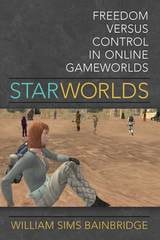
Star Worlds
Freedom Versus Control in Online GameworldsWilliam Sims Bainbridge
University of Michigan Press, 2016
The four “star worlds” explored in this book illustrate the dilemmas concerning the role of technology as liberator or oppressor in our postindustrial society, and represent computer simulations of future possibilities of human experience. Bainbridge considers the relationship between a real person and the role that person plays, the relationship of an individual to society, and the relationship of human beings to computing technology. In addition to collecting ethnographic and quantitative data about the social behavior of other players, he has immersed himself in each of these worlds, role-playing 14 avatars with different skills and goals to gain new insights into the variety of player experience from a personal perspective.
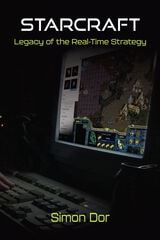
StarCraft
Legacy of the Real-Time StrategySimon Dor
University of Michigan Press, 2024
Apart from the game’s clear landmark status, StarCraft offers a unique insight into changes in gaming culture and, more broadly, the marketability and profit of previously niche areas of interest. The book places StarCraft in the history of real-time strategy games in the 1990s—Dune II, Command & Conquer, Age of Empires—in terms of visual style, narrative tropes, and control. It shows how design decisions, technological infrastructures, and a strong contribution from its gaming community through Battle.net and its campaign editor were necessary conditions for the flexibility it needed to grow its success. In exploring the fanatic clusters of competitive players who formed the first tournaments and professionalized gaming, StarCraft shows that the game was key to the transition towards foreseeing play and essential to competitive gaming and e-sports.

Stardust Monuments
The Saving and Selling of HollywoodAlison Trope
Dartmouth College Press, 2012
Stare in the Darkness
The Limits of Hip-hop and Black PoliticsLester K. Spence
University of Minnesota Press, 2010
A growing number of black activists and artists claim that rap and hip-hop are the basis of an influential new urban social movement. Simultaneously, black citizens evince concern with the effect that rap and hip-hop culture exerts on African American communities. According to a recent Pew survey conducted on the opinions of Black Americans, 71 percent of blacks think that rap is a bad influence. To what extent are African American hopes and fears about hip-hop’s potential political power justified? In Stare in the Darkness, Lester K. Spence answers this question using a blend of neoliberal analysis, survey data, experiments, and case studies.
Spence finds that rap does in fact influence black political attitudes. However, rap also reproduces rather than critiques neoliberal ideology. Furthermore, black activists seeking to create an innovative model of hip-hop politics are hamstrung by their reliance on outmoded forms of organizing. By considering the possibilities inherent in the most prolific and prominent activities of hip-hop politics, Stare in the Darkness reveals, in a clear and practical manner, the political consequences of rap culture for black publics.
Starring Mandela and Cosby
Media and the End(s) of ApartheidRon Krabill
University of Chicago Press, 2010
During the worst years of apartheid, the most popular show on television in South Africa—among both Black and White South Africans—was The Cosby Show. Why did people living under a system built on the idea that Black people were inferior and threatening flock to a show that portrayed African Americans as comfortably mainstream? Starring Mandela and Cosby takes up this paradox, revealing the surprising impact of television on racial politics.
The South African government maintained a ban on television until 1976, and according to Ron Krabill, they were right to be wary of its potential power. The medium, he contends, created a shared space for communication in a deeply divided nation that seemed destined for civil war along racial lines. At a time when it was illegal to publish images of Nelson Mandela, Bill Cosby became the most recognizable Black man in the country, and, Krabill argues, his presence in the living rooms of white South Africans helped lay the groundwork for Mandela’s release and ascension to power.
Weaving together South Africa’s political history and a social history of television, Krabill challenges conventional understandings of globalization, offering up new insights into the relationship between politics and the media.
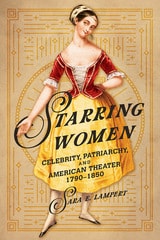
Starring Women
Celebrity, Patriarchy, and American Theater, 1790-1850Sara E. Lampert
University of Illinois Press, 2020
A revealing foray into a lost time, Starring Women returns a generation of performers to their central place in the early history of American theater.

Stars Fell on Alabama
Carl Carmer
University of Alabama Press, 2000
A timeless journey into the heart and folklore of Alabama.
Stars Fell on Alabama is a landmark work of Southern literature that transports readers to Alabama during the early 20th century. Written by Carl Carmer, this evocative narrative blends memoir, travel writing, and folklore to paint a rich portrait of a region steeped in tradition and complexity. Carmer captures the rhythms of rural life, the haunting beauty of the landscape, and the voices of its people—farmers, musicians, storytellers—whose tales reveal the cultural fabric of the Deep South. From ghost stories and folk songs to accounts of social customs and racial tensions, this book offers an unflinching yet affectionate look at Alabama’s heritage. Both a historical document and a literary masterpiece, Stars Fell on Alabama remains essential reading for anyone interested in Southern history, American folklore, and the enduring power of storytelling.
Starting Over
Feminism and the Politics of Cultural CritiqueJudith Newton
University of Michigan Press, 1994
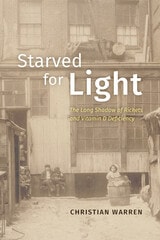
Starved for Light
The Long Shadow of Rickets and Vitamin D DeficiencyChristian Warren
University of Chicago Press, 2024
Rickets, a childhood disorder that causes soft and misshapen bones, transformed from an ancient but infrequent threat to a common scourge during the Industrial Revolution. Factories, mills, and urban growth transformed the landscape. Malnutrition and insufficient exposure to sunlight led to severe cases of rickets across Europe and the United States, affecting children in a variety of settings: dim British cities and American slave labor camps, moneyed households and impoverished ones. By the late 1800s, it was one of the most common pediatric diseases, seemingly an intractable consequence of modern life.
Starved for Light offers the first comprehensive history of this disorder. Tracing the efforts to understand, prevent, and treat rickets—first with the traditional remedy of cod liver oil, then with the application of a breakthrough corrective, industrially produced vitamin D supplements—Christian Warren places the disease at the center of a riveting medical history, one alert to the ways society shapes our views on illness. Warren shows how physicians and public health advocates in the United States turned their attention to rickets among urban immigrants, both African Americans and southern Europeans; some concluded that the disease was linked to race, while others blamed poverty, sunless buildings and cities, or cultural preferences in diet and clothing. Spotlighting rickets’ role in a series of medical developments, Warren leads readers through the encroachment on midwifery by male obstetricians, the development of pediatric orthopedic devices and surgeries, early twentieth-century research into vitamin D, appalling clinical experiments on young children testing its potential, and the eventual commercialization of all manner of vitamin D supplements. As vitamin D consumption rose in the mid-twentieth century, rickets—previously a major concern for doctors, parents, and public health institutions—faded in its severity and frequency, and as a topic of discussion. But despite the availability of drugstore supplements and fortified milk, small numbers of cases still appear today, and concerns and controversies about vitamin D deficiency in general continue to grow.
Sweeping and engaging, Starved for Light illuminates the social conditions underpinning our cures and our choices, helping us to see history’s echoes in contemporary prescriptions.

Starved for Light
The Long Shadow of Rickets and Vitamin D DeficiencyChristian Warren
University of Chicago Press, 2024
A wide-ranging history of rickets tracks the disease’s emergence, evolution, and eventual treatment—and exposes the backstory behind contemporary worries about vitamin D deficiency.
Rickets, a childhood disorder that causes soft and misshapen bones, transformed from an ancient but infrequent threat to a common scourge during the Industrial Revolution. Factories, mills, and urban growth transformed the landscape. Malnutrition and insufficient exposure to sunlight led to severe cases of rickets across Europe and the United States, affecting children in a variety of settings: dim British cities and American slave labor camps, moneyed households and impoverished ones. By the late 1800s, it was one of the most common pediatric diseases, seemingly an intractable consequence of modern life.
Starved for Light offers the first comprehensive history of this disorder. Tracing the efforts to understand, prevent, and treat rickets—first with the traditional remedy of cod liver oil, then with the application of a breakthrough corrective, industrially produced vitamin D supplements—Christian Warren places the disease at the center of a riveting medical history, one alert to the ways society shapes our views on illness. Warren shows how physicians and public health advocates in the United States turned their attention to rickets among urban immigrants, both African Americans and southern Europeans; some concluded that the disease was linked to race, while others blamed poverty, sunless buildings and cities, or cultural preferences in diet and clothing. Spotlighting rickets’ role in a series of medical developments, Warren leads readers through the encroachment on midwifery by male obstetricians, the development of pediatric orthopedic devices and surgeries, early twentieth-century research into vitamin D, appalling clinical experiments on young children testing its potential, and the eventual commercialization of all manner of vitamin D supplements. As vitamin D consumption rose in the mid-twentieth century, rickets—previously a major concern for doctors, parents, and public health institutions—faded in its severity and frequency, and as a topic of discussion. But despite the availability of drugstore supplements and fortified milk, small numbers of cases still appear today, and concerns and controversies about vitamin D deficiency in general continue to grow.
Sweeping and engaging, Starved for Light illuminates the social conditions underpinning our cures and our choices, helping us to see history’s echoes in contemporary prescriptions.

Starved for Light
The Long Shadow of Rickets and Vitamin D DeficiencyChristian Warren
University of Chicago Press, 2024
A wide-ranging history of rickets tracks the disease’s emergence, evolution, and eventual treatment—and exposes the backstory behind contemporary worries about vitamin D deficiency.
Rickets, a childhood disorder that causes soft and misshapen bones, transformed from an ancient but infrequent threat to a common scourge during the Industrial Revolution. Factories, mills, and urban growth transformed the landscape. Malnutrition and insufficient exposure to sunlight led to severe cases of rickets across Europe and the United States, affecting children in a variety of settings: dim British cities and American slave labor camps, moneyed households and impoverished ones. By the late 1800s, it was one of the most common pediatric diseases, seemingly an intractable consequence of modern life.
Starved for Light offers the first comprehensive history of this disorder. Tracing the efforts to understand, prevent, and treat rickets—first with the traditional remedy of cod liver oil, then with the application of a breakthrough corrective, industrially produced vitamin D supplements—Christian Warren places the disease at the center of a riveting medical history, one alert to the ways society shapes our views on illness. Warren shows how physicians and public health advocates in the United States turned their attention to rickets among urban immigrants, both African Americans and southern Europeans; some concluded that the disease was linked to race, while others blamed poverty, sunless buildings and cities, or cultural preferences in diet and clothing. Spotlighting rickets’ role in a series of medical developments, Warren leads readers through the encroachment on midwifery by male obstetricians, the development of pediatric orthopedic devices and surgeries, early twentieth-century research into vitamin D, appalling clinical experiments on young children testing its potential, and the eventual commercialization of all manner of vitamin D supplements. As vitamin D consumption rose in the mid-twentieth century, rickets—previously a major concern for doctors, parents, and public health institutions—faded in its severity and frequency, and as a topic of discussion. But despite the availability of drugstore supplements and fortified milk, small numbers of cases still appear today, and concerns and controversies about vitamin D deficiency in general continue to grow.
Sweeping and engaging, Starved for Light illuminates the social conditions underpinning our cures and our choices, helping us to see history’s echoes in contemporary prescriptions.
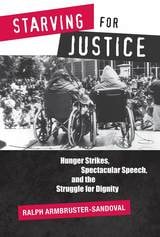
Starving for Justice
Hunger Strikes, Spectacular Speech, and the Struggle for DignityRalph Armbruster-Sandoval
University of Arizona Press, 2017
In the 1990s three college campuses in California exploded as Chicano/a and Latino/a students went on hunger strikes. Through courageous self-sacrifice, these students risked their lives to challenge racial neoliberalism, budget cuts, and fee increases. The strikers acted and spoke spectacularly and, despite great odds, produced substantive change.
Social movement scholars have raised the question of why some people risk their lives to create a better world. In Starving for Justice, Ralph Armbruster-Sandoval uses interviews and archival material to examine people’s willingness to make the extreme sacrifice and give their lives in order to create a more just society.
Popular memory and scholarly discourse around social movements have long acknowledged the actions of student groups during the 1960s. Now Armbruster-Sandoval extends our understanding of social justice and activism, providing one of the first examinations of Chicana/o and Latina/o student activism in the 1990s.
Students at University of California, Los Angeles; University of California, Santa Barbara; and Stanford University went on hunger strikes to demand the establishment and expansion of Chicana/o studies departments. They also had even broader aspirations—to obtain dignity and justice for all people. These students spoke eloquently, making their bodies and concerns visible. They challenged anti-immigrant politics. They scrutinized the rapid growth of the prison-industrial complex, racial and class polarization, and the university’s neoliberalization. Though they did not fully succeed in having all their demands met, they helped generate long-lasting social change on their respective campuses, making those learning institutions more just.