Results by title
22279 books match the query 'Social Science' and 1635 start with s

Stepchildren of Nature
Krafft-Ebing, Psychiatry, and the Making of Sexual IdentityHarry Oosterhuis
University of Chicago Press, 2000
But in this powerful new cultural history Harry Oosterhuis invites us to reconsider the quality and extent of Krafft-Ebing's influence. Revisiting the case studies on which Krafft-Ebing based his findings, and thus drawing on the voices of his patients and informants, Oosterhuis finds that Krafft-Ebing was not the harsh judge of perversions that we think he was. He argues that Krafft-Ebing had a deep appreciation of the psyche, and that his work reveals an attempt to separate sexual deviancies from ideas of immorality. In the tradition of Freud, then, Krafft-Ebing should stand not as a villain, but as a contributor to more modern notions of sexual identity.
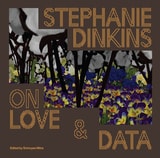
Stephanie Dinkins
On Love & DataSrimoyee Mitra
University of Michigan Press, 2024
Stephanie Dinkins: On Love & Data brings together nationally renowned curators and theorists who draw from methodologies of art criticism, social practice, new media theory, and critical studies to offer an in-depth analysis of key installations in Dinkins’s survey exhibition. The book also includes an important essay by Stephanie Dinkins on her concept of Afro-now-ism in which she expands on her theoretical framework and positionality as a Black new media artist in the 21st century. Dinkins’s artistic research transcends the boundaries of visual art to challenge and expose the bias and inequities of caste, race, and gender, which are encoded within digital systems on which governance, healthcare, and security infrastructures in the United States are based.

Stephen King on the Small Screen
Mark Browning
Intellect Books, 2011
In this follow up to Stephen King on the Big Screen, Mark Browning turns his critical eye to the much-neglected subject of the best-selling author’s work in television, examining what it is about King’s fiction that makes it particularly suitable for the small screen.
By focusing on this body of work, from the highly successful The Stand and The Night Flier to the lesser-known TV films Storm of the Century, Rose Red, Kingdom Hospital, and the 2004 remake of Salem’s Lot, Browning is able to articulate how these adaptations work and, in turn, suggest new ways of viewing them. This book is the first written by a film specialist to consider King’s television work in its own right, and it rejects previous attempts to make the films and books fit rigid thematic categories. Browning examines what makes a written or visual text successful at evoking fear on a case-by-case basis, in a highly readable and engaging way. He also considers the relationship between the big and small screen. Why, for instance, are some TV versions more effective than movie adaptations and vice versa? In the process, Stephen King on the Small Screen is able to shed new light on what it is that makes King’s novels so successful and reveal the elements of style and approach that have helped make King one of the world’s best-selling authors.

Stephen King's America
Jonathan P. Davis
University of Wisconsin Press, 1994
Stephen King's America aims to heighten awareness of the numerous American issues that resonate throughout King's fiction, issues that bear universal application to the evolution of the human condition.
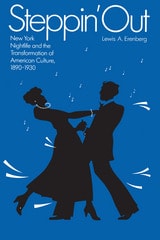
Steppin' Out
New York Nightlife and the Transformation of American CultureLewis A. Erenberg
University of Chicago Press, 1984

Steppin' on the Blues
The Visible Rhythms of African American DanceJacqui Malone
University of Illinois Press, 1996
pantheon of world art.
Steppin' on the Blues explores not only the meaning of dance in African American life but also the ways in which music, song, and dance are interrelated in African American culture. Dance as it has emanated from the black community is a pervasive, vital, and distinctive form of expression--its movements speak eloquently of African American values and aesthetics. Beyond that it has been, finally, one of the most important means of cultural survival.
Former dancer Jacqui Malone throws a fresh spotlight on the cultural history of black dance, the Africanisms that have influenced it, and the significant role that vocal harmony groups, black college and university marching bands, and black sorority and fraternity stepping teams have played in the evolution of dance in African American life. From the cakewalk to the development of jazz dance and jazz music, all Americans can take pride in the vitality, dynamism, drama, joy, and uncommon singularity with which African American dance has gifted the world.
Stepping Forward
Black Women in Africa and the AmericasCatherine Higgs
Ohio University Press, 2002
A unique and important study, Stepping Forward examines the experiences of nineteenth- and twentieth-century black women in Africa and African diaspora communities from a variety of perspectives in a number of different settings.
This wide-ranging collection designed for classroom use explores the broad themes that have shaped black women’s goals, options, and responses: religion, education, political activism, migration, and cultural transformation. Essays by leading scholars in the field examine the lives of black women in the United States and the Caribbean Basin; in the white settler societies of Kenya, Zimbabwe, and South Africa; and in the black settler societies of Liberia and Sierra Leone.
Among the contributors to this volume are historians, political scientists, and scholars of literature, music, and law. What emerges from their work is an image of black women’s agency, self-reliance, and resiliency. Despite cultural differences and geographical variations, black women have provided foundations on which black communities have not only survived, but also thrived. Stepping Forward is a valuable addition to our understanding of women’s roles in these diverse communities.
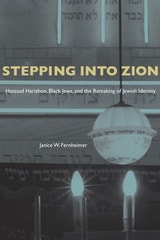
Stepping Into Zion
Hatzaad Harishon, Black Jews, and the Remaking of Jewish IdentityJanice W. Fernheimer
University of Alabama Press, 2014
Considers the question “Who is a Jew?”— a critical rhetorical issue with far-reaching consequences for Jews and non-Jews alike
Hatzaad Harishon ("The First Step") was a New York-based, multiracial Jewish organization that worked to increase recognition and legitimacy for Black Jews in the sixties and seventies. In Stepping into Zion, Janice W. Fernheimer examines the history and archives of Hatzaad Harishon to illuminate the shifting definitions and borders of Jewish identity, which have critical relevance to Jews of all traditions as well as to non-Jews.
Fernheimer focuses on a period when Jewish identity was in flux and deeply influenced by the Civil Rights and Black Power movements. In 1964, white and Black Jews formed Hatzaad Harishon to foster interaction and unity between Black and white Jewish communities. They raised the question of who or what constitutes Jewishness or Jewish identity, and in searching for an answer succeeded—both historically and rhetorically—in gaining increased recognition for Black Jews. Fernheimer traces how, despite deep disagreement over definitions, members of Hatzaad Harishon were able to create common ground in a process she terms "interruptive invention": an incremental model for rhetorical success that allows different groups to begin and continue important but difficult discussions when they share little common ground or make unequal claims to institutional and discursive power, or when the nature of common ground is precisely what is at stake. Consequently, they provide a practical way out of the seemingly incommensurable stalemate incompatible worldviews present.
Through insightful interpretations of Hatzaad Harishon's archival materials, Fernheimer chronicles the group's successes and failures within the larger rhetorical history of conflicts that emerge when cultural identities shift or expand.
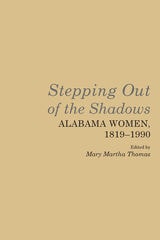
Stepping Out of the Shadows
Alabama Women, 1819–1990Mary Martha Thomas
University of Alabama Press, 1995
Discover the women who transformed Alabama's past and continue to inspire its future.
The history of Alabama has been told, but most often in terms of white men and their politics and economics. Now a more complex story of the state is emerging from the shadows of history in a new book that investigates the place of women from the perspective of race, class, and gender. Stepping Out of the Shadows, is a compilation of articles first presented at the 1990 Alabama Women’s History Forum in Birmingham, and edited by Mary Martha Thomas. The writers discuss the lives of women in antebellum Alabama and reexamine the roles of both black and white women as missionaries during Reconstruction, as reformers and suffrage leaders in the Progressive era, and as members of the state legislature in the 20th century.
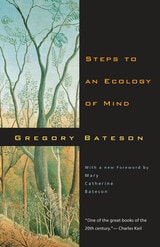
Steps to an Ecology of Mind
Collected Essays in Anthropology, Psychiatry, Evolution, and EpistemologyGregory Bateson
University of Chicago Press, 2000
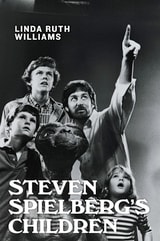
Steven Spielberg's Children
Linda Ruth Williams
Rutgers University Press, 2025
Steven Spielberg’s Children presents children and childhood in some surprising ways, not only analyzing boyhood and girlhood according to Spielberg, but considering children as alien, adult-children who refuse to grow up, and children who aren’t even human. It discusses the way in which children have served to cast Spielberg as a sentimentalist, but also how they are more frequently framed as complex, cruel, and canny. The child might be dangled as bait in an exploitation horror scenario (Jaws), might become the image of universal higher beings (Close Encounters of the Third Kind), or might be a young cultural creator like the director was himself (The Fabelmans), "born with a camera glued to [his] eye." The child, on both sides of the camera, is a resonant image, signifying all that adult culture wants it to be, yet resisting this through authorship of their own stories. The book also looks at Spielberg's young actors in the long history of child stars in theater and cinema, and how Spielberg’s children have fared as performers and celebrities.
Stewards of the House
Detective Fiction of Jonathan LatimerBill Brubaker
University of Wisconsin Press, 1993
Jonathan Latimer (1906-1983) wrote nine detective novels. He also wrote or co-wrote 20 film scripts, including such noir classics as the second version of Dasheill Hammett's The Glass Key, Kenneth Fearing's The Big Clock, and Cornell Woolrich's The Night Has a Thousand Eyes. Moving to television writing, he scripted 45 original stories and adapted 50 Eric Stanley Gardner novels for the Perry Mason series.

Sticking Stigma
Performance, Affect, and the Movement of Social NormsDani Snyder-Young
Vanderbilt University Press, 2026
Applied theater projects have been used to reduce the stigma related to many health conditions including bipolar disorder, HIV, suicide bereavement, mental illness, autism, and substance use disorder. Beyond this applied theater tradition, theater and performance studies tend not to use the framework or language of stigma very often. Stigma is a more commonly used framework in social science fields such as health and sociology. However, theater and performance regularly attends to the material and affective violence of stigma power: oppression, dispossession, abjection, objectification, expulsion. Snyder-Young examines a set of activist performance projects attempting to use the force of stigma to redistribute and recenter social power.
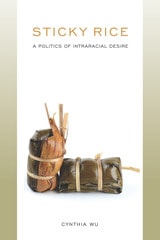
Sticky Rice
A Politics of Intraracial DesireCynthia Wu
Temple University Press, 2018
Cynthia Wu’s provocative Sticky Rice examines representations of same-sex desires and intraracial intimacies in some of the most widely read pieces of Asian American literature. Analyzing canonical works such as John Okada’s No-No Boy, Monique Truong’s The Book of Salt, H. T. Tsiang’s And China Has Hands, and Lois-Ann Yamanaka’s Blu’s Hanging, as well as Philip Kan Gotanda’s play, Yankee Dawg You Die, Wu considers how male relationships in these texts blur the boundaries among the homosocial, the homoerotic, and the homosexual in ways that lie beyond our concepts of modern gay identity.
The “sticky rice” of Wu’s title is a term used in gay Asian American culture to describe Asian American men who desire other Asian American men. The bonds between men addressed in Sticky Rice show how the thoughts and actions founded by real-life intraracially desiring Asian-raced men can inform how we read the refusal of multiple normativities in Asian Americanist discourse. Wu lays bare the trope of male same-sex desires that grapple with how Asian America’s internal divides can be resolved in order to resist assimilation.
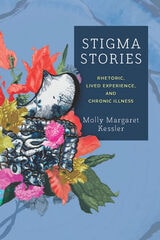
Stigma Stories
Rhetoric, Lived Experience, and Chronic IllnessMolly Margaret Kessler
The Ohio State University Press, 2022
Engaging interdisciplinary conversations from the rhetoric of health and medicine, disability studies, narrative medicine, and sociology, Kessler takes an innovative look at how stigma functions on individual, interpersonal, and societal levels. In doing so, Kessler reveals how stories and lived experiences have much to teach us not only about how stigma functions but also about how it can be dismantled.
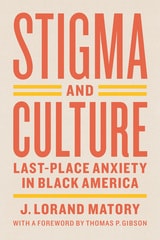
Stigma and Culture
Last-Place Anxiety in Black AmericaJ. Lorand Matory
University of Chicago Press, 2015
Matory describes the competitive process that hierarchically structures their self-definition as ethnic groups and the similar process by which middle-class African Americans seek distinction from their impoverished compatriots. Drawing on research at universities such as Howard, Harvard, and Duke and among their alumni networks, he details how university life—while facilitating individual upward mobility, touting human equality, and regaling cultural diversity—also perpetuates the cultural standards that historically justified the dominance of some groups over others. Combining his ethnographic findings with classic theoretical insights from Frantz Fanon, Fredrik Barth, Erving Goffman, Pierre Bourdieu and others—alongside stories from his own life in academia—Matory sketches the university as an institution that, particularly through the anthropological vocabulary of culture, encourages the stigmatized to stratify their own.
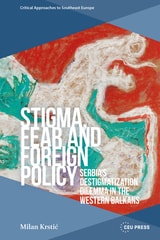
Stigma, Fear and Foreign Policy
Serbia’s Destigmatization Dilemma in the Western BalkansMilan Krstic
Central European University Press, 2026
The central argument is that Serbia’s decision-makers grappled with a “destigmatization dilemma,” perceiving that actions aimed at facilitating Serbia’s destigmatization within international society could simultaneously undermine its security in regional relations with former adversaries. This produced a dillema between prioritizing destigmatization or security concerns. Through an examination of Serbia’s relations with Croatia and Bosnia and Herzegovina, the book explores how decision-makers navigated this dilemma, focusing on two key perceptions: the level of threat posed by the former adversary, and the perceived importance of the bilateral relationship for its destigmatization goals.
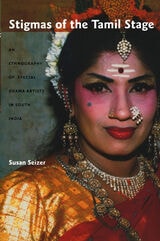
Stigmas of the Tamil Stage
An Ethnography of Special Drama Artists in South IndiaSusan Seizer
Duke University Press, 2005
Special Drama is looked down upon by the middle- and upper-classes as too popular, too vulgar, and too “mixed.” The artists are stigmatized: people insult them in public and landlords refuse to rent to them. Stigma falls most heavily, however, on actresses, who are marked as “public women” by their participation in Special Drama. As Susan Seizer’s sensitive study shows, one of the primary ways the performers deal with such stigma is through humor and linguistic play. Their comedic performances in particular directly address questions of class, culture, and gender deviations—the very issues that so stigmatize them. Seizer draws on extensive interviews with performers, sponsors, audience members, and drama agents as well as on careful readings of live Special Drama performances in considering the complexities of performers’ lives both on stage and off.

Still Connected
Family and Friends in America Since 1970Claude S. Fischer
Russell Sage Foundation, 2011

Still Dangerous!
The Harmony Hammond ReaderHarmony Hammond. Edited by Tirza True Latimer.
Duke University Press, 2026
Still Life in Real Time
Theory After TelevisionRichard Dienst
Duke University Press, 1994
Five theoretical projects provide Still Life in Real Time with its framework: the cultural studies tradition of Raymond Williams; Marxist political economy; Heideggerian existentialism; Derridean deconstruction; and a Deleuzian anatomy of images. Drawing lessons from television programs like Twin Peaks and Crime Story, television events like the Gulf War, and television personalities like Madonna, Dienst produces a remarkable range of insights on the character of the medium and on the theories that have been affected by it.
From the earliest theorists who viewed television as a new metaphor for a global whole, a liberal technology empty of ideological or any other content, through those who saw it as a tool for consumption, making time a commodity, to those who sense television’s threat to being and its intimate relation to power, Dienst exposes the rich pattern of television’s influence on philosophy, and hence on the deepest levels of contemporary experience.
A book of theory, Still Life in Real Time will compel the attention of all those with an interest in the nature of the ever present, ever shifting medium and its role in the thinking that marks our time.
Still Life
Ecologies of the Modern Imagination at the Art MuseumFernando Domínguez Rubio
University of Chicago Press, 2020
Still Life offers a fascinating and detailed ethnographic account of what it takes to prevent these disasters from happening. Going behind the scenes at MoMA, Domínguez Rubio provides a rare view of the vast technological apparatus—from climatic infrastructures and storage facilities, to conservation labs and machine rooms—and teams of workers—from conservators and engineers to guards and couriers—who fight to hold artworks still.
As MoMA reopens after a massive expansion and rearranging of its space and collections, Still Life not only offers a much-needed account of the spaces, actors, and forms of labor traditionally left out of the main narratives of art, but it also offers a timely meditation on how far we, as a society, are willing to go to keep the things we value from disappearing into oblivion.
Still The Big News
Racial Oppression In AmericaBob Blauner
Temple University Press, 2001
Blauner launched his concept of internal colonialism in the turbulent 1960's, a period in which many Americans worried that racial conflicts would propel the country into another civil war. The notion that the systematic oppression of people of color in the United States resembles the situation of colonized populations in Third World countries still informs much of the academic research on race as well as public discourse. Indeed, today's critical race and whiteness studies are deeply indebted to Blauner's work on internal colonialism and the pervasiveness of white privilege. Offering a radical perspective on the United States' racial landscape, Bob Blauner forcefully argues that we ignore the persistence of oppression and our continuing failure to achieve equality at our own peril.
Still, the Small Voice
Narrative, Personal Revelation, and the Mormon Folk TraditionTom Mould
Utah State University Press, 2011
Memorates—personal experience narratives of encounters with the supernatural—that recount individuals’ personal revelations, primarily through the Holy Ghost, are a pervasive aspect of the communal religious experience of Mormons, members of the Church of Jesus Christ of Latter-day Saints. In accordance with current emphases in folklore studies on narrative and belief, Tom Mould uses ethnographic research and an emic approach that honors the belief systems under study to analyze how people within Mormon communities frame and interpret their experiences with the divine through the narratives they share. In doing so, he provides a significant new ethnographic interpretation of Mormon culture and belief and also applies his findings directly to broader scholarly folklore discourse on performance, genre, personal experience narrative, belief, and oral versus written traditions.
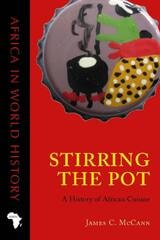
Stirring the Pot
A History of African CuisineJames C. McCann
Ohio University Press, 2009
Africa’s art of cooking is a key part of its history. All too often Africa is associated with famine, but in Stirring the Pot, James C. McCann describes how the ingredients, the practices, and the varied tastes of African cuisine comprise a body of historically gendered knowledge practiced and perfected in households across diverse human and ecological landscape. McCann reveals how tastes and culinary practices are integral to the understanding of history and more generally to the new literature on food as social history.
Stirring the Pot offers a chronology of African cuisine beginning in the sixteenth century and continuing from Africa’s original edible endowments to its globalization. McCann traces cooks’ use of new crops, spices, and tastes, including New World imports like maize, hot peppers, cassava, potatoes, tomatoes, and peanuts, as well as plantain, sugarcane, spices, Asian rice, and other ingredients from the Indian Ocean world. He analyzes recipes, not as fixed ahistorical documents,but as lively and living records of historical change in women’s knowledge and farmers’ experiments. A final chapter describes in sensuous detail the direct connections of African cooking to New Orleans jambalaya, Cuban rice and beans, and the cooking of African Americans’ “soul food.”
Stirring the Pot breaks new ground and makes clear the relationship between food and the culture, history, and national identity of Africans.
Stirrings In The Jug
Black Politics In The Post-Segregation EraAdolph Reed, Jr.
University of Minnesota Press, 1999
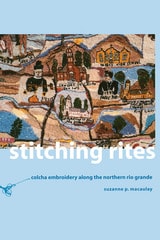
Stitching Rites
Colcha Embroidery along the Northern Rio GrandeSuzanne P. MacAulay
University of Arizona Press, 2000
In the San Luis Valley of southern Colorado, there thrives a folk tradition with links to both the past and future.
Colcha embroidery is a traditional Spanish colonial style of textile, bed covering, or wall hanging dating from the early nineteenth century. In the first book to consider this craft, Suzanne MacAulay provides a detailed account of this folk art tradition that is both old and constantly renewing itself, presenting a sensitive portrayal of artists and the contexts in which they live and work.
Stitching Rites reveals how art, history, and memory interweave in a rich creative web. Based on archival research and on extensive interviews with artists, the book reveals the personal motivations of the embroiderers and their relationships with their work, with each other, with their community, and with outsiders. Through stitchers like Josephine Lobato and the San Luis Ladies Sewing Circle, MacAulay shows how colcha creation is bound up in a perpetual round of cultural commentary and self-reflection.
MacAulay includes detailed descriptions of changes in stitching techniques, themes, and styles to show the impact of a wide range of outside influences on the lives of the artists and on the art form. She also provides a discussion of New Mexican Carson colchas and their place in the collector market. By focusing on the individual creative act, she shows how colcha embroidery is used to record how a stitcher's memories of her life are intertwined with the history of her community.
Through this picture of a community of embroiderers, MacAulay helps us to understand their stitching rites and sheds new light on the relationship between Hispanic and Anglo cultures.

Stolen Bases
Why American Girls Don't Play BaseballJennifer Ring
University of Illinois Press, 2013
Jennifer Ring questions the forces that try to keep girls who want to play baseball away from the game. Focusing on a history that, unfortunately, repeats itself, Ring describes the circumstances that twice stole baseball from American girls: once in the late nineteenth and early twentieth century, and again in the late twentieth century, after it was no longer legal to exclude girls who wanted to play. In the early twentieth century, Albert Goodwill Spalding--sporting goods magnate, baseball player, and promoter--declared baseball off limits for women and envisioned global baseball on a colonialist scale, using the American sport to teach men from non-white races and non-European cultures to become civilized and rational. And by the late twentieth century, baseball had become serious business for boys and men at all levels, with female players perceived as obstacles or detriments to rising male players' chances of success.
Stolen Bases also looks at the backgrounds of American softball, which was originally invented by men who wanted to keep playing baseball indoors during cold winter months but has become the consolation sport for most female players. Throughout her analysis, Ring searches for ways to rescue baseball from its arrogance and sense of exclusionary entitlement.

Stolen Life
Fred Moten
Duke University Press, 2018
In Stolen Life—the second volume in his landmark trilogy consent not to be a single being—Fred Moten undertakes an expansive exploration of blackness as it relates to black life and the collective refusal of social death. The essays resist categorization, moving from Moten's opening meditation on Kant, Olaudah Equiano, and the conditions of black thought through discussions of academic freedom, writing and pedagogy, non-neurotypicality, and uncritical notions of freedom. Moten also models black study as a form of social life through an engagement with Fanon, Hartman, and Spillers and plumbs the distinction between blackness and black people in readings of Du Bois and Nahum Chandler. The force and creativity of Moten's criticism resonate throughout, reminding us not only of his importance as a thinker, but of the continued necessity of interrogating blackness as a form of sociality.
Stolen Time
Black Fad Performance and the Calypso CrazeShane Vogel
University of Chicago Press, 2018
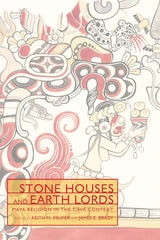
Stone Houses and Earth Lords
Maya Religion in the Cave ContextKeith M. Prufer
University Press of Colorado, 2021
Demonstrating the importance of these subterranean spaces to Maya archaeology, contributors provide interpretations of archaeological remains that yield insights into Maya ritual and cosmology. Compiling the best current scholarship in this fast-growing area of research, Stone Houses and Earth Lords is a vital reference for Mayanists, Mesoamerican specialists, and others interested in the human use of caves in the New World. Contributors include: Juan Luis Bonor, James E. Brady, Robert Burnett, Allan B. Cobb, Pierre Robert Colas, Cesar Espinosa, Sergio Garza, David M. Glassman, Christina T. Halperin, Amalia Kenward, Andrew Kindon, Patricia McAnany, Christopher Morehart, Holley Moyes, Vanessa A. Owen, Shankari Patel, Polly Peterson, Keith M. Prufer, Timothy. W. Pugh, Frank Saul, Julie Saul, Ann M. Scott, Andrea Stone, and Vera Tiesler.
Stone Masters
Power Encounters in Mainland Southeast AsiaEdited by Holly High
National University of Singapore Press, 2022
Stones and stone masters are an important focus of animist religious practice in Southeast Asia. Recent studies on animism see animist rituals not as a mere metaphor for community or shared values, but as a way of forming and maintaining relationships with occult presences. This book features city pillars, statues, megaliths, termite mounds, mountains, rocks found in forests, and stones that have been moved to shrines, as well as the territorial cults which can form around them. The contributors extend and deepen the recent literature on animism to form a new analytical perspective on these cults across mainland Southeast Asia. Not just a collection of exemplary ethnographies, Stone Masters is also a deeply comparative volume that develops its ideas through a meshwork of regional entanglements, parallels, and differences, before entering into a dialogue with debates on power, mastery, and the social theory of animism globally.
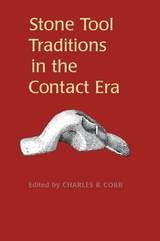
Stone Tool Traditions in the Contact Era
Edited by Charles Richard Cobb
University of Alabama Press, 2003
Explores the impact of European colonization on Native American and Pacific Islander technology and culture
This is the first comprehensive analysis of the partial replacement of flaked stone and ground stone traditions by metal tools in the Americas during the Contact Era. It examines the functional, symbolic, and economic consequences of that replacement on the lifeways of native populations, even as lithic technologies persisted well after the landing of Columbus. Ranging across North America and to Hawai'i, the studies show that, even with wide access to metal objects, Native Americans continued to produce certain stone tool types—perhaps because they were still the best implements for a task or because they represented a deep commitment to a traditional practice.Chapters are ordered in terms of relative degree of European contact, beginning with groups that experienced brief episodes of interaction, such as the Wichita-French meeting on the Arkansas River, and ending with societies that were heavily influenced by colonization, such as the Potawatomi of Illinois. Because the anthology draws comparisons between the persistence of stone tools and the continuity of other indigenous crafts, it presents holistic models that can be used to explain the larger consequences of the Contact Era.
Marvin T. Smith, of Valdosta State University has stated that, “after reading this volume, no archaeologist will ever see the replacement of lithic technology by metal tools as a simple matter of replacement of technologically inferior stone tools with their superior metal counterparts. This is cutting-edge scholarship in the area of contact period studies.”
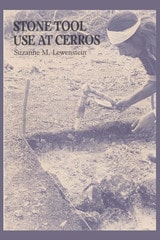
Stone Tool Use at Cerros
The Ethnoarchaeological and Use-Wear EvidenceBy Suzanne M. Lewenstein
University of Texas Press, 1987
For centuries scholars have pondered and speculated over the uses of the chipped stone implements uncovered at archaeological sites. Recently a number of researchers have attempted to determine prehistoric tool function through experimentation and through observation of the few remaining human groups who still retain this knowledge. Learning how stone tools were made and used in the past can tell us a great deal about ancient economic systems, exchange networks, and the social and political structure of prehistoric societies.
Suzanne M. Lewenstein used the artifacts from Cerros, an important Late Preclassic (200 BC–AD 200) Mayan site in northern Belize, to study stone tool function. Through a comprehensive program of experimentation with stone tool replicas, she was able not only to infer the tasks performed by individual tool specimens but also to recognize a wide variety of past activities for which stone tools were used.
Unlike previous works that focused on hunter-gatherer groups, Stone Tool Use at Cerros is the first comprehensive experimental study of tool use in an agricultural society. The lithic data are used in an economic interpretation of a lowland Mayan community within a hierarchically complex society.
Apart from its significance to Mayan studies, this innovative work offers the beginnings of a reference collection of identifiable tool functions that may be documented for sedentary, complex society. It will be of major interest to all archaeologists and anthropologists, as well as those interested in economic specialization and artisanry in complex societies.
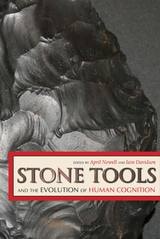
Stone Tools and the Evolution of Human Cognition
April Nowell
University Press of Colorado, 2010
Dating as far back as 2.5-2.7 million years ago, stone tools were used in cutting up animals, woodworking, and preparing vegetable matter. Today, lithic remains give archaeologists insight into the forethought, planning, and enhanced working memory of our early ancestors. Contributors focus on multiple ways in which archaeologists can investigate the relationship between tools and the evolving human mind-including joint attention, pattern recognition, memory usage, and the emergence of language.
Offering a wide range of approaches and diversity of place and time, the chapters address issues such as skill, social learning, technique, language, and cognition based on lithic technology. Stone Tools and the Evolution of Human Cognition will be of interest to Paleolithic archaeologists and paleoanthropologists interested in stone tool technology and cognitive evolution.
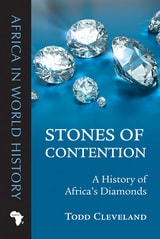
Stones of Contention
A History of Africa’s DiamondsTodd Cleveland
Ohio University Press, 2014
Africa supplies the majority of the world’s diamonds, yet consumers generally know little about the origins and history of these precious stones beyond sensationalized media accounts of so-called blood diamonds.
Stones of Contention explores the major developments in the remarkable history of Africa’s diamonds, from the earliest stirrings of international interest in the continent’s mineral wealth in the first millennium A.D. to the present day. In the European colonial period, the discovery of diamonds in South Africa ushered in an era of unprecedented greed during which monopolistic enterprises exploited both the mineral resources and the indigenous workforce. In the aftermath of World War II, the governments of newly independent African states, both democratic and despotic, joined industry giant De Beers and other corporations to oversee and profit from mining activity on the continent.
The book also considers the experiences of a wide array of Africans—from informal artisanal miners, company mineworkers, and indigenous authorities to armed rebels, mining executives, and premiers of mineral-rich states—and their relationships to the stones that have the power to bring both wealth and misery. With photos and maps, Stones of Contention illustrates the scope and complexity of the African diamond trade as well as its impact on individuals and societies.
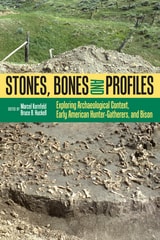
Stones, Bones, and Profiles
Exploring Archaeological Context, Early American Hunter-Gatherers, and BisonMarcel Kornfeld
University Press of Colorado, 2016
Stones, Bones, and Profiles addresses key and cutting-edge research of three pillars of hunter-gatherer archaeology. Stones and bones—flaked stone tools and the bones of the prey animals—are the objects most commonly recovered from hunter-gatherer archaeological sites, and profiles represent the geologic context of the archeological record. Together they constitute the foundations of much of early archaeology, from the appearance of the earliest humans to the advent of the Neolithic.
The volume is divided into three sections: Peopling of North America and Paleoindians, Geoarchaeology, and Bison Bone Bed Studies. The first section dissects established theories about the Paleoindians, including the possibility that human populations were in North America before Clovis and the timing of the opening of the Alberta Corridor. The second section provides new perspectives on the age and contexts of several well-known New World localities such as the Lindenmeier Folsom and the UP Mammoth sites, as well as a synthesis of the geoarchaeology of the Rocky Mountains' Bighorn region that addresses significant new data and summarizes decades of investigation. The final section, Bison Bone Bed Studies, consists of groundbreaking zooarchaeological studies offering new perspectives on bison taxonomy and procurement.
Stones, Bones, and Profiles presents new data on Paleoindian archaeology and reconsiders previous sites and perspectives, culminating in a thought-provoking and challenging contribution to the ongoing study of Paleoindians around the world.
Contributors: Leland Bement, Jack W. Brink, John Carpenter, Brian Carter, Thomas J. Connolly, Linda Scott Cummings, Loren G. Davis, Allen Denoyer, Stuart J. Fiedel, Judson Byrd Finley, Andrea Freeman, C. Vance Haynes Jr., Bryan Hockett, Vance T. Holliday, Dennis L. Jenkins, Thomas A. Jennings, Eileen Johnson, George T. Jones, Oleksandra Krotova, Patrick J. Lewis, Vitaliy Logvynenko, Ian Luthe, Katelyn McDonough, Lance McNees, Fred L. Nials, Patrick W. O’Grady, Mary M. Prasciunas, Karl J. Reinhard, Michael Rondeau, Guadalupe Sanchez, William E. Scoggin, Ashley M. Smallwood, Iryna Snizhko, Thomas W. Stafford Jr., Mark E. Swisher, Frances White, Eske Willerslev, Robert M. Yohe II, Chad Yost

Stop Saying Snip!
The Rhetoric of VasectomyJenna Vinson
Rutgers University Press, 2026
In the US, the most common contraceptive methods rely on women’s time, labor, and vulnerability to risk. Comparatively few people rely on vasectomies as a means of preventing pregnancies. Something is happening rhetorically—through meaning-making symbols and the material practices they manifest—that sustains a collective disinterest in vasectomies. Jenna Vinson draws from her feminist rhetorical study of thirty-seven television and film representations, health insurance policies, and interviews with seventeen people who have experienced vasectomy, surfacing barriers to vasectomy uptake, including problematic tropes and practices that keep vasectomy unappealing, out of mind, and inaccessible. Stop Saying Snip! also illustrates tactics and circumstances that lead people to get a vasectomy, sharing real vasectomy stories and showing that women often play an important (and until now unheeded or pathologized) role in this communication process. This book intervenes in the misogynistic cultural expectation that it is women’s responsibility to endure the pain, labor, and risks of managing fertility by identifying the rhetorics that make men’s reproductive bodies seem unnatural sites for pregnancy prevention work. Fostering a persuasive vision of vasectomy is an urgent project that contributes to the movement toward reproductive justice.

Storied Landscapes
Ethno-Religious Identity and the Canadian PrairiesFrances Swyripa
University of Manitoba Press, 2010
Stories Employers Tell
Race, Skill, and Hiring in AmericaPhilip Moss
Russell Sage Foundation, 2001
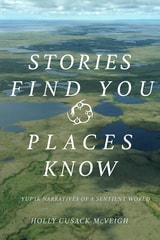
Stories Find You, Places Know
Yup'ik Narratives of a Sentient WorldHolly Cusack-McVeigh
University of Utah Press, 2017
For the Yup’ik people, places are also social actors that react to human actions and emotions. Stories tell how people learn about each other through encounters on the land, and thereby places also learn about people. Places comment on human behavior through the land's responses to specific actions. Stories variously reveal ideas about human associations and relationships between humans and nonhuman beings. Pointing to a systematic correlation between places and narrative elements that has not been previously explored, this volume makes a unique contribution to the literature on place.
Winner of the Brian McConnell Book Award from the International Society for Contemporary Legend Research.
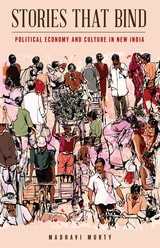
Stories That Bind
Political Economy and Culture in New IndiaMadhavi Murty
Rutgers University Press, 2022
Moving between mediascapes to create an archive of popular culture, Murty advances our understanding of political economy through material that is often seen as inconsequential, namely the popular cultural story. These stories stoke our desires (e.g. for wealth), scaffold our instincts (e.g. for a strong leadership) and shape our values.
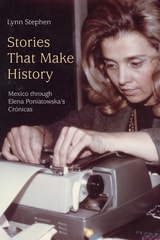
Stories That Make History
Mexico through Elena Poniatowska’s CrónicasLynn Stephen
Duke University Press, 2021
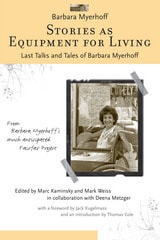
Stories as Equipment for Living
Last Talks and Tales of Barbara MyerhoffBarbara Myerhoff
University of Michigan Press, 2007
Barbara Myerhoff's groundbreaking work in reflexivity and narrative ethnography broke with tradition by focusing not on the raw ethnographic data, but on her interaction with those she studied. Myerhoff's unfinished projects, including her final talks on storytelling, ritual, and the "culture of aging and Yiddishkeit," offer a magisterial summary of her life's work.
"The beauty of Stories as Equipment for Living is the quality of being a compilation of rescued fragments, bits and pieces of a great master's writing and thinking that were coming towards synthesis but had never reached a finished form prior to her death. This collection is an examination of the place of narrative in human life, the synthetic nature of culture and the constant search for visibility particularly by those relegated for one reason or another to the margins. A thought-provoking book worthy of extended reflection."
---Jack Kugelmass, Professor of Anthropology and Director of Jewish Studies, University of Florida
"Stories as Equipment for Living achieves a nice balance between preserving Myerhoff's work in its original form and reconstructed contexts, but presenting it in a manner relevant to readers a generation after her death. The book documents Myerhoff's growing involvement with Jewish culture, the actual process of anthropological work through field notes, and the picture of how she always was bouncing the fine details of this combined professional and personal venture off the 'big questions' of anthropology in its broadest sense."
---Harvey E. Goldberg, Professor of Sociology and Anthropology, Hebrew University, Israel
"These essays capture the rhythm of Barbara Myerhoff's words and her vivid and distinctive train of thought, bringing the reader into the classroom of one of anthropology's finest lecturers. As an anthropologist with a poet's gift for language, she utilizes the tools of ethnography and extraordinary powers of observation---a remarkable 'ethnographic eye'---to explore the outward expressions and inner lives of the Fairfax neighborhood of L.A. These stories are not only glorious introductions to the study of culture, but provide in their revelations a reason for studying it. They are required reading for anyone passionate to know what an anthropologist can teach us about communities and ultimately about ourselves."
---Steve Zeitlin, Director, City Lore: The New York Center for Urban Folk Culture
"Master of the third voice, the voice of collaboration, Myerhoff is at once a consummate listener and inspired storyteller. This book offers a rare and luminous opening into the working process and wisdom of one of the great anthropologists of the twentieth century."
---Barbara Kirshenblatt-Gimblett, Professor of Performance Studies at New York University and coauthor of They Called Me Mayer July: Painted Memories of a Jewish Childhood in Poland Before the Holocaust
"Myerhoff and her collaborators have given her 'Hasidim,' her disciples old and new, a final and precious gift."
---Jonathan Boyarin, The Robert M. Beren Distinguished Professor of Modern Jewish Studies at the University of Kansas and author of Thinking in Jewish
Barbara Myerhoff was a renowned anthropologist who did pioneering work in gerontology, Jewish studies, folklore, and narrative anthropology. She is best known for her ethnography of and personal involvement with a community of elderly immigrant Jews in California. Her writings and lectures have had an enormous impact on all of these areas of study, and her books are widely celebrated, especially Number Our Days, whose companion documentary film won an Academy Award.
Marc Kaminsky is a psychotherapist, a poet, a writer, and the former codirector of the Institute on Humanities, Arts and Aging of the Brookdale Center on Aging.
Mark Weiss is a writer, an editor, a translator, and a poet; his books include the widely praised Across the Line/Al Otro Lado.
Deena Metzger is a novelist, a poet, and the founding codirector (with Marc Kaminsky) of the Myerhoff Center.
Thomas R. Cole is the Beth and Toby Grossman Professor and Director of the McGovern Center for Health, Humanities, and the Human Spirit at the University of Texas Health Science Center in Houston, and a Professor of Humanities in the Department of Religious Studies at Rice University; his expertise lies in the history of aging and humanistic gerontology.
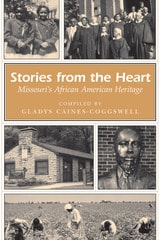
Stories from the Heart
Missouri's African American HeritageCompiled by Gladys Caines-Coggswell
University of Missouri Press, 2009
All along the river, from the front porches of Hannibal to the neighborhoods of St. Louis to the cotton fields of the Bootheel and west to Kansas City, stories are being told.
This collection of family stories and traditional tales brings to print down-home stories about all walks of African American life. Passed down from grandparents and great-grandparents, they have been lovingly gathered by Gladys Caines Coggswell as she visited Missouri communities and participated in storytelling events over the last two decades. These stories bring to life characters with uncommon courage, strength, will, and wit as they offer insight into African American experiences throughout the state’s history.
Often profound, always entertaining, some of these stories hark back to times barely remembered. Many tell of ordinary folks who achieved victories in the face of overwhelming odds. They range from recollections of KKK activities—recalling a Klan leader who owned property on which a black family lived as “the man who was always so nice to us”—to remembered differences between country and city schools and black schoolchildren introduced to Dick and Jane and Little Black Sambo. Stories from the Bootheel shed light on family life, sharecropping, and the mechanization of cotton culture, which in one instance led to a massive migration of rats as the first mechanical cotton pickers came in.
As memorable as the stories are the people who tell them, such as the author’s own “Uncle Pete” reporting on a duck epidemic or Evelyn Pulliam of Kennett telling of her resourceful neighbors in North Lilburn. Loretta Washington remembers sitting on her little wooden stool beside her great-grandmother’s rocking chair on the front porch in Wardell, mesmerized by stories—and the time when rocking chair and little wooden stool were moved inside and the stories stopped. Marlene Rhodes writes of her mother’s hero, Odie, St. Louis “Entrepreneur and English gentleman.”
Whether sharing previously unknown stories from St. Louis or betraying the secret of “Why Dogs Chase Cats,” this book is a rich repository of African American life. And if some of these tales seem unusual, the people remembering them will be the first to tell you: that’s the way it was. Coggswell preserves them for posterity and along with them an important slice of Missouri history.
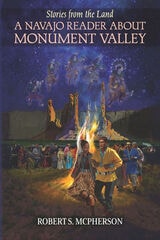
Stories from the Land
A Navajo Reader about Monument ValleyRobert S. McPherson
University Press of Colorado, 2022
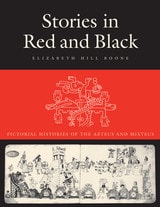
Stories in Red and Black
Pictorial Histories of the Aztecs and MixtecsBy Elizabeth Hill Boone
University of Texas Press, 2000
Winner, Arvey Award, Association for Latin American Art, 2001
Honorable Mention, Honorable Mention, George Wittenborn Memorial Book Award, Art Libraries Society of North America, 2001
The Aztecs and Mixtecs of ancient Mexico recorded their histories pictorially in images painted on hide, paper, and cloth. The tradition of painting history continued even after the Spanish Conquest, as the Spaniards accepted the pictorial histories as valid records of the past. Five Pre-Columbian and some 150 early colonial painted histories survive today.
This copiously illustrated book offers the first comprehensive analysis of the Mexican painted history as an intellectual, documentary, and pictorial genre. Elizabeth Hill Boone explores how the Mexican historians conceptualized and painted their past and introduces the major pictorial records: the Aztec annals and cartographic histories and the Mixtec screenfolds and lienzos.
Boone focuses her analysis on the kinds of stories told in the histories and on how the manuscripts work pictorially to encode, organize, and preserve these narratives. This twofold investigation broadens our understanding of how preconquest Mexicans used pictographic history for political and social ends. It also demonstrates how graphic writing systems created a broadly understood visual "language" that communicated effectively across ethnic and linguistic boundaries.
Stories of Capitalism
Inside the Role of Financial AnalystsStefan Leins
University of Chicago Press, 2018
Building on recent developments in the social studies of finance, Stories of Capitalism provides the first ethnography of financial analysis. Drawing on two years of fieldwork in a Swiss bank, Stefan Leins argues that financial analysts construct stories of possible economic futures, presenting them as coherent and grounded in expert research and analysis. In so doing, they establish a role for themselves—not necessarily by laying bare empirically verifiable trends but rather by presenting the market as something that makes sense and is worth investing in. Stories of Capitalism is a nuanced look at how banks continue to boost investment—even in unstable markets—and a rare insider’s look into the often opaque financial practices that shape the global economy.
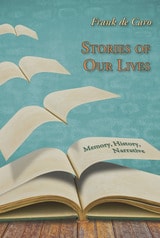
Stories of Our Lives
Memory, History, NarrativeFrank de Caro
Utah State University Press, 2013
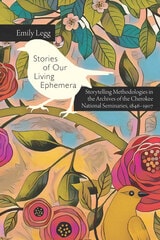
Stories of Our Living Ephemera
Storytelling Methodologies in the Archives of the Cherokee National Seminaries, 1846-1907Emily Legg
Utah State University Press, 2023
Emily Legg turns to the Cherokee medicine wheel and cardinal directions as a Cherokee rhetorical discipline of knowledge making in the archives, an embodied and material practice that steers knowledge through the four cardinal directions around all relations. Going beyond historiography, Legg delineates educational practices that are intertwined with multiple strands of traditional Cherokee stories that privilege Indigenous and matriarchal theoretical lenses. Stories of Our Living Ephemera synthesizes the connections between contemporary and nineteenth-century academic experiences to articulate the ways that colonial institutions and research can be Indigenized by centering Native American sovereignty.
By undoing the erasure of Cherokee literacy and educational practices, Stories of Our Living Ephemera celebrates the importance of storytelling, especially for those who are learning about Indigenous histories and rhetorics. This book is of cultural importance and value to academics interested in composition and pedagogy, the Cherokee Nation, and a general audience seeking to learn about Indigenous rhetorical devices and Cherokee history.