Results by title
28167 books match the query 'History' and 1838 start with s

Sponsored Identities
Cultural Politics in Puerto RicoArlene Davila
Temple University Press, 1997
Author Arlene Davila focuses on the Institute for Puerto Rican Culture, the government institution charged with defining authenticated views of national identity since the 1950s, and on popular festival organizers to illuminate contestations over appropriate representations of culture in the increasingly mass-mediated context of contemporary Puerto Rico. She examines the creation of an essentialist view of nationhood based on a peasant culture and a "unifying" Hispanic heritage, and the ways in which grassroots organizations challenge and reconfigure definitions of national identity through their own activities and representations.
Davila pays particular attention to the increasing prominence of corporate sponsorship in determining what is distinguished as authentic "Puerto Rican culture" and discusses the politicization of culture as a discourse to debate and legitimize conflicting claims from selling commercial product to advocating divergent status options for the island. In so doing, Davila illuminates the prospects for cultural identities in an increasingly transnational context by showing the growth of cultural nationalism to be intrinsically connected to forms of political action directed to the realm of culture and cultural politics. This in-depth examination also makes clear that despite contemporary concerns with "authenticity," commercialism is an inescapable aspect of all cultural expression on the island.

Sponsored Migration
The State and Puerto Rican Postwar Migration to the United StatesEdgardo Meléndez
The Ohio State University Press, 2017
Sponsored Migration places Puerto Rico’s migration policy in its historical context, examining the central role the Puerto Rican government played in encouraging and organizing migration during the postwar period. Meléndez sheds an important new light on the many ways in which the government intervened in the movement of its people: attempting to provide labor to U.S. agriculture, incorporating migrants into places like New York City, seeking to expand the island’s air transportation infrastructure, and even promoting migration in the public school system. One of the first scholars to explore this topic in depth, Meléndez illuminates how migration influenced U.S. and Puerto Rican relations from 1898 onward.

Spoon River America
Edgar Lee Masters and the Myth of the American Small TownJason Stacy
University of Illinois Press, 2021
A literary and cultural milestone, Spoon River Anthology captured an idea of the rural Midwest that became a bedrock myth of life in small-town America. Jason Stacy places the book within the atmosphere of its time and follows its progress as the poetry took root and thrived. Published by Edgar Lee Masters in 1915, Spoon River Anthology won praise from modernists while becoming an ongoing touchstone for American popular culture. Stacy charts the ways readers embraced, debated, and reshaped Masters's work in literary controversies and culture war skirmishes; in films and other media that over time saw the small town as idyllic then conflicted then surreal; and as the source of three archetypes—populist, elite, and exile—that endure across the landscape of American culture in the twenty-first century.
A wide-ranging reconsideration of a literary landmark, Spoon River America tells the story of how a Midwesterner's poetry helped change a nation's conception of itself.

Spoon River Anthology
An Annotated EditionEdgar Lee Masters. Edited and with an Introduction and Annotations by John E. Hallwas
University of Illinois Press, 1992
What lies beneath the surface of Masters' timeless classic
One of the most striking and original achievements in American poetry is now available in a remarkable edition that comprehends the poet and his book in an entirely new way.
This edition of Spoon River Anthology probes the social background of the small-town world that Edgar Lee Masters loved and hated--and finally transmuted into powerful literary art. Extensive annotations identify the people whose lives inspired the 243 poetic accounts of frustration, violence, struggle, and triumph that shocked American readers.
The most extraordinary feature of this edition is the extensive introduction that provides the key to this misunderstood American classic. The book's relationship to Whitman is clearly established, and the important influences of Browning, Goethe, Spinoza, and others are revealed for the first time. John Hallwas' approach combines cultural, biographical, philosophical, psychoanalytic, mythic, and symbolic insights--and concludes with a stunning reassessment of "Our New Poet."
The annotated Spoon River Anthology supersedes seventy-five years of largely misdirected critical commentary. It will send a new generation of readers back to this surprisingly complex book that probes so deeply into the American consciousness.
Sport History in the Digital Era
Edited by Gary Osmond and Murray G. Phillips
University of Illinois Press, 2015
Chapters consider how the philosophical and theoretical understanding of the meaning of history influence a willingness to engage with digital history, and conceptualize the relationship between history making and the digital era. As the writers show, digital media's mostly untapped potential for studying the recent past via blogs, chat rooms, gambling sites, and the like forge a symbiosis between sports and the internet, and offer historians new vistas to explore and utilize.
Sport History in the Digital Era also shows how the best digital history goes beyond a static cache of curated documents. Instead, it becomes a truly public history that serves as a dynamic site of enquiry and discussion. In such places, scholars enter into a give-and-take with individuals while inviting the audience to grapple with, rather than passively absorb, the evidence being offered.
Timely and provocative, Sport History in the Digital Era affirms how the information revolution has transformed sport and sport history--and shows the road ahead.
Contributors include Douglas Booth, Mike Cronin, Martin Johnes, Matthew Klugman, Geoffery Z. Kohe, Tara Magdalinski, Fiona McLachlan, Bob Nicholson, Rebecca Olive, Gary Osmond, Murray G. Phillips, Stephen Robertson, Synthia Sydnor, Holly Thorpe, and Wayne Wilson.
Sport and Exercise Science
ESSAYS IN THE HISTORY OF SPORTS MEDICINEEdited by Jack W. Berryman and Roberta J. Parks
University of Illinois Press, 1992
athlete's heart, exercise physiology, physical activity and sport for females, women's
health, physical culture and quackery, diet, and more.

Sport and Moral Conflict
A Conventionalist TheoryWilliam J.Morgan
Temple University Press, 2020
What is the purpose of sport, and how are ethical conceptions of sport shaped by the answers to this question? In Sport and Moral Conflict, William Morgan investigates, examining sport as a moral crucible that puts athletes in competitive, emotionally charged situations where fairness and equality are contested alongside accomplishment.
Morgan looks at the modern Olympics—from 1906 Athens to 1924 Paris, when the Games reached international prestige — in order to highlight the debate about athletic excellence and the amateur-professional divide. Whereas the Americans emphasized winning, the Europeans valued a love of the game. Morgan argues that the existing moral theories of sport—formalism and broad internalism (aka interpretivism), which rely on rules and general principles—fall short when confronted with such a dispute as the transition from amateur to professional sport. As such, he develops a theory of conventionalism, in which the norms at work in athletic communities determine how players should ethically acquit themselves. Presenting his case for an ethical theory of sport, Morgan provides insights regarding the moral controversies and crises that persist today.

Sport
Ship Dog of the Great LakesPamela Cameron
Wisconsin Historical Society Press, 2019
In this beautifully illustrated children’s book based on historical documents and photographs, readers share in Sport’s adventures while discovering the various ways lighthouse tender ships helped keep the lake safe for others. Helpful diagrams, a map, and a historical note supplement this engaging story for young readers.
2020 Wisconsin Library Association Outstanding Children’s Book of the Year
2020 Midwest Book Award Gold Medal
2020 Library of Michigan Notable Book Award
2019 Historical Society of Michigan State History Award
2019 Moonbeam Children’s Book Award

Sports in Africa, Past and Present
Todd Cleveland
Ohio University Press, 2020
These groundbreaking essays demonstrate how Africans past and present have utilized sports to forge complex identities and shape Africa’s dynamic place in the world.
Since the late nineteenth century, modern sports in Africa have both reflected and shaped cultural, social, political, economic, generational, and gender relations on the continent. Although colonial powers originally introduced European sports as a means of “civilizing” indigenous populations and upholding then current notions of racial hierarchies and “muscular Christianity,” Africans quickly appropriated these sporting practices to fulfill their own varied interests. This collection encompasses a wide range of topics, including women footballers in Nigeria, Kenya’s world-class long-distance runners, pitches and stadiums in communities large and small, fandom and pay-to-watch kiosks, the sporting diaspora, sports pedagogy, sports as resistance and as a means to forge identity, sports heritage, the impact of politics on sports, and sporting biography.

Sports in Chicago
Edited by Elliott Gorn
University of Illinois Press, 2007
Chicago teams have won the World Series, Super Bowl, multiple Stanley Cups, and a string of National Basketball Association titles. But amateur sports also play a large role in the city's athletic traditions, especially in schools and youth leagues that allow people from across the city to add to Chicago sports history.
In Sports and Chicago, an all-star roster of experts focuses on multiple aspects of Chicago sports, including long looks at amateur boxing, the impact of gender and ethnicity in sports, the politics of horse racing and stadium building, the lasting scandal of the Black Sox, and the once-perpetual heartbreak of the Cubs. Illustrated with forty photographs, the collection encourages historians and sports fans alike to appreciate the long-standing importance of sports in the Windy City.
Contributors: Peter Alter, Robin F. Bachin, Larry Bennett, Linda J. Borish, Gerald Gems, Elliott J. Gorn, Richard Kimball, Gabe Logan, Daniel A. Nathan, Timothy Neary, Steven A. Riess, John Russick, Timothy Spears, Costas Spirou, and Loïc Wacquant.

Sports in Zion
Mormon Recreation, 1890-1940Richard Ian Kimball
University of Illinois Press, 2002
If a religion cannot attract and instruct young people, it will struggle to survive, which is why recreational programs were second only to theological questions in the development of twentieth-century Mormonism. In this book, Richard Ian Kimball explores how Mormon leaders used recreational programs to ameliorate the problems of urbanization and industrialization and to inculcate morals and values in LDS youth. As well as promoting sports as a means of physical and spiritual excellence, Progressive Era Mormons established a variety of institutions such as the Deseret Gymnasium and camps for girls and boys, all designed to compete with more "worldly" attractions and to socialize adolescents into the faith.
Kimball employs a wealth of source material including periodicals, diaries, journals, personal papers, and institutional records to illuminate this hitherto underexplored aspect of the LDS church. In addition to uncovering the historical roots of many Mormon institutions still visible today, Sports in Zion is a detailed look at the broader functions of recreation in society.
Sports in the Western World
William J. Baker
University of Illinois Press, 1982

Sports through the Lens
Essays on 25 Iconic PhotographsEdited by Maureen M. Smith, Daniel A. Nathan, and Sarah K. Fields
University of Texas Press, 2024
2025 Anthology Award, North American Society for Sport History
The stories behind and legacies of important sports photos from the last 130 years.
Ever since photography and professional sports originated in the nineteenth century, photographers have shaped how we perceive sports. Sports through the Lens collects essays by twenty-five historians that consider what it means to capture and revisit a moment of cultural significance in sports, looking at each photo’s creation, its contexts, and how its meaning has shifted over time. Some essays provide fresh perspectives on such iconic images as Muhammad Ali standing over Sonny Liston at their 1965 rematch and Michael Jordan soaring at the 1988 NBA All-Star Game slam dunk competition; others introduce readers to the lesser-known stories of the first woman to officially run the Boston Marathon or the inaugural World Indigenous Games. The authors examine the photos' legacies alongside the artistry of both the athletes and the photographers. Reflecting on images of athletes from around the world engaged in sports from baseball to horse-racing to hockey, Sports through the Lens provides a wide-ranging meditation on the visual, historical, and cultural meaning of sports photographs.

Sports
The First Five MillenniaAllen Guttmann
University of Massachusetts Press, 2004
From ancient Egyptian archery and medieval Japanese football to contemporary American baseball, every sport has been shaped by—and in turn has helped shape—the culture of which it is part. Yet as Allen Guttmann shows in this far-ranging study, for all their differences sports have followed a similar historical trajectory from traditional to modern forms.
In Sports: The First Five Millennia, Guttmann traces this evolution across continents, cultures, and historical epochs to construct a single comprehensive narrative of the world's sports.
SportsWars
Athletes in the Age of AquariusDavid Zang
University of Arkansas Press, 2001

SportsWorld
An American DreamlandLipsyte, Robert
Rutgers University Press, 2018
In the America of 2017—where the SuperBowl is worth billions, athletes are penalized or forced out of sports for political and anti-racist activism, and Title IX is constantly questioned and undermined—Robert Lipsyte’s 1975 critique remains startlingly and intensely relevant.
Sprawl
A Compact HistoryRobert Bruegmann
University of Chicago Press, 2005
In his incisive history of the expanded city, Bruegmann overturns every assumption we have about sprawl. Taking a long view of urban development, he demonstrates that sprawl is neither recent nor particularly American but as old as cities themselves, just as characteristic of ancient Rome and eighteenth-century Paris as it is of Atlanta or Los Angeles. Nor is sprawl the disaster claimed by many contemporary observers. Although sprawl, like any settlement pattern, has undoubtedly produced problems that must be addressed, it has also provided millions of people with the kinds of mobility, privacy, and choice that were once the exclusive prerogatives of the rich and powerful.
The first major book to strip urban sprawl of its pejorative connotations, Sprawl offers a completely new vision of the city and its growth. Bruegmann leads readers to the powerful conclusion that "in its immense complexity and constant change, the city-whether dense and concentrated at its core, looser and more sprawling in suburbia, or in the vast tracts of exurban penumbra that extend dozens, even hundreds, of miles-is the grandest and most marvelous work of mankind."
“There are scores of books offering ‘solutions’ to sprawl. Their authors would do well to read this book.”—Witold Rybczynski, Slate
Squaring the Circle
The War between Hobbes and WallisDouglas M. Jesseph
University of Chicago Press, 1999
Hobbes believed that by recasting geometry in a materialist mold, he could solve any geometric problem and thereby demonstrate the power of his materialist metaphysics. Wallis, a prominent Presbyterian divine as well as an eminent mathematician, refuted Hobbes's geometry as a means of discrediting his philosophy, which Wallis saw as a dangerous mix of atheism and pernicious political theory.
Hobbes and Wallis's "battle of the books" illuminates the intimate relationship between science and crucial seventeenth-century debates over the limits of sovereign power and the existence of God.
Squatters and the Roots of Mau Mau, 1905–1963
Tabitha Kanogo
Ohio University Press, 1987
This is a study of the genesis, evolution, adaptation and subordination of the Kikuyu squatter labourers, who comprised the majority of resident labourers on settler plantations and estates in the Rift Valley Province of the White Highlands. The story of the squatter presence in the White Highlands is essentially the story of the conflicts and contradictions that existed between two agrarian systems, the settler plantation economy and the squatter peasant option. Initially, the latter developed into a viable but much resented sub-system which operated within and, to some extent, in competition with settler agriculture. This study is largely concerned with the dynamics of the squatter presence in the White Highlands and with the initiative, self-assertion and resilience with which they faced their subordinate position as labourers. In their response to the machinations of the colonial system, the squatters were neither passive nor malleable but, on the contrary, actively resisted coercion and subordination as they struggled to carve out a living for themselves and their families….
It is a firm conviction of this study that Kikuyu squatters played a crucial role in the initial build-up of the events that led to the outbreak of the Mau Mau war.
—from the introduction
Squeeze This!
A Cultural History of the Accordion in AmericaMarion Jacobson
University of Illinois Press, 2012
Sri Lanka at the Crossroads of History
Edited by Zoltán Biedermann and Alan Strathern
University College London, 2017
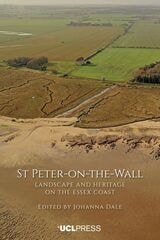
St Peter-On-The-Wall
Landscape and Heritage on the Essex CoastEdited by Johanna Dale
University College London, 2023
The Chapel of St Peter-on-the-Wall, built on the ruins of a Roman fort, dates from the mid-seventh century and is one of the oldest largely intact churches in England. It stands in splendid isolation on the shoreline at the mouth of the Blackwater Estuary in Essex, where the land meets and interpenetrates with the sea and the sky. This book brings together contributors from across the arts, humanities, and social sciences to uncover the premodern contexts and modern resonances of this medieval building and its landscape setting. In analyzing the significance of the chapel and surrounding landscape over more than a thousand years, this collection additionally contributes to wider debates about the relationship between space and place, and particularly the interfaces between both medieval and modern cultures and also heritage and the natural environment.

St. Augustine's Bones
A MicrohistoryHarold Samuel Stone
University of Massachusetts Press, 2002
In 1695, workers in Pavia, Italy, chanced upon a collection of bones in the crypt of the Cathedral of San Pietro in Ciel d'Oro. The workers later testified that they had seen the name of St. Augustine written in charcoal on the surface of the casket they had uncovered. Yet by the time of the official inquest, all traces of the writing had disappeared.
Rich with new insights into urban literacy and conceptions of reading, this book explores the controversy that ensued over the alleged discovery of Augustine's bones. Manuscripts, broadsides, pamphlets—even whole books—were devoted to proving or disproving the authenticity of the remains. Although these works were addressed to members of the clergy, they were also intended for the general reading public in Pavia, Milan, and Venice. Their dissemination helped create a temporary public sphere in which the merits of the case were examined in a spirit of free debate.
A reexamination of the dispute over St. Augustine's bones illuminates aspects of Catholic spirituality in Northern Italy during the late seventeenth and early eighteenth centuries. It also reveals the different ways in which Catholic scholars, local religious leaders, and the papal administration sought to influence and direct local popular religious belief and practices. Although the controversy was officially resolved by the papacy in 1728, the debate over the relics of San Pietro continued into the twentieth century.
By combining methods developed in the burgeoning field of the history of the book with the tools of cultural analysis, Harold Samuel Stone not only recovers the stories surrounding St. Augustine's bones, but also reconstructs the mental world of those who read or heard them.

St. Austin Review, History As If Truth Mattered, September/October 2015, Vol. 15, No. 5
Joseph Pearce
St. Augustine's Press, 2015
St. Elmo
Or, Saved at LastAugusta Jane Evans
University of Alabama Press, 1992
The nineteenth-century Southern novel that transformed romance, virtue, and redemption into literary legend.
St. Elmo was the most famed and beloved novel by Augusta Jane Evans, a June 2015 inductee into the Alabama Writers Hall of Fame. First published in 1866, Evans’s rich tale of the relationship between the dashing and worldly St. Elmo and Edna Earl, an exemplar of virtuous Southern womanhood, sold over a million copies in four months and became one of the nineteenth century’s most influential novels.
This edition includes an introduction by Evans scholar Diane Roberts about the enduring relevance and legacy of St. Elmo as a work of literature as well as a reflection of gender roles and the seismic societal changes taking place in the United States in the aftermath of the Civil War.
St. John's College
Faith and Education in Western CanadaJ.M. Bumsted
University of Manitoba Press, 2006
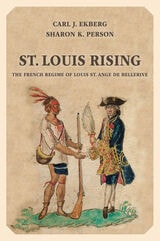
St. Louis Rising
The French Regime of Louis St. Ange de BelleriveCarl J. Ekberg and Sharon K. Person
University of Illinois Press, 2015
Drawing on new source materials, the authors delve into the complexities of politics, Indian affairs, slavery, and material culture that defined the city's founding period. Their alternative version of the oft-told tale uncovers the imperial realities--as personified by St. Ange--that truly governed in the Illinois Country of the time, and provide a trove of new information on everything from the fur trade to the arrival of the British and Spanish after the Seven Years' War.
St. Louis and Empire
250 Years of Imperial Quest and Urban CrisisHenry W. Berger
Southern Illinois University Press, 2015
Berger uses a biographical approach to explore the individuals and institutions that played a leading role in St. Louis’s expansionist reach. He shows how St. Louis business leaders, entrepreneurs, politicians, and investors—often driven by personal and ideological motives, as well as the potential betterment of the city and its people—looked to the west, southwest, Latin America, Europe, Asia, and the Pacific to form economic or political partnerships. Among the people and companies Berger profiles are Thomas Hart Benton, who envisioned a western democratic capitalist empire hosted by St. Louis; cotton exporters James Paramore and William Senter, who were involved in empire building in the southwest and Mexico; St. Louis oil tycoon and railroad investor Henry Clay Pierce, who became deeply involved in political intrigue and intervention in Mexican affairs; entrepreneur and politician David R. Francis, who promoted personal and St. Louis interests in Russia; and McDonnell-Douglas and its founder, James S. McDonnell Jr., who were part of the transformation of St. Louis’s political economy during the Cold War.
Many of these attempted imperial activities failed, but even when they succeeded, Berger explains, the economy and the people of St. Louis did not usually benefit. The vision of a democratic capitalist empire embraced by its exponents proved to be both an illusion and a contradiction. By shifting the focus of foreign relations history from the traditional confines of nation-state conduct to city and regional behavior, this innovative study highlights the domestic foundations and content of foreign policy, opening new avenues for study in the field of foreign relations.
St. Louis
Evolution Of American Urban LandscapeERIC SANDWEISS
Temple University Press, 2001
In this book, Eric Sandweiss scrutinizes the everyday landscape -- streets, houses, neighborhoods, and public buildings -- as it evolved in a classic American city. Bringing to life the spaces that most of us pass without noticing, he reveals how the processes of dividing, trading, improving, and dwelling upon land are acts that reflect and shape social relations. From its origins as a French colonial settlement in the eighteenth century to the present day, St. Louis offers a story not just about how our past is diagrammed in brick and asphalt, but also about the American city's continuing viability as a place where the balance of individual rights and collective responsibilities can be debated, demonstrated and adjusted for generations to come.
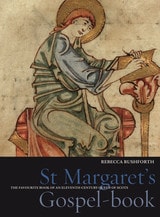
St. Margaret's Gospel
The Favourite Book of a Queen of ScotlandRebecca Rushforth
Bodleian Library Publishing, 2007
Margaret’s piety, dignity, and compassion made her a beloved figure long after her death. Her illuminated manuscript reveals the depths of her sanctity, opening with a Latin poem relating the one miracle attributed to her, where she preserved this book from damage. Exquisite illustrations transform the script into an arresting treasure, and Rebecca Rushforth uses incisive and comprehensive commentary to explain the story behind the manuscript and set it within Margaret’s historical context. She explores both the creation of the manuscript and its special meaning for Margaret, along with Margaret’s role as a significant figure in British and world history.
A fascinating piece of historical art, St Margaret’s Gospel-Book will be treasured by historians, religious scholars, and classicists alike.
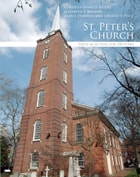
St. Peter's Church
Faith in Action for 250 YearsCornelia Frances Biddle
Temple University Press, 2011
Celebrating 250 years, St. Peter's Episcopal Church in the Society Hill neighborhood of Philadelphia, has witnessed a rich mixture of people and events that reflect critical periods of American political and cultural history. George Washington worshiped here as did abolitionists and slave holders, Whigs, Democrats, and Republicans. St. Peter's was a point of first contact for thousands of immigrants, and the church opened schools for immigrants to help them to acculturate to life in Philadelphia.
Opening a window onto colonial Philadelphia and the nation's histories, St. Peter's Church is a glorious testament to this National Historic Landmark. In addition to the stories and hundreds of black-and-white and color photographs, this handsome volume provides a history of the grounds, the churchyard, and the church itself-a classic example of eighteenth-century Philadelphia design that later incorporated the work of renown architects William Strickland, Thomas U. Walter, and Frank Furness.
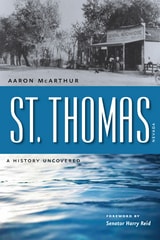
St. Thomas, Nevada
A History UncoveredAaron McArthur
University of Nevada Press, 2013

Stacked Decks
Building Inspectors and the Reproduction of Urban InequalityRobin Bartram
University of Chicago Press, 2022
Though we rarely see them at work, building inspectors have the power to significantly shape our lives through their discretionary decisions. The building inspectors of Chicago are at the heart of sociologist Robin Bartram’s analysis of how individuals impact—or attempt to impact—housing inequality. In Stacked Decks, she reveals surprising patterns in the judgment calls inspectors make when deciding whom to cite for building code violations. These predominantly white, male inspectors largely recognize that they work within an unequal housing landscape that systematically disadvantages poor people and people of color through redlining, property taxes, and city spending that favor wealthy neighborhoods. Stacked Decks illustrates the uphill battle inspectors face when trying to change a housing system that works against those with the fewest resources.

Stage Blood
Vampires of the 19th Century StageRoxana Stuart
University of Wisconsin Press, 1994
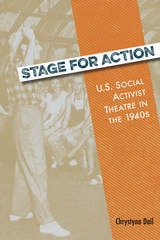
Stage for Action
U.S. Social Activist Theatre in the 1940sChrystyna Dail
Southern Illinois University Press, 2016
Exploring the intersection between performance and politics and the direct impact of the arts on social activism, Dail argues Stage for Action is a theatrical reflection of progressivism and the pro-working-class theatrical aesthetic of the 1940s. The theatre group, which used performance to encourage direct action and personal responsibility for change, eventually would function as the theatrical voice of the United States Progressive Party in the failed presidential campaign of former vice president Henry A. Wallace.
Calling into question the widely held belief that U.S. theatre in the early years of the Cold War was indifferent to activism, Stage for Action offers historians a new interpretation of social activist performance at midcentury.
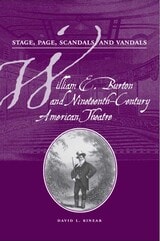
Stage, Page, Scandals, & Vandals
William E. Burton and Nineteenth-Century American TheatreDavid L. Rinear
Southern Illinois University Press, 2004
In this first modern book-length biography of native Englander William E. Burton, theatre historian David L. Rinear explores Burton’s diary, letters, published reviews, and various reminiscences to reveal the tumultuous personal and professional lives of the mid-nineteenth-century actor/manager and his role in American literary history. Stage, Page, Scandals, and Vandals: William E. Burton and Nineteenth-Century American Theatre also provides insight into the cultural and artistic climate of an early period in American history when the country was still forming a national identity.
Burton fled England in 1834 and came to America in the wake of a public scandal caused by his marriage to a sixteen-year-old orphan. Burton was then already married with a ten-year-old son. Settling in Philadelphia, the thirty-two-year-old actor rapidly established himself in the city’s theatrical productions and quickly became an audience favorite.
In 1837, while continuing to act, Burton founded and edited The Gentleman’s Magazine, a monthly literary publication later called Burton’s Gentleman’s Magazine. Burton hired struggling author Edgar Allan Poe as coeditor, and the journal achieved literary acclaim as it first published many of Poe’s short stories and poems.
Burton sold the journal in 1841 and used the money to build a new theatre, which he managed, although the depression of the early 1840s soon drove his venture out of business. After declaring bankruptcy the following year, Burton worked as a touring actor before returning to theatre management in 1845. For the next thirteen years, Burton managed a succession of theatres in Philadelphia, Baltimore, and New York.
Burton’s work as a producer of Shakespearean comedies and romances marks him as the first of the intellectual theatre managers to raise the theatrical experience from mere popular culture to high art. Burton made a fortune in his ventures, amassed the finest private Shakespearean library in the country, and built a grand seaside estate in Glen Cove, Long Island. Shrewd in his personal affairs and in business, Burton also had a violent temper, which led him to viciously attack his competitors. His peculiar domestic relationships marred his brilliant career as an actor, manager, and man of letters; he may have been married to three women at once and lived with two of these women simultaneously.
Fully revealing Burton’s contributions to American culture, Rinear traces Burton’s personal and professional pursuits from his emigration to his death in 1860. Bolstered by twenty-two illustrations, Stage, Page, Scandals, and Vandals sheds light on the history of American entertainment during the antebellum era, exposes the ruthless business practices required to succeed in theatre and literary magazine publishing, and reveals a sense of what constituted celebrity status in mid-nineteenth-century America.
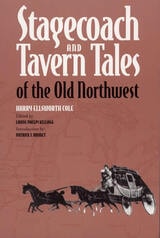
Stagecoach and Tavern Tales of the Old Northwest
Harry Ellsworth Cole. Edited by Louise Phelps Kellogg. Foreword by Patrick J. Brunet
Southern Illinois University Press, 1997
One journalist curious about life in the taverns along the stagecoach lines in Wisconsin and northern Illinois from the early 1800s until the 1880s was Harry Ellsworth Cole. While he could not sample strong ales at all of the taverns he wrote about, Cole did study newspaper accounts, wrote hundreds of letters to families of tavern owners, read widely in regional history, and traveled extensively throughout the territory. The result, according to Brunet, is a "nostalgic, sometimes romantic, well-written, and easily digested social history."
At Cole’s death, historian Louise Phelps Kellogg edited his manuscript, which in this case involved turning his notes and illustrations into a book and publishing it with the Arthur H. Clark Company in 1930.

Staged News
The Federal Theatre Project’s Living Newspapers in New YorkJordana Cox
University of Massachusetts Press, 2023
Finalist for the 2023 Frank Luther Mott - Kappa Tau Alpha Journalism and Mass Communication Research Award
In 1935, a group of journalists and theater artists embarked on an unusual collaboration. With funds from the Federal Theatre Project (FTP), a Depression-era employment initiative established by President Roosevelt’s New Deal, they set out to produce news for the theatrical stage. Over the next four years, the New York–based team created six productions, known as the Living Newspapers. Covering a variety of public issues that included affordable housing, the plight of Dust Bowl farmers, the Tennessee Valley Authority, and labor law, Living Newspaper productions would reach hundreds of thousands of spectators and inspire adaptations across the country.
Staged News interprets the Living Newspaper’s process and repertoire amid journalists’ changing conceptions of their profession. Jordana Cox spotlights marginalized “newsmakers,” particularly Black artists, who challenged the parameters of public knowledge and assumptions surrounding newsworthiness. This timely analysis reveals how a vital theatrical form sprouted from a changing news landscape and reimagined what journalism could do for people seeking democratic change.
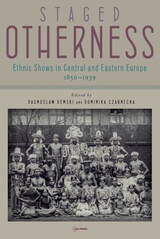
Staged Otherness
Ethnic Shows in Central and Eastern Europe, 1850–1939Dagnoslaw Demski
Central European University Press, 2022
The cultural phenomenon of exhibiting non-European people in front of the European audiences in the 19th and 20th century was concentrated in the metropolises in the western part of the continent. Nevertheless, traveling ethnic troupes and temporary exhibitions of non-European humans took place also in territories located to the east of the Oder river and Austria. The contributors to this edited volume present practices of ethnographic shows in Russia, Poland, Czechia, Slovenia, Hungary, Germany, Romania, and Austria and discuss the reactions of local audiences. The essays offer critical arguments to rethink narratives of cultural encounters in the context of ethnic shows. By demonstrating the many ways in which the western models and customs were reshaped, developed, and contested in Central and Eastern European contexts, the authors argue that the dominant way of characterizing these performances as “human zoos” is too narrow.
The contributors had to tackle the difficult task of finding traces other than faint copies of official press releases by the tour organizers. The original source material was drawn from local archives, museums, and newspapers of the discussed period. A unique feature of the volume is the rich amount of images that complement every single case study of ethnic shows.
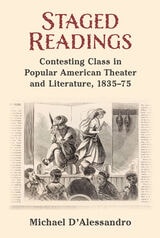
Staged Readings
Contesting Class in Popular American Theater and Literature, 1835-75Michael D’Alessandro
University of Michigan Press, 2022
Based in the historical archive, Staged Readings presents a panoramic display of mid-century leisure and entertainment. It examines best-selling novels, such as Harriet Beecher Stowe’s Uncle Tom’s Cabin and George Lippard’s The Quaker City. But it also analyzes a series of sensational melodramas, parlor theatricals, doomsday speeches, tableaux vivant displays, curiosity museum exhibits, and fake volcano explosions. These oft-overlooked spectacles capitalized on consumers’ previous cultural encounters and directed their social identifications. The book will be particularly appealing to those interested in histories of popular theater, literature and reading, social class, and mass culture.
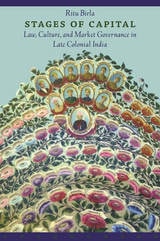
Stages of Capital
Law, Culture, and Market Governance in Late Colonial IndiaRitu Birla
Duke University Press, 2009
Birla reveals how the categories of public and private infiltrated colonial commercial law, establishing distinct worlds for economic and cultural practice. This bifurcation was especially apparent in legal dilemmas concerning indigenous or “vernacular” capitalists, crucial engines of credit and production that operated through networks of extended kinship. Focusing on the story of the Marwaris, a powerful business group renowned as a key sector of India’s capitalist class, Birla demonstrates how colonial law governed vernacular capitalists as rarefied cultural actors, so rendering them illegitimate as economic agents. Birla’s innovative attention to the negotiations between vernacular and colonial systems of valuation illustrates how kinship-based commercial groups asserted their legitimacy by challenging and inhabiting the public/private mapping. Highlighting the cultural politics of market governance, Stages of Capital is an unprecedented history of colonial commercial law, its legal fictions, and the formation of the modern economic subject in India.
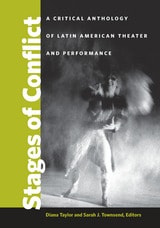
Stages of Conflict
A Critical Anthology of Latin American Theater and PerformanceDiana Taylor and Sarah J. Townsend, Editors
University of Michigan Press, 2008
"An invaluable resource to teachers of Latin American theater, with texts that provide an accurate panorama of Latin American theater."
---Adam Versenyi, University of North Carolina at Chapel Hill
"A most welcome and needed collection . . . Not only is it the first English-language anthology of theater and performance in Latin America from the Conquest onward, but it also includes excellent introductory and background material . . . certain to become an essential source book."
---Marvin Carlson, City University of New York
"A rich resource for teachers and students, and for everyone intrigued by the history of performing Latin America . . . Diana Taylor and Sarah Townsend locate an animating tension between indigenous and colonial performance practices, and between the irreducibly local character of performance and the insistent pressure---as visible in the sixteenth century as in the twenty-first---of a globalizing, often oppressive modernity."
---W. B. Worthen, Barnard College, Columbia University
Stages of Conflict brings together a vast array of dramatic texts, ambitiously tracing the intersection of theater and social and political life in the Americas over the past five centuries. Including eighteen works faithfully translated into English, the collection moves from a sixteenth century Mayan dance-drama to a 2003 production by the first published indigenous playwright in Mexico. Historical pieces from the sixteenth century to the present highlight the encounter between indigenous tradition and colonialism, while contributions from modern playwrights such as Virgilio Pinero, Jose Triana, and Denise Stolkos take on the tumultuous political and social upheavals of the past century.
The editors have added comprehensive critical commentary that details the origins of each play, affording scholars and students of theater, performance studies, and Latin American studies the opportunity to view the history of a continent through its rich and diverse theatrical traditions.
Diana Taylor is Director of The Hemispheric Institute of Performance and Politics and Professor of Performance Studies and Spanish at New York University. Her books include the award-winning volume The Archive and the Repertoire: Performing Cultural Memory in the Americas.
Sarah J. Townsend is a doctoral student at New York University.
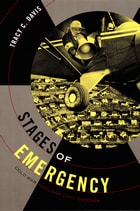
Stages of Emergency
Cold War Nuclear Civil DefenseTracy C. Davis
Duke University Press, 2007
Stages of Emergency covers public education campaigns and school programs—such as the ubiquitous “duck and cover” drills—meant to heighten awareness of the dangers of a possible attack, the occupancy tests in which people stayed sequestered for up to two weeks to simulate post-attack living conditions as well as the effects of confinement on interpersonal dynamics, and the British first-aid training in which participants acted out psychological and physical trauma requiring immediate treatment. Davis also brings to light unpublicized government exercises aimed at anticipating the global effects of nuclear war. Her comparative analysis shows how the differing priorities, contingencies, and social policies of the three countries influenced their rehearsals of nuclear catastrophe. When the Cold War ended, so did these exercises, but, as Davis points out in her perceptive afterword, they have been revived—with strikingly similar recommendations—in response to twenty-first-century fears of terrorists, dirty bombs, and rogue states.
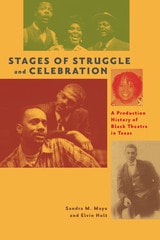
Stages of Struggle and Celebration
A Production History of Black Theatre in TexasBy Sandra M. Mayo and Elvin Holt
University of Texas Press, 2015
From plantation performances to minstrel shows of the late nineteenth century, the roots of black theatre in Texas reflect the history of a state where black Texans have continually created powerful cultural emblems that defy the clichés of horses, cattle, and bravado. Drawing on troves of archival materials from numerous statewide sources, Stages of Struggle and Celebration captures the important legacies of the dramatic arts in a historical field that has paid most of its attention to black musicians.
Setting the stage, the authors retrace the path of the cakewalk and African-inspired dance as forerunners to formalized productions at theaters in the major metropolitan areas. From Houston’s Ensemble and Encore Theaters to the Jubilee in Fort Worth, gospel stage plays of the Black Academy of Arts and Letters in Dallas, as well as San Antonio’s Hornsby Entertainment Theater Company and Renaissance Guild, concluding with ProArts Collective in Austin, Stages of Struggle and Celebration features founding narratives, descriptions of key players and memorable productions, and enlightening discussions of community reception and the business challenges faced by each theatre. The role of drama departments in historically black colleges in training the companies’ founding members is also explored, as is the role the support of national figures such as Tyler Perry plays in ensuring viability. A canon of Texas playwrights completes the tour. The result is a diverse tribute to the artistic legacies that continue to inspire new generations of producers and audiences.

Stagestruck
Theater, AIDS, and the Marketing of Gay AmericaSarah Schulman
Duke University Press, 1998
Closely recounting her discovery of the ways in which Rent took materials from her own novel, Schulman takes us on her riveting and infuriating journey through the power structures of New York theater and media, a journey she pursued to seek legal restitution and make her voice heard. Then, to provide a cultural context for the emergence of Rent—which Schulman experienced first-hand as a weekly theater critic for the New York Press at the time of Rent’s premiere—she reveals in rich detail the off- and off-off-Broadway theater scene of the time. She argues that these often neglected works and performances provide more nuanced and accurate depictions of the lives of gay men, Latinos, blacks, lesbians and people with AIDS than popular works seen in full houses on Broadway stages. Schulman brings her discussion full circle with an incisive look at how gay and lesbian culture has become rapidly commodified, not only by mainstream theater productions such as Rent but also by its reduction into a mere demographic made palatable for niche marketing. Ultimately, Schulman argues, American art and culture has made acceptable a representation of “the homosexual” that undermines, if not completely erases, the actual experiences of people who continue to suffer from discrimination or disease. Stagestruck’s message is sure to incite discussion and raise the level of debate about cultural politics in America today.
Stagg's University
The Rise, Decline, and Fall of Big-Time Football at ChicagoRobin Lester
University of Illinois Press, 1995
The legendary University of Chicago football program had an unusual beginning, a dazzling middle, and an inglorious conclusion. Its architect: Amos Alonzo Stagg, the most creative and entrepreneurial college coach of his time. A former all-American gridiron star at Yale, Stagg joined an elite academic institution that boasted intellectual notables like John Dewey, Thorstein Veblen, and Albert Michelson. Within fifteen years, the fame of Stagg's football program had eclipsed even Michelson's renown as the first American citizen to win a Nobel Prize.
Robin Lester follows the commercial trail blazed by Stagg and University President William Rainey Harper and the subsequent transformation of college football into a mass entertainment industry that changed campuses and captured the national imagination. Fascinating and detailed, Stagg's Universityreveals how the University of Chicago's football industry prefigured today's billion-dollar sport juggernaut and details the life and leadership of one of its foundational personages.

Staging America
The Artistic Legacy of the Provincetown PlayersJeffery Kennedy
University of Alabama Press, 2023
A comprehensive history of the Provincetown Players and their influence on modern American theatre
The Provincetown Players created a revolution in American theatre, making room for truly modern approaches to playwriting, stage production, and performance unlike anything that characterized the commercial theatre of the early twentieth century. In Staging America: The Artistic Legacy of the Provincetown Players, Jeffery Kennedy gives readers the unabridged story in a meticulously researched and comprehensive narrative that sheds new light on the history of the Provincetown Players. This study draws on many new sources that have only become available in the last three decades; this new material modifies, refutes, and enhances many aspects of previous studies.
At the center of the study is an extensive account of the career of George Cram Cook, the Players’ leader and artistic conscience, as well as one of the most significant facilitators of modernist writing in early twentieth-century American literature and theatre. It traces Cook’s mission of “cultural patriotism,” which drove him toward creating a uniquely American identity in theatre. Kennedy also focuses on the group of friends he calls the “Regulars,” perhaps the most radical collection of minds in America at the time; they encouraged Cook to launch the Players in Provincetown in the summer of 1915 and instigated the move to New York City in fall 1916.
Kennedy has paid particular attention to the many legends connected to the group (such as the “discovery” of Eugene O’Neill), and also adds to the biographical record of the Players’ forty-seven playwrights, including Susan Glaspell, Neith Boyce, Edna St. Vincent Millay, Floyd Dell, Rita Wellman, Mike Gold, Djuna Barnes, and John Reed. Kennedy also examines other fascinating artistic, literary, and historical personalities who crossed the Players’ paths, including Emma Goldman, Charles Demuth, Berenice Abbott, Sophie Treadwell, Theodore Dreiser, Claudette Colbert, and Charlie Chaplin. Kennedy highlights the revolutionary nature of those living in bohemian Greenwich Village who were at the heart of the Players and the America they were responding to in their plays.
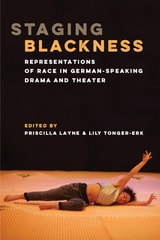
Staging Blackness
Representations of Race in German-Speaking Drama and TheaterPriscilla Dionne Layne and Lily Tonger-Erk, Editors
University of Michigan Press, 2024
Written by scholars and theater professionals with a wide variety of historical and theoretical expertise, the chapters seek to explore the connections between the German discourse on national theater and emerging ideas about race, analyze how dramaturges deal with older representations of Blackness in current productions, and discuss the contributions Black German playwrights and dramaturges have made to this discourse. Historians question how these plays were staged in their time, while cultural studies scholars contemplate how to interpret the function of race in these plays and how they can continue to be staged today.
Staging Christ's Passion in Eighteenth-Century Nahua Mexico
Louise M. Burkhart
University Press of Colorado, 2023
A cast with over fifty distinct roles acted out events extending from Palm Sunday to Christ’s death on the cross. One actor became a localized embodiment of Jesus through a process of investiture and mimesis that carried aspects of pre-Columbian materialized divinity into the later colonial period. The play told afar richer version of the Passion story than what later colonial Nahuas typically learned from their priests or catechists. And by assimilating Jesus to an Indigenous, or macehualli, identity, the players enacted a protest against colonial rule.
The situation in eighteenth-century New Spain presents both a unique confrontation between Indigenous communities and Enlightenment era religious reformers and a new chapter in an age-old power game between popular practice and religious orthodoxy. By focusing on how Nahuas localized the universalizing narrative of Christ’s Passion, Staging Christ’s Passion in Eighteenth-Century Nahua Mexico offers an unusually in-depth view of religious life under colonial rule.
Burkhart’s accompanying website also makes available transcriptions and translations of the six Nahuatl-language plays, four Spanish-language plays composed in response to the suppression of the Nahuatl practice, and related documentation, providing a valuable resource for anyone interested in consulting the original material.
Comments restricted to single page
plays composed in response to the suppression of the Nahuatl practice, and related documentation,
providing a valuable resource for anyone interested in consulting the original material
Staging Contemplation
Participatory Theology in Middle English Prose, Verse, and DramaEleanor Johnson
University of Chicago Press, 2018
Yet, in this groundbreaking new book, Eleanor Johnson argues instead for the pervasiveness and accessibility of contemplative works to medieval audiences. By drawing together ostensibly diverse literary genres—devotional prose, allegorical poetry, cycle dramas, and morality plays—Staging Contemplation paints late Middle English contemplative writing as a broad genre that operated collectively and experientially as much as through radical individual disengagement from the world. Johnson further argues that the contemplative genre played a crucial role in the exploration of the English vernacular as a literary and theological language in the fifteenth century, tracing how these works engaged modes of disfluency—from strained syntax and aberrant grammar, to puns, slang, code-switching, and laughter—to explore the limits, norms, and potential of English as a devotional language. Full of virtuoso close readings, this book demonstrates a sustained interest in how poetic language can foster a participatory experience of likeness to God among lay and devotional audiences alike.