Results by title
3071 books match the query 'Business & Economics' and 189 start with s

Social Security
A Fresh Look at Policy AlternativesJagadeesh Gokhale
University of Chicago Press, 2010
Many of us suspect that Social Security faces eventual bankruptcy. But the government projects its future finances using long outdated methods. Employing a more up-to-date approach, Jagadeesh Gokhale here argues that the program faces insolvency far sooner than previously thought.
To assess Social Security’s fate more accurately under current and alternative policies, Gokhale constructs a detailed simulation of the forces shaping American demographics and the economy to project their future evolution. He then uses this simulation to analyze six prominent Social Security reform packages—two liberal, two centrist, and two conservative—to demonstrate how far they would restore the program’s financial health and which population groups would be helped or hurt in the process.
Arguments over Social Security have raged for decades, but they have taken place in a relative informational vacuum; Social Security provides the necessary bedrock of analysis that will prove vital for anyone with a stake in this important debate.
Social Security
The Phony CrisisDean Baker and Mark Weisbrot
University of Chicago Press, 1999
According to the authors of this important new study, the answer to these questions is a resounding no. In Social Security: The Phony Crisis, economists Dean Baker and Mark Weisbrot argue that there is no economic, demographic, or actuarial basis for the widespread belief that the program needs to be fixed.
As the authors emphasize, there is virtually no disagreement about the facts of Social Security's finances, or even the projections for its future. Rather, the Social Security debate has been foundering on misconceptions, confusion, and lack of agreement on the meaning of crucial terms.
The authors also take on related issues: that privatization would help save Social Security, that America has a pressing need to increase its national savings, and that future generations will suffer from the costs—especially for health care—of supporting a growing elderly population.
As New York Times columnist Fred Brock recently wrote, "So-called reform of the Social Security system is looking more and more like a solution in search of a problem." In this accessible and insightful work, Baker and Weisbrot seek to cut through some of the myths and fallacies surrounding this crucial policy issue.
"Dean Baker and Mark Weisbrot have no trouble at all demonstrating that even on highly conservative assumptions about economic growth, the much-forecast insolvency of the Social Security system by about 2030 is most unlikely to happen then, if indeed ever."—The Economist
"The authors challenge basic assumptions with vigor and intelligence. . . . An absolutely relevant and important analysis, presented with force and clarity, that asks, basically, what kind of a nation we really are."—Kirkus Reviews
"Proponents—like George W. Bush—of Social Security privatization . . . typically ignore prospects for a stagnant or falling stock market. In Social Security: The Phony Crisis, [Baker and Weisbrot] show how a falling stock market could place pressure on both future Social Security payments and privatization schemes because earnings from the trust fund could actually fall."—Jeff Madrick, New York Review of Books
Socialism after Hayek
Theodore A. Burczak
University of Michigan Press, 2009
Socialism after Hayek recasts and reinvigorates the socialist quest for class justice by rendering it compatible with Hayek's social and economic theories. Theodore A. Burczak puts forth a conception of socialism from a postmodern perspective, drawing from the apparently opposing ideas of Marx and Hayek (the latter of whom achieved worldwide recognition in the twentieth century as a champion of the free market and fierce opponent of government interference in markets). Burczak sketches an institutional structure that would promote a democratic socialist notion of distributive justice and his own interpretation of Marx's notion of freely associated labor, while avoiding Hayek's criticisms of centrally planned socialism.
Burczak's version of market socialism is one in which privately owned firms are run democratically by workers, governments engage in ongoing redistribution of wealth to support human development, and markets are otherwise unregulated. Burczak poses this model of "free market socialism" against other models of socialism, especially those developed by John Roemer, Michael Albert, and Robin Hahnel.
Socialism and War
Essays, Documents, ReviewsF. A. Hayek
University of Chicago Press, 1997
Opening with Hayek's arguments against market socialism, the volume continues with his writings on the economics of war, many in response to the proposals made in John Maynard Keynes's famous pamphlet, How to Pay for the War. The last section presents articles that anticipated The Road to Serfdom, Hayek's classic meditation on the dangers of collectivism. An appendix contains a number of topical book reviews written by Hayek during this crucial period, and a masterful introduction by the volume editor, Bruce Caldwell, sets Hayek's work in context.
Socialism and War will interest not just fans of The Road to Serfdom, but anyone concerned with the ongoing debates over the propriety of government intervention in the economy.
"When he wrote The Road to Serfdom, [Hayek's] was a voice in the wilderness. Now the fight [has] been taken up by people all over the world, by institutions and movements, and the ideas that seemed so strange to many in 1944 can be found from scholarly journals to television programs."—Thomas Sowell, Forbes
"Intellectually [Hayek] towers like a giant oak in a forest of saplings."—Chicago Tribune
"Each new addition to The Collected Works of F. A. Hayek, the University of Chicago's painstaking series of reissues and collections, is a gem."—Liberty on Volume IX of The Collected Works of F. A. Hayek
Socialism, Capitalism, Transformation
Leszek Balcerowicz
Central European University Press, 1995
Socialist States and the Environment
Lessons for Eco-Socialist FuturesSalvatore Engel-Di Mauro
Pluto Press, 2021
More than thirty years after the collapse of the USSR, the critique of state socialism is still used to deny alternatives to capitalism, irrespective of global capitalist ecological and social devastation. There is seemingly nothing worthwhile salvaging from decades of state socialist experiences.
As the climate crisis deepens, Engel-Di Mauro argues that we need to re-evaluate the environmental practices and policies of state socialism, especially as they had more environmentally beneficial than destructive effects. Rather than dismissing state socialism’s heritage out of hand, we should reclaim it for contemporary eco-socialist ends.
By means of a comparative and multiple-scaled approach, Engel-Di Mauro points to highly diverse and environmentally constructive state socialist experiences. Taking the reader from the USSR to China and Cuba, this is a fiery and contentious look at what worked, what didn’t, and how we can move towards an eco-socialist future.
Soft Corruption
How Unethical Conduct Undermines Good Government and What To Do About ItSchluter, William E
Rutgers University Press, 2017
In this searing personal narrative, the former state senator recounts his fight to expose and reform these acts of government misconduct. Not afraid to cite specific cases of soft corruption in New Jersey politics, he paints a vivid portrait of public servants who care more about political power and personal gain than the public good. By recounting events that he witnessed firsthand in the Garden State, he provides dramatic illustrations of ills that afflict American politics nationwide.
As he identifies five main forms of soft corruption, Schluter diagnoses the state government’s ethical malaise, and offers concrete policy suggestions for how it might be cured. Not simply a dive through the muck of New Jersey politics, Soft Corruption is an important first step to reforming our nation’s political system, a book that will inspire readers to demand that our elected officials can and must do better.
Visit: www.softcorruption.com (http://www.softcorruption.com)
Solidarity and Fragmentation
Working People and Class Consciousness in Detroit, 1875-1900Richard Jules Oestreicher
University of Illinois Press, 1985

Solidarity in Strategy
Making Business Meaningful in American Trade AssociationsLyn Spillman
University of Chicago Press, 2012
Popular conceptions hold that capitalism is driven almost entirely by the pursuit of profit and self-interest. Challenging that assumption, this major new study of American business associations shows how market and non-market relations are actually profoundly entwined at the heart of capitalism.
In Solidarity in Strategy, Lyn Spillman draws on rich documentary archives and a comprehensive data set of more than four thousand trade associations from diverse and obscure corners of commercial life to reveal a busy and often surprising arena of American economic activity. From the Intelligent Transportation Society to the American Gem Trade Association, Spillman explains how business associations are more collegial than cutthroat, and how they make capitalist action meaningful not only by developing shared ideas about collective interests but also by articulating a disinterested solidarity that transcends those interests.
Deeply grounded in both economic and cultural sociology, Solidarity in Strategy provides rich, lively, and often surprising insights into the world of business, and leads us to question some of our most fundamental assumptions about economic life and how cultural context influences economic.
Solutions Manual to Elements of Econometrics
Jan Kmenta
University of Michigan Press, 1997
The Solutions Manual to Elements of Econometrics, Second Edition provides chapter solutions to the exercises in the college textbook: Elements of Econometrics, Second Edition by Jan Kmenta.

Something for Everyone
Memories of Lauerman Brothers Department StoreMichael Leanah
Wisconsin Historical Society Press, 2013
This book traces the history of the Lauerman enterprise and its importance to the community of Marinette and dozens of counties in northern Wisconsin and the UP. The author takes readers on a tour of the store’s most memorable and delightful features, from the plethora of merchandise offered to the record-listening booths to the famous frosted malt cones. Along the way we hear the recollections of dozens of former customers and employees whose memories form a unique tapestry of family, business, and community story. As it brings to life the people who worked and shopped at Lauermans, Something for Everyone will have readers fondly recalling their own favorite shopping destinations during the golden age of department stores.

South Vietnam Trial and Experience
A Challenge for DevelopmentAng Tuan Nguyen
Ohio University Press, 1987
Dr. Nguyen Anh Tuan, former Minister of Finance of the Republic of South Vietnam, addresses a common perception of Vietnam: that South Vietnam was a fragmented society which did not deserve to succeed because of its internal weaknesses. According to Tuan, however, South Vietnam in the last decade of its life developed considerable governmental cohesion and internal social strength. Before the final failure of will, the South and its defenders were well on the way to becoming a viable society that had managed with American assistance to lift itself by its bootstraps to the point to economic take-off. Tuan argues that South Vietnam’s fall was not inevitable. This controversial book will be of great interest to all those concerned with the Vietnamese experience during the period 1954-1975.

Southern Illinois Coal
A PortfolioC. William Horrell. Edited with an Introduction by Herbert K. Russell. Foreword by Jeffrey L. Horrell
Southern Illinois University Press, 1995
The coal mining photographs of C. William Horrell, taken across the southern Illinois Coal Belt over a twenty-year period from 1966 to 1986, are extraordinary examples of documentary photography—so stark and striking that captions often seem superfluous.
Horrell’s photographs capture the varied phenomena of twentieth-century coal mining technology: the awesome scale of surface mining machines and their impact on the land; massive machines forced into narrow passageways with inches to spare as they carry coal from the face to conveyer belts; and, more significant, the advent of continuous miners, machines that can handle four previously separate processes and which have been a fixture in underground or “deep” mines since the mid-1960s.
Horrell was also intrigued by the related activities of mining, including coal’s processing, cleaning, and transportation, as well as the daily, behind-the-scenes operations that keep mines and miners working. His photographs reflect the beauty of the commonplace—the clothes of the miners, their dinner pails, and their tools—and reveal the picturesque remnants of closed mines: the weathered boards of company houses, the imposing iron beauty of an ancient tipple, and an abandoned building against the lowering sky of an approaching storm. Finally, his portraits of coal minersshow the strength, dignity, and enduring spirit of the men and women who work the southern Illinois coal mines.

Southern Journeys
Tourism, History, and Culture in the Modern SouthEdited by Richard D. Starnes
University of Alabama Press, 2003
The first collection of its kind to examine tourism as a complicated and vital force in southern history, culture, and economics
Anyone who has seen Rock City, wandered the grounds of Graceland, hiked in Great Smoky Mountains National Park, or watched the mermaids swim at Weeki Wachee knows the southern United States offers visitors a rich variety of scenic, cultural, and leisure activities. Tourism has been, and is still, one of the most powerful economic forces in the modern South. It is a multibillion-dollar industry that creates jobs and generates revenue while drawing visitors from around the world to enjoy the region’s natural and man-made attractions.This collection of 11 essays explores tourism as a defining force in southern history by focusing on particular influences and localities. Alecia Long examines sex as a fundamental component of tourism in New Orleans in the early 20th century, while Brooks Blevins describes how tourism served as a modernizing influence on the Arkansas Ozarks, even as the region promoted itself as a land of quaint, primitive hillbillies. Anne Whisnant chronicles the battle between North Carolina officials building the Blue Ridge Parkway and the owner of Little Switzerland, who fought for access and advertising along the scenic highway. One essay probes the racial politics behind the development of Hilton Head Island, while another looks at the growth of Florida's
panhandle into a “redneck Riviera,” catering principally to southerners, rather than northern tourists.
Southern Journeys is a pioneering work in southern history. It introduces a new window through which to view the region's distinctiveness. Scholars and students of environmental history, business history, labor history, and social history will all benefit from a consideration of the place of tourism in southern life.
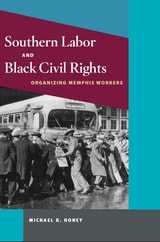
Southern Labor and Black Civil Rights
Organizing Memphis WorkersMichael K. Honey
University of Illinois Press, 1993
Winner of the Charles S. Sydnor Award, given by the Southern Historical Association, 1994. Winner of the James A. Rawley Prize given by the Organization of American Historians, 1994. Winner of the Herbert G. Gutman Award for an outstanding book in American social history.
Southern Wealth and Northern Profits
Thomas P. Kettell with Introduction by Fletcher M. Green
University of Alabama Press, 1965
Thomas Prentice Kettell was an outstanding spokesman of that group of pre-Civil War Northerners who earnestly believed that it was possible to save their country from the horrors of a sectional conflict, who worked many years to prevent the threatened dissolution of the Union, but zealously supported the national government during the Civil War in the hope that military victory would achieve what thirty years of wrangling, negotiation, and compromise had failed to accomplish-namely the preservation of a united North and South. Most of this Northern group were linked by economic ties to the planters of the South. As merchants, shippers, and financiers they largely depended upon the cotton trade for much of their prosperity; hence they opposed governmental policies which they believed would disturb their connections with the South and the foundations on which their economic prosperity and well being rested. But the fact that their ideas and position were founded on selfish economic interests did not make their action dishonest or unpatriotic.
Southern Wealth and Northern Profits was favorably received in the South where Kettell’s free trade principles, sympathetic attitude toward slavery, and his interest in Southern economic development had long been known. Moderate Southerners hoped the book might be helpful toward a compromise that would prevent secession, whereas radicals hoped it would further the cause of secession.
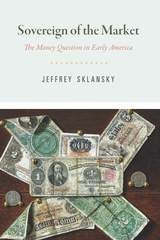
Sovereign of the Market
The Money Question in Early AmericaJeffrey Sklansky
University of Chicago Press, 2017
Jeffrey Sklansky’s wide-ranging study comprises three chronological parts devoted to major episodes in the career of the money question. First, the fight over the innovation of paper money in colonial New England. Second, the battle over the development of commercial banking in the new United States. And third, the struggle over the national banking system and the international gold standard in the late nineteenth century. Each section explores a broader problem of power that framed each conflict in successive phases of capitalist development: circulation, representation, and association. The three parts also encompass intellectual biographies of opposing reformers for each period, shedding new light on the connections between economic thought and other aspects of early American culture. The result is a fascinating, insightful, and deeply considered contribution to the history of capitalism.

Sowing the American Dream
How Consumer Culture Took Root in the Rural MidwestDavid Blanke
Ohio University Press, 2000
From 1840 to 1900, midwestern Americans experienced firsthand the profound economic, cultural, and structural changes that transformed the nation from a premodern, agrarian state to one that was urban, industrial, and economically interdependent. Midwestern commercial farmers found themselves at the heart of these changes. Their actions and reactions led to the formation of a distinctive and particularly democratic consumer ethos, which is still being played out today.
By focusing on the consumer behavior of midwestern farmers, Sowing the American Dream provides illustrative examples of how Americans came to terms with the economic and ideological changes that swirled around them. From the formation of the Grange to the advent of mail-order catalogs, the buying patterns of rural midwesterners set the stage for the coming century.
Carefully documenting the rise and fall of the powerful purchasing cooperatives, David Blanke explains the shifting trends in collective consumerism, which ultimately resulted in a significant change in the way that midwestern consumers pursued their own regional identity, community, and independence.

Sowing the Seeds of Change
The Story of the Community Food Bank of Southern ArizonaSeth Schindler
University of Arizona Press, 2021
The numbers are no less shocking in southern Arizona: one in six residents, and one in four children, are food insecure. How can this be in the richest country in the world? This book explores that paradox and the innovative solutions that one organization has developed to create a healthier, more secure tomorrow for the less fortunate among us.
The Community Food Bank of Southern Arizona (CFB) is one of the oldest and most respected food banks in America. It is a widely recognized leader not simply in providing hunger relief but in attacking the root causes of hunger and poverty through community development, education, and advocacy. In 2018, Feeding America—the national organization of food banks—named it “Food Bank of the Year.” The CFB serves as a model for all nonprofits to follow, no matter their mission.
This profusely illustrated book chronicles the CFB’s amazing success and evolution from a tiny grassroots hunger-relief organization to one with more than six thousand workers and an annual budget exceeding $100 million. The book gives voice to the thousands of CFB participants past and present, weaving their profiles and quotes throughout the book. These profiles personalize the history of the CFB and give readers an insider’s perspective on the people and events that shaped the food bank’s success. It shows how individuals working together can help prevent hunger and break the cycle of poverty that is its cause.
The aim of Sowing the Seeds of Change is not to laud the CFB’s achievements. It is to demonstrate to readers that the war against hunger, despite the obstacles, can be won. And not tomorrow. Now!
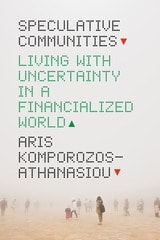
Speculative Communities
Living with Uncertainty in a Financialized WorldAris Komporozos-Athanasiou
University of Chicago Press, 2022
In Speculative Communities, Aris Komporozos-Athanasiou examines the ways that speculation has moved beyond financial markets to shape fundamental aspects of our social and political lives. As ordinary people make exceptional decisions, such as the American election of a populist demagogue or the British vote to leave the European Union, they are moving from time-honored and -tested practices of governance, toward the speculative promise of a new, more uncertain future. This book shows how even our methods of building community have shifted to the speculative realm as social media platforms enable and amplify our volatile wagers.
For Komporozos-Athanasiou, “to speculate” means increasingly “to connect,” to endorse the unknown pre-emptively, and often daringly, as a means of social survival. Grappling with the question of how more uncertainty can lead to its full-throated embrace rather than dissent, Speculative Communities shows how finance has become the model for society writ large. As Komporozos-Athanasiou argues, virtual marketplaces, new social media, and dating apps bring finance’s opaque infrastructures into the most intimate realms of our lives, leading to a new type of speculative imagination across economy, culture, and society.

Speculative Security
The Politics of Pursuing Terrorist MoniesMarieke de Goede
University of Minnesota Press, 2012
Since the terrorist acts of September 11, 2001, finance and security have become joined in new ways to produce particular targets of state surveillance. In Speculative Security, Marieke de Goede describes how previously unscrutinized practices such as donations and remittances, especially across national borders, have been affected by security measures that include datamining, asset freezing, and transnational regulation. These “precrime” measures focus on transactions that are perfectly legal but are thought to hold a specific potential to support terrorism. The pursuit of suspect monies is not simply an issue of financial regulation, she shows, but a broad political, social, and even cultural phenomenon with profound effects on everyday life.
Speculative Security offers a range of examples that illustrate the types of security interventions employed today, including the extralegal targeting and breaking up of the al-Barakaat financial network that was accompanied by raids in the United States, asset freezes in Sweden, and the incarceration of a money remitter at Guantánamo Bay. De Goede develops the paradigm of “speculative security” as a way to understand the new fusing of finance and security, denoting the speculative nature of both the means and the ends of the war on terrorist financing.
Ultimately, de Goede reveals how the idea of creating “security” appeals to multiple imaginable—and unimaginable—futures in order to enable action in the present.

Speculum Iuris
Roman Law as a Reflection of Social and Economic Life in AntiquityJean-Jacques Aubert and Boudewijn Sirks, Editors
University of Michigan Press, 2002
Speculum Iuris examines the complex relationship between law and social practice from the particular angle of Roman legislation and jurisprudence as conditioned by or reacting to a specific social, economic, and political context. Using various strategies, the editors and contributors mine a huge body of texts to study attitudes and behaviors of the Roman upper class, whose social concerns are reflected in the development of legal rules.
A close reading of juristic opinions and Republican or imperial legislation allows the contributors to find rationales behind rules and decisions in order to explain practices and mentalities of the elite within a larger social context. This book demonstrates clearly that Roman law was not divorced from the realities of daily life, even if some jurists may have been working with purely hypothetical cases.
Speculum Iuris provides a multidisciplinary approach to the question of the interplay of legal and social forces in the Roman world. As such, it will be a helpful study for general classicists and ancient historians, as well as for legal historians, social historians, economic historians, sociologists, and cultural anthropologists.
Jean-Jacques Aubert is Professor of Latin Language and Literature, University of Neuchâtel, Switzerland. Boudewijn Sirks is Professor of the History of Ancient Law, the History of European Private Law, and German Civil Law, Institute for the History of Law, Germany.

Spin Cycle
How Research Gets Used in Policy Debates--The Case of Charter SchoolsJeffrey R. Henig
Russell Sage Foundation, 2008
Spiritual Investments
Wall Street Wisdom From Sir JohnGary Moore
Templeton Press, 1998
Gathered here are seventeen sound investment principles that will help people make sensible choices for financial security. What is surprising, however, is how applicable these principles are to life.

Sport Facility Management
Organizing Events and Mitigating Risks, Fourth EditionRobert E. Ammon
FiT Publishing, 2023
The success of facilities and events in a multi-billion dollar sport industry requires that sport and event facility managers understand the complex relationships between the events, facilities, the players and the public and the risks involved in organizing events.
Sport Facility Management: Organizing Events and Mitigating Risks, 4th Edition, examines what it takes to successfully operate and manage a sport facility. Veteran authors Robin Ammon, Richard Southall, and Mark Nagel provide a framework for the successful operation of sport and event venues through proven strategies and techniques, as highlighted through salient industry examples.
Chapters in this edition explore the complex rules and relationships of public and private financing and ownership, the management of facility revenues and expenses, pricing strategies at the box office, approaches to booking and scheduling, best practices in leveraging human resources, as well as an understanding of and adherence to laws and regulations governing and affecting facilities, employees, and the public through venue contracts, risks, liability, negligence, crowd and alcohol management, as well as emergency planning.
Sport Facility Management: Organizing Events and Mitigating Risks, 4th Edition, builds understanding of this important segment of the global sport industry to prepare undergraduate and graduate students for the challenges, the risks, and the rewards inherent in operating sport and event facilities.
Sport and the Neoliberal University
Profit, Politics, and PedagogyKing-White, Ryan
Rutgers University Press, 2018
The contributors to Sport and the Neoliberal University examine how intercollegiate athletics became a contested terrain of public/private interests. They look at college sports from economic, social, legal, and cultural perspectives to cut through popular mythologies regarding intercollegiate athletics and to advocate for increased clarity about what is going on at a variety of campuses with regard to athletics. Focusing on current issues, including the NCAA, Title IX, recruitment of high school athletes, and the Penn State scandal, among others, Sport and the Neoliberal University shows the different ways institutions, individuals, and corporations are interacting with university athletics in ways that are profoundly shaped by neoliberal ideologies.

Squaring Up
Policy Strategies to Raise Women's Incomes in the United StatesMary C. King, Editor
University of Michigan Press, 2001
Stadium City
Sports and Media Infrastructure in the United StatesHelen Morgan Parmett
University of Illinois Press, 2025

Staging Tourism
Bodies on Display from Waikiki to Sea WorldJane C. Desmond
University of Chicago Press, 1999
Gathering together written accounts, postcards, photographs, advertisements, films, and oral histories as well as her own interpretations of these displays, Desmond gives us a vibrant account of U.S. tourism in Waikiki from 1900 to the present. She then juxtaposes cultural tourism with "animal tourism" in the United States, which takes place at zoos, aquariums, and animal theme parks. In each case, Desmond argues, the relationship between the viewer and the viewed is ultimately based on concepts of physical difference harking back to the nineteenth century.

Staging a Comeback
Broadway, Hollywood, and the Disney RenaissancePeter C. Kunze
Rutgers University Press, 2023

Staircases or Treadmills?
Labor Market Intermediaries and Economic Opportunity in a Changing EconomyChris Benner
Russell Sage Foundation, 2007

Start-Up Poland
The People Who Transformed an EconomyJan Cienski
University of Chicago Press, 2018
As the Warsaw bureau chief for the Financial Times, Jan Cienski spent more than a decade talking with the people who did something that had never been done before: recreating a market economy out of a socialist one. Poland had always lagged behind wealthier Western Europe, but in the 1980s the gap had grown to its widest in centuries. But the corrupt Polish version of communism also created the conditions for its eventual revitalization, bringing forth a remarkably resilient and entrepreneurial people prepared to brave red tape and limited access to capital. In the 1990s, more than a million Polish people opened their own businesses, selling everything from bicycles to leather jackets, Japanese VCRs, and romance novels. The most business-savvy turned those primitive operations into complex corporations that now have global reach.
Well researched and accessibly and entertainingly written, Start-Up Poland tells the story of the opening bell in the East, painting lively portraits of the men and women who built successful businesses there, what their lives were like, and what they did to catapult their ideas to incredible success. At a time when Poland’s new right-wing government plays on past grievances and forms part of the populist and nationalist revolution sweeping the Western world, Cienski’s book also serves as a reminder that the past century has been the most successful in Poland’s history.
Starting and Running a Nonprofit Organization
Joan M. Hummel
University of Minnesota Press, 1996
Starting and Running a Nonprofit Organization is a book for people who are forming new small nonprofits; thinking about converting an informal, grassroots group into tax-exempt status; reorganizing an existing agency; or currently managing a nonprofit. It provides practical and basic how-to information on legal, tax, organizational, and other issues particular to nonprofits.
This one-of-a-kind resource has been a valuable guide to nonprofit management for decades. While much of the information originated in an earlier era of nonprofit formation, it remains highly useful for gaining an overview and creating an action plan for people entering this realm of organizational management. Its compact format provides information in an easy-to-understand style. The book describes, step-by-step, the typical phases of creating and operating a new nonprofit, including incorporation, establishing a board of directors, writing bylaws, obtaining tax-exempt status, creating a strategic plan, budgeting and grant seeking, understanding accounting principles, managing human resources, and creating a community relations plan.
The Center for Nonprofit Management is a department of the Graduate School of Business at the University of St. Thomas in Minneapolis and St. Paul. It provides training and guidance in all aspects of the nonprofit sector to existing organizations as well as individuals or groups who are seeking help in starting a nonprofit.

State Employment Policy in Hard Times
Michael Barker, ed.
Duke University Press, 1983
State Institutions, Private Incentives, Global Capital
Andrew C. Sobel
University of Michigan Press, 2002

State Taxation Policy and Economic Growth
Michael Barker, ed.
Duke University Press, 1983

State Trading in the Twenty-First Century
The World Trade Forum, Volume 1Thomas Cottier and Petros C. Mavroidis, Editors
University of Michigan Press, 1998
Statistics for Public Policy
A Practical Guide to Being Mostly Right (or at Least Respectably Wrong)Jeremy G. Weber
University of Chicago Press, 2024
A long-overdue guide on how to use statistics to bring clarity, not confusion, to policy work.
Statistics are an essential tool for making, evaluating, and improving public policy. Statistics for Public Policy is a crash course in wielding these unruly tools to bring maximum clarity to policy work. Former White House economist Jeremy G. Weber offers an accessible voice of experience for the challenges of this work, focusing on seven core practices:
- Thinking big-picture about the role of data in decisions
- Critically engaging with data by focusing on its origins, purpose, and generalizability
- Understanding the strengths and limits of the simple statistics that dominate most policy discussions
- Developing reasons for considering a number to be practically small or large
- Distinguishing correlation from causation and minor causes from major causes
- Communicating statistics so that they are seen, understood, and believed
- Maintaining credibility by being right (or at least respectably wrong) in every setting
Steady Gains and Stalled Progress
Inequality and the Black-White Test Score GapKatherine Magnuson
Russell Sage Foundation, 2008
Steam City
Railroads, Urban Space, and Corporate Capitalism in Nineteenth-Century BaltimoreDavid Schley
University of Chicago Press, 2020
Steam City tells the story of corporate capitalism starting from the street and moving outward, looking at how the rise of the railroad altered the fabric of everyday life in the United States. The B&O’s founders believed that their new line would remap American economic geography, but no one imagined that the railroad would also dramatically reshape the spaces of its terminal city. As railroad executives wrangled with city officials over their use of urban space, they formulated new ideas about the boundaries between public good and private profit. Ultimately, they reinvented the B&O as a private enterprise, unmoored to its home city. This bold reconception had implications not only for the people of Baltimore, but for the railroad industry as a whole. As David Schley shows here, privatizing the B&O helped set the stage for the rise of the corporation as a major force in the post-Civil War economy.
Steam City examines how the birth and spread of the American railroad—which brought rapid communications, fossil fuels, and new modes of corporate organization to the city—changed how people worked, where they lived, even how they crossed the street. As Schley makes clear, we still live with the consequences of this spatial and economic order today.

Steel and Economic Growth in Mexico
By William E. Cole
University of Texas Press, 1967
Iron ore is widely distributed over the world and has been mined from ancient times, but Mexico, with a good supply of ore, was a relative newcomer to the ranks of iron- and steel-producing nations. This distinctive book offers a history of the Mexican iron and steel industry through the 1960s.
Archaeological evidence, the author states, shows that the indigenous peoples of Mexico had developed a technology of metallurgy—relying on gold, silver, copper, tin and bronze—before the arrival of the Spaniards, but those same peoples had no knowledge of iron. That knowledge and accompanying technology arrived with the conquistadores.
Extremely slow development characterized the progress of iron mining in Mexico and until the twentieth century ore mining and metal forging continued to be handled on a small scale.
By the turn of the century two occurrences had combined to give Mexico an embryonic steel market: the railroad grid had come to link Mexico’s diverse regions and Porfirio Díaz had used his personal power to eliminate interstate tariff barriers to trade. In 1900 the first integrated steel mill in Latin America was established in Monterrey—the city that was to become the capital of Mexico’s manufacturing sector.
Forty years later, shortages of steel imports provided the motivation for the second stage of growth of the steel industry. Much of the book is devoted to the study of this period of growth.
William E. Cole tells the whole story in this scholarly study, which has as its twofold purpose a complete examination of the iron and steel industry of Mexico and an assessment of the impact of that industry on other sectors of the economy. Much space is devoted to an analysis of the role of the Mexican government in promoting and regulating the steel industry and to discussion of the efficiency of the promotional tools employed by the government. Further, he studies the status of the industry in the 1960s, its production and its consumption, and presents a projection for the future.
Stories Employers Tell
Race, Skill, and Hiring in AmericaPhilip Moss
Russell Sage Foundation, 2001
Stories of Capitalism
Inside the Role of Financial AnalystsStefan Leins
University of Chicago Press, 2018
Building on recent developments in the social studies of finance, Stories of Capitalism provides the first ethnography of financial analysis. Drawing on two years of fieldwork in a Swiss bank, Stefan Leins argues that financial analysts construct stories of possible economic futures, presenting them as coherent and grounded in expert research and analysis. In so doing, they establish a role for themselves—not necessarily by laying bare empirically verifiable trends but rather by presenting the market as something that makes sense and is worth investing in. Stories of Capitalism is a nuanced look at how banks continue to boost investment—even in unstable markets—and a rare insider’s look into the often opaque financial practices that shape the global economy.
Strained Relations
US Foreign-Exchange Operations and Monetary Policy in the Twentieth CenturyMichael D. Bordo, Owen F. Humpage, and Anna J. Schwartz
University of Chicago Press, 2015
Straining at the Anchor
The Argentine Currency Board and the Search for Macroeconomic Stability, 1880-1935Gerardo della Paolera and Alan M. Taylor
University of Chicago Press, 2001
With many countries now using—or seriously contemplating—monetary arrangements similar to Argentina's, this important and persuasive study maps out one of history's most interesting monetary experiments to show what works and what doesn't.

Strategic Advertising Mechanisms
From Copy Strategy to Iconic BrandsJorge David Fernández Gómez
Intellect Books, 2021
This book takes an in-depth look at the most important and transcendent strategic advertising mechanisms to emerge in the twentieth century. Charting trends in classic advertising methodologies, the author explores key concepts from Rosser Reeves’s unique selling proposition and Procter & Gamble’s copy strategy to influential modern approaches including Kevin Roberts’s Lovemarks and Douglas Holt’s iconic brand framework. It also considers European mechanisms, including Jacques Séguéla’s star strategy and Henri Joannis’ psychological axis theory. Practitioners, researchers, scholars, and students will find much to gain from this rich exploration of the strategies that shaped modern advertising and the figures behind them.

Strategic Communications in Healthcare
Building Trust, Reputation, and ImpactEdited by Rose Glenn and David Jarrard
Michigan Publishing Services, 2027
Strategic Communications in Healthcare: Building Trust, Reputation and Impact is a landmark textbook that combines innovative approaches to communication with the enduring principles that drive effectiveness, influence, and results. Drawing on the real-world expertise of nationally recognized leaders Rose Glenn and David Jarrard—along with a who’s who of senior healthcare communicators and educators—this hands-on guide brings together trust-building, messaging, crisis response, culture, brand, patient experience, research, measurement, AI, and more foundational elements into a cohesive framework for students and professionals alike.
Strategic Factors in Nineteenth Century American Economic History
A Volume to Honor Robert W. FogelEdited by Claudia Goldin and Hugh Rockoff
University of Chicago Press, 1992
These sixteen essays reveal, by example, the continuing vitality of Fogel's approach. The authors use an astonishing variety of data, including genealogies, the U.S. federal population census manuscripts, manumission and probate records, firm accounts, farmers' account books, and slave narratives, to address collectively market integration and its impact on the lives of Americans. The evolution of markets in agricultural and manufacturing labor is considered first; that concerning capital and credit follows. The demography of free and slave populations is the subject of the third section, and the final group of papers examines the extra-market institutions of governments and unions.
Strategic Giving
The Art and Science of PhilanthropyPeter Frumkin
University of Chicago Press, 2006
The philanthropic landscape is changing dramatically as a new generation of wealthy donors seeks to leave its mark on the public sphere. Peter Frumkin reveals in Strategic Giving why these donors could benefit from having a comprehensive plan to guide their giving. And with this thoughtful and timely book, he provides the much-needed framework to understand and develop this kind of philanthropic strategy.
After listening for years to scores of individual and institutional funders discuss the challenges of giving wisely, Frumkin argues here that contemporary philanthropy requires a thorough rethinking of its underlying logic. Philanthropy should be seen, he contends, as both a powerful way to meet public needs and a meaningful way to express private beliefs and commitments. He demonstrates that finding a way to simultaneously fulfill both of these functions is crucial to the survival of philanthropy and its potential to support pluralism in society. And he goes on to identify the five essential elements donors must consider when developing a philanthropic strategy—the vehicle through which giving will flow, the way impact will be achieved, the level of engagement and profile sought, the time frame for giving, and the underlying purpose of the gift. Frumkin’s point is that donors must understand strategic giving as the integration of these five critical dimensions to giving.
Essential reading for donors, researchers, and anyone involved with the world of philanthropy, Strategic Giving provides a new basis for understanding philanthropic effectiveness and a promising new way for philanthropy to achieve the legitimacy that has at times eluded it.