Results by title
2194 books match the query 'Women's Studies' and 186 start with s
Squaring Up
Policy Strategies to Raise Women's Incomes in the United StatesMary C. King, Editor
University of Michigan Press, 2001
Staging Desire
Queer Readings of American Theater HistoryKim Marra and Robert A. Schanke, Editors
University of Michigan Press, 2002
Essays cover the careers of major figures Clyde Fitch, Rachel Crothers, Mercedes de Acosta, Djuna Barnes, Cole Porter, Lorenz Hart, George Kelly, William Inge, James "Acorn" Oaks, Adam "Vagabond" Badeau, Eric Bentley, Loie Fuller, Robert Edmond Jones, and Jean Rosenthal. Grounded in research into the history of sexuality, the book engages central problems of terminology and evidence in analyzing sexual practices of the past and the modes of articulation of sexuality in theater, conditioned by American culture's peculiar anxieties about both.
Kim Marra is Associate Professor of Theatre Arts, University of Iowa. Robert A. Schanke is Professor of Theatre, Central College, Iowa. They edited Passing Performances: Queer Readings of Leading Players in American Theater History, a previous volume in this series.

Staging Desire
Queer Readings of American Theater HistoryKim Marra and Robert A. Schanke, Editors
University of Michigan Press, 0
Staging Masculinity
The Rhetoric of Performance in the Roman WorldErik Gunderson
University of Michigan Press, 2000
Staging Philanthropy
Patriotic Women and the National Imagination in Dynastic Germany, 1813-1916Jean H. Quataert
University of Michigan Press, 2001

Standing Our Ground
Women, Environmental Justice, and the Fight to End Mountaintop RemovalJoyce M. Barry
Ohio University Press, 2012
Standing Our Ground: Women, Environmental Justice, and the Fight to End Mountaintop Removal examines women’s efforts to end mountaintop removal coal mining in West Virginia. Mountaintop removal coal mining, which involves demolishing the tops of hills and mountains to provide access to coal seams, is one of the most significant environmental threats in Appalachia, where it is most commonly practiced.
The Appalachian women featured in Barry’s book have firsthand experience with the negative impacts of Big Coal in West Virginia. Through their work in organizations such as the Coal River Mountain Watch and the Ohio Valley Environmental Coalition, they fight to save their mountain communities by promoting the development of alternative energy resources. Barry’s engaging and original work reveals how women’s tireless organizing efforts have made mountaintop removal a global political and environmental issue and laid the groundwork for a robust environmental justice movement in central Appalachia.

Star Charting
Bess Matassa
Duke University Press, 2026
Starting Over
Feminism and the Politics of Cultural CritiqueJudith Newton
University of Michigan Press, 1994

State of Virginity
Gender, Religion, and Politics in an Early Modern Catholic StateUlrike Strasser
University of Michigan Press, 2006
Winner: 2005 Book Award from the Society for the Study of Early Modern Women; Selected by the German Studies Association as one of the top five books of 2004 in early modern history
"A fresh, original study of gender roles and religious ideology in the early modern Catholic state. . . . Using a rich array of archival sources, Strasser explores ways in which an increasingly centralized Bavarian government in Munich inaugurated marriage and convent reforms and a civil religion based on the veneration of the Virgin Mary. Her carefully selected case studies show how church and state collaborated to produce a shared discourse and consistent policies proscribing extramarital sex, and excluding those without property from marriage. "
Ulrike Strasser is Associate Professor of History, Affiliate Faculty in Women's Studies, and Core Faculty in Religious Studies at the University of California, Irvine.

Stately Bodies
Literature, Philosophy, and the Question of GenderAdriana Cavarero
University of Michigan Press, 2002
She examines bodily metaphor in political discourse and in fictional depictions of politics, including Sophocles' Antigone, Plato's Timaeus, Livy, John of Salisbury, Shakespeare's Hamlet, and Hobbes' Leviathan. An appendix explores two texts by women that disrupt these notions: Maria Zambrano's Tomb of Antigone and Ingeborg Bachmann's Undine Goes.
Cavarero exposes the problematic nature of the mind/body dualism that has been essential in Western thought. Her insight that the expelled, depoliticized body is a female one becomes an instrument for decoding many paradoxical tropes of the political body. For instance, Cavarero revisits Antigone as the tragedy in which a body that is displaced, bleeding, and matrilinear allows the construction of a political order where misogynous rationality rules. Throughout the book, Cavarero argues that women have been cast by male thinkers into the realm of the corporeal as nonpolitical, and also suggests that this nonpolitical position is also a source of knowledge and power, that politics is a masculine pursuit that should not be admired or envied.
Adriana Cavarero is Professor of Philosophy, University of Verona, and frequently is Visiting Professor. New York University. Her books Relating Narratives: Storytelling and Selfhood and In Spite of Plato: A Feminist Rewriting of Ancient Philosophy were published by Routledge.
Stepping Forward
Black Women in Africa and the AmericasCatherine Higgs
Ohio University Press, 2002
A unique and important study, Stepping Forward examines the experiences of nineteenth- and twentieth-century black women in Africa and African diaspora communities from a variety of perspectives in a number of different settings.
This wide-ranging collection designed for classroom use explores the broad themes that have shaped black women’s goals, options, and responses: religion, education, political activism, migration, and cultural transformation. Essays by leading scholars in the field examine the lives of black women in the United States and the Caribbean Basin; in the white settler societies of Kenya, Zimbabwe, and South Africa; and in the black settler societies of Liberia and Sierra Leone.
Among the contributors to this volume are historians, political scientists, and scholars of literature, music, and law. What emerges from their work is an image of black women’s agency, self-reliance, and resiliency. Despite cultural differences and geographical variations, black women have provided foundations on which black communities have not only survived, but also thrived. Stepping Forward is a valuable addition to our understanding of women’s roles in these diverse communities.
Stepping Out of the Shadows
Alabama Women, 1819–1990Mary Martha Thomas
University of Alabama Press, 1995
Discover the women who transformed Alabama's past and continue to inspire its future.
The history of Alabama has been told, but most often in terms of white men and their politics and economics. Now a more complex story of the state is emerging from the shadows of history in a new book that investigates the place of women from the perspective of race, class, and gender. Stepping Out of the Shadows, is a compilation of articles first presented at the 1990 Alabama Women’s History Forum in Birmingham, and edited by Mary Martha Thomas. The writers discuss the lives of women in antebellum Alabama and reexamine the roles of both black and white women as missionaries during Reconstruction, as reformers and suffrage leaders in the Progressive era, and as members of the state legislature in the 20th century.

Stolen Bases
Why American Girls Don't Play BaseballJennifer Ring
University of Illinois Press, 2013
Jennifer Ring questions the forces that try to keep girls who want to play baseball away from the game. Focusing on a history that, unfortunately, repeats itself, Ring describes the circumstances that twice stole baseball from American girls: once in the late nineteenth and early twentieth century, and again in the late twentieth century, after it was no longer legal to exclude girls who wanted to play. In the early twentieth century, Albert Goodwill Spalding--sporting goods magnate, baseball player, and promoter--declared baseball off limits for women and envisioned global baseball on a colonialist scale, using the American sport to teach men from non-white races and non-European cultures to become civilized and rational. And by the late twentieth century, baseball had become serious business for boys and men at all levels, with female players perceived as obstacles or detriments to rising male players' chances of success.
Stolen Bases also looks at the backgrounds of American softball, which was originally invented by men who wanted to keep playing baseball indoors during cold winter months but has become the consolation sport for most female players. Throughout her analysis, Ring searches for ways to rescue baseball from its arrogance and sense of exclusionary entitlement.

Strained Sisterhood
Gender and Class in the Boston Female Anti-Slavery SocietyDebra Gold Hansen
University of Massachusetts Press, 1993
Debra Gold Hansen explores the origins of the equality-versus-difference debate by examining the Boston Female Anti-Slavery Society, which disbanded in 1840 over this very issue. After establishing a historical framework for women's lives in early nineteenth-century Boston, Hansen analyzes the membership of the Society along the lines of race, religion, and socioeconomic status. Through her findings, she concludes that many of the issues that estranged female abolitionists in antebellum Boston continue to divide women today, testifying not to the strength of the bonds between women but to the fragility of those ties.

Street Corner Secrets
Sex, Work, and Migration in the City of MumbaiSvati P. Shah
Duke University Press, 2014
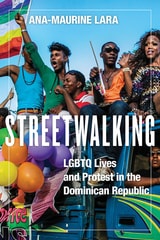
Streetwalking
LGBTQ Lives and Protest in the Dominican RepublicAna-Maurine Lara
Rutgers University Press, 2021
Streetwalking: LGBTQ Lives and Protest in the Dominican Republic is an exploration of the ways that lesbian, gay, bisexual, trans and queer persons exercise power in a Catholic Hispanic heteropatriarchal nation-state, namely the Dominican Republic. Lara presents the specific strategies employed by LGBTQ community leaders in the Dominican Republic in their struggle for subjectivity, recognition, and rights. Drawing on ethnographic encounters, film and video, and interviews, LGBTQ community leaders teach readers about streetwalking, confrontación, flipping the script, cuentos, and the use of strategic universalisms in the exercise of power and agency. Rooted in Maria Lugones's theorization of streetwalker strategies and Audre Lorde's theorization of silence and action, this text re-imagines the exercise and locus of power in examples provided by the living, thriving LGBTQ community of the Dominican Republic.
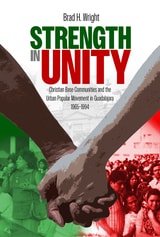
Strength in Unity
Christian Base Communities and the Urban Popular Movement in Guadalajara, 1965–1994Brad H. Wright
University of Alabama Press, 2026
Examines how poor and working-class communities in Guadalajara organized through faith, education, and culture to claim dignity, justice, and the right to the city.
Strength in Unity: Christian Base Communities and the Urban Popular Movement in Guadalajara, 1965–1994 presents the grassroots history of Guadalajara’s urban popular movement, centering the voices and struggles of poor and working-class communities, especially women, who organized for dignity, justice, and the right to the city. Brad H. Wright brings to light the transformative role of Christian base communities and Freirean popular education as incubators of political consciousness and collective action in the face of authoritarian repression and neoliberal coaptation.
Drawing from oral histories, personal archives, and the records of the Sagrado Corazón nuns, Wright reconstructs a powerful counternarrative to dominant portrayals of marginalized populations as “apathetic” and “uneducated.” Strength in Unity reveals a vibrant culture of resistance where women led campaigns for basic services, built schools, and demanded access to transportation, using tools such as community newspapers, street theater, and music to mobilize and sustain solidarity.
This deeply researched and compellingly told history challenges conventional accounts of urban development and social movements in Latin America. Strength in Unity is essential reading for scholars, students, and activists interested in grassroots organizing, liberation theology, and the enduring power of community-led change.
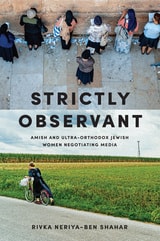
Strictly Observant
Amish and Ultra-Orthodox Jewish Women Negotiating MediaRivka Neriya-Ben Shahar
Rutgers University Press, 2024
The Amish and ultra-Orthodox Jewish communities have typically been associated with strict religious observance, a renunciation of worldly things, and an obedience of women to men. Women’s relationship to media in these communities, however, betrays a more nuanced picture of the boundaries at play and women’s roles in negotiating them.
Strictly Observant presents a compelling ethnographic study of the complex dynamic between women in both the Pennsylvanian Old Order Amish and Israeli ultra-Orthodox Jewish communities and contemporary media technologies. These women regularly establish valuable social, cultural, and religious capital through the countless decisions for use and nonuse of media that they make in their daily lives, and in ways that challenge the gender hierarchies of each community. By exhibiting a deep awareness of how media can be managed to increase their social and religious reputations, these women prompt us to reconsider our outmoded understanding of the Amish and ultra-Orthodox Jewish communities, the role that women play in these communities as agents of change, and our own relationship to media today.

Strong Voices, Weak History
Early Women Writers and Canons in England, France, and ItalyPamela J Benson and Victoria Kirkham, Editors
University of Michigan Press, 2005
Subject to Reality
Women and Documentary FilmShilyh Warren
University of Illinois Press, 2019
Shilyh Warren reopens this understudied period and links it to a neglected era of women's filmmaking that took place from 1920 to 1940, another key period of thinking around documentary, race, and gender. Drawing women’s cultural expression during these two explosive times into conversation, Warren reconsiders key debates about subjectivity, feminism, realism, and documentary and their lasting epistemological and material consequences for film and feminist studies. She also excavates the lost ethnographic history of women's documentary filmmaking in the earlier era and explores the political and aesthetic legacy of these films in more explicitly feminist periods like the Seventies.
Filled with challenging insights and new close readings, Subject to Reality sheds light on a profound and unexamined history of feminist documentaries while revealing their influence on the filmmakers of today.
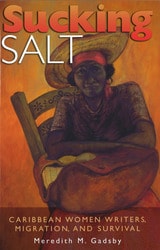
Sucking Salt
Caribbean Women Writers, Migration, and SurvivalMeredith M. Gadsby
University of Missouri Press, 2006

Sugar Girls & Seamen
A Journey into the World of Dockside Prostitution in South AfricaHenry Trotter
Ohio University Press, 2011
Sugar Girls and Seamen illuminates the shadowy world of dockside prostitution in South Africa, focusing on the women of Cape Town and Durban who sell their hospitality to foreign sailors.
Dockside “sugar girls” work at one of the busiest cultural intersections in the world. Through their continual interactions with foreign seamen, they become major traffickers in culture, ideas, languages, styles, goods, currencies, genes, and diseases. Many learn the seamen’s languages, develop emotional relationships with them, have their babies, and become entangled in vast webs of connection. Henry Trotter argues that these South African women are the ultimate cosmopolitans, the unsung sirens of globalization.
Based on research at the seamen’s nightclubs, plus countless interviews with sugar girls, sailors, club owners, cabbies, bouncers, and barmaids, this book provides a comprehensive account of dockside prostitution at the southern tip of Africa. Through stories, analysis, and firsthand experiences, it reveals this gritty world in all its raw vitality and fragile humanity. Sugar Girls and Seamen is simultaneously racy and light, critical and profound.

Surface Encounters
Screen Materials and Film CultureAndrea J. Kelley
University of Illinois Press, 2027
Kelley expands film history into homes, parks, and outdoor spaces to reveal that ordinary screen materials bring with them long histories tied to labor, race, gender, and industry. As she shows, when people project films onto these surfaces, their histories impact the meaning of the viewing experience. Kelley draws on archival research, film analysis, and examples like backyard movie nights and COVID-era outdoor screenings to focus on how overlooked elements affect our understanding of spectatorship, exhibition, and media culture.
An evocative look at a popular experience, Surface Encounters shows that movie screens matter because of what they are made of and the ways people encounter them in everyday places.

Surfer Girls in the New World Order
Krista Comer
Duke University Press, 2010
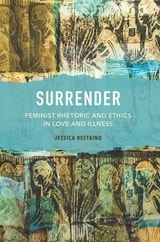
Surrender
Feminist Rhetoric and Ethics in Love and IllnessJessica Restaino
Southern Illinois University Press, 2019
One of Library Journal's Top 20 Best-Selling Language Titles of 2019
In an ethnographic study spanning the last years of research collaborator and friend Susan Lundy Maute’s life with terminal breast cancer, author Jessica Restaino argues the interpretative challenges posed by research and writing amid illness and intimacy demand a methodological break from accepted genres and established practices of knowledge making. Restaino searches their experiences—recorded in interviews, informal writings, and correspondence—to discover a rhetoric of love and illness. She encourages a synthesis of methods and the acceptance of a reversal of roles—researcher and researched, writer and written-about—and emphasizes the relevancy of methodological diversity, the necessity of the personal, and the analytical richness of unpredictability and risk in being who we are in our scholarship at any given moment.
Bringing together critical analysis, qualitative-style research methods, close reading, Surrender: Feminist Rhetoric and Ethics inLove and Illness resists traditional ideas about academic writing and invites others to pursue collaborations that subvert accepted approaches to representation, textual production, and subjectivity. Restaino demonstrates a way of writing—the rendering of the academic text itself—that suggests how we do our work has resonance for what we produce. She offers framing questions for use by others interested in doing similar kinds of scholarship that may frighten, overwhelm, or confound. This book deepens our understanding of subjectivity and the gains made by feminist resistance to conventional concepts of objectivity in research collaborations.
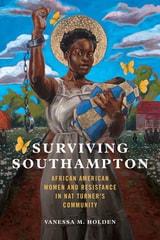
Surviving Southampton
African American Women and Resistance in Nat Turner's CommunityVanessa M. Holden
University of Illinois Press, 2021
The 1831 Southampton Rebellion led by Nat Turner involved an entire community. Vanessa M. Holden rediscovers the women and children, free and enslaved, who lived in Southampton County before, during, and after the revolt. Mapping the region's multilayered human geography, Holden draws a fuller picture of the inhabitants, revealing not only their interactions with physical locations but also their social relationships in space and time. Her analysis recasts the Southampton Rebellion as one event that reveals the continuum of practices that sustained resistance and survival among local Black people. Holden follows how African Americans continued those practices through the rebellion’s immediate aftermath and into the future, showing how Black women and communities raised children who remembered and heeded the lessons absorbed during the calamitous events of 1831.
A bold challenge to traditional accounts, Surviving Southampton sheds new light on the places and people surrounding Americas most famous rebellion against slavery.
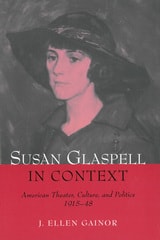
Susan Glaspell in Context
American Theater, Culture, and Politics, 1915-48J. Ellen Gainor
University of Michigan Press, 2003
Susan Glaspell
Essays on Her Theater and FictionLinda Ben-Zvi, Editor
University of Michigan Press, 1995
The career of Susan Glaspell (1876-1948), the American playwright and novelist, follows closely the trajectory of other "reclaimed" American women writers of the century such as Kate Chopin, Charlotte Perkins Gilman, and Zora Neale Hurston. She was well known in her time, effaced from canonical consideration after her death, and rediscovered years later through the surfacing of one work around which critical attention has focused. Glaspell was a respected international playwright and novelist who amassed some of the most impressive credentials in American theater history, including the Pulitzer Prize in 1931. Over the past fifteen years, she has been rediscovered through the work of leading feminist scholars; and her one-act play Trifles and its short story form, "A Jury of Her Peers," have become classics. This book is the first collection devoted to the study of the body of Glaspell's work. Essays by leading playwrights and scholars provide an array of perspectives on the writer and her work. The book features the first complete Glaspell bibliography, including original reviews of her plays and fiction and recent critical studies of her writing.
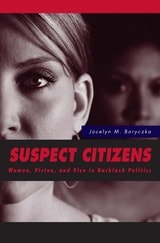
Suspect Citizens
Women, Virtue, and Vice in Backlash PoliticsJocelyn Boryczka
Temple University Press, 2012
What drives the cycle of backlashes against women’s ongoing struggle for equality, freedom, and inclusion in American politics? In her innovative and provocative book, Suspect Citizens, Jocelyn Boryczka presents a feminist conceptual history that shows how American politics have largely defined women in terms of their reproductive and socializing functions. This framework not only denies women full citizenship, but also devalues the active political engagement of all citizens who place each other and their government under suspicion.
Developing the gendered dynamics of virtue and vice, Boryczka exposes the paradox of how women are perceived as both virtuous moral guardians and vice-ridden suspect citizens capable of jeopardizing the entire nation’s exceptional future. She uses wide-ranging examples from the Puritans and contemporary debates over sex education to S&M lesbian feminists and the ethics of care to show how to move beyond virtue and vice to a democratic feminist ethics.
Suspect Citizens advances a politics of collective responsibility and belonging.
Sweatshop Capital
Profit, Violence, and Solidarity Movements in the Long Twentieth CenturyBeth Robinson
Duke University Press, 2025
Sweeping Beauty
Contemporary Women Poets Do HouseworkPamela Gemin
University of Iowa Press, 2005

Sweet Dreams
The World of Patsy ClineEdited by Warren R. Hofstra
University of Illinois Press, 2013
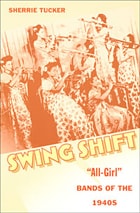
Swing Shift
"All-Girl" Bands of the 1940sSherrie Tucker
Duke University Press, 2001
Filled with firsthand accounts of more than a hundred women who performed during this era and complemented by thorough—and eye-opening—archival research, Swing Shift not only offers a history of this significant aspect of American society and culture but also examines how and why whole bands of dedicated and talented women musicians were dropped from—or never inducted into—our national memory. Tucker’s nuanced presentation reveals who these remarkable women were, where and when they began to play music, and how they navigated a sometimes wild and bumpy road—including their experiences with gas and rubber rationing, travel restrictions designed to prioritize transportation for military needs, and Jim Crow laws and other prejudices. She explains how the expanded opportunities brought by the war, along with sudden increased publicity, created the illusion that all female musicians—no matter how experienced or talented—were “Swing Shift Maisies,” 1940s slang for the substitutes for the “real” workers (or musicians) who were away in combat. Comparing the working conditions and public representations of women musicians with figures such as Rosie the Riveter, WACs, USO hostesses, pin-ups, and movie stars, Tucker chronicles the careers of such bands as the International Sweethearts of Rhythm, Phil Spitalny’s Hours of Charm, The Darlings of Rhythm, and the Sharon Rogers All-Girl Band.

Sylvia Pankhurst
A Life in Radical PoliticsMary Davis
Pluto Press, 1999
Sylvia Pankhurst
Suffragette, Socialist and Scourge of EmpireKatherine Connelly
Pluto Press, 2013
From militant suffragette at the beginning of the twentieth century to campaigner against colonialism in Africa after the Second World War, Sylvia Pankhurst dedicated her life to fighting oppression and injustice.
In this vivid biography Katherine Connelly examines Pankhurst’s role at the forefront of significant developments in the history of radical politics. She guides us through Pankhurst's construction of a suffragette militancy which put working-class women at the heart of the struggle, her championing of the Bolshevik Revolution and her clandestine attempts to sabotage the actions of the British state, as well as her early identification of the dangers of Fascism.
The book explores the dilemmas, debates and often painful personal consequences faced by Pankhurst which were played out in her art, writings and activism. It argues that far from being an advocate of disparate causes, Pankhurst’s campaigns were united by an essential continuity which hold vital lessons for achieving social change. This lively and accessible biography presents Pankhurst as a courageous and inspiring campaigner, of huge relevance to those engaged in social movements today.

Sylvia Plath and the Mythology of Women Readers
Janet Badia
University of Massachusetts Press, 2011
Janet Badia investigates the evolution of this narrative, tracing its origins, exposing the gaps and elisions that have defined it, and identifying it as a bullying mythology whose roots lie in a long history of ungenerous, if not outright misogynistic, rhetoric about women readers that has gathered new energy from the backlash against contemporary feminism.
More than just an exposé of our cultural biases against women readers, Badia's research also reveals how this mythology has shaped the production, reception, and evaluation of Plath's body of writing, affecting everything from the Hughes family's management of Plath's writings to the direction of Plath scholarship today. Badia discusses a wide range of texts and issues whose significance has gone largely unnoticed, including the many book reviews that have been written about Plath's publications; films and television shows that depict young Plath readers; editorials and fan tributes written about Plath; and Ted and (daughter) Frieda Hughes's writings about Plath's estate and audience.