Results by title
8812 books match the query 'Political Science' and 537 start with s

State of Empowerment
Low-Income Families and the New Welfare StateCarolyn Barnes
University of Michigan Press, 2020
On weekday afternoons, dismissal bells signal not just the end of the school day but also the beginning of another important activity: the federally funded after-school programs that offer tutoring, homework help, and basic supervision to millions of American children. Nearly one in four low-income families enroll a child in an after-school program. Beyond sharpening students’ math and reading skills, these programs also have a profound impact on parents. In a surprising turn—especially given the long history of social policies that leave recipients feeling policed, distrusted, and alienated—government-funded after-school programs have quietly become powerful forces for political and civic engagement by shifting power away from bureaucrats and putting it back into the hands of parents. In State of Empowerment Carolyn Barnes uses ethnographic accounts of three organizations to reveal how interacting with government-funded after-school programs can enhance the civic and political lives of low-income citizens.

State of Exception
Giorgio Agamben
University of Chicago Press, 2004
The sequel to Agamben's Homo Sacer: Sovereign Power and Bare Life, State of Exception is the first book to theorize the state of exception in historical and philosophical context. In Agamben's view, the majority of legal scholars and policymakers in Europe as well as the United States have wrongly rejected the necessity of such a theory, claiming instead that the state of exception is a pragmatic question. Agamben argues here that the state of exception, which was meant to be a provisional measure, became in the course of the twentieth century a normal paradigm of government. Writing nothing less than the history of the state of exception in its various national contexts throughout Western Europe and the United States, Agamben uses the work of Carl Schmitt as a foil for his reflections as well as that of Derrida, Benjamin, and Arendt.
In this highly topical book, Agamben ultimately arrives at original ideas about the future of democracy and casts a new light on the hidden relationship that ties law to violence.
State of Fear
Policing a Postcolonial CityJoshua Barker
Duke University Press, 2024
State of Segregation
America’s Freedom Rights Struggles as Told by AlabamaMark J. Tenhundfeld
University of Alabama Press, 2026
A revealing legal journey through Alabama’s civil rights battles, exposing systemic discrimination and the enduring fight for justice via landmark Supreme Court cases
State of Segregation: America’s Freedom Rights Struggles, as Told by Alabama by Mark J. Tenhundfeld offers a compelling exploration of Alabama’s civil rights and civil liberties history through the lens of thirty-two pivotal US Supreme Court cases. Each case, rooted in Alabama’s social and legal conflicts, reveals the persistent struggle to fulfill the Constitution’s promises of equal protection and due process. From early twentieth-century challenges to the Alabama Constitution of 1901 to contemporary battles over gerrymandering, Tenhundfeld traces how discrimination was embedded in the state’s institutions—and how it was contested.
State of Segregation uniquely blends legal analysis, historical narrative, and social commentary to expose the deep-rooted systems of racial, gender, and class-based discrimination in Alabama. Tenhundfeld argues that while discrimination is the most defining feature of Alabama’s past, it remains the most difficult to confront. By illuminating the legal strategies used to uphold and dismantle injustice, State of Segregation contributes to the broader understanding of how historical inequities continue to shape modern society.
Accessible to general readers and scholars alike, this work stands apart by combining Alabama history, civil rights struggles, and Supreme Court jurisprudence into a single, powerful narrative. It offers both cautionary tales about the fragility of freedom and enduring lessons for today’s social justice advocates.

State of Translation
Turkey in Interlingual RelationsEinar Wigen
University of Michigan Press, 2018
International politics often requires two or more languages. The resulting interlingual relations mean translation, either by interpreters who are quite literally in the middle of conversations, or by bilingual statesmen who negotiate internationally in one language and then legitimize domestically in another. Since no two languages are the same, what can be argued in one language may be impossible in another. Political concepts can thus be significantly reformulated in the translation process. State of Translation examines this phenomenon using the case of how 19th-century Ottoman and later Turkish statesmen struggled to reconcile their arguments in external languages (French, then English) with those in their internal language (Ottoman, later Turkish), and in the process further entangled them. Einar Wigen shows how this process structured social relations between the Ottoman state and its interlocutors, both domestically and internationally, and shaped the dynamics of Turkish relations with Europe.

State, Space, World
Selected EssaysHenri Lefebvre
University of Minnesota Press, 2009
State, Space, World collects a series of Lefebvre’s key writings on the state from this period. Making available in English for the first time the as-yet-unexplored political aspect of Lefebvre’s work, it contains essays on philosophy, political theory, state formation, spatial planning, and globalization, as well as provocative reflections on the possibilities and limits of grassroots democracy under advanced capitalism.
State, Space, World is an essential complement to The Production of Space, The Urban Revolution, and The Critique of Everyday Life. Lefebvre’s original and prescient analyses that emerge in this volume are urgently relevant to contemporary debates on globalization and neoliberal capitalism.
State-building
A Comparative Study of Ukraine, Lithuania, Belarus, and RussiaVerena Fritz
Central European University Press, 2007

Stateless
Tienshi Lara Chen
National University of Singapore Press, 2023
"In the springtime of the year that I was twenty-one, I found myself stuck at the border between two familiar countries, unable to enter either. I had never felt my statelessness so keenly.”
Japan’s 1971 termination of diplomatic ties with the Republic of China left 9,200 Chinese residents stateless. Tienshi “Lara” Chen was one of them, born to Chinese parents in Yokohama’s Chinatown. What does it mean to be stateless? What does it feel like?
To answer, Stateless presents Chen’s engaging autobiographical account of her bi-cultural upbringing and Japanese education. She reflects on her experience of statelessness eventually led her into a career spanning academia and activism, and she analyzes the contradictions inherent in the concepts of nationality, nation-state, and citizenship, in a world where individual nationality, identity, and experience are increasingly complex. She concludes that the current system of regulating individuals with citizenship is unworkable in the long run.
Blending life writing, auto-ethnography, and a study of stateless communities around Asia, this book unpacks the idea of citizenship by showing the hidden everyday narratives and lived experiences of stateless persons who have no legal ties to any nation-state. Originally published in Japanese, this adapted and updated English edition critically engages with questions of borders, mobility, belonging, and identity.

Statelessness
On Almost Not ExistingTony C. Brown
University of Minnesota Press, 2022
A pathbreaking new genealogy of statelessness
Just as the modern state and the citizenship associated with it are commonly thought of as a European invention, so too is citizenship’s negation in the form of twentieth-century diaspora and statelessness. Statelessness sets forth a new genealogy, suggesting that Europe first encountered mass statelessness neither inside its own borders nor during the twentieth century, as Hannah Arendt so influentially claimed, but outside of itself—in the New World, several hundred years earlier.
Through close readings of political philosophers from Hobbes to Rousseau to Kant, Tony C. Brown argues that statelessness became a central problem for political thought early on, with far-reaching implications for thinking both on the state and on being human. What Europeans thought they saw among the “savages” of the Americas was life without political order, life less than human. Lacking almost everything those deemed clearly human had achieved, the stateless existed in a radically precarious, almost inhuman privation.
And yet this existence also raised the unsettling possibility that state-based existence may not be inevitable, necessary, or even ideal. This possibility, as Brown shows, prompts the response—as defensive as it was aggressive—that we call Enlightenment political philosophy, which arguably still orders much thinking on being stateless today, including our discourses concerning migrants and Indigenous peoples.

Stately Bodies
Literature, Philosophy, and the Question of GenderAdriana Cavarero
University of Michigan Press, 2002
She examines bodily metaphor in political discourse and in fictional depictions of politics, including Sophocles' Antigone, Plato's Timaeus, Livy, John of Salisbury, Shakespeare's Hamlet, and Hobbes' Leviathan. An appendix explores two texts by women that disrupt these notions: Maria Zambrano's Tomb of Antigone and Ingeborg Bachmann's Undine Goes.
Cavarero exposes the problematic nature of the mind/body dualism that has been essential in Western thought. Her insight that the expelled, depoliticized body is a female one becomes an instrument for decoding many paradoxical tropes of the political body. For instance, Cavarero revisits Antigone as the tragedy in which a body that is displaced, bleeding, and matrilinear allows the construction of a political order where misogynous rationality rules. Throughout the book, Cavarero argues that women have been cast by male thinkers into the realm of the corporeal as nonpolitical, and also suggests that this nonpolitical position is also a source of knowledge and power, that politics is a masculine pursuit that should not be admired or envied.
Adriana Cavarero is Professor of Philosophy, University of Verona, and frequently is Visiting Professor. New York University. Her books Relating Narratives: Storytelling and Selfhood and In Spite of Plato: A Feminist Rewriting of Ancient Philosophy were published by Routledge.
Statemaking and Social Movements
Essays in History and TheoryEdited by Charles Bright and Susan Harding
University of Michigan Press, 1984

Statemaking and Social Movements
Essays in History and TheoryCharles Bright and Susan Harding, Editors
University of Michigan Press, 1984
States And Labor Markets
edited by John Myles and Jill Quadagno
Temple University Press, 1991
During the last decade worries about population aging, increases in national expenditures for the elderly, and the trend toward early retirement have aroused new concerns about the future of old-age security. Myles and Quadagno have assembled a collection of original essays that examine how different countries have responded to these issues.
The essays in Part I explore the recent politics of old age in Great Britain, Canada, Poland, Scandinavia, West Germany, France, the Netherlands, Japan, and Australia. They demonstrate that while, during the Reagan and Thatcher era, the United States and Great Britain forged debates about old-age policies around a neo-conservative agenda, other countries facing similar matters followed different paths. In Part II, the authors examine how transformations in labor- market practices are gradually altering the status of older workers and with it our conventional understanding of old age.
The reconstruction of the international division of labor, the shift of employment from goods to services, and the adoption of new, knowledge-intensive technologies are changing the economic and political basis of the organization of old age. As we move toward the next century, these essays provide a starting point for a new generation of studies in the political economy of aging.
States of Belonging
Immigration Policies, Attitudes, and InclusionTomas R. Jimenez
Russell Sage Foundation, 2021
Arizona and New Mexico are historically and demographically similar, but they differ in their immigration policies. Arizona has enacted unwelcoming policies towards immigrants, restricting the access of immigrants to state resources, social services, and public institutions. New Mexico is more welcoming, actively seeking to protect the rights of immigrants and extending access to state resources and institutions. The authors draw on an original survey and in-depth interviews of a cross-section of each state’s population to illustrate how these differing approaches affect the sense of belonging not only among immigrants, but among the U.S.-born as well.
Respondents in Arizona, regardless of whether they were foreign- or native-born or their ethno-racial background, agreed that the state is unwelcoming to immigrants, and they pointed to Arizona’s restrictive policies as the primary factor. The sense of rejection perceived by Latinos in Arizona, including the foreign-born and the U.S.-born, was profound. They felt the effects of administrative and symbolic exclusions of the state’s unwelcoming policies as they went about their daily lives.
New Mexico’s more welcoming approach had positive effects on the Latino immigrant population, and these policies contributed to an increased sense of belonging among U.S.-born Latinos and U.S.-born whites as well. The authors show that exposure to information about welcoming policies is associated with an improved sense of belonging across most population groups. They also find that the primary dividing line when it came to reactions to welcoming policies was political, not ethno-racial. Only self-identified Republicans, Latino as well as white, showed reduced feelings of belonging.
States of Belonging demonstrates that welcoming policies cultivate a greater sense of belonging for immigrants and other state citizens, suggesting that policies aimed at helping immigrants gain a social, economic, and political foothold in this country can pay a broad societal dividend.
States of Defeat
US Imaginaries of Revolutionary Central AmericaEric A. Vázquez
University of Minnesota Press, 2025
The cultural reverberations of Central America’s failed revolutions on US intellectual thought
The thwarted Central American revolutions during the latter half of the twentieth century marked a watershed in what had become a global anti-imperialist movement striving for a more egalitarian future. Examining a range of documentary, literary, and artistic works, States of Defeat looks at how left-wing intellectuals in the United States reckoned with the fallout from these defeats through wide-ranging creative expressions of indignation, cynicism, and grief.
As he argues for the historical significance of Central America in the transition out of the Cold War, Eric A. Vázquez shows how the unfulfilled revolutionary ambitions in Nicaragua, El Salvador, and Guatemala prompted intellectuals in the United States to reexamine their desires for radical transformation. Analyzing novels, memoirs, anthropological writings, documentary film, and archival materials from the 1980s and 1990s, he demonstrates how these texts prefigured later anxieties about secrecy and securitization, the rise of nongovernmental organizational forms, and state failure.
Examining the legacies of unfulfilled anti-imperialist political ideals and their implications for the global left in the twenty-first century, States of Defeat offers a renewed perspective on the function of Central America in the US imagination. Amid a resurgence of crackdowns on public protest and a rise in virulent anti-immigrant campaigns throughout the United States and globally, Vázquez presents urgent and valuable insights into the viability of political solidarity and state power.
States of Exception in American History
Edited by Gary Gerstle and Joel Isaac
University of Chicago Press, 2020
The first comprehensive account of the politics of exceptions and emergencies in the history of the United States, this book weaves together historical studies of moments and spaces of exception with conceptual analyses of emergency, the state of exception, sovereignty, and dictatorship. The Civil War, the Great Depression, and the Cold War figure prominently in the essays; so do Francis Lieber, Frederick Douglass, John Dewey, Clinton Rossiter, and others who explored whether it was possible for the United States to survive states of emergency without losing its democratic way. States of Exception combines political theory and the history of political thought with histories of race and political institutions. It is both inspired by and illuminating of the American experience with constitutional rule in the age of terror and Trump.

States of Terror
History, Theory, LiteratureDavid Simpson
University of Chicago Press, 2019
Introducing the concept of the “fear-terror cluster,” Simpson is able to capture the wide range of terms that we have used to express extreme emotional states over the centuries—from anxiety, awe, and concern to dread, fear, and horror. He shows that the choices we make among such words to describe shades of feeling have seriously shaped the attribution of motives, causes, and effects of the word “terror” today, particularly when violence is deployed by or against the state. At a time when terror-talk is widely and damagingly exploited by politicians and the media, this book unpacks the slippery rhetoric of terror and will prove a vital resource across humanistic and social sciences disciplines.
Statesmanship and Party Government
A Study of Burke and BolingbrokeHarvey C. Mansfield
University of Chicago Press, 1965
Mansfield points out that while parties have always existed, the party government that we know today is possible only because parties are now considered respectable. In Burke’s day, however, they were thought by detractors to be a cancer in a free polity. Even many supporters of the parties viewed them as a dangerous instrument, only to be used cautiously by statesmen in dire times. Burke, however, was an early champion of the party system in Britain and made his arguments with a clear-eyed realism. In Statesmanship and Party Government, Mansfield provides a skillful evaluation of Burke’s writings and sheds light present-day party politics through a profound understanding of the historical background of the their inception.

Stations of the Cross
Adorno and Christian Right RadioPaul Apostolidis
Duke University Press, 2000
Public ideology and institutional tendencies clash, the author argues, in the restructuring of the welfare state, the financing of the electoral system, and the backlash against women and minorities. These frictions are nowhere more apparent than on Christian right radio. Reinvigorating the intellectual tradition of the Frankfurt School, Apostolidis shows how ideas derived from early critical theory—in particular that of Theodor W. Adorno—can illuminate the political and social dynamics of this aspect of contemporary American culture. He uses and reworks Adorno’s theories to interpret the nationally broadcast Focus on the Family, revealing how the cultural discourse of the Christian right resonates with recent structural transformations in the American political economy. Apostolidis shows that the antidote to the Christian right’s marriage of religious and market fundamentalism lies not in a reinvocation of liberal fundamentals, but rather depends on a patient cultivation of the affinities between religion’s utopian impulses and radical, democratic challenges to the present political-economic order.
Mixing critical theory with detailed analysis, Stations of the Cross provides a needed contribution to sociopolitical studies of mass movements and will attract readers in sociology, political science, philosophy, and history.
Statistics for Public Policy
A Practical Guide to Being Mostly Right (or at Least Respectably Wrong)Jeremy G. Weber
University of Chicago Press, 2024
A long-overdue guide on how to use statistics to bring clarity, not confusion, to policy work.
Statistics are an essential tool for making, evaluating, and improving public policy. Statistics for Public Policy is a crash course in wielding these unruly tools to bring maximum clarity to policy work. Former White House economist Jeremy G. Weber offers an accessible voice of experience for the challenges of this work, focusing on seven core practices:
- Thinking big-picture about the role of data in decisions
- Critically engaging with data by focusing on its origins, purpose, and generalizability
- Understanding the strengths and limits of the simple statistics that dominate most policy discussions
- Developing reasons for considering a number to be practically small or large
- Distinguishing correlation from causation and minor causes from major causes
- Communicating statistics so that they are seen, understood, and believed
- Maintaining credibility by being right (or at least respectably wrong) in every setting

Staying Power
The History of Black People in BritainPeter Fryer
Pluto Press, 2018
Stretching back to the Roman conquest, encompassing the court of Henry VIII, and following a host of characters from the pioneering nurse and war hero Mary Seacole to the abolitionist Olaudah Equiano, Peter Fryer paints a picture of two thousand years of black presence in Britain. By rewriting black Britons into British history, showing where they influenced political traditions, social institutions, and cultural life, Staying Power presented a radical challenge to racist and nationalist agendas. This edition includes a new foreword by Gary Younge examining the book’s continued significance in shaping black British identity today, alongside the now-classic introduction by Paul Gilroy.
Steeped in Heritage
The Racial Politics of South African Rooibos TeaSarah Ives
Duke University Press, 2017

Stefan Stambolov and the Emergence of Modern Bulgaria, 1870-1895
Duncan M. Perry
Duke University Press, 1993
Perry begins with Bulgaria in the tumultuous years immediately following its founding in 1878. After the ousting of the country's first prince, Stambolov enters the stage as the fiery young lawyer who restored him to the throne. Although the prince promptly abdicated, Stambolov stepped into the breach and led the nation during the interregnum. Perry traces this patriotic politician's transformation into an authoritarian prime minister. He shows how Stambolov stabilized the Bulgarian economy and brought relative security to the land—but not without cost to himself and his regime. Perry depicts a man whose promotion of Bulgaria's independence exacted its price in individual rights, a ruler whose assassination in 1895 was the cause of both rejoicing and sorrow.
Stambolov thus emerges from these pages as a complex historical figure, an authoritarian ruler who protected his country's liberty at the cost of the people's freedom and whose dictatorial policies set Bulgaria upon a course of stability and modernization. An afterword compares the Bulgarian liberation era of Stambolov with the communist-era dictator, Todor Zhikov, analyzing similarities and differences.
Sticks and Stones
Living with Uncertain WarsPadraig O'Malley
University of Massachusetts Press, 2006
Following an introduction by Padraig O'Malley, the book is divided into four sections: "Understanding the World as We Have Known It"; "Global Uncertainties"; "Whose Values? Whose Justice?"; and "Shaping a New World." The first section reviews what we have learned about war and establishes benchmarks for judging whether that knowledge is being translated into changes in the behavior of our political cultures. It suggests that the world's premier superpower, in its effort to promote Western-style democracy, has taken steps that have inhibited rather than facilitated democratization.
The second section examines the war on terror and the concept of global war. From the essays in this section emerges a consensus that democracy as practiced in the West cannot be exported to countries with radically different cultures, traditions, and values. The third section visits the question of means and ends in the context of varying value systems and of theocracy, democracy, and culture. In the final section, the focus shifts to our need for global institutions to maintain order and assist change in the twenty-first century.
Although each contributor comes from a different starting point, speaks with a different voice, and has a different ideological perspective, the essays reach startlingly similar conclusions. In sum, they find that the West has not absorbed the lessons from the wars of the last century and is inadequately prepared to meet the new challenges that now confront us.
Contributors to the volume include J. Brian Atwood, Susan J. Atwood, John Cooley, Romeo Dallaire, Ramu Damodaran, Valerie Epps, Michael J. Glennon, Stanley Heginbotham, Robert Jackson, Winston Langley, Alfred W. McCoy, Greg Mills, Jonathan Moore, Chris Patten, Gwyn Prins, Jonathan Schell, John Shattuck, Cornelio Sommargua, Brian Urquhart, Stephen Van Evera, and Robert Weiner.
Stigma, Fear and Foreign Policy
Serbia’s Destigmatization Dilemma in the Western BalkansMilan Krstic
Central European University Press, 2026
The central argument is that Serbia’s decision-makers grappled with a “destigmatization dilemma,” perceiving that actions aimed at facilitating Serbia’s destigmatization within international society could simultaneously undermine its security in regional relations with former adversaries. This produced a dillema between prioritizing destigmatization or security concerns. Through an examination of Serbia’s relations with Croatia and Bosnia and Herzegovina, the book explores how decision-makers navigated this dilemma, focusing on two key perceptions: the level of threat posed by the former adversary, and the perceived importance of the bilateral relationship for its destigmatization goals.
Still a Hollow Hope
State Power and the Second AmendmentAnthony D. Cooling
University of Michigan Press, 2022
The U.S. Supreme Court increasingly matters in American political life when those across the political spectrum look at the Court for relief from policies they oppose and as another venue for advancing their own policy agendas. However, the evidence is mounting, to include this book in a big way, that courts are more of a sideshow to the culture war. While court decisions, especially Supreme Court decisions, do have importance, the decisions emanating from the Court reflect social, cultural, and political change that occurred long prior to their decision ever being made.
This book tests how much political and social change has been made primarily through Gerald Rosenberg’s framework from his seminal work, The Hollow Hope: Can Courts Bring About Social Change, but it also utilizes Daniel Elazar’s Political Culture Theory to explain state level variations in political and social change. The findings indicate that while courts are not powerless institutions, reformers will not have success unless supported by the public and the elected branches, and most specifically, that preexisting state culture is a determining factor in the amount of change courts make. In short, federalism still matters.

Stirring the Pot
A History of African CuisineJames C. McCann
Ohio University Press, 2009
Africa’s art of cooking is a key part of its history. All too often Africa is associated with famine, but in Stirring the Pot, James C. McCann describes how the ingredients, the practices, and the varied tastes of African cuisine comprise a body of historically gendered knowledge practiced and perfected in households across diverse human and ecological landscape. McCann reveals how tastes and culinary practices are integral to the understanding of history and more generally to the new literature on food as social history.
Stirring the Pot offers a chronology of African cuisine beginning in the sixteenth century and continuing from Africa’s original edible endowments to its globalization. McCann traces cooks’ use of new crops, spices, and tastes, including New World imports like maize, hot peppers, cassava, potatoes, tomatoes, and peanuts, as well as plantain, sugarcane, spices, Asian rice, and other ingredients from the Indian Ocean world. He analyzes recipes, not as fixed ahistorical documents,but as lively and living records of historical change in women’s knowledge and farmers’ experiments. A final chapter describes in sensuous detail the direct connections of African cooking to New Orleans jambalaya, Cuban rice and beans, and the cooking of African Americans’ “soul food.”
Stirring the Pot breaks new ground and makes clear the relationship between food and the culture, history, and national identity of Africans.
Stirrings In The Jug
Black Politics In The Post-Segregation EraAdolph Reed, Jr.
University of Minnesota Press, 1999
Stories That Bind
Political Economy and Culture in New IndiaMadhavi Murty
Rutgers University Press, 2022
Moving between mediascapes to create an archive of popular culture, Murty advances our understanding of political economy through material that is often seen as inconsequential, namely the popular cultural story. These stories stoke our desires (e.g. for wealth), scaffold our instincts (e.g. for a strong leadership) and shape our values.
Storming Heaven
Class Composition and Struggle in Italian Autonomist MarxismSteve Wright
Pluto Press, 2017

Story Tech
Power, Storytelling, and Social Change AdvocacyFilippo Trevisan, Michael Vaughan, and Ariadne Vromen
University of Michigan Press, 2025
Story Tech explores the increasingly influential impact of technologies—such as databases, algorithms, and digital story banks—that are usually invisible to the public. It shows that hidden “story tech” enables political organizations to treat stories as data that can be queried for storylines and used to intervene in news and information cycles in real time. In particular, the authors review successful story-centered campaigns that helped change dominant narratives on disability rights, marriage equality, and essential workers’ rights in the United States and Australia. They compare the use of storytelling advocacy across different types of organizations including volunteer grassroots groups, large national advocacy coalitions, and trade unions, and examine how trends differ for storytellers, organizers, and their technology partners. As political stories shift to being “on demand,” they reshape power relationships in key public debates in ways that produce moments of tension as well as positive narrative change. Story Tech examines these trends and illustrates how storytelling success can—and should—be achieved in conjunction with personal dignity, privacy, and empowerment for storytellers and their communities, particularly marginalized ones.
Straddling the Border
Immigration Policy and the INSBy Lisa Magaña
University of Texas Press, 2003
With the dual and often conflicting responsibilities of deterring illegal immigration and providing services to legal immigrants, the U. S. Immigration and Naturalization Service (INS) is a bureaucracy beset with contradictions. Critics fault the agency for failing to stop the entry of undocumented workers from Mexico. Agency staff complain that harsh enforcement policies discourage legal immigrants from seeking INS aid, while ever-changing policy mandates from Congress and a lack of funding hinder both enforcement and service activities.
In this book, Lisa Magaña convincingly argues that a profound disconnection between national-level policymaking and local-level policy implementation prevents the INS from effectively fulfilling either its enforcement or its service mission. She begins with a history and analysis of the making of immigration policy which reveals that federal and state lawmakers respond more to the concerns, fears, and prejudices of the public than to the realities of immigration or the needs of the INS. She then illustrates the effects of shifting and conflicting mandates through case studies of INS implementation of the Immigration Reform and Control Act of 1986, Proposition 187, and the 1996 Welfare Reform and Responsibility Act and their impact on Mexican immigrants. Magaña concludes with fact-based recommendations to improve the agency's performance.

Straight Power Concepts in the Middle East
US Foreign Policy, Israel and World HistoryGregory Harms
Pluto Press, 2010
How did the US become a world power? How did it become involved in the Middle East? What is the history and nature of its 'special relationship' with Israel?
Given the increase in tensions in the Middle East, and the United States' involvement in them, news coverage is in abundance. Yet, the reportage and discussion of American foreign policy is often narrow in scope, offering little background or context. The subject is routinely treated with the vocabulary provided by government officials, presenting best intentions while conceding occasional mistakes and unfortunate incidents. As Gregory Harms demonstrates in Straight Power Concepts, the historical record bears out a different vocabulary and tells a story that sharply contrasts with the common assumptions.
In this brief and accessible account, the reader is guided through the panoramic sweep of world and American history, reviewing how the US became a world power, how the Middle East became 'modern' and how Israel became an American 'strategic asset.' In so doing, the book provides a broad frame of reference, illustrating that recent developments are closer to business-as-usual and nothing resembling the rhetoric commonly used by heads of state, press secretaries, news media, and commentators.
As in his highly successful book The Palestine-Israel Conflict, Harms makes complex subjects accessible to everyone, without sacrificing analytical rigour. This book should be the first port of call for students and anyone seeking clarity and a historical elucidation of current events involving the United States, Israel, and the Middle East.
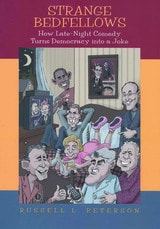
Strange Bedfellows
How Late-Night Comedy Turns Democracy into a JokePeterson, Russell
Rutgers University Press, 2008
It is no coincidence that presidential candidates have been making it a point to add the late-night comedy circuit to the campaign trail in recent years. In 2004, when John Kerry decided it was time to do his first national television interview, he did not choose CBS’s 60 Minutes, ABC’s Nightline, or NBC Nightly News. Kerry picked Comedy Central’s The Daily Show. When George W. Bush was lagging in the polls, his appearance on the David Letterman Show gave him a measurable boost. Candidates for the 2008 presidential election began their late-night bookings almost as soon as they launched their campaigns.
How can this be? The reason is that polls have been consistently finding that a significant number of Americans—and an even larger proportion of those under the age of thirty—get at least some of their “news” about politics and national affairs from comedy shows. While this trend toward what some have called “infotainment” seems to herald the descent of our national discourse—the triumph of entertainment over substance—the reality, according to Russell L. Peterson, is more complex. He explains that this programming is more than a mere replacement for traditional news outlets; it plays its own role in shaping public perception of government and the political process.
From Johnny Carson to Jon Stewart, from Chevy Chase’s spoofing of President Ford on Saturday Night Live to Stephen Colbert’s roasting of President Bush at the White House Correspondents Dinner, Strange Bedfellows explores what Americans have found so funny about our political institutions and the people who inhabit them, and asks what this says about the health of our democracy. Comparing the mainstream network hosts—Jay, Dave, Conan, and Johnny before them—who have always strived to be “equal opportunity offenders” to the newer, edgier crop of comedians on cable networks, Peterson shows how each brand of satire plays off a different level of Americans’ frustrations with politics.
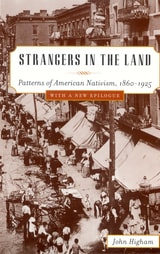
Strangers in the Land
Patterns of American Nativism, 1860-1925Higham, John
Rutgers University Press, 1988
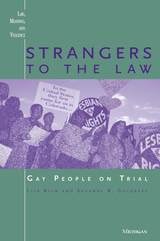
Strangers to the Law
Gay People on TrialLisa Keen and Suzanne B. Goldberg
University of Michigan Press, 2000
Starting with the background of the initiative, the authors tell us about the debates over strategy, the court proceedings, and the impact of each stage of the litigation on the parties involved. The authors explore the meaning of legal protection for gay people and the arguments for and against the Colorado initiative.
This book is essential reading for anyone interested in the development of civil rights protections for gay people and the evolution of what it means to be gay in contemporary American society and politics. In addition, it is a rich story well told, and will be of interest to the general reader and scholars working on issues of civil rights, majority-minority relations, and the meaning of equal rights in a democratic society.
Suzanne Goldberg is an attorney with the Lambda Legal Defense and Education Fund. Lisa Keen is Senior Editor at the Washington Blade newspaper.

Strangers to the Law
Gay People on TrialLisa Keen and Suzanne B. Goldberg
University of Michigan Press, 1998
Starting with the background of the initiative, the authors tell us about the debates over strategy, the court proceedings, and the impact of each stage of the litigation on the parties involved. The authors explore the meaning of legal protection for gay people and the arguments for and against the Colorado initiative.
This book is essential reading for anyone interested in the development of civil rights protections for gay people and the evolution of what it means to be gay in contemporary American society and politics. In addition, it is a rich story well told, and will be of interest to the general reader and scholars working on issues of civil rights, majority-minority relations, and the meaning of equal rights in a democratic society.
Suzanne Goldberg is an attorney with the Lambda Legal Defense and Education Fund. Lisa Keen is Senior Editor at the Washington Blade newspaper.

Strategic Alliances
Coalition Building and Social MovementsNella Van Dyke
University of Minnesota Press, 2010
Contributors: Paul Almeida, Texas A&M U; Elizabeth Borland, College of New Jersey; Daniel B. Cornfield, Vanderbilt U; Catherine Corrigall-Brown, U of British Columbia; Mario Diani, U of Trento; Katja M. Guenther, UC Riverside; Larry Isaac, Vanderbilt U; Isobel Lindsay, Biggar, Scotland; David S. Meyer, UC Irvine; Brian Obach, SUNY New Paltz; Dina G. Okamoto, UC Davis; Christine Petit, UC Riverside; Derrick Purdue, U of the West of England; Ellen Reese, UC Riverside; Benita Roth, SUNY Binghamton; Suzanne Staggenborg, U of Pittsburgh; Dawn Wiest, U of Memphis.
Strategic Budgeting
Roy T. Meyers
University of Michigan Press, 1996
Strategic Party Government
Why Winning Trumps IdeologyGregory Koger and Matthew J. Lebo
University of Chicago Press, 2017
In Strategic Party Government, Koger and Lebo argue that Congress is now primarily a forum for partisan competition. In order to avoid losing, legislators unite behind strong party leaders, even when they do not fully agree with the policies their party is advocating. They do so in the belief that party leaders and voters will reward them for winning—or at least trying to win—these legislative contests. And as the parties present increasingly united fronts, partisan competition intensifies and pressure continues to mount for a strong party-building strategy—despite considerable disagreement within the parties.
By bringing this powerful but underappreciated force in American politics to the forefront, Koger and Lebo provide a new interpretation of the problems facing Congress that is certain to reset the agenda for legislative studies.
Strategic Politicians, Institutions, and Foreign Policy
Randolph M. Siverson, Editor
University of Michigan Press, 1998
Strategic Responsiveness
How Congress Confronts Presidential PowerScott H. Ainsworth, Brian M. Harward, and Kenneth W. Moffett
University of Michigan Press, 2025
Strategic Responsiveness takes a theoretically developed and empirically oriented approach— situated within legal and historical contexts—to explore the system of separated powers. The authors find that Congress is not as weak as many perceive it to be and show how members of Congress often anticipate individualized policy loss and choose to respond. These policy struggles shape the constitutional order as surely as broad, statutory constraints might. While the aggrandizement of the presidency and the usurpation of congressional control are not countered, ordinary policy losses are. For members and senators, presidential overreach is fine as long as the policy wins continue, but policy losses may motivate members to reassert congressional prerogatives in policymaking through increased oversight. Strategic Responsiveness reveals how profoundly important policy-level disputes are in the politics of maintaining a particular constitutional order.
Strategies for Social Change
Gregory M. Maney
University of Minnesota Press, 2012
The theory and practice of social movements come together in strategy—whether, why, and how people can realize their visions of another world by acting together. Strategies for Social Change offers a concise definition of strategy and a framework for differentiating between strategies. Specific chapters address microlevel decision-making processes and creativity, coalition building in Northern Ireland, nonviolent strategies for challenging repressive regimes, identity politics, GLBT rights, the Christian right in Canada and the United States, land struggles in Brazil and India, movement-media publicity, and corporate social movement organizations.
Contributors: Jessica Ayo Alabi, Orange Coast College; Kenneth T. Andrews, U of North Carolina at Chapel Hill; Anna-Liisa Aunio, U of Montreal; Linda Blozie; Tina Fetner, McMaster U; James M. Jasper, CUNY; Karen Jeffreys; David S. Meyer, U of California, Irvine; Sharon Erickson Nepstad, U of New Mexico; Francesca Polletta, U of California, Irvine; Belinda Robnett, U of California, Irvine; Charlotte Ryan, U of Massachusetts–Lowell; Carrie Sanders, Wilfrid Laurier U; Kurt Schock, Rutgers U; Jackie Smith, U of Pittsburgh; Suzanne Staggenborg, U of Pittsburgh; Stellan Vinthagen, U West, Sweden; Nancy Whittier, Smith College.
Strategizing against Sweatshops
The Global Economy, Student Activism, and Worker EmpowermentMatthew S. Williams
Temple University Press, 2020
For the past few decades, the U.S. anti-sweatshop movement was bolstered by actions from American college students. United Students Against Sweatshops (USAS) effectively advanced the cause of workers’ rights in sweatshops around the world. Strategizing against Sweatshops chronicles the evolution of student activism and presents an innovative model of how college campuses are a critical site for the advancement of global social justice.
Matthew Williams shows how USAS targeted apparel companies outsourcing production to sweatshop factories with weak or non-existent unions. USAS did so by developing a campaign that would support workers organizing by leveraging their college’s partnerships with global apparel firms like Nike and Adidas to abide by pro-labor codes of conduct.
Strategizing against Sweatshops exemplifies how organizations and actors cooperate across a movement to formulate a coherent strategy responsive to the conditions in their social environment. Williams also provides a model of political opportunity structure to show how social context shapes the chances of a movement’s success—and how movements can change that political opportunity structure in turn. Ultimately, he shows why progressive student activism remains important.
Strategy or Principle?
The Choice Between Regulation and TaxationMark Kelman
University of Michigan Press, 1999

Strawberries and Technologies
How Media Transforms Farmworker Communities in Southern CaliforniaCarlos Jimenez Jr.
University of Illinois Press, 2027
Carlos Jimenez Jr. looks at the lives of farmworkers living at the intersection of agriculture and digital technologies. As he tells the workers’ stories, Jimenez shows how technology like non-commercial radio and autonomous robots offer chances to create, experiment, dream, develop new skills, and participate in civic life, yet also power the automation that may replace their jobs. The simultaneous processes of stabilization with visibility, and destabilization with invisibility, drive an ongoing evolution that continually redefines contemporary farmworker life.
Enlightening and richly detailed, Strawberries and Technologies provides an on-the-ground report of the surprising role of digital communication in farmworker communities.

Street Fight
Mean America and the War on Sesame StreetMichael Davis
Rutgers University Press, 2027
Street Fight is muscularly reported journalism trained on the people and events that shaped Sesame Street from the 1990s to the present. Expanding from Street Gang, Michael Davis’s acclaimed origin story of the series, this revelatory new book probes deeply into the decisions made by Sesame Workshop, the New York-based corporate non-profit that has weathered political and financial storms, all while upholding aspirational values instilled in the late-1960s.
Hundreds of eyewitnesses provide on-the-record recollections of the show’s evolution in the narrative and a series of chapter-ending oral histories.
Interwoven are passages of time-tested alliances, courtships and marriages, the back stories of the artists who provided the show’s melodies and lyrics. That, plus plenty of dish about the performers behind Muppets of Sesame Street, and how Jim Henson, decades after his shocking passing in 1990, is a spectral figure quite powerful in spirit.
Laughter and tears – in equal measure – await readers.
Street Fight
The Politics of Mobility in San FranciscoJason Henderson
University of Massachusetts Press, 2013
Faced with intolerable congestion and noxious pollution, cities around the world are rethinking their reliance on automobiles. In the United States a loosely organized livability movement seeks to reduce car use by reconfiguring urban space into denser, transit-oriented, walkable forms, a development pattern also associated with smart growth and new urbanism. Through a detailed case study of San Francisco, Jason Henderson examines how this is not just a struggle over what type of transportation is best for the city, but a series of ideologically charged political fights over issues of street space, public policy, and social justice.
Historically San Francisco has hosted many activist demonstrations over its streets, from the freeway revolts of the 1960s to the first Critical Mass bicycle rides decades later. Today the city's planning and advocacy establishment is changing zoning laws to limit the number of parking spaces, encouraging new car-free housing near transit stations, and applying “transit first” policies, such as restricted bus lanes. Yet Henderson warns that the city's accomplishments should not be romanticized. Despite significant gains by livability advocates, automobiles continue to dominate the streets, and the city's financially strained bus system is slow and often unreliable.
Both optimistic and cautionary, Henderson argues that ideology must be understood as part of the struggle for sustainable cities and that three competing points of view—progressive, neoliberal, and conservative—have come to dominate the contemporary discourse about urban mobility. Consistent with its iconic role as an incubator of environmental, labor, civil rights, and peace movements, San Francisco offers a compelling example of how the debate over sustainable urban transportation may unfold both in the United States and globally.
Street Saints
Renewing American CitiesBarbara J. Elliott
Templeton Press, 2006
Based on eight years of hands-on experience and more than 300 interviews, Street Saints is both a book of motivational stories about unsung heroes and a sociological study of the "faith factor," documenting faith-based programs that are treating social maladies in America. This book takes readers on a tour of communities and institutions in America where faith-based initiatives are making a difference. It offers inspiration, role models, and guidelines for people who would like to give back to their own communities.
Street-Level Bureaucracy, 30th Anniversary Edition
Dilemmas of the Individual in Public ServiceMichael Lipsky
Russell Sage Foundation, 2010