Results by title
159 books match the query 'Academic writing' and 23 start with t

Talking Back
Senior Scholars and Their Colleagues Deliberate the Past, Present, and Future of Writing StudiesNorbert Elliot
Utah State University Press, 2020
In Talking Back, a veritable Who’s Who of writing studies scholars deliberate on intellectual traditions, current practices, and important directions for the future. In response, junior and mid-career scholars reflect on each chapter with thoughtful and measured moves forward into the contemporary environment of research, teaching, and service. Each of the prestigious chapter authors in the volume has three common traits: a sense of responsibility for advancing the profession, a passion for programs of research dedicated to advancing opportunities for others, and a reflective sense of their work accompanied by humility for their contributions. As a documentary, Talking Back is the first history of writing studies in autobiography.
Contributors: Jo Allen, Ann N. Amicucci, Akua Duku Anokye, Paige Davis Arrington, Doug Baldwin, John C. Brereton, Judy Buchanan, Hugh Burns, Leasa Burton, Ellen C. Carillo, William Condon, Dylan B. Dryer, Michelle F. Eble, Jennifer Enoch, Joan Feinberg, Patricia Friedrich, Cinthia Gannett, Eli Goldblatt, Shenika Hankerson, Janis Haswell, Richard Haswell, Eric Heltzel, Douglas Hesse, Bruce Horner, Alice S. Horning, Asao B. Inoue, Ruth Ray Karpen, Suzanne Lane, Min-Zhan Lu, Donald McQuade, Elisabeth L. Miller, Rebecca Williams Mlynarczyk, Sean Molloy, Les Perelman, Louise Wetherbee Phelps, Stacey Pigg, Sherry Rankins-Robertson, Jessica Restaino, J. Michael Rifenburg, Eliana Schonberg, Geneva Smitherman, Richard Sterling, Katherine E. Tirabassi, Devon Tomasulo, Martha A. Townsend, Mike Truong, Victor Villanueva, Edward M. White, Anne Elrod Whitney, Kathleen Blake Yancey
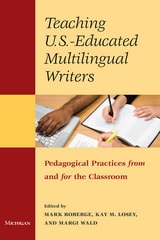
Teaching U.S.-Educated Multilingual Writers
Pedagogical Practices from and for the ClassroomMark Roberge, Kay M. Losey, Margi Wald
University of Michigan Press, 2015
All of the contributors are teachers who are writing about and reflecting on their own experiences and outcomes and interweaving those experiences and outcomes with current theory and research in the field. The volume thus portrays teachers as active, reflective participants engaged in critical inquiry. Contributors represent community college, college, and university contexts; academic ESL, developmental writing, and first-year composition classes; and face-to-face, hybrid, and online contexts.
This book was developed primarily to meet the needs of practicing writing teachers in college-level ESL, basic writing, and college composition classrooms, but will also be useful to pre-service teachers in TESOL, Composition, and Education graduate programs.
Telling Stories
Perspectives on Longitudinal Writing ResearchJenn Fishman
Utah State University Press, 2023
In Telling Stories, more than a dozen longitudinal writing researchers look beyond conventional project findings to story their work and, in doing so, offer otherwise unavailable glimpses into the logics and logistics of long-range studies of writing. The result is a volume that centers interrelations among people, places, and politics across two decades of praxis and an array of educational sites: two-year colleges, a senior military college, an adult literacy center, a small liberal arts college, and both public and private four-year universities.
Contributors share direct knowledge of longitudinal writing research, citing project data (e.g., interview transcripts, research notes, and journals), descriptions drawn from memory, and extended personal reflections. The resulting stories, tempered by the research and scholarship of others, convey a sense of longitudinal research as a lived activity as well as a prominent and consequential approach to inquiry. Yet Telling Stories is not a how-to guide, nor is it written for longitudinal researchers alone. Instead, this volume addresses issues about writing research that are germane to all who conduct or count on it. Such topics include building and sustaining good interpersonal research relations, ethically negotiating the institutional power dynamics that undergird writing research, effectively using knowledge from longitudinal studies to advocate for writers and writing educators, and improving both conceptual and concrete resources for long-range research in writing studies.
Telling a Research Story
Writing a Literature ReviewChristine B. Feak and John M. Swales
University of Michigan Press, 2009
Telling a Research Story: Writing a Literature Review is concerned with the writing of a literature review and is not designed to address any of the preliminary processes leading up to the actual writing of the literature review.
This volume represents a revision and expansion of the material on writing literature reviews that appeared in English in Today's Research World.
This volume progresses from general to specific issues in the writing of literature reviews. It opens with some orientations that raise awareness of the issues that surround the telling of a research story. Issues of structure and matters of language, style, and rhetoric are then discussed. Sections on metadiscourse, citation, and paraphrasing and summarizing are included.
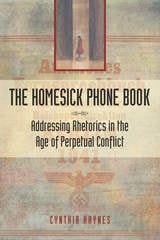
The Homesick Phone Book
Addressing Rhetorics in the Age of Perpetual ConflictCynthia Haynes
Southern Illinois University Press, 2016
Terrorist attacks, war, and mass shootings by individuals occur on a daily basis all over the world. In The Homesick Phone Book, author Cynthia Haynes examines the relationship of rhetoric to such atrocities. Aiming to disrupt conventional modes of rhetoric, logic, argument, and the teaching of writing, Haynes illuminates rhetoric’s ties to horrific acts of violence and the state of perpetual conflict around the world, both in the Holocaust era and more recently.
Each chapter, marked by a physical address, functions as a kind of expanded phone book entry, with a discussion of violent events at a particular location giving way to explorations of larger questions related to rhetoric and violence. At the core of the work is Haynes’s call for a writing pedagogy based on abstraction that would allow students to appeal to emotional and ethical grounds in composing arguments. Written in a lyrical style, the book weaves rhetorical theories, poetics, philosophy, works of art, and personal experience into a complex, compelling, and innovative mode of writing.
Ultimately, The Homesick Phone Book demonstrates how scholars of rhetoric and writing studies can break their dependence on conventional argument and logic to discover what might be possible if we dive into and become lost within the very concepts and events that frighten and terrorize us.
The Imposter's Guide to Writing About Literature
Suzanne Manizza Roszak
Rutgers University Press, 0
A handbook for students of literature with particular attention to all those who have ever been made to feel like outsiders in our field, The Imposter’s Guide to Writing About Literature democratizes access to the knowledge necessary for successful professionalization—and especially publication—within literary studies.
The Power of Writing
Dartmouth '66 in the Twenty-First CenturyEdited by Christiane Donahue and Kelly Blewett
Dartmouth College Press, 2015
The Promise of Reason
Studies in The New RhetoricEdited by John T. Gage
Southern Illinois University Press, 2011
Divided into four sections—Conceptual Understandings of The New Rhetoric, Extensions of The New Rhetoric, The Ethical Turn in Perelman and The New Rhetoric, and Uses of The New Rhetoric—this insightful volume covers a wide variety of topics. It includes general assessments of The New Rhetoric and its central concepts, as well as applications of those concepts to innovative areas in which argumentation is being studied, such as scientific reasoning, visual media, and literary texts. Additional essays compare Perelman’s ideas with those of other significant thinkers like Kenneth Burke and Richard McKeon, explore his career as a philosopher and activist, and shed new light on Perelman and Olbrechts- Tyteca’s collaboration. Two contributions present new scholarship based on recent access to letters, interviews, and archival materials housed in the Université Libre de Bruxelles. Among the volume’s unique gifts is a personal memoir from Perelman’s daughter, Noémi Perelman Mattis, published here for the first time.
The Promise of Reason, expertly compiled and edited by John T. Gage, is the first to investigate the pedagogical implications of Perelman and Olbrechts- Tyteca’s groundbreaking work and will lead the way to the next generation of argumentation studies.
The Radical Case for Teaching Skim Reading in First-Year Writing
Ellen C. Carillo
Utah State University Press, 2025
Data from studies of the lived experiences of undergraduates indicate that students do not need deep reading practices in the majority of their classes across the disciplines and, moreover, that students succeed in their classes by skim reading. Rather than imagining an idealized set of circumstances that allow for sustained deep reading, as does a great deal of the scholarship on reading in writing studies, The Radical Case for Teaching Skim Reading in First-Year Writing argues for teaching students reading practices that will support their success in their college writing assignments rather than those strategies the field believes should support their success.
In our information landscape and our fragile democracy, encouraging skimming as opposed to deep reading may seem like a gamble—this very tendency toward the quick rather than the critical has undoubtedly contributed to the current crisis of mass misinformation. However, teaching students to use skim reading as a strategic tool for purposeful engagement and efficient yet thoughtful information filtering better equips them to navigate the rapidly changing information landscape and manage the fast-paced flow of content from diverse media sources.
The Talk and Texts of Teacher Development
Values, the Practicum, and Programmatic Change in Writing StudiesAdrienne Jankens
Utah State University Press, 2026
Through her multi-site analysis, Jankens examines the ways values are reflected in syllabi, committee meetings, and classroom practices. She demonstrates how values that are often unstated or assumed can be made explicit and linked to programmatic action, thus supporting development and aligning instructional goals with broader institutional objectives. Offering a nuanced framework on practicum courses, Jankens also highlights the importance of local contexts and distinguishes among tacit, implicit, explicit, emergent, and articulated values. This layered understanding helps reveal the often hidden mechanisms by which writing program values are enacted in day-to-day teaching practices.
Teacher development is a crucial site for enacting and understanding programmatic values, and making these values explicit can guide meaningful programmatic change. Providing an institutional ethnography of Jankens’s own writing program and situating those findings within broader conversations in writing studies, The Talk and Texts of Teacher Development adds to scholarship exploring the focus of the practicum course, the positionality and experience of graduate teaching assistants in writing programs, and the perennial work of the field to identify its core values and disciplinary identity.
Toward More Sustainable Metaphors of Writing Program Administration
edited by Lydia Wilkes, Lilian W. Mina, and Patti Poblete afterword by Douglas Hesse
Utah State University Press, 2022
This volume presents twelve chapters that reclaim and revise established metaphors; offer new metaphors based on sustainable, relational, or emotional labor practices and phenomena; and reveal the improvisational, artisanal nature of WPA work. Chapters resonate across three sections. The first section focuses on organic relationships captured in phrases like “putting out fires” and "seeing forests for the trees” alongside unexpected comparisons to ground and light. The second describes institutional landscapes featuring generative juxtapositions such as the WPA as a labor activist or a mapper of emotional geography. And the third discusses performance crafts like improv comedy and artisanal making.
Toward More Sustainable Metaphors of Writing Program Administration offers new and revised ways of thinking and acting for WPAs, who are constantly negotiating the paradoxical demands of their work and continually striving to act ethically in conflicted, and even fraught, situations. It will inspire practicing, aspiring, and former WPAs working in a time of transformation by highlighting more sustainable ways of enacting WPA identity.
Contributors: Jacob Babb, John Belk, Katherine Daily O'Meara, Ryan J. Dippre, Douglas Hesse, Andrew Hollinger, Rona Kaufman, Cynthia D. Mwenja, Manny Piña, Scott Rogers, Robyn Tasaka, Alexis Teagarden, Christy I. Wenger, Lydia Wilkes
Toward Translingual Realities in Composition
(Re)Working Local Language Representations and PracticesNancy Bou Ayash
Utah State University Press, 2019
Translingualism work has concentrated on critiquing monolingual and multilingual notions of language, but it is only beginning to examine translingual enactments in writing programs and classrooms. Focusing on language representations and practices at both the macro and micro levels, author Nancy Bou Ayash places the study and teaching of university-level writing in the context of the globalization and pluralization of English(es) and other languages. Individual chapters feature various studies that Bou Ayash brings together to address how students act as agents in marshaling their language practices and resources and shows a deliberate translingual intervention that complicates and enriches students’ assumptions about language and writing. Her findings about writing programs, instructors, and students are detailed, multidimensional, and complex.
A substantial contribution to growing translingual scholarship in the field of composition studies, Toward Translingual Realities in Composition offers insights into how writing teacher-scholars and writing program administrators can more productively intervene in local postmonolingual tensions and contradictions at the level of language representations and practices through actively and persistently reworking the design and enactment of their curricula, pedagogies, assessments, teacher training programs, and campus-wide partnerships.
Toward a Transnational University
WAC/WID Across Borders of Language, Nation, and DisciplineJonathan Hall
University Press of Colorado, 2023
Toward an Anti-Capitalist Composition
James Rushing Daniel
Utah State University Press, 2022
Drawing on an array of philosophers, political theorists, and activists, Daniel outlines an anti-capitalist approach informed by the common, a concept theorized by Pierre Dardot and Christian Laval as a solidaristic response to capitalism rooted in inventive political action. Rather than relying upon claims of membership or ownership, the common supports radical, collective acts of remaking that comprehensively reject capitalist logics. Applying this approach to collaborative writing, student debt, working culture, and digital writing, Daniel demonstrates how the writing classroom may be oriented toward capitalist harms and prepare students to critique and resist them. He likewise employs the common to theorize how anti-capitalist interventions beyond the classroom could challenge institutional privatization and oppose the adjunctification of the professoriate.
Arguing that composition scholars have long neglected marketization and corporate power, Toward an Anti-Capitalist Composition extends a case for adopting a resolute anti-capitalist stance in the field and for remaking the university as a site of common work.
Tracing the Impact of First-Year Writing
Identity, Process, and Transfer at a Public UniversityLaura Wilder
Utah State University Press, 2024
In contrast to previous longitudinal studies of college writers undertaken at institutions with high prestige and resources, Tracing the Impact of First-Year Writing explores the role of writing at a regional public university and documents how students’ experiences with writing can be highly divergent across the curriculum and unequal across campuses. Additionally, this book includes the voices of students who do not identify as capable writers and have strongly negative emotional reactions to writing and writing instruction and adds empirical support to innovative calls in the field to transform the first-year writing course into one that inspires students to reflectively consider writing itself.
Transformations
Change Work across Writing Programs, Pedagogies, and PracticesHolly Hassel
Utah State University Press, 2021
The collection includes chapters from multiple award-winning writing programs, including the recipients of the Two-Year College Association’s Outstanding Programs in English Award and the Conference on College Composition and Communication’s Writing Program Certificate of Excellence. These authors offer perspectives that demonstrate the deep work of transformation in writing programs and practices writ large, confirm the ways in which writing programs are connected to and situated within larger institutional and disciplinary contexts, and outline successful methods for navigating these contexts in order to transform the work.
In using the prism of transformation as the organizing principle for the collection, Transformations offers a range of strategies for adapting writing programs so that they meet the needs of students and teachers in service of creating equitable, ethical literacy instruction in a range of postsecondary contexts.
Contributors: Leah Anderst, Cynthia Baer, Ruth Benander, Mwangi Alex Chege, Jaclyn Fiscus-Cannaday, Joanne Giordano, Rachel Hall Buck, Sarah Henderson Lee, Allison Hutchinson, Lynee Lewis Gaillet, Jennifer Maloy, Neil Meyer, Susan Miller-Cochran, Ruth Osorio, Lori Ostergaard, Shyam Pandey, Cassie Phillips, Brenda Refaei, Heather Robinson, Shelley Rodrigo, Julia Romberger, Tiffany Rousculp, Megan Schoen, Paulette Stevenson
Transforming Ethos
Place and the Material in Rhetoric and WritingRosanne Carlo
Utah State University Press, 2020
Through case studies of professional and student writings as well as narrative reflections Transforming Ethos imagines the ethos appeal as not only connected to style and voice but also a process of habituation, related to practices of everyday interaction in places and with things. Carlo addresses how ethos aids in creating identification, transcending divisions between the self and other. She shows that when writers tell their experiences, they create and reveal the ethos appeal, and this type of narrative/multimodal writing is central to scholarship in rhetoric and composition as well as the teaching of writing. In addition, Carlo considers how composition is becoming compromised by professionalization—particularly through the idea of “transfer”—which is overtaking the critical work of self-development with others that a writing classroom should encourage in college students.
Transforming Ethos cements ethos as an essential term for the modern practice and teaching of rhetoric and places it at the heart of writing studies. This book will be significant for students and scholars in rhetoric and composition, as well as those interested in higher education more broadly.
Translingual Dispositions
The Affordances of Globalized Approaches to the Teaching of WritingAllana Frost
University Press of Colorado, 2020
Translingual Pedagogical Perspectives
Engaging Domestic and International Students in the Composition ClassroomJulia Kiernan
Utah State University Press, 2021
The book showcases concrete and adaptable writing assignments from a variety of learning environments in postsecondary, English-medium writing classrooms, writing centers, and writing programs populated by monolingual and multilingual students. By providing descriptive and reflective examples of how understanding translanguaging can influence pedagogy, Translingual Pedagogical Perspectives fills the gap between theoretical inquiry surrounding translanguaging and existing translingual pedagogical models for writing classrooms and programs.
Additional appendixes provide a variety of readings, exercises, larger assignments, and other entry points, making Translingual Pedagogical Perspectives useful for instructors and graduate students interested in engaging translingual theories in their classrooms.
Contributors: Daniel V. Bommarito, Mark Brantner, Tania Cepero Lopez, Emily Cooney, Norah Fahim, Ming Fang, Gregg Fields, Mathew Gomes, Thomas Lavalle, Esther Milu, Brice Nordquist, Ghanashyam Sharma, Naomi Silver, Bonnie Vidrine-Isbell, Xiqiao Wang, Dan Zhu
Translingual and Transnational Graduate Education in Rhetoric and Composition
Nancy Bou Ayash
Utah State University Press, 2023
Contributors to the collection articulate the need for translingual and transnational sensibilities in rhetoric and composition graduate programs in light of the material conditions of graduate students’ lives and labor. They further present pathways for rethinking the design of graduate-level coursework, foreign language learning policies and labor, mentoring practices, writing teacher and writing center tutor training, and other professionalization initiatives. Offering a range of conceptually and empirically driven pieces, the collection brings together the voices and lived experiences of graduate students, faculty advisors, and administrators involved in the constant, necessary reworking of rhetoric and composition graduate education in a variety of institutional locales.
Translingual and Transnational Graduate Education in Rhetoric and Composition provides inspiration for graduate programs working to enact well-grounded curricular and pedagogical changes to counter the long-standing effects of the dominant racist and monolingualist ideologies in higher education generally, and rhetoric and composition studies specifically.
Contributors: Lucía Durá, Patricia Flores, Joe Franklin, Moisés Garcia-Renteria, Bruce Horner, Aimee Jones, Corina Lerma, Kate Mangelsdorf, Brice Nordquist, Madelyn Pawlowski, Christine Tardy, Amy Wan, Alex Way, Anselma Widha Prihandita, Joe Wilson, Xiaoye You, Emily Yuko Cousins, Michelle Zaleski
Tricks of the Trade
How to Think about Your Research While You're Doing ItHoward S. Becker
University of Chicago Press, 1998
Drawing on decades of experience as a researcher and teacher, Howard Becker brings to students and researchers the many valuable techniques for conducting research that he learned and taught. Tricks of the Trade will help students learn how to think about research projects. Assisted by Becker's sage advice, students can make better sense of their research and simultaneously generate fresh ideas on where to look next for new data. The tricks cover four broad areas of social science: the creation of the "imagery" to guide research; methods of "sampling" to generate maximum variety in the data; the development of "concepts" to organize findings; and the use of "logical" methods to explore systematically the implications of what is found. Becker's advice ranges from simple tricks such as changing an interview question from "Why?" to "How?" (as a way of getting people to talk without asking for a justification) to more technical tricks such as how to manipulate truth tables.
Becker has extracted these tricks from a variety of fields such as art history, anthropology, sociology, literature, and philosophy; and his dazzling variety of references ranges from James Agee to Ludwig Wittgenstein. Becker finds the common principles that lie behind good social science work, principles that apply to both quantitative and qualitative research. He offers practical advice, ideas students can apply to their data with the confidence that they will return with something they hadn't thought of before.
Try This
Research Methods for Writersedited by Jennifer Clary-Lemon, Derek Mueller, and Kate Pantelides
University Press of Colorado, 2022
This book is also available as an open access ebook through the WAC Clearinghouse.
Twenty-One Genres and How to Write Them
Brock Dethier
Utah State University Press, 2013
In the first section, Dethier efficiently presents each genre, providing models; a description of the genres’ purpose, context, and discourse; and suggestions for writing activities or “moves” that writers can use to get words on the page and accomplish their writing tasks. The second section explains these moves, over two hundred of them, in chapters ranging from “Solve Your Process Problems” and “Discover” to “Revise” and “Present.” Applicable to any writing task or genre, these moves help students overcome writing blocks and develop a piece of writing from the first glimmers of an idea to its presentation.
This approach to managing the complexity and challenge of writing in college strives to be useful, flexible, eclectic, and brief—a valuable resource for students learning to negotiate unfamiliar writing situations.