Results by title
69 books match the query 'American Culture' and 17 start with t

Technical Knowledge in American Culture
Science, Technology, and Medicine Since the Early 1800sEdited by Hamilton Cravens, Alan I Marcus, and David M. Katzman
University of Alabama Press, 1996
Addresses the relationships between what modern-day experts say to each other and to their constituencies
Technical Knowledge in American Culture is an interdisciplinary volume that brings together leading historians to investigate how science, technology, and medicine have shaped—and been shaped by—American intellectual and cultural traditions since the early nineteenth century. Rather than treating science and technology simply as products of social forces, the contributors examine them as forms of knowledge with their own internal logics, debates, and authority structures. The book asks a central question: how do experts—scientists, engineers, physicians—communicate with one another and with broader audiences, and how does that communication influence American society?
The volume is organized into three major sections, each anchored in a distinct historical moment: Part I: The Rise of Democratic Culture, 1800–1870; Part II: The Age of Hierarchy, 1870–1920; and Part III: Toward an Infinity of Dimensions (20th Century). Across its essays, the book argues that technical knowledge is not just a tool of progress—it is a cultural force shaped by communication, interpretation, and authority. By focusing on case studies rather than sweeping narratives, the volume reveals how expertise operates in practice and how it influences broader debates about science, society, and public trust.

Television, History, and American Culture
Feminist Critical EssaysMary Beth Haralovich and Lauren Rabinovitz, eds.
Duke University Press, 1999
The essays collected here focus on women in front of, behind, and on the TV screen, as producers, viewers, and characters. Using feminist and historical criticism, the contributors investigate how television has shaped our understanding of gender, power, race, ethnicity, and sexuality from the 1950s to the present. The topics range from the role that women broadcasters played in radio and early television to the attempts of Desilu Productions to present acceptable images of Hispanic identity, from the impact of TV talk shows on public discourse and the politics of offering viewers positive images of fat women to the negotiation of civil rights, feminism, and abortion rights on news programs and shows such as I Spy and Peyton Place.
Innovative and accessible, this book will appeal to those interested in women’s studies, American studies, and popular culture and the critical study of television.
Contributors. Julie D’Acci, Mary Desjardins, Jane Feuer, Mary Beth Haralovich, Michele Hilmes, Moya Luckett, Lauren Rabinovitz, Jane M. Shattuc, Mark Williams
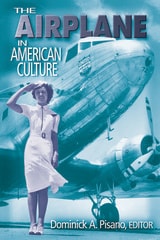
The Airplane in American Culture
Dominick A. Pisano, Editor
University of Michigan Press, 2003
Although countless books for aviation buffs have appeared since World War II, none has attempted to place the airplane in its full social, cultural, and interdisciplinary context until now. The first book of its kind, The Airplane in American Culture presents essays by distinguished contributors including historians, literary scholars, scholars of American studies, art historians, and museum professionals that explore a range of topics, including the connections between flying and race and gender; aviation's role in forming perceptions of the landscape; the airplane's significance to the culture of war; and the influence of flight on literature and art.
A must-read collection for anyone fascinated by the airplane, The Airplane in American Culture represents a dramatic new approach to writing the history of aviation, and makes an important contribution to American social and cultural history.
Dominick A. Pisano is Curator of the Aeronautics Department at the National Air and Space Museum, Smithsonian Institution.
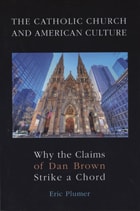
The Catholic Church and American Culture
Why the Claims of Dan Brown Strike a ChordEric A. Plumer
University of Scranton Press, 2009
More than fifty books debunking the religious claims of The Da Vinci Code have been published. Thisis the first book devoted to the fundamentally more interesting question: if those claims are so unfounded and erroneous, why have they resonated so strongly with millions of intelligent readers and filmgoers?
From the sexual abuse scandal that shook the foundations of the Catholic Church to the 9/11 terrorist attacks that cast a cloud over a troubled nation, Eric Plumer’s The Catholic Church and American Culture: Why the Claims of the DaVinci Code Struck a Chord investigates the contemporary events, ideas, and movements that fostered Dan Brown’s unprecedented dominance of best-seller lists and dinner-table conversation. This ambitious book considers the feminist movement, radical individualism, twelve-step programs, the authority of science and psychology, and other cultural developments that paved the way for The Da Vinci Code craze. It also reflects on the recent publication of the Gnostic Gospels, including the Gospel of Mary Magdalene. Plumer’s engaging book is sure to stimulate further discussion about the role of religion in contemporary life.
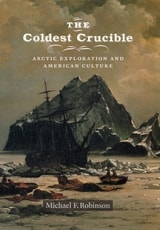
The Coldest Crucible
Arctic Exploration and American CultureMichael F. Robinson
University of Chicago Press, 2006
With chronological chapters featuring emblematic Arctic explorers—including Elisha Kent Kane, Charles Hall, and Robert Peary—The Coldest Crucible reveals why the North Pole, a region so geographically removed from Americans, became an iconic destination for discovery.
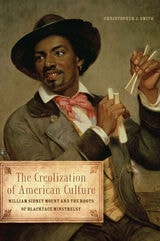
The Creolization of American Culture
William Sidney Mount and the Roots of Blackface MinstrelsyChristopher J. Smith
University of Illinois Press, 2014

The Ecological Other
Environmental Exclusion in American CultureSarah Jaquette Ray
University of Arizona Press, 2013
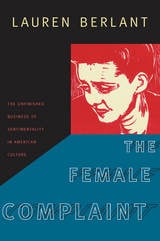
The Female Complaint
The Unfinished Business of Sentimentality in American CultureLauren Berlant
Duke University Press, 2008
Pairing literary criticism and historical analysis, Berlant explores the territory of this intimate public sphere through close readings of U.S. women’s literary works and their stage and film adaptations. Her interpretation of Uncle Tom’s Cabin and its literary descendants reaches from Harriet Beecher Stowe to Toni Morrison’s Beloved, touching on Shirley Temple, James Baldwin, and The Bridges of Madison County along the way. Berlant illuminates different permutations of the women’s intimate public through her readings of Edna Ferber’s Show Boat; Fannie Hurst’s Imitation of Life; Olive Higgins Prouty’s feminist melodrama Now, Voyager; Dorothy Parker’s poetry, prose, and Academy Award–winning screenplay for A Star Is Born; the Fay Weldon novel and Roseanne Barr film The Life and Loves of a She-Devil; and the queer, avant-garde film Showboat 1988–The Remake. The Female Complaint is a major contribution from a leading Americanist.

The Imperialist Imaginary
Visions of Asia and the Pacific in American CultureJohn Eperjesi
Dartmouth College Press, 2014
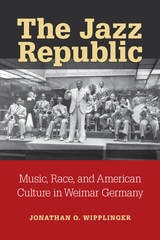
The Jazz Republic
Music, Race, and American Culture in Weimar GermanyJonathan O. Wipplinger
University of Michigan Press, 2017
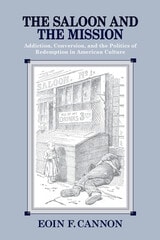
The Saloon and the Mission
Addiction, Conversion, and the Politics of Redemption in American CultureEoin F. Cannon
University of Massachusetts Press, 2013
In this book Eoin Cannon illuminates the role that sobriety movements have played in placing notions of personal and societal redemption at the heart of modern American culture. He argues against the dominant scholarly perception that recovery narratives are private and apolitical, showing that in fact the genre's conventions turn private experience to public political purpose. His analysis ranges from neglected social reformer Helen Stuart Campbell's embrace of the "gospel rescue missions" of postbellum New York City to William James's use of recovery stories to consider the regenerative capabilities of the mind, to writers such as Upton Sinclair and Djuna Barnes, who used this narrative form in much different ways.
Cannon argues that rather than isolating recovery from these realms of wider application, the New Deal–era Alcoholics Anonymous refitted the "drunkard's conversion" as a model of selfhood for the liberal era, allowing for a spiritual redemption story that could accommodate a variety of identities and compulsions. He concludes by considering how contemporary recovery narratives represent both a crisis in liberal democracy and a potential for redemptive social progress.

The Scrapbook in American Culture
Susan Tucker
Temple University Press, 2006
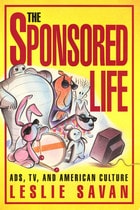
The Sponsored Life
Ads, TV, and American CultureLeslie Savan
Temple University Press, 1994
How does a blatant lying in TV commercials—like Joe Isuzu's manic claims—create public trust in a product or a company? How does a company associated with a disaster, Exxon or Du Pont for example, restore its reputation? What is the real story behind the rendering of the now infamous Joe Camel? And what is the deeper meaning of living in an ad, ad, ad world? For a decade, journalist Leslie Savan has been exposing the techniques used by advertisers to push products and pump up corporate images. In the lively essays in this collection, Savan penetrates beneath the slick surfaces of specific ads and marketing campaigns to show how they reflect and shape consumer desires.
Savan's interviews with ad agencies and corporate clients—along with her insightful analyses of influential TV sports—reveal how successful advertising works. Ads do more than command attention. They are signposts to the political, cultural, and social trends that infiltrate the individual consumer's psyche. Think of the products associated with corporate mascots—the drum-beating bunny, the cereal-pushing tiger, the doughboy—that have become pop culture icons. Think cool. Think of the clothing manufacturer that uses multiracial imagery. Think progressive. Buy their worldview, buy their product. When virtually every product can be associate with some positive self-image, we are subtly refashioned into the advertiser's concept of a good citizen. Like it or not, we lead "the sponsored life."
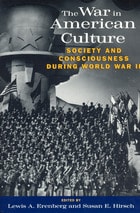
The War in American Culture
Society and Consciousness during World War IIEdited by Lewis A. Erenberg and Susan E. Hirsch
University of Chicago Press, 1996
World War II posed a crisis for American culture: to defeat the enemy, Americans had to unite across the class, racial and ethnic boundaries that had long divided them. Exploring government censorship of war photography, the revision of immigration laws, Hollywood moviemaking, swing music, and popular magazines, these essays reveal the creation of a new national identity that was pluralistic, but also controlled and sanitized. Concentrating on the home front and the impact of the war on the lives of ordinary Americans, the contributors give us a rich portrayal of family life, sexuality, cultural images, and working-class life in addition to detailed consideration of African Americans, Latinos, and women who lived through the unsettling and rapidly altered circumstances of wartime America.
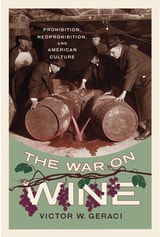
The War on Wine
Prohibition, Neoprohibition, and American CultureVictor W. Geraci
University of Nevada Press, 2023
The development of an American wine ethos.
The history of wine is a tale of capitalist production and consumer experience, and early Americans embraced the idea of having their own wine culture. But many began to believe that excessive alcohol consumption had become a moral, ethical, economic, political, social, and health conundrum. The result was a national on-again, off-again relationship with the concept of an American wine culture.
Citizens struggled to build a wine culture patterned after their diasporic European custom of wine as a moderating beverage that was part of a healthy diet. Yet, as America grew, untold attempts to create a wine culture failed due to climate, pests, diseases, wars, and depressions, resulting in some people considering the nation an alcoholic republic. Thus began an anti-alcohol culture war aimed at restricting or prohibiting alcoholic beverages.
With the passage of the Eighteenth Amendment (Prohibition), a culture war started between wet and dry proponents. After the repeal of Prohibition, the decimated wine industry responded by forming the Wine Institute to rebrand wine’s role in American society, after which neoprohibitionists attempted to restrict alcohol availability and consumption. To confront these aggressive actions, the Wine Institute hired politically trained John A. De Luca to navigate the new attacks and pushed for rebranding wine as a cultural spirit with health benefits.
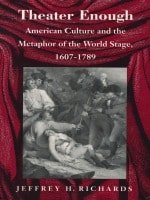
Theater Enough
American Culture and the Metaphor of the World Stage, 1607–1789Jeffrey H. Richards
Duke University Press, 1991
The rhetoric, or discourse, of early American theater emerged out of the figures of speech that permeated the colonists’ lives and literary productions. Jeffrey H. Richards examines a variety of texts—histories, diaries, letters, journals, poems, sermons, political tracts, trial transcripts, orations, and plays—and looks at the writings of such authors as John Winthrop and Mercy Otis Warren. Richards places the American usage of theatrum mundi—the world depicted as a stage—in the context of classical and Renaissance traditions, but shows how the trope functions in American rhetoric as a register for religious, political, and historical attitudes.
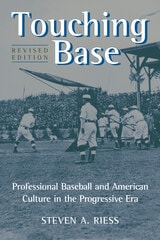
Touching Base
Professional Baseball and American Culture in the Progressive EraSteven A. Riess
University of Illinois Press, 1999