Results by title
784 books match the query 'American Government' and 199 start with t
THE INDIRECT EFFECT OF DIRECT LEGISLATION
HOW INSTITUTIONS SHAPE INTEREST GROUP SYSTEMSFREDERICK J BOEHMKE
The Ohio State University Press, 2005
To demonstrate this, the author models the incentives that the initiative process creates for interests to organize and for how they communicate their preferences to policy makers. Interests that represent a broader range of the public are found to gain the most from the option to propose initiatives, implying that the set of organized interests in initiative states should reflect this advantage. Ironically, an effect of direct legislation is to potentially increase the effectiveness of special interest lobbying in state legislatures—in a sense, the opposite of the direct control that gives direct legislation its theoretical appeal. Yet, the clear effect is one of empowering voices that traditionally had very little effect in the legislative process. If greater representation is the goal of direct legislation, it is a clear success, even though that success does not really come in the act of ballot initiatives itself.
THE MYSTERIES OF THE GREAT CITY
THE POLITICS OF URBAN DESIGN, 1877-1937JOHN FAIRFIELD
The Ohio State University Press, 1997
The Mysteries of the Great City examines the physical, cultural, and political transformations of the American city between the Gilded Age and the New Deal. Focusing on New York, Chicago, and Cincinnati, John Fairfield demonstrates that these transformations before and after the advent of city planning were the result of political decisions influenced by corporate and private wealth.
The expansion and reorganization of the great city stood out as the most visible symbol of the transformation. The new metropolitan form, with its skyscraping business center, industrial satellites, crowded working-class neighborhoods, and exclusive suburbs, embodied an emerging corporate order. But the metropolis also disguised the new order and gave it an apparent physical implacability and inevitability that obscured the role of choice in its creation and therefore placed it beyond criticism. Fairfield unravels the mysteries of the new form to reveal the centrality of power and politics in urban design.
While acknowledging that a great many factors shaped urban development, Fairfield underscores the decisive role of human design. He argues that American cities, both before and after the advent of professional planning, have always been in some measure “planned.” Discussing such figures as Frederick Law Olmsted, Henry George, Daniel Burnham, Frederic Howe, Edward Bassett, Robert E. Park, and Louis Wirth, Fairfield illuminates the political and intellectual conflicts among advocates of alternative paths of urban development.
The Mysteries of the Great City will enlighten all readers interested in the development of cities, particularly urban historians and planners. In pointing to the Gilded Age as a period of great possibilities of progressive reform, this study will also reward readers interested in the historical foundations of our modern society.
THE PRESIDENTIAL AGENDA
SOURCES OF EXECUTIVE INFLUENCE IN CONGRESSROGER T LAROCCA
The Ohio State University Press, 2006
Larocca develops a theoretical model that explains how the president can raise the public salience of issues in his major addresses, long accepted as one of the president’s strongest agenda-setting tools. He also develops a theoretical model that explains how control over executive agency expertise yields a more reliable and persistent influence on the congressional agenda than presidential addresses.
The Presidential Agenda tests these theoretical models with an innovative empirical study of presidential agenda setting. Using data from all House and Senate Commerce Committee bills from 1979 to 2002, Larocca converts information about bills into information about policy issues and then traces the path of presidential influence through the committee and floor stages of legislative consideration.
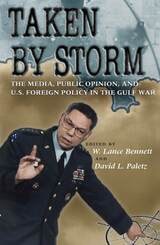
Taken by Storm
The Media, Public Opinion, and U.S. Foreign Policy in the Gulf WarEdited by W. Lance Bennett and David L. Paletz
University of Chicago Press, 1994
Tracing the flow of news, public opinion, and policy decisions from Sadam Hussein's rise to power in 1979, to the Iraqi invasion of Kuwait, through the outbreak and conclusion of the war, the contributors look at how the media have become key players in the foreign policy process. They examine the pre-war media debate, news coverage during and after the war, how the news-gathering process shaped the content of the coverage, and the media's effect on public opinion and decision makers. We see what goes on behind the scenes in the high tech world of political communication, and are confronted by troubling questions about the ways the government managed coverage of the war and captured journalists at their own news game.
Taken by Storm also examines more general patterns in post-Cold war journalism and foreign policy, particularly how contemporary journalistic practices determine whose voices and what views are heard in foreign policy coverage. At stake are the reactions of a vast media audience and the decision of government officials who see both the press and the public and key elements of the policy game.
The first book to fully integrate our understanding of the news business, public opinion, and government action, Taken by Storm transcends the limits of the Gulf War to illuminate the complex relationship between the media, the public, and U.S. foreign policy in the late twentieth century.
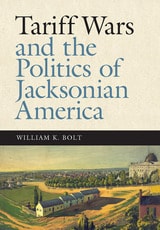
Tariff Wars and the Politics of Jacksonian America
William K. Bolt
Vanderbilt University Press, 2016
The spreading of democracy caused by the tariff evoked bitter sectional controversy among Americans. Northerners claimed they needed a tariff to protect their industries and also their wages. Southerners alleged the tariff forced them to buy goods at increased prices. Having lost the argument against the tariff on its merits, in the 1820s, southerners began to argue the Constitution did not allow Congress to enact a protective tariff. In this fight, we see increased tensions between northerners and southerners in the decades before the Civil War began.
As Tariff Wars reveals, this struggle spawned a controversy that placed the nation on a path that would lead to the early morning hours of Charleston Harbor in April of 1861.
Term Limits in State Legislatures
John M. Carey, Richard G. Niemi, and Lynda W. Powell
University of Michigan Press, 2000
The 2012 Campaign and the Timeline of Presidential Elections
Robert S. Erikson and Christopher Wlezien
University of Chicago Press, 2014
The Adaptability Paradox
Political Inclusion and Constitutional ResilienceStephen Skowronek
University of Chicago Press, 2025
Has American democracy outstripped its constitutional accommodations?
Faith in the resilience and adaptability of the US Constitution rests on a long history of finding new ways to make the system work. In The Adaptability Paradox, political scientist Stephen Skowronek examines the rearrangements that regenerated the American government in the past and brings that experience to bear on our current predicament. He shows how a constitution framed in writing some 230 years ago can run into serious difficulties directly related to its long and impressive history of adaptation.
Skowronek connects questions about the Constitution’s adaptability to the challenges of democratization. For most of American history, serial rearrangements of constitutional relationships widened the government’s purview as a national democracy without giving either nationalism or democracy free rein. Skowronek argues that the politics of adaptation shifted fundamentally with the “Rights Revolution” of the 1960s and `70s when American national democracy approached the inclusion of all its citizens on equal footing. Since then, power and authority have been reconfigured in ways that have steadily magnified conflicts over the essentials of good order. Conservatives aim to dismantle a Constitution that progressives are intent on building upon, and the consensus necessary for a constitutional democracy to function effectively has all but evaporated. No longer a socially bound framework for national action, the Constitution has become an abstract matrix of possibilities, a disembodied opportunity structure open to starkly different, mutually unacceptable futures.
Rather than being liberated by this unbound Constitution, the American people now appear entrapped by it. Is it possible that the development of American democracy has exhausted the adaptive capacities of the Constitution? A timely reminder that constitutional democracies do not survive on faith alone, The Adaptability Paradox is a sober appraisal of the unfamiliar ground on which we now tread.
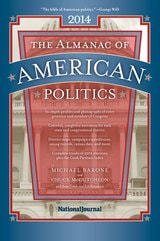
The Almanac of American Politics 2014
Michael Barone, Chuck McCutcheon, Sean Trende, and Josh Kraushaar
University of Chicago Press, 2013
Like every edition since the almanac first appeared in 1972, the 2014 edition is helmed by veteran political analyst Michael Barone. Together with Chuck McCutcheon, collaborator since 2012, and two new editors, Sean Trende, senior elections analyst for RealClearPolitics, and Josh Kraushaar, managing editor at National Journal, Barone offers an unparalleled perspective on contemporary politics.
Full of maps, census data, and detailed information about the American political landscape, the 2014 Almanac of American Politics remains the most comprehensive resource for journalists, politicos, business people, and academics.
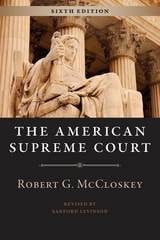
The American Supreme Court, Sixth Edition
Robert G. McCloskey and Sanford Levinson
University of Chicago Press, 2016
As in prior editions, McCloskey’s original text remains unchanged. In his historical interpretation, he argues that the strength of the Court has always been its sensitivity to the changing political scene, as well as its reluctance to stray too far from the main currents of public sentiment. In this new edition, Sanford Levinson extends McCloskey’s magisterial treatment to address developments since the 2010 election, including the Supreme Court’s decisions regarding the Defense of Marriage Act, the Affordable Care Act, and gay marriage.
The best and most concise account of the Supreme Court and its place in American politics, McCloskey's wonderfully readable book is an essential guide to the past, present, and future prospects of this institution.
The American Supreme Court, Sixth Edition
Robert G. McCloskey and Sanford Levinson
University of Chicago Press, 2016
For more than fifty years, Robert G. McCloskey’s classic work on the Supreme Court’s role in constructing the US Constitution has introduced generations of students to the workings of our nation’s highest court.
As in prior editions, McCloskey’s original text remains unchanged. In his historical interpretation, he argues that the strength of the Court has always been its sensitivity to the changing political scene, as well as its reluctance to stray too far from the main currents of public sentiment. In this new edition, Sanford Levinson extends McCloskey’s magisterial treatment to address developments since the 2010 election, including the Supreme Court’s decisions regarding the Defense of Marriage Act, the Affordable Care Act, and gay marriage.
The best and most concise account of the Supreme Court and its place in American politics, McCloskey's wonderfully readable book is an essential guide to the past, present, and future prospects of this institution.
The American Supreme Court
Fifth EditionRobert G. McCloskey
University of Chicago Press, 2010
Celebrating its fiftieth anniversary, Robert McCloskey’s classic work on the Supreme Court’s role in constructing the U.S. Constitution has introduced generations of students to the workings of our nation’s highest court. For this new fifth edition, Sanford Levinson extends McCloskey’s magisterial treatment to address the Court’s most recent decisions.
As in prior editions, McCloskey’s original text remains unchanged. In his historical interpretation, he argues that the strength of the Court has always been its sensitivity to the changing political scene, as well as its reluctance to stray too far from the main currents of public sentiments. In two revised chapters, Levinson shows how McCloskey’s approach continues to illuminate developments since 2005, including the Court’s decisions in cases arising out of the War on Terror, which range from issues of civil liberty to tests of executive power. He also discusses the Court’s skepticism regarding campaign finance regulation; its affirmation of the right to bear arms; and the increasingly important nomination and confirmation process of Supreme Court justices, including that of the first Hispanic justice, Sonia Sotomayor.
The best and most concise account of the Supreme Court and its place in American politics, McCloskey's wonderfully readable book is an essential guide to the past, present, and future prospects of this institution.
The American Warfare State
The Domestic Politics of Military SpendingRebecca U. Thorpe
University of Chicago Press, 2014
The Assault on American Labor Law
Unions Before the Supreme Court, 1965–2025Roger C. Hartley
University of Massachusetts Press, 2025
Reviewing the dismantling of American labor law in more than 100 Supreme Court cases
The National Labor Relations Act (NLRA), signed into law by Franklin Delano Roosevelt in 1935, guarantees the right of private sector employees to organize into trade unions, engage in collective bargaining, and take collective action such as strikes. Since its passage, the NLRA has functioned as the foundational statute of United States labor law. Opposed by conservatives and members of the Republican Party from the beginning, its provisions were largely upheld by the Supreme Court until the 1960s. In the latter part of the twentieth century and into the twenty-first, however, the Court began to erode the protections of the NLRA. While some cases have received widespread attention from commentators and scholars, such as Starbucks Corp. v. McKinney (2024), there have been numerous detrimental rulings that are little discussed. Taken as a whole, the Supreme Court’s efforts to undermine the NLRA appear sustained and systematic.
In The Assault on American Labor Law, distinguished labor law professor Roger C. Hartley collects and carefully reviews every Supreme Court decision concerning the NLRA over the past sixty years. By examining approximately 100 cases, Hartley demonstrates that the Court has often operated more like a legislature than a judicial body, effectively amending the NLRA’s collectivist policy underpinnings in favor of the interests of individuals and businesses. These judicial decisions create staggering obstacles for American workers to collectively organize and force them to face globalization, deindustrialization, and technological change individually, without the negotiating leverage provided by union representation. While scholars have suggested individual reforms to re-establish the efficacy of the NLRA, Hartley’s thorough study illuminates how the current crisis in US labor law evolved—a comprehensive view that is necessary to help restore the rights of workers to unionize.
The Barren Sacrifice
An Essay on Political ViolencePaul Dumouchel
Michigan State University Press, 2015
The Battle for the University of Alabama
The Perilous Path of Higher Education in the Reconstruction SouthWilliam Warren Rogers, Jr.
University of Alabama Press, 2025
Traces the little-known story of the bitter contest for the fate of the University of Alabama after the Civil War.
In The Battle for the University of Alabama, William Warren Rogers Jr. gives a fascinating account of the fierce struggle over the nature of the University of Alabama after the Civil War. Union forces reduced the campus to ruins as the war ended, and the university did not reopen until 1869. In the interregnum, powerful forces shifted the trajectory of the school. Alabama Republicans authored an egalitarian state constitution that delivered oversight of the university to the Republican Party. That set the stage for turmoil and confrontation. This book tells the story of that conflict.
In the next few years, Democrats charged Republicans with turning the university into a “radical” institution. They alleged that a handful of unqualified individuals had gained faculty positions because of their political allegiance, which resulted in the university’s academic desecration. Professors were bitterly denounced in the state newspaper press and quite personally in Tuscaloosa. Administration of the university became part of the fratricidal political debate in the state. Political violence and questions concerning race, specifically the possible integration of the university, illuminated the controversies of the Reconstruction years. Many of these questions resonate even today.
This authoritative account sets events at the University of Alabama against the backdrop of what occurred at other state universities in the Reconstruction South. The University of North Carolina experienced controversy similar to Alabama’s. At the University of Georgia, however, calm prevailed. This story of the incendiary events at Alabama’s flagship university charts new ground and provides a revelatory look into the extraordinary partisanship that characterized the South after the Civil War.
The Blood of Abraham
Insights into the Middle EastJimmy Carter
University of Arkansas Press, 2007
The Bonds of Inequality
Debt and the Making of the American CityDestin Jenkins
University of Chicago Press, 2021
In this passionate and deeply researched book, Destin Jenkins shows in vivid detail how, beyond the borrowing decisions of American cities and beneath their quotidian infrastructure, there lurks a world of politics and finance that is rarely seen, let alone understood. Focusing on San Francisco, The Bonds of Inequality offers a singular view of the postwar city, one where the dynamics that drove its creation encompassed not only local politicians but also banks, credit rating firms, insurance companies, and the national municipal bond market. Moving between the local and the national, The Bonds of Inequality uncovers how racial inequalities in San Francisco were intrinsically tied to municipal finance arrangements and how these arrangements were central in determining the distribution of resources in the city. By homing in on financing and its imperatives, Jenkins boldly rewrites the history of modern American cities, revealing the hidden strings that bind debt and power, race and inequity, democracy and capitalism.
The Boy Governor
Stevens T. Mason and the Birth of Michigan PoliticsDon Faber
University of Michigan Press, 2012
In 1831, Stevens T. Mason was named Secretary of the Michigan Territory at the tender age of 19, two years before he could even vote. The youngest presidential appointee in American history, Mason quickly stamped his persona on Michigan life in large letters. After championing the territory's successful push for statehood without congressional authorization, he would defend his new state's border in open defiance of the country's political elite and then orchestrate its expansion through the annexation of the Upper Peninsula---all before his official election as Michigan's first governor at age 24, the youngest chief executive in any state's history.
The Boy Governor tells the complete story of this dominant political figure in Michigan's early development. Capturing Mason's youthful idealism and visionary accomplishments, including his advocacy for a strong state university and legislating for the creation of the Soo Locks, this biography renders a vivid portrait of Michigan's first governor---his conflicts, his desires, and his sense of patriotism. This book will appeal to anyone with a love of American history and interest in the many, larger-than-life personalities that battled on the political stage during the Jacksonian era.
The Browning of the New South
Jennifer A. Jones
University of Chicago Press, 2019
The Changing Face of Representation
The Gender of U.S. Senators and Constituent CommunicationsKim L. Fridkin and Patrick J. Kenney
University of Michigan Press, 2015
As the number of women in the U.S. Senate grows, so does the number of citizens represented by women senators. At the same time, gender remains a key factor in senators’ communications to constituents as well as in news media portrayals of senators. Focusing on 32 male and female senators during the 2006 congressional election year, Kim L. Fridkin and Patrick J. Kenney examine in detail senators’ official websites, several thousand press releases and local news stories, and surveys of 18,000 citizens to discern constituents’ attitudes about their senators.
The authors conclude that gender role expectations and stereotypes do indeed constrain representational and campaign messages and influence news coverage of both candidates and elected senators. Further, while citizens appear to be less influenced by entrenched stereotypes, they pay more attention to female senators’ messages and become more knowledgeable about them, in comparison to male senators.
The Chief Executive In Texas
A Study in Gubernatorial LeadershipBy Fred Gantt, Jr.
University of Texas Press, 1964
"A Texas governor has only two happy days: the day he is inaugurated and the day he retires."
So spoke Joseph D. Sayers at the beginning of the twentieth century. Now, in an analysis of the Texas governorship by Fred Gantt, Jr., the reader learns why Governor Sayers' remark remains true many years after it was uttered: the office has come to be so demanding that the reader may ask why anyone would want it. Price Daniel described a typical day: "The governor's job is a night-and-day job; I usually get up in the morning about seven and start answering the telephone, and then look over the mail that has come in late the day before. I sign mail before going over to the office and then have interviews most of the day. . . . In the evening at the Mansion I take calls and messages until late in the night."
The Chief Executive in Texas is much more than a book full of interesting facts: It is a discerning political commentary built on a broad historical foundation that places events and persons in a perspective perhaps not previously considered by the reader.
The office of chief executive in other states also is explored, as well as the decline and rise of executive power as it has been limited in various constitutions in Texas and as it has developed through custom. The account of the governor's relationship with the Legislature is historically valuable. Especially interesting to many readers will be the discussions of the political roles of individual Texas governors, whose ranks include "Ma" and "Pa" Ferguson and "Pappy" O'Daniel. These studies are personally revealing, and they attest that polities in Texas apparently can never be dull.
The Chief Justice
Appointment and InfluenceDavid J. Danelski and Artemus Ward, editors
University of Michigan Press, 2016

The Civilian Conservation Corps in Wisconsin
Nature’s Army at WorkJerry Apps
Wisconsin Historical Society Press, 2019
The Civitas Collection 250
Edited by Richard M. Reinsch II
University of Texas Press, 2026
Twenty-five leading scholars examine the Declaration of Independence on its 250th anniversary.
On July 4, 1776, the Second Continental Congress approved a document that would change the world. Drawing on natural rights, moral philosophy, natural and biblical theology, and classical virtue, the Declaration of Independence did not merely announce a political separation—it established the principles upon which a new republic would stand or fall.
As America marks the 250th anniversary of that founding act, The Civitas Collection 250 brings together 25 of the nation's leading scholars to examine the Declaration in depth. These essays resist the temptation to flatten the founding into a simple story. They probe what the Declaration meant in 1776, what it meant to Abraham Lincoln and Martin Luther King, Jr., and what it demands of us now—on questions of liberty and equality, self-government, executive power, religion, race, and the persistent effort to diminish what the founders established.
To read the Declaration as a whole is to discover not a relic but a living challenge. The Civitas Collection 250, featuring essays by scholars from leading universities and research institutions across the country, including from the newly established schools of civic thought, is essential reading for citizens, students, and scholars who take the American founding seriously.
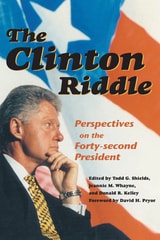
The Clinton Riddle
Perspectives on the Forty-second PresidentTodd G. Shields
University of Arkansas Press, 2004

The Collected Works of William Howard Taft, Volume I
Four Aspects of Civic Duty and Present Day ProblemsDavid H. Burton
Ohio University Press, 2001
The inaugural volume of The Collected Works of William Howard Taft is composed of two of his earliest books, Four Aspects of Civic Duty and Present Day Problems. Based on a series of lectures delivered at Yale in 1906, Four Aspects of Civic Duty is an attempt by then Secretary of War Taft to bring to the attention of his audience the importance of civic duty from the perspective of the university graduate, the judge on the bench, the colonial administrator, and the national executive branch of government. His remarks were drawn from his own experience, while at the same time he laid down the principles of citizenship with which all people could identify. In Present Day Problems, William Howard Taft demonstrates the depth of his knowledge and the seriousness of his reflections on a wide range of topics including Sino-American relations and the ongoing contest between capital and labor in America’s increasingly industrial socioeconomy. The problems he takes up are met head-on and discussed in a fashion likely to persuade his audience that he is well prepared to tackle the burdens of the presidency.
The Collected Works of William Howard Taft, in eight volumes, will include Taft’s complete published works as well as his presidential and state addresses and selected court opinions from his days as chief justice of the Supreme Court.
The Collected Works of William Howard Taft, Volume II
Political Issues and Outlooks: Speeches Delivered Between August 1908 and February 1909David H. Burton
Ohio University Press, 2001
The second volume of The Collected Works of William Howard Taft is dedicated to the speeches and writings that displayed his thinking in the autumn of 1908 and the following winter.
At this time he was campaigning for the presidency against the well-known William Jennings Bryan, and in Taft’s writings is evidence of the contrast in style between Taft and Bryan and between Taft and his predecessor, Teddy Roosevelt. as well. Although uncomfortable with campaigning, he thoughtfully addresses the concerns of the day that framed the election, including race, the Philippines, and socialism.
Political Issues and Outlooks also contains speeches made after the election and leading up to his inauguration as the twenty-seventh president of the United States. Introduced by a commentary from the general series editor Professor David H. Burton, the second volume of The Collected Works of William Howard Taft is a revealing look at the machinations of United States politics at the beginning of the twentieth century and a glimpse into the mind of one of the century’s most influential political architects.
The Collected Works of William Howard Taft, Volume III
Presidential Addresses and State PapersDavid H. Burton
Ohio University Press, 2001
The third volume of The Collected Works of William Howard Taft imparts an appreciation of the range of the twenty-seventh president’s interests. Beginning with his inaugural address and concluding with a detailed exposition of governmental expenses and needed economies, President William Howard Taft showed himself willing to tackle the routine as well as the rarified responsibilities of executive rule.
Whether he was addressing the issue of strikes and labor unions or conservation, President Taft consistently demonstrated that, in word and action, he was prepared to be a modern president. What impresses the reader of these remarks is Taft’s willingness to administer to virtually every part of the nation, thereby proving that he was not a mere figurehead but a chief executive truly concerned about problems across the country. Perhaps, as his words here indicate, Taft was not a good politician after all but a kind man who saw himself as president of all the people. As the first of two volumes directly related to Taft’s tenure as president, Presidential Addresses and State Papers documents a pivotal time in the public life of this man from Ohio. Introduced by a commentary from the general series editor Professor David H. Burton, the third volume of The Collected Works of William Howard Taft underscores the presidential stature of William Howard Taft.
The Collected Works of William Howard Taft, Volume IV
Presidential Messages to CongressDavid H. Burton
Ohio University Press, 2002
“A time when panics seem far removed is the best time to prepare our financial system to withstand a storm. The most crying need this country has is a proper banking and currency system. The existing one is inadequate, and everyone who has studied the question admits it.”—William Howard Taft
The interaction between President William Howard Taft and the Congress provides a window on his leadership. Volume IV of The Collected Works of William Howard Taft is devoted to his messages to the legislative branch and concerns some of the pressing issues of the day, issues that have relevance still.
Oftentimes President Taft was at odds with a somewhat reactionary Congress, causing him to veto legislation that he thought unwise. For example, his commitment to the independence of elected judges led him to reject statehood for Arizona until its constitution was altered to address his objection.
His messages also touched on subjects for which he led the way over the objections of Congress, such as his recommendation of a federal law to protect resident aliens against denial of their civil rights and his advocacy of free trade with Canada.
In his commentary to the volume, Professor Burton points out: “There is exhibited time after time concern for the American people, for men and women from different walks of life. Taft comes across less as a judge, which he had been, or the chief justice he was to become, and more as a sitting president of all the people.”
Taft’s Presidential Messages to Congress provides the documentary evidence to support that claim.
The Collected Works of William Howard Taft, Volume V
Popular Government and The Anti-trust Act and the Supreme CourtDavid H. Burton
Ohio University Press, 2003
The fifth volume of The Complete Works of William Howard Taft presents two publications Taft wrote as Kent Professor of Constitutional Law at Yale University, the position he assumed in 1913 after he was defeated in his bid for re-election as U.S. president. The first, Popular Government, was prepared for a series of lectures, but was motivated by Taft’s passion over the issue of constitutional interpretation, which had been hotly contested during the campaign. Organized around the preamble of the Constitution, the lectures and later the book were opportunities for Taft to restate his opposition to the direct democracy movement and to reveal the workings of a conservative mind.
In the second, The Anti-trust Act and the Supreme Court, Taft articulates his position in the ongoing debate over the conventional nineteenth-century notion of “laissez faire” and the provisions of the Sherman Antitrust Act. Taft had pursued a policy of vigorous antitrust enforcement during his presidency. In this book he intended to demonstrate that restraint of trade was part of the common law, thereby arguing to good effect in favor of reasonable restraint of trade in his own time.
Taft's careful distinction between predatory monopolistic practices and the reasonable business practices of well-behaved corporations continues to inform today's chambers of government.
The Collected Works of William Howard Taft, Volume VI
The President and His Powers and The United States and PeaceDavid H. Burton
Ohio University Press, 2003
Volume VI of The Collected Works of William Howard Taft follows the career of William Howard Taft upon his leaving the White House. It consists of two short publications from 1914 and 1915.
The first, The President and His Powers, is based on a series of lectures delivered at Columbia University and draws on Taft’s experience in the presidency and the executive branch. It speaks particularly to the nature of executive power and its place in the American system and is rooted in his disagreement with Theodore Roosevelt regarding presidential power. Taft believed all presidential power must be traced to some specific grant of power or be necessary to its exercise, while Roosevelt saw the presidency as a position of “steward of the people” limited only by some express provision of the Constitution.
The second, The United States and Peace, reflects Taft’s interest in foreign policy, which was intensified by his years as governor of the Philippines and as secretary of war, as well as by his presidency. Originally four lectures delivered in 1914, The United States and Peace discusses the Monroe Doctrine, the threat to peace presented by incidents of violence to foreigners in the United States, the maintenance of peace through international arbitration, and the trend toward federation in international affairs. Taft hoped to see the latter result in the establishment of an independent judiciary to resolve international disputes.
Taft’s reasoned arguments, supplemented by the commentaries of Professors McWilliams and Gerrity, will stimulate interest among historians, lawmakers, political activists, and the general public.
The Collected Works of William Howard Taft, Volume VII
Taft Papers on League of NationsFrank X. Gerrity
Ohio University Press, 2003
Eager to turn the congressional election of 1918 into a confirmation of his foreign policy, President Woodrow Wilson was criticized for abandoning the spirit of the popular slogan “Politics adjourned!”
His predecessor, William Howard Taft, found Wilson difficult to deal with and took issue with his version of the League of Nations, which Taft felt was inferior to the model proposed by the League to Enforce Peace. Rather than join the massive Republican opposition to the Treaty of Versailles, however, Taft instead supported Wilson’s controversial decision to travel to Paris as the head of the American peace delegation, and he defended the critical tenth article in the covenant, which detractors saw as a surrender of American sovereignty. He also counseled Wilson to insert a clause concerning the Monroe Doctrine that would pacify the Senate’s group of “reservationists,” whose votes were essential to approval of the treaty.
Volume VII in The Collected Works of William Howard Taft consists of the Taft Papers on League of Nations originally published in 1920. This is a collection ofTaft’s speeches, newspaper articles, and complementary documents that reflect his consistent support for a league of nations and, eventually, for the Covenant of the League of Nations emanating from the Paris Peace Conference.
Although the failure of the treaty and its League of Nations can probably be laid at the feet of an obstinate Wilson and a wily Henry Cabot Lodge, William Howard Taft can be credited with rising above partisanship to emerge as the League’s most consistent supporter.
As in the rest of the Collected Works, Taft Papers on League of Nations provides a window on the machinations surrounding some of the most significant decisions of the era.
The Collected Works of William Howard Taft, Volume VIII
“Liberty under Law” and Selected Supreme Court OpinionsFrancis Graham Lee
Ohio University Press, 2004
William Howard Taft’s presidency (1909-1913), succeeding Theodore Roosevelt’s, was mired in bitter partisan fighting, and Taft sometimes blundered politically. However, this son of Cincinnati assumed his true calling when President Warren G. Harding appointed him to the U.S. Supreme Court in 1921. Taft remains the only person to have served both as president of the United States and as chief justice of the Supreme Court.
The Collected Works of William Howard Taft, Volume VIII, consists of “Liberty under Law” and selected Supreme Court opinions, among the most instructive accomplishments of Taft’s ten years at the helm of the court. The writings reveal the sober judgments of a federalist who viewed state regulation with suspicion, championed national government, and saw an independent and powerful judiciary as the bulwark protecting the “vested rights” that the framers of the U.S. Constitution sought to guarantee.
Whatever his failings as a politician, Taft was an intellectual powerhouse who knew how to use the law as a lever to encourage society to move toward more stable and productive ends. Although Taft is considered an average president at best, historians and political scientists rank him among fifteen “near greats” who have served on the high court. His ability and his love for the law shine through in Volume VIII, the concluding volume of The Collected Works of William Howard Taft. As Taft reportedly said to President Harding upon his appointment as chief justice, “I love judges and I love courts. They are my ideals on earth of what we shall meet afterward in heaven under a just God.”
The Collision of Political and Legal Time
Foreign Affairs and the Supreme Court's Transformation of Executive AuthorityKimberley L. Fletcher
Temple University Press, 2018
How does the U.S. Supreme Court shape constitutional and political development? In The Collision of Political and Legal Time, Kimberley Fletcher answers this question by analyzing the key role the Court has played in interpreting presidential decision-making in the area of foreign affairs since 1936. She reconsiders the Curtiss-WrightCourt, which instituted a new constitutional order that established plenary powers independent of congressional delegation. Fletcher also reexamines Japanese internment and detainee cases, demonstrating the entrenchment of the new constitutional order and how presidential ascendency becomes institutionalized. Other cases, such as Youngstown, illustrate how the Court, during a time of war, will check Executive power and authority.
The Collision of Political and Legal Time examines these cases and controversies in foreign policymaking through the twentieth and into the twenty-first centuries to show that the Court is not passive or constrained; it does not merely follow politics or the majority coalition. Through her nuanced analysis, Fletcher makes a larger argument about the role of the U.S. Supreme Court as an agent of change, which ultimately transforms power, shapes politics, and redirects history.
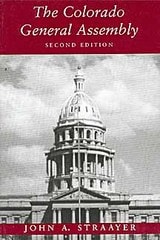
The Colorado General Assembly, Second Edition
John A. Straayer
University Press of Colorado, 2000
The Colorado General Assembly is based on years of author John Straayer's first-hand observations, his review of original documents and secondary sources, and hundred of conversations with lawmakers, lobbyists, members of the legislative staff, executive branch personnel, and journalists.
In this lively, informative book, Straayer describes the formal structure of the Legislature, as well as the all-important process by which bills become or do not become law, and how the power center within the institution can move or kill legislative initiatives. He also examines the clout of the lobby corps, which outnumbers the elected lawmakers five to one; the way the Legislature dominates the budget process; and the manner by which divisions between the two parties, the two houses, and the legislative and executive branches impact the conduct of the public's business under Colorado's gold dome.
The Colorado General Assembly fills a major gap in our knowledge of state government. It will appeal to students and practitioners of politics as well as to those with general interest in civic life.
The Committee
A Study of Policy, Power, Politics and Obama's Historic Legislative Agenda on Capitol HillBryan W. Marshall and Bruce C. Wolpe
University of Michigan Press, 2018
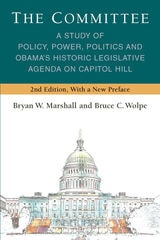
The Committee
A Study of Policy, Power, Politics and Obama’s Historic Legislative Agenda on Capitol HillBryan W. Marshall and Bruce C. Wolpe
University of Michigan Press, 2021
For three years while serving as a senior adviser to Rep. Henry A. Waxman (D-CA), chairman of the House Committee on Energy and Commerce—one of the most powerful committees in Congress—Bruce C. Wolpe kept a diary, a senior staffer’s look at how committees develop and promote legislation. With its insider’s view of the rough-and-tumble politics of cap-and-trade, healthcare reform, tobacco, oversight, and the debt ceiling agreement, The Committee uniquely melds the art of politics and policymaking with the theory and literature of political science. The authors engage with the important questions that political science asks about committee power, partisanship, and the strategies used to build winning policy coalitions both in the Committee and on the floor of the House. In this new edition, the authors revisit the relationship between the executive and Congress in the wake of the sweeping changes wrought by the Trump administration, as well as thoughts about how that relationship will change again as President Biden faces a 117th Congress that is strikingly similar to Obama’s 111th. The insider politics and strategies about moving legislation in Congress, from internal and external coalition building to a chairman’s role in framing policy narratives, will captivate both novice and die-hard readers of politics.
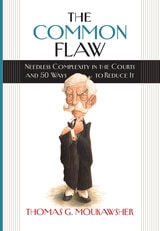
The Common Flaw
Needless Complexity in the Courts and 50 Ways to Reduce ItThomas Moukawsher
Brandeis University Press, 2023
Americans are losing faith in their courts. After long delays, judges often get rid of cases for technical reasons, or force litigants to settle rather than issue a decision. When they do decide cases, we can't understand why.
The Common Flaw seeks to rid the American lawsuit of this needless complexity. The book proposes fifty changes from the filing of a complaint in court to the drafting of appellate decisions to replace the legal system’s formalism with a kind of humanism. Thomas G. Moukawsher calls for courts that decide cases promptly based more on the facts than the law, that prioritize the parties involved over lawyers, that consider the consequences for the people and the public, and that use words we can all understand. Sure to spark an important conversation about court reform, The Common Flaw makes the case for a more effective and credible legal system with warmth and humor, incorporating cartoons alongside insightful reflection.
The Congressional Black Caucus, Minority Voting Rights, and the U.S. Supreme Court
Christina R. Rivers
University of Michigan Press, 2014
Both the U.S. Supreme Court and the Congressional Black Caucus (CBC) claim to advocate minority political interests, yet they disagree over the intent and scope of the Voting Rights Act (VRA), as well as the interpretation of the equal protection clause of the 14th Amendment. Whereas the Court promotes color-blind policies, the CBC advocates race-based remedies. Setting this debate in the context of the history of black political thought, Rivers examines a series of high-profile districting cases, from Rodgers v. Lodge (1982) through NAMUDNO v. Holder (2009). She evaluates the competing approaches to racial equality and concludes, surprisingly, that an originalist, race-conscious interpretation of the 14th Amendment, along with a revised states' rights position regarding electoral districting, may better serve minority political interests.
The Congressional Endgame
Interchamber Bargaining and CompromiseJosh M. Ryan
University of Chicago Press, 2018
With The Congressional Endgame, Josh M. Ryan offers a coherent explanation of how the bicameral legislative process works in Congress and shows that the types of policy outcomes it produces are in line with those intended by the framers of the Constitution. Although each bargaining outcome may seem idiosyncratic, the product of strong leadership and personality politics, interchamber bargaining outcomes in Congress are actually structured by observable institutional factors. Ryan finds that the characteristics of the winning coalition are critically important to which chamber “wins” after bargaining, with both conference committees and an alternative resolution venue, amendment trading, creating policy that approximates the preferences of the more moderate chamber. Although slow and incremental, interchamber negotiations serve their intended purpose well, The Congressional Endgame shows; they increase the odds of compromise while at the same time offering a powerful constraint on dramatic policy changes.
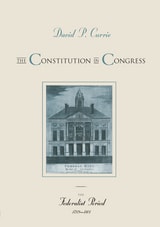
The Constitution in Congress
The Federalist Period, 1789-1801David P. Currie
University of Chicago Press, 1997
"A joy to read."—Appellate Practive Journal and Update
"[A] patient and exemplary analysis of the work of the first six Congresses."—Geoffrey Marshall, Times Literary Supplement
The Constitutional Bind
How Americans Came to Idolize a Document That Fails ThemAziz Rana
University of Chicago Press, 2024
An eye-opening account of how Americans came to revere the Constitution and what this reverence has meant domestically and around the world.
Some Americans today worry that the Federal Constitution is ill-equipped to respond to mounting democratic threats and may even exacerbate the worst features of American politics. Yet for as long as anyone can remember, the Constitution has occupied a quasi-mythical status in American political culture, which ties ideals of liberty and equality to assumptions about the inherent goodness of the text’s design. The Constitutional Bind explores how a flawed document came to be so glorified and how this has impacted American life.
In a pathbreaking retelling of the American experience, Aziz Rana shows that today’s reverential constitutional culture is a distinctively twentieth-century phenomenon. Rana connects this widespread idolization to another relatively recent development: the rise of US global dominance. Ultimately, such veneration has had far-reaching consequences: despite offering a unifying language of reform, it has also unleashed an interventionist national security state abroad while undermining the possibility of deeper change at home.
Revealing how the current constitutional order was forged over the twentieth century, The Constitutional Bind also sheds light on an array of movement activists—in Black, Indigenous, feminist, labor, and immigrant politics—who struggled to imagine different constitutional horizons. As time passed, these voices of opposition were excised from memory. Today, they offer essential insights.
The Constitutional Bind
How Americans Came to Idolize a Document That Fails ThemAziz Rana
University of Chicago Press, 2024
This is an auto-narrated audiobook version of this book.
An eye-opening account of how Americans came to revere the Constitution and what this reverence has meant domestically and around the world.
Some Americans today worry that the Federal Constitution is ill-equipped to respond to mounting democratic threats and may even exacerbate the worst features of American politics. Yet for as long as anyone can remember, the Constitution has occupied a quasi-mythical status in American political culture, which ties ideals of liberty and equality to assumptions about the inherent goodness of the text’s design. The Constitutional Bind explores how a flawed document came to be so glorified and how this has impacted American life.
In a pathbreaking retelling of the American experience, Aziz Rana shows that today’s reverential constitutional culture is a distinctively twentieth-century phenomenon. Rana connects this widespread idolization to another relatively recent development: the rise of US global dominance. Ultimately, such veneration has had far-reaching consequences: despite offering a unifying language of reform, it has also unleashed an interventionist national security state abroad while undermining the possibility of deeper change at home.
Revealing how the current constitutional order was forged over the twentieth century, The Constitutional Bind also sheds light on an array of movement activists—in Black, Indigenous, feminist, labor, and immigrant politics—who struggled to imagine different constitutional horizons. As time passed, these voices of opposition were excised from memory. Today, they offer essential insights.
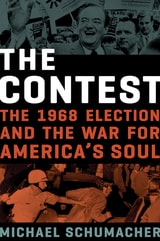
The Contest
The 1968 Election and the War for America's SoulMichael Schumacher
University of Minnesota Press, 2021
A dramatic, deeply informed account of one of the most consequential elections and periods in American history
1968—rife with riots, assassinations, anti–Vietnam War protests, and realpolitik—was one of the most tumultuous years in the twentieth century, culminating in one of the most consequential presidential elections in American history. The Contest tells the story of that contentious election and that remarkable year. Bringing a fresh perspective to events that still resonate half a century later, this book is especially timely, giving us the long view of a turning point in American culture and politics.
Author Michael Schumacher sets the stage with a deep look at the people with important roles in the unfolding drama: Lyndon B. Johnson, Robert F. Kennedy, Eugene McCarthy, George Wallace, Richard Nixon, and especially Hubert H. Humphrey, whose papers and journals afford surprising new insights. Following these politicians in the lead-up to the primaries, through the chaotic conventions, and down the home stretch to the general election, The Contest combines biographical and historical details to create a narrative as intimate in human detail as it is momentous in scope and significance.
An election year when the competing forces of law and order and social justice were on the ballot, the Vietnam War divided the country, and the liberal regime begun with Franklin D. Roosevelt was on the defensive, 1968 marked a profound shift in the nation’s culture and sense of itself. Thorough in its research and spellbinding in the telling, Schumacher’s book brings sharp focus to that year and its lessons for our current critical moment in American politics.
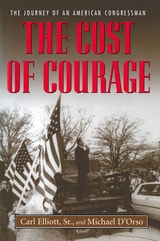
The Cost of Courage
The Journey of an American CongressmanCarl Elliott
University of Alabama Press, 2001
This deeply moving story chronicles the tenacity and vision that carried Carl Elliott from the hills of northwest Alabama to eight distinguished terms in the United States House of Representatives.
Born in a log cabin on a tenant farm in 1913, Carl Elliott worked his way through The University of Alabama during the Great Depression and was elected to Congress in 1948. With a no-nonsense philosophy of fairness and equal opportunity, he established himself as one of the most effective members of the House of Representatives during the 1950s. He was a progressive Democrat and he fought hard for the dirt farmers and coal miners he grew up with and who sent him to Congress.
In an era when racial segregationists dominated southern politics, Elliott worked with many of the important political leaders of the 20th century, including Presidents Truman, Eisenhower, and Kennedy and powerful House Speaker Sam Rayburn. He was instrumental in passing the National Defense Education Act of 1958, which continues to provide college loans to more than 20 million Americans. But his brave stand against racism and George Wallace in the 1966 Alabama gubernatorial race ruined him professionally (he never returned to elected office) and financially (he cashed in his congressional pension to help fund the campaign). Even as a destitute invalid in his old age, however, Elliott kept his dignity and integrity intact.
The life story of Carl Elliott is full of humor and wry wisdom and explains how he made his way across a stage as big as America, influencing its politics and future, and then emerged, belatedly, as an unsung hero of the fight for civil rights and equality.
The Court vs. Congress
Prayer, Busing, and AbortionEdward Keynes and Randall Miller
Duke University Press, 1989
Edward Keynes and Randall Miller argue that Congress lacks the constitutional power to legislate away the powers of the federal courts and to prevent individuals from seeking redress for presumed infringements of their constitutional rights in these areas. They demonstrate that neither the framers nor ratifiers of the Constitution intended the Congress to exercise plenary power over the appellate jurisdiction of the Supreme Court. Throughout its history the Court has never conceded unlimited powers to Congress; and until the late 1950s Congress had not attempted to gerrymander the Court’s jurisdiction in response to specific decisions. But the authors contend this is just what the sponsors of recent legislative attacks on the Court intend, and they see such efforts as threatening the Court’s independence and authority as defined in the separation of powers clauses of the Constitution.
The Cult Of The Court
John Brigham
Temple University Press, 1991
In recent years widespread attention has been focused on decisions handed down by the Supreme Court that grapple with passionate issues: integration, school prayer, abortion, affirmative action. The appointment of new justices is a highly charged political event although the Court is supposed to be "above" politics. Amidst the bicentennial celebration of the Constitution and almost daily reports of major confrontations awaiting the highest court’s judicial review, John Brigham presents a fresh and innovative examination of the U.S. Supreme Court as the final arbiter of constitutional interpretation.
Drawing on philosophy and anthropology, The Cult of the Court offers a social scientific investigation of an institution whose authority has come to be taken for granted. The author emphasizes that the Court is an institution and that its authority is founded less in the claim of legal expertise than in hierarchical finality—the assertion of political will, not of legal judgment. He shows how the Court has supplanted the Constitution as the authority in our political world and that what makes legal "sense" is affected by these factors of institutionalization, bureaucratization, and court-dominated constitutionalism.
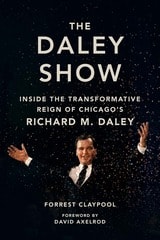
The Daley Show
Inside the Transformative Reign of Chicago's Richard M. DaleyForrest Claypool; Foreword by David Axelrod
University of Illinois Press, 2024
American cities once had mayors who actually governed.
For twenty-two years, Richard M. Daley ran Chicago with the type of authority that is unthinkable today. He reshaped downtown, triggered a jobs boom, delivered the iconic Millennium Park, turned around troubled public schools, and slashed violent crime to 40-year lows. He outfoxed Republican legislators to retain control of O’Hare Airport and expand it into the nation’s premier international aviation hub. Leveraging carefully built national political ties, he sidelined a powerful nemesis to tear down Chicago’s infamous public housing projects.
Rebuilding parts of his father’s legendary political machine through brazen (and illegal) patronage deals, he centralized power to a remarkable degree, cut deals behind closed doors, racked up piles of debt, and made long-term bets whose consequences are still unfolding.
This is not simply a biography. It is a challenge to contemporary urban orthodoxy:
Do cities thrive because of strong, decisive leaders—or despite them?
Through vivid storytelling, this book exposes how Daley consolidated power, aligned business and labor, navigated crises, survived damaging scandals, and imposed discipline on a sprawling city. It dares readers to reconsider what kind of leadership modern American cities truly need.