Results by title
244 books match the query 'Arkansas' and 41 start with t
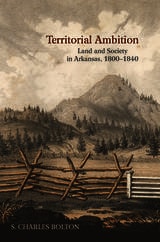
Territorial Ambition
Land and Society in Arkansas, 1800-1840S. Charles Bolton
University of Arkansas Press, 2020

The Amphibians and Reptiles of Arkansas
Stanley E. Trauth
University of Arkansas Press, 2004

The Amphibians and Reptiles of Arkansas
Stanley E. Trauth
University of Arkansas Press, 2026
The rich diversity of Arkansas’s amphibian and reptilian species comes alive in this thoroughly updated second edition of The Amphibians and Reptiles of Arkansas. An indispensable resource for both professionals and enthusiasts, and praised for its accessible language and scientific rigor, this field guide not only reflects the latest in taxonomic research but also celebrates the surge in herpetological studies in Arkansas over the past two decades, showcasing a thriving academic interest while addressing gaps in the first edition.
Building on the foundation of the acclaimed first edition, this updated work introduces enhanced color maps, updated range data, and an array of new illustrations, capturing a more vivid and comprehensive picture of Arkansas’s herpetofauna. Meticulously illustrated identification keys, species accounts, and pictorial guides make this a valuable tool for identifying species in the field, in classrooms, or in one’s own backyard.
The Arkansas Freedom of Information Act
John J. Watkins
University of Arkansas Press, 2017
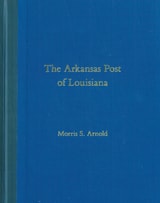
The Arkansas Post of Louisiana
Morris S. Arnold
University of Arkansas Press, 2017
Arkansas Post, the first European settlement in what would become Jefferson’s Louisiana, had an important mission as the only settlement between Natchez and the Illinois Country, a stretch of more than eight hundred miles along the Mississippi River. The Post was a stopping point for shelter and supplies for those travelling by boat or land, and it was of strategic importance as well, as it nurtured and sustained a crucial alliance with the Quapaw Indians, the only tribe that occupied the region.
The Arkansas Post of Louisiana covers the most essential aspects of the Post’s history, including the nature of the European population, their social life, the economy, the architecture, and the political and military events that reflected and shaped the Post’s mission.
Beautifully illustrated with maps, portraits, lithographs, photographs, documents, and superb examples of Quapaw hide paintings, The Arkansas Post of Louisiana is a perfect introduction to this fascinating place at the confluence of the Arkansas and Mississippi Rivers, a place that served as a multicultural gathering spot, and became a seminal part of the history of Arkansas and the nation.

The Best of Fisher
28 years of Editorial Cartoons from Faubus to ClintonGeorge Fisher
University of Arkansas Press, 1993

The Boy from Altheimer
From the Depression to the BoardroomWilliam H. Bowen
University of Arkansas Press, 2006
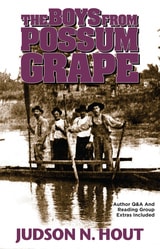
The Boys from Possum Grape
A novellaJudson N. Hout
Parkhurst Brothers, Inc., 2013
Set in the days of small, local banks when embarrassing entrepreneurs were the one family in town who bought a new car every year—those cars everyone else called ‘gunboats—and the bad guys came with black hats, this rollicking send-up of stupid criminals who even Barnie Fife could have outwitted makes for belly-laughs while reading and memories that will bring smiles to readers’ faces.

The Buffalo, Ben, and Me
Todd Parnell & Foreword by Jim Baker
University of Missouri Press, 2007
The Buffalo River in northwest Arkansas is one of the longest free-flowing, undammed rivers west of the Mississippi—and one of the most beautiful waterways on earth. Almost lost to development, it proved to be the perfect testing ground for a young boy almost lost to mediocrity.
Middle-schooler Ben is struggling with learning challenges that have left him resentful and underachieving. His father, middle-ager Todd, wants to help his son gain self-confidence but is searching for his own identity. For twelve adventure-filled days on the river—all 125 miles of her navigable course, from Ponca to the White River—father and son discover the formative, curative, and redemptive powers of nature.
Leaving video games and cell phones behind isn’t easy for kids these days, but in the great outdoors parents and youngsters can connect in unimaginable ways. The Buffalo, Ben, and Me shares such a connection in an adventure story set on a wild river. It is a captivating tale featuring a host of colorful characters and enlivened by photos that reflect the essence of the wilderness.
But deeper than that, it is the story of crossing a threshold from dream to possibility—of one man’s search for meaning in his life and his efforts to motivate his son, blending love of family with love of nature in a tale of transformation. It tells how a rebellious teen and a bored banker conspired to buck a system keyed to predictability, and how a wild river inspired both to a better use of their lives. “This trip hit me as hard as it did Ben,” writes Parnell, “as a wake-up call to life, to what is important, to what is not.”
The trip down the Buffalo was one that even Ben admits changed his life in more ways than one, as he later went on to earn a master of science degree specializing in stream ecology. For any reader who loves the outdoors—and especially those seeking to connect with their children—The Buffalo, Ben, and Me is essential reading that reminds us of possibilities to be had in facing life head-on as it raises awareness of the need to protect the Ozarks’ water resources and heritage.

The Clintons of Arkansas
An Introduction by Those Who Know Them BestErnest Dumas
University of Arkansas Press, 1993

The Die Is Cast
Arkansas Goes to War, 1861Mark K. Christ
Butler Center for Arkansas Studies, 2010

The Education of Ernie Dumas
Chronicles of the Arkansas Political MindErnest Dumas
Butler Center for Arkansas Studies, 2019
Beginning with the defeat of Governor Francis Cherry by the son of a hillbilly socialist at the end of the Joe McCarthy era, Dumas traces the development of a modernist political cast that eventually produced Arkansas’s first president of the United States. It follows the seed from 1978 that would germinate into the second impeachment of an American president.
Dumas has written for newspapers and about politics for sixty-three years, since 1954, the year that the stolid Cherry fell to Orval Eugene Faubus. The book is a political memoir that describes not only his education in the ways of politicians but the politicians’ own education and miseducation in how you win voters and then how you get things done.
It is mostly a collection of untold stories, often deeply personal, that reveal the inner struggles and sometimes the tribulations of the state’s leaders—Cherry, Faubus, Winthrop Rockefeller, Dale Bumpers, David Pryor, John McClellan, J. William Fulbright, Bill Clinton, Jim Guy Tucker, and others.
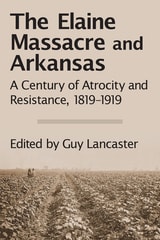
The Elaine Massacre and Arkansas
A Century of Atrocity and Resistance, 1819-1919Guy Lancaster
Butler Center for Arkansas Studies, 2018
We cannot fully understand what happened at Elaine without examining the one hundred years leading up to the massacre. An analysis of the years from 1819, when Arkansas officially became an American territory, to 1919 provides the historical foundation for understanding one of the bloodiest manifestations of racial violence in U.S. history.
During the antebellum years, slaveholders grew paranoid about possible “insurrections,” and after the Civil War and Emancipation, these fears lingered and led to numerous atrocities long before Elaine. At the same time, African Americans—particularly fieldworkers—worked to organize themselves to resist oppression, setting the stage for the farmers’ union that was the target for mob and military wrath during the Elaine Massacre.
These essays provide the larger history necessary for understanding what happened at Elaine in 1919—and thus provide a window into the current state of Arkansas and the nation at large. Contributors include Richard Buckelew, Nancy Snell Griffith, Matthew Hild, Adrienne Jones, Kelly Houston Jones, Cherisse Jones-Branch, Brian K. Mitchell, William H. Pruden III, and Steven Teske.
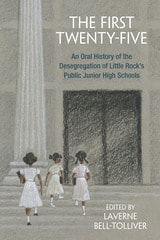
The First Twenty-Five
An Oral History of the Desegregation of Little Rock’s Public Junior High SchoolsLaVerne Bell-Tolliver
University of Arkansas Press, 2018
“It was one of those periods that you got through, as opposed to enjoyed. It wasn’t an environment that . . . was nurturing, so you shut it out. You just got through it. You just took it a day at a time. You excelled if you could. You did your best. You felt as though the eyes of the community were on you.”—Glenda Wilson, East Side Junior High
Much has been written about the historical desegregation of Little Rock Central High School by nine African American students in 1957. History has been silent, however, about the students who desegregated Little Rock’s five public junior high schools—East Side, Forest Heights, Pulaski Heights, Southwest, and West Side—in 1961 and 1962.
The First Twenty-Five gathers the personal stories of these students some fifty years later. They recall what it was like to break down long-standing racial barriers while in their early teens—a developmental stage that often brings emotional vulnerability. In their own words, these individuals share what they saw, heard, and felt as children on the front lines of the civil rights movement, providing insight about this important time in Little Rock, and how these often painful events from their childhoods affected the rest of their lives.

The Governors of Arkansas
Essays in Political BiographyJr. Gatewood
University of Arkansas Press, 1995

The Gudge Creek and Wad Chronicles
Richard Allin
University of Arkansas Press, 1989
The Impact of the Civil War and Reconstruction on Arkansas
Persistence in the Midst of RuinCarl H. Moneyhon
University of Arkansas Press, 2002

The Improbable Life of the Arkansas Democrat
An Oral HistoryJerry McConnell
University of Arkansas Press, 2016
The Improbable Life of the Arkansas Democrat is based on more than one hundred interviews with employees of the Democrat, including editors, reporters, feature writers, cartoonists, circulation managers, business managers, salespeople, typesetters and others, from the 1930s through the early 1990s, when the Democrat took over the more prominent Arkansas Gazette after an aggressive newspaper war.
This new addition to Arkansas journalism history provides vivid details about what it was like to work at the Democrat. August Engel, who led the paper with focused devotion for forty-two years, was famous for his thrift, creating austere conditions that included no air conditioning in the newsroom and sub-par wages. In spite of these drawbacks, the paper was still home to many dedicated journalism professionals endeavoring to do good work.
Readers who remember the ultimate acrimony between the two papers may be surprised to learn that for many years the Democrat and the Gazette owners operated under a tacit agreement of civility. The papers didn’t raid each other’s staff, for example, and when a fire broke out in the Gazette pressroom, Democrat management offered to loan the use of its press. Staffers recall that when the Gazette struggled with an advertising boycott and reduced circulation during the Little Rock Central High crisis because of its perceived progressive editorial stance, which infuriated many Arkansans, the Democrat did less than it might have to capitalize. The eventual newspaper war that combined the two rivals saw the end of any semblance of civility when the Democrat hired an aggressive and infamous managing editor named John Robert Starr.
Through these firsthand stories of those who lived it, The Improbable Life of the Arkansas Democrat tells the story of how the second-place paper overtook the oldest newspaper west of the Mississippi, forever changing not only Arkansas journalism but also Arkansas history.
The Jungles of Arkansas
A Personal History of the Wonder StateRobert Lancaster
University of Arkansas Press, 1989
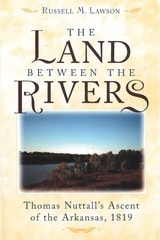
The Land between the Rivers
Thomas Nuttall's Ascent of the Arkansas, 1819Russell M. Lawson
University of Michigan Press, 2004
During the early nineteenth century, Nuttall explored the waters, valleys, plains, and mountains of the Great Lakes, Ohio River, Mississippi River, as well as the Missouri, Arkansas, Red, and Canadian river valleys of the former Louisiana Territory.
In this fascinating account of Nuttall's travels through the wilderness of the middle west, author Russell Lawson-using Nuttall's own journal-captures the sense of excitement of the early wanderer. As much a delight for the mind as the senses, The Land between the Rivers details the unremitting weather and rugged geography of uncharted lands within the Louisiana Territory. A sense of discovery pervades the narrative as Nuttall's odyssey builds to its climax in the prairie wilderness of what is now Oklahoma. Sickened by "ague"-in his case, malaria-Nuttall at times was barely able to go on; yet he continued to search for and catalog plants and animals.
The Land between the Rivers expands our knowledge of the work of one of the country's earliest botanists. We also learn a great deal about the early explorers, the inhabitants of the unsettled land, and about the land and culture of the times.
The Lost Roads Project
A Walk-in Book of ArkansasC.D. Wright
University of Arkansas Press, 1994

The Metal of a Thousand Uses
Mercury Mining in Arkansas, 1930-1946Terry S. Reynolds
University of Arkansas Press, 2026
In 1930, a remote corner of southwest Arkansas witnessed the discovery of cinnabar, the ore from which mercury is extracted. Upon the arrival of “the metal of a thousand uses,” a wave of hope and ambition swept through the foothills of the Ouachita Mountains as mercury mining promised economic revival for the struggling state. Despite the known dangers of the industry, Arkansans greeted the prospect of a mercury boom with unbridled enthusiasm, seeing it as a potential solution to their economic woes amid the Great Depression.
In The Metal of a Thousand Uses: Mercury Mining in Arkansas, 1930–1946, Terry S. Reynolds charts the dramatic rise and fall of the state’s mercury mining district, from the euphoria of discovery to the logistical and financial challenges of industrialization. Drawing on deep archival research, Reynolds explores the experiences of the miners and managers whose fates became bound to the companies that sought to commercialize mercury refining in the Ouachita Mountains. The result is a vivid account of a little-known chapter in American mineral-resource history.
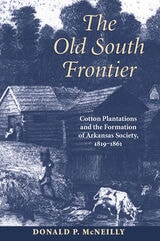
The Old South Frontier
Cotton Plantations and the Formation of Arkansas Society, 1819–1861Donald P. Mcneilly
University of Arkansas Press, 2000

The Ozarks
An American Survival of Primitive SocietyVance Randolph
University of Arkansas Press, 2017
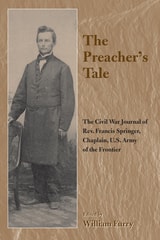
The Preacher's Tale
The Civil War Journal of Rev. Francis Springer, Chaplain, U.S. Army of the FrontierWilliam Furry
University of Arkansas Press, 2001
In the fall of 1861, fifty-one-year-old Rev. Francis Springer enlisted in the Union army. The following spring, Springer, a friend and one-time neighbor to Abraham Lincoln, rode away with the 10th Illinois Cavalry. A witness to the Battle of Prairie Grove (December 1862), Springer was later named post chaplain at Fort Smith, where, in additon to preaching and ministering to the troops, he was placed in charge of refugees—widows, orphans, and contrabands—the displaced victims of virulent guerrilla warfare in Northwest Arkansas. Springer also wrote articles and columns in the Fort Smith New Era under the pseudonym, “Thrifton.” Springer’s honest appraisals of life in the Army of the Frontier make for fascinating reading, and his unique perspective as moralist, educator, and journalist provide new insight into the Civil War and how it was fought in the West. The book includes several never-before published photographs and appendixes which feature accounts of six military executions that Springer participated in as a Union Army chaplain, the hitherto unpublished last letters home of two rebel soldiers condemned and executed at Fort Smith, as well as a eulogy for Abraham Lincoln.
The Preacher’s Tale includes several never before published photographs, and appendixes that contain accounts of six military executions that Springer participated in as a Union Army chaplain, the last letters home of two rebel soldiers condemned and executed at Fort Smith, as well as a eulogy written for Abraham Lincoln.

The Public's Health
A Narrative History Of Health And Disease In ArkansasSam Taggert
Arkansas Times Press, 2013

The State of Education in Arkansas
Harry Anthony Patrinos
University of Arkansas Press, 2026
For generations, Arkansas has wrestled with a stubborn reality: Despite flashes of progress, its education system has struggled to deliver consistent, equitable, high‑quality learning for all students. Now the state stands at a pivotal moment in its educational history, confronting sweeping reforms whose impact will shape generations.
The State of Education in Arkansas draws on original empirical research, statewide longitudinal data, and decades of national evidence to trace the evolution of Arkansas’s educational landscape, including major policy changes like the LEARNS and ACCESS Acts, higher teacher pay, science-of-reading mandates, universal early literacy, and responses to pandemic-era learning losses. This volume makes the case forcefully that Arkansas now possesses the rare combination of political alignment, financial investment, and policy coherence necessary to make real gains, but that outcomes will ultimately depend on disciplined implementation and attention to equity. The stakes—for students, families, and the state’s long-term economic future—could not be higher.

The Thane of Cawdor Comes to Bauxite
And Other Whimsy and Wisdom From the Pen of Mike TrimbleErnie Dumas
Butler Center for Arkansas Studies, 2024
“Although of a relatively scarce breed,” the Arkansas Times observed in the obituary of the itinerant writer it had once employed, “Mike Trimble was Arkansas’s and perhaps the country’s greatest self-deprecating journalist.” Readers will find in this fifty-year inventory of Trimble’s wit and wisdom all the vindication they might seek for that quaint judgment—the rare humble author. Whether he was chronicling, in the 1980s, rising political worthies like the far-into-the-future governors Asa Hutchinson and Mike Beebe, or, more often, the ordinary and feckless people that he encountered every day, befriended, and spent most of his career writing about, Trimble usually found a way, subtly or artlessly, to bring up his own failings, such as identifying the wrong person as the dead woman in an obituary he had written in his earliest days for his first employer, the Texarkana Gazette. Like the yokels in the vaudeville duos Laurel and Hardy, Abbott and Costello, Rowan and Martin, and Fey and Poehler, Trimble’s confessed bumblings were purposeful and studied instruments of his humor.
Arkansas produced more than its quota of weirdos, fabulists, con men, oleaginous politicians, charlatans, creeps, visionaries, and fantastical creatures—from Albert Pike, Arvin the Wino, Dr. Brinkley the Great Depression’s goat-gland sex therapist, Editor Weston, and the salty riverboat queen Ray Dorthy all the way to Say McIntosh and Red the Irish Setter. Mike Trimble, the South’s best and funniest storyteller, put them all down on paper for some of the best reading since Catch-22. Trimble turned humor into art and history into vaudeville.

The Thirty-Foot Elvis
A novelJane F. Hankins
Parkhurst Brothers, Inc., 2013

The Un-Natural State
Arkansas and the Queer SouthBrock Thompson
University of Arkansas Press, 2010
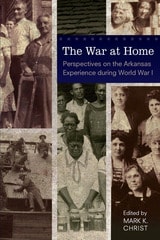
The War at Home
Perspectives on the Arkansas Experience during World War IMark K. Christ
University of Arkansas Press, 2020
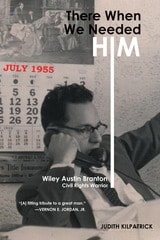
There When We Needed Him
Wiley Austin Branton, Civil Rights WarriorJudith Kilpatrick
University of Arkansas Press, 2007
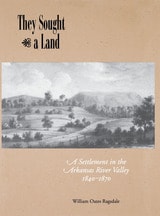
They Sought a Land
A Settlement in the Arkansas River Valley, 1840–1870William Oates Ragsdale
University of Arkansas Press, 1997
Pisgah grew and prospered, developing increasingly successful farming practices, landholding patterns, and trading strategies. But the Civil War took a heavy toll, taking workers away from farms, subjecting those left on the home front to deprivation and violence, and creating division in the community. By 1870, the people of Pisgah had dispersed into Arkansas’s larger developing society.
Absorbing to read and rich with colorful detail, They Sought a Land is an important story of the westward expansion of the United States and the settling of the American South during the nineteenth century.

Thin Safety Margin
The SEFOR Super-Prompt-Critical Transient Experiments, Ozark Mountains, Arkansas, 1970–71Jerry Havens
Arkansas Scholarly Editions , 2021
Thin Safety Margin charts the history of SEFOR, a twenty-megawatt reactor that operated for three years in the rural Ozark Mountains of Arkansas as part of an internationally sponsored program designed to demonstrate the Doppler effect in plutonium-oxide-fueled fast reactors. Authors Jerry Havens and Collis Geren draw upon this history to assess the accidental explosion risk inherent in using fast reactors to reduce the energy industry’s carbon dioxide emissions.
If a sufficiently powerful fast-neutron explosion were to cause the containment of a reactor such as SEFOR’s to fail, the reactor’s radiotoxic plutonium fuel could vaporize and escape into the surrounding environment, resulting in a miles-wide swath of destruction. The demonstration that the Doppler effect could prevent limited runaway reactivity in the event of an accident or natural disaster proved a critical development in producing safe nuclear technology. But while SEFOR was hailed as a breakthrough in nuclear safety, Havens and Geren’s examination of the project, including the partial SCRAM that occurred in late 1970, confirms experts’ concerns regarding the limits of the Doppler effect and presents a compelling argument for caution in adopting fast reactors like SEFOR to reduce carbon emissions.
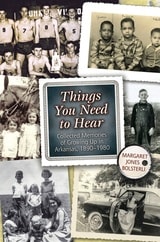
Things You Need to Hear
Collected Memories of Growing Up in Arkansas, 1890–1980Margaret Jones Bolsterli
University of Arkansas Press, 2016
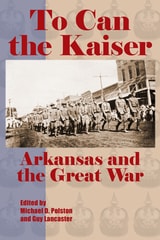
To Can the Kaiser
Arkansas and the Great WarMichael D. Polston
Butler Center for Arkansas Studies, 2015
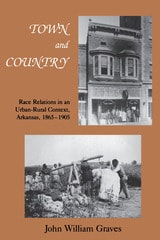
Town and Country
Race Relations in an Urban-Rural Context, Arkansas, 1865–1905John Graves
University of Arkansas Press, 1990
A thoroughly researched and extensively documented look at race relations in Arkansas druing the forty years after the Civil War, Town and Country focuses on the gradual adjustment of black and white Arkansans to the new status of the freedman, in both society and law, after generations of practicing the racial etiquette of slavery.
John Graves examines the influences of the established agrarian culture on the developing racial practices of the urban centers, where many blacks living in the towns were able to gain prominence as doctors, lawyers, successful entrepreneurs, and political leaders. Despite the tension, conflict, and disputes within and between the voice of the government and the voice of the people in an arduous journey toward compromise, Arkansas was one of the most progressive states during Reconstruction in desegregating its people.
Town and Country makes a significant contribution to the history of the postwar South and its complex engagement with the race issue.

Trails of Central Arkansas
A Guide to Central Arkansas' Land and Water TrailsJohnnie Chamberlin
Parkhurst Brothers, Inc., 2012
Trails of Central Arkansas delivers:
* Sixty trails in 36 parks or locations from Benton and Bryant to Cabot, from Wrightsville to Conway
* Color maps of every trail
* GPS coordinates for every trailhead
* Color-coded distinctions between paved and unpaved trails
* Level of difficulty ratings
* Scenery Scores
* Top-ten lists: Most Scenic, Trails for Kids, and Trails for Solitude

Trails of Little Rock
Hiking, Biking, and Kayaking Trails in Little RockJohnnie Chamberlin
Parkhurst Brothers, Inc., 2009

True Faith, True Light
The Devotional Art of Ed StilleyKelly Mulhollan
University of Arkansas Press, 2015
But one day Ed’s life was permanently altered. While plowing his field, he became convinced he was having a heart attack. Ed stopped his work and lay down on the ground. Staring at the sky, he saw himself as a large tortoise struggling to swim across a river. On his back were five small tortoises—his children—clinging to him for survival. And then, as he lay there in the freshly plowed dirt, Ed received a vision from God, telling him that he would be restored to health if he would agree to do one thing: make musical instruments and give them to children.
And so he did. Beginning with a few simple hand tools, Ed worked tirelessly for twenty-five years to create over two hundred instruments, each a crazy quilt of heavy, rough-sawn wood scraps joined with found objects. A rusty door hinge, a steak bone, a stack of dimes, springs, saw blades, pot lids, metal pipes, glass bottles, aerosol cans—Ed used anything he could to build a working guitar, fiddle, or dulcimer. On each instrument Ed inscribed “True Faith, True Light, Have Faith in God.”
True Faith, True Light: The Devotional Art of Ed Stilley documents Ed Stilley’s life and work, giving us a glimpse into a singular life of austere devotion.

Twenty Acres
A Seventies Childhood in the WoodsSarah Neidhardt
University of Arkansas Press, 2023
"A memoir infused with both empathy and inquiry."
—Wendy J. Fox, Electric Literature
“Twenty Acres is an engaging, thoughtful memoir of growing up in an off-the-grid cabin as part of the 1970s back-to-the-land movement. Sarah Neidhardt captures her subject beautifully and offers a compelling portrait of a highly specific, historically significant time and place.”
—Kate Daloz, author of We Are As Gods: Back to the Land in the 1970s on the Quest for a New America
Sarah Neidhardt grew up in the woods. When she was an infant, her parents left behind comfortable, urbane lives to take part in the back-to-the-land movement. They moved their young family to an isolated piece of land deep in the Arkansas Ozarks where they built a cabin, grew crops, and strove for eight years to live self-sufficiently.
In this vivid memoir Neidhardt explores her childhood in wider familial and social contexts. Drawing upon a trove of family letters and other archival material, she follows her parents’ journey from privilege to food stamps—from their formative youths, to their embrace of pioneer homemaking and rural poverty, to their sudden and wrenching return to conventional society—and explores the back-to-the-land movement of the 1970s as it was, and as she lived it.
A story of strangers in a strange land, of class, marriage, and family in a changing world, Twenty Acres: A Seventies Childhood in the Woods is part childhood idyll, part cautionary tale. Sarah Neidhardt reveals the treasures and tolls of unconventional, pastoral lives, and her insightful reflections offer a fresh perspective on what it means to aspire to pre-industrial lifestyles in a modern world.