Results by title
332 books match the query 'Canada' and 61 start with t
Taking Trade to the Streets
The Lost History of Public Efforts to Shape GlobalizationSusan Ariel Aaronson
University of Michigan Press, 2002

Tell the Driver
A Biography of Elinor F.E. Black, MDJulie Vandervoort
University of Manitoba Press, 1992
The American Response to Canada Since 1776
Gordon T. Stewart
Michigan State University Press, 1992
Canadians long have engaged in in-depth, wide-ranging discussions about their nation's relations with the United States. On the other hand, American citizens usually have been satisfied to accept a series of unexamined myths about their country's unchanging, benign partnership with the "neighbor to the north". Although such perceptions of uninterrupted, friendly relations with Canada may dominate American popular opinion, not to mention discussions in many American scholarly and political circles, they should not, according to Stewart, form the bases for long-term U.S. international economic, political, and cultural relations with Canada. Stewart describes and analyzes the evolution of U.S. policymaking and U.S. policy thinking toward Canada, from the tense and confrontational post-Revolutionary years to the signing of the Free Trade Agreement in 1988, to discover if there are any permanent characteristics of American policies and attitudes with respect to Canada. American policymakers were concerned for much of the period before World War II with Canada's role in the British empire, often regarded as threatening, or at least troubling, to developing U.S. hegemony in North America and even, in the late nineteenth century, to U.S. trade across the Pacific. A permanent goal of U.S. policymakers was to disengage Canada from that empire. They also thought that Canada's natural geographic and economic orientation was southward to the U.S., and policymakers were critical of Canadian efforts to construct an east- west economy. The Free Trade Agreement of 1988 which prepared the way for north-south lines of economic force, in this context, had been an objective of U.S. foreign policy since the founding of the republic in 1776. At the same time, however, these deep-seated U.S. goals were often undermined by domestic lobbies and political factors within the U.S., most evidently during the era of high tariffs from the 1860s to the 1930s when U.S. tariff policies actually encouraged a separate, imperially-backed economic and cultural direction in Canada. When the dramatic shift toward integration in trade, investment, defense and even popular culture began to take hold in the 1930s, 1940s and 1950s in the wake of the Depression and World War II, American policymakers viewed themselves as working in harmony with underlying, "natural" converging economic, political and cultural trends recognized and accepted by their Canadian counterparts.
The Arts of Indigenous Health and Well-Being
Nancy Van Styvendale
University of Manitoba Press, 2021
The Battle for the Fourteenth Colony
America’s War of Liberation in Canada, 1774–1776Mark R. Anderson
University Press of New England, 2013

The Business of Professional Sports
Edited by Paul D. Staudohar and James A. Mangan
University of Illinois Press, 1991
Beyond the highly publicized heroics and foibles of players and teams, when the grandstands are empty and the scoreboards dark, there is a world of sport about which little is known by even the most ardent fan. It is the business world of sport; it is characterized by a thirst for power and money, and its players are just as active as those on the professional teams they oversee. In this collection, some of the best scholars in the field use examples from baseball, football, basketball, and hockey to illuminate the significant economic, legal, social, and historic aspects of the business of professional sports.
Contributors: Dennis A. Ahlburg, Rob B. Beamish, Joan M. Chandler, James B. Dworkin, Lawrence M. Kahn, Charles P. Korr, John J. MacAloon, David Mills, Roger G. Noll, Steven A. Reiss, Gary R. Roberts, Stephen F. Ross, Peter D. Sherer, Leigh Steinberg, and David G. Voigt,
The Clay We Are Made Of
Haudenosaunee Land Tenure on the Grand RiverSusan M. Hill
University of Manitoba Press, 2017
The Columbia River Treaty Revisited
Transboundary River Governance in the Face of UncertaintyEdited by Barbara Cosens
Oregon State University Press, 2012
The Columbia River Treaty Revisited, with contributions from historians, geographers, environmental scientists, and other experts, is intended to facilitate conversation about the impending expiration. It allows the reader, through the close inspection of the Columbia River Basin, to better grasp the uncertainty of water governance. It aids efforts, already underway, to understand changes in the basin since the treaty was passed, to predict future changes, and to determine whether alteration of the treaty is ultimately advisable.
The Columbia River Treaty Revisited will appeal to those interested in water basin management–scholars, stakeholders, and residents of the Columbia River basin alike.
A Project of the Universities Consoritum on Columbia River Governance
The Universities Consortium on Columbia River Governance, with representatives from universities in the U.S. and Canada, formed to offer a nonpartisan platform to facilitate an informed, inclusive, international dialogue among key decision-makers and other interested people and organizations; to connect university research to problems faced within the basin; and to expose students to a complex water resources problem. The Consortium organized the symposium on which this volume is based.
The Crooked Stovepipe
Athapaskan Fiddle Music and Square Dancing in Northeast Alaska and Northwest CanadaCraig Mishler
University of Illinois Press, 1993

The Diviners
Margaret Laurence
University of Chicago Press, 1993
"Mrs. Laurence's [novel] is both poetic and muscular, and her heroine is certainly one of the more humane, unglorified, unpolemical, believable women to have appeared in recent fiction."—The New Yorker

The Ends of Research
Indigenous and Settler Science after the War in the WoodsTom Özden-Schilling
Duke University Press, 2023

The Fire-Dwellers
Margaret Laurence
University of Chicago Press, 1993
"Stacey's state of mind is revealed in a swift-flowing stream of dialogue, reaction, reproach, and nostalgia. . . . [Laurence] is the best fiction writer in the Dominion and one of the best in the hemisphere."—Atlantic
The Fisher Site
Archaeological, Geological and Paleobotanical Studies at an Early Paleo-Indian Site in Southern Ontario, CanadaPeter L. Storck
University of Michigan Press, 1997
The Foreign Missionary Enterprise at Home
Explorations in North American Cultural HistoryEdited by Daniel H. Bays and Grant Wacker
University of Alabama Press, 2010
This volume is the first to examine at length and in detail the impact of the missionary experience on American cultural, political, and religious history.
This collection of 15 essays provides a fully developed account of the domestic significance of foreign missions from the 19th century through the Vietnam War. U.S. and Canadian missions to China, South America, Africa, and the Middle East have, it shows, transformed the identity and purposes of their mother countries in important ways. Missions provided many Americans with their first significant exposure to non-Western cultures and religions. They helped to establish a variety of new academic disciplines in home universities—linguistics, anthropology, and comparative religion among them. Missionary women helped redefine gender roles in North America, and missions have vitalized tiny local churches as well as entire denominations, causing them to rethink their roles and priorities, both here and abroad. In fact, missionaries have helped define our own national identity by influencing our foreign, trade, military, and immigration policies over the last two centuries.
Topics in the collection range from John Saillant's essay on the missions of free African Americans to Liberia in the 19th century to Grant Wacker's essay on the eventual disillusionment of noted writer Pearl S. Buck. Kathryn T. Long’s essay on the “Auca martyrs” offers a sobering case study of the missionary establishment's power to, in tandem with the evangelical and secular press, create and record the stories of our time. William L. Svelmoe documents the improbable friendship between fundamentalist Bible translator William Cameron Townsend and Mexico’s secular socialist president Lázaro Cárdenas. And Anne Blue Wills details the ways many American groups—black, Protestant, Catholic, and Mormon—sought to convert one another, stead-
fastly envisioning “others” as every bit as “heathen” as those in far-off lands.
The Foreign Missionary Enterprise at Home is an insightful, provocative collection that will stimulate much discussion and debate. It is valuable for academic libraries and seminaries, scholars of religious history and American studies, missionary groups, cultural historians and ethnographers, and political scientists.
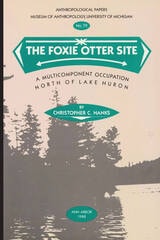
The Foxie Otter Site
A Multicomponent Occupation North of Lake HuronChristopher C. Hanks
University of Michigan Press, 1988
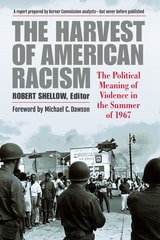
The Harvest of American Racism
The Political Meaning of Violence in the Summer of 1967Robert Shellow
University of Michigan Press, 2018
In the summer of 1967, in response to violent demonstrations that rocked 164 U.S. cities, the National Advisory Commission on Civil Disorders, a.k.a. the Kerner Commission, was formed. The Commission sought reasons for the disturbances, including the role that law enforcement played. Chief among its research projects was a study of 23 American cities, headed by social psychologist Robert Shellow. An early draft of the scientists’ analysis, titled “The Harvest of American Racism: The Political Meaning of Violence in the Summer of 1967,” provoked the Commission’s staff in November 1967 by uncovering political causes for the unrest; the team of researchers was fired, and the controversial report remained buried at the LBJ Presidential Library until now.
The first publication of the Harvest report half a century later reveals that many of the issues it describes are still with us, including how cities might more effectively and humanely react to groups and communities in protest. In addition to the complete text of the suppressed Harvest report, the book includes an introduction by Robert Shellow that provides useful historical context; personal recollections from four of the report’s surviving social scientists, Robert Shellow, David Boesel, Gary T. Marx, and David O. Sears; and an appendix outlining the differences between the unpublished Harvest analysis and the well-known Kerner Commission Report that followed it.
“The [Harvest of American Racism] report was rejected by Johnson administration functionaries as being far too radical—politically ‘unviable’… Social science can play an extremely positive role in fighting racial and other injustice and inequality, but only if it is matched with a powerful political will to implement the findings. That will has never come from within an American presidential administration—that will has only been forged in black and other radical communities’ movements for justice. The political power for change, as incremental as it has been, has come from within those communities. Washington responds, it does not lead."
—from the Foreword by Michael C. Dawson
The Iron Rose
The Extraordinary Life of Charlotte Ross, MDFred Edge
University of Manitoba Press, 1992

The Journals of Jeffery Amherst, 1757-1763, Volume 1
The Daily and Personal JournalsRobert J. Andrews
Michigan State University Press, 2014

The Journals of Jeffery Amherst, 1757-1763, Volume 2
A Dictionary of People, Places, and ShipsRobert J. Andrews
Michigan State University Press, 2014
The Literary Voices of Winnifred Eaton
Redefining Ethnicity and AuthenticityCole, Jean Lee
Rutgers University Press, 2002
Eaton attempted to disguise her Chinese heritage by writing under a hypothetically Japanese pen name. In legal documents, she usually claimed a "white" racial identity. In her fiction, Eaton portrayed Japanese, Chinese, Irish, and American characters, relying on the accepted stereotypes of the day. Jean Lee Cole shows that the many voices Eaton adopted show her deep preoccupations with "American" identity as a whole. The author attempts to reconcile all of these "voices," examining how Eaton survived in a climate hostile to minority writers in the early twentieth century, and how her seemingly anomalous works conjoin Asian American and American literary history.
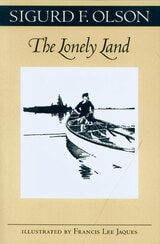
The Lonely Land
Sigurd F. Olson
University of Minnesota Press, 1997
"The lonely land lies a thousand miles northwest of Lake Superior in upper Saskatchewan. Here the Churchill River, famed water trail of such early voyageurs as the Hudson’s Bay fur traders, flows in a wandering course through one of the last great wildernesses of the continent. For 500 miles, the author and five Canadian friends retraced the trail of the voyageurs down the Churchill and the Sturgeon Weir rivers to the Saskatchewan. Sigurd F. Olson has added page after page to the lasting literature of the canoe, and the illustrations by Francis Lee Jaques, the canoe-country artist supreme, perfectly complement the text. Mr. Olson writes sensitively but also straight-forwardly, without heroics."—New York Times Book Review
"His love for the untouched wild and camaraderie of his fellow canoeists shine through in this classic trip story."—Explore Magazine

The Making and Meaning of Hospital Policy in the United States and Canada
Terry Boychuk
University of Michigan Press, 1999
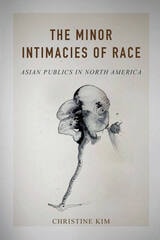
The Minor Intimacies of Race
Asian Publics in North AmericaChristine Kim
University of Illinois Press, 2016
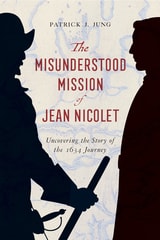
The Misunderstood Mission of Jean Nicolet
Uncovering the Story of the 1634 JourneyPatrick J. Jung
Wisconsin Historical Society Press, 2018
In more recent decades, historians have pieced together a story that is not only more likely but more complicated and interesting. Patrick Jung synthesizes the research about Nicolet and his superior Samuel de Champlain, whose diplomatic goals in the region are crucial to understanding this much misunderstood journey across the Great Lakes. Additionally, historical details about Franco-Indian relations and the search for the Northwest Passage provide a framework for understanding Nicolet’s famed mission.
The New Buffalo
The Struggle for Aboriginal Post-Secondary Education in CanadaBlair Stonechild
University of Manitoba Press, 2006
The Ojibwa of Western Canada 1780-1870
Laura Peers
University of Manitoba Press, 1994
The western Ojibwa are descendants of Ojibwa who migrated from around the Great Lakes in the late 18th century. This was an era of dramatic change. Between 1780 and 1870, they survived waves of epidemic disease, the rise and decline of the fur trade, the depletion of game, the founding of non-Native settlement, the loss of tribal lands, and the government's assertion of political control over them. As a people who emerged, adapted, and survived in a climate of change, the western Ojibwa demonstrate both the effects of historic forces that acted upon Native peoples, and the spirit, determination, and adaptive strategies that the Native people have used to cope with those forces. This study examines the emergence of the western Ojibwa within this context, seeing both the cultural changes that they chose to make and the continuity within their culture as responses to historical pressures.
The Ojibwa of Western Canada differs from earlier works by focussing closely on the details of western Ojibwa history in the crucial century of their emergence. It is based on documents to which pioneering scholars did not have access, including fur traders' and missionaries' journals, letters, and reminiscences. Ethnographic and archaeological data, and the evidence of material culture and photographic and art images, are also examined in this well-researched and clearly written history.
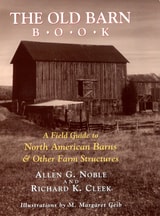
The Old Barn Book
A Field Guide to North American Barns & Other Farm StructuresNoble, Allen G
Rutgers University Press, 1996
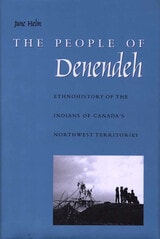
The People of Denendeh
Ethnohistory of the Indians of Canada's Northwest TerritoriesJune Helm
University of Iowa Press, 2000
Helm begins with a broad-ranging, stimulating overview of the social organization of hunter-gatherer peoples of the world, past and present, that provides a background for all she has learned about the Dene. The chapters in part 1 focus on community and daily life among the Mackenzie Dene in the middle of the twentieth century. After two historical overview chapters, Helm moves from the early years of the twentieth century to the earliest contacts between Dene and white culture, ending with a look at the momentous changes in Dene-government relations in the 1970s. Part 3 considers traditional Dene knowledge, meaning, and enjoyments, including a chapter on the Dogrib hand game. Throughout, Helm's encyclopedic knowledge combines with her personal interactions to create a collection that is unique in its breadth and intensity.
The Peoples Clearance
Highland Emigration to British North America, 1770-1815J.M. Bumsted
University of Manitoba Press, 1982
The Politics of the Canoe
Bruce Erickson
University of Manitoba Press, 2021
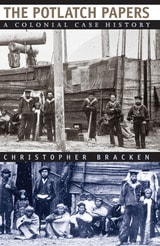
The Potlatch Papers
A Colonial Case HistoryChristopher Bracken
University of Chicago Press, 1997
However, as Christopher Bracken shows in this elegantly argued work, the potlatch was in fact invented by the nineteenth-century Canadian law that sought to destroy it. In addition to giving the world its own potlatch, the law also generated a random collection of "potlatch papers" dating from the 1860s to the 1930s. Bracken meticulously analyzes these documents—some canonical, like Franz Boas's ethnographies, others unpublished and little known—to catch a colonialist discourse in the act of constructing fictions about certain First Nations and then deploying those fictions against them. Rather than referring to objects that already exist, the "potlatch papers" instead gave themselves something to refer to; a mirror in which to observe not "the Indian," but "the European."

The Quality Infrastructure
Measuring, Analyzing, and Improving Library ServicesSarah Anne Murphy
American Library Association, 2013
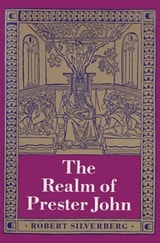
The Realm Of Prester John
Robert Silverberg
Ohio University Press, 1996
In this modern account of the genesis of a great medieval myth, celebrated science fiction author Robert Silverberg’s explores the mysterious origins of Prester John, the astonishing Christian potentate of the East.
Prester John was a legendary figure who cast a powerful spell over Latin Christendom for almost five centuries. Rumors of the warrior-king-prelate’s fabulous realms first reached Europe in the eleventh century and quickly assumed an exalted status alongside such fabled wonders as El Dorado, The Fountain of Youth, and the Holy Grail.
The defeat of a Moslem Turkish tribe by a Buddhist Chinese warlord seems to have been the unlikely historical nugget around which the Prester John myth grew, but contributions to this strange saga have also been traced all around the globe to the Apostle Thomas' apocryphal preaching in India, to the actual existence of small colonies of Nestorian schismatics in central Asia, and even to Genghis Khan.
The Resurgence of Conservatism in Anglo-American Democracies
Barry Cooper, Allan Kornberg, and William Mishler, eds.
Duke University Press, 1987
The Sandy Ridge and Halstead Paleo-Indian Sites
Unifacial Tool Use and Gainey Phase Definition in South-Central OntarioLawrence J. Jackson with a foreword by Henry T. Wright and phytolith analysis by Anita Buehrle
University of Michigan Press, 1998
The Search for a Socialist El Dorado
Finnish Immigration to Soviet Karelia from the United States and Canada in the 1930sAlexey Golubev and Irina Takala
Michigan State University Press, 2014
The Showman and the Ukrainian Cause
Folk Dance, Film, and the Life of Vasile AvramenkoOrest T. Martynowych
University of Manitoba Press, 2014
The Siege of Fort William Henry
A Year on the Northeastern FrontierBen Hughes
Westholme Publishing, 2012
Immortalized in The Last of the Mohicans, the True Story of a Pivotal Battle in the British and French War for the North American Continent
The opening years of the French and Indian War were disastrous for the British. In 1755 General Braddock’s troops were routed at the Battle of Monongahela and by the middle of 1756 Fort Oswego on Lake Ontario had fallen. Hindered by quarrelsome provincial councils, incompetent generals, and the redcoats’ inability to adapt to wilderness warfare, Britain was losing the war. In 1757 the 35th Regiment of Foot stepped into the breach. A poorly trained assortment of conscripts, old soldiers, and convicted criminals led by Lieutenant Colonel George Monro, the regiment was destined to take center stage in the most controversial event of the war. Fort William Henry on the southern shore of New York’s Lake George was a key fortification supporting British interests along the frontier with French America. Monro and his regiment occupied the fort in the spring of 1757 while Britain planned its attack on the key French fortress at Louisbourg, Nova Scotia. Learning that most of Britain’s military resources were allocated to Louisbourg, the French launched a campaign along the weakened frontier. French Commander Louis-Joseph de Montcalm and his American Indian allies laid siege to Fort William Henry; Monro could not hold out and was forced to surrender. As part of the terms, the British regiment, colonial militia, and their camp followers would be allowed safe passage to nearby Fort Edward. The French watched in horror, however, as their Indian allies attacked the British column after it left the fort, an episode that sparked outrage and changed the tactics of the war.
Seen through the eyes of participants such as Louis Antoine de Bougainville, a scholarly young aide-de-camp, Jabez Fitch, an amiable Connecticut sergeant, and Kisensik, a proud Nipissing chief whose father once met Louis XIV in the marbled halls of Versailles, The Siege of Fort William Henry: A Year on the Northeastern Frontier uses contemporary newspaper reports, official documents, private letters, and published memoirs to bring the narrative to life. From Indian councils on the banks of the Saint Lawrence River and bustling military camps in northern New York to the narrative’s bloody denouement on the shores of Lake George, the reader is immersed in the colorful, yet brutal world of eighteenth-century northeastern America.
The Sounds of Ethnicity
Listening to German North America, 1850 - 1914Barbara Lorenzkowski
University of Manitoba Press, 2010

The Stone Angel
Margaret Laurence
University of Chicago Press, 1993
In The Stone Angel, Hagar Shipley, age ninety, tells the story of her life, and in doing so tries to come to terms with how the very qualities which sustained her have deprived her of joy. Mingling past and present, she maintains pride in the face of senility, while recalling the life she led as a rebellious young bride, and later as a grieving mother. Laurence gives us in Hagar a woman who is funny, infuriating, and heartbreakingly poignant.
"This is a revelation, not impersonation. The effect of such skilled use of language is to lead the reader towards the self-recognition that Hagar misses."—Robertson Davies, New York Times
"It is [Laurence's] admirable achievement to strike, with an equally sure touch, the peculiar note and the universal; she gives us a portrait of a remarkable character and at the same time the picture of old age itself, with the pain, the weariness, the terror, the impotent angers and physical mishaps, the realization that others are waiting and wishing for an end."—Honor Tracy, The New Republic
"Miss Laurence is the best fiction writer in the Dominion and one of the best in the hemisphere."—Atlantic
"[Laurence] demonstrates in The Stone Angel that she has a true novelist's gift for catching a character in mid-passion and life at full flood. . . . As [Hagar Shipley] daydreams and chatters and lurches through the novel, she traces one of the most convincing—and the most touching—portraits of an unregenerate sinner declining into senility since Sara Monday went to her reward in Joyce Cary's The Horse's Mouth."—Time
"Laurence's triumph is in her evocation of Hagar at ninety. . . . We sympathize with her in her resistance to being moved to a nursing home, in her preposterous flight, in her impatience in the hospital. Battered, depleted, suffering, she rages with her last breath against the dying of the light. The Stone Angel is a fine novel, admirably written and sustained by unfailing insight."—Granville Hicks, Saturday Review
"The Stone Angel is a good book because Mrs. Laurence avoids sentimentality and condescension; Hagar Shipley is still passionately involved in the puzzle of her own nature. . . . Laurence's imaginative tact is strikingly at work, for surely this is what it feels like to be old."—Paul Pickrel, Harper's
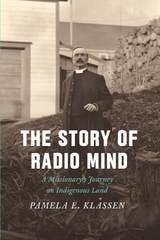
The Story of Radio Mind
A Missionary's Journey on Indigenous LandPamela E. Klassen
University of Chicago Press, 2018
Following Du Vernet’s journey westward from Toronto to Ojibwe territory and across the young nation of Canada, Pamela Klassen examines how contests over the mediation of stories—via photography, maps, printing presses, and radio—lucidly reveal the spiritual work of colonial settlement. A city builder who bargained away Indigenous land to make way for the railroad, Du Vernet knew that he lived on the territory of Ts’msyen, Nisga’a, and Haida nations who had never ceded their land to the onrush of Canadian settlers. He condemned the devastating effects on Indigenous families of the residential schools run by his church while still serving that church. Testifying to the power of radio mind with evidence from the apostle Paul and the philosopher Henri Bergson, Du Vernet found a way to explain the world that he, his church and his country made.
Expanding approaches to religion and media studies to ask how sovereignty is made through stories, Klassen shows how the spiritual invention of colonial nations takes place at the same time that Indigenous peoples—including Indigenous Christians—resist colonial dispossession through stories and spirits of their own.
The Suburb of Dissent
Cultural Politics in the United States and Canada during the 1930sCaren Irr
Duke University Press, 1998
Irr highlights works by Richard Wright, John Dos Passos, Nathanael West, and others to uncover the complex relationship between American anti-communism and communist anti-Americanism. In an unprecedented move, she extends her inquiry to the work of Canadian intellectuals such as Dorothy Livesay and Hugh MacLennan to reveal the important yet overlooked fact that the territory at the border of the United States and Canada provided a vital contact zone and transnational “home” for leftist thinkers. Attending to intersections of race, ethnicity, and gender, Irr illustrates the ways dissenting writers made culture actively respond to the political crises of the Great Depression and questioned the nature of what it means to be “American.”
Drawing on insights from postcolonial and American studies and taking into account the intellectual and cultural dimensions of leftist politics, The Suburb of Dissent is the first study of the 1930s to bring together U.S. and Canadian writings. In doing so, it reveals how the unique culture of the left contributed to North American history at this critical juncture and beyond.
The Terms of Our Surrender
Colonialism, Dispossession and the Resistance of the InnuElizabeth Cassell
University of London Press, 2021
Based on extensive fieldwork and oral history, The Terms of Our Surrender is a powerful critical appraisal of unceded indigenous land ownership in eastern Canada. Set against an ethnographic, historical, and legal framework, this book traces the myriad ways the Canadian state has evaded the 1763 Royal Proclamation that guaranteed First Nations people a right to their land and way of life.
Focusing on the Innu of Quebec and Labrador, whose land has been taken for resource extraction and development, this book strips back the law of fiduciary duty to its origins. The Terms of Our Surrender argues for the preservation of land ownership and positions First Nations people as natural land defenders amidst a devastating climate crisis. This volume offers a voice to the Innu people, detailing the spirituality practices, culture, and values that make it impossible for them to willingly cede their land.
This book is intended to bridge the gap in knowledge between legal practitioners and those working at the intersections of human rights, social work, and public policy. It offers a potent template for using the law to fight back against the indignities suffered by indigenous communities.

The Truth About Stories
A Native NarrativeThomas King
University of Minnesota Press, 2005
The University of Manitoba
An Illustrated HistoryJ.M. Bumsted
University of Manitoba Press, 2001
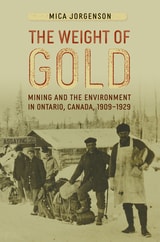
The Weight of Gold
Mining and the Environment in Ontario, Canada, 1909-1929Mica Jorgenson
University of Nevada Press, 2023
Mining in North America has long been criticized for its impact on the natural environment. Mica Jorgenson’s The Weight of Gold explores the history of Ontario, Canada’s rise to prominence in the gold mining industry, while detailing a series of environmental crises related to extraction activities. In Ontario in 1909, the discovery of exceptionally rich hard rock gold deposits in the Abitibi region in the north precipitated industrial development modeled on precedents in Australia, South Africa, and the United States. By the late 1920s, Ontario’s mines had reached their maturity, and in 1928, Minister of Mines Charles McRae called Canada “the mineral treasure house to [the] world.”
Mining companies increasingly depended upon their ability to redistribute the burdens of mining onto surrounding communities—a strategy they continue to use today—both at home and abroad. Jorgenson connects Canadian gold mining to its international context, revealing that Ontario’s gold mines informed extractive knowledge which would go on to shape Canada’s mining industry over the next century.
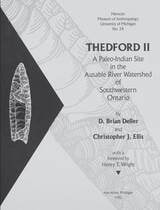
Thedford II
A Paleo-Indian Site in the Ausable River Watershed of Southwestern OntarioD. Brian Deller and Christopher J. Ellis with a foreword by Henry T. Wright
University of Michigan Press, 1992

Therapeutic Nations
Healing in an Age of Indigenous Human RightsDian Million
University of Arizona Press, 2013
Million contends that nation-state relations are influenced by a theory of trauma ascendant with the rise of neoliberalism. Such use of trauma theory regarding human rights corresponds to a therapeutic narrative by Western governments negotiating with Indigenous nations as they seek self-determination.
Focusing on Canada and drawing comparisons with the United States and Australia, Million brings a genealogical understanding of trauma against a historical filter. Illustrating how Indigenous people are positioned differently in Canada, Australia, and the United States in their articulation of trauma, the author particularly addresses the violence against women as a language within a greater politic. The book introduces an Indigenous feminist critique of this violence against the medicalized framework of addressing trauma and looks to the larger goals of decolonization. Noting the influence of humanitarian psychiatry, Million goes on to confront the implications of simply dismissing Indigenous healing and storytelling traditions.
Therapeutic Nations is the first book to demonstrate affect and trauma’s wide-ranging historical origins in an Indigenous setting, offering insights into community healing programs. The author’s theoretical sophistication and original research make the book relevant across a range of disciplines as it challenges key concepts of American Indian and Indigenous studies.
Thomas Scott's Body
And Other Essays on Early Manitoba HistoryJ.M. Bumsted
University of Manitoba Press, 2000
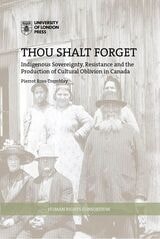
Thou Shalt Forget
Indigenous sovereignty, resistance and the production of cultural oblivion in CanadaPierrot Ross-Tremblay
University of London Press, 2019