475 books match the query 'Catholic' and 126 start with t
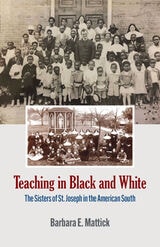
cover of Teaching in Black and White: The Sisters of St. Joseph in the American South

Teaching in Black and White

The Sisters of St. Joseph in the American South

Barbara E. Mattick

Catholic University of America Press, 2022
Teaching in Black and White: The Sisters of St. Joseph in the American South discusses the work of the Sisters of St. Joseph of (the city of) St. Augustine, who came to Florida from France in 1866 to teach newly freed blacks after the Civil War, and remain to this day. It also tells the story of the Sisters of St. Joseph of Georgia, who sprang from the motherhouse in St. Augustine. A significant part of the book is a comparison of the Sisters of St. Josephs’ work against that of their major rivals, missionaries from the Protestant American Missionary Association. Using letters the Sisters wrote back to their motherhouse in France, the book provides rare glimpses into the personal and professional (pun intended) lives of these women religious in St. Augustine and other parts of Florida and Georgia, from the mid-nineteenth century through the era of anti-Catholicism in the early twentieth century South. It carries the story through 1922, the end of the pioneer years of the Sisters of St. Josephs’ work in Florida, and the end of Sisters of St. Joseph of Georgia’s existence as a distinct order. Through the lenses of Catholicism, Florida and Southern history, gender, and race, the book addresses the Protestant concept of domesticity and how it was reinforced in Catholic terms by women who seemingly defied the ideal. It also relates the Sisters’ contributions in shaping life in the South during Reconstruction as they established elite academies and free schools, created orphanages, ministered to all during severe yellow fever epidemics, and fought the specter of anti-Catholicism as it crept across the rural regions of the country. To date, little has been written about Catholics in the South, much less the women religious who served there. This book helps to fill that gap. Teaching in Black and White provides rare glimpses into the personal and professional lives of women religious in Florida and Georgia, from the mid-nineteenth to early twentieth-century.
[more]
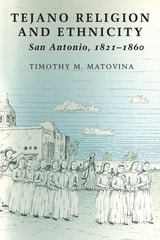
cover of Tejano Religion and Ethnicity: San Antonio, 1821-1860

Tejano Religion and Ethnicity

San Antonio, 1821-1860

By Timothy M. Matovina

University of Texas Press, 1995

While the flags of Spain, Mexico, the Republic of Texas, and the United States successively flew over San Antonio, its Tejano community (Texans of Spanish or Mexican descent) formed a distinct ethnic identity that persisted despite rapid social and cultural changes. In this pioneering study, Timothy Matovina explores the central role of Tejano Catholicism in forging this unique identity and in binding the community together.

The first book-length treatment of the historical role of religion in a Mexican-origin community in the United States, this study covers three distinct periods in the emergence of Tejano religious and ethnic identity: the Mexican period (1821-1836), the Texas Republic (1836-1845), and the first decade and a half after annexation into the United States (1845-1860). Matovina's research demonstrates how theories of unilateral assimilation are inadequate for understanding the Tejano community, especially in comparison with the experiences of European immigrants to the United States.

As residents of the southwestern United States continue to sort out the legacy of U.S. territorial expansion in the nineteenth century, studies like this one offer crucial understanding of the survival and resilience of Latino cultures in the United States. Tejano Religion and Ethnicity will be of interest to a broad popular and scholarly audience.
[more]
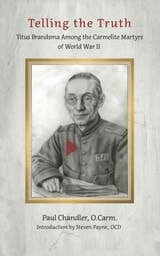
cover of Telling the Truth: Titus Brandsma Among the Carmelite Martyrs of World War II

Telling the Truth

Titus Brandsma Among the Carmelite Martyrs of World War II

Paul Chandler

Catholic University of America Press, 2026
Titus Brandsma is best known for courageously speaking out against the ideology of National Socialism and for defending the freedom of the Catholic press to refuse their propaganda. Indeed, it was his activities as a Catholic journalist and on behalf of Catholic journalism that placed him in the crosshairs of the Nazi authorities. But his imprisonment and eventual death in the concentration camp of Dachau was preceded by a notable academic career and a life of tireless service. As Paul Chandler reveals in this ground-breaking volume, the torture and “experiments” that he suffered in the infirmary at Dachau included shocking examples of sexual abuse, according to the infirmary nurse who administered the fatal injection, whose eye-witness account previous biographers have glossed over. For the first time, Chandler provides an English translation of her complete testimony. Additional material reminds us of other major Carmelite “witnesses to truth” during World War II, including St. Edith Stein (Teresa Benedicta of the Cross) and Père Jacques Bunel. All of them show that authentic Carmelite and Christian spirituality is not something abstract and ethereal, but has social consequences, and that mystical prayer must express itself in prophetic words and actions.
[more]
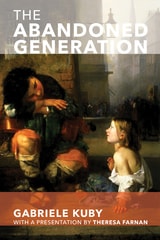
cover of The Abandoned Generation

The Abandoned Generation

Gabriele Kuby

St. Augustine's Press, 2021

A broken family throws formidable stumbling blocks onto the path of life that a society as a whole must traverse. But the stones under the feet of the children in these situations are the most hurtful and most in need of redress. Gabriele Kuby answers the call and does so with an acute sense of responsibility. As a child of divorce and later divorcee, Kuby speaks to herself when she urges the men and women of her generation to consider how failing as spouses we fail as parents, and as such cause the most trouble for our children. 

Reading Kuby’s analysis of cultural, sociological and biological data, the danger is clear and present. Yet Kuby asserts that, generally, our plight goes unnoticed and is veiled from our eyes. We need to see children for who and what they really are to us, to the family, and society at large. In the words of Fulton Sheen, “Children play a redeemer role in the family. The represent the victory of love over the insatiable ego. They symbolize the defeat of selfishness and the triumph of giving love.” Tragically, children are increasingly less a part of Western culture. This leaves the family, in the best case scenario, an artifact, and in the worst case, a casualty. 

The topics addressed by Kuby cover towering influences in postmodern family life: Gender politics, the abortion mentality, daycare (“Socialism 2.0”), premature stress, rights of children, digital distractions, pornography, and divorce. A native German, Kuby’s work is, heartbreakingly, as relevant to American society as her own.  This European perspective drives home the urgent need to recognize our situation as global and embedded, and one that requires more than political mobilization of mainstream efforts and responses. What really is good and normal, and how to we realize it? Listen to the heartstrings that yearn for true knowledge of oneself, Kuby implores, of God, and how in the surprise of God’s mercy we are guided through life. Kuby backs up this invitation to personal conversion and betterment with hard data.
[more]
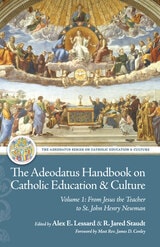
cover of The Adeodatus Handbook on Catholic Education and Culture: Volume 1: From Jesus the Teacher to St. John Henry Newman

The Adeodatus Handbook on Catholic Education and Culture

Volume 1: From Jesus the Teacher to St. John Henry Newman

Alex E. Lessard

Catholic University of America Press, 2025
Catholic education stands in need of renewal, for it too has experienced the consequences of the rupture of faith and reason in the modern period. Secularism affects Catholic schools as well as public ones when faith remains confined solely to a religion class or the celebration of the Mass. Our past provides a model of integration: the unity of divine revelations and the liberal arts and a life of wisdom that pursues what is truly highest. Modern people too often settle for less—little comforts and distractions—while the theologians, philosophers, and educators of the past spur us on to stop at nothing less than God’s invitation to enter his divine life. This first volume of the Adeodatus Handbook seeks to provide inspiration to return to the central vision of Catholic education: an integrated approach to the liberal arts that flows from God’s initiative toward us and is ordered toward eternal union with him. The essays of this volume unfold the narrative offered in this introduction in more detail. We consider them to be the most essential figures who have established the Catholic approach to education. Two of them, Plato and Aristotle, were pagan authors who formed the philosophical basis of the Catholic approach. The others, flowing from the Incarnation of the Son of God, appropriated the truths of nature contemplated by philosophy and drew them into a sacramental synthesis with the truths of divine revelation. There can be no genuine Christian education that does help the student to contemplate the whole of reality and to live a life of wisdom, rooted in the virtues that perfect human nature while ultimately receptive of the gifts and fruits of the Holy Spirit. The majority of the figures addressed in this volume are canonized saints, pointing us to the priority of holiness in Catholic education. Education serves the ultimate aim of human life: our perfect happiness in the beatific vision. To reach this, we need the support of mentors and friends. This requires the concrete embodiment of Christian community within the home and school. It can also, however, flow from our communion with the great sainted educators of our heritage. We have inherited their legacy, and with their prayers and support, we have been tasked with continuing in our own age. We will not be able to replicate their efforts, but with the grace and inspiration of the Holy Spirit, we can make our contribution in educating the youth, young adults, seminarians, and lay people of the Church of God.
[more]
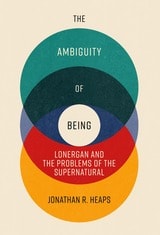
cover of The Ambuiguity of Being: Lonergan and the Problems of the Supernatural

The Ambuiguity of Being

Lonergan and the Problems of the Supernatural

Jonathan R. Heaps

Catholic University of America Press, 2024
The debate in Catholic theology over the relationship between the natural and the supernatural has only occasionally engaged with Bernard Lonergan’s philosophical and theological contributions on the topic. The Ambiguity of Being argues that more detailed engagement with Lonergan’s work implies an oversight in both the 20th- and 21st-century debates. The Ambiguity of Being argues the controversy has failed to notice how the problem of the natural and the supernatural is, in fact, two problems. The Ambiguity of Being takes both problems in their widest sense to be about action—both divine and human. The first problem asks how God can act in human action. A question for Christians at least since St. Augustine faced the Pelagian controversy, Lonergan retrieved what he understood to be St. Thomas Aquinas’ mature solution. It is a solution gathering together a whole series of theological and philosophical developments into a subtle metaphysical theory of divine and human cooperation. But the recent debates have resituated this problem (and various interpretations of St. Thomas’s solution to it) in a modern world with modern concerns about culture and politics for the sake of answering a second, intrinsically related, but really distinct question: what is God doing in human action? Ambiguity finds that the recent controversy almost always finds participants attempting to deduce an answer to the second, modern problem from the medieval, metaphysical Thomist solution to the first. By contrast, The Ambiguity of Being argues at length the modern problem cannot be reduced to, nor an answer deduced from its medieval, metaphysical partner because the modern problem of the supernatural—what is God doing in human action?—is a hermeneutical problem that calls out for a hermeneutical answer. The Ambiguity of Being sketches a heuristic for what a fully adequate answer to this question would require, suggesting a radical re-conception of modern theology’s scope.
[more]
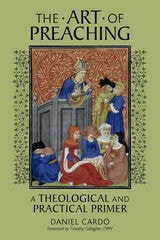
cover of The Art of Preaching: A Theological and Practical Primer

The Art of Preaching

A Theological and Practical Primer

Daniel Cardo

Catholic University of America Press, 2021
The growing awareness of the importance of preaching is a sign of our times. In the past decades, conscious that a renewal of preaching is essential for a renewed evangelization, many seminaries have implemented homiletic courses. However, there is still a real limitation of good and systematic resources in order to learn the theological depth and practical elements of the art of preaching. The Art of Preaching: A Theological and Practical Primer aims to fill that gap. It explores the theological understanding of the homily, lessons from classical and contemporary rhetoric, the relevance of preaching for the life of the Church, highlighting recent teachings of the Magisterium, and it presents the incarnation as the foundation for preaching, understood as an essential aspect of the priestly life and mission. This primer also offers a simple and effective method for the preparation and delivery of homilies, illustrating this by the example of brilliant preachers and exploring the idea of preaching as locus theologicus, i.e., the privileged place for the exercise of theology today. It is in deepening in the value and importance of preaching that theology can be renewed as a living and essential part of the daily life of priests. Seeing the homily not as a burden but as an occasion to fulfill the priestly identity will offer the opportunity to embrace the preparation for preaching as a key for unity among the many tasks and demands of pastoral life. In the homily prayer, study, and work come together. The Art of Preaching will also provide a selection of homilies from the great preachers of the Church, organized chronologically, with brief introductions and commentaries that highlight what those homilies teach us for our preaching today. Only learning from the best preachers can we hope to preach effectively in our times.
[more]
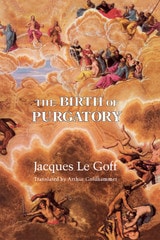
cover of The Birth of Purgatory

The Birth of Purgatory

Jacques Le Goff

University of Chicago Press, 1984
In The Birth of Purgatory, Jacques Le Goff, the brilliant medievalist and renowned Annales historian, is concerned not with theological discussion but with the growth of an idea, with the relation between belief and society, with mental structures, and with the historical role of the imagination. Le Goff argues that the doctrine of Purgatory did not appear in the Latin theology of the West before the late twelfth century, that the word purgatorium did not exist until then. He shows that the growth of a belief in an intermediate place between Heaven and Hell was closely bound up with profound changes in the social and intellectual reality of the Middle Ages. Throughout, Le Goff makes use of a wealth of archival material, much of which he has translated for the first time, inviting readers to examine evidence from the writings of great, obscure, or anonymous theologians.
[more]
cover of The Book of Before and After: The Liturgy of the Hours of the Church of the East

The Book of Before and After

The Liturgy of the Hours of the Church of the East

Andrew Younan

Catholic University of America Press, 2025
The Book of Before & After is the traditional name given to the book of commonly-used portions of the liturgy of the hours of the Church of the East (the branches of which are now the Chaldean Catholic Church, the Assyrian Church of the East, the Ancient Apostolic Assyrian Church of the East, and the Malabar Catholic Church). This volume will present, for the first time, a complete English translation (from the original Aramaic/Syriac) of all the Ordinaries and Commons of the Liturgy of the Hours used by all the Churches of this Tradition. It will also include a complete translation of the Psalter as included in the liturgical books (with antiphons and prayers between sets of Psalms), the full collection of the famous “Martyr Hymns,” and extensive selections of the Propers for each week of the Liturgical Year. Finally, the volume will also include translations of the Introductions written by the various Chaldean and Assyrian Patriarchs who published editions of the Hudhra (the full liturgy of the hours) over the past two centuries, as well as a comprehensive Introductory Essay by Younan. Many of the hymns translated in this volume will be singable according to their original melody.
[more]
cover of The Book of Divine Works

The Book of Divine Works

Nathaniel M. St. Hildegard of Bingen

Catholic University of America Press, 2018

Completed in 1173, The Book of Divine Works (Liber Divinorum Operum) is the culmination of the Visionary’s Doctor’s theological project, offered here for the first time in a complete and scholarly English translation. The first part explores the intricate physical and spiritual relationships between the cosmos and the human person, with the famous image of the universal Man standing astride the cosmic spheres. The second part examines the rewards for virtue and the punishments for vice, mapped onto a geography of purgatory, hellmouth, and the road to the heavenly city. At the end of each Hildegard writes extensive commentaries on the Prologue to John’s Gospel (Part 1) and the first chapter of Genesis (Part 2)—the only premodern woman to have done so. Finally, the third part tells the history of salvation, imagined as the City of God standing next to the mountain of God’s foreknowledge, with Divine Love reigning over all.
[more]
cover of The Book of Hours of the Armenian Church Zamagirk: English Translation, Contexts and Perspectives

The Book of Hours of the Armenian Church Zamagirk

English Translation, Contexts and Perspectives

Michael Daniel Findikyan

Catholic University of America Press, 2027
The Book of Hours of the Armenian Church (Žamagirk‘): English Translation, Contexts, and Perspectives offers the first critically grounded English rendering of one of the central liturgical books of the Armenian Christian tradition—and, as such, the first complete translation of this text into any language. Long central to the daily cycle of prayer, the Žamagirk‘ preserves a rich and layered inheritance reaching back to the formative centuries of Christian worship, even as it bears the marks of later historical development. Prepared by a leading scholar of Armenian liturgy, with broader expertise in eastern Christian liturgical traditions, the translation attends closely to the structure, language, and internal logic of the text. It is designed not only to make the Žamagirk‘ accessible to English-speaking readers, but also to reflect, as faithfully as possible, the texture and rhythm of the original, and will be of interest not only to scholars but also to those who wish to engage the text for devotional use. The translation is accompanied by an extensive analytical study that situates the work within its historical, theological, and liturgical contexts. Particular attention is given to the distinctive features of the Armenian Liturgy of the Hours: its organization of psalmody and hymnography, its unique combinations of biblical and poetic materials, and its preservation of elements that point to early Jerusalemite practice. At the same time, the study explores the ways in which the tradition has remained dynamic, incorporating new layers while retaining older forms in often surprising configurations. More than a reference work, this volume opens a window onto the spiritual world embodied in the Armenian daily office, a world marked by a striking interplay of solemnity and lyricism, scriptural depth and poetic imagination, penitential gravity and buoyant hope. It will be of interest to scholars and students of liturgy, historians of Christianity, and all readers seeking to encounter one of the great yet comparatively little-known traditions of Christian prayer.
[more]
cover of The Business Francis Means: Understanding the Pope's Message on the Economy

The Business Francis Means

Understanding the Pope's Message on the Economy

Martin Schlag

Catholic University of America Press, 2017

Pope Francis, generally speaking, has thus far chosen to concentrate his papacy on social justice issues, as opposed to doctrinal or liturgical issues. This has led to Francis being hailed as a hero to many on the left, while it has made some conservative supporters of St. John Paul II and Pope Emeritus Benedict XVI disappointed and uncomfortable, even as they love and appreciate his person and gestures of mercy and compassion. Some find his teachings difficult to embrace, especially those concerning business and the economy. Pope Francis has spoken of building bridges as part of what it is to be Christian, but aspects of his message seem to be just constructing walls between the Holy Father and groups of the faithful.

The Business Francis Means aims to break through these walls, showing that Pope Francis has something to say to all Christians. His message, taken as a whole, keeps us from dividing the “seamless garment” of Christ: he reminds the conservatives of the problems of inequality and poverty, and the liberals that social justice is not enough – the Church is the bride of Christ, not a social institution or an NGO.

Monsignor Martin Schlag summarizes and explains the message of Pope Francis on business and the economy in this compact volume. The Business Francis Means will be of great interest to the Catholic layperson, especially one involved in political or economic life.
[more]
cover of The Catholic Church and the Genesis of the Arab-Israeli Conflict: Vatican Diplomacy and Interfaith Relations During the Interwar Period, 1918-1939

The Catholic Church and the Genesis of the Arab-Israeli Conflict

Vatican Diplomacy and Interfaith Relations During the Interwar Period, 1918-1939

Bernhard Kronegger

Catholic University of America Press, 2026
This book delves into the history of how the Catholic Church’s leadership, both in the Vatican and in the Latin Patriarchate of Jerusalem, responded to the emerging conflict between Zionism and Palestinian nationalism for the future of the Holy Land. Beginning with the Balfour Declaration of 1917 and the conquest of Jerusalem by the Allied forces, it traces how the popes, Benedict XV (1914-1922) as well as Pius XI (1922-1939), anxiously and skeptically regarded British designs for what would become Mandatory Palestine. Through the economic crisis of the late 1920s, the violent clashes of the Arab Revolt, and ending with the outbreak of the Second World War, it examines how the relationship between the local Catholic community and British government officials developed, from evictions and expropriations following wartime upheavals to a careful co-operation filled with mistrust and tensions. Likewise, it investigates how the escalating hostility and violence between the Jewish and Muslim sections of the population influenced the interreligious relations between them and Catholics. Based on research in the Vatican Archives, it offers novel perspectives on the shifting policies of the Vatican, the maneuvrings of European governments and the schemes of the Latin Patriarch of Jerusalem, Luigi Barlassina, to further their interests in the struggle for the future of the Holy Land.
[more]
cover of The Catholic Social Imagination: Activism and the Just Society in Mexico and the United States

The Catholic Social Imagination

Activism and the Just Society in Mexico and the United States

Joseph M. Palacios

University of Chicago Press, 2007

The reach of the Catholic Church is arguably greater than that of any other religion, extending across diverse political, ethnic, class, and cultural boundaries. But what is it about Catholicism that resonates so profoundly with followers who live under disparate conditions? What is it, for instance, that binds parishioners in America with those in Mexico? For Joseph M. Palacios, what unites Catholics is a sense of being Catholic—a social imagination that motivates them to promote justice and build a better world.

In The Catholic Social Imagination, Palacios gives readers a feeling for what it means to be Catholic and put one’s faith into action. Tracing the practices of a group of parishioners in Oakland, California, and another in Guadalajara, Mexico, Palacios reveals parallels—and contrasts—in the ways these ordinary Catholics receive and act on a church doctrine that emphasizes social justice. Whether they are building a supermarket for the low-income elderly or waging protests to promote school reform, these parishioners provide important insights into the construction of the Catholic social imagination. Throughout, Palacios also offers important new cultural and sociological interpretations of Catholic doctrine on issues such as poverty, civil and human rights, political participation, and the natural law.
[more]
cover of The Catholic Tradition

The Catholic Tradition

Thomas Langan

University of Missouri Press, 1998

In his Tradition and Authenticity in the Search for Ecumenic Wisdom, Thomas Langan argued that the close interaction of traditions in today's society calls for methodical critical appropriation of the beliefs fostered by the principal traditions. He also promised to demonstrate by example how such appropriation could be accomplished. In The Catholic Tradition, Langan successfully fulfills that vow by showing how a tradition—the Catholic—has shaped his own outlook.

In this comprehensive study, Langan examines the history of the Catholic Church and the origins of its teachings since the Church's conception. Although committed to the Catholic religion, Langan does not obscure the Church's failings as he lays out the fundamentals of the Catholic faith.

He provides insight into the great Christological councils, discusses the differences in the spiritualities of East and West, and portrays the crucial roles that the pope and bishops played during the Middle Ages. He incorporates the thought of Augustine, Aquinas, and medieval Catholicism as he traces the rise and decline of Christian Europe, the great issues raised by the reform: priesthood, the Eucharist, spirituality, and Church structure.

Satan has no greater triumph, Langan asserts, than when Catholics, who are recipients of the Good News of God's universal love, allow selections from their tradition to be turned into sectarianism and ideology. This balanced history of the Church as human reality faces such perversions squarely. But despite betrayals by its own across the centuries, the Catholic tradition, with its origin at Sinai, remains the oldest and largest extant religious institution.

In a last section Langan offers a unique overview of the church's present situation, its strengths and weaknesses, the new movement and the challenge of the "new evangelization."
[more]
cover of The Catholic and Manichaean Ways of Life

The Catholic and Manichaean Ways of Life

Saint Augustine

Catholic University of America Press, 1966

No description available
[more]
cover of The Challenge of Catholic-Jewish Theological Dialogue

The Challenge of Catholic-Jewish Theological Dialogue

Matthew Tapie

Catholic University of America Press, 2024
[more]
cover of The Charismatic Gymnasium: Breath, Media, and Religious Revivalism in Contemporary Brazil

The Charismatic Gymnasium

Breath, Media, and Religious Revivalism in Contemporary Brazil

Maria José de Abreu

Duke University Press, 2020
In The Charismatic Gymnasium Maria José de Abreu examines how Charismatic Catholicism in contemporary Brazil produces a new form of total power through a concatenation of the breathing body, theology, and electronic mass media. De Abreu documents a vast religious respiratory program of revival popularly branded as “the aerobics of Jesus.” Pneuma—the Greek term for air, breath, and spirit—is central to this aerobic program, whose goal is to labor on the athletic elasticity of spirit. Tracing the rhetoric, gestures, and spaces that together constitute this new theological community, de Abreu exposes the articulating forces among evangelical Christianity, neoliberal logics, and the rise of right-wing politics. By calling attention to how an ethics of pauperism vitally intersects with the neoliberal ethos of flexibility, de Abreu shows how paradoxes do not hinder but expand the Charismatic gymnasium. The result, de Abreu demonstrates, is the production of a fluid form of totalitarianism and Christianity in Brazil and beyond.
[more]
cover of The Christian Philosophy of Jacques Maritain

The Christian Philosophy of Jacques Maritain

Jason L.A. West

Catholic University of America Press, 2025
A study of the Christian philosophy of Jacques Maritain (1882-1973), an influential, creative, and prolific writer. He was widely recognized as one of the most prominent Catholic intellectuals during his own lifetime and was widely seen as a spokesman for the Thomistic revival. This study aims to present Maritain’s thought as a dynamic and coherent philosophy in its own right. This is the only book in English to present Maritain’s philosophy on the full range of topics upon which he wrote. It focusses on Maritain as a twentieth-century philosopher, rather than an interpreter of Aquinas. Accordingly, this book presents Maritain’s philosophy in its own context. Finally, this work is also attentive to the religious context of Maritain’s philosophy and highlights his overlooked contributions to theology and other areas of philosophy that are informed by his theological commitments, e.g. mysticism, ecclesiology, education and philosophy of history. Accordingly, The Christian Philosophy of Jacques Maritain aims at providing the reader with a comprehensive presentation of Maritain’s thought and a clear vision of his philosophy as a whole.
[more]
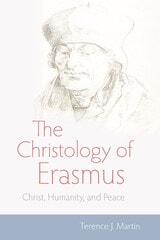
cover of The Christology of Erasmus: Christ, Humanity, and Peace

The Christology of Erasmus

Christ, Humanity, and Peace

Terence J. Martin

Catholic University of America Press, 2024
Nothing is more central to the religious thinking of Erasmus of Rotterdam than the reality of Christ—in his eyes, that supreme revelation of divine mercy embodied in the life of Jesus of Nazareth to which Christian scriptures variously testify, but also the divine presence undergirding that life-centering ethic of love and peace, what Erasmus calls the “philosophy of Christ.” The purpose of this book is to distill the Christological elements from his vast corpus in a manner that shows the range, coherence, and value of Erasmus’ thinking on Christological questions. While Erasmus works within the broad parameters of orthodox teaching, his critical skills with languages, accent on rhetoric in theology, keen sense of irony, appreciation for the limits of human knowledge, incipient sense of history, emphasis on the welfare of humanity, and passionate defense of peace, give his work a distinctive stamp and thereby make a singular contribution to the history of Christology. What Erasmus contributes to discussions of the divinity of Christ is a counsel of restraint in metaphysical speculation, an accent on the revelatory breadth of the eternal Word of God, and an invitation to think of Christ incarnate as the eloquent oration of God. But the central impulse of the Christology of Erasmus is the affirmation of the full incarnation of Christ in human existence, abstaining as much as possible from docetic insulation of the divine from the struggles of human experience, in order to highlight the redemptive capacity of Christ for the transformation of human life. With that, the ethical capstone of Erasmus’ reflections on Christ centers on the responsibility to imitate Christ’s love for others, and thus for advancing the cause of peace in personal and social life. This books adds the voice of this remarkable Catholic humanist to the history of theological discussions in the early modern era, while also restoring its rightful place in the broader history of Christology.
[more]
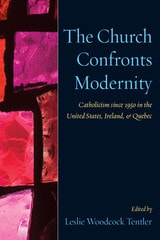
cover of The Church Confronts Modernity

The Church Confronts Modernity

Leslie Woodcock Tentler

Catholic University of America Press, 2007
The Church Confronts Modernity assesses the history of Roman Catholicism since 1950 in the United States, the Republic of Ireland, and the Canadian province of Quebec
[more]
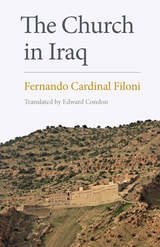
cover of The Church in Iraq

The Church in Iraq

Fernando Cardinal Filoni

Catholic University of America Press, 2017

The persecution of the church in Iraq is one of the great tragedies of the twenty-first century. In this short, yet sweeping account, Cardinal Filoni, the former Papal Nuncio to Iraq, shows us the people and the faith in the land of Abraham and Babylon, a region that has been home to Persians, Parthians, Byzantines, Mongols, Ottomans, and more. This is the compelling and rich history of the Christian communities in a land that was once the frontier between Rome and Persia, for centuries the crossroads of East and West for armies of invaders and merchants, and the cradle of all human civilization. Its unique cultural legacy has, in the past few years, been all but obliterated.

The Church in Iraq is both a diligent record and loving testimonial to a community that is struggling desperately to exist. Filoni guides the reader through almost two thousand years of history, telling the story of a people who trace their faith back to the Apostle Thomas. The diversity of peoples and churches is brought deftly into focus through the lens of their interactions with the papacy, but The Church in Iraq does not shy away from discussing the local political, ethnic, and theological tensions that have resulted in centuries of communion and schism. Never losing his focus on the people to whom this book is so clearly dedicated, Cardinal Filoni has produced a personal and engaging history of the relationship between Rome and the Eastern Churches. This book has much to teach its reader about the church in the near East. Perhaps its most brutal lesson is the ease with which such a depth of history and culture can be wiped away in a few short decades.
[more]
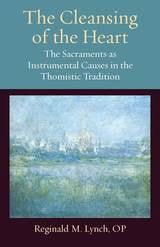
cover of The Cleansing of the Heart

The Cleansing of the Heart

Reginald Lynch

Catholic University of America Press, 2017

Recalling the Biblical and Patristic roots of the Church's sacramental identity, the Second Vatican Council calls the Church the 'visible sacrament' of that unity offered through Christ (LG 9). 'Sacrament' in this sense not only describes who the Church is, but what she does. In this regard, the Council Fathers were careful to establish a strong connection between the symbolic nature of the Church's sacraments and their effect on those who received them.

Reginald Lynch is concerned with the cleansing of the heart—a phrase borrowed from St. Augustine and employed by Aquinas, which describes the effects that natural elements such as water or bread have on the human person when taken up by the Church as sacramental signs. Aquinas' approach to sacramental efficacy is unique for its integration of diverse theological topics such as Christology, merit, grace, creation and instrumentality. While all of these topics will be considered to some extent, the primary focus of The Cleansing of the Heart is the sacraments understood as instrumental causes of grace. This volume provides the historical context for understanding the development of sacramental causality as a theological topic in the scholastic period, emphasizing the unique features of Aquinas' response to this question. Following this, relevant texts from Aquinas' early and later work are examined, noting Aquinas' development and integration of the idea of sacramental causality in his later work. The Cleansing of the Heart concludes by contrasting alternatives to Aquinas' theory of sacramental causality that subsequently emerged. The rise of humanism introduced many changes within rhetoric and philosophy of language that had a profound effect on some theologians during the Modern period. This book provides historical context for understanding the most prominent of these theories in contrast to Aquinas, and examines some of their theological implications.
[more]
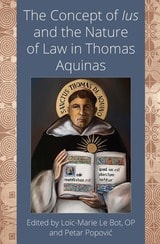
cover of The Concept of <i>Ius</i> and the Nature of Law in Thomas Aquinas

The Concept of <i>Ius</i> and the Nature of Law in Thomas Aquinas

Loic-Marie Le Bot, OP

Catholic University of America Press, 2025
This collection of essays constitutes the fruit of a scholarly conference held in Rome in April 2023, which was organized by the Pontifical University of Saint Thomas Aquinas, the Pontifical University of the Holy Cross, and the Angelicum Thomistic Institute. The essays offer a scholarly reflection on various historical and doctrinal aspects of Aquinas’s concept of ius, and on the extent to which this concept helps to illuminate his account of the nature of law, that is, of the juridical phenomenon. Each essay addresses, from the viewpoint of its specific topic, the implications of the Angelic Doctor’s description of ius as the object of justice, as presented in the Secunda secundae of his Summa theologiae (starting from question 57, article 1). Following Aquinas’s own insights, the focus on the virtue of justice is thus deemed crucial for understanding the essence or the ontological fabric of law. Justice is simultaneously analyzed as always remaining inherently connected to its moral and divine-salvific aspects. The volume is divided in three parts. The first part of the collection contains essays that are dedicated to the analysis of Aquinas’s concept of ius in a historical perspective. The second group of essays in this collection examine some further doctrinal and contextual issues pertinent to the essence of ius. Each attempt to elucidate the ontology of law should be supported by the aptitude of the resulting accounts of law’s nature to provide workable platforms for legal practices. This line of reasoning represents the rationale for the third part of this collection, which focuses on the matters of applying Aquinas’s concept of ius in systemic and practical legal settings of State law and canon law.
[more]
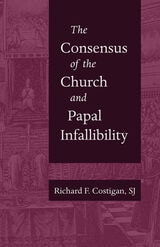
cover of The Consensus of the Church and Papal Infallibility: A Study in the Background of Vatican I

The Consensus of the Church and Papal Infallibility

A Study in the Background of Vatican I

Richard F. Costigan, S.J.

Catholic University of America Press, 2005
After a concise introduction that defines the two schools of theology, Richard Costigan examines the thought of nine major theologians on the subject: Bossuet, Tournely, Orsi, Ballerini, Bailly, Bergier, La Luzerne, Muzzarelli, and Perrone.
[more]
cover of The Correspondence of Theodoret of Cyrus: The Collectio Sirmondiana, Volume 4

The Correspondence of Theodoret of Cyrus

The Collectio Sirmondiana, Volume 4

John F. Theodoret of Cyrus

Catholic University of America Press, 2025
Volumes 4 and 5 of the Library of Early Christianity, The Correspondence of Theodoret of Cyrus: The Collectio Sirmondiana, present a text and translation of the largest of three collections of Theodoret’s letters that have come down to us (first edited by the Jesuit father Jacques Sirmond, Paris 1642). Though pastor of the remote see of Cyrus in Syria, Theodoret was one of the major teachers of the eastern Christian church of the late fourth and early fifth century. These 147 letters place before us the myriad concerns, both spiritual and secular, of a late-antique bishop: Theodoret expounds theological and moral issues for fellow churchmen, begs imperial officials for tax relief for local landowners, provides for the sustenance and safety of refugees from the Vandal war in Africa, thanks a friend for a gift of wine. The edition of the Greek text is the work of John Petruccione. A textual introduction explains the relationships among the manuscripts, and the critical notes the choices made where the text is uncertain. The historical / theological introduction is the work of István Pásztori-Kupán, one of the foremost expositors of the thought of Theodoret and of his Antiochene predecessors and contemporaries. Two maps locate for the reader the place names mentioned in the letters, and three indices (a Scriptural Index, General Index, and Index of Modern Authors) complement the notes attached to the text and translation.
[more]
cover of The Correspondence of Theodoret of Cyrus: The Collectio Sirmondiana, Volume 5

The Correspondence of Theodoret of Cyrus

The Collectio Sirmondiana, Volume 5

John F. Theodoret of Cyrus

Catholic University of America Press, 2025
Volumes 4 and 5 of the Library of Early Christianity, The Correspondence of Theodoret of Cyrus: The Collectio Sirmondiana, present a text and translation of the largest of three collections of Theodoret’s letters that have come down to us (first edited by the Jesuit father Jacques Sirmond, Paris 1642). Though pastor of the remote see of Cyrus in Syria, Theodoret was one of the major teachers of the eastern Christian church of the late fourth and early fifth century. These 147 letters place before us the myriad concerns, both spiritual and secular, of a late-antique bishop: Theodoret expounds theological and moral issues for fellow churchmen, begs imperial officials for tax relief for local landowners, provides for the sustenance and safety of refugees from the Vandal war in Africa, thanks a friend for a gift of wine. The edition of the Greek text is the work of John Petruccione. A textual introduction explains the relationships among the manuscripts, and the critical notes the choices made where the text is uncertain. The historical / theological introduction is the work of István Pásztori-Kupán, one of the foremost expositors of the thought of Theodoret and of his Antiochene predecessors and contemporaries. Two maps locate for the reader the place names mentioned in the letters, and three indices (a Scriptural Index, General Index, and Index of Modern Authors) complement the notes attached to the text and translation.
[more]
cover of The Development of Dogma: A Systematic Account

The Development of Dogma

A Systematic Account

Guy Mansini, OSB

Catholic University of America Press, 2023
The Development of Dogma examines the nature of dogmatic statements and the causes of development. It devotes particular attention to the emergence of the form of dogmatic statements at the Council of Nicaea, but notes how this form is anticipated in the New Testament. It situates dogma and its development within the matrix of the great fundamental theological realities of Scripture, Tradition, and Magisterium. Fr. Mansini examines at some length how the Church comes to recognize a development as a genuine development rather than as a distortion of the word of God. The Development of Dogma is especially valuable today for its discussion and defense of the philosophical presuppositions of dogma, which are often simply presupposed but should not be ignored in a complete account of development. These presuppositions touch on fundamental philosophical issues, including the nature of knowledge, the objectivity and trustworthiness of names, and the various logical forms employed in understanding how development is related to a closed revelation. The historicity of human knowledge is also addressed, and the role of dogma itself in heading off the extreme relativism the historical nature of man is supposed to imply for ecclesial faith and life. The Church's dogma about dogma enunciated at the First Vatican Council is also examined. The role of certain fundamental concepts in understanding the possibility of the irreformability of dogma it speaks of is expressly addressed—concepts in principle accessible to all human beings and that enable a trans-cultural, trans-temporal proposal and reception of revealed truth.
[more]
cover of The Diaconate Revisited: Questions and Developments Since Vatican II

The Diaconate Revisited

Questions and Developments Since Vatican II

Marc B. Caron

Catholic University of America Press, 2026
The sacrament of Holy Orders is the only one of the seven sacraments which exists in three ranks arranged hierarchically, that is, bishops, presbyters, and deacons. Deacons are distinct from both bishops and presbyters, yet united with them in one sacrament. Since the Second Vatican Council, various magisterial documents have limited the priestly dimension of holy orders to bishops and presbyters alone. If deacons do not share in the hierarchical priesthood at all, how are they then related to bishops and to presbyters? In the end, is the diaconate even part of the sacrament of holy orders? This book attempts to show how a ministerial dimension to the character received in ordination to each of the three ranks unites the episcopate, the presbyterate, and the diaconate in a single sacrament. According to the theology of the sacrament of holy orders found in Lumen gentium, the bishop receives the fullness of the sacrament, meaning both its sacerdotal and diaconal or ministerial dimensions. The presbyter then receives a lesser portion than the bishop of both sacerdotal and ministerial dimensions of the sacrament. Finally, the deacon receives an even lesser share than that of the presbyter of the ministerial dimension of holy orders alone. This approach makes clear that the bishop is the greatest servant of the Church as well as its high priest. It challenges presbyters to be of greater service to the Body of Christ than even deacons. The baptismal call to holiness of all the faithful can also be described as having both priestly and ministerial or diaconal dimensions as well. With this understanding, it now becomes clearer how the laity can perform certain functions by delegation which the Church normally entrusts to deacons by ordination. Finally, the unity of the diaconate with the two priestly ranks must inform the current discussions taking place about any possible ordination of women to the sacrament of holy orders in the diaconal rank.
[more]
cover of The Dividing of Christendom

The Dividing of Christendom

Christopher Dawson

Catholic University of America Press, 2026
Christopher Dawson, the renowned historian of culture, offered an overarching narrative in two volumes of the rise and fall of Christian unity within Western Civilization in lectures he delivered at Harvard University between 1958 and 1962. Volume 1, The Formation of Christendom, laid out Dawson’s anthropological approach to culture in general and to the formation of Christian culture in particular. Volume 2, The Dividing of Christendom, examines the forces that led to the dissolution of European unity and the rise of a new secular vision of humanity with its hopes set on material progress. Dawson begins the tale of dissolution in the Middle Ages, examining its spiritual, intellectual, and social causes. A Church in desperate need of reform, divided in its allegiance during the Great Western Schism, could not muster the collective will to overcome laxity and corruption. Nominalism and voluntarism unraveled the great intellectual synthesis of scholasticism. Political and economic forces, burdened by feudal restraints, needed only a catalyst to overturn the old order. The Dividing of Christendom highlights the social and cultural forces that shaped the Age of Reformations and its aftermath. While not neglecting the importance of theological claims, Dawson explains how political ambition and consolidation of power played a role just as significant. Furthermore, the distinct theological vision of the different reformations of the sixteenth century created a new culture, focused much more on the individual and an emphasis on industry. The mystical extravagance of the Baroque period, which characterized the Catholic renewal of southern Europe and spread throughout the world, eventually gave way to the more utilitarian values of the ascendant European north. Religious wars resulted in a secularism that prioritized science and economics in the shaping of modern culture. The Enlightenment, in particular, initiated a campaign against throne and altar that paved the way for political revolutions. Successful movements of religious revival occurred simultaneously, as Dawson traces their influence on the American colonies, particularly Puritanism and Methodism. Nevertheless, those bent on material progress as a kind of new religion undermined the spiritual foundations of Christian culture so completely that we must seek to rediscover a new source of internal vigor and unity to overcome our cultural crisis.
[more]
cover of The Eucharist in Modern Philosophy

The Eucharist in Modern Philosophy

Xavier Tilliette

Catholic University of America Press, 2022
The Eucharist in Modern Philosophy is one of the last books written by the renowned Jesuit philosopher Xavier Tilliette (1921-2018), and the first to be translated into English. Jonathan Martin Ciraulo, the translator, also provides an introduction to the thought of Tilliette and the content of this book, while Cyril O’Regan provides the foreword, noting the particular intellectual characteristics of Tilliette and his analysis of eucharistic philosophies. In addition to being known as one of the foremost experts on the German Idealist Friedrich Schelling, Tilliette wrote voluminously on the relationship between modern philosophy and theology, particularly concerning the way in which Christology is central to the development of modern philosophy. In this volume, he extends that project to look at how various philosophers, such as Descartes, Leibniz, Hegel, Blondel, and Marion, as well as poets and mystics, such as de Chardin, Simone Weil, and Paul Claudel, thought extensively about the question of the Eucharist. The result is an enormous diversity of Eucharistic thought, from Descartes’ attempt to justify transubstantiation in light of his philosophical revolution, to Feuerbach’s supposed exposure of the contradiction inherent to sacramentality, to Antonio Rosmini’s eucharistic piety and speculation, to Maurice Blondel’s recovery and expansion of Leibniz’s notion of the substantial bond. Tilliette shows that this philosophical conversation about the Eucharist is a living tradition, as the aporias and failures of one generation provide stimulus for all that follows. Much of the work is largely historical, showing in great detail the context of each particular eucharistic philosophy, but Tilliette also evaluates the relative fruitfulness of the various eucharistic theories for philosophy, theology, and the life of the Church. This book demonstrates that the Eucharist has been, and will likely continue to be, a major impetus for philosophical reflection.
[more]
cover of The Eucharistic Vision of Laudato Si: Praise, Conversion, and Integral Ecology

The Eucharistic Vision of Laudato Si

Praise, Conversion, and Integral Ecology

Lucas Briola

Catholic University of America Press, 2022
No other encyclical has generated as much conversation—both Catholic and non-Catholic—as Laudato si’. Often forgotten in these conversations is the theological heart and eucharistic vision of the encyclical and its integral ecology. Even the title of Laudato si’—“Praised be!”—signals the centrality of right praise in caring for our common home. Using Bernard Lonergan’s theology of history, this book unearths the doxological, eucharistic vision that shapes the encyclical’s integral presentation of social and ecological conversion. It offers the first book-length study that recovers the eucharistic nature of Laudato si’. In drawing out the eucharistic vision of Laudato si’, the book accomplishes several feats for the reader. It roots the eucharistic dimensions of the encyclical in the writings of Popes John Paul II and Benedict XVI, showing how Pope Francis develops their thought in notable ways. It introduces Bernard Lonergan’s theology of history, showing how his framework can capture the eucharistic contours of caring for our common home; so too, in light of Laudato si’, does the book expand his theology of history to incorporate both ecological concern and the doxological, eucharistic essence of the church. The book assembles a liturgically shaped, systematic account of the church’s social mission. It joins poles otherwise sundered in a polarized church and world: between worship and justice, between concerns for human life and concerns for the natural world. Realizing the eucharistic vision of Laudato si’ promises much for our contemporary moment. Pope Francis recently observed that the integral ecology of Laudato si’ holds the key for the world’s recovery from the COVID-19 pandemic. The U.S. Catholic Bishops recently launched a Eucharistic Revival that aims to rekindle eucharistic devotion and praxis. The Eucharistic Vision of Laudato Si’: Praise, Conversion, and Integral Ecology supplies a timely study that helps fulfill these intertwined calls.
[more]
cover of The Experiment of Faith: Pope Benedict XVI on Living the Theological Virtues in a Secular Age

The Experiment of Faith

Pope Benedict XVI on Living the Theological Virtues in a Secular Age

Catholic University of America Press, 2020
Pope Benedict XVI memorably remarked that the Christian faith is a lot like a Gothic cathedral with its stained-glass windows. From the outside, the Church can appear dark, dreary, and worn with age—the crumbling relic of an institution that no longer speaks to men and women living in our modern world. Indeed, for many people today, Christian morality with all of its commandments appears to be a source not of life and joy but instead of suffering and oppression. Even within the Church, many wonder: why should I submit to ancient doctrines and outdated practices that restrict my freedom and impede my happiness? In this timely and original book, his third exploring the riches of Benedict XVI’s vast corpus, theologian Matthew Ramage sets out to meet this challenge with an in-depth study of the emeritus pontiff’s wisdom on how to live Christian discipleship in today’s increasingly secularized world. Taking as his starting point Benedict’s conviction that the truth of Christianity—like the beauty of a cathedral’s glorious windows—can be grasped only from the inside, Ramage draws on Benedict’s insights to show how all Christians can make the “experiment of faith” by living the theological virtues of faith, hope, and charity in daily life. Along the way, he shares his personal reflections on how Benedict’s wisdom has helped him to navigate difficulties in embracing the faith and provides a way forward to those struggling to live as disciples in a way that is intellectually serious without remaining merely intellectual. In so doing, he also presents a highly nuanced yet accessible approach to defending the truth of the gospel in a world where life in Jesus Christ tends to be seen as unfulfilling, irrelevant, or just one lifestyle choice among others.
[more]
cover of The Exposition of 1 John and An Exposition upon Matthew V-VII

The Exposition of 1 John and An Exposition upon Matthew V-VII

William Tyndale

Catholic University of America Press, 2023
The Exposition of 1 John and An Exposition upon Matthew V-VII are William Tyndale’s two major exegetical writings, published respectively in 1531 and 1533 in Antwerp. By this period Tyndale’s English translations of the New Testament and Pentateuch had both been printed, and he was preparing a revised version of the former to be published in 1534. Among the books he produced in the interim are these verse-by-verse commentaries on St. John’s first epistle and on Jesus’s Sermon on the Mount. In them Tyndale characteristically alternates between fierce polemics and solemn homilies that together, as has been claimed, amount to the most complete articulation of his theological positions. This volume replaces the nineteenth-century editions on which scholars and students have long relied by providing an original-spelling text of each Exposition with notes recording substantive textual variants in all sixteenth-century editions; an introduction and extensive commentary documenting, in particular, parallels and differences between the two texts and Tyndale’s other works, the works of Luther and other reform theologians, and the works of the Church Fathers and others; plus a comprehensive glossary, appendices, and indices.
[more]
cover of The Family as Basic Social Unit: Living Out Catholic Social Teaching

The Family as Basic Social Unit

Living Out Catholic Social Teaching

Kevin Schemenauer

Catholic University of America Press, 2024
The Family as Basic Social Unit seeks to take seriously the claim that a family is a basic social unit. As a basic social unit, a family is both internally social, and socially interdependent with other communities. Since a family is a basic social unit, Schemenauer proposes that family life is a location for applying Catholic social teaching. Kevin Schemenauer specifically applies Catholic social principles concerning the dignity of work and peacemaking to household labor and violence among siblings, and he reflects on how individuals feed the hungry and care for the sick when they care for their family members. In the second part of the volume, Schemenauer describes the social interdependence of families. He analyzes the relationship between families and the Church, civil society, the economy, and the state. Schemenauer proposes that the question for families is not whether to engage with other social communities but how to do so well. He explicitly highlights how consumer capitalism creates obstacles for families attempting to live as a basic social unit. Then, employing the categories of infused simplicity and moral cooperation, he provides a framework for discerning family engagement with broader society. Finally, Schemenauer analyzes the relationship between family commitments and social ministry. Working from the family outward, Schemenauer describes how family commitments can motivate broader social service, but then employs the example of families involved in the Catholic Worker Movement to reflect on the joys and dangers of balancing commitment to one’s family with social ministry focused on the urgent needs of those outside of one’s household.
[more]
cover of The Formation of Christendom

The Formation of Christendom

Christopher Dawson

Catholic University of America Press, 2026
Together with its sequel The Dividing of Christendom, this book was the fruit of the Harvard lectures that Christopher Dawson delivered as the first occupant of the Charles Chauncey Stillman Chair of Roman Catholic Studies from 1958-1962. Here, as in all his works, he sees religion as the dynamic element of culture. This work traces the formation of Christian culture from its roots in the Judeo-Christian tradition through the rise and fall of medieval Christendom, and ends with an epilogue in which the author reflects on the defining characteristics of Christianity in general and the Catholic Church in particular. In the introductory section of this work, Dawson highlights the importance of language in the origin and development of civilization. Christina Scott, the author’s daughter and first biographer, summarises Dawson’s ideas on this point in her work A Historian and his World: “In the beginning was the word: language was the gateway to the human world and was the single factor that distinguished man from the animal kingdom.” Language, as Dawson wrote, “enables man to think, to create a new world of imagination and reason.” In parts two and three Dawson traces the beginnings of Christian culture in the first centuries after Christ through to the decline of medieval unity. Some of the tantalizing chapter headings include The Christian and Jewish Idea of Revelation, The Foundation of Europe: The Monks of the West, The Carolingian Age, Feudal Europe and the Age of Anarchy, The Achievement of Medieval Thought, and East and West in the Middle Ages. Dawson shared with Arnold Toynbee the ideal of a universal spiritual society as the goal of history; but whereas Dr. Toynbee saw this as achievable by a consensus of the great world religions, Dawson concludes his work with a clear exposition of the Catholic ideal of a universal spiritual society. It provides an excellent summary of the author’s view of the uniqueness and universality of the Catholic Church, as well as its fundamentally non-sectarian basis. His concluding words demonstrate his commitment to the concept of unity: “On the other hand, if Christianity were to lead the nations still further apart from one another into spiritual disunity, it would defeat the central purpose of the Church’s institution.”
[more]
cover of The Garden of God

The Garden of God

Pope Benedict XVI

Catholic University of America Press, 2014
This book gathers together the audiences, addresses, letters, and homilies of Benedict on a wide-ranging set of topics that deal with the world about us. The major themes and connections he explores are creation and the natural world; the environment, science, and technology; and hunger, poverty, and the earth's resources.
[more]
cover of The Godly Image: Christian Satisfaction in Aquinas

The Godly Image

Christian Satisfaction in Aquinas

Romanus Cessario

Catholic University of America Press, 2020
Christian satisfaction stands at the center of the Church’s teaching about salvation. Satisfaction pertains to studies about Christ, redemption, the Sacraments, and pastoral practice. The topic also enters into questions about God and the creature as well as about the divine mercy and providence. Somewhat neglected in the period after Vatican II, satisfaction now appears to scholars as the forgotten key to entering deeply into the mystery of Christ and his work. Seminarians especially will benefit from studying the place satisfaction holds in Catholic life. Further, ecumenical work requires a proper understanding of the place that satisfaction holds in Christian theology. Various factors operative since the sixteenth century have worked to displace satisfaction almost entirely from reformed practice and theology. To address such concerns, The Godly Image, has, over the past several decades and more, done a great deal to put satisfaction within its proper context of image-restoration. That is, to interpret satisfaction within the context of the divine mercy and not the divine justice. This unique contribution to satisfaction studies owes a great deal to the achievement of Saint Thomas Aquinas. In this sense, the book enacts a retrieval of the theology of the high classical period. Like much of Aquinas’s refined teaching, a proper understanding requires appeal to the commentatorial tradition that follows him. Interested students will find in this study the touchstones for further studies of these authors. The Godly Image aims also to distinguish the theology of Aquinas from that of the medieval author with whom the notion of satisfaction remains mostly identified, that is, Anselm of Canterbury. Although not a developed focus of the book’s contents, the attentive reader will recognize that Aquinas treats Saint Anselm with a reverential reading, even as the Common Doctor moves significantly away from interpretations of satisfaction that suggest that an angry God exacts from his innocent Son a painful substitutional penalty for a fallen human race.
[more]
cover of The Good Is Love: The Body and Human Acts in Humanae Vitae and John Paul II

The Good Is Love

The Body and Human Acts in Humanae Vitae and John Paul II

Adrian Reimers

St. Augustine's Press, 2020

John Paul II in his personalist approach to moral questions reaffirmed that as sin offends that which is good, if we truly know what human love is––and that it is good––we would thereby see how certain acts can never be acceptable insofar as they in all cases wound this love. Yet in moral debates surrounding love, sex and contraception Adrian Reimers observes that we are not using this approach and these debates are not advancing the cause of real love. 

Reimers draws upon the encyclical Humanae Vitae and John Paul II’s catechesis known as the theology of the body to respond to the stalled development of moral theology on the issues most crucial to human love and intimacy. “It is time, we are told, for a ‘paradigm shift’ in the Catholic Church’s moral teaching, such shift representing a more pastoral and less dogmatic approach to moral issues,” writes Reimers. His claim that “a paradigm shift in moral theology and philosophy may be valuable––perhaps vital––to scholars who think and write about these sciences and to teachers who communicate moral truth” is not an exhortation to redefine moral truths. Rather, he argues that an approach to contraception, for example, that relies exclusively on natural law is a hackneyed one and often “tedious.”

John Paul II’s series of catechetical addresses known as the theology of the body was originally composed in the 1970s after Paul VI’s encyclical Humanae Vitae. Albeit derived from the writing of an archbishop and not yet pope, Reimers identifies John Paul II’s perspectives on love, sex and contraception as an essential force behind this so-called paradigm shift in continuity with the profound and unchanging truths set forth in Humanae Vitae. As Reimers states, “Moral truths do not change, even if our ways to understand them improve.”

How, then, is our sense of the goodness or badness of contraception meant to be helped by such a development of thought? Ethics grounded philosophically tends to lean toward legalism in the context of moral actions, says Reimers, as it emphasizes conformity to God’s law and largely overlooks “the relationship between moral behavior and the human person’s ultimate end of beatitude with God.” The important principle of the necessarily two-fold description that natural law gives to sex––namely, as unitive and procreative––must not be the authoritative end of the discussion regarding the moral nature of contraception. In an age where technology has given human beings new power it seems there must be new rules as well, and the conquest of procreative acts changes the human perception of the limitations once associated with harmful acts. Herein lies the importance of John Paul II’s catechesis––the goodness or badness of acts is not just concerned with end of a particular act. As Reimers writes, “If we are to understand the complex relationships among love, marriage, and their sexual expression, we must situate these within the context of the end of the human being.”

A position on contraception and human sexuality cannot be comprehensive without a concept of love properly understood. Human acts must bring us closer to sanctity, not to comfort or possession. Holiness is the perfection of love, and its pursuit aims at ultimate beatitude. This end, the truest love human can know, is the end which ultimately condemns contraception once and for all, as “contracepted sex is contrary to holiness.” Reimers unpacks this sometimes difficult truth in eight chapters, which begin with love and conclude with faithfulness to moral norms and a spirituality of marriage.  

The arguments surrounding contraception and “good sex” seem to have set the grounds for coherently choosing a side rather than to have succeeded in presenting certain human acts as definitively immoral. As Reimers notes, a natural law position on contraception often fails to employ its greatest ally: the reality of authentic human love and “victory” of the individual in one’s sanctity as achieved through that love. This work will reorient the objectives and claims of the moral debate, as well as influence the popular notion of what love is and what it cannot be. It is an aid to scholars, students and study groups, humanists, and those who seek to deepen the sense of love’s highest physical expression. 
[more]
cover of The Grasinski Girls: The Choices They Had and the Choices They Made

The Grasinski Girls

The Choices They Had and the Choices They Made

Mary Patrice Erdmans

Ohio University Press, 2004

The Grasinski Girls were working-class Americans of Polish descent, born in the 1920s and 1930s, who created lives typical of women in their day. They went to high school, married, and had children. For the most part, they stayed home to raise their children. And they were happy doing that. They took care of their appearance and their husbands, who took care of them. Like most women of their generation, they did not join the women’s movement, and today they either reject or shy away from feminism.

Basing her account on interviews with her mother and aunts, Mary Erdmans explores the private lives of these white, Christian women in the post-World War II generation. She compares them, at times, to her own postfeminist generation. Situating these women within the religious routines that shaped their lives, Professor Erdmans explores how gender, class, ethnicity, and religion shaped the choices the Grasinski sisters were given as well as the choices they made. These women are both acted upon and actors; they are privileged and disadvantaged; they resist and surrender; they petition the Lord and accept His will.

The Grasinski Girls examines the complexity of ordinary lives, exposing privileges taken for granted as well as nuances of oppression often overlooked. Erdmans brings rigorous scholarship and familial insight to bear on the realities of twentieth-century working-class white women in America.

[more]
cover of The House of the Lord

The House of the Lord

Steven Smith

Catholic University of America Press, 2017
[more]
cover of The Hymns on Faith

The Hymns on Faith

Jeffrey T. St. Ephrem the Syrian

Catholic University of America Press, 2015

Ephrem is known for a theology that relies heavily on symbol and for a keen awareness of Jewish exegetical traditions. Yet he is also our earliest source for the reception of Nicaea among Syriac-speaking Christians. It is in his eighty-seven Hymns on Faith - the longest extant piece of early Syriac literature - that he develops his arguments against subordinationist christologies most fully. These hymns, most likely delivered orally and compiled after the author's death, were composed in Nisibis and Edessa between the 350s ans 373. They reveal an author conversant with Christological debates further to the west, but responding in a uniquely Syriac idiom. As such, they form an essential source for reconstructing the development of pro-Nicene thought in the eastern Mediterranean.
[more]
cover of The Idea of Democratic Capitalism: A Primer to Micheal Novak's Political, Economic, and Social Thought

The Idea of Democratic Capitalism

A Primer to Micheal Novak's Political, Economic, and Social Thought

Robert Felice

Catholic University of America Press, 2026
The Idea of Democratic Capitalism is intended as an introduction to the works of Michael Novak, offering a general framework within which to illustrate the development of the American theologian and political scientist's thought. This framework is based on the idea of establishing a renewed relationship between the spirit of entrepreneurship or economic initiative and the modern Social Doctrine of the Catholic Church, as set out in the social encyclicals of John Paul II: Laborem Exercens, Sollicitudo Rei Socialis and Centesimus Annus. Novak belongs to a tradition of thought stretching from Polybius and the Federalist Papers to the US Constitution and the Church’s social doctrine. This doctrine is an original method of analysing social realities, not a self-contained system. It is a point of reference for developing a civil philosophy engaging with the social sciences and contemporary political and economic thought open to the Christian anthropological perspective. The book is divided into seven parts: A brief biographical and bibliographical profile of the author; an introductory overview outlining the essential aspects of the historical and cultural context in which Novak’s work developed; three central chapters devoted to the themes of order and history within the ideal of 'democratic capitalism', the redefinition of the notion of 'social justice,' and the spirit of initiative or entrepreneurship. Novak presents this as a human virtue that responds to the call of the Creator; and a concise analysis of the influence of Novak’s work in the social sciences and a bibliography of his works.
[more]
cover of The Incarnate Lord

The Incarnate Lord

Thomas Josepth White, OP

Catholic University of America Press, 2015
The Incarnate Lord, then, considers central themes in Christology from a metaphysical perspective. Particular attention is given to the hypostatic union, the two natures of Christ, the knowledge and obedience of Jesus, the passion and death of Christ, his descent into hell, and resurrection. A central concern of the book is to argue for the perennial importance of ontological principles of Christology inherited from patristic and scholastic authors. However, the book also seeks to advance an interpretation of Thomistic Christology in a modern context. The teaching Aquinas, then, is central to the study, but it is placed in conversation with various modern theologians, such as Karl Barth, Karl Rahner and Hans Urs von Balthasar. Ultimately the goal of the work is to suggest how traditional Catholic theology might thrive under modern conditions, and also develop fruitfully from engaging in contemporary controversies.
[more]
cover of The Indissolubility of Marriage and the Council of Trent

The Indissolubility of Marriage and the Council of Trent

E. Christian Brugger

Catholic University of America Press, 2017
This important volume examines the Catholic Church’s doctrine on the indissolubility of marriage as taught by the 16th century Ecumenical Council of Trent (1545-1563). In the Council’s reply to Reformation challenges on the sacraments, it took up the ques
[more]
cover of The Inspiration and Truth of Scripture: Testing the Ratzinger Paradigm

The Inspiration and Truth of Scripture

Testing the Ratzinger Paradigm

Aaron Pidel, SJ

Catholic University of America Press, 2023
What does it mean to say that Scripture is God’s Word? And just how true is the Bible? Though sometimes dismissed as “fundamentalist” concerns, these questions also sent twentieth-century Catholic theology searching for a new paradigm of biblical inspiration. Theologians repeatedly attempted to reconcile the traditional conviction that the Bible shares in the omniscience of its divine author with scholarly findings that suggested otherwise. Joseph Ratzinger contributed both negatively and positively to this project, deconstructing the regnant manualist models of inspiration and constructing an alternative inspired by St. Bonaventure. The result is an ecclesial model of surprising comprehensiveness and balance. Indeed, The Inspiration and Truth of Scripture concludes that Ratzinger’s alternative provides the least inadequate paradigm currently on offer today. The Inspiration and Truth of Scripture breaks new ground in several ways. First, it situates Ratzinger within a broader Catholic quest for a theology of inspiration, showing his model offers advantages even relative to those proposed by modern theology’s most eminent minds: John Henry Newman, Pierre Benoit, Karl Rahner, and David Tracy. Secondly, this book shows how Ratzinger’s paradigm generates “tests” for identifying the perennially valid affirmations of Scripture, and thus an approach to resolving disputed biblical questions. Must one who accepts the authority of Scripture believe in the Devil? Are the Marian dogmas really “in” Scripture? To what extent does Jesus’s prohibition of divorce still apply in today’s changed social circumstances? Just how historical are Gospel narratives, like the Last Supper, intended to be? The result is a book that bridges the gap between normative theology and historical exegesis. Overall, The Inspiration and Truth of Scripture presents Ratzinger not as an unimaginative enforcer of doctrinal conclusions but as a creatively faithful theologian, whose reconfiguration of inspiration should serve as the point of departure for all future reflection on the subject.
[more]
cover of The Irreducibility of the Human Person: A Catholic Synthesis

The Irreducibility of the Human Person

A Catholic Synthesis

Mark K. Spencer

Catholic University of America Press, 2022
Catholic philosophical anthropologists have defended views of the human person on which we are irreducible to anything non-personal. For example, it is not the case that we are nothing but matter, souls, or parts of society. But many Catholic anthropologies have overlooked ways in which we are irreducible and so have not given an adequate account of the uniqueness of each human person. This book presents a philosophical portrait of human persons that depicts each way in which we are irreducible, with the goal of guiding the reader to perceive, wonder at, and love all the unique features of human persons. It builds this portrait by showing how claims from many strands of the Catholic tradition can be synthesized. These strands include Thomism, Scotism, phenomenology, personalism, nouvelle théologie, analytic philosophy, and Greek and Russian thought. The book focuses on how these traditions’ claims are grounded in experience and on how they help us to perceive irreducible features of persons. While many metaphysical claims about persons are defended, the picture of persons that ultimately emerges is one on which persons are best grasped not through abstract concepts but through aesthetic perception and love, as unique kinds of beauty. This book also explores irreducible features of our subjectivity, senses, intellect, freedom, and affections, and of our souls, bodies, and activities. It includes discussions of divine simplicity and causality, and of the nature of angels, matter, organisms, and artifacts, all of which must be understood to fully grasp our irreducibility. In showing how to synthesize various traditions’ claims, the book also offers new solutions to a number of debates in Catholic philosophy. These include debates over natural law, the natural desire to see God, the separated soul, integralism and personalism, idealist and realist phenomenology, and scholastic accounts of the act of existence.
[more]
cover of The Key to Natural Philosophy

The Key to Natural Philosophy

Barbara Honorius Augustodunensis

Catholic University of America Press, 2026
Honorius Augustodunensis (“of Regensburg”), born perhaps in the 1070s, was a native son of southern Germany or Austria who pursued his studies in England with St. Anselm of Canterbury. Under Anselm’s influence he became a Benedictine monk before returning to Germany in the opening years of the twelfth century. During his life-long monastic career he blossomed as a prolific writer. He died around 1140. The epithet “of Autun,” as a translation of “Augustodunensis,” was applied to him by scholars a century ago and earlier, but it has long been discredited, and the meaning of “Augustodunensis” remains a mystery. Although Honorius has been appropriately described as an enigmatic figure, his strong influence on Western theologians is widely recognized. Despite his large corpus, now known to consist of approximately thirty texts (but almost certainly more) Honorius Augustodunensis is the most unjustly neglected writer of the twelfth- century renaissance. Although he is best known as a popularizer, he also composed a major philosophical text, The Key to Natural Philosophy (Clavis physicae), ca. 1125-30. Taking the form of a dialogue between master and disciple, the Clavis is an abridged paraphrase of Eriugena’s Periphyseon, the most radical work of Neoplatonic thought in the time frame between pseudo-Dionysius and Meister Eckhart. Honorius treats such topics as the unknowability of God, apophatic and cataphatic theology, the primordial causes, the cosmological process of creation and return, human and angelic nature, the Fall, the four elements, and the findings of ancient astronomers. Although Eriugena was condemned for heresy in the thirteenth century, Honorius managed to escape that censure. The Key to Natural Philosophy thus became the chief conduit of the Carolingian philosopher’s thought in the later Middle Ages, influencing readers from Eckhart through Nicholas of Cusa.
[more]
cover of The Letters of St. Patrick and Early Patrician Literature

The Letters of St. Patrick and Early Patrician Literature

Philip Freeman

Catholic University of America Press, 2025
The two fifth-century letters of St. Patrick are the earliest records we have of Christianity in Ireland. Written in Latin in his later years, they are an intimate and revealing look into the life and world of a man who was among the first to spread the Gospel to a land beyond the Roman Empire. Both Patrick's Letter to the Soldiers of Coroticus and his Confession detail his many admitted failings and insecurities but also his passionate faith in God and his mission to the Irish. These letters are presented in this volume with both the Latin originals and translation along with other key texts of early Patrician literature, including Muirchu's Life of St. Patrick, Tírechán's Journey of St. Patrick, The First Synod of St. Patrick, The Hymn of St. Secundinus, and the Old Irish St. Patrick's Breastplate. It includes a detailed introduction, commentary, notes, and other useful tools, along with a complete bibliography. The Letters of St. Patrick and Early Patrician Literature brings together for the first time in a single volume the most important works of the Patrician tradition and allows students and scholars from many different fields the opportunity to explore these rich texts.
[more]
cover of The Light of Christ: An Introduction to Catholicism

The Light of Christ

An Introduction to Catholicism

Thomas Joseph White, OP

Catholic University of America Press, 2017

The Light of Christ provides an accessible presentation of Catholicism that is grounded in traditional theology, but engaged with a host of contemporary questions or objections. Inspired by the theologies of Iranaeus, Thomas Aquinas and John Henry Newman, and rooted in a post-Vatican II context, Fr. Thomas Joseph White presents major doctrines of the Christian religion in a way that is comprehensible for non-specialists: knowledge of God, the mystery of the Trinity, the Incarnation and the atonement, the sacraments and the moral life, eschatology and prayer.

At the same time, The Light of Christ also addresses topics such as evolution, the modern historical study of Jesus and the Bible, and objections to Catholic moral teaching. Touching on the concerns of contemporary readers, Fr. White examines questions such as whether Christianity is compatible with the findings of the modern sciences, do historical Jesus studies disrupt or confirm the teaching of the faith, and does history confirm the antiquity of Catholic claims.

This book serves as an excellent introduction for young professionals with no specialized background in theology who are interested in learning more about Catholicism, or as an introduction to Catholic theology. It will also serve as a helpful text for theology courses in a university context.

As Fr. White states in the book’s introduction: “This is a book that offers itself as a companion. I do not presume to argue the reader into the truths of the Catholic faith, though I will make arguments. My goal is to make explicit in a few broad strokes the shape of Catholicism. I hope to outline its inherent intelligibility or form as a mystery that is at once visible and invisible, ancient and contemporary, mystical and reasonable.”
[more]