Results by title
57 books match the query 'Discourse' and 10 start with t
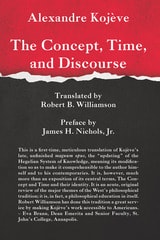
The Concept, Time, and Discourse
Alexandre Kojève
St. Augustine's Press, 2019
Alexandre Kojève (1902–1968) is most widely known in America for his provocative assertion that history is at its end, that is, its completion. In the “practical” sense, this means that the process of historical development can at last be seen (if from a distance) as the realization of the Marxist “universal and homogeneous state.” However, Kojève claimed as well that the history of philosophical thinking had also reached its goal in the transformation of philosophy, as the “love of wisdom” (or the unsatisfied quest for comprehensive knowledge), into that very Wisdom itself and had done so in the most essential respects in the philosophy of Hegel.
The Concept, Time, and Discourse is the first volume of Kojève’s magnum opus, which was to have given an exposition of the (Hegelian) System of Knowledge and of which five volumes were written before his death. It contains, along with a preliminary discussion of the need for an updating of the Hegelian system, the first two of three introductions to the exposition of that system: a First Introduction of the Concept (the integrated totality of what is comprehensible, which is the final object of philosophic inquiry) and a Second Introduction concerning Time, both introductions leading to the (Hegelian) identification of the Concept with Time, an identification which alone takes adequate account of the fact that Philosophy is necessarily discursive (that it must actualize the requirements and essential structure of Discourse).
The present volume offers Kojève’s fullest statement of his Ontology. It includes a critical discussion of the traditional oppositions of the “general” to the “particular” and of the “abstract” to the “concrete” and an analysis of the act of “generalizing abstraction,” which detaches Essence from the Existence of Things. Kojève then discusses the three great figures in the three-stage development of philosophy into wisdom: Parmenides, Plato, and Hegel. Parmenides’ monadic account of Being (= Eternity) rendered it ineffable, thereby reducing philosophy to (non-philosophic) silence; Plato’s dyadic account of Being (as eternal) was intended to make Being a possible subject of discourse but failed to reflect adequately the triadic (and temporally developing) structure which Plato himself discerned in Discourse. Finally, Hegel’s triadic account of Being as itself “dialectical” achieved the final identification of the Concept with Time.
This is a first-time, meticulous translation of Kojève’s late, unfinished magnum opus, the “updating” of the Hegelian System of Knowledge, meaning its modification so as to make it comprehensible to the author himself and to his contemporaries. It is, however, much more than an exposition of its central terms, The Concept and Time and their identity. It is an acute, original review of the major themes of the West’s philosophical tradition; it is, in fact, a philosophical education in itself. Robert Williamson has done this tradition a great service by making Kojève’s work accessible to Americans. – Eva Brann, Dean Emerita and Senior Faculty, St. John’s College, Annapolis, Maryland
We now recognize Alexandre Kojève as one of the central figures of 20th century European philosophy. A translation of his The Concept, Time, and Discourse will enable English speaking readers to have a fuller understanding of his remarkably ambitious intellectual project. – Michael S. Roth, President, Wesleyan University, Middletown, Connecticut.
Robert B. Williamson is Tutor Emeritus at St. John’s College in Annapolis, Maryland, where he continues to teach. He is co-author, with Alfred Mollin, of An Introduction to Ancient Greek (University Press of America) and the author of articles on Plato’s philosophy and Einstein’s early work on relativity theory.
James H. Nichols, Jr. is Professor of Government and Dr. Jules L. Whitehill Professor of Humanism and Ethics at Claremont McKenna College, where he teaches political philosophy. Among his publications are Epicurean Political Philosophy: The De rerum natura of Lucretius, translations with interpretations of Plato’s Gorgias and Phaedrus, and most recently Alexandre Kojève: Wisdom at the End of History.
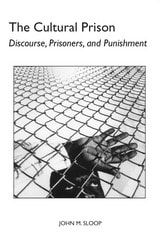
The Cultural Prison
Discourse, Prisoners, and PunishmentJohn M. Sloop
University of Alabama Press, 2005
The Cultural Prison brings a new dimension to the study of prisoners and punishment by focusing on how the punishment of American offenders is represented and shaped in the mass media through public arguments. The study is based on an analysis of 642 articles collected by the author from American popular journals and magazines, as well as newspaper accounts, films, and public speeches, spanning the years 1950 to 1992. By piecing together and studying these popular narratives, he divides the history of prisoners and punishment into four eras, each marked by a shift in value system. He argues that the discourse, or rhetoric, surrounding prisoners and punishment on the public level works as a historical force that shapes contemporary culture.
The author is concerned that the public seems to have an inability or unwillingness to question or resist cultural definitions of normalcy and legal behavior. He explains that ideally moral behavior should be a matter of public debate rather than of unquestioned perpetuation, and he urges increased understanding of institutional and cultural discipline and our questioning the ways in which the constitution of punishment and prisoners influences us culturally.
The"cultural prison" refers to the way in which this study acts as an investigation of "the discipline of discipline"; it is an examination of the way in which discipline is shaped and formed in public discourse. The volume concludes with a fascinating account of the move to electronic means of surveillance; coupled with the representations of the prisoner along the lines of race and gender, it explains what these new techniques mean to contemporary culture.
The Discourse of Domination
From the Frankfurt School to PostmodernismBen Agger
Northwestern University Press, 1992
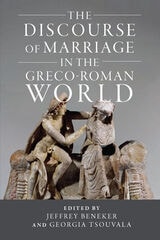
The Discourse of Marriage in the Greco-Roman World
Edited by Jeffrey Beneker and Georgia Tsouvala
University of Wisconsin Press, 2022
Through aesthetically informed and sensitive modes of analysis, these contributors examine a wealth of representations—including violence in weddings and spousal devotion after death. The Discourse of Marriage in the Greco-Roman World demonstrates the varying conceptions of an institution that was central to ancient social and political life—and remains prominent in the modern world. This volume will contribute to scholars' understanding of the era and fascinate anyone interested in historic depictions of marriage and the role and status of women in the late Hellenistic and early Imperial periods.
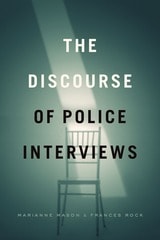
The Discourse of Police Interviews
Edited by Marianne Mason and Frances Rock
University of Chicago Press, 2020
The first book to focus exclusively on the discourses of police interviewing, The Discourse of Police Interviews examines leading debates, approaches, and topics in contemporary police interview research. Among other topics, the book explores the sociolegal, psychological, and discursive framework of popular police interview techniques employed in the United States and the United Kingdom, such as PEACE and Reid, and the discursive practices of institutional representatives like police officers and interpreters that can influence the construction and quality of linguistic evidence. Together, the contributions situate the police interview as part of a complex, and multistage, criminal justice process. The book will be of interest to both scholars and practitioners in a variety of fields, such as linguistic anthropology, interpreting studies, criminology, law, and sociology.
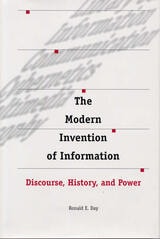
The Modern Invention of Information
Discourse, History, and PowerRonald E. Day
Southern Illinois University Press, 2008
In The Modern Invention of Information: Discourse, History, and Power, Ronald E. Day provides a historically informed critical analysis of the concept and politics of information. Analyzing texts in Europe and the United States, his critical reading method goes beyond traditional historiographical readings of communication and information by engaging specific historical texts in terms of their attempts to construct and reshape history.
After laying the groundwork and justifying his method of close reading for this study, Day examines the texts of two pre–World War II documentalists, Paul Otlet and Suzanne Briet. Through the work of Otlet and Briet, Day shows how documentation and information were associated with concepts of cultural progress. Day also discusses the social expansion of the conduit metaphor in the works of Warren Weaver and Norbert Wiener. He then shows how the work of contemporary French multimedia theorist Pierre Lévy refracts the earlier philosophical writings of Gilles Deleuze and Félix Guattari through the prism of the capitalist understanding of the “virtual society.”
Turning back to the pre–World War II period, Day examines two critics of the information society: Martin Heidegger and Walter Benjamin. He explains Heidegger’s philosophical critique of the information culture’s model of language and truth as well as Benjamin’s aesthetic and historical critique of mass information and communication. Day concludes by contemplating the relation of critical theory and information, particularly in regard to the information culture’s transformation of history, historiography, and historicity into positive categories of assumed and represented knowledge.
The Prettier Doll
Rhetoric, Discourse, and Ordinary DemocracyEdited by Karen Tracy, James P. McDaniel and Bruce E. Gronbeck
University of Alabama Press, 2007
The Tree That Bends
Discourse, Power, and the Survival of Maskoki PeoplePatricia Riles Wickman
University of Alabama Press, 1999
In her compelling and controversial arguments, Wickman rejects the myths that erase Native Americans from Florida through the agency of Spaniards and diseases and make the area an empty frontier awaiting American expansion. Through research on both sides of the Atlantic and extensive oral history interviews among the Seminoles of Florida and Oklahoma, Wickman shatters current theories about the origins of the people encountered by the Spaniards and presents, for the first time ever, the Native American perspective. She describes the genesis of the groups known today as Creek, Seminole, and Miccosukee—the Maskoki peoples—and traces their common Mississippian heritage, affirming their claims to continuous habitation of the Southeast and Florida. Her work exposes the rhetoric of conquest and replaces it with the rhetoric of survival.
An important cross-disciplinary work, The Tree That Bends reveals the flexibility of the Maskoki people and the sociocultural mechanisms that allowed them to survive the pressures introduced at contact. Their world was capable of incorporating the New without destroying the Old, and their descendants not only survive today but also succeed as a discrete culture as a result.

The War Against The Intellect
Episodes Decline Of DiscoursePeter Shaw
University of Iowa Press, 1989
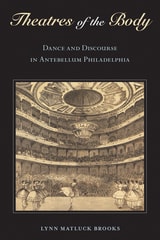
Theatres of the Body
Dance and Discourse in Antebellum PhiladelphiaLynn Matluck Brooks
Temple University Press, 2025
Reviewing print culture in the 1840s, Brooks shows how newspapers, magazines, and popular fiction provided documentation of dancing in Philadelphia as well as the responses of dance commentators, practitioners, and moralists. Theatres of the Body also considers the interplay of science with dance in the 1850s, which impacted both dance practices and reception.
Providing an expansive historiography of these significant contributions to dance in the United States, Brooks deepens our understanding of antebellum culture and history.