230 books match the query 'Doctrines' and 69 start with t

cover of THE AMERICAN QUEST FOR THE PRIMITIVE CHURCH

THE AMERICAN QUEST FOR THE PRIMITIVE CHURCH

Richard T. Hughes

University of Illinois Press, 1988
The dream of restoring primitive Christianity lies close to the core of the identity of some American denominations---Churches of Christ, Latter-day Saints, some Mennonites, and a variety of Holiness and Pentecostal denominations. But how can a return to ancient Christianity be sustained in a world increasingly driven by modernization? What meaning might such a vision have in the modern world? Twelve distinguished scholars explore these and related questions in this provocative book.
 
[more]
cover of The Ambuiguity of Being: Lonergan and the Problems of the Supernatural

The Ambuiguity of Being

Lonergan and the Problems of the Supernatural

Jonathan R. Heaps

Catholic University of America Press, 2024

The debate in Catholic theology over the relationship between the natural and the supernatural has only occasionally engaged with Bernard Lonergan’s philosophical and theological contributions on the topic. The Ambiguity of Being argues that more detailed engagement with Lonergan’s work implies an oversight in both the 20th- and 21st-century debates. The Ambiguity of Being argues the controversy has failed to notice how the problem of the natural and the supernatural is, in fact, two problems. The Ambiguity of Being takes both problems in their widest sense to be about action—both divine and human. The first problem asks how God can act in human action. A question for Christians at least since St. Augustine faced the Pelagian controversy, Lonergan retrieved what he understood to be St. Thomas Aquinas’ mature solution. It is a solution gathering together a whole series of theological and philosophical developments into a subtle metaphysical theory of divine and human cooperation. But the recent debates have resituated this problem (and various interpretations of St. Thomas’s solution to it) in a modern world with modern concerns about culture and politics for the sake of answering a second, intrinsically related, but really distinct question: what is God doing in human action? Ambiguity finds that the recent controversy almost always finds participants attempting to deduce an answer to the second, modern problem from the medieval, metaphysical Thomist solution to the first. By contrast, The Ambiguity of Being argues at length the modern problem cannot be reduced to, nor an answer deduced from its medieval, metaphysical partner because the modern problem of the supernatural—what is God doing in human action?—is a hermeneutical problem that calls out for a hermeneutical answer. The Ambiguity of Being sketches a heuristic for what a fully adequate answer to this question would require, suggesting a radical re-conception of modern theology’s scope.
[more]
cover of The Amish Struggle with Modernity

The Amish Struggle with Modernity

Edited by Donald B. Kraybill and Marc A. Olshan

University Press of New England, 1994
Throughout their history, the Amish communities of North America have tried to remain separate from the currents of progress that swirl in the larger society. The authors and others argue that although the nation’s nearly 140,000 Amish continue to resist the influence of worldly institutions, the communities have nonetheless acquiesced to modernity in significant ways. Such change has not been easy and The Amish Struggle with Modernity examines on a national scale dilemmas that arise when a people devoted to plain living face the complexities of modern life.
[more]
cover of The Ancient Order of Things: Essays on the Mormon Temple

The Ancient Order of Things

Essays on the Mormon Temple

Christian Larsen

Signature Books, 2019

Temple worship has long distinguished the Church of Jesus Christ of Latter-day Saints from mainstream Christendom. Even the denominations that trace their roots to LDS Church founder Joseph Smith have largely defined temple doctrines and ordinances as relics of the past; others have adopted and restored them to what they deem to be their purest form. To understand the LDS people is to grasp the impact the temple has had on church members as they embraced both temple-related teachings as essential to exaltation as well as the brick-and-mortar structures that stand as symbols of faith and sacrifice.  

Christian Larsen has assembled a collection of essays that illuminate the role of the temple and its rocky relationship with controversial subjects such as race and marriage. Some temples were built, abandoned, and given new life; others were either constructed for temporary use or never built at all. The nature of LDS temple ordinances is such that what LDS members deem sacred, others dismiss as secret. 
[more]
cover of The Bible and the Latter-day Saint Tradition

The Bible and the Latter-day Saint Tradition

Edited by Taylor G. Petrey, Cory Crawford, and Eric A. Eliason

University of Utah Press, 2022

Like other Christian denominations, the Church of Jesus Christ of Latter-day Saints (Mormons) has been engaged in the battle for the Bible since challenges to biblical authority began to exert significant influence in America toward the end of the nineteenth century. Other believing communities have responded with various reevaluations of the biblical text. Latter-day Saints have experimented with similar approaches, often taking liberal positions on biblical authority and conservative positions on history and authorship. However, Latter-day Saints accept additional scripture and embrace a theology notably distinct from traditional Christianity. Hence, they relate to the Bible differently from other Christians, creating gaps with mainstream biblical studies. This volume bridges that gap.

From comparing the Book of Mormon to the Bible or the Dead Sea Scrolls, to Mormon feminists’ views on the Gospels, this volume takes a comprehensive and inclusive approach to understanding Bible scholarship’s role in Mormon history, exploring these differences for both scholars and students. A diverse group of contributors presents an accessible resource to mediate between Latter-day Saint traditions and the broader context of biblical history, literature, and scholarship. Each essay provides a synopsis of relevant major scholarly views and delivers new insights into varied crosscurrents of biblical studies.
[more]
cover of The Book of Divine Works

The Book of Divine Works

Nathaniel M. St. Hildegard of Bingen

Catholic University of America Press, 2018
Completed in 1173, The Book of Divine Works (Liber Divinorum Operum) is the culmination of the Visionary’s Doctor’s theological project, offered here for the first time in a complete and scholarly English translation. The first part explores the intricate physical and spiritual relationships between the cosmos and the human person, with the famous image of the universal Man standing astride the cosmic spheres. The second part examines the rewards for virtue and the punishments for vice, mapped onto a geography of purgatory, hellmouth, and the road to the heavenly city. At the end of each Hildegard writes extensive commentaries on the Prologue to John’s Gospel (Part 1) and the first chapter of Genesis (Part 2)—the only premodern woman to have done so. Finally, the third part tells the history of salvation, imagined as the City of God standing next to the mountain of God’s foreknowledge, with Divine Love reigning over all.
[more]
cover of The Catholic Social Imagination: Activism and the Just Society in Mexico and the United States

The Catholic Social Imagination

Activism and the Just Society in Mexico and the United States

Joseph M. Palacios

University of Chicago Press, 2007

The reach of the Catholic Church is arguably greater than that of any other religion, extending across diverse political, ethnic, class, and cultural boundaries. But what is it about Catholicism that resonates so profoundly with followers who live under disparate conditions? What is it, for instance, that binds parishioners in America with those in Mexico? For Joseph M. Palacios, what unites Catholics is a sense of being Catholic—a social imagination that motivates them to promote justice and build a better world.

In The Catholic Social Imagination, Palacios gives readers a feeling for what it means to be Catholic and put one’s faith into action. Tracing the practices of a group of parishioners in Oakland, California, and another in Guadalajara, Mexico, Palacios reveals parallels—and contrasts—in the ways these ordinary Catholics receive and act on a church doctrine that emphasizes social justice. Whether they are building a supermarket for the low-income elderly or waging protests to promote school reform, these parishioners provide important insights into the construction of the Catholic social imagination. Throughout, Palacios also offers important new cultural and sociological interpretations of Catholic doctrine on issues such as poverty, civil and human rights, political participation, and the natural law.
[more]
cover of The Catholic Tradition

The Catholic Tradition

Thomas Langan

University of Missouri Press, 1998

In his Tradition and Authenticity in the Search for Ecumenic Wisdom, Thomas Langan argued that the close interaction of traditions in today's society calls for methodical critical appropriation of the beliefs fostered by the principal traditions. He also promised to demonstrate by example how such appropriation could be accomplished. In The Catholic Tradition, Langan successfully fulfills that vow by showing how a tradition—the Catholic—has shaped his own outlook.

In this comprehensive study, Langan examines the history of the Catholic Church and the origins of its teachings since the Church's conception. Although committed to the Catholic religion, Langan does not obscure the Church's failings as he lays out the fundamentals of the Catholic faith.

He provides insight into the great Christological councils, discusses the differences in the spiritualities of East and West, and portrays the crucial roles that the pope and bishops played during the Middle Ages. He incorporates the thought of Augustine, Aquinas, and medieval Catholicism as he traces the rise and decline of Christian Europe, the great issues raised by the reform: priesthood, the Eucharist, spirituality, and Church structure.

Satan has no greater triumph, Langan asserts, than when Catholics, who are recipients of the Good News of God's universal love, allow selections from their tradition to be turned into sectarianism and ideology. This balanced history of the Church as human reality faces such perversions squarely. But despite betrayals by its own across the centuries, the Catholic tradition, with its origin at Sinai, remains the oldest and largest extant religious institution.

In a last section Langan offers a unique overview of the church's present situation, its strengths and weaknesses, the new movement and the challenge of the "new evangelization."
[more]
cover of The Center is Jesus Christ Himself: Essays on Revelation, Salvation, and Evangelization in Honor of Robert P. Imbelli

The Center is Jesus Christ Himself

Essays on Revelation, Salvation, and Evangelization in Honor of Robert P. Imbelli

Andrew Meszaros

Catholic University of America Press, 2021
The polarization in the Church today can be traced back to a more fundamental crisis in theology, one which has failed to connect our mundane experiences and the mysteries of the Christian faith with the person of Jesus Christ. Ecclesial discourse on the so-called ‘hot- button issues’ of the day too often take place without considering the foundation and goal of the Church. And this is unfortunately due to a similar tendency in the academic theology that informs that ecclesial discourse. In short, much of post-conciliar Catholic theology is adrift, floating aimlessly away from the center of the Christian faith, who is Christ. The Center is Jesus Christ Himself is a collection of essays which anchor theological reflection in Jesus Christ. These diverse essays share a unified focal point, but engage with a variety of theological subdisciplines (e.g., dogmatic, moral, Biblical, etc.), areas (e.g., Christology, Pneumatology, missiology, etc.), and periods (e.g., patristic, medieval, and modern). Given the different combinations of sub-disciplines, areas, and periods, theology is susceptible to fragmentation when it is not held together by some principle of unity. A theology in which the person of Jesus Christ serves as that principle of unity is a Christocentric theology. Together, the essays illustrate not only what Christocentric theology looks like, but also what the consequences are when Christ is dislodged from the center, whether by a conspicuous silence on, or by a relativization of, his unique salvific mission. The volume is published in honor of Emeritus Professor of Systematic Theology at Boston College, Rev. Dr. Robert P. Imbelli, who dedicated his teaching and writing to bringing Christ back to the center of Catholic theological discourse.
[more]
cover of The Christian Tradition: A History of the Development of Doctrine, Volume 2: The Spirit of Eastern Christendom (600-1700)

The Christian Tradition

A History of the Development of Doctrine, Volume 2: The Spirit of Eastern Christendom (600-1700)

Jaroslav Pelikan

University of Chicago Press, 1974

The line that separated Eastern Christendom from Western on the medieval map is similar to the "iron curtain" of recent times. Linguistic barriers, political divisions, and liturgical differences combined to isolate the two cultures from each other. Except for such episodes as the schism between East and West or the Crusades, the development of non-Western Christendom has been largely ignored by church historians. In The Spirit of Eastern Christendom, Jaroslav Pelikan explains the divisions between Eastern and Western Christendom, and identifies and describes the development of the distinctive forms taken by Christian doctrine in its Greek, Syriac, and early Slavic expression.

"It is a pleasure to salute this masterpiece of exposition. . . . The book flows like a great river, slipping easily past landscapes of the utmost diversity—the great Christological controversies of the seventh century, the debate on icons in the eighth and ninth, attitudes to Jews, to Muslims, to the dualistic heresies of the high Middle Ages, to the post-Reformation churches of Western Europe. . . . His book succeeds in being a study of the Eastern Christian religion as a whole."—Peter Brown and Sabine MacCormack, New York Review of Books

"The second volume of Professor Pelikan's monumental work on The Christian Tradition is the most comprehensive historical treatment of Eastern Christian thought from 600 to 1700, written in recent years. . . . Pelikan's reinterpretation is a major scholarly and ecumenical event."—John Meyendorff

"Displays the same mastery of ancient and modern theological literature, the same penetrating analytical clarity and balanced presentation of conflicting contentions, that made its predecessor such an intellectual treat."—Virgina Quarterly Review
[more]
cover of The Church of God in Jesus Christ : A Catholic Ecclesiology

The Church of God in Jesus Christ

A Catholic Ecclesiology

Roch A. Kereszty

Catholic University of America Press, 2019
Investigating Vatican II is a collection of Fr. Jared Wicks’ recent articles on Vatican II, and presents the Second Vatican Council as an event to which theologians contributed in major ways and from which Catholic theology can gain enormous insights. Taken as a whole, the articles take the reader into the theological dynamics of Vatican II at key moments in the Council’s historical unfolding. Wicks promotes a contemporary re-reception of Vatican II’s theologically profound documents, especially as they featured God’s incarnate and saving Word, laid down principles of Catholic ecumenical engagement, and articulated the church’s turn to the modern world with a new “face” of respect and dedication to service. From the original motivations of Pope John XXIII in convoking the Council, Investigating Vatican II goes on to highlight the profound insights offered by theologians who served behind the scenes as Council experts. In its chapters, the book moves through the Council’s working periods, drawing on the published and non-published records, with attention to the Council’s dramas, crises, and breakthroughs. It brings to light the bases of Pope Francis’s call for synodality in a listening church, while highlighting Vatican II’s mandate to all of prayerful biblical reading, for fostering a vibrant “joy in the Gospel.”
[more]
cover of The Cleansing of the Heart

The Cleansing of the Heart

Reginald Lynch

Catholic University of America Press, 2017

Recalling the Biblical and Patristic roots of the Church's sacramental identity, the Second Vatican Council calls the Church the 'visible sacrament' of that unity offered through Christ (LG 9). 'Sacrament' in this sense not only describes who the Church is, but what she does. In this regard, the Council Fathers were careful to establish a strong connection between the symbolic nature of the Church's sacraments and their effect on those who received them.

Reginald Lynch is concerned with the cleansing of the heart—a phrase borrowed from St. Augustine and employed by Aquinas, which describes the effects that natural elements such as water or bread have on the human person when taken up by the Church as sacramental signs. Aquinas' approach to sacramental efficacy is unique for its integration of diverse theological topics such as Christology, merit, grace, creation and instrumentality. While all of these topics will be considered to some extent, the primary focus of The Cleansing of the Heart is the sacraments understood as instrumental causes of grace. This volume provides the historical context for understanding the development of sacramental causality as a theological topic in the scholastic period, emphasizing the unique features of Aquinas' response to this question. Following this, relevant texts from Aquinas' early and later work are examined, noting Aquinas' development and integration of the idea of sacramental causality in his later work. The Cleansing of the Heart concludes by contrasting alternatives to Aquinas' theory of sacramental causality that subsequently emerged. The rise of humanism introduced many changes within rhetoric and philosophy of language that had a profound effect on some theologians during the Modern period. This book provides historical context for understanding the most prominent of these theories in contrast to Aquinas, and examines some of their theological implications.
[more]
cover of The Common Good of Constitutional Democracy: Essays in Political Philosophy and on Catholic Social Teaching

The Common Good of Constitutional Democracy

Essays in Political Philosophy and on Catholic Social Teaching

Martin Rhonheimer

Catholic University of America Press, 2013
The Common Good of Constitutional Democracy offers a rich collection of essays in political philosophy by Swiss philosopher Martin Rhonheimer. Like his other books in both ethical theory and applied ethics, which have recently been published in English, the essays included are distinguished by the philosophical rigor and meticulous attention to the primary and secondary literature of the various topics discussed
[more]
cover of The Complementarity of Women and Men: Philosophy, Theology, Psychology, and Art

The Complementarity of Women and Men

Philosophy, Theology, Psychology, and Art

Paul C. Vitz

Catholic University of America Press, 2021
The Complementarity of Women and Men provides a Catholic Christian case that men and women are in certain respects quite different but also have a positive, synergistic complementary relationship. Although differences and their mutually supporting relationships are focused on throughout the volume, men and women are assumed to have equal dignity and value. This underlying interpretation comes from the familiar, basic theological position in Genesis that both sexes were made in the image of God. After a cogent philosophical introduction to complementary differences by J. Budziszewski, this position is developed from theological, philosophical, and historical perspectives by Sr. Prudence Allen. Next Deborah Savage, building upon the writings of St. John Paul II, gives a strong theological basis for complementarity. This is followed by Elizabeth Lev’s chapter presenting new and surprising art history evidence from the paintings of Michelangelo in the Sistine Chapel supporting the complementarity interpretation. A final chapter by Paul Vitz documents and summarizes the scientific evidence supporting sexual difference and complementarity in the disciplines of psychology and neuroscience. As a consequence of both the individual chapters and the integrated understanding they present The Complementarity of Women and Men is a significant contribution to the important, complex, contemporary debate about men, women, sex, and gender.
[more]
cover of The Consensus of the Church and Papal Infallibility: A Study in the Background of Vatican I

The Consensus of the Church and Papal Infallibility

A Study in the Background of Vatican I

Richard F. Costigan, S.J.

Catholic University of America Press, 2005
After a concise introduction that defines the two schools of theology, Richard Costigan examines the thought of nine major theologians on the subject: Bossuet, Tournely, Orsi, Ballerini, Bailly, Bergier, La Luzerne, Muzzarelli, and Perrone.
[more]
cover of The Development of Dogma: A Systematic Account

The Development of Dogma

A Systematic Account

Guy Mansini, OSB

Catholic University of America Press, 2023
The Development of Dogma examines the nature of dogmatic statements and the causes of development. It devotes particular attention to the emergence of the form of dogmatic statements at the Council of Nicaea, but notes how this form is anticipated in the New Testament. It situates dogma and its development within the matrix of the great fundamental theological realities of Scripture, Tradition, and Magisterium. Fr. Mansini examines at some length how the Church comes to recognize a development as a genuine development rather than as a distortion of the word of God. The Development of Dogma is especially valuable today for its discussion and defense of the philosophical presuppositions of dogma, which are often simply presupposed but should not be ignored in a complete account of development. These presuppositions touch on fundamental philosophical issues, including the nature of knowledge, the objectivity and trustworthiness of names, and the various logical forms employed in understanding how development is related to a closed revelation. The historicity of human knowledge is also addressed, and the role of dogma itself in heading off the extreme relativism the historical nature of man is supposed to imply for ecclesial faith and life. The Church's dogma about dogma enunciated at the First Vatican Council is also examined. The role of certain fundamental concepts in understanding the possibility of the irreformability of dogma it speaks of is expressly addressed—concepts in principle accessible to all human beings and that enable a trans-cultural, trans-temporal proposal and reception of revealed truth.
[more]
cover of The Diaconate Revisited: Questions and Developments Since Vatican II

The Diaconate Revisited

Questions and Developments Since Vatican II

Marc B. Caron

Catholic University of America Press, 2026
The sacrament of Holy Orders is the only one of the seven sacraments which exists in three ranks arranged hierarchically, that is, bishops, presbyters, and deacons. Deacons are distinct from both bishops and presbyters, yet united with them in one sacrament. Since the Second Vatican Council, various magisterial documents have limited the priestly dimension of holy orders to bishops and presbyters alone. If deacons do not share in the hierarchical priesthood at all, how are they then related to bishops and to presbyters? In the end, is the diaconate even part of the sacrament of holy orders? This book attempts to show how a ministerial dimension to the character received in ordination to each of the three ranks unites the episcopate, the presbyterate, and the diaconate in a single sacrament. According to the theology of the sacrament of holy orders found in Lumen gentium, the bishop receives the fullness of the sacrament, meaning both its sacerdotal and diaconal or ministerial dimensions. The presbyter then receives a lesser portion than the bishop of both sacerdotal and ministerial dimensions of the sacrament. Finally, the deacon receives an even lesser share than that of the presbyter of the ministerial dimension of holy orders alone. This approach makes clear that the bishop is the greatest servant of the Church as well as its high priest. It challenges presbyters to be of greater service to the Body of Christ than even deacons. The baptismal call to holiness of all the faithful can also be described as having both priestly and ministerial or diaconal dimensions as well. With this understanding, it now becomes clearer how the laity can perform certain functions by delegation which the Church normally entrusts to deacons by ordination. Finally, the unity of the diaconate with the two priestly ranks must inform the current discussions taking place about any possible ordination of women to the sacrament of holy orders in the diaconal rank.
[more]
cover of The Economics of the Mishnah

The Economics of the Mishnah

Jacob Neusner

University of Chicago Press, 1990

In this compelling study, Jacob Neusner argues that economics is an active and generative ingredient of the system of the Mishnah. The Mishnah directly addresses such economic concerns as the value of work, agronomics, currency, commerce and the marketplace, and correct management of labor and of the household. In all its breadth, the Mishnah poses the question of the critical place occupied by the economy in society under God's rule.

The Economics of the Mishnah is the first book to examine the place of economic theory generally in the Judaic system of the Mishnah. Jacob Neusner begins by surveying previous work on economics and Judaism, the best known being Werner Sombart's The Jews and Modern Capitalism. The mistaken notion that Jews have had a common economic history has outlived the demise of Sombart's argument, and it is a notion that Neusner overturns before discussing the Mishnaic economics.

Only in Aristotle, Neusner argues, do we find an equal to the Mishnah's accomplishment in engaging economics in the service of a larger systemic statement. Neusner shows that the framers of the Mishnah imagined a distributive economy functioning through the Temple and priesthood, while also legislating for the action of markets. The economics of the Mishnah, then, is to some extent a mixed economy. The dominant, distributive element in this mixed economy, Neusner contends, derives from the belief that the Temple and its designated castes on earth exercise God's claim to the ownership of the holy land. He concludes by considering the implications of the derivation of the Mishnah's economics from the interests of the undercapitalized and overextended farmer.
[more]
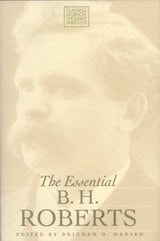
cover of The Essential B. H. Roberts

The Essential B. H. Roberts

Brigham D. Madsen

Signature Books, 2000

 Although Brigham H. Roberts was an LDS general authority, he was by public consensus and his own admission an intellectual. Consequently, and due to the painfully earnest, meticulous way he approached any issue of consequence and his intimate familiarity with Western thought, he occasionally appeared to be knowingly contradictory. Readers are therefore left to judge whether he vacillated over time, tailored his message to the audience on a “milk-before-meat” principle, or was comfortable camouflaging his real intent in metaphor.

On one occasion Roberts defended the traditional Mormon view of the godhead—perfected men who “eat, drink … and procreate” as exalted mortals; another time he seemed less comfortable imposing limitations on a God who cannot be fixed to a single location, for whom Jesus was a mortal incarnation, and for whom the term “trinity” seemed more eloquent than the “presidency of heaven.”

His most famous and penetrating analysis focused on the Book of Mormon. In this collection Roberts discusses the mode of its translation, while stopping short of saying that God, who speaks to humans in their own language, could have authored the inconsistent grammar that appeared luminously in Joseph Smith’s seer stone. Instead he credits this to Smith’s own linguistic contribution, thereby preserving for God a fitting transcendence. Later Roberts went so far as to question the Book of Mormon’s historicity.

A final example of Roberts’s complexity: He proclaimed in public the perfect unity and harmony found at church conferences, but he privately castigated his colleagues for what he considered to be obstinance. He once asked what additional, irrational proposal “may occur to some genius” in the Quorum of the Twelve.

A paradox still, this feisty president of the church’s Seventies continues to provoke mixed and heated feelings, as expressed by a Scottish immigrant working in the First Presidency’s office who one day said to Roberts: “Aye, mon, the frankness of it. How dare you do it, mon?” But for those who are sincere and secure in their faith, Roberts can provide a delightfully rewarding journey. Consider just the following four, short excerpts from this compilation—two are originally from Roberts’s published works and two are from his personal letters:

“It is not given to mortal man always to walk upon that plane where the sunlight of God’s inspiration is playing upon him. Sometimes the servants of God speak merely from their human knowledge, influenced by passions; influenced by the interests of men, and by anger, and vexation. When they so speak, that is not likely to be the word of God. In any event it must be allowed by us that many unwise things were said in times past that did not possess the value of scripture, or anything like it; and it was not revelation.”

“What has become, in the church, of the principle that governments derive their just powers from the consent of the governed? Will it be enough to say that the consent of the governed can come later when nominations have been made by leaders? The procedure may be so, and the quorums thus ignored may silently submit, and the matter going on in a dull, gray, and sullen manner; but you will have no esprit de corps in the quorums; and young men of active minds will grow restive. Why not regard them as having some judgment, and right to have a voice in nominating those with whom they are to work?”

“So I say that when the churches turn to secular government to enforce religious doctrines and discipline, they abandon their legitimate sphere and enter one wholly repugnant to their principles. When churches thus abandon their confidence in the power of truth, they play havoc with their own authority.”

“My dear Bishop Nibley, let me commend you for the delicacy with which you can tell the poor ‘theorist’ to ‘get off the earth.’ I know not if you were born with such delicacy or have acquired it, but in either event it challenges one’s admiration. You write that ‘You (myself) are a theorist, while he (Senator-Apostle Smoot) is needed and has a place in the economy of things.’ That is decidedly good. There is but one thing more you could have suggested to my advantage; you might have indicated the particular location in oblivion where you would be willing for me to sit.”

Brigham Henry Roberts was born in England in 1857. Among his other achievements, he was president of the LDS First Quorum of Seventy and Assistant Church Historian. His numerous books include: (historical) A Comprehensive History of the Church, Joseph Smith: The Prophet-Teacher, The Life of John Taylor, Outlines of Ecclesiastical History, and (theological) A New Witness for God, the Mormon Doctrine of Deity, and the Seventy’s Course in Theology—all of which are considered authoritative, and for which Roberts earned the epithet, “Defender of the Faith.” He died in 1933.
[more]
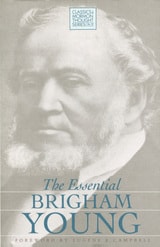
cover of The Essential Brigham Young

The Essential Brigham Young

Eugene E. Campbell

Signature Books, 1992

 After converting to Mormonism in 1832, Brigham Young (1801-77) quickly rose to prominence and was called to the Quorum of Twelve Apostles within three years. He personally directed the highly successful 1839 proselyting mission to Great Britain, and he was appointed president of the Twelve Apostles the following year. In 1846-47 he oversaw the epic colonization of the Intermountain West.

Self-educated and preoccupied with the day-to-day business of his widespread empire, Young rarely found time to read. But he delivered hundreds of lively, extemporaneous sermons which blended common sense with theological speculation. Such homespun treatises carried an immediacy that was absent from the philosophically-oriented studies of his ecclesiastical colleague Orson Pratt, though, at the same time, Young’s speeches could be unfocused and contradictory.

Several of the more controversial teachings that Young promulgated—Adam-as-God, divine omniscience, and blood atonement—have sparked considerable debate since they were first uttered more than one hundred years ago. “Will you love your brothers and sisters likewise,” he once asked, “when they have committed a sin that cannot be atoned for without the shedding of their blood? Will you love that man or woman well enough to shed their blood?”

Other favorite topics were the “personality of God,” “election and reprobation,” and “the resurrection.” His sermons usually begin in a chatty way: “I remarked last Sunday that I had not felt much like preaching,” or “When I contemplate the subject of salvation, and rise before a congregation to speak upon that all-important matter, it has been but a few times in my life that I could see a beginning point to it, or a stopping place.” Readers will find themselves drawn into the rhythm of Young’s rhetoric in the same way as his original hearers were.
[more]
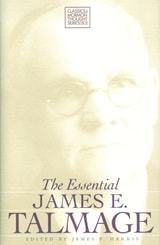
cover of The Essential James E. Talmage

The Essential James E. Talmage

James P. Harris

Signature Books, 1997

 Latter-day Saints were stunned in 1911 to learn that the interior of the Salt Lake temple had been secretly photographed and that perpetrators were demanding a $100,000 ransom for the photos. As church leaders considered their options, former University of Utah president James E. Talmage proposed that the First Presidency commission its own photos, which they did, authorizing Talmage to write his landmark House of the Lord. As the manuscript and photos were being readied for press, the presidency appointed the forty-nine-year-old educator to the Quorum of Twelve Apostles.

This was not the first time that Talmage had been of service to his church. As a geology professor, he was consulted about underground ventilation options for the Salt Lake Tabernacle and about the scientific evidence for organic evolution, which he cautiously promoted. At the church president’s request, Talmage also delivered a series of lectures on church theology which would form the basis for his later influential books.

Not that Talmage was unaccustomed to controversy. When his book, The Articles of Faith, first appeared, he was accused of “apostasy” and narrowly escaped church sanction. When he read from an advance text of Jesus the Christ in general conference, some leaders objected to the doctrinal content and had the offending paragraphs excised from the published conference proceedings.

Scholars have noted that much of Talmage’s work reflects the thinking of his day, particularly in his reliance on Frederick Farrar’s Life of Christ and in his portrayal of a so-called “Victorian Jesus.” But as James P. Harris observes, Talmage also “supplemented the biblical narrative with modern revelation” and produced “a source of information and inspiration to church members worldwide.”

The Essential James E. Talmage includes some of the apostle’s lesser-known works. For Talmage’s more popular writings, the editor has included relevant diary entries and material omitted from later editions. Readers will appreciate the process by which these seminal works were produced and the character of the man who composed them.
[more]
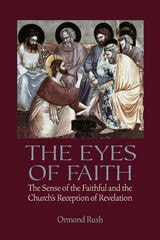
cover of The Eyes of Faith: The Sense of the Faithful and the Church's Reception of Revelation

The Eyes of Faith

The Sense of the Faithful and the Church's Reception of Revelation

Ormond Rush

Catholic University of America Press, 2009
The Eyes of Faith presents a systematic theology of the sense of the faithful (sensus fidelium) and shows the fundamental and necessary interrelationship between sensus fidelium, tradition, Scripture, theology, and the magisterium.
[more]
cover of The Fathers of the Church in Christian Theology

The Fathers of the Church in Christian Theology

Catholic University of America Press, 2019
The main purpose of The Fathers of the Church in Christian Theology is to argue that Patristic studies still has much to contribute to theological reflections in our time. Throughout history, the reading of the Fathers of the Church has made major contributions to Christian thinking. This fecundity was notably verified in the 20th century through the work of theologians like Henri de Lubac and Hans Urs von Balthasar. It was as well manifested broadly in the life of the church that, with the Vatican II council, drew from the patristic tradition a source of inspiration for its own renewal. However, even though the research and work on early Christianity has experienced considerable growth for several decades, Christian theology is today confronted with new questions. Thus, what status to recognize in the exegesis of the Fathers? Has not the distance from the heritage of patristic thinking been widened? More radically, do not the demands of contextual theologies on diverse continents compel a distancing away from some traditions that formerly were principally limited to Mediterranean and European regions? If these questions must be taken into account, they, nevertheless, cannot dispense with Christian theology being, today as yesterday, inspired and made fecund by the writings of the Fathers. Michel Fédou attempts to shed light on what, in our own era, justifies the necessity of a patristic theology. He shows how the reading of the Fathers contributes to the understanding of the faith in the different fields of Christian thinking. It highlights the importance of their writings for the spiritual life and the valuable nourishment that they thus offer to our times.
[more]
cover of The Guide of the Perplexed: Complete in One Volume

The Guide of the Perplexed

Complete in One Volume

Moses Maimonides

University of Chicago Press, 1963

The classic translation of this most important medieval Jewish text, presented in one volume for the first time.

The twelfth-century Judeo-Arabic text The Guide of the Perplexed is a monument of rabbinical exegesis and one of the most important works in the history of Jewish thought. Written by Moses ben Maimon,commonly known as Maimonides, the Guide aims to liberate people from the perplexities that arise from an understanding of the Bible based only on its literal meaning.

Shlomo Pines’s translation has served students and scholars for decades, and it is presented here, with Leo Strauss’s influential introduction, in one volume for the first time.
[more]
cover of The Holy Spirit in Puritan Faith and Experience

The Holy Spirit in Puritan Faith and Experience

Geoffrey F. Nuttall

University of Chicago Press, 1992

Geoffrey F. Nuttall establishes the primacy of the doctrines of the Holy Spirit in seventeenth-century English Puritanism and demonstrates the continuity of the Reformation tradition from the more conservative views of Luther to the more radical interpretations of the Quakers. Nuttall illuminates prominent spokesmen, including Richard Sibbes, Richard Baxter, John Owen, Walter Cradock, Morgan Llwyd, and George Fox.

In a new Introduction, Peter Lake discusses the relevance of Nuttall's book to, and its influence on, major works in seventeenth-century English history written since 1946.
[more]
cover of The House of the Lord

The House of the Lord

Steven Smith

Catholic University of America Press, 2017
[more]
cover of The Indissolubility of Marriage and the Council of Trent

The Indissolubility of Marriage and the Council of Trent

E. Christian Brugger

Catholic University of America Press, 2017
This important volume examines the Catholic Church’s doctrine on the indissolubility of marriage as taught by the 16th century Ecumenical Council of Trent (1545-1563). In the Council’s reply to Reformation challenges on the sacraments, it took up the ques
[more]
cover of The Invention of Sodomy in Christian Theology

The Invention of Sodomy in Christian Theology

Mark D. Jordan

University of Chicago Press, 1997

In this startling original work of historical detection, Mark D. Jordan explores the invention of Sodomy by medieval Christendom, examining its conceptual foundations in theology and gauging its impact on Christian sexual ethics both then and now. This book is for everyone involved in the ongoing debate within organized religions and society in general over moral judgments of same-sex eroticism.

"A crucial contribution to our understanding of the tortured and tortuous relationship between men who love men, and the Christian religion—indeed, between our kind and Western society as a whole. . . . The true power of Jordan's study is that it gives back to gay and lesbian people our place in history and that it places before modern theologians and church leaders a detailed history of fear, inconsistency, hatred and oppression that must be faced both intellectually and pastorally."—Michael B. Kelly, Screaming Hyena

"[A] detailed and disturbing tour through the back roads of medieval Christian thought."—Dennis O'Brien, Commonweal

"Being gay and being Catholic are not necessarily incompatible modes of life, Jordan argues. . . . Compelling and deeply learned."—Virginia Quarterly Review
[more]
cover of The Irreducibility of the Human Person: A Catholic Synthesis

The Irreducibility of the Human Person

A Catholic Synthesis

Mark K. Spencer

Catholic University of America Press, 2022
Catholic philosophical anthropologists have defended views of the human person on which we are irreducible to anything non-personal. For example, it is not the case that we are nothing but matter, souls, or parts of society. But many Catholic anthropologies have overlooked ways in which we are irreducible and so have not given an adequate account of the uniqueness of each human person. This book presents a philosophical portrait of human persons that depicts each way in which we are irreducible, with the goal of guiding the reader to perceive, wonder at, and love all the unique features of human persons. It builds this portrait by showing how claims from many strands of the Catholic tradition can be synthesized. These strands include Thomism, Scotism, phenomenology, personalism, nouvelle théologie, analytic philosophy, and Greek and Russian thought. The book focuses on how these traditions’ claims are grounded in experience and on how they help us to perceive irreducible features of persons. While many metaphysical claims about persons are defended, the picture of persons that ultimately emerges is one on which persons are best grasped not through abstract concepts but through aesthetic perception and love, as unique kinds of beauty. This book also explores irreducible features of our subjectivity, senses, intellect, freedom, and affections, and of our souls, bodies, and activities. It includes discussions of divine simplicity and causality, and of the nature of angels, matter, organisms, and artifacts, all of which must be understood to fully grasp our irreducibility. In showing how to synthesize various traditions’ claims, the book also offers new solutions to a number of debates in Catholic philosophy. These include debates over natural law, the natural desire to see God, the separated soul, integralism and personalism, idealist and realist phenomenology, and scholastic accounts of the act of existence.
[more]
cover of The LDS Gospel Topics Series: A Scholarly Engagement

The LDS Gospel Topics Series

A Scholarly Engagement

Matthew L. Harris and Newell G. Bringhurst

Signature Books, 2020
This anthology provides a scholarly, in-depth analysis of the thirteen Gospel Topics essays issued by the Church of Jesus Christ of Latter-day Saints from December 2013 to October 2015. The contributors reflect a variety of faith traditions, including the LDS Church, Community of Christ, Catholic, and Evangelical Christian.  Each contributor is an experienced, thoughtful scholar, many having written widely on religious thought in general and Mormon history in particular.  The writers probe the strengths and weaknesses of each of the Gospel Topics essays, providing a forthright discussion on the relevant issues in LDS history and doctrine.  The editors hope that these analyses will spark a healthy discussion about the Gospel Topics essays, as well as stimulate further discussion in the field of Mormon Studies.
[more]
cover of The Light of Christ: An Introduction to Catholicism

The Light of Christ

An Introduction to Catholicism

Thomas Joseph White, OP

Catholic University of America Press, 2017

The Light of Christ provides an accessible presentation of Catholicism that is grounded in traditional theology, but engaged with a host of contemporary questions or objections. Inspired by the theologies of Iranaeus, Thomas Aquinas and John Henry Newman, and rooted in a post-Vatican II context, Fr. Thomas Joseph White presents major doctrines of the Christian religion in a way that is comprehensible for non-specialists: knowledge of God, the mystery of the Trinity, the Incarnation and the atonement, the sacraments and the moral life, eschatology and prayer.

At the same time, The Light of Christ also addresses topics such as evolution, the modern historical study of Jesus and the Bible, and objections to Catholic moral teaching. Touching on the concerns of contemporary readers, Fr. White examines questions such as whether Christianity is compatible with the findings of the modern sciences, do historical Jesus studies disrupt or confirm the teaching of the faith, and does history confirm the antiquity of Catholic claims.

This book serves as an excellent introduction for young professionals with no specialized background in theology who are interested in learning more about Catholicism, or as an introduction to Catholic theology. It will also serve as a helpful text for theology courses in a university context.

As Fr. White states in the book’s introduction: “This is a book that offers itself as a companion. I do not presume to argue the reader into the truths of the Catholic faith, though I will make arguments. My goal is to make explicit in a few broad strokes the shape of Catholicism. I hope to outline its inherent intelligibility or form as a mystery that is at once visible and invisible, ancient and contemporary, mystical and reasonable.”
[more]
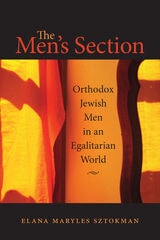
cover of The Men's Section: Orthodox Jewish Men in an Egalitarian World

The Men's Section

Orthodox Jewish Men in an Egalitarian World

Elana Maryles Sztokman

Brandeis University Press, 2011
In this illuminating book, Elana Maryles Sztokman investigates a fascinating new sociological phenomenon: Orthodox Jewish men who connect themselves to egalitarian or quasi-egalitarian religious enterprises. She examines the men who have enabled these transitions by constituting the requisite ten-man prayer quorum of Orthodoxy. By participating in “Partnership Minyanim,” these men support the reconstruction of both male and female roles without leaving the Orthodox religious world. Sztokman interrogates the ideologies and motivations of more than fifty such men in the United States, Israel, and Australia. Beginning with the “Orthodox Man Box” of conventionally constructed male behavior, she explores their struggles to navigate individualism and conformity, tradition and change. Setting their experiences in the context of gender role construction in traditional and contemporary synagogues, she shows how, for example, changes in leadership in Partnership Minyanim facilitate a fresh approach to liturgical expression, offering the possibility of reforming how modern Orthodox Jews attend services and pray.
[more]
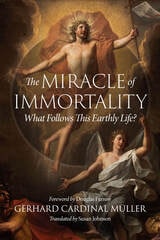
cover of The Miracle of Immortality: What Follows This Earthly Life?

The Miracle of Immortality

What Follows This Earthly Life?

Gerhard Cardinal Muller

Catholic University of America Press, 2026
In The Miracle of Immortality, Gerhard Cardinal Müller tackles some of the great mysteries of human life and hope. The former prefect of the Dicastery for the Doctrine of the Faith is not content merely to present Catholic doc­trine on the afterlife and the last things, although his reflections are always rooted in the teachings and traditions of the Church. Rather, he invites readers to walk with him by the restless sea of human learning, a sea formed by man’s unquenchable thirst for something or someone greater than man himself, by his desire to know the beginning and the end. One who accepts the invitation finds himself in conversation with a mentor whose mind is suffused with scripture and very much sharpened by it. Cherished assumptions are queried or quietly corrected. Slowly but surely he is confronted with the miracle of immortality, without which true happiness is impossible. Cardinal Müller demonstrates in this book that it is entirely possible, and eminently rational, to believe in the miracle of immortality; indeed, that it is ultimately not rational not to believe. The Miracle of Immortality is a work of penetrating theological insight set, chiaroscuro-like, against the darkness of modern and postmodern skepticism. It is at once poetical in spirit and profoundly catechetical in substance, for Müller understands that Christian eschatology cannot be elucidated properly without proclaiming the whole counsel of God. The miracle in question is a miracle for the whole person, accomplished by way of what Paul calls adoption; that is, filiation to the eternal Father through the incarnate Son, effected by the limitless power of the Holy Spirit. It is a miracle that perfects the divine work of creation.
[more]
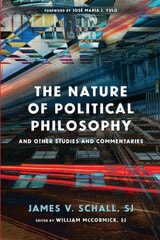
cover of The Nature of Political Philosophy: And Other Studies and Commentaries

The Nature of Political Philosophy

And Other Studies and Commentaries

James V. Schall

Catholic University of America Press, 2022
In his final collection of essays, Father Schall explores the life of faith across a dazzling array of subjects, from Martin Luther to bioethics. With his characteristic patience, brilliance, and careful tenacity, Father Schall interrogates profoundly what it means to try to be a citizen of the Kingdom of God in the city of Man. Never shying away from controversy, across 14 articles and 4 book reviews Father Schall investigates the critical themes of his life and scholarship: reason and revelation; the nature of modernity; literature and salvation; metaphysics and politics; and much more. Whether the reader is new to Father Schall or a longtime student, this posthumously-published collection of essays offers a profound meditation on the nature of political philosophy, and particularly what it would mean for Catholicism to offer a political philosophy. From such fundamental considerations, Schall explores ethical, literary and legal themes, displaying his typical breadth and depth of engagement with all that is real. Ultimately, Father Schall leads one on a Socratic enterprise, an education whereby one comes to question for oneself basic assumptions, and to dig deeper into the first principles as they are recalled in the orders of knowledge and being. While Father Schall has passed on to his reward, this collection of essays helps ensure that his lessons continue to guide, challenge and enrich students for generations to come.
[more]
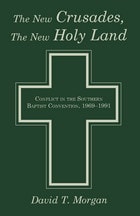
cover of The New Crusades, the New Holy Land: Conflict in the Southern Baptist Convention, 1969-1991

The New Crusades, the New Holy Land

Conflict in the Southern Baptist Convention, 1969-1991

David T. Morgan

University of Alabama Press, 1996

Examines the conflict between modern-day Southern Baptists and “liberal” Southern Baptists over control of the Southern Baptist Convention

David Morgan captures the essence of the conflict between some modern-day Southern Baptists, who saw themselves as crusaders for truth, as they sought to redeem a new holy land--the Southern Baptist Convention-- from the control of other Southern Baptists they viewed as "liberals." To the so-called liberals, the crusaders were "fundamentalists" on a mission, not to reclaim the SBC in the name of theological truth but to gain control and redirect its activities according to their narrow political, social, and theological perspectives. The New Crusades provides a comprehensive history of the conflict, taking the reader through the bitter and divisive struggles of the late 1980s, that culminated in the 1991 emergence of a moderate faction within the SBC. The fundamentalists had won.
 

[more]
cover of The Old Testament for Latter-day Saints

The Old Testament for Latter-day Saints

Douglas, Alex

Signature Books, 2023

In The Old Testament for Latter-day Saints, Alex Douglas explores the Old Testament from various perspectives: as a believer, a skeptic, a secular scholar, and a member of the Latter-day Saint community. He delves deep into biblical scholarship, incorporating insights from disciplines such as ancient Near Eastern archaeology and the rich mythic traditions of Israel’s neighboring cultures. By doing so, Douglas helps the reader appreciate the profound significance the Old Testament held for its earliest readers.

This book also explores the intriguing ways in which Latter-day Saints have interpreted and engaged with this ancient text and the author navigates their diverse interpretations of it. He examines how individuals have alternately embraced the Old Testament as myth or history, law or legend, wise counsel or sacred scripture. He shows where many traditional interpretations have come from, and offers many ways to encourage a more nuanced understanding of the text.

Drawing from a wealth of scholarly research and his own unique perspective, Douglas presents a compelling and multidimensional analysis of the Old Testament. However readers approach the text, this book sheds light on the complex nature of the Old Testament and its enduring relevance to the Latter-day Saint tradition.
[more]
cover of The One Creator God in Thomas Aquinas and Contemporary Theology

The One Creator God in Thomas Aquinas and Contemporary Theology

Michael J. Dodds, OP

Catholic University of America Press, 2020
This book provides a fundamental introduction to Aquinas's theology of the One Creator God. Aimed at making that thought accessible to contemporary audiences, it gives a basic explanation of his theology while showing its compatibility with contemporary science and its relevance to current theological issues. Opening with a brief account of Aquinas’s life, it then describes the purpose and nature of the Summa Theologica and gives a short review of current varieties of Thomism. Without neglecting other works, it then focuses primarily on the discussion of the One God in the first part of the Summa Theologica. God's transcendence and immanence is a recurrent theme in that discussion. Evidence of God's immanent causality in the natural world grounds Aquinas's five arguments for the existence of God (the Five Ways) which then open onto God's transcendence. The subsequent discussion of the divine attributes builds on the modes of God's causality established in the Five Ways. It also shows the need for a language of analogy to preserve God's transcendence and prevent us from reducing God to the level of creatures, even as qualities such as "goodness" and "love," which we first know from creatures, are applied to God. The discussion of God's providence and governance establishes that the transcendent Creator God is most intimately present in creation. God acts in all creatures in a way that does not diminish their proper causality, but is rather its source. As there is no contradiction between God's transcendence and immanence, so there is no competition between the primary causality of God and the secondary causality of creatures. Empirical science, which is limited by its method to the secondary causality of creatures, is shown to be compatible with the broader discipline of theology which also embraces the primary causality of the Creator.
[more]
cover of The Origins of Catholic Evolutionism, 1831-1950

The Origins of Catholic Evolutionism, 1831-1950

Kenneth W. Kemp

Catholic University of America Press, 2025
The history of the Catholic Church’s response to evolutionary biology has often been badly misrepresented as antagonistic. In fact, its response is better characterized as a long process of accommodation. This work is a comprehensive introduction to the work of the Catholic scientists and theologians who worked out the details of that accommodation. Few Catholics found the evolutionary origin of plant and animal species theologically objectionable. None thought that evolutionary processes provided a sufficient account of the origin of the first human beings. Catholics differed over whether those processes played a role in the origin of the first human body. Catholic evolutionism began with the work of four nineteenth-century scientists who might be called the pioneers of Catholic evolutionism—Belgian geologist Jean-Baptiste d’Omalius d’Halloy, English anatomist George Mivart, Italian anatomist Filippo De Filippi, and French paleontologist Albert Gaudry. The next generations of Catholic evolutionists, writing in the period from about 1890 -1940, included scientists (Jesuit entomologists Erich Wasmann and Felix Rüschkamp) as well as priests who focused more exclusively on the question of compatibility (Dalmace Leroy, John Zahm, Henry de Dorlodot, and Ernest Messenger). Among the scientists might also be included French paleontologist Pierre Teilhard de Chardin, who made some contributions to the general idea of the compatibility of evolutionary biology and Catholic theology, but who eventually veered off in the direction of a comprehensive evolutionary theology of nature the details of which are beyond the scope of this book. Catholic anti-evolutionists made efforts to have the Church prohibit works of Catholic evolutionism that, in their judgment gave evolutionary processes too great a rôle in the formation of the human body or that relied on problematic principles of hermeneutics. Efforts on the former front were eventually blocked by Pope Pius XI. The first magisterial statement on the question came, however, only in 1950, with Pope Pius XII’s encyclical Humani generis, which provisionally declared the orthodoxy of evolutionary accounts of the origin of the human body. In addition to providing details about Catholic evolutionists and the magisterium, the book also reviews the treatment of the new ideas in Catholic encyclopedias, periodicals, and textbooks. Although written in the first instance as a work of scholarship, the book was also written with attention to the needs of scientists, priests, and members of the general public who are interested in the question.
[more]
cover of The Other Jonathan Edwards: Selected Writings on Society, Love, and Justice

The Other Jonathan Edwards

Selected Writings on Society, Love, and Justice

Gerald McDermott

University of Massachusetts Press, 2015

Widely regarded as perhaps America's greatest theologian, Jonathan Edwards still suffers the stereotype of hellfire preacher obsessed with God's wrath. In this anthology, Gerald McDermott and Ronald Story seek to correct that common view by showing that Edwards was also a compassionate, socially conscious minister of the first order. 

Through a selection of sermons and primary writings, McDermott and Story reveal an Edwards who preached love toward all humanity regardless of belief or appearance; who demanded private and public charity to the poor; who criticized hard-hearted business dealings as impious and socially destructive; and who condemned envy and status-seeking as anti-Christian and anti-community. This “other” Jonathan Edwards preached about grace and the love of God but also about responsive constitutional government, the iniquities of hypocrisy and corruption, and the nature of wise leadership. He acknowledged the need for national defense but left room for popular revolt from tyranny. He anticipated a millennial age of peace and prosperity and believed that people should live in the world as they would live through grace in heaven. 

Jonathan Edwards was, in sum, a worldly as well as spiritual reformer who resisted the materialistic, acquisitive, and individualistic currents of American culture. For these reasons, McDermott and Story think he may have lessons to teach us today.
[more]
cover of The Philosophy of Epicurus: Letters, Doctrines, and Parallel Passages from Lucretius

The Philosophy of Epicurus

Letters, Doctrines, and Parallel Passages from Lucretius

Epicurus, translated with commentary and introduction by George K. Strodach

Northwestern University Press, 1963
The teachings of Epicurus, whose philosophy focused on the pursuit of happiness, attracted adherents throughout the ancient Mediterranean world and deeply influenced later European thought. The Philosophy of Epicurus contains a long introductory essay on the philosophy of Epicurus and a selection of primary texts. In in George K. Strodach translates excerpts from “The Life of Epicurous” by Diogenes Laertius, letters to Herodotus, Pythocles, and Menoeceus with parallel passages from Lucretius, and the Vatican collection of Epicurus’s aphorisms. These have become the standard English translations of these classic texts that are foundational to Western philosophy.
[more]
cover of The Philosophy of Jesus

The Philosophy of Jesus

Peter Kreeft

St. Augustine's Press, 2007

Amazingly, no one ever seems to have looked at Jesus as a philosopher, or his teaching as philosophy. Yet no one in history has ever had a more radically new philosophy, or made more of a difference to philosophy, than Jesus. He divided all human history into two, into "B.C." and "A.D."; and the history of philosophy is crucial to human history, since philosophy is crucial to man; so how could He not also divide philosophy?

This book (1) looks at Jesus as a complete human being (as well as divine), therefore also as a philosopher; (2) looks at philosophy as Jesus' pre-modern contemporaries did, as a wisdom, a world-view, and a way of life rather than as a super-science (Descartes, Hegel) or as a servant-science (Hobbes, Hume); and (3) looks at philosophy in light of Jesus rather than at Jesus in light of philosophy. It explores the consequences of Etienne Gilson's point that when St. John brought Christianity and Greek philosophy into contact and identified the Messiah the Jews had most deeply sought with the logos that the Greeks had most deeply sought, nothing happened to Christ but something happened to the logos.

This book explores the most radical revolution in the history of philosophy, the differences Jesus made to metaphysics (the philosophy of being), to epistemology (the philosophy of knowing), to anthropology (the philosophy of man), and to philosophical ethics and politics.

And, besides, it has the greatest ending of any philosophy book in a century.
[more]
cover of The Poisoned Chalice: Eucharistic Grape Juice and Common-Sense Realism in Victorian Methodism

The Poisoned Chalice

Eucharistic Grape Juice and Common-Sense Realism in Victorian Methodism

Jennifer L. Woodruff Tait

University of Alabama Press, 2011

Examines the introduction of grape juice into the celebration of Holy Communion in the late 19th century Methodist Episcopal Church and reveals how a 1,800-year-old practice of using fermented communion wine became theologically incomprehensible in a mere forty years

This work examines the introduction of grape juice into the celebration of Holy Communion in the late 19th century Methodist Episcopal Church and reveals how a 1,800-year-old practice of using fermented communion wine became theologically incomprehensible in a mere forty years. Through study of denominational publications, influential exegetical works, popular fiction and songs, and didactic moral literature, Jennifer Woodruff Tait charts the development of opposing symbolic associations for wine and grape juice. She argues that 19th century Methodists, steeped in Baconian models of science and operating from epistemological presuppositions dictated by common-sense realism, placed a premium on the ability to perceive reality accurately in order to act morally. They therefore rejected any action or substance that dulled or confused the senses (in addition to alcohol, this included “bad” books, the theatre, stimulants, etc., which were all seen as unleashing unchecked, ungovernable thoughts and passions incompatible with true religion). 
 
This outlook informed Methodist opposition to many popular amusements and behaviors, and they decided to place on the communion table a substance scientifically and theologically pure. Grape juice was considered holy because it did not cloud the mind, and new techniques—developed by Methodist laymen Thomas and Charles Welch—permitted the safe bottling and shipment of the unfermented juice.
 
Although Methodists were not the only religious group to oppose communion wine, the experience of this broadly based and numerous denomination illuminates similar beliefs and actions by other groups.
[more]
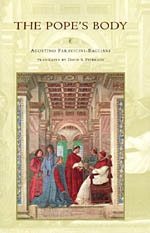
cover of The Pope's Body

The Pope's Body

Agostino Paravicini-Bagliani

University of Chicago Press, 2000

In contrast to the role traditionally fulfilled by secular rulers, the pope has been perceived as an individual person existing in a body subject to decay and death, yet at the same time a corporeal representation of Christ and the Church, eternity and salvation. Using an array of evidence from the eleventh through the fifteenth centuries, Agostino Paravicini- Bagliani addresses this paradox. He studies the rituals, metaphors, and images of the pope's body as they developed over time and shows how they resulted in the expectation that the pope's body be simultaneously physical and metaphorical. Also included is a particular emphasis on the thirteenth century when, during the pontificate of Boniface VIII (1294-1303), the papal court became the focus of medicine and the natural sciences as physicians devised ways to protect the pope's health and prolong his life.

Masterfully translated from the Italian, this engaging history of the pope's body provides a new perspective for readers to understand the papacy, both historically and in our own time.
[more]
cover of The Practice of Catholic Theology

The Practice of Catholic Theology

Paul J. Griffiths

Catholic University of America Press, 2016
In The Practice of Catholic Theology: A Modest Proposal, Paul J. Griffiths has written a how-to book for Catholic theologians that will both instruct beginners and challenge long-time practitioners to sharpen their understanding of their craft. He defines Catholic theology as the practice of thinking, speaking, and writing about the God of Christian confession; so understood, it's something that anyone can learn to do. Personal sanctity is not required, but as with any other practice, practitioners of this beautiful and elevated thought-performance need to know some things and to develop some skills in order to be able to perform it.
[more]
cover of The Predestination of Humans: Augustinus, <i>Tome III, Book IX</i>

The Predestination of Humans

Augustinus, <i>Tome III, Book IX</i>

Cornelius Jansen

Catholic University of America Press, 2022
No other theological text polarized the early modern Catholic world as much as Cornelius Jansen's Augustinus. In it the erudite bishop not only reconstructed St. Augustine's teaching on grace and free will, but also boldly claimed that his views were in line with the Council of Trent and the Society of Jesus. For Jansen the latter had marginalized the Church Father's doctrine on divine predestination by overemphasizing human free will. Published after his death in 1640, Jansen's work drew a large crowd of followers and inspired an Augustinian reform movement. Its papal condemnation unintentionally spread this theology, but stifled an impassionate, academic engagement with the Augustinus. This first-ever translation of some of its central chapters enables historians, philosophers and theologians to finally engage with the founding text of Jansenism.
[more]
cover of The Priesthood, Mystery of Faith: Priestly Ministry in the Magisterium of John Paul II

The Priesthood, Mystery of Faith

Priestly Ministry in the Magisterium of John Paul II

Nilson Leal de Sa, CB

Catholic University of America Press, 2022
After almost twenty-seven years of his pontificate, what was John Paul II’s legacy regarding the ministerial priesthood? What answers did he give to the questions still surrounding this reality today? Nilson Leal de Sá, CB, examines the pontiff’s twenty-seven letters of Holy Thursday addressed annually to the priests. Unlike some papal documents, which are drafted by many hands, these letters to priests were born of a personal initiative, wherein the pope spoke ab imo pectore (from the depths of his heart), giving a little of himself and his thought. Cardinal Georges-Marie Cottier, theologian emeritus of the Pontifical House and a connoisseur of the texts of the Holy Father, has confirmed that “the Letters of Holy Thursday were written by John Paul II himself.” Leal de Sá has sought in the diversity of the letters of Holy Thursday the major points of the thought of John Paul II on this important topic. The first chapter dwells on the sources of his teaching and emphasizes his use of the Word of God, Tradition, and the conciliar Magisterium. These foundations are the basis of the second chapter, which highlights the priestly identity in the life of the Church. Finally, the third chapter elucidates the specific mission of the priest. The Priesthood, Mystery of Faith presents itself as a real and stimulating synthesis of John Paul II’s thought about the ministerial priesthood in a systematic way. It renews us in the appreciation of the inestimable gift that God makes to the whole Church through the sacrament of the Holy Orders.
[more]
cover of The Quest for God and the Good Life

The Quest for God and the Good Life

Mark T. Miller

Catholic University of America Press, 2013
Throughout this introductory text, progress, decline, and redemption constitute a systematic framework for examining the central terms of Catholic theology, as well as key notions in Lonergan's theology. The book provides a firm foundation for students of Lonergan as well as anyone interested in understanding Catholic theology and applying it to ministry, education, and other fields.
[more]
cover of The Regensburg Lecture

The Regensburg Lecture

James V. Schall, S.J.

St. Augustine's Press, 2007
[more]
cover of The Sacramental Theology of Marriage: One Flesh in One Spirit

The Sacramental Theology of Marriage

One Flesh in One Spirit

Jose Granados

Catholic University of America Press, 2026
The Sacramental Theology of Marriage offers a comprehensive vision of the dogmatic theology of marriage. It takes into account biblical and patristic sources, the teaching of the Magisterium (with particular emphasis on the Councils of Trent and Vatican II), and the most important contemporary theological contributions. It begins with a vision of the sacrament of mar­riage as the sacrament that integrates the order of creation into the order of sacraments. This dual dimension of marriage justifies the division of the book into two parts: marriage as a sacrament of creation and marriage as a sacrament of redemption instituted by Christ. To describe the coordinates of marriage in creation, the book refers to St. Augustine (the goods of marriage), St. Thomas Aquinas (the ends of marriage), and modern personalism as re­flected in the Second Vatican Council (the gifts of marriage). The book also draws on the theology of St. Bonaventure, who emphasized the institution of marriage by God in creation. The presentation of marriage as a sacrament of the new law is rooted in the way Christ lived the various meanings of the body. Marriage’s foundation in the body and in the experience of love sheds new light on the key milestones of its sacramentality: its matter and form, its signification, the grace it transmits, its liturgy and ministers, its indissolubil­ity, its role in building up the Church, and the path of holiness it opens to the spouses. In all of this, marriage emerges as a pivotal sacrament for articulating Christianity’s relationship to the cosmos and to society. The Sacramental The­ology of Marriage includes modern philosophical and theological explorations of the language of the body and the meaning of love (including the proposal of St. John Paul II). It also outlines the main principles for the pastoral care of marriage and family.
[more]
cover of The September Six and the Struggle for the Soul of Mormonism

The September Six and the Struggle for the Soul of Mormonism

Patterson, Sara M.

Signature Books, 2023

In the single month of September 1993, the Church of Jesus Christ of Latter-day Saints excommunicated or disciplined six of its members. These six individuals–some of them intellectuals, some activists, and some both–were soon dubbed the “September Six.” In The September Six and the Struggle for the Soul of Mormonism, Sara M. Patterson challenges readers to think more deeply about the events of that month and the era in which they unfolded. Patterson argues that the clever alliterative phrase “September Six” masks our ability to see that what happened that month was part of a much broader, decades-long cultural and theological debate over the nature of the church and its restoration narrative. During those decades the institutional church invested in and policed a purity system, expecting believers to practice doctrinal, familial, and bodily purity. Dissenters within the institution pushed back, imagining instead a vision of the Restoration that embraced personal conscience, truth-seeking and telling, and social egalitarianism at its core. Both sides were profoundly shaped by the cultural milieu that surrounded them. What happened in September 1993 continues to echo in the church today, having lasting effects on the institution, its believers, and the broader culture.
[more]