94 books match the query 'Economy' and 39 start with t
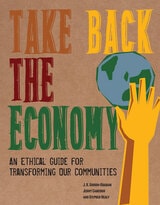
cover of Take Back the Economy: An Ethical Guide for Transforming Our Communities

Take Back the Economy

An Ethical Guide for Transforming Our Communities

J. K. Gibson-Graham

University of Minnesota Press, 2013


In the wake of economic crisis on a global scale, more and more people are reconsidering their role in the economy and wondering what they can do to make it work better for humanity and the planet. In this innovative book, J. K. Gibson-Graham, Jenny Cameron, and Stephen Healy contribute complex understandings of economics in practical terms: what can we do right now, in our own communities, to make a difference?


Full of exercises, thinking tools, and inspiring examples from around the world, Take Back the Economy shows how people can implement small-scale changes in their own lives to create ethical economies. There is no manifesto here, no one prescribed model; rather, readers are encouraged and taught how to take back the economy in ways appropriate for their own communities and context, using what they already have at hand.


Take Back the Economy dismantles the idea that the economy is separate from us and best comprehended by experts. Instead, the authors demonstrate that the economy is the outcome of the decisions and efforts we make every day. The economy is thus reframed as a space of ethical action—something we can shape and alter according to what is best for the well-being of people and the planet. The book explores what people are already doing to build ethical economies, presenting these deeds as mutual concerns: What is necessary for survival, and what do we do with the surplus produced beyond what will fulfill basic needs? What do we consume, and how do we preserve and replenish the commons—those resources that can be shared to maintain all? And finally, how can we invest in a future worth living in?


Suitable for activists and students alike, Take Back the Economy will be of interest to anyone seeking a more just, sustainable, and equitable world.

[more]
cover of Tax Policy and the Economy, Volume 22

Tax Policy and the Economy, Volume 22

Edited by James M. Poterba

University of Chicago Press Journals, 2008
Tax Policy and the Economy publishes current academic research findings on taxation and government spending that have both immediate bearing on policy debates and longer-term interest. Volume 22 includes issues related to savings through tax-deferred retirement programs, consumer choice on high-deductible health plans, financial aid applications and the tax filing process, and recent developments in corporate income tax reform in the European Union and possible implications for the United States.
[more]
cover of Tax Policy and the Economy, Volume 23

Tax Policy and the Economy, Volume 23

Edited by James M. Poterba

University of Chicago Press Journals, 2009

Tax Policy and the Economy publishes current academic research findings on taxation and government spending that have both immediate bearing on policy debates and longer-term interest. The articles in Volume 23 address a range of topics, including Social Security, understanding corporate tax losses, the influence of globalization on the design of a tax system, and the question of whether federal provision of goods and services crowds out their provision by lower levels of government or the private sector.
[more]
cover of Tax Policy and the Economy, Volume 24

Tax Policy and the Economy, Volume 24

Edited by Jefferey R. Brown

University of Chicago Press Journals, 2010

Tax Policy and the Economy publishes current academic research findings on taxation and government spending that have both immediate bearing on policy debates and longer-term interest. The papers in this volume range from topics as broad as the relative efficacy of tax cuts versus spending increases as a form of economic stimulus to a targeted analysis of the Low Income Housing Tax Credit. Also included are two papers at that examine different aspects of policies designed to provide fiscal stimulus, as well as an examination of the effects of recent reforms in the Earned Income Tax Credit.
[more]
cover of Tax Policy and the Economy, Volume 25

Tax Policy and the Economy, Volume 25

Edited by Jeffrey R. Brown

University of Chicago Press Journals, 2011
In light of the very public debate on the federal budget this year between Democrats and Republicans, the economic ramifications of tax policy are now more than ever a focus of national attention. Tax Policy and the Economy, Volume 25 is thus an invaluable tool, publishing current academic research findings on taxation and government spending, which informs important policy debates with rigorous economic analysis. The papers in Volume 25 include a review of current fuel economy taxation; research on implicit taxes on work from Social Security and Medicare; an analysis on how future increases in aggregate health care expenditures will impact future tax rates required to support Medicare and Medicaid; and two papers that analyze the implications of large and sustained budget deficits on the economy.
[more]
cover of Tax Policy and the Economy, Volume 26

Tax Policy and the Economy, Volume 26

Edited by Jeffrey R. Brown

University of Chicago Press Journals, 2012
There is no question that the US is facing significant fiscal challenges. Tax Policy and the Economy research papers make valuable contributions to our understanding of the economic effects of alternative approaches. The papers collected in Volume 26 include a study of an important determinant of the labor supply effects of Social Security; an examination of the budgetary and economic impact of changing how employer health insurance is treated in the tax code; an analysis of how US investment in Europe might be impacted by proposed corporate tax reform in the European Union; a look at the term “tax expenditures,” often used to describe governmental policies that show as reduction in taxes rather than as an increase in spending. The final paper in the volume shows how uncertainty about the restoration of US fiscal balance imposes additional efficiency costs on the economy in consumption, saving, labor supply and portfolio decisions, and how it reduces individual welfare.
[more]
cover of Tax Policy and the Economy, Volume 27

Tax Policy and the Economy, Volume 27

Edited by Jeffrey R. Brown

University of Chicago Press Journals, 2013
Taxation policy was a central part of the policy debates over the “fiscal cliff.” Given the importance of fiscal issues, it is vital for rigorous empirical research to inform the policy dialogue.  In keeping with the NBER’s tradition of carrying out rigorous but policy-relevant research, Volume 27 of Tax Policy and the Economy offers insights on a number of key tax policy questions.  This year's volume features six papers by leading scholars who examine the tax treatment of tuition at private K-12 schools, the potential streamlining of the federal rules for post-secondary financial aid and the use of tax return information in this process, the effect of tax and benefit programs on incentives to work, the macroeconomic effects of fiscal adjustments, and the set of factors that contributed to the weakening US fiscal outlook in the last decade.
[more]
cover of Tax Policy and the Economy, Volume 28

Tax Policy and the Economy, Volume 28

Edited by Jeffrey R. Brown

University of Chicago Press Journals, 2014
The papers in Volume 28 of Tax Policy and the Economy illustrate the depth and breadth of the research by NBER research associates who study taxation and government spending programs.  The first paper explores whether closely held firms are used as tax shelters. The second examines the taxation of multinational corporations. The third discusses the taxation of housing, focusing on the ways in which current income tax rules may affect location and consumption decisions and lead to economic inefficiencies. The fourth paper offers an historical perspective on the political economy of gasoline taxes, with a particular focus on the response to the oil shocks of the early 1970s. The fifth and final paper uses the tools of financial economics to estimate the unfunded liabilities of the Pension Benefit Guaranty Corporation.
[more]
cover of Tax Policy and the Economy, Volume 29

Tax Policy and the Economy, Volume 29

Edited by Jeffrey R. Brown

University of Chicago Press Journals, 2016
The papers in Volume 29 of Tax Policy and the Economy illustrate the depth and breadth of the taxation-related research by NBER research associates, both in terms of methodological approach and in terms of topics.  In the first paper, former NBER President Martin Feldstein estimates how much revenue the federal government could raise by limiting tax expenditures in various ways, such as capping deductions and exclusions. The second paper, by George Bulman and Caroline Hoxby, makes use of a substantial expansion in the availability of education tax credits in 2009 to study whether tax credits have a significant causal effect on college attendance and related outcomes. In the third paper, Casey Mulligan discusses how the Affordable Care Act (ACA) introduces or expands taxes on income and on full-time employment. In the fourth paper, Bradley Heim, Ithai Lurie, and Kosali Simon focus on the “young adult” provision of the ACA that allows young adults to be covered by their parents’ insurance policies. They find no meaningful effects of this provision on labor market outcomes.  The fifth paper, by Louis Kaplow, identifies some of the key conceptual challenges to analyzing social insurance policies, such as Social Security, in a context where shortsighted individuals fail to save adequately for their retirement. 
[more]
cover of Tax Policy and the Economy, Volume 30

Tax Policy and the Economy, Volume 30

Edited by Jeffrey R. Brown

University of Chicago Press Journals, 2016
The research papers in Volume 30 of Tax Policy and the Economy make significant contributions to the academic literature in public finance and provide important conceptual and empirical input to policy design. In the first paper, Gerald Carlino and Robert Inman consider whether state-level fiscal policies create spillovers for neighboring states and how federal stimulus can internalize these externalities. The second paper, by Nathan Hendren, presents a new framework for evaluating the welfare consequences of tax policy changes and explains how the key parameters needed to implement this framework can be estimated. The third paper, a collaborative effort by several academic and US Treasury economists, documents the dramatic increase in pass-through businesses, including partnerships and S-corporations, over the last thirty years.  It notes that these entities now generate more than half of all US business income. The fourth paper examines property tax compliance using a pseudo-randomized experiment in Philadelphia, in which those who owed taxes received supplemental letters regarding their tax delinquency. The research explores what types of communication lead to higher rates of tax payment. In the fifth paper, Jeffrey Clemens discusses cross-program budgetary spillovers of minimum wage regulations. Severin Borenstein and Lucas Davis, the authors of the sixth paper, study the distributional effects of income tax credits for clean energy.
[more]
cover of Tax Policy and the Economy, Volume 31

Tax Policy and the Economy, Volume 31

Edited by Robert A. Moffitt

University of Chicago Press Journals, 2017
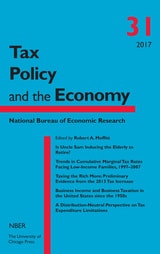
The papers in Tax Policy and the Economy Volume 31 are all directly related to important and often long-standing issues, often including how transfer programs affect tax rates and behavior. In the first paper, Alan Auerbach, Laurence Kotlikoff, Darryl Koehler, and Manni Yu take a lifetime perspective on the marginal tax rates facing older individuals and families arising from a comprehensive set of sources. In the second, Gizem Kosar and Robert A. Moffitt provide new estimates of the cumulative marginal tax rates facing low-income families over the period 1997-2007. In the third paper, Emmanuel Saez presents evidence on the elasticity of taxable income with respect to tax rates, drawing on data from the 2013 federal income tax reform.  In the fourth, Conor Clarke and Wojciech Kopczuk survey the treatment of business income taxation in the United States since the 1950s, providing new data on how business income and its taxation have evolved over time.  In the fifth paper, Louis Kaplow argues that the reduction in statutory tax rates from base-broadening may not reduce effective marginal tax rates on households. 
 
[more]
cover of Tax Policy and the Economy, Volume 33

Tax Policy and the Economy, Volume 33

Edited by Robert A. Moffitt

University of Chicago Press Journals, 2019
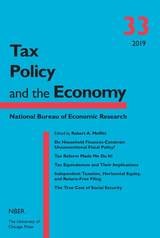
This volume presents five new studies on taxation and government transfer programs.  Alexander Blocker, Laurence Kotlikoff, Stephen Ross, and Sergio Villar Vallenas show how asset pricing can be used to value implicit fiscal debts, which are currently rarely measured or adjusted for risk, while accounting for risk properties.  They apply their methodology to study Social Security.  Michelle Hanson, Jeffrey Hoopes, and Joel Slemrod examine the effects of the Tax Cuts and Jobs Act on corporation behavior and on firms’ statements about their behavior.  They focus on for four outcomes: bonuses, investment, share repurchases, and dividends. Scott Baker, Lorenz Kueng, Leslie McGranahan, and Brian Melzer explore whether “unconventional” fiscal policy in the form of pre-announced consumption tax changes can shift durables purchases intertemporally, how it such shifts are affected by consumer credit.  Alan Auerbach discusses “tax equivalences,” disparate sets of policies that have the same economic effects, and also illustrates when these equivalences break down.  Jeffrey Liebman and Daniel Ramsey use data from NBER’s TAXSIM model to investigate the equity implications of a switch from joint to independent taxation that could occur in conjunction with adoption of return-free tax filing.
[more]
cover of Tax Policy and the Economy, Volume 34

Tax Policy and the Economy, Volume 34

Edited by Robert A. Moffitt

University of Chicago Press Journals, 2020
This volume presents five new studies on current topics in taxation and government spending.  Mark Shepard, Katherine Baicker, and Jonathan Skinner explore implementation aspects of a Medicare-for-All program, which provides a uniform health insurance benefit to everyone, and contrast it with a program providing a basic benefit that can be supplemented voluntarily. John Beshears, James Choi, Mark Iwry, David John, David Laibson, and Brigitte Madrian examine the design and feasibility of firm-sponsored “rainy day funds,” short-term savings accounts for employees that can be used when faced with temporary periods of high expenditure. Robert Barro and Brian Wheaton investigate the impact of taxation on choice of corporate form, on the formation and legal structure of new businesses, and indirectly on productivity in the economy. Jonathan Meer and Benjamin Priday examine the impact of the 2017 federal income tax reform, which reduced marginal tax rates and the incentive for charitable giving, on such giving. Finally, Casey Mulligan analyzes the impact of the Affordable Care Act on whether firms employ fewer than 50 employees, the employment threshold below which they are exempt from the requirement to provide health insurance to their employees.
[more]
cover of Tax Policy and the Economy, Volume 35

Tax Policy and the Economy, Volume 35

Edited by Robert A. Moffitt

University of Chicago Press Journals, 2021
This volume presents six new studies on current topics in taxation and government spending. The first study looks at the costs of income tax filing, which have risen over time because of the numerous tax forms families have to fill out when filing their taxes and because of increased costs of itemizing deductions, and explores ways to simplify filing and reduce those costs. The second study investigates the design of income tax schedules when there is uncertainty about the way taxation affects household behavior. The third study provides new and comprehensive estimates of the impact of the US Earned Income Tax Credit on the employment of low-income men and women, finding that the large majority of the various expansions of that credit over the last forty years have increased employment of single mothers. The fourth study reviews the structure of business taxation in China and describes a number of tax distortions and potential inefficiencies in the system. The next paper considers how the Affordable Care Act has affected the health insurance and labor market choices of individuals who are between the ages of 60 and 64, and it finds increases in insurance coverage and reductions in employment for some groups. The last study considers how reimbursement rates for health care providers under various government insurance programs affect providers’ willingness to take on new patients and expand their patient capacity.
 
[more]
cover of Tax Policy and the Economy, Volume 36

Tax Policy and the Economy, Volume 36

Edited by Robert A. Moffitt

University of Chicago Press Journals, 2022

This volume presents five new studies on current topics in taxation and government spending.  
Natasha Sarin, Lawrence Summers, Owen Zidar, and Eric Zwick study how investors respond to taxes on capital gains, whether their incentives to invest are affected by those taxes, and whether that responsiveness has changed over time. Ethan Rouen, Suresh Nallareddy, and Juan Carlos Suárez Serrato revisit the question of whether cuts to corporate taxes increase income inequality, bringing new data and new statistical techniques to generate fresh findings. Alan Auerbach and William Gale investigate whether the advantages and disadvantages of different types of taxation are affected when interest rates stay low for long periods, as has been the case in the U.S. for many years. Nora Gordon and Sarah Reber study the distributional impact of emergency subsidies to schools made by the federal government during the recent COVID pandemic and whether those subsidies were sufficient to cover the increased school costs induced by the pandemic. Jacob Goldin, Elaine Maag, and Katherine Michelmore investigate the fiscal cost of an expansion of the U.S. child tax credit, which has been discussed extensively in policy circles recently. They take into account not only the direct expenditure on the allowance but how cost is affected by the existence of work incentives and by possible beneficial effects on childrens’ adult earnings.
[more]
cover of Tax Policy and the Economy, Volume 37

Tax Policy and the Economy, Volume 37

Edited by Robert A. Moffitt

University of Chicago Press Journals, 2023

Timely and authoritative research on the latest issues in tax policy.

Tax Policy and the Economy publishes current academic research on taxation and government spending with both immediate bearing on policy debates and longer-term interest.

This volume of Tax Policy and the Economy presents new research on important issues concerning US taxation and transfers. First, Edward L. Glaeser, Caitlin S. Gorback, and James M. Poterba examine the distribution of burdens associated with taxes on transportation. Replacing the gasoline tax with a vehicle-miles-traveled (VMT) tax would increase the burden on higher-income households, who drive more fuel-efficient cars and are more likely to own electric vehicles. User charges for airports, subways, and commuter rail are progressive, while the burden of bus fees is larger for lower-income households than for their higher-income counterparts. Next, Katarzyna Bilicka, Michael Devereux, and Irem Güçeri investigate tax shifting by multinational companies (MNCs) and the implications of a potential Global Minimum Tax (GMT). They find that MNCs shift intellectual property to tax havens, and that a large share of patenting activity takes place in tax havens where little or no R&D occurs. Tax havens are particularly important for MNCs with large subsidiary networks; such firms would likely be subject to a GMT. Mark Duggan, Audrey Guo, and Andrew C. Johnston study the role of experience rating in the Unemployment Insurance (UI) system and find that the current structure stabilizes the labor market because it penalizes firms with high rates of UI-eligible layoffs. In the fourth paper, David Altig, Laurence J. Kotlikoff, and Victor Yifan Ye calculate how retiring at different ages will affect Social Security benefit amounts, taking into account taxation and other benefits. They find that virtually all individuals aged 45 to 62 should wait until age 65 or later to maximize their Social Security benefits. Indeed, 90 percent would benefit from waiting until age 70, but only 10 percent do so. Finally, Jonathan Meer and Joshua Witter examine the potential impact of the Earned Income Tax Credit on the labor force decisions of childless adults who are eligible for a small credit after they reach age 25. Comparing labor force attachment changes just before and after this age suggests that the EITC has little impact on the labor force participation of this group.
[more]
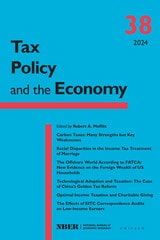
cover of Tax Policy and the Economy, Volume 38

Tax Policy and the Economy, Volume 38

Edited by Robert A. Moffitt

University of Chicago Press Journals, 2024

Timely and authoritative research on the latest issues in tax policy.

Tax Policy and the Economy publishes current academic research on taxation and government spending with both immediate bearing on policy debates and longer-term interest.

This volume presents new research on taxation and public expenditure programs, with particular focus on how they affect economic behavior. John Guyton, Kara Leibel, Dayanand Manoli, Ankur Patel, Mark Payne, and Brenda Schafer study the disallowance of Earned Income Tax Credit (EITC) benefits as a result of IRS audits, and find that in post-audit years, audited taxpayers are less likely than similar non-audited taxpayers to claim EITC benefits. Janet Holtzblatt, Swati Joshi, Nora Cahill, and William Gale provide new empirical evidence on racial differences in the income tax penalty, or bonus, associated with a couple being married. Haichao Fan, Yu Liu, Nancy Qian, and Jaya Wen evaluate how computerizing value-added tax transactions in China affected the tax revenue collected from large manufacturing firms. Niels Johannesen, Daniel Reck, Max Risch, Joel Slemrod, John Guyton, and Patrick Langetieg study data on the ownership of foreign bank accounts and other financial accounts as reported on income tax returns. They find that many of these accounts are in tax havens, and they discuss the impact of the Foreign Account Tax Compliance Act on tax compliance and government revenue. Louis Kaplow integrates charitable giving into an optimal income tax framework, and shows that the externalities associated with such giving are key to determining its optimal tax treatment. Finally, Roger Gordon compares caps or quantity targets on emissions with carbon taxes and points out that which one dominates can be situation-specific and depend on a number of features of the economy.
[more]
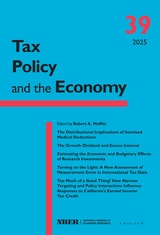
cover of Tax Policy and the Economy, Volume 39

Tax Policy and the Economy, Volume 39

Edited by Robert A. Moffitt

University of Chicago Press Journals, 2025

Timely and authoritative research on the latest issues in tax policy.

Tax Policy and the Economy publishes current academic research on taxation and government spending with both immediate bearing on policy debates and longer-term interest. This volume highlights new insights on taxation, transfer programs, and related issues. First, analyzing the itemized medical deduction in the US federal income tax, Gopi Shah Goda, Ithai Lurie, Priyanka Parikh, and Chelsea Swete find that this provision disproportionately benefits higher-income taxpayers, particularly after the passage of the 2017 Tax Cuts and Jobs Act. They also consider alternative structures, such as a tax credit, that could make the distribution of the tax benefits for those with high medical outlays more equal. Next, Danny Yagan analyzes factors influencing the US federal budget deficit and the debt-to-GDP ratio. He describes the "growth dividend," the impact of GDP growth on the debt ratio, and warns about the potential costs of high debt-to-GDP ratios, especially when interest rates rise. In the third paper, Theresa Gullo, Benjamin Page, David Weiner, and Heidi Williams synthesize the economic evidence on the economic and budgetary effects of R&D investment and examine how this evidence could be incorporated into the standard projections generated by various federal agencies. Fourth, Rosanne Altshuler, Lysle Boller, and Juan Carlos Suárez Serrato investigate profit shifting by US multinational corporations and evaluate the importance of aggregation errors in reported foreign earnings and on estimates of profit shifting elasticities based on these data. Finally, David Neumark and Zeyu Li find no employment effect of California’s Earned Income Tax Credit on less-skilled single mothers, in contrast with the effects of federal and other states' programs. They suggest that structural differences and interactions with minimum wage laws explain this result.
[more]
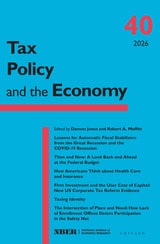
cover of Tax Policy and the Economy, Volume 40

Tax Policy and the Economy, Volume 40

Edited by Damon Jones and Robert A. Moffitt

University of Chicago Press Journals, 2026

Timely and authoritative research on the latest issues in tax policy.

Tax Policy and the Economy publishes current academic research on taxation and government spending with both immediate bearing on policy debates and longer-term interest.

This volume presents new research on taxation, transfer programs, and related issues. Karen Dynan and Douglas Elmendorf examine the potential impact of automatic fiscal stabilizers on fiscal policy and economic activity. They find that a stabilizer providing direct payments could have produced faster unemployment decline after the Great Recession without raising inflation and much lower inflation after COVID-19 at the cost of a slower unemployment reduction. Alan J. Auerbach and William Gale review federal budget history and project the US debt-to-GDP ratio over the next 30 years, arguing that high projected debt could constrain future policy actions. They also explore possible fiscal consolidation policies. Beatrice Ferrario and Stefanie Stantcheva survey Americans’ views of health care and insurance, finding broad agreement regarding costs, access, and efficiency but partisan gaps in policy preferences stemming from fundamentally different views of government scope rather than contrasting efficiency or fairness beliefs. Jonathan S. Hartley, Kevin A. Hassett, and Joshua D. Rauh analyze the corporate investment response to the Tax Cut and Jobs Act of 2017, finding a larger response than a number of earlier studies of investment sensitivity would have suggested. Joel Slemrod reviews historical taxation based on racial, religious, and gender identity and examines how tax policies that are not conditioned on any of these attributes can nevertheless differentially impact families as a result of systemic differences in their economic circumstances. Finally, Marianne Bitler, Jason Cook, Chloe N. East, Sonya R. Porter, and Laura Tiehen analyze geographic proximity effects on Supplemental Nutrition Assistance Program (SNAP) participation, finding that when a SNAP office opens, participation increases by about 20%. When an office closes, they find that participation drops by about 8% in the next two years.
[more]
cover of Tax Policy and the Economy: Volume 32

Tax Policy and the Economy

Volume 32

Edited by Robert A. Moffitt

University of Chicago Press Journals, 2018
The six research studies in Volume 32 of Tax Policy and the Economy analyze the U.S. tax and transfer system, in particular its effects on revenues, expenditures, and economic behavior. First, James Andreoni examines donor advised funds, which are financial vehicles offered by investment houses to provide savings accounts for tax-free charitable giving, and weighs their effects on donations against their tax cost. Second, Caroline Hoxby analyzes the use of tax credits by students enrolled in online post-secondary education. Third, Alex Rees-Jones and Dmitry Taubinsky explore taxpayers’ psychological biases that lead to incorrect perceptions and understanding of tax incentives. Fourth, Jeffrey Clemens and Benedic Ippolito investigate the implications of block grant reforms of Medicaid for receipt of federal support by different states. Fifth, Andrew Samwick examines means-testing of Medicare and federal health benefits under the Affordable Care Act. Sixth, Bruce Meyer and Wallace Mok study the incidence and effects of disability among U.S. women from 1968 to 2015, examining the impacts of disability on income, consumption, and public transfers.
[more]
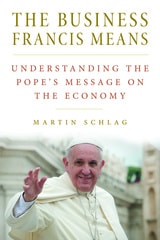
cover of The Business Francis Means: Understanding the Pope's Message on the Economy

The Business Francis Means

Understanding the Pope's Message on the Economy

Martin Schlag

Catholic University of America Press, 2017

Pope Francis, generally speaking, has thus far chosen to concentrate his papacy on social justice issues, as opposed to doctrinal or liturgical issues. This has led to Francis being hailed as a hero to many on the left, while it has made some conservative supporters of St. John Paul II and Pope Emeritus Benedict XVI disappointed and uncomfortable, even as they love and appreciate his person and gestures of mercy and compassion. Some find his teachings difficult to embrace, especially those concerning business and the economy. Pope Francis has spoken of building bridges as part of what it is to be Christian, but aspects of his message seem to be just constructing walls between the Holy Father and groups of the faithful.

The Business Francis Means aims to break through these walls, showing that Pope Francis has something to say to all Christians. His message, taken as a whole, keeps us from dividing the “seamless garment” of Christ: he reminds the conservatives of the problems of inequality and poverty, and the liberals that social justice is not enough – the Church is the bride of Christ, not a social institution or an NGO.

Monsignor Martin Schlag summarizes and explains the message of Pope Francis on business and the economy in this compact volume. The Business Francis Means will be of great interest to the Catholic layperson, especially one involved in political or economic life.
[more]
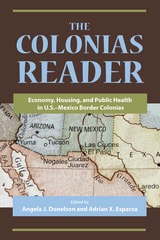
cover of The Colonias Reader: Economy, Housing and Public Health in U.S.-Mexico Border Colonias

The Colonias Reader

Economy, Housing and Public Health in U.S.-Mexico Border Colonias

Edited by Angela J. Donelson and Adrian X. Esparza

University of Arizona Press, 2010

The colonias of the U.S.–Mexico border form a loose network of more than 2,500 settlements, ranging in size from villages to cities, that are home to over a million people. While varying in size, all share common features: wrenching poverty, substandard housing, and public health issues approaching crisis levels. This book brings together scholars, professionals, and activists from a wide range of disciplines to examine the pressing issues of economic development, housing and community development, and public and environmental health in colonias of the four U.S.–Mexico border states.

The Colonias Reader is the first book to present such a broad overview of these communities, offering a glimpse into life in the colonias and the circumstances that allow them to continue to exist—and even grow—in persistent poverty. The contributors document the depth of existing problems in each state and describe how government agencies, nongovernmental organizations, and community activists have mobilized resources to overcome obstacles to progress.

More than reporting problems and documenting programs, the book provides conceptual frameworks that tie poverty to institutional and class-based conflicts, and even challenges the very basis of colonia designations. Most of these contributions move beyond portraying border residents as hapless victims of discrimination and racism, showing instead their devotion to improving their own living conditions through grassroots organizing and community leadership.

These contributions show that, despite varying degrees of success, all colonia residents aspire to a livable wage, safe and decent housing, and basic health care. The Colonias Reader showcases many situations in which these people have organized to fulfill these ambitions and provides new insight into life along the border.
[more]
cover of The Economy and Material Culture of Russia, 1600-1725

The Economy and Material Culture of Russia, 1600-1725

Richard Hellie

University of Chicago Press, 1999

In this extraordinary and definitive study of the Russian economy from 1600-1725, Richard Hellie offers a glimpse of the material life of the people of Muscovy during that tumultuous period—how they lived, what they ate, how they were taxed, what their wages allowed them to enjoy. Making these determinations required more than a decade of work and analysis of over 107,000 records. The resulting book devotes chapters to each category of consumer goods, in which transactions involving the product are summarized. Hellie further provides notes and commentary on the transactions to locate their place in the full Russian economy.

Impressive in scope and data analysis, Economy and Material Culture of Russia, 1600-1725 will be an invaluable resource and reference work for all readers interested in economic history and the history of material culture. Since there is no comparable one-volume work for any other society at any other time in history, Hellie's is a truly unique and profound achievement.
[more]
cover of The Economy of British West Florida, 1763-1783

The Economy of British West Florida, 1763-1783

Robin F. A. Fabel

University of Alabama Press, 1988

The untold economic story of Britain’s Gulf Coast frontier.

This is the first book-length investigation of the economy of British West Florida and the extent to which it was economically viable given that it had been an economic failure for Spain. In it, author Robin Fabel explores both the territory's economy and history but also analyzes previously neglected but key aspects of British West Florida, including the maritime life of the province, the institution of slavery, and the potentially great immigration scheme sponsored by the Company of Military Adventures.

The British divided Florida into two colonies: East Florida and West Florida. West Florida comprised the area between the Apalachicola, Chattahoochee, and Mississippi rivers, and from the Gulf of Mexico north to thirty-two degrees twenty-eight minutes north latitude, roughly the latitude of modern-day Jackson, MS and Montgomery, AL. In the geographic center of the colony were Mobile, Alabama and Pensacola, Floriday. British West Florida included parts of the states of Alabama, Florida, Louisiana, and Mississippi and existed from 1763 until 1783 at the end of the American Revolutionary War. 

Fabel contrasts the founding of Georgia, where slaves were initially excluded, with West Florida, where the slave trade became important economically. The British believed that only enslaved Blacks could labor successfully in the hot climate. Fabel gives an account of how owners employed enslaved people, how rare it was for slaves to be emancipated, and the passage of slave laws for West Florida. Fabel also explores British West Florida’s trade with Native Americans and the Caribbean islands, as well as the colony's relationships with neighboring Spanish and French communities.

Fabel's work offers an engaging and accessible account of the history of an expansive region of colonial North America during a fluid period of colonial history before American independence.
 

[more]
cover of The Economy of Character: Novels, Market Culture, and the Business of Inner Meaning

The Economy of Character

Novels, Market Culture, and the Business of Inner Meaning

Deidre Shauna Lynch

University of Chicago Press, 1998

At the start of the eighteenth century, talk of literary "characters" referred as much to letters and typefaces as it did to persons in books. Yet by the nineteenth century, characters had become the equals of their readers, friends with whom readers might spend time and empathize.

Although the story of this shift is usually told in terms of the "rise of the individual," Deidre Shauna Lynch proposes an ingenious alternative interpretation. Elaborating a "pragmatics of character," Lynch shows how readers used transactions with characters to accommodate themselves to newly commercialized social relations. Searching for the inner meanings of characters allowed readers both to plumb their own inwardness and to distinguish themselves from others. In a culture of mass consumption, argues Lynch, possessing a belief in the inexpressible interior life of a character rendered one's property truly private.

Ranging from Defoe and Smollett to Burney and Austen, Lynch's account will interest students of the novel, literary historians, and anyone concerned with the inner workings of consumer culture and the history of emotions.
[more]
cover of The Economy of Communist China, 1949–1969

The Economy of Communist China, 1949–1969

Cheng Chu-yuan

University of Michigan Press, 1971
Economic development in mainland China during the first two decades of Communist control provides a typical example for the difficult task to transform a vast underdeveloped agrarian economy into a modern industrial one. In the first half of this period, a series of massive transformations of social and economic institutions was accompanied by a drafted industrialization program; the result was an impressive speed-up in economic growth. The second decade witnessed an economic crisis (1960–62) and a political upheaval (1966–68). These disruptions marred the economic performance over the period as a whole. Consequently, the long-term growth rate appears to have been only moderate.
The Economy of Communist China reviews selected aspects of the economy. After examining the development strategy, it analyzes the quantitative trends and the structural changes. The book goes on to analyze the key factors contributing to the earlier growth and the elements responsible for the later disruption and finally assesses the impact of the Cultural Revolution on the Chinese economy and the prospects of the current Third Five-Year Plan.
The text includes a bibliography of selected materials on Chinese economic development.
[more]
cover of The Economy of Glory: From Ancien Régime France to the Fall of Napoleon

The Economy of Glory

From Ancien Régime France to the Fall of Napoleon

Robert Morrissey

University of Chicago Press, 2013

From the outset of Napoleon’s career, the charismatic Corsican was compared to mythic heroes of antiquity like Achilles, and even today he remains the apotheosis of French glory, a value deeply embedded in the country’s history. From this angle, the Napoleonic era can be viewed as the final chapter in the battle of the Ancients and Moderns. In this book, Robert Morrissey presents a literary and cultural history of glory and its development in France and explores the “economy of glory” Napoleon sought to implement in an attempt to heal the divide between the Old Regime and the Revolution.
 
Examining how Napoleon saw glory as a means of escaping the impasse of Revolutionary ideas of radical egalitarianism, Morrissey illustrates the challenge the leader faced in reconciling the antagonistic values of virtue and self-interest, heroism and equality. He reveals that the economy of glory was both egalitarian, creating the possibility of an aristocracy based on merit rather than wealth, and traditional, being deeply embedded in the history of aristocratic chivalry and the monarchy—making it the heart of Napoleon’s politics of fusion. Going beyond Napoleon, Morrissey considers how figures of French romanticism such as Chateaubriand, Balzac, and Hugo constantly reevaluated this legacy of glory and its consequences for modernity. Available for the first time in English, The Economy of Glory is a sophisticated and beautifully written addition to French history.
[more]
cover of The Economy of Modern Israel: Malaise and Promise

The Economy of Modern Israel

Malaise and Promise

Assaf Razin and Efraim Sadka

University of Chicago Press, 1993

In this up-to-date study of the Israeli economy, Assaf Razin and Efraim Sadka cover the entire economic history of the state, focusing on links between Israel's economic growth, its integration into world markets, its tax and welfare systems, and the political conflicts in the Middle East.

The authors present the first detailed economic analysis of the Palestinian uprising, showing how the unrest has led to a fall in Arab employment in Israel and serious economic loss to the occupied territories with some loss to Israel. They also examine how the uprising has affected Israel's financial standing internationally and the inflow of foreign aid.

Razin and Sadka see promise for Israel's economy in the waves of immigration from the former Soviet Union, despite the current difficulties in absorbing the immigrants; in the coexistence of a flourishing and highly competitive private sector with a relatively large public sector, which is undergoing privatization; and in a tax structure that encourages long-term saving and business growth. By examining the interplay between the exchange rate, interest rates, and monetary and anti-inflation policies, the authors investigate the possibilities for renewed growth and conclude that the future of Israel's economy crucially depends on serious efforts to secure peace in the Middle East.
[more]
cover of The Economy of Prostitution in the Roman World: A Study of Social History and the Brothel

The Economy of Prostitution in the Roman World

A Study of Social History and the Brothel

Thomas A. J. McGinn

University of Michigan Press, 2004

In recent years, a number of classical scholars have turned their attention to prostitution in the ancient world. Close examination of the social and legal position of Roman meretrices and Greek hetairai have enriched our understanding of ancient sexual relationships and the status of women in these societies. These studies have focused, however, almost exclusively on the legal and literary evidence.
McGinn approaches the issues from a new direction, by studying the physical venues that existed for the sale of sex, in the context of the Roman economy. Combining textual and material evidence, he provides a detailed study of Roman brothels and other venues of venal sex (from imperial palaces and privates houses to taverns, circuses, and back alleys) focusing on their forms, functions, and urban locations.
The book covers the central period of Roman history, roughly from 200 B.C. to A.D. 250. It will especially interest social and legal historians of the ancient world, and students of gender, sexuality, and the family.
Thomas A. J. McGinn is Associate Professor of Classical Studies at Vanderbilt University.
[more]
cover of The Iconoclastic Imagination: Image, Catastrophe, and Economy in America from the Kennedy Assassination to September 11

The Iconoclastic Imagination

Image, Catastrophe, and Economy in America from the Kennedy Assassination to September 11

Ned O'Gorman

University of Chicago Press, 2015

Bloody, fiery spectacles—the Challenger disaster, 9/11, JFK’s assassination—have given us moments of catastrophe that make it easy to answer the “where were you when” question and shape our ways of seeing what came before and after. Why are these spectacles so packed with meaning?

In The Iconoclastic Imagination, Ned O’Gorman approaches each of these moments as an image of icon-destruction that give us distinct ways to imagine social existence in American life. He argues that the Cold War gave rise to crises in political, aesthetic, and political-aesthetic representations. Locating all of these crises within a “neoliberal imaginary,” O’Gorman explains that since the Kennedy assassination, the most powerful way to see “America” has been in the destruction of representative American symbols or icons. This, in turn, has profound implications for a neoliberal economy, social philosophy, and public policy. Richly interwoven with philosophical, theological, and rhetorical traditions, the book offers a new foundation for a complex and innovative approach to studying Cold War America, political theory, and visual culture.
[more]
cover of The Living Line: Modern Art and the Economy of Energy

The Living Line

Modern Art and the Economy of Energy

Robin Veder

Dartmouth College Press, 2015
Robin Veder’s The Living Line is a radical reconceptualization of the development of late-nineteenth- and early-twentieth-century American modernism. The author illuminates connections among the histories of modern art, body cultures, and physiological aesthetics in early-twentieth-century American culture, fundamentally altering our perceptions about art and the physical, and the degree of cross-pollination in the arts. The Living Line shows that American producers and consumers of modernist visual art repeatedly characterized their aesthetic experience in terms of kinesthesia, the sense of bodily movement. They explored abstraction with kinesthetic sensibilities and used abstraction to achieve kinesthetic goals. In fact, the formalist approach to art was galvanized by theories of bodily response derived from experimental physiological psychology and facilitated by contemporary body cultures such as modern dance, rhythmic gymnastics, physical education, and physical therapy. Situating these complementary ideas and exercises in relation to enduring fears of neurasthenia, Veder contends that aesthetic modernism shared industrial modernity’s objective of efficiently managing neuromuscular energy. In a series of finely grained and interconnected case studies, Veder demonstrates that diverse modernists associated with the Armory Show, the Société Anonyme, the Stieglitz circle (especially O’Keeffe), and the Barnes Foundation participated in these discourses and practices and that “kin-aesthetic modernism” greatly influenced the formation of modern art in America and beyond. This daring and completely original work will appeal to a broad audience of art historians, historians of the body, and American culture in general.
[more]
cover of The Moneywasting Machine: Five Months Inside Serbia‘s Ministry of Economy

The Moneywasting Machine

Five Months Inside Serbia‘s Ministry of Economy

Dusan Pavlovic

Central European University Press, 2022

For five months in 2013–2014, Dušan Pavlović took time off from teaching to accept a senior position in Serbia’s Ministry of Economy. This short period was long enough for him to make a penetrating diagnosis of the economic activity of the postcommunist government. He found that a coterie of tycoons and politicians live off the wealth of the majority of citizens and smaller entrepreneurs, while the economy performs below its capacities. In academic terms, extractive economic institutions create allocative inefficiency.

Vivid, suggestive, and even entertaining accounts depict how privatization is administered and foreign investment projects are handled, and how party members, relatives, and friends are hired into public administration and state-owned companies. They show how the managers of firms that queue for state subsidies resist the systematic screening of their businesses. The principles of Keynesian economics are distorted and misused to conceal deliberate fiscal mismanagement. Huge ill-conceived development projects siphon taxpayers’ money from “non-economic” activities like social services, health, education, science, and culture.

What Pavlović found in Serbia is acutely symptomatic of many other European post-communist regimes of our time, lending his book singular importance.
[more]
cover of The New Chinese America: Class, Economy, and Social Hierarchy

The New Chinese America

Class, Economy, and Social Hierarchy

Zhao, Xiaojian

Rutgers University Press, 2010

The 1965 Immigration Act altered the lives and outlook of Chinese Americans in fundamental ways. The New Chinese America explores the historical, economic, and social foundations of the Chinese American community, in order to reveal the emergence of a new social hierarchy after 1965.

In this detailed and comprehensive study of contemporary Chinese America, Xiaojian Zhao uses class analysis to illuminate the difficulties of everyday survival for poor and undocumented immigrants and analyzes the process through which social mobility occurs. Through ethnic ties, Chinese Americans have built an economy of their own in which entrepreneurs can maintain a competitive edge given their access to low-cost labor; workers who are shut out of the mainstream job market can find work and make a living; and consumers can enjoy high quality services at a great bargain. While the growth of the ethnic economy enhances ethnic bonds by increasing mutual dependencies among different groups of Chinese Americans, it also determines the limits of possibility for various individuals depending on their socioeconomic and immigration status.
[more]
cover of The Politics of India under Modi: An Introduction to India’s Democracy, Economy, and Foreign Policy

The Politics of India under Modi

An Introduction to India’s Democracy, Economy, and Foreign Policy

Vikash Yadav and Jason A. Kirk

Lever Press, 2023

Since the right-wing, Hindu-nationalist government of Narendra Modi’s Bharatiya Janata Party (BJP) came to power at the national level in 2014, and with its consolidation of power in the 2019 general election, India has witnessed a significant realignment of its national politics and a shift toward the right of the political spectrum. The Politics of India under Modi provides a detailed overview of India’s political trends, economic prospects, and international relations in the twenty-first century.

This book is designed as a supplement and update for existing syllabi that trace India’s political economy from the birth of the republic to the quest for economic liberalization and great power status. Undergraduates and scholars interested in India’s foreign policy and political reform will find value in this timely book.

“The subject of this book is extremely compelling and important, as well as timely. BJP rule and the Modi regime, it is now clear, represent some critical turning points in Indian politics, which have yet to be analyzed in depth academically by experts. I see this book as a key first step in this process.”
-Rina Verma Williams, School of Public and International Affairs at the University of Cincinnati
[more]
cover of The Politics of Value: Three Movements to Change How We Think about the Economy

The Politics of Value

Three Movements to Change How We Think about the Economy

Jane L. Collins

University of Chicago Press, 2017

The Great Recession not only shook Americans’ economic faith but also prompted powerful critiques of economic institutions. This timely book explores three movements that gathered force after 2008: the rise of the benefit corporation, which requires social responsibility and eschews share price as the best metric for success; the emergence of a new group, Slow Money, that fosters peer-to-peer investing; and the 2011 Wisconsin protests against a bill restricting the union rights of state workers.

Each case shows how the concrete actions of a group of citizens can prompt us to reflect on what is needed for a just and sustainable economic system. In one case, activists raised questions about the responsibilities of business, in the second about the significance of local economies, and in the third about the contributions of the public sector. Through these movements, Jane L. Collins maps a set of cultural conversations about the types of investments and activities that contribute to the health of the economy. Compelling and persuasive, The Politics of Value offers a new framework for viewing economic value, one grounded in thoughtful assessment of the social division of labor and the relationship of the state and the market to civil society.
[more]
cover of The Power at the End of the Economy

The Power at the End of the Economy

Brian Massumi

Duke University Press, 2015
Rational self-interest is often seen as being at the heart of liberal economic theory. In The Power at the End of the Economy Brian Massumi provides an alternative explanation, arguing that neoliberalism is grounded in complex interactions between the rational and the emotional. Offering a new theory of political economy that refuses the liberal prioritization of individual choice, Massumi emphasizes the means through which an individual’s affective tendencies resonate with those of others on infra-individual and transindividual levels. This nonconscious dimension of social and political events plays out in ways that defy the traditional equation between affect and the irrational. Massumi uses the Arab Spring and the Occupy Movement as examples to show how transformative action that exceeds self-interest takes place. Drawing from David Hume, Michel Foucault, Gilles Deleuze, Niklas Luhmann and the field of nonconsciousness studies, Massumi urges a rethinking of the relationship between rational choice and affect, arguing for a reassessment of the role of sympathy in political and economic affairs.
[more]
cover of The Sociology of the Economy

The Sociology of the Economy

Frank Dobbin

Russell Sage Foundation, 2004

The new economic sociology is based on the theory that patterns of economic behavior are shaped by social factors. The Sociology of the Economy brings together a dozen path-breaking empirical studies that explore how social forces—such as shifts in political power, the influence of social networks, or the spread of new economic ideas—shape real-world economic behavior. The contributors—all leading economic sociologists—show these social forces at work in a diverse range of international settings and historical circumstances. Examining why so many American banks followed industry leaders into foreign markets in the 1970s, only to pull back within a few years, Mark Mizruchi and Gerald Davis suggest that social emulation rather than rational calculation led banks to expand globally before there was any evidence that foreign offices paid off. William Schneper and Mauro Guillé show that despite the international diffusion of the hostile takeover during the last twenty years, the practice became widespread only in countries with political institutions conducive to buying and selling entire companies. Thus during the 1990s, the United States and United Kingdom. saw hundreds of hostile takeover bids, while Germany had only a handful, and Japan just one. Deborah Davis explores resistance to the globalization of Western ideas about real-estate ownership—particularly in China where the government has had little success in instituting a market system in place of traditional, family-based real-estate inheritance. And Richard Scott examines the controversial rise of managed care in the American healthcare system, as the quest for market efficiency collided with the ideal of equity in access to health care. Together, these studies provide compelling evidence that economic behavior is not ruled by immutable laws, and is but one realm of social behavior, with its own conventions, roles, and social structures. The Sociology of the Economy demonstrates the vitality of empirical research in the field of economic sociology and the power of sociological models in explaining how markets operate.
[more]
cover of The Sonoran Desert: Its Geography, Economy, and People

The Sonoran Desert

Its Geography, Economy, and People

Roger Dunbier

University of Arizona Press, 1968

Although possessing a common physical heritage, the Sonoran Desert has taken on highly contrasting forms in its American and Mexican portions. This work does not, therefore, attempt a regional study in the usual sense of the term, but is rather an examination of disparate economic development, much influenced by contrasting technological achievements as well as the accidents of history.

Although the significance of geographic regionalism is implicit throughout this study, no attempt is made to show any overriding unity at work, geographical or otherwise, welding together a "desert region." Instead the desert acts as a stage for social drama in which drought and extreme heat provide the essential backcloth. The scarcity of water and man's inability to grow crops without irrigation have not, indeed, changed with time, and only constant reference to this immutable factor can give meaning to the evolution of human activities within the desert.

[more]
cover of Transforming Cities and Minds through the Scholarship of Engagement: Economy, Equity, and Environment

Transforming Cities and Minds through the Scholarship of Engagement

Economy, Equity, and Environment

Lorlene Hoyt

Vanderbilt University Press, 2013

Written by engaged scholars and practitioners, Transforming Minds and Cities is an "instrument-for-action" on the problems faced by U.S. cities that have suffered from decades of disinvestment. The book advocates the concept of reciprocal knowledge: real learning on both sides, campus and city, through a complex network of human relationships.

Across the country from Camden to Oakland, the contributors engaged with community partners--hospitals, churches, community development corporations, community foundations, and other rooted institutions--to help restore old cities to life. Their collaborative thesis project engaged them with one another and university staff; it may offer a new paradigm for graduate education.

[more]