Results by title
218 books match the query 'Education, Higher' and 50 start with t
The Adjunct Underclass
How America’s Colleges Betrayed Their Faculty, Their Students, and Their MissionHerb Childress
University of Chicago Press, 2019
Welcome to the life of the mind in the gig economy. Over the past few decades, the job of college professor has been utterly transformed—for the worse. America’s colleges and universities were designed to serve students and create knowledge through the teaching, research, and stability that come with the longevity of tenured faculty, but higher education today is dominated by adjuncts. In 1975, only thirty percent of faculty held temporary or part-time positions. By 2011, as universities faced both a decrease in public support and ballooning administrative costs, that number topped fifty percent. Now, some surveys suggest that as many as seventy percent of American professors are working course-to-course, with few benefits, little to no security, and extremely low pay.
In The Adjunct Underclass, Herb Childress draws on his own firsthand experience and that of other adjuncts to tell the story of how higher education reached this sorry state. Pinpointing numerous forces within and beyond higher ed that have driven this shift, he shows us the damage wrought by contingency, not only on the adjunct faculty themselves, but also on students, the permanent faculty and administration, and the nation. How can we say that we value higher education when we treat educators like desperate day laborers?
Measured but passionate, rooted in facts but sure to shock, The Adjunct Underclass reveals the conflicting values, strangled resources, and competing goals that have fundamentally changed our idea of what college should be. This book is a call to arms for anyone who believes that strong colleges are vital to society.

The African Experience with Higher Education
J. F. Ade Ajayi
Ohio University Press, 1996
There have been institutions of higher learning for centuries in Africa, but the phenomenal growth has taken place in the last fifty years, first in the later days of colonialism and then in the heady days of independence and commodity boom. Without them, there would have been no development.
The three highly distinguished authors have written the first comprehensive assessment of universities and higher education in Africa south of the Sahara. As can be seen from their biographies, they draw on experience from both francophone and anglophone Africa and from teaching in both the sciences and the arts.
The Aims of Higher Education
Problems of Morality and JusticeEdited by Harry Brighouse and Michael McPherson
University of Chicago Press, 2015
The contributors tackle the biggest questions in higher education: What are the proper aims of the university? What role do the liberal arts play in fulfilling those aims? What is the justification for the humanities? How should we conceive of critical reflection, and how should we teach it to our students? How should professors approach their intellectual relationship with students, both in social interaction and through curriculum? What obligations do elite institutions have to correct for their historical role in racial and social inequality? And, perhaps most important of all: How can the university serve as a model of justice? The result is a refreshingly thoughtful approach to higher education and what it can, and should, be doing.
The American College in the Nineteenth Century
Roger L. Geiger
Vanderbilt University Press, 2000
At the end of the eighteenth century, just eighteen colleges existed in the United States, with an average enrollment of fewer than seventy. One hundred years later, over 450 American colleges and universities boasted enrollments up more than one hundredfold. The role of educational institutions in the life of the nation had been utterly transformed.
As the bridge between the two eras, the nineteenth-century college has been among the most controversial subjects in the history of American higher education. While earlier historians portrayed the "old-time" college as an impediment to modernization, later scholars affirmed the broad role of the colleges in the education of the American people.
The American College in the Nineteenth Century combines the best recent scholarship with an interpretive introduction to provide a fresh view of the development of American colleges. The contributors consider these institutions within four new contexts: first, the dramatic transformation in the college students' experience from oppressive discipline to relative freedom; second, the regional variations among the developing American colleges (for example, a South dominated by state colleges, a Midwest by denominational schools); third, the revolution in the century's third quarter as colleges became multipurpose institutions; and fourth, universities that became dominant by the end of the century, incorporating rather than displacing the colleges.
Innovative in its examination of the nature and function of these uniquely American institutions, The American College in the Nineteenth Century is a vital addition to the scholarship of the period.
Contributors: David B. Potts, Leon Jackson, Julie Ann Bubolz, Michael Sugrue, James Findlay, Margaret A. Nash, Peter Dobkin Hall, James Turner, Paul Bernard, and Willard J. Pugh.
The American University of Beirut
Arab Nationalism and Liberal EducationBy Betty S. Anderson
University of Texas Press, 2011
Since the American University of Beirut opened its doors in 1866, the campus has stood at the intersection of a rapidly changing American educational project for the Middle East and an ongoing student quest for Arab national identity and empowerment. Betty S. Anderson provides a unique and comprehensive analysis of how the school shifted from a missionary institution providing a curriculum in Arabic to one offering an English-language American liberal education extolling freedom of speech and analytical discovery.
Anderson discusses how generations of students demanded that they be considered legitimate voices of authority over their own education; increasingly, these students sought to introduce into their classrooms the real-life political issues raging in the Arab world. The Darwin Affair of 1882, the introduction of coeducation in the 1920s, the Arab nationalist protests of the late 1940s and early 1950s, and the even larger protests of the 1970s all challenged the Americans and Arabs to fashion an educational program relevant to a student body constantly bombarded with political and social change. Anderson reveals that the two groups chose to develop a program that combined American goals for liberal education with an Arab student demand that the educational experience remain relevant to their lives outside the school's walls. As a result, in eras of both cooperation and conflict, the American leaders and the students at the school have made this American institution of the Arab world and of Beirut.
The American University
How It Runs, Where It Is GoingJacques Barzun
University of Chicago Press, 1992
"American higher education is fortunate to have had a scholar and intellectual of Jacques Barzun's stature give so many years of service to the daily bread-and-butter details of running a great university and then share his reflections with us in a literate, humane, and engaging book."—Charles Donovan, America
The Autocratic Academy
Reenvisioning Rule within America's UniversitiesTimothy V. Kaufman-Osborn
Duke University Press, 2023
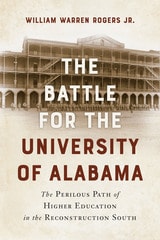
The Battle for the University of Alabama
The Perilous Path of Higher Education in the Reconstruction SouthWilliam Warren Rogers, Jr.
University of Alabama Press, 2025
Traces the little-known story of the bitter contest for the fate of the University of Alabama after the Civil War.
In The Battle for the University of Alabama, William Warren Rogers Jr. gives a fascinating account of the fierce struggle over the nature of the University of Alabama after the Civil War. Union forces reduced the campus to ruins as the war ended, and the university did not reopen until 1869. In the interregnum, powerful forces shifted the trajectory of the school. Alabama Republicans authored an egalitarian state constitution that delivered oversight of the university to the Republican Party. That set the stage for turmoil and confrontation. This book tells the story of that conflict.
In the next few years, Democrats charged Republicans with turning the university into a “radical” institution. They alleged that a handful of unqualified individuals had gained faculty positions because of their political allegiance, which resulted in the university’s academic desecration. Professors were bitterly denounced in the state newspaper press and quite personally in Tuscaloosa. Administration of the university became part of the fratricidal political debate in the state. Political violence and questions concerning race, specifically the possible integration of the university, illuminated the controversies of the Reconstruction years. Many of these questions resonate even today.
This authoritative account sets events at the University of Alabama against the backdrop of what occurred at other state universities in the Reconstruction South. The University of North Carolina experienced controversy similar to Alabama’s. At the University of Georgia, however, calm prevailed. This story of the incendiary events at Alabama’s flagship university charts new ground and provides a revelatory look into the extraordinary partisanship that characterized the South after the Civil War.
The Calling of Education
"The Academic Ethic" and Other Essays on Higher EducationEdward Shils
University of Chicago Press, 1997
Edward Shils understood the university as a great symphonic conductor comprehends the value of each instrument and section, both separately and in cooperation. The Calling of Education offers Shils's insightful perspective on problems that are no less pressing than when he first confronted them.
Edward Shils (1910-1995) was distinguished service professor in the Committee on Social Thought and the department of sociology at the University of Chicago. Among his many books published by the University of Chicago Press are Portraits: A Gallery of Intellectuals and the three-volume Selected Papers of Edward Shils.
The Channels of Student Activism
How the Left and Right Are Winning (and Losing) in Campus Politics TodayAmy J. Binder and Jeffrey L. Kidder
University of Chicago Press, 2022
The past six years have been marked by a contentious political atmosphere that has touched every arena of public life, including higher education. Though most college campuses are considered ideologically progressive, how can it be that the right has been so successful in mobilizing young people even in these environments?
As Amy J. Binder and Jeffrey L. Kidder show in this surprising analysis of the relationship between political activism on college campuses and the broader US political landscape, while liberal students often outnumber conservatives on college campuses, liberal campus organizing remains removed from national institutions that effectively engage students after graduation. And though they are usually in the minority, conservative student groups have strong ties to national right-leaning organizations, which provide funds and expertise, as well as job opportunities and avenues for involvement after graduation. Though the left is more prominent on campus, the right has built a much more effective system for mobilizing ongoing engagement. What’s more, the conservative college ecosystem has worked to increase the number of political provocations on campus and lower the public’s trust in higher education.
In analyzing collegiate activism from the left, right, and center, The Channels of Student Activism shows exactly how politically engaged college students are channeled into two distinct forms of mobilization and why that has profound consequences for the future of American politics.
The Community-Based PhD
Complexities and Triumphs of Conducting CBPREdited by Sonya Atalay and Alexandra McCleary
University of Arizona Press, 2022
The Community-Based PhD brings together the experiences of PhD students from a range of disciplines discussing CBPR in the arts, humanities, social sciences, public health, and STEM fields. They write honestly about what worked, what didn’t, and what they learned. Essays address the impacts of extended research time frames, why specialized skill sets may be needed to develop community-driven research priorities, the value of effective relationship building with community partners, and how to understand and navigate inter- and intra-community politics.
This volume provides frameworks for approaching dilemmas that graduate student CBPR researchers face. They discuss their mistakes, document their successes, and also share painful failures and missteps, viewing them as valuable opportunities for learning and pushing the field forward. Several chapters are co-authored by community partners and provide insights from diverse community perspectives. The Community-Based PhD is essential reading for graduate students, scholars, and the faculty who mentor them in a way that truly crosses disciplinary boundaries.
Contributors: Anna S. Antoniou, Amy Argenal, Sonya Atalay, Stacey Michelle Chimimba Ault, Victoria Bochniak, Megan Butler, Elias Capello, Ashley Collier-Oxandale, Samantha Cornelius, Annie Danis, Earl Davis, John Doyle, Margaret J. Eggers, Cyndy Margarita García-Weyandt, R. Neil Greene, D. Kalani Heinz, Nicole Kaechele, Myra J. Lefthand, Emily Jean Leischner, Christopher B. Lowman, Geraldine Low-Sabado, Alexandra G. Martin, Christine Martin, Alexandra McCleary, Chelsea Meloche, Bonnie Newsom, Katherine L. Nichols, Claire Novotny, Nunanta (Iris Siwallace), Reidunn H. Nygård, Francesco Ripanti, Elena Sesma, Eric Simons, Cassie Lynn Smith, Tanupreet Suri, Emery Three Irons, Arianna Trott, Cecilia I. Vasquez, Kelly D. Wiltshire, Julie Woods, Sara L. Young
The Conscience of the University, and Other Essays
By Harry Huntt Ransom
University of Texas Press, 1982
In 1982, a century after the laying of the cornerstone of its first building, the University of Texas was ranked by the New York Times among the best in the nation. No one had more to do with that extraordinary achievement than Harry Huntt Ransom. From 1935 to his death in 1976, he served the University in positions ranging from instructor in English to chancellor of The University of Texas System. In the fifties, sixties, and seventies, he held a succession of administrative posts requiring him to face a myriad of perplexing problems. Among the critical issues calling for analysis and decision in those years were the post-Sputnik pressure for greater emphasis on science and technology, the student revolts during the 1960s, and the defection of growing numbers of university faculty to industry and government.
Harry Huntt Ransom did not merely respond to the problems of the times. He had his own large ambitions for the University of Texas, in particular the improvement of student programs, the development of a vigorous faculty, and—the achievement for which he is best remembered—the building of a world-renowned library.
He was concerned with the role of the university in society, what the university should do and do well, and what it should not do. Always he viewed these matters in broad perspective, and his approach to them was far-sighted and deeply philosophical.
As dean, vice-president, president, and chancellor, Ransom wrote and spoke often on these and other important subjects. Aside from the books that he wrote and edited, he left a prodigious amount of material, some of which had been published in various journals and some of which had been delivered as lectures and addresses and never made available in printed form.
For the last twenty-five years of Ransom's life his wife, Hazel, was his closest companion and confidant. At the urging of Harry's friends, colleagues, and admirers, she undertook the task of sifting through her late husband's papers in an effort to organize and preserve some of the important contributions he had made to the thought and planning that were so instrumental in shaping the University of Texas and higher education in general. In these essays we see the force of reasoning and grace of style for which Ransom was so widely admired. It was he who reminded us that books last longer than buildings. This is a book of lasting importance that Harry Ransom himself might have given us had he lived longer.

The Culture of Digital Scholarship in Academic Libraries
Robin Chin Roemer
American Library Association, 2019
At the heart of digital scholarship are universal questions, lessons, and principles relating both to the mission of higher education and the shared values that make an academic library culture. But while global in aspirations, digital scholarship starts with local culture drawn from the community. Editors Chin Roemer and Kern invite you into their institutional workspace, the University of Washington, gathering voices from a range of positions that speak to the facets of digital scholarship. This mosaic of perspectives reveals the challenges, questions, and personalities that sit at the nexus of academic libraries and digital scholarship culture. Reflecting on UW’s approach, you’ll gain insights for your own institution on topics such as
- ways to create awareness of digital services through training;
- supporting students as creators of content;
- blending existing analog collections with ongoing digital initiatives using a media lab;
- creating a campus-wide, discipline agnostic, data repository service;
- how a popular digital storytelling workshop spawned digital scholarship across campus;
- digital scholarship consultations, viewed from an instructional technologist’s approach;
- the place of digital scholarship in the fabric of a revitalized urban community;
- four strategies for teaching research skills within an online-only bachelor’s degree program; and
- assessment findings from focus groups, surveys, digital pedagogy projects, and Omeka case studies.
By thoroughly exploring a single institution, this unique volume elucidates the many ways in which digital scholarship can express the values, priorities, opportunities, and challenges of the community’s intellectual and technical environment.
The Development of Higher Education and Social Change
Teshome Wagaw
Michigan State University Press, 1990
Begun while the author taught at the Ethiopian National University, this study examines the development of the institutions of higher education and the roles they played in transforming traditional Ethiopian society.
Wagaw sets out to prove that, although other modernizing institutions of learning may contribute significantly to social and economic change, institutions of higher education and their students already have effected profound revolution and proven indispensable to the established order.
His study argues that Ethiopian institutions of higher education were germane to the emerging society. They led Ethiopia down an often unpeaceful path from its oppressively traditional past toward progress and enlightenment.
The Diversity Bargain
And Other Dilemmas of Race, Admissions, and Meritocracy at Elite UniversitiesNatasha Warikoo
University of Chicago Press, 2016
What Warikoo uncovers—talking with both white students and students of color at Harvard, Brown, and Oxford—is absolutely illuminating; and some of it is positively shocking. As she shows, many elite white students understand the value of diversity abstractly, but they ignore the real problems that racial inequality causes and that diversity programs are meant to solve. They stand in fear of being labeled a racist, but they are quick to call foul should a diversity program appear at all to hamper their own chances for advancement. The most troubling result of this ambivalence is what she calls the “diversity bargain,” in which white students reluctantly agree with affirmative action as long as it benefits them by providing a diverse learning environment—racial diversity, in this way, is a commodity, a selling point on a brochure. And as Warikoo shows, universities play a big part in creating these situations. The way they talk about race on campus and the kinds of diversity programs they offer have a huge impact on student attitudes, shaping them either toward ambivalence or, in better cases, toward more productive and considerate understandings of racial difference.
Ultimately, this book demonstrates just how slippery the notions of race, merit, and privilege can be. In doing so, it asks important questions not just about college admissions but what the elite students who have succeeded at it—who will be the world’s future leaders—will do with the social inequalities of the wider world.
The Diversity Challenge
Social Identity and Intergroup Relations on the College CampusJames Sidanius
Russell Sage Foundation, 2008
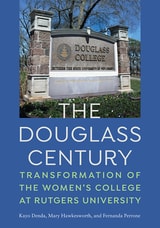
The Douglass Century
Transformation of the Women’s College at Rutgers UniversityDenda, Kayo
Rutgers University Press, 2018
The Douglass Century celebrates the college’s longevity and diversity as distinctive accomplishments, and analyzes the contributions of Douglass administrators, alumnae, and students to its survival, while also investigating multiple challenges that threatened its existence. This book demonstrates how changing historical circumstances altered the possibilities for women and the content of higher education, comparing the Jazz Age, American the Great Depression, the Second World War, the post-war Civil Rights era, and the resurgence of feminism in the 1970s and 1980s. Concluding in the present day, the authors highlight the college’s ongoing commitment to Mabel Smith Douglass’ founding vision, “to bring about an intellectual quickening, a cultural broadening in connection with specific training so that women may go out into the world fitted…for leadership…in the economic, political, and intellectual life of this nation.” In addition to providing a comprehensive history of the college, the book brings its subjects to life with eighty full-color images from the Special Collections and University Archives, Rutgers University Libraries.
The Educated Underclass
Students and the False Promise of Social MobilityGary Roth
Pluto Press, 2019
The dream of social mobility is dying. Where previous generations routinely expected to surpass their parents' level of economic success, prospects for today's young people are increasingly bleak. What role does higher education play in the process? An essential and frightening one, according to author Gary Roth.
The Educated Underclass reveals the structural problems that are helping to create this problem. Gary Roth shows how universities—touted as the best way up the economic ladder for young people—actually reproduce traditional class hierarchies. And as more graduates emerge every year into economies that are no longer creating a steady stream of stable jobs, the odds of landing one decrease—and over-educated people end up scrapping for poorly compensated positions for which they're overqualified. Chapters include:
*Higher education and class
*The overproduction of intelligence
*Class in transition: historical background
*Underemployment through the decades
*Class status and economic instability
*And more!
Roth writes in his Introduction, “Education has become an intermediary institution between a social system that habitually sputters and declines while ever-greater amounts of consumer products are dangled in front of the system’s workforce. The result: a dynamic fraught with all sort of negative possibilities, both socially and psychotically.”
A broadside against the failures of our education system and our economy, Gary Roth’s The Educated Underclass aims to startle us out of our complacency and wake us up to action.
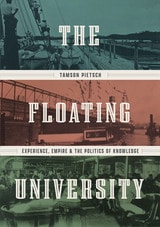
The Floating University
Experience, Empire, and the Politics of KnowledgeTamson Pietsch
University of Chicago Press, 2023
In 1926, New York University professor James E. Lough—an educational reformer with big dreams—embarked on a bold experiment he called the Floating University. Lough believed that taking five hundred American college students around the globe by ship would not only make them better citizens of the world but would demonstrate a model for responsible and productive education amid the unprecedented dangers, new technologies, and social upheavals of the post–World War I world. But the Floating University’s maiden voyage was also its last: when the ship and its passengers returned home, the project was branded a failure—the antics of students in hotel bars and port city back alleys that received worldwide press coverage were judged incompatible with educational attainment, and Lough was fired and even put under investigation by the State Department.
In her new book, Tamson Pietsch excavates a rich and meaningful picture of Lough’s grand ambition, its origins, and how it reveals an early-twentieth-century America increasingly defined both by its imperialism and the professionalization of its higher education system. As Pietsch argues, this voyage—powered by an internationalist worldview—traced the expanding tentacles of US power, even as it tried to model a new kind of experiential education. She shows that this apparent educational failure actually exposes a much larger contest over what kind of knowledge should underpin university authority, one in which direct personal experience came into conflict with academic expertise. After a journey that included stops at nearly fifty international ports and visits with figures ranging from Mussolini to Gandhi, what the students aboard the Floating University brought home was not so much knowledge of the greater world as a demonstration of their nation’s rapidly growing imperial power.
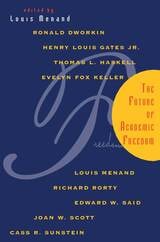
The Future of Academic Freedom
Edited by Louis Menand
University of Chicago Press, 1996
"Louis Menand has assembled The Future of Academic Freedom to better define and delineate what should and should not happen within our colleges and universities. . . . The whole extremely learned yet accessible debate exploits the freedoms it extols, tackling sensitive subjects such as ethnicity and ethics head-on."—Publishers Weekly
"The essays are not only sharp, elegant and lucid, but extremely well-informed about the history of American battles over academic freedom."—Alan Ryan, Times Higher Education Supplement
"[A] superb inquiry into some of the most vexing and significant issues in higher education today."—Zachary Karabell, Boston Book Review

The Great University Gamble
Money, Markets and the Future of Higher EducationAndrew McGettigan
Pluto Press, 2013
Displaying a stunning grasp of the financial and policy details, Andrew McGettigan surveys the emerging brave new world of higher education. He looks at the big questions: What will be the role of universities within society? How will they be funded? What kind of experiences will they offer students? Where does the public interest lie?
Written in a clear and accessible style, The Great University Gamble outlines the architecture of the new policy regime and tracks the developments on the ground. It is an urgent warning that our universities and colleges are now open to commercial pressures, which threaten to transform education from a public good into a private, individual financial investment.
The Idea and Practice of General Education
An Account of the College of the University of ChicagoThe College of the University of Chicago
University of Chicago Press, 1992
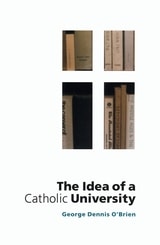
The Idea of a Catholic University
George Dennis O'Brien
University of Chicago Press, 2002
Truth is a central concept for both university and church, and O'Brien's book is built on the idea that there are different areas of truth—scientific, artistic, and religious—each with its own proper warrant and "method." In this light, he argues that one can reverse Shaw's comparison and uncover academic dogma and Christian freedom, university "infallibility" and dogmatic "fallibility."
Drawing on theology and the history of philosophy, O'Brien shows how religious truth relates to the work of a Catholic university. He then turns to the current controversies over Pope John Paul II's recent statement, Ex Corde Ecclesiae, which seeks to make Catholic universities conform to the church's official teaching office. O'Brien rejects the conventional "institutional-juridical" model used by the Vatican as improper both to faith and academic freedom. He argues for a "sacramental" model, one that respects the different kinds of "truth"—thus preserving the integrity of both church and university while making their combination in a Catholic university not only possible but desirable. O'Brien concludes with a practical consideration of how the ideal Catholic university might be expressed in the actual life of the contemporary curriculum and extracurriculum.
For anyone concerned about the place of religion in higher education, The Idea of a Catholic University will be essential reading.
The Impact of College Diversity
Struggles and Successes at Age 30Elizabeth Aries
Temple University Press, 2023
The Impact of College Diversity details how exposure to diversity in college helped shape Black and white graduates process issues of economic and racial privilege and inequality at age 30. She investigates how college diversity experiences also facilitate the attainment of upward social mobility in lower-income students and the role that mobility played in their relationships with family and friends in their home communities. Aries further examines how interactions with peers of another race and class influenced development of citizenship skills and civic engagement, as well as Black students’ ability to cope with the challenges they faced in the professional world.
Aries concludes her study with a discussion of why elite colleges have been beneficial in promoting upward mobility in lower-income students, and the importance of achieving equity and inclusion in making diversity initiatives successful.

The Inheritor
A PlayKate Bredeson and Thalia Wolff
Northwestern University Press, 2025
The first English-language translation of the 1968 activist play about inequality and access to education
In The Inheritor, surrealist imagery and experimental forms convey the radically different experience of two students, the Inheritor and the Non-Inheritor, as they prepare for a high-stakes exam. Revealing a world of privilege where “there is no such thing as luck,” the play features a beheaded knight, a talking record player, and a boisterous chorus of professors depicted as a flock of squawking birds.
Based on sociologists Pierre Bourdieu and Jean-Claude Passeron’s The Inheritors: French Students and Their Relations to Culture, the play was collectively created by Théâtre de l’Aquarium, a company then composed entirely of students. It proved a powerful success when it premiered in May 1968 amid student and worker protests in Paris, and it continues to speak forcefully to education inequity on campuses across anglophone countries today.
The Instruction Myth
Why Higher Education is Hard to Change, and How to Change ItJohn Tagg
Rutgers University Press, 2019
The Instruction Myth argues that yes, higher education can be reformed and reinvigorated, but it will not be an easy process. In fact, it will require universities to abandon their central operating principle, the belief that education revolves around instruction, easily measurable in course syllabi, credits, and enrollments. Acclaimed education scholar John Tagg presents a powerful case that instruction alone is worthless and that universities should instead be centered upon student learning, which is far harder to quantify and standardize. Yet, as he shows, decades of research have indicated how to best promote student learning, but few universities have systematically implemented these suggestions.
This book demonstrates why higher education must undergo radical change if it hopes to survive. More importantly, it offers specific policy suggestions for how universities can break their harmful dependence on the instruction myth. In this extensively researched book, Tagg offers a compelling diagnosis of what’s ailing American higher education and a prescription for how it might still heal itself.
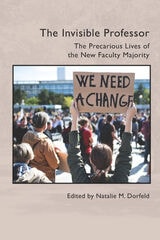
The Invisible Professor
The Precarious Lives of the New Faculty MajorityNatalie M. Dorfeld
University Press of Colorado, 2023
This edited collection, the first in the Practices & Possibilities series to be published in its Voices from the Field section, offers a rich set of narratives by writing instructors who are serving or have worked in contingent positions. Intended for anyone considering a career in the humanities, The Invisible Professor seeks to reach individuals in three phases of their careers: those thinking of entering the profession, those knee-deep in it and looking for ways to improve conditions, and those who have vacated academic positions for more humane alternative tracks.
As academia comes to a crossroads, with a disheartening shift towards a more disposable business model, multiple solutions are desperately needed. Faculty members in contingent positions are the new faculty majority on college campuses, and they are most likely the first professors students will meet. They deserve respect and a livable wage.
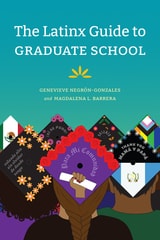
The Latinx Guide to Graduate School
Genevieve Negrón-Gonzales and Magdalena L. Barrera
Duke University Press, 2023
The Laws of Cool
Knowledge Work and the Culture of InformationAlan Liu
University of Chicago Press, 2004
The Lost Promise
American Universities in the 1960sEllen Schrecker
University of Chicago Press, 2021
The 1950s through the early 1970s are widely seen as American academia’s golden age, when universities—well-funded and viewed as essential for national security, economic growth, and social mobility—embraced an egalitarian mission. Swelling in size, schools attracted new types of students and professors, including radicals who challenged their institutions’ calcified traditions. But that halcyon moment soon came to a painful and confusing end, with consequences that still afflict the halls of ivy. In The Lost Promise, Ellen Schrecker—our foremost historian of both the McCarthy era and the modern American university—delivers a far-reaching examination of how and why it happened.
Schrecker illuminates how US universities’ explosive growth intersected with the turmoil of the 1960s, fomenting an unprecedented crisis where dissent over racial inequality and the Vietnam War erupted into direct action. Torn by internal power struggles and demonized by conservative voices, higher education never fully recovered, resulting in decades of underfunding and today’s woefully inequitable system. As Schrecker’s magisterial history makes blazingly clear, the complex blend of troubles that disrupted the university in that pivotal period haunts the ivory tower to this day.
The Making of the Modern University
Intellectual Transformation and the Marginalization of MoralityJulie A. Reuben
University of Chicago Press, 1996
Based on extensive research at eight universities—Harvard, Yale, Columbia, Johns Hopkins, Chicago, Stanford, Michigan, and California at Berkeley—Reuben examines the aims of university reformers in the context of nineteenth-century ideas about truth. She argues that these educators tried to apply new scientific standards to moral education, but that their modernization efforts ultimately failed. By exploring the complex interaction between institutional and intellectual change, Reuben enhances our understanding of the modern university, the secularization of intellectual life, and the association of scientific objectivity with value-neutrality.
The Myth of Political Correctness
The Conservative Attack on Higher EducationJohn K. Wilson
Duke University Press, 1995
The phrase "political correctness" is on everyone’s lips, on radio and television, and in newspapers and magazines. The phenomenon itself, however, has been deceptively described. Wilson steps into the nation’s favorite cultural fray to reveal that many of the most widely publicized anecdotes about PC are in fact more myth than reality. Based on his own experience as a student and in-depth research, he shows what’s really going on beneath the hysteria and alarmism about political correctness and finds that the most disturbing examples of thought policing on campus have come from the right. The image of the college campus as a gulag of left-wing totalitarianism is false, argues Wilson, created largely through the exaggeration of deceptive stories by conservatives who hypocritically seek to silence their political opponents.
Many of today’s most controversial topics are here: multiculturalism, reverse discrimination, speech codes, date rape, and sexual harassment. So are the well-recognized protagonists in the debate: Dinesh D’Souza, William Bennett, and Lynne Cheney, among others. In lively fashion and in meticulous detail, Wilson compares fact to fiction and lays one myth after another to rest, revealing the double standard that allows "conservative correctness" on college campuses to go unchallenged.
The Next Twenty-five Years
Affirmative Action in Higher Education in the United States and South AfricaDavid L. Featherman, Martin Hall, and Marvin Krislov, editors
University of Michigan Press, 2009
"Ambitious, provocative, and wide-ranging, this rich collection of essays from U.S. and South African perspectives reflects the thinking of thoughtful advocates of affirmative action."
---William G. Bowen, President Emeritus, The Andrew W. Mellon Foundation, and President Emeritus, Princeton University
"Thoughtful commentary from outstanding experts on affirmative action’s future in two countries struggling to overcome a legacy of racial injustice."
---Derek Bok, 300th Anniversary University Research Professor, and President Emeritus, Harvard University
"An enormously important comparative study and reflection on affirmative (U.S.) and corrective (South Africa) action with exhaustive and sensitive treatment of a vital topic."
---Kader Asmal, Professor of Law, University of the Western Cape, Cape Town, and former Minister of Education, South Africa
A penetrating exploration of affirmative action's continued place in 21st-century higher education, The Next Twenty-five Years assembles the viewpoints of some of the most influential scholars, educators, university leaders, and public officials. Its comparative essays span the political spectrum and dissect debates in two nations to elucidate the legal, political, social, economic, and moral dimensions of affirmative action in higher education and its role in contributing to a just, equitable, and vital society.
David L. Featherman is Professor of Sociology and Psychology and Founding Director of the Center for Advancing Research and Solutions for Society at the University of Michigan.
Martin Hall is Vice-Chancellor of the University of Salford, Greater Manchester, and previously was Deputy Vice-Chancellor at the University of Cape Town.
Marvin Krislov is President of Oberlin College and previously was Vice President and General Counsel at the University of Michigan.
The Non-Modern Crisis of the Modern University
D. Bret Leraul and Willy Thayer
Northwestern University Press, 2025
A landmark work of critical theory about the Western university from the Southern Cone
Renowned Chilean philosopher Willy Thayer’s La crisis no moderna de la universidad moderna, first published in 1996 and in an updated edition in 2019, is a landmark work of critical theory from the Southern Cone. Presented in English for the first time, The Non-Modern Crisis of the Modern University rewrites the idea of the Western university while also diagnosing the ills of postdictatorship Chile through a philosophically informed dismantling of its neoliberal institutionalization of higher education. Bret Leraul’s translation advances the vital work of globalizing critical university studies by disseminating theory from the Global South. If the university helped to construct Chile’s neoliberal society, Thayer’s polemical deconstruction of both will help readers reconstruct the cultural politics of the era to better understand the global hegemony of neoliberalism today.
The Ocean in the School
Pacific Islander Students Transforming Their UniversityRick Bonus
Duke University Press, 2020
The Opinionated University
Academic Freedom, Diversity, and the Myth of Neutrality in American Higher EducationBrian Soucek
University of Chicago Press, 2026
Can a university ever truly be neutral in today’s social and political climate? Pushing against the tide of universities increasingly pledging to stay neutral about contentious issues, law professor Brian Soucek argues that their promises are doomed to fail—universities can’t help being opinionated.
In The Opinionated University, Soucek shows that neutrality is a myth by taking a deep dive into several prominent campus controversies of the day, including diversity, equity, and inclusion (DEI) efforts and restrictions on campus speech and protest. Each issue requires universities to choose a side in what they do, if not also in what they say. In everything from curricular and admissions decisions to their response to outside rankings and their evaluation of faculty, universities express the values at the heart of their mission. Soucek argues that those pushing for neutrality are only preventing universities from standing up for their values, whether in today’s current moment of crisis or in periods of political calm.
Both timely and deeply engaging, The Opinionated University calls on universities to dispense with neutrality as a governing principle and focus instead on what their mission should be, and who should determine it.
The Politics of Research
Edited by E. Ann Kaplan and George Levine
Rutgers University Press, 1997
The Production of Living Knowledge
The Crisis of the University and the Transformation of Labor in Europe and North AmericaGigi Roggero
Temple University Press, 2011
Evaluating higher education institutions—particularly the rise of the “global university”—and their rapidly changing role in the global era, Gigi Roggero finds the system in crisis. In his groundbreaking book, The Production of Living Knowledge, Roggero examines the university system as a key site of conflict and transformation within “cognitive capitalism”—a regime in which knowledge has become increasingly central to the production process at large. Based on extensive fieldwork carried out through the activist method of conricerca, or “co-research,” wherein researchers are also subjects, Roggero’s book situates the crisis of the university and the changing composition of its labor force against the backdrop of the global economic crisis.
Combining a discussion of radical experiments in education, new student movements, and autonomist Marxian (or post-operaista) social theory, Roggero produces a distinctly transnational and methodologically innovative critique of the global university from the perspective of what he calls “living knowledge.”
In light of new student struggles in the United States and across the world, this first English-language edition is particularly timely.
The Rise of the Research University
A SourcebookEdited by Louis Menand, Paul Reitter, and Chad Wellmon
University of Chicago Press, 2017
The editors focus on the development of American universities such as Cornell, Johns Hopkins, Harvard, and the Universities of Chicago, California, and Michigan. Looking to Germany, they translate a number of seminal sources that formulate the shape and purpose of the university and place them next to hard-to-find English-language texts that took the German university as their inspiration, one that they creatively adapted, often against stiff resistance. Enriching these texts with short but insightful essays that contextualize their importance, the editors offer an accessible portrait of the early research university, one that provides invaluable insights not only into the historical development of higher learning but also its role in modern society.
The Synergistic Classroom
Interdisciplinary Teaching in the Small College SettingCorey Campion
Rutgers University Press, 2021
Written by faculty engaged in the design and delivery of interdisciplinary courses, programs, and experiential learning opportunities in the small college setting, The Synergistic Classroom addresses the many ways faculty can leverage their institutions' small size and openness to pedagogical experimentation to overcome the challenges of limited institutional resources and enrollment concerns and better prepare students for life and work in the twenty-first century. Taken together, the contributions in this volume invite reflection on a variety of important issues that attend the work of small college faculty committed to expanding student learning across disciplinary boundaries.
The Tanner Lectures on Human Values
Volume 33Mark Matheson
University of Utah Press, 2014
William G. Bowen, “Costs and Productivity in Higher Education” and “Prospects for an Online Fix: Can We Harness Technology in the Service of Our Aspirations?”
Craig Calhoun, “The Problematic Public: Revisiting Dewey, Arendt, and Habermas”
Michael Ignatieff, “Representation and Responsibility: Ethics and Public Office”
F. M. Kamm, “Who Turned the Trolley?” and “How Was the Trolley Turned?”
Claude Lanzmann, “Resurrection”
Robert Post, “Representative Democracy: The Constitutional Theory of Campaign Finance Reform” and “Campaign Finance Reform and the First Amendment”
Michael J. Sandal, “The Moral Economy of Speculation: Gambling, Finance, and the Common Good”
The Thinking Student's Guide to College
75 Tips for Getting a Better EducationAndrew Roberts
University of Chicago Press, 2010
Each fall, thousands of eager freshmen descend on college and university campuses expecting the best education imaginable: inspiring classes taught by top-ranked professors, academic advisors who will guide them to a prestigious job or graduate school, and an environment where learning flourishes outside the classroom as much as it does in lecture halls. Unfortunately, most of these freshmen soon learn that academic life is not what they imagined. Classes are taught by overworked graduate students and adjuncts rather than seasoned faculty members, undergrads receive minimal attention from advisors or administrators, and potentially valuable campus resources remain outside their grasp.
Andrew Roberts’ Thinking Student’s Guide to College helps students take charge of their university experience by providing a blueprint they can follow to achieve their educational goals—whether at public or private schools, large research universities or small liberal arts colleges. An inside look penned by a professor at Northwestern University, this book offers concrete tips on choosing a college, selecting classes, deciding on a major, interacting with faculty, and applying to graduate school. Here, Roberts exposes the secrets of the ivory tower to reveal what motivates professors, where to find loopholes in university bureaucracy, and most importantly, how to get a personalized education. Based on interviews with faculty and cutting-edge educational research, The Thinking Student’s Guide to College is a necessary handbook for students striving to excel academically, creatively, and personally during their undergraduate years.
The Three Cs of Higher Education
Competition, Collaboration and ComplementarityMark O'Hara
Central European University Press, 2019
The University and Social Justice
Struggles Across the GlobeAziz Choudry
Pluto Press, 2020
Whether calling for the decommodification or the decolonization of education, many of these struggles have attempted to draw on (and in turn, resonate with) longer histories of popular resistance, broader social movements and radical visions of a fairer world. In this critical collection, Aziz Choudry, Salim Vally and a host of international contributors bring grounded, analytical accounts of diverse struggles relating to higher education into conversation with each other.
Featuring contributions written by students and staff members on the frontline of struggles from 12 different countries, including Canada, Chile, France, India, Mexico, Nigeria, Occupied Palestine, the Philippines, South Africa, Turkey, the UK and the USA, the book asks what can be learned from these movements' strategies, demands and visions.
The University in the Twenty-first Century
Teaching the New Enlightenment in the Digital AgeHannes Klöpper
Central European University Press, 2016
The Virtues
John H. Garvey
Catholic University of America Press, 2022
The Vulnerability of Public Higher Education
Michael Bernard-Donals
The Ohio State University Press, 2023
Reduced state funding to public institutions. The removal of tenure from state statutes. Attempts to silence faculty. Michael Bernard-Donals takes on these issues and other crises in higher education in The Vulnerability of Public Higher Education, exploring how values once used to justify higher education—the democratization of knowledge, the fostering of expertise, the creation of well-informed citizens, and critical engagement with issues—have been called into question.
Bernard-Donals argues that public higher education, especially the work of faculty, has become vulnerable—socially, politically, professionally—and this book takes seriously the idea of vulnerability, suggesting that university faculty see it not as an encumbrance to their work but as an opportunity to form relations of solidarity with one another through mutual recognition and shared, albeit different forms of, precarity. Through a series of case studies on faculty rights and responsibilities, the efficacy of diversity initiatives, and tenure and academic freedom, Bernard-Donals employs a rhetorical perspective to show how vulnerability can reshape faculty work and provide ways to shift the relations of materiality and power while opening up new forms of deliberation, engagement, and knowledge production.

Tracing the Impact of First-Year Writing
Identity, Process, and Transfer at a Public UniversityLaura Wilder
Utah State University Press, 2024
In contrast to previous longitudinal studies of college writers undertaken at institutions with high prestige and resources, Tracing the Impact of First-Year Writing explores the role of writing at a regional public university and documents how students’ experiences with writing can be highly divergent across the curriculum and unequal across campuses. Additionally, this book includes the voices of students who do not identify as capable writers and have strongly negative emotional reactions to writing and writing instruction and adds empirical support to innovative calls in the field to transform the first-year writing course into one that inspires students to reflectively consider writing itself.
Transforming the Academy
Faculty Perspectives on Diversity and PedagogyWillie-LeBreton, Sarah
Rutgers University Press, 2016
Transnational Intellectual Networks
Forms of Academic Knowledge and the Search for Cultural IdentitiesEdited by Christophe Charle, Jürgen Schriewer, and Peter Wagner
Campus Verlag, 2004