Results by title
542 books match the query 'Emigration and immigration' and 107 start with t
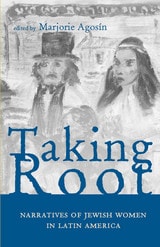
Taking Root
Narratives of Jewish Women in Latin AmericaMarjorie Agosín
Ohio University Press, 2002
In Taking Root, Latin American women of Jewish descent, from Mexico to Uruguay, recall their coming of age with Sabbath candles and Hebrew prayers, Ladino songs and merengue music, Queen Esther and the Virgin of Guadalupe. Rich and poor, Sephardi and Ashkenazi, Jewish immigrant families searched for a new home and identity in predominantly Catholic societies. The essays included here examine the religious, economic, social, and political choices these families have made and continue to make as they forge Jewish identities in the New World.
Marjorie Agosín has gathered narratives and testimonies that reveal the immense diversity of Latin American Jewish experience. These essays, based on first- and second-generation immigrant experience, describe differing points of view and levels of involvement in Jewish tradition. In Taking Root, Agosín presents us with a contemporary and vivid account of the Jewish experience in Latin America.
Taking Root documents the sadness of exile and loss but also a fierce determination to maintain Jewish traditions. This is Jewish history but it is also part of the untold history of Brazil, Argentina, El Salvador, Ecuador, Chile, Peru, and all of Latin America.
Teaching Writing through the Immigrant Story
Heather Ostman
Utah State University Press, 2021
Each of the chapters recognizes the prevalence of immigrant students in writing classrooms across the United States—including foreign-born, first- and second-generation Americans, and more—and the myriad opportunities and challenges those students present to their instructors. These contributors have seen the validity in the stories and experiences these students bring to the classroom—evidence of their lifetimes of complex learning in both academic and nonacademic settings. Like thousands of college-level instructors in the United States, they have immigrant stories of their own. The immigrant “narrative” offers a unique framework for knowledge production in which students and teachers may learn from each other, in which the ordinary power dynamic of teacher and students begins to shift, to enable empathy to emerge and to provide space for an authentic kind of pedagogy.
By engaging writing and literature teachers within and outside the classroom, Teaching Writing through the Immigrant Story speaks to the immigrant narrative as a viable frame for teaching writing—an opportunity for building and articulating knowledge through academic discourse. The book creates a platform for immigration as a writing and literary theme, a framework for critical thinking, and a foundation for significant social change and advocacy.
Contributors: Tuli Chatterji, Katie Daily-Bruckner, Libby Garland, Silvia Giagnoni, Sibylle Gruber, John Havard, Timothy Henderson, Brennan Herring, Lilian Mina, Rachel Pate, Emily Schnee, Elizabeth Stone
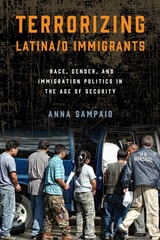
Terrorizing Latina/o Immigrants
Race, Gender, and Immigration Policy Post-9/11Anna Sampaio
Temple University Press, 2015
Immigration politics has been significantly altered by the advent of America’s war on terror and the proliferation of security measures. In her cogent study, Terrorizing Latina/o Immigrants, Anna Sampaio examines how these processes are racialized and gendered and how they impose inequitable burdens on Latina/o immigrants. She interrogates the rise of securitization, restrictive legislation, and the return of large-scale immigration raids and describes how these re-articulate and re-inscribe forms of racial and gender hierarchy.
Terrorizing Latina/o Immigrants demonstrates how the ascendance of America as a security state serves as a template to scrutinize, harass, and encumber immigrants while also reconfiguring citizenship. Sampaio uses intersectional analysis coupled with theoretical and empirical approaches to develop a critical framework for analyzing current immigration politics.
Sampaio provides a sustained and systematic examination of policy and enforcement shifts impacting Latinas/os. Her book concludes with an examination of immigration reform under the Obama administration, contrasting the promise of hope and change with the reality of increased detentions, deportations, and continued marginalization.
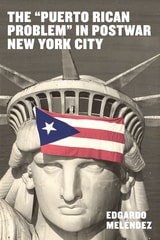
The "Puerto Rican Problem" in Postwar New York City
Edgardo Meléndez
Rutgers University Press, 2023

The Affinity of the Eye
Writing Nikkei in PeruIgnacio López-Calvo
University of Arizona Press, 2013
In The Affinity of the Eye: Writing Nikkei in Peru, Ignacio López-Calvo rises above the political emergence of the Fujimori phenomenon and uses politics and literature to provide one of the first comprehensive looks at how the Japanese assimilated and inserted themselves into Peruvian culture. Through contemporary writers’ testimonies, essays, fiction, and poetry, López-Calvo constructs an account of the cultural formation of Japanese migrant communities. With deftly sensitive interviews and comments, he portrays the difficulties of being a Japanese Peruvian. Despite a few notable examples, Asian Peruvians have been excluded from a sense of belonging or national identity in Peru, which provides López-Calvo with the opportunity to record what the community says about their own cultural production. In so doing, López-Calvo challenges fixed notions of Japanese Peruvian identity.
The Affinity of the Eye scrutinizes authors such as José Watanabe, Fernando Iwasaki, Augusto Higa, Doris Moromisato, and Carlos Yushimito, discussing their literature and their connections to the past, present, and future. Whether these authors push against or accept what it means to be Japanese Peruvians, they enrich the images and feelings of that experience. Through a close reading of literary and cultural productions, López-Calvo’s analysis challenges and reframes the parameters of being Nikkei in Peru.
Covering both Japanese issues in Peru and Peruvian issues in Japan, the book is more than a compendium of stories, characters, and titles. It proves the fluid, enriching, and ongoing relationship that exists between Peru and Japan.
The Already Dead
The New Time of Politics, Culture, and IllnessEric Cazdyn
Duke University Press, 2012
To resist the exploitative crisis state, which Cazdyn terms "the global abyss," he posits the concept of "the already dead," a condition in which the subject (medical, political, psychological) has been killed but has yet to die. Embracing this condition, he argues, allows for a revolutionary consciousness open to a utopian future. Woven into Cazdyn's analysis are personal anecdotes about his battle with leukemia and his struggle to obtain Canadian citizenship during his illness. These narratives help to illustrate his systemic critique, one that reconfigures the relationship between politics, capitalism, revolution, and the body.
The Balkan Reconquista and Turkey's Forgotten Refugee Crisis
William H. Holt
University of Utah Press, 2019
In this book, William H. Holt tells the story of a people and moment in time that has largely been neglected in modern Turkish and Balkan memory. Holt uncovers the reasons for this mass forgetting, finding context both within the development of the modern Turkish state and the workings of collective memory. Bringing together a wide array of eyewitness accounts, the book provides unprecedented detail on the plight of the Muslim refugees in their flight from Bulgaria, in Istanbul, and in their resettlement in Anatolia. In crisp, clear, and engaging prose, Holt offers an insightful analysis of human suffering and social memory.
The Battle to Stay in America
Immigration's Hidden Front LineMichael Kagan
University of Nevada Press, 2025
The Battle to Stay in America is the story of a community coming to grips with the federal government’s crackdown on immigrants, and learning how to defend itself. Informative and personal, this is a story about mothers and fathers, lawyers and activists, local police and federal agencies, and a struggle for the identity of a nation. This is the quintessential story of the war on immigrants, as fought and felt on the front lines in the heart of America.
The Border Crossed Us
Rhetorics of Borders, Citizenship, and Latina/o IdentityJosue David Cisneros
University of Alabama Press, 2013
Explores efforts to restrict and expand notions of US citizenship as they relate specifically to the US-Mexico border and Latina/o identity.
Borders and citizenship go hand in hand. Borders define a nation as a territorial entity and create the parameters for national belonging. But the relationship between borders and citizenship breeds perpetual anxiety over the purported sanctity of the border, the security of a nation, and the integrity of civic identity.
In The Border Crossed Us, Josue David Cisneros addresses these themes as they relate to the US-Mexico border, arguing that issues ranging from the Mexican-American War of 1846–1848 to contemporary debates about Latina/o immigration and border security are negotiated rhetorically through public discourse. He explores these rhetorical battles through case studies of specific Latina/o struggles for civil rights and citizenship, including debates about Mexican American citizenship in the 1849 California Constitutional Convention, 1960s Chicana/o civil rights movements, and modern-day immigrant activism.
Cisneros posits that borders—both geographic and civic—have crossed and recrossed Latina/o communities throughout history (the book’s title derives from the popular activist chant, “We didn’t cross the border; the border crossed us!”) and that Latina/os in the United States have long contributed to, struggled with, and sought to cross or challenge the borders of belonging, including race, culture, language, and gender.
The Border Crossed Us illuminates the enduring significance and evolution of US borders and citizenship, and provides programmatic and theoretical suggestions for the continued study of these critical issues.
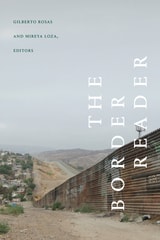
The Border Reader
Gilberto Rosas and Mireya Loza, editors
Duke University Press, 2023
Contributors. Leisy J. Abrego, Gloria E. Anzaldúa, Martha Balaguera, Lionel Cantú, Leo R. Chavez, Raúl Fernández, Rosa-Linda Fregoso, Roberto G. Gonzales, Gilbert G. González, Ramón Gutiérrez, Kelly Lytle Hernández, José E. Limón, Mireya Loza, Alejandro Lugo, Eithne Luibhéid, Martha Menchaca, Cecilia Menjívar, Natalia Molina, Fiamma Montezemolo, Américo Paredes, Néstor Rodríguez, Renato Rosaldo, Gilberto Rosas, María Josefina Saldaña-Portillo, Sonia Saldívar-Hull, Alicia Schmidt Camacho, Sayak Valencia Triana, Carlos G. Vélez-Ibáñez, Patricia Zavella
The Border Within
The Economics of Immigration in an Age of FearTara Watson and Kalee Thompson
University of Chicago Press, 2021
For decades, immigration has been one of the most divisive, contentious topics in American politics. And for decades, urgent calls for its policy reform have gone mostly unanswered. As the discord surrounding the modern immigration debate has intensified, border enforcement has tightened. Crossing harsher, less porous borders makes unauthorized entry to the United States a permanent, costly undertaking. And the challenges don’t end on the other side.
At once enlightening and devastating, The Border Within examines the costs and ends of America’s interior enforcement—the policies and agencies, including ICE, aimed at removing immigrants already living in the country. Economist Tara Watson and journalist Kalee Thompson pair rigorous analysis with deeply personal stories from immigrants and their families to assess immigration’s effects on every aspect of American life, from the labor force to social welfare programs to tax revenue. What emerges is a critical, utterly complete examination of what non-native Americans bring to the country, including immigration’s tendency to elevate the wages and skills of those who are native-born.
News coverage has prompted many to question the humanity of American immigration policies; The Border Within opens a conversation of whether it is effective. The United States spends billions each year on detention and deportation, all without economic gain and at a great human cost. With depth and discipline, the authors dissect the shock-and-awe policies that make up a broken, often cruel system, while illuminating the lives caught in the chaos. It is an essential work with far-reaching implications for immigrants and non-immigrants alike.
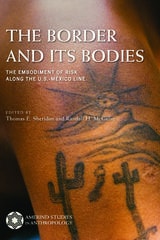
The Border and Its Bodies
The Embodiment of Risk Along the U.S.-México LineEdited by Thomas E. Sheridan and Randall H. McGuire
University of Arizona Press, 2019
The increasingly militarized U.S.-México border is an intensely physical place, affecting the bodies of all who encounter it. The essays in this volume explore how crossing becomes embodied in individuals, how that embodiment transcends the crossing of the line, and how it varies depending on subject positions and identity categories, especially race, class, and citizenship.
Timely and wide-ranging, this book brings into focus the traumatic and real impact the border can have on those who attempt to cross it, and it offers new perspectives on the effects for rural communities and ranchers. An intimate and profoundly human look at migration, The Border and Its Bodies reminds us of the elemental fact that the border touches us all.
Contributors
Bruce E. Anderson
Jared Beatrice
Rebecca Crocker
Jason De León
Linda Green
Randall H. McGuire
Shaylih Muehlmann
Robin Reineke
Olivia T. Ruiz Marrujo
David Seibert
Thomas E. Sheridan
Angela Soler
Ruth M. Van Dyke
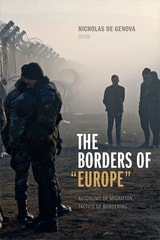
The Borders of "Europe"
Autonomy of Migration, Tactics of BorderingNicholas De Genova, editor
Duke University Press, 2017
Contributors. Ruben Andersson, Nicholas De Genova, Dace Dzenovska, Evelina Gambino, Glenda Garelli, Charles Heller, Clara Lecadet, Souad Osseiran, Lorenzo Pezzani, Fiorenza Picozza, Stephan Scheel, Maurice Stierl, Laia Soto Bermant, Martina Tazzioli
The Borders of America
Migration, Control, and Resistance Across Latin America and the CaribbeanSoledad Álvarez Velasco, Nicholas De Genova, Gustavo Dias, and Eduardo Domenech, editors
Duke University Press, 2026
Contributors. Soledad Álvarez Velasco, Tanya Basok, Janneth Clavijo, Nicholas De Genova, Gustavo Dias, Eduardo Domenech, Roberto Dufraix-Tapia, Jonathan Echeverri Zuluaga, Valentina Glockner Fagetti, Luin Goldring, Patricia Landolt, Carolina Moulin, Margarita Luz Núñez Chaim, Juan Ordóñez, Daniel Quinteros, Romina Ramos, Martha Rojas-Wiesner, Fabio Santos, Amarela Varela-Huerta, and Laura Velasco Ortiz
The Borders of Inequality
Where Wealth and Poverty CollideÍñigo Moré
University of Arizona Press, 2011
In this fascinating book, originally published in Spain to much acclaim, researcher Íñigo Moré looks at the bigger picture. With a professionally trained eye, he examines the world’s “top twenty most unequal borders.” What he finds is that many of these border situations share similar characteristics. There is always illegal immigration from the poor country to the wealthy one. There is always trafficking in illegal substances. And the unequal neighbors usually regard each other with suspicion or even open hostility.
After surveying the “top twenty,” Moré explores in depth the cases of three borders: between Germany and Poland, Spain and Morocco, and the United States and Mexico. The core problem, he concludes, is not drugs or immigration or self-protection. Rather, the problem is inequality itself. Unequal borders result, he writes, from a skewed interaction among markets, people, and states. Using these findings, Moré builds a useful new framework for analyzing border dynamics from a quantitative view based on economic inequality.
The Borders of Inequality illustrates how longstanding “multidirectional misunderstandings” can exacerbate cross-border problems—and consequent public opinion. Perpetuating these misunderstandings can inflame and complicate the situation, but purposeful efforts to reduce inequality can produce promising results.
The Borders of Responsibility
Migration Control in the Mediterranean SeaKiri Olivia Santer
Duke University Press, 2026
The Browning of the New South
Jennifer A. Jones
University of Chicago Press, 2019
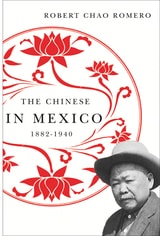
The Chinese in Mexico, 1882-1940
By Robert Chao Romero
University of Arizona Press, 2010
Robert Romero argues that Chinese immigrants turned to Mexico as a new land of economic opportunity after the passage of the U.S. Chinese Exclusion Act of 1882. As a consequence of this legislation, Romero claims, Chinese immigrants journeyed to Mexico in order to gain illicit entry into the United States and in search of employment opportunities within Mexico’s developing economy. Romero details the development, after 1882, of the “Chinese transnational commercial orbit,” a network encompassing China, Latin America, Canada, and the Caribbean, shaped and traveled by entrepreneurial Chinese pursuing commercial opportunities in human smuggling, labor contracting, wholesale merchandising, and small-scale trade.
Romero’s study is based on a wide array of Mexican and U.S. archival sources. It draws from such quantitative and qualitative sources as oral histories, census records, consular reports, INS interviews, and legal documents. Two sources, used for the first time in this kind of study, provide a comprehensive sociological and historical window into the lives of Chinese immigrants in Mexico during these years: the Chinese Exclusion Act case files of the U.S. Immigration and Naturalization Service and the 1930 Mexican municipal census manuscripts. From these documents, Romero crafts a vividly personal and compelling story of individual lives caught in an extensive network of early transnationalism.

The Consequences of Counterterrorism
Martha Crenshaw
Russell Sage Foundation, 2010
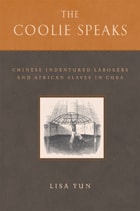
The Coolie Speaks
Chinese Indentured Laborers and African Slaves in CubaLisa Yun
Temple University Press, 2009
Introducing radical counter-visions of race and slavery, and probing the legal and philosophical questions raised by indenture, The Coolie Speaks offers the first critical reading of a massive testimony case from Cuba in 1874. From this case, Yun traces the emergence of a "coolie narrative" that forms a counterpart to the "slave narrative." The written and oral testimonies of nearly 3,000 Chinese laborers in Cuba, who toiled alongside African slaves, offer a rare glimpse into the nature of bondage and the tortuous transition to freedom. Trapped in one of the last standing systems of slavery in the Americas, the Chinese described their hopes and struggles, and their unrelenting quest for freedom.
Yun argues that the testimonies from this case suggest radical critiques of the "contract" institution, the basis for free modern society. The example of Cuba, she suggests, constitutes the early experiment and forerunner of new contract slavery, in which the contract itself, taken to its extreme, was wielded as a most potent form of enslavement and complicity. Yun further considers the communal biography of a next-generation Afro-Chinese Cuban author and raises timely theoretical questions regarding race, diaspora, transnationalism, and globalization.
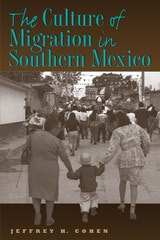
The Culture of Migration in Southern Mexico
By Jeffrey H. Cohen
University of Texas Press, 2004
Migration is a way of life for many individuals and even families in the Mexican state of Oaxaca. Some who leave their rural communities go only as far as the state capital, while others migrate to other parts of Mexico and to the United States. Most send money back to their communities, and many return to their homes after a few years. Migration offers Oaxacans economic opportunities that are not always available locally—but it also creates burdens for those who stay behind.
This book explores the complex constellation of factors that cause rural Oaxacans to migrate, the historical and contemporary patterns of their migration, the effects of migration on families and communities, and the economic, cultural, and social reasons why many Oaxacans choose not to migrate. Jeffrey Cohen draws on fieldwork and survey data from twelve communities in the central valleys of Oaxaca to give an encompassing view of the factors that drive migration and determine its outcomes. He demonstrates conclusively that, while migration is an effective way to make a living, no single model can explain the patterns of migration in southern Mexico.
The Cybernetic Border
Drones, Technology, and IntrusionIván Chaar López
Duke University Press, 2024
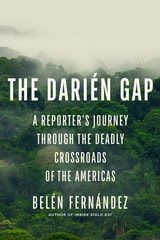
The Darién Gap
A Reporter's Journey through the Deadly Crossroads of the AmericasBelén Fernández
Rutgers University Press, 2025
The narrow Darién Gap, the only land bridge connecting South and Central America, encompasses a spectacularly hostile jungle, covered in steep mountains, dense rainforests, and flood-prone marshes. Known in Spanish as el infierno verde, or “the green hell,” it is one of the most inhospitable places in the world. Its terrain is too treacherous for roads, yet hundreds of thousands of refuge seekers contend with its horrors every year in the hopes of reaching the United States, still some three thousand miles away. And of the countless who set out for the border, an untold number never arrive.
In this book, journalist Belén Fernández travels through the Darién Gap to report on the dehumanizing and deadly stretch of land that has become a mass graveyard for migrants. Fernández’s journey brings her into contact with refuge seekers, people smugglers, law enforcement officials, and many more whose stories bring life to a place overwhelmingly associated with death. Combining history, on-the-ground reporting, travelogue, memoir, and searing politico-economic analysis, she shines light on a largely made-in-the-USA crisis that has come to define our modern era.
Engrossing and heartrending, The Darién Gap is a poignant and compassionate indictment of structural inequality and institutionalized inhumanity in a world where the have-nots must risk death for a chance at a better life—or any life at all.

The Darkest Evening
William Durbin
University of Minnesota Press, 2011
Instead of finding the utopia they were promised, Jake and his family encounter only disappointment and hardship. When Stalin’s secret police begin targeting Americans for arrest, his worst fears are confirmed, and Jake leads his family on a daring midwinter escape attempt on cross-country skis, fleeing toward the Finnish border.

The Deep Blue Memory
Monique Laxalt Urza
University of Nevada Press, 1993
The Diasporic Condition
Ethnographic Explorations of the Lebanese in the WorldGhassan Hage
University of Chicago Press, 2021
In The Diasporic Condition, Ghassan Hage engages with the diasporic Lebanese community as a shared lifeworld, defining a common cultural milieu that transcends spatial and temporal distance—a collective mode of being here termed the “diasporic condition.” Encompassing a complicated transnational terrain, Hage’s long-term ethnography takes us from Mehj and Jalleh in Lebanon to Europe, Australia, South America, and North America, analyzing how Lebanese migrants and their families have established themselves in their new homes while remaining socially, economically, and politically related to Lebanon and to each other.
At the heart of The Diasporic Condition lies a critical anthropological question: How does the study of a particular sociocultural phenomenon expand our knowledge of modes of existing in the world? As Hage establishes what he terms the “lenticular condition,” he breaks down the boundaries between “us” and “them,” “here” and “there,” showing that this convergent mode of existence increasingly defines everyone’s everyday life.
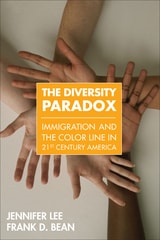
The Diversity Paradox
Immigration and the Color Line in Twenty-First Century AmericaJennifer Lee
Russell Sage Foundation, 2010
The Economic Sociology of Immigration
Essays on Networks, Ethnicity, and EntrepreneurshipAlejandro Portes
Russell Sage Foundation, 1995

The Ellis Island Snow Globe
Erica Rand
Duke University Press, 2005
Rand notes that portrayals of the Statue of Liberty as a beacon for immigrants tend to suppress the Statue’s connections to people brought to this country by force. She examines what happened to migrants at Ellis Island whose bodies did not match the gender suggested by the clothing they wore. In light of contemporary ideas about safety and security, she examines the “Decide an Immigrant’s Fate” program, which has visitors to Ellis Island act as a 1910 board of inspectors hearing the appeal of an immigrant about to be excluded from the country. Rand is a witty, insightful, and open-minded tour guide, able to synthesize numerous diverse ideas—about tourism, immigration history, sexuality, race, ethnicity, commodity culture, and global capitalism—and to candidly convey her delight in her Ellis Island snow globe. And pen. And lighter. And back scratcher. And golf ball. And glittery pink key chain.

The End of Tolerance
Racism in 21st Century BritainArun Kundnani
Pluto Press, 2007
Exacerbated by the attacks of 9/11 and 7/7, Kundnani argues that a new form of racism is emerging that is based on a systematic failure to understand the causes of forced migration, global terrorism and social segregation. The result is a climate of hatred, especially against Muslims and asylum seekers, and the erosion of the human rights of those whose cultures and values are perceived as 'alien'.
Communities are more divided than ever. Yet the government presses ahead with flawed immigration and 'integration' policies and anti-terrorist legislation that creates further resentment, alienation and criminalisation. Behind it all lies a refusal to grasp the ways in which the world has been changed by neoliberal globalisation.
What can be done? This timely and precise analysis is a useful account of why racism is now thriving -- and what can be done to stop it. It will be of interest to anyone who is appalled by the current state of race relations in Britain and it should be required reading for all policy-makers.

The Fixer
Visa Lottery ChroniclesCharles Piot with Kodjo Nicolas Batema
Duke University Press, 2019
The Great Famine and the Irish Diaspora in America
Arthur Gribben
University of Massachusetts Press, 1999

The Great Transformation
The Contribution of German-Jewish Exiles to British CultureJeremy Adler
University of London Press, 2019
The Handbook of International Migration
The American ExperienceCharles Hirschman
Russell Sage Foundation, 1999
The Heimat Abroad
The Boundaries of GermannessKrista O'Donnell, Renate Bridenthal, and Nancy Reagin, Eds.
University of Michigan Press, 2005
Germans have been one of the most mobile and dispersed populations on earth. Communities of German speakers, scattered around the globe, have long believed they could recreate their Heimat (homeland) wherever they moved, and that their enclaves could remain truly German. Furthermore, the history of Germany is inextricably tied to Germans outside the homeland who formed new communities that often retained their Germanness. Emigrants, including political, economic, and religious exiles such as Jewish Germans, fostered a nostalgia for home, which, along with longstanding mutual ties of family, trade, and culture, bound them to Germany.
The Heimat Abroad is the first book to examine the problem of Germany's long and complex relationship to ethnic Germans outside its national borders. Beyond defining who is German and what makes them so, the book reconceives German identity and history in global terms and challenges the nation state and its borders as the sole basis of German nationalism.
Krista O'Donnell is Associate Professor of History, William Paterson University.
Nancy Reagin is Professor of History, Pace University.
Renete Bridenthal is Emerita Professor of History, Brooklyn College of the City University of New York.
The Huddled Masses Myth
Immigration And Civil RightsKevin R. Johnson
Temple University Press, 2003
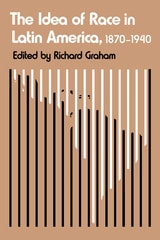
The Idea of Race in Latin America, 1870-1940
Edited and with an introduction by Richard Graham
University of Texas Press, 1990
From the mid-nineteenth century until the 1930s, many Latin American leaders faced a difficult dilemma regarding the idea of race. On the one hand, they aspired to an ever-closer connection to Europe and North America, where, during much of this period, "scientific" thought condemned nonwhite races to an inferior category. Yet, with the heterogeneous racial makeup of their societies clearly before them and a growing sense of national identity impelling consideration of national futures, Latin American leaders hesitated. What to do? Whom to believe?
Latin American political and intellectual leaders' sometimes anguished responses to these dilemmas form the subject of The Idea of Race in Latin America. Thomas Skidmore, Aline Helg, and Alan Knight have each contributed chapters that succinctly explore various aspects of the story in Brazil, Argentina, Cuba, and Mexico. While keenly alert to the social and economic differences that distinguish one Latin American society from another, each author has also addressed common issues that Richard Graham ably draws together in a brief introduction. Written in a style that will make it accessible to the undergraduate, this book will appeal as well to the sophisticated scholar.

The Immigrant Threat
The Integration of Old and New Migrants in Western Europe since 1850Leo Lucassen
University of Illinois Press, 2005
Leo Lucassen tackles the question of whether the integration process of these recent immigrants will fundamentally differ in the long run (over multiple generations) from the experiences of similar immigrant groups in the past. For comparison, Lucassen focuses on "large and problematic groups" from Western Europe's past (the Irish in the United Kingdom, the Poles in Germany, and the Italians in France) and demonstrates a number of structural similarities in the way migrants and their descendants integrated into these nation states. Lucassen emphasizes that the geographic sources of the "threat" have changed and that contemporaries tend to overemphasize the threat of each successive wave of immigrants, in part because the successfully incorporated immigrants of the past have become invisible in national histories.
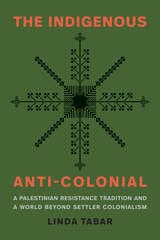
The Indigenous Anti-Colonial
A Palestinian Resistance Tradition and a World Beyond Settler ColonialismLinda Tabar
Duke University Press, 2026

The Invention of the Jewish Gaucho
Villa Clara and the Construction of Argentine IdentityBy Judith Noemí Freidenberg
University of Texas Press, 2009
By the mid-twentieth century, Eastern European Jews had become one of Argentina's largest minorities. Some represented a wave of immigration begun two generations before; many settled in the province of Entre Ríos and founded an agricultural colony. Taking its title from the resulting hybrid of acculturation, The Invention of the Jewish Gaucho examines the lives of these settlers, who represented a merger between native cowboy identities and homeland memories.
The arrival of these immigrants in what would be the village of Villa Clara coincided with the nation's new sense of liberated nationhood. In a meticulous rendition of Villa Clara's social history, Judith Freidenberg interweaves ethnographic and historical information to understand the saga of European immigrants drawn by Argentine open-door policies in the nineteenth century and its impact on the current transformation of immigration into multicultural discourses in the twenty-first century. Using Villa Clara as a case study, Freidenberg demonstrates the broad power of political processes in the construction of ethnic, class, and national identities. The Invention of the Jewish Gaucho draws on life histories, archives, material culture, and performances of heritage to enhance our understanding of a singular population—and to transform our approach to social memory itself.
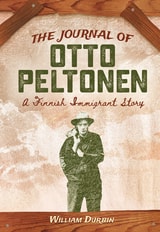
The Journal of Otto Peltonen
A Finnish Immigrant StoryWilliam Durbin
University of Minnesota Press, 2020
A portrait of the Finnish immigrant experience in Minnesota during the early twentieth century—now in paperback
After journeying across the Atlantic with his mother and two sisters, young Otto Peltonen joins his father in the iron ore mines of northern Minnesota, experiencing the harsh labor conditions that were common at the time, as mining companies cared more about making a profit than for their workers’ safety. Writing in his journal about his family’s struggles and the hard life Finnish immigrants endured in the early twentieth century, Otto ultimately strengthens his resolve to find the freedom his family had first sought in America.
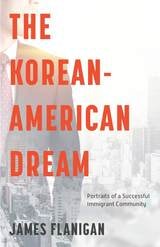
The Korean-American Dream
Portraits of a Successful Immigrant CommunityJames Flanigan
University of Nevada Press, 2018
In The Korean-American Dream, respected and distinguished business journalist James Flanigan uncovers the struggles and contributions of the people who have made Los Angeles the largest Korean city outside of Seoul.
This intimate account illustrates how Korean immigrants have preserved their culture and history as well as adapted to the American culture of E Pluribus Unum, the radical promise of “out of many, one.” Flanigan shows how Los Angeles emerged as a capital of the Asia Pacific region.
At less than 2 million, Korean Americans are a relatively small group compared to new Americans from China, the Philippines, and India. But with energy and drive, they are building landmarks in New York as well as L.A., lobbying for causes in Washington, founding businesses, heading universities and hospitals, and holding public office in all parts of the U.S.
Flanigan’s compelling narrative told largely through personal interviews provides a front-row seat to the economic, business, and cultural developments of the Korean American Community. At a time of spirited debate about immigration, their energy and ambition serve as a ringing reminder of the promise of the American mosaic.
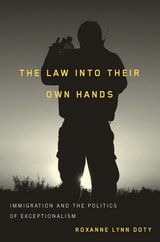
The Law Into Their Own Hands
Immigration and the Politics of ExceptionalismRoxanne Lynn Doty
University of Arizona Press, 2009
Doty examines the social and political contexts that have enabled these civilian groups to flourish and gain legitimacy amongst policy makers and the public. The sentiments underlying the vigilante movement both draw upon and are channeled through a diverse range of organizations whose messages are often reinforced by the media. Taking action when they believe official policy is lacking, groups ranging from elements of the religious right to anti-immigrant groups to white supremacists have created a social movement.
Doty seeks to alert us to the consequences related to this growing movement and to the restructuring of our society. She maintains that with immigrants being considered as enemies and denied basic human rights, it is irresponsible of both citizens and policy makers to treat this complicated issue as a simple black or white reality.
In this solid and theoretically grounded look at contemporary, post-9/11 border vigilantism, the author observes the dangerous and unproductive manner in which private citizens seek to draw firm and uncompromising lines between who is worthy of inclusion in our society and who is not.
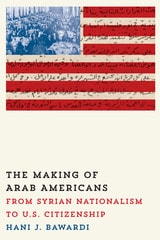
The Making of Arab Americans
From Syrian Nationalism to U.S. CitizenshipBy Hani J. Bawardi
University of Texas Press, 2014

The Making of Pioneer Wisconsin
Voices of Early SettlersMichael E. Stevens
Wisconsin Historical Society Press, 2018
The Making of Pioneer Wisconsin provides a unique and intimate glimpse into the lives of these early settlers, as they describe what it felt like to be a teenager in a wagon heading west or an isolated young wife living far from her friends and family. Woven together with context provided by historian Michael E. Stevens, these first-person accounts form a fascinating narrative that deepens our ability to understand and empathize with Wisconsin’s early pioneers.
The Marcus Garvey and Universal Negro Improvement Association Papers, Volume XI
The Caribbean Diaspora, 1910–1920Marcus Garvey
Duke University Press, 2011
Praise for the Previous Volumes:
“The Marcus Garvey and Universal Negro Improvement Association Papers will take its place among the most important records of the Afro-American experience. . . . ‘The Marcus Garvey Papers’ lays the groundwork for a long overdue reassessment of Marcus Garvey and the legacy of racial pride, nationalism and concern with Africa he bequeathed to today’s black community.”—Eric Foner, the New York Times Book Review
“Until the publication of The Marcus Garvey and Universal Negro Improvement Association Papers, many of the documents necessary for a full assessment of Garvey’s thought or of his movement’s significance have not been easily accessible. Robert A. Hill and his staff . . . have gathered over 30,000 documents from libraries and other sources in many countries. . . . The Garvey papers will reshape our understanding of the history of black nationalism and perhaps increase our understanding of contemporary black politics.”—Clayborne Carson, the Nation
“Now is our chance, through these important volumes, to finally begin to come to terms with the significance of Garvey’s complex, fascinating career and the meaning of the movement he built.”—Lawrence W. Levine, the New Republic
The Marcus Garvey and Universal Negro Improvement Association Papers, Volume XII
The Caribbean Diaspora, 1920-1921Marcus Garvey
Duke University Press, 2014
Volume XII highlights the centrality of the Caribbean people not only to the convention, but also to the movement. The reports to the convention discussed the range of social and economic conditions obtaining in the Caribbean, particularly their impact on racial conditions. The quality of the discussions and debates were impressive. Contained in these reports are some of the earliest and most clearly enunciated statements in defense of social and political freedom in the Caribbean. These documents form an underappreciated and still underutilized record of the political awakening of Caribbean people of African descent.
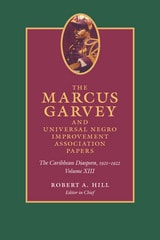
The Marcus Garvey and Universal Negro Improvement Association Papers, Volume XIII
The Caribbean Diaspora, 1921-1922, Volume 13Marcus Garvey
Duke University Press, 2016
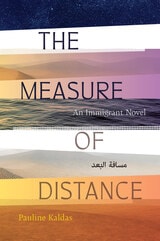
The Measure of Distance
An Immigrant NovelPauline Kaldas
University of Arkansas Press, 2023
This family saga begins when Salim, the eldest of three brothers, moves to Cairo at the start of the twentieth century with dreams of opening his own bakery. His decision to leave his ancestral village of Kom Ombo despite his parents’ objections reverberates across generations, kicking off a series of migrations that shape the lives of his family and their descendants throughout the decades that follow. These migrations only intensify after the revolution of 1952—with Misha, Salim’s eldest grandchild, being the first to flee to “Amreeka,” his annual phone calls home becoming briefer and briefer with each passing year.
Culminating with the 2011 protests in Tahrir Square, Pauline Kaldas’s The Measure of Distance is a detailed portrait of immigration against the backdrop of an Egypt in constant flux and an America that is always falling short of the fantasy. Alternating between tales of those who migrate and those who stay, this expansive novel follows its characters as they determine the course of their lives, often choosing one uncertainty over another as they migrate to new lands or plant their roots more firmly in their homeland.
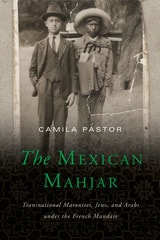
The Mexican Mahjar
Transnational Maronites, Jews, and Arabs under the French MandateBy Camila Pastor
University of Texas Press, 2017
Winner, Khayrallah Migration Studies Prize, Moise Khayrallah Center for Lebanese Diaspora Studies, 2018
Migration from the Middle East brought hundreds of thousands of people to the Americas in the late nineteenth and early twentieth centuries. By the time the Ottoman political system collapsed in 1918, over a third of the population of the Mashriq, i.e. the Levant, had made the transatlantic journey. This intense mobility was interrupted by World War I but resumed in the 1920s and continued through the late 1940s under the French Mandate. Many migrants returned to their homelands, but the rest concentrated in Brazil, Argentina, the United States, Haiti, and Mexico, building transnational lives.
The Mexican Mahjar provides the first global history of Middle Eastern migrations to Mexico. Making unprecedented use of French colonial archives and historical ethnography, Camila Pastor examines how French colonial control over Syria and Lebanon affected the migrants. Tracing issues of class, race, and gender through the decades of increased immigration to Mexico and looking at the narratives created by the Mahjaris (migrants) themselves in both their old and new homes, Pastor sheds new light on the creation of transnational networks at the intersection of Arab, French, and Mexican colonial modernisms. Revealing how migrants experienced mobility as conquest, diaspora, exile, or pilgrimage, The Mexican Mahjar tracks global history on an intimate scale.