Results by title
240 books match the query 'English as a Second Language' and 46 start with t
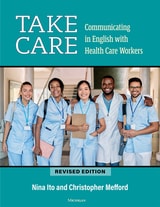
Take Care
Communicating in English with Health Care WorkersNina Ito and Christopher Mefford
University of Michigan Press, 2023
A high level of communicative skills are essential and expected for health care workers. Take Care is designed to give readers the strategies and tools to build, maintain, and repair communication within interactions that take place in health care settings. It is designed for students who are enrolled in health care training as well as nurses or health care workers who are already on the job but may want to improve their English. This text is designed to provide readers with a firm grasp of verbal and non-verbal communication strategies for more successful interactions. It will also help readers develop strategic competence by asking them to practice formulaic phrases needed to get things done. Carefully selected situations will also help readers to understand some of the social situations health care workers need to prepare for, such as apologizing, expressing condolences, or giving advice.
Take Care breaks each unit into the following sections to teach readers new skills:
- Listening for Language
- Dialogue
- Vocabulary
- Communication Strategy
- Pronunciation
- Dialogue Review
- Role Plays
- End-of-Unit Discussion
- Culture Point
This revised edition is updated to include information about pandemics, vaccines, and other medical developments. Audio files for the listening activities are available online.

Take Care
Communicating in English with U.S. Health Care WorkersNina Ito and Christopher Mefford
University of Michigan Press, 2011
Take Care was written to help nursing students and other health care workers communicate better in health care settings, with a focus on improving speaking and listening skills, vocabulary, and pronunciation. The aim was to provide users with the tools and specific communication strategies to build, maintain, or repair interactions that take place on the job. This book is also designed to develop the pragmatic competence necessary to get things done on the job and to understand some of the social situations required by health care workers, like expressing condolences or giving advice.
The individuals most likely to benefit from the material in the book are:
- Nursing students enrolled in community college (e.g., pre-nursing courses or RN students who have a special class)
· ESL students enrolled in specific CNA or medical assistant classes
· ESL students enrolled in U.S. universities who are here to learn more about nursing or health care as profession (they may or may not already have a degree in their own countries)
· Nurses or health care workers who already work in a health care setting but who are not proficient in English and so may be taking an English course sponsored by the hospital or local health system
It is therefore generally assumed that students have some knowledge of common medical and health care terms, so the book does not attempt to teach medical terminology, except in the context of communicating effectively in a health care setting. The various Vocabulary sections in each unit can therefore be used as review or as a new lesson—whatever works best for your students.
Instructors using this book do not need knowledge of the field of nursing or health care because the majority of material covered focuses on the language, not the industry.
Task-Based Listening
What Every ESL Teacher Needs to KnowSteven Brown
University of Michigan Press, 2019
Teacher's Answer Pack for The Official MET Go! Practice Test Book
Michigan Language Assessment
University of Michigan Press, 2019
The MET Go! is intended for early adolescents at the middle school to lower-secondary school level who want to measure their general English language proficiency in a variety of linguistic contexts. The test results can be used for educational purposes, such as when finishing an English language course, as a motivational tool to encourage students as they progress in their English study, or as a supporting credential for youth opportunities requiring English skills. It may also be used as a bridge to a higher-level exam such as the MET.
The Teacher’s Answer Pack for The Official MET Go! Practice Test Book includes:
- answer keys
- audio transcripts for the Listening practice tests
- Writing test responses with commentary for two of the practice tests
- examiner instructions and script for the Speaking test prompts
- selected practice test vocabulary lists
- a progress tracking log for recording practice test scores
- actual test form instructions and a sample answer sheet
Teaching Academic Writing in the Health Sciences
A Guide for Instructors, Mentors, and TrainersElla August
University of Michigan Press, 2026
Part 1 offers the pedagogical basis teachers need to apply best practices, as well as:
- Tips for collaborative writing and writing productivity
- Strategies for using generative artificial intelligence (AI) technology in teaching and writing
- Open-access resources and instruction planning activities
Part 2 focuses on the steps of writing a scientific paper, offering:
- A strong foundation in the structure of and strategies for successful writing
- Customizable teaching materials on how to write a scientific paper
- Strategies for planning a paper, crafting writing to reach readers, developing persuasive arguments, and building a successful author team
- How-to write each section of a paper, from the title to the conclusion
- Guidance on navigating the publishing process, including selecting the appropriate journal and effectively responding to peer-reviewer comments
Teaching College Writing to Diverse Student Populations
Dana R. Ferris
University of Michigan Press, 2013
Statistical and anecdotal evidence documents that even states with relatively little ethnic or cultural diversity are beginning to notice and ask questions about long-term resident immigrants in their classes. As shifts in student population become more widespread, there is an even greater need for second language specialists, composition specialists, program administrators, and developers in colleges and universities to understand and adapt to the needs of the changing student audience(s).
Teaching English as a Foreign or Second Language, Second Edition
A Teacher Self-Development and Methodology GuideJerry G. Gebhard
University of Michigan Press, 2006
The second edition of Teaching English as a Foreign or Second Language includes a wider range of examples to coincide with a variety of teaching contexts-from K-12 schools, to university intensive language programs and refugee programs. It is also updated with discussions of technology throughout, and it considers ways in which technology can be used in teaching language skills. Sources for further study are included in each chapter and in the appendixes.
Teaching English as a Foreign or Second Language, Third Edition
A Self-Development and Methodology GuideJerry G. Gebhard
University of Michigan Press, 2017
This edition has the same three major sections: (1) Self-Development, Exploration, and Settings; (2) Principles of EFL/ESL Teaching; and (3) Teaching Language Skills. New to this edition are:
- a chapter on digital literacy, technology, and teaching
- the addition of technology issues as they relate to the teaching of the various skills in Part 3
- discussions of task-based teaching, student presentations, how corpus linguistics can inform teaching, metacognitive reading strategies, collaborative writing, assessing writing, and the teaching of grammar.
Teaching Speaking Online
What Every ESL Teacher Needs to KnowPamela S.H. Bogart
University of Michigan Press, 2020
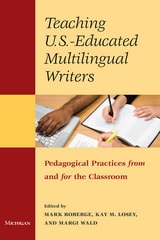
Teaching U.S.-Educated Multilingual Writers
Pedagogical Practices from and for the ClassroomMark Roberge, Kay M. Losey, Margi Wald
University of Michigan Press, 2015
All of the contributors are teachers who are writing about and reflecting on their own experiences and outcomes and interweaving those experiences and outcomes with current theory and research in the field. The volume thus portrays teachers as active, reflective participants engaged in critical inquiry. Contributors represent community college, college, and university contexts; academic ESL, developmental writing, and first-year composition classes; and face-to-face, hybrid, and online contexts.
This book was developed primarily to meet the needs of practicing writing teachers in college-level ESL, basic writing, and college composition classrooms, but will also be useful to pre-service teachers in TESOL, Composition, and Education graduate programs.
Teaching Vocabulary Is the Writing Teacher's Job
Why and HowKeith S. Folse
University of Michigan Press, 2020
Teaching Writing That Works
A Group Approach to Practical EnglishEric S. Rabkin and Macklin Smith
University of Michigan Press, 1990
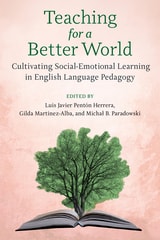
Teaching for a Better World
Cultivating Social-Emotional Learning in English Language PedagogyEdited by Luis Javier Pentón Herrera, Gilda Martínez-Alba, and Michal B. Paradowski
University of Michigan Press, 2026
In a world where language connects people across cultures, Teaching for a Better World invites readers to imagine classrooms where words do more than teach grammar; they build empathy, resilience, and understanding. This groundbreaking volume is the first to focus on the integration of social-emotional learning (SEL) into English language teaching from a global perspective, bringing together educators and researchers from diverse cultural and educational contexts. Through conceptual discussions, research, and practical examples, the authors demonstrate how English lessons can also be lessons in compassion, collaboration, and global citizenship.
Organized into three sections—Conceptual Pieces, Empirical Studies, and Practical Examples—the book offers a comprehensive examination of SEL’s theoretical foundations, evidence-based practices, and real-world classroom applications. Contributors explore SEL through lenses such as culturally responsive pedagogy, trauma-sensitive practices, teacher and student well-being, ecolinguistics, and intercultural dialogue. Readers will find innovative and practical ways to create inclusive, culturally responsive classrooms; support student and teacher well-being; and use English as a bridge for intercultural dialogue. Accessible and inspiring, this book’s combination of conceptual depth, empirical rigor, and applied strategies position it as a foundational resource for advancing research and practice in SEL-informed English language pedagogy worldwide.
Readers of Teaching for a Better World will
- Learn pedagogically sound ways to foster empathy and resilience while creating inclusive, culturally responsive classrooms.
- Find ready-to-use lesson plans and activities.
- Encounter diverse perspectives of educators from a range of contexts, including conflict-affected regions, refugee resettlement contexts, and higher education.
Teaching the Pronunciation of English
Focus on Whole CoursesJohn Murphy, Editor
University of Michigan Press, 2017
Teaching the Pronunciation of English illustrates that pronunciation teaching is compatible with communicative, task-based, post-method, and technology-mediated approaches to language teaching. This theme permeates the volume as a whole and is well represented in Chapters 3-12, which are dedicated to specialist-teachers’ firsthand depictions of pronunciation-centered courses. Each of these ten chapters features a set of innovative teaching strategies and contemporary course design structures developed by the chapter contributor(s).
To prepare readers to more fully appreciate the substance and quality of Chapters 3-12, the volume’s two initial chapters are more foundational. Chapters 1 and 2 provide an overview of core topics language teachers need to know about to become pronunciation teachers: suprasegmentals (thought groups, prominence, word stress, intonation, and pitch jumps) and the English consonants and vowel sounds.
Technology for the Process
Teaching Academic Writing to Multilingual Students in the Age of AIM. Sidury Christiansen and Qian Du
University of Michigan Press, 2027
As digital tools and artificial intelligence (AI) reshape how writing is taught and learned, instructors face new questions about how to integrate technology without losing sight of sound pedagogy. Technology for the Process offers a research-informed and practice-driven response. Written by experienced writing teachers, the book presents ready-to-use, adaptable, classroom-tested approaches for teaching academic writing to multilingual students through purposeful use of digital tools, including generative AI. Rather than treating technology as an add-on or a substitute for instruction, the book shows how it can meaningfully support writing as a process: from generating ideas and revising drafts to making rhetorical decisions and developing academic voice. Designed for university-level and adult learning contexts, this book serves as both a practical resource and a thoughtful guide for educators, librarians, and institutions seeking accessible, effective, and sustainable approaches to writing instruction in the age of AI.
Technology in the Language Classroom
What Every New ESL Teacher Needs to KnowMatt Kessler
University of Michigan Press, 2026
Technology in the Language Classroom provides early-career and pre-service second language (L2) instructors with an overview of important issues involved in effectively integrating technology into the L2 classroom. Each chapter provides practical strategies, resources, and application activities to help new teachers gain familiarity with utilizing a variety of digital tools for teaching different skills, including listening, speaking, reading, grammar, vocabulary, and writing. Readers will be encouraged to think critically about the key factors to consider when choosing tools that work for them, their lessons, and their students.
Telling a Research Story
Writing a Literature ReviewChristine B. Feak and John M. Swales
University of Michigan Press, 2009
Telling a Research Story: Writing a Literature Review is concerned with the writing of a literature review and is not designed to address any of the preliminary processes leading up to the actual writing of the literature review.
This volume represents a revision and expansion of the material on writing literature reviews that appeared in English in Today's Research World.
This volume progresses from general to specific issues in the writing of literature reviews. It opens with some orientations that raise awareness of the issues that surround the telling of a research story. Issues of structure and matters of language, style, and rhetoric are then discussed. Sections on metadiscourse, citation, and paraphrasing and summarizing are included.
Testing Your Grammar, Revised Edition
Susan M. Reinhart
University of Michigan Press, 2002
With all units enlarged or significantly modified, the new and improved edition of Testing Your Grammar features reworked grammatical explanations and more example sentences so grammar points are easier to understand. Other features of the new edition:
- Explanations have been added to the answer key.
- A review test is found at the end of every two units.
- At the end of the book are four examinations that can be used for either pre-testing or post-testing.
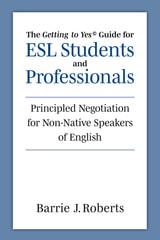
The "Getting to Yes" Guide for ESL Students and Professionals
Principled Negotiation for Non-Native Speakers of EnglishBarrie J. Roberts
University of Michigan Press, 2024
The Getting to Yes Guide for ESL Students and Professionals prepares non-native speakers of English to join the global community of people who use Getting to Yes to negotiate win-win agreements in English. It provides page-by-page explanations of over 1,000 words, phrases, concepts, and examples that these readers may misunderstand; short stories that use these new words and concepts to help readers apply them to new contexts; delightful cartoons to highlight main ideas; optional ESL activities; and a glossary of the key negotiation idioms and terms used in Getting to Yes. In this guide, author Barrie J. Roberts applies her experience as a public interest attorney, court Alternative Dispute Resolution administrator, ESL instructor, and court interpreter trainer to help readers improve their professional-level English along with their negotiation skills.
Benefits for teachers:
- Each Chapter Guide provides a ready-made lesson plan with activities to do before, while, and after reading each chapter of Getting to Yes
- The book can be used as a recommended self-study reference
- This book can be used for selected chapters of Getting to Yes or for a complete standalone course on Getting to Yes for non-native speakers of English or Generation 1.5 students
- Optional activities throughout the book can be assigned for in or out of the classroom. These include activities for reading comprehension, vocabulary building, paraphrasing, critical thinking, discussing, and writing
- Short stories written to accompany each chapter require students to apply new vocabulary and negotiation concepts to real-world disputes
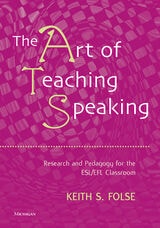
The Art of Teaching Speaking
Research and Pedagogy for the ESL/EFL ClassroomKeith S. Folse
University of Michigan Press, 2006
*Which tasks or activities really help build speaking fluency?
*What does the research show regarding speaking activities?
*What mistakes do ESL teachers often make in speaking activity design?
In this highly accessible and practical resource, Keith S. Folse provides a wealth of information to help ESL/EFL teachers design and use speaking tasks that will actually improve students' speaking fluency. The book presents and discusses the relevant research and assessment issues and includes case studies from twenty different settings and classrooms around the world so that readers learn from others about the problems and successes of using various speaking activities.
Teachers will find the chapters on Twenty Successful Activities and Ten Unsuccessful Activities particularly valuable. The successful activities are provided for classroom use and are reproducible. The book also contains five appendixes that explain what teachers need to know about vocabulary, pronunciation, and grammar and how they affect the teaching of speaking. Samples of successful lesson plans and a list of resources useful for teaching speaking are also included.
Keith S. Folse, Ph.D., is Coordinator, TESOL Programs, University of Central Florida (Orlando). He is the author of Vocabulary Myths (University of Michigan Press, 2004) and more than 35 second language textbooks, including texts on grammar, reading, speaking, listening, and writing.
The Article Book
Practice toward Mastering a, an, and theTom Cole
University of Michigan Press, 2000
A comprehensive guide and workbook for improving ESL/EFL students' understanding of English articles, The Article Book can be used as either a supplement to any ESL/EFL core text or as a self-study tool for intermediate through advanced learners. Cole involves students in "learning by doing" through an integrated approach to skill acquisition that includes other grammar structures, reading, vocabulary, and speaking. Each chapter of the book is organized into teachable units or lessons and includes presentation of a grammatical rule with examples, exercises, quizzes, and a comprehensive test. While the fifty rules (and fifteen exceptions) are taught to provide a logical framework for the text and serve as a handy reference, students will learn through guided practice instead of memorization.
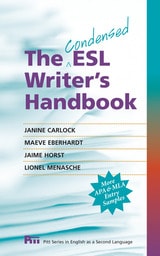
The Condensed ESL Writer's Handbook
Janine Carlock, Maeve Eberhardt, Jaime Horst, Lionel Menasche
University of Michigan Press, 2013
The CondensedESL Writer’s Handbook is a reference work for ESL students who are taking college-level courses. Because its purpose is to provide help with the broad variety of writing questions students may have when working on school assignments, the text focuses on English for Academic Purposes. Unlike other handbooks on the market, this book’s sole purpose is to address the issues of primary importance to language learners.
The Condensed Handbook complements a student writer’s dictionary, thesaurus, and grammar reference book. It would be suitable as a text for an advanced ESL writing course.
The Condensed Handbook is concise and easily navigated; is accessible, with clear and direct explanatory language; and limits its focus to the grammatical and style aspects of writing and reference material.
Included as special features in the Condensed Handbook are:
• The explanatory language is appropriate for ESL students, in contrast to the more complex and idiomatic language of other English handbooks.
• The level of detail is more manageable for ESL students, compared to what is in other English handbooks.
• Many of the examples of paragraphs and exercise sentences were written by ESL students; this encourages users of this Handbook to realize that they too can also become effective writers.
• Additional samples of MLA and APA reference entries.
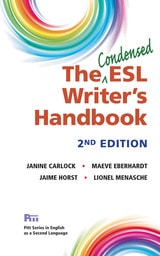
The Condensed ESL Writer's Handbook, 2nd Ed.
Janine Carlock, Maeve Eberhardt, Jaime Horst, and Lionel Menasche
University of Michigan Press, 2018
The Condensed version is concise and easily navigated; is accessible with clear and direct explanatory language; and limits its focus to the grammatical and style aspects of writing and reference material.
The 2nd Edition of The Condensed ESL Writer’s Handbook has been revised to better align with the exercises in Workbook for The ESL Writer’s Handbook, 2nd Ed.(978-0-472-03726-1). It also features an expanded Section 1 (to include more on pre-writing, drafting, revising, and editing), updated exercise items, and completely revised APA and MLA style guides (featuring MLA, 8th Edition). Overall, this handbook has these special features:
- The topic selection is based on ESL writers’ needs as observed by the authors over many years.
- The coverage of topics is more complete than the limited amount usually provided for ESL writers in first language or L1 handbooks.
- The explanatory language is appropriate for ESL students, in contrast to the more complex and idiomatic language of other English handbooks.
- Many of the text examples and exercise sentences were written by ESL students to help users realize that they too can become effective writers.
The ESL Writer's Handbook
Janine Carlock, Maeve Eberhardt, Jaime Horst, Lionel Menasche
University of Michigan Press, 2010
The ESL Writer’s Handbook is a reference work for ESL students who are taking college-level courses. Because its purpose is to provide help with the broad variety of writing questions students may have when working on school assignments, the text focuses on
English for Academic Purposes. Unlike other handbooks on the market, this book’s sole purpose is to address the issues of second language learners.
This spiral-bound Handbook complements a student writer’s dictionary, thesaurus, and grammar reference book. It would be suitable as a text for an advanced ESL writing course when used together with the companion Workbook (978-0-472-03404-8). The Handbook is concise and easily navigated; is accessible, with clear and direct explanatory language; features information on both APA and MLA styles (including a sample paper for each); and includes many examples from ESL student writers to provide realistic models.
Included as special features in the Handbook are:
• The topic selection is based on ESL writers’ needs as observed by the authors over many years.
• The coverage of topics is more complete than the limited amount usually provided for ESL writers in first language or L1 handbooks.
• The explanatory language is appropriate for ESL students, in contrast to the more complex and idiomatic language of other English handbooks.
• The level of detail is more manageable for ESL students, compared to what is in other English handbooks.
- Many of the examples of paragraphs, essays, research papers, and exercise sentences were written by ESL students; this encourages users of this Handbook to realize that they can also become effective writers.
The ESL Writer's Handbook, 2nd Ed.
Janine Carlock, Maeve Eberhardt, Jaime Horst, Lionel Menasche
University of Michigan Press, 2018
The spiral-bound Handbook complements a student writer’s dictionary, thesaurus, and grammar reference book. It would be suitable as a text for an advanced ESL writing course when used together with the companion Workbook (978-0-472-03726-1).
The new edition features significant revisions to Sections 3 and 4; in particular, both APA and MLA style guides have been updated and new sample papers for each are included. The new edition includes new and revised exercises and many new samples of student writing.
Like its predecessor, the 2nd Edition has these special features:
- The topic selection is based on ESL writers’ needs as observed by the authors over many years.
- The coverage of topics is more complete than the limited amount usually provided for ESL writers in first language or L1 handbooks.
- The explanatory language is appropriate for ESL students, in contrast to the more complex and idiomatic language of other English handbooks.
- Many of the examples of paragraphs, essays, research papers, and exercise sentences were written by ESL students to help users realize that they too can become effective writers.
The ESL Writer's Handbook, 3rd Edition
Janine Carlock, Maeve Eberhardt, Jaime Horst
University of Michigan Press, 2025
In addition to updated style guides, sample student papers, writing examples, and exercises, the 3rd edition highlights “tech tips” on different technologies that may be useful to students, explains inclusive language, and expands the section on taking notes as a research tool.
With this handbook, students will learn:
- The concept of genre and apply it to unpacking assignments and writing effectively.
- The process for generating ideas, structuring those ideas into a paper, and checking over a paper before turning it in.
- Five common patterns for organizing an academic essay: narrative, process, comparison/contrast, cause and effect, and argument.
- Different steps for creating a good research paper, including major citation styles.
- Guidance for addressing the grammar, punctuation, and style issues most often encountered by international students writing in English.
- How to differentiate between other types of writing U.S. undergraduate students are expected to complete, such as emails, resumes, cover letters, and personal statements.
The English Language Common Law Workbook
A Resource for Students Studying English-medium Law DegreesIan Collins and David Brody
University of Michigan Press, 2025
The English Language Common Law Workbook is designed to support students in developing the core competencies necessary for studying in a common law context. It provides readings and exercises based on authentic legal materials for practicing critical reading and writing skills. In particular, it includes an extensive number of statutes and cases and accompanying exercises that give students an opportunity to work with the type of sources they will encounter in English-medium law degree programs. By emphasizing common law principles throughout, the book helps international students coming from non–common law jurisdictions familiarize themselves with how statutes and cases in common law countries are written and structured. Students are supported in critically reading statutes and cases by focusing on key terminology and language structures. Finally, the book supports students in applying the skills they learn to construct basic case briefs and answer hypothetical legal questions using the IRAC structure.
CEFR Levels: B2–C2
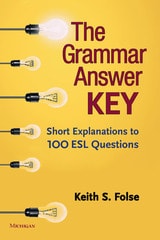
The Grammar Answer Key
Short Explanations to 100 ESL QuestionsKeith S. Folse
University of Michigan Press, 2018
The 100 questions are organized into 12 chapters on topics that teachers and students can relate to well: adjectives, articles, clauses, connectors, gerunds and infinitives, prepositions, pronouns, pronunciation, subject-verb agreement, suffixes, verbs, and vocabulary-grammar connections. The number of questions in each chapter ranges from 3 to 13 and is based on the questions submitted. Each chapter begins with a short overview of the topic that features key terminology and a chart explaining three common ESL errors.
Each question is presented in a box and is followed by an "answer" that can inform instruction, often in chart format. Examples of questions are:
- How do you know if a word is an adjective?
- Can I say the Monday or the January?
- Do you say on July or in July?
- I received an email from someone that said “Greetings from my wife and I.” Is this right? Why?
- How do I know which way to pronounce the -ed at the end of a word?
- Which verb tenses are the most common in English? Which ones should I study?
- Why do you say turn on the light instead of turn the light?
- In my language, we have one word for make and do. In English, when should I use make and when should I use do?
The book is the ideal teacher resource and professional development tool.
The International Student's Guide to Writing a Research Paper
Janine Carlock, Maeve Eberhardt, Jaime Horst, Peter Kolenich
University of Michigan Press, 2017
Each section of the book includes a discrete task called a Building Block, which requires students to apply the skills learned toward the development of their own paper. This step-by-step approach allows students to construct knowledge as they become more familiar with the process, making writing a research paper a less intimidating task.
Special features:
- This guide uses simple direct language for those for whom writing a research paper is new.
- Most example writing is from international students in an ESL program or first-year writing class, including two sample papers—one in APA and one in MLA.
- A section on responding to instructor feedback to provide students with the tools to read and understand comments and use them to improve the first draft.
- A subsection dedicated to constructing clear and cohesive paragraphs and sentences.
- The guide includes citation and style examples in MLA 8th edition.
The Official MET Go! Practice Test Book
Michigan Language Assessment
University of Michigan Press, 2019
The MET Go! is intended for early adolescents at the middle school to lower-secondary school level who want to measure their general English language proficiency in a variety of linguistic contexts. The test results can be used for educational purposes, such as when finishing an English language course, as a motivational tool to encourage students as they progress in their English study, or as a supporting credential for youth opportunities requiring English skills. It may also be used as a bridge to a higher-level exam such as the MET.
The Official MET Go! Practice Test Book is first book to provide actual practice tests for students preparing to take the MET Go!
The Official MET Go! Practice Test Book includes:
- 4 complete practice tests (Listening, Reading, Writing)
- 4 sets of practice Speaking Test prompts
- tips for practicing the different sections of the tests
- a progress tracking log for recording practice test cores
- actual test form instructions and a sample answer sheet
More information about the MET Go! is available at www.michiganassessment.org.
The Official MET Practice Test Book with Answers
Michigan Language Assessment
University of Michigan Press, 2019
The MET is intended for adults and adolescents at or above a secondary level of education who want to measure their general English language proficiency in a variety of linguistic contexts. The test results can be used for educational purposes, such as when finishing an English language course, or for employment purposes, like when applying for a job or pursuing a promotion that requires an English language qualification.
The Official MET Practice Test Book is the first book to provide actual practice tests for students preparing to take the MET.
The Official MET Practice Test Book with Answers, designed for self-study (information about the Classroom Edition can be found at https://www.press.umich.edu/11390089/official_met_practice_test_book_classroom_edition), includes:
- 4 complete practice tests (Listening, Reading and Grammar, Writing)
- 4 sets of Speaking test prompts
- tips for practicing the different sections of the tests
- a progress tracking log for recording practice test scores
- selected practice test vocabulary lists
- answer keys
- audio transcripts for the Listening section
- Writing test responses with commentary for two of the tests
- Examiner scripts for the Speaking test
- actual test form instructions and a sample answer sheet
The audio for the Listening section can be accessed at www.press.umich.edu/elt/compsite/met
For more information about the MET, go to www.michiganassessment.org
The Official MET Practice Test Book, Classroom Edition
Michigan Language Assessment
University of Michigan Press, 2019
The MET is intended for adults and adolescents at or above a secondary level of education who want to measure their general English language proficiency in a variety of linguistic contexts. The test results can be used for educational purposes, such as when finishing an English language course, or for employment purposes, like when applying for a job or pursuing a promotion that requires an English language qualification.
The Official MET Practice Test Book is the first book to provide specific test-preparation materials for the MET.
The Classroom Edition, designed for school use (the self-study version can be found at https://www.press.umich.edu/11390380/official_met_practice_test_book_with_answers), includes:
- 4 complete practice tests (Listening, Reading and Grammar, Writing)
- 4 sets of Speaking test prompts
- tips for preparing for the different sections of the tests
- a progress tracking log for recording practice test scores
- selected practice test vocabulary lists
- actual test form instructions and a sample answer sheet
For more information about the MET, go to www.michiganassessment.org

The Other Tongue
English Across CulturesEdited by Braj B. Kachru
University of Illinois Press, 1992
When The Other Tongue appeared in 1982, it was called "required reading for all those concerned with English teaching in non-native situations, from the classroom teacher to the policy planner", Jowhn Platt, English World-Wide) and "an extremely useful and stimulating collection" (William C. Ritchie, Language). It introduced refreshingly new perspectives for understanding the spread and functions of English around the world.
This dramatically revised volume contains eight new chapters, replacing or updating more than half of the first edition. The Other Tongue is the first attempt to integrate and address provocative issues relevant to a deeper understanding of the forms and functions of English within different sociolinguistic, cross-cultural, and cross-linguistic contexts. The volume discusses linguistic, literary, pedagogical, and attitudinal issues related to world Englishes.
The Preposition Book
Practice toward Mastering English PrepositionsTom Cole
University of Michigan Press, 2006
The Preposition Book is organized by level of difficulty but was written for
intermediate-level students. Many exercises are included within each chapter, and Putting It Together and Expansion Exercises are designed to give students even more opportunity to practice. A Comprehensive Test appears at the end of each chapter.
The Structure of English
Studies in Form and Function for Language TeachingJeanette S. DeCarrico
University of Michigan Press, 2000
With an emphasis on discourse function throughout, students are never expected to rely on lists of unrelated, constructed example sentences. Rather, when major points of grammar are presented, the structures are illustrated with rich, "real world" contexts excerpted from literature (mostly American), including novels, short stories, poems, essays, and drama. Exercises in the companion workbook are likewise based on naturally occurring stretches of discourse.
The Teaching Guide for English for Dispute Resolution
Mastering Negotiation, Mediation, and Alternative Dispute ResolutionBarrie J. Roberts
University of Michigan Press, 2025
Each chapter of the textbook provides a ready-made lesson plan with a sample dispute, warm-up questions, background readings, follow-up questions, activities, and reflections, and The Teaching Guide supplements each chapter with:
- Support in the form of teaching tips, lesson plans, additional activities or role-plays, assessment suggestions, and resources for further exploration.
- Separate guidance for ESL and Legal English/Business English instructors that helps them select the material and activities best suited to their students’ interests and needs.
- Resources such as sample syllabi and activities with step-by-step instructions that make it easy to start teaching the textbook.
- An online companion site where instructors can download and send activities and role-plays directly to their students.
The Three Minute Thesis in the Classroom
What Every ESL Teacher Needs to KnowHeather Boldt
University of Michigan Press, 2019
The Unplanned Lesson
How to Stop Searching for Activities and Start Engaging StudentsIan Roth and Paul Wicking
University of Michigan Press, 2023
Thinking Critically, Second Edition
World Issues for Reading, Writing, and ResearchMyra Shulman
University of Michigan Press, 2014
Just like its predecessor, Thinking Critically helps students improve reading, writing, and research skills while exploring and analyzing major global issues. Although many of the same topics are explored in this second edition—world hunger, global health, gender equality, regional conflict, cultural heritage, and immigration policies—all 31 authentic readings in the second edition are new. New topics included in this edition are cybersecurity, climate change, education reform, leadership, and human rights.
Each chapter contains two or three readings (from print and online news sources, journals, and blogs) designed to raise rather than provide answers; a vocabulary review and discussion questions for each reading; a reaction writing task; a question on the topic to research; a writing assignment for a specific academic or business genre (with models in an appendix); speaking activities (oral presentation, debate, or role-play); and a Thinking about It task. The Thinking about It task calls on students’ ability to evaluate a complex issue with objectivity and to propose a realistic approach, making this textbook good preparation for academic courses that require critical-thinking skills to express opinions both orally and in writing.
Several new academic/business written genres (abstract, fact sheet, briefing paper, report on a survey) have also been added.
Thriving as a Graduate Writer
Principles, Strategies, and Habits for Effective Academic WritingRachael Cayley
University of Michigan Press, 2023
Readers of Thriving as a Graduate Writer will:
- Learn how to establish an effective writing practice
- Discover how to position themselves as competent and engaged writers
- Learn how to structure their writing, craft effective sentences, and create movement with a text
- Develop processes for draft revisions
- Create individual writing strategies that will last throughout their careers
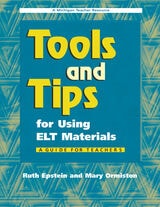
Tools and Tips for Using ELT Materials
A Guide for TeachersRuth Epstein and Mary Ormiston
University of Michigan Press, 2007
The book begins by addressing basic considerations in selecting and designing materials for classroom use. Textbooks themselves are covered in depth, which is very helpful for teachers choosing or assessing a textbook. An abundance of information is provided on how to use written texts from different genres (including teacher- and student-created texts), teacher-created resources, audio-visual aids, computers and the Internet, and how to provide community and service learning.
This resource aims to help instructors choose the most effective, appropriate, and flexible materials for their students and their programs. Teachers and teachers-in-training will find this to be a practical and comprehensive guide to integrating ELT materials and resources into a curriculum.
Translanguaging
What Every Teacher Needs to KnowJacob Huckle
University of Michigan Press, 2027
Multilingual learners bring a wealth of resources to the classroom in the form of their various languages. How can teachers tap into these resources as part of the learning process? How can we intentionally embrace linguistic diversity in our classrooms through the way we design learning? Despite the proliferation of research and writing about pedagogical translanguaging, many teachers do not feel equipped to effectively implement translanguaging approaches in their teaching.
Translanguaging provides a comprehensive introduction to the what, why, and how of translanguaging. The book synthesizes the research literature for a non-specialist audience, and builds on these insights by providing practical guidance for how students can be empowered to use all their linguistic resources—not just English or the language of instruction—to learn and thrive in school or college. Whether teachers of ESL or other subjects, all teachers will benefit from the practical guidance about translanguaging in this book and will be equipped to begin rethinking and redesigning their teaching to make more space for students’ multilingualism.
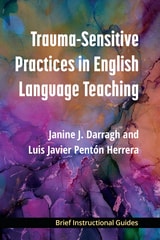
Trauma-Sensitive Practices in English Language Teaching
Janine J. Darragh and Luis Javier Pentón Herrera
University of Michigan Press, 2026
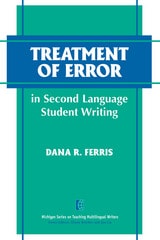
Treatment of Error in Second Language Student Writing
Dana R. Ferris
University of Michigan Press, 2002
Unlike a teachers' manual or a handbook that purports to give all the answers needed, Ferris's research-based volume offers a solid scholarly foundation for the practical ideas presented together with an abundance of illustrative sample texts. This book will be a rich resource in language teaching methodology courses, but experienced teachers too will no doubt benefit from the depth and breadth of Ferris's coverage of various error response techniques as well as of the research that motivates those techniques.
Ferris offers a realistic, well-reasoned account of what second language (L2) writing teacher--or teachers with L2 students in their classes--need to know about error and how to put what they know to use. She persuasively addresses the fundamental error treatment questions that plague novice and expert writing specialists alike: What types of errors should teachers respond to? When should we respond to them? What are the most efficacious ways of responding to them? And ultimately, what role should error treatment play in the teaching of the process of writing?
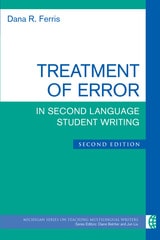
Treatment of Error in Second Language Student Writing, Second Edition
Dana R. Ferris
University of Michigan Press, 2011
Treatment of Error offers a realistic, well-reasoned account of what teachers of multilingual writers need to know about error and how to put what they know to use. As in the first edition, Ferris again persuasively addresses the fundamental error treatment questions that plague novice and expert writing specialists alike: What types of errors should teachers respond to? When should we respond to them? What are the most efficacious ways of responding to them? And ultimately, what role should error treatment play in the teaching of the process of writing?
The second edition improves upon the first by exploring changes in the field since 2002, such as the growing diversity in what is called “L2 writers,” the blurring boundaries between “native” and “non-native” speakers of English, the influence of genre studies and corpus linguistics on the teaching of writing, and the need the move beyond “error” to “second language development” in terms of approaching students and their texts. It also explores what teacher preparation programs need to do to train teachers to treat student error.
The second edition features
* an updating of the literature in all chapters
* a new chapter on academic language development
* a postscript on how to integrate error treatment/language development suggestions in Chapters 4-6 into a writing class syllabus
* the addition of discussion/analysis questions at the end of each chapter, plus suggested readings, to make the book more useful in pedagogy or teacher development workshops
Treatment of Error in Second Language Student Writing, Third Edition
Dana R. Ferris and Sabina Simon
University of Michigan Press, 2027
Treatment of Error in Second Language Student Writing is a practical book for teachers to help students writing in a second/other language develop greater precision (accuracy and style) in the language they use. While it does focus on language errors made by student writers, it goes beyond error to helping them develop strategies to become independent self-editors. It also discusses ongoing second language development—how students can increase and deploy their linguistic resources (grammar and vocabulary) to become more effective communicators of their written ideas.
This new edition retains the accessible design that helps teachers prepare themselves to treat error effectively. It contains guidance on how to organize course syllabi and lessons to provide authentically integrated error treatment and language development that is complementary to the overall goals of a writing course. In addition, the authors have incorporated new research and theory on written corrective feedback, discussion of philosophical questions raised by the translingual and Critical Language Awareness (CLA) movements, and analysis of how AI tools can help (or hinder) the students working to gain greater linguistic control of their writing.