Results by title
681 books match the query 'English language' and 114 start with t
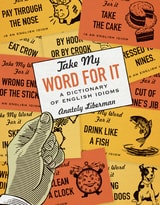
Take My Word for It
A Dictionary of English IdiomsAnatoly Liberman
University of Minnesota Press, 2022
Three centuries of English idioms—their unusual origins and unexpected interpretations
To pay through the nose. Raining cats and dogs. By hook or by crook. Curry favor. Drink like a fish. Eat crow. We hear such phrases every day, but this book is the first truly all-encompassing etymological guide to both their meanings and origins. Spanning more than three centuries, Take My Word for It is a fascinating, one-of-a-kind window into the surprisingly short history of idioms in English. Widely known for his studies of word origins, Anatoly Liberman explains more than one thousand idioms, both popular and obscure, occurring in both American and British standard English and including many regional expressions.
The origins, and even the precise meaning, of most idioms are often obscure and lost in history. Based on a critical analysis of countless conjectures, with exact, in-depth references (rare in the literature on the subject), Take My Word for It provides not only a large corpus of idiomatic phrases but also a vast bibliography. Detailed indexes and a thesaurus make the content accessible at a glance, and Liberman’s introduction and conclusion add historical dimensions. The result of decades of research by a leading authority, this book is both instructive and absorbing for scholars and general readers, who won’t find another resource as comparable in scope or based on data even remotely as exhaustive.
Talk, Tools, and Texts
A Logic-in-Use for Studying Lifespan Literate Action DevelopmentRyan J. Dippre
University Press of Colorado, 2020
Talk, Tools, and Texts tackles a perplexing issue: how can we envision writing as developing throughout a lifetime, from the first purposeful marks made on paper to the last? How can we make accounts of writing development that keep the complexity of our lives in mind while also providing useful insight to researchers, teachers, and writers?
Drawing on eleven accounts of writers at different points in the lifespan (ages 12 to 80) and in different social circumstances (from a middle-school classroom to a bird-sanctuary newsletter), Talk, Tools, and Texts constructs a “logic-in-use” for following writers and their writing development at a variety of points in the lifespan. It also offers several strategies scholars can use in pursuit of their own research into lifespan writing.

Talking Back
Senior Scholars and Their Colleagues Deliberate the Past, Present, and Future of Writing StudiesNorbert Elliot
Utah State University Press, 2020
In Talking Back, a veritable Who’s Who of writing studies scholars deliberate on intellectual traditions, current practices, and important directions for the future. In response, junior and mid-career scholars reflect on each chapter with thoughtful and measured moves forward into the contemporary environment of research, teaching, and service. Each of the prestigious chapter authors in the volume has three common traits: a sense of responsibility for advancing the profession, a passion for programs of research dedicated to advancing opportunities for others, and a reflective sense of their work accompanied by humility for their contributions. As a documentary, Talking Back is the first history of writing studies in autobiography.
Contributors: Jo Allen, Ann N. Amicucci, Akua Duku Anokye, Paige Davis Arrington, Doug Baldwin, John C. Brereton, Judy Buchanan, Hugh Burns, Leasa Burton, Ellen C. Carillo, William Condon, Dylan B. Dryer, Michelle F. Eble, Jennifer Enoch, Joan Feinberg, Patricia Friedrich, Cinthia Gannett, Eli Goldblatt, Shenika Hankerson, Janis Haswell, Richard Haswell, Eric Heltzel, Douglas Hesse, Bruce Horner, Alice S. Horning, Asao B. Inoue, Ruth Ray Karpen, Suzanne Lane, Min-Zhan Lu, Donald McQuade, Elisabeth L. Miller, Rebecca Williams Mlynarczyk, Sean Molloy, Les Perelman, Louise Wetherbee Phelps, Stacey Pigg, Sherry Rankins-Robertson, Jessica Restaino, J. Michael Rifenburg, Eliana Schonberg, Geneva Smitherman, Richard Sterling, Katherine E. Tirabassi, Devon Tomasulo, Martha A. Townsend, Mike Truong, Victor Villanueva, Edward M. White, Anne Elrod Whitney, Kathleen Blake Yancey
Teaching About Place
Learning From The LandLaird Christensen
University of Nevada Press, 2008
Teaching Accelerated and Corequisite Composition
David Starkey
Utah State University Press, 2023
The book primarily explores accelerated composition through the lens of two-year colleges to answer a central question in the field: to what extent do educators need to alter two-year college curricular design? The contributors also delve into assessment, a crucial process for instructors and their students transitioning to accelerated learning; the key role that reading plays in the writing process; and noncognitive learning, an area of study that has been associated with accelerated learning since its inception. Together these thirteen chapters provide instructors with a strategic approach to teaching accelerated and corequisite composition.
Teaching Accelerated and Corequisite Composition points toward a new way of approaching first-year composition: a method of instruction that fosters the growth and success of writers who were once considered underprepared for college writing and are now achieving unprecedented success.
Teaching College Writing to Diverse Student Populations
Dana R. Ferris
University of Michigan Press, 2013
Statistical and anecdotal evidence documents that even states with relatively little ethnic or cultural diversity are beginning to notice and ask questions about long-term resident immigrants in their classes. As shifts in student population become more widespread, there is an even greater need for second language specialists, composition specialists, program administrators, and developers in colleges and universities to understand and adapt to the needs of the changing student audience(s).
Teaching Composition As A Social Process
Bruce McComiskey
Utah State University Press, 2000
Bruce McComiskey is a strong advocate of social approaches to teaching writing. However, he opposes composition teaching that relies on cultural theory for content, because it too often prejudges the ethical character of institutions and reverts unnecessarily to product-centered practices in the classroom. He opposes what he calls the "read-this-essay-and-do-what-the-author-did method of writing instruction: read Roland Barthes's essay 'Toys' and write a similar essay; read John Fiske's essay on TV and critique a show."
McComiskey argues for teaching writing as situated in discourse itself, in the constant flow of texts produced within social relationships and institutions. He urges writing teachers not to neglect the linguistic and rhetorical levels of composing, but rather to strengthen them with attention to the social contexts and ideological investments that pervade both the processes and products of writing.
A work with a sophisticated theory base, and full of examples from McComiskey's own classrooms, Teaching Composition as a Social Process will be valued by experienced and beginning composition teachers alike.
Teaching English as a Foreign or Second Language, Second Edition
A Teacher Self-Development and Methodology GuideJerry G. Gebhard
University of Michigan Press, 2006
The second edition of Teaching English as a Foreign or Second Language includes a wider range of examples to coincide with a variety of teaching contexts-from K-12 schools, to university intensive language programs and refugee programs. It is also updated with discussions of technology throughout, and it considers ways in which technology can be used in teaching language skills. Sources for further study are included in each chapter and in the appendixes.
Teaching English as a Foreign or Second Language, Third Edition
A Self-Development and Methodology GuideJerry G. Gebhard
University of Michigan Press, 2017
This edition has the same three major sections: (1) Self-Development, Exploration, and Settings; (2) Principles of EFL/ESL Teaching; and (3) Teaching Language Skills. New to this edition are:
- a chapter on digital literacy, technology, and teaching
- the addition of technology issues as they relate to the teaching of the various skills in Part 3
- discussions of task-based teaching, student presentations, how corpus linguistics can inform teaching, metacognitive reading strategies, collaborative writing, assessing writing, and the teaching of grammar.
Teaching Lives
Essays & StoriesWendy Bishop
Utah State University Press, 1997
Teaching Mindful Writers
Brian Jackson
Utah State University Press, 2020
Teaching Mindful Writers introduces new writing teachers to a learning cycle that will help students become self-directed writers through planning, practicing, revising, and reflecting. Focusing on the art and science of instructing self-directed writers through major writing tasks, Brian Jackson helps teachers prepare students to engage purposefully in any writing task by developing the habits of mind and cognitive strategies of the mindful writer.
Relying on the most recent research in writing studies and learning theory, Jackson gives new teachers practical advice about setting up writing tasks, using daily writing, leading class discussions, providing feedback, joining teaching communities, and other essential tools that should be in every writing teacher’s toolbox. Teaching Mindful Writers is a timely, fresh perspective on teaching students to be self-directed writers.
Teaching Multiwriting
Researching and Composing with Multiple Genres, Media, Disciplines, and CulturesRobert L. Davis and Mark F. Shadle
Southern Illinois University Press, 2007
Teaching Writing That Works
A Group Approach to Practical EnglishEric S. Rabkin and Macklin Smith
University of Michigan Press, 1990
Teaching Writing as a Second Language
Alice S. Horning. Foreword by W. Ross Winterowd
Southern Illinois University Press, 1986
Classrooms filled with glassy-eyed students provide an experiential base for Alice S. Horning’s new comprehensive theory about basic writers.
Horning explores the theory of writing acquisition in detail. Her examination of spoken and written language and redundancy give a theoretical base to her argument that academic discourse is a separate linguistic system characterized by particular psycholinguistic features. She proposes that basic writers learn to write as other learners master a second language because for them, academic written English is a whole new language.
She explores the many connections to be found in second language acquisition research to the teaching and learning of writing and gives special attention to the interlanguage hypothesis, pidginization theory, and the Monitor theory. She also addresses the role of affective factors (feelings, attitudes, emotions, and motivation) in the success or failure of writing students.
Teaching Writing through the Immigrant Story
Heather Ostman
Utah State University Press, 2021
Each of the chapters recognizes the prevalence of immigrant students in writing classrooms across the United States—including foreign-born, first- and second-generation Americans, and more—and the myriad opportunities and challenges those students present to their instructors. These contributors have seen the validity in the stories and experiences these students bring to the classroom—evidence of their lifetimes of complex learning in both academic and nonacademic settings. Like thousands of college-level instructors in the United States, they have immigrant stories of their own. The immigrant “narrative” offers a unique framework for knowledge production in which students and teachers may learn from each other, in which the ordinary power dynamic of teacher and students begins to shift, to enable empathy to emerge and to provide space for an authentic kind of pedagogy.
By engaging writing and literature teachers within and outside the classroom, Teaching Writing through the Immigrant Story speaks to the immigrant narrative as a viable frame for teaching writing—an opportunity for building and articulating knowledge through academic discourse. The book creates a platform for immigration as a writing and literary theme, a framework for critical thinking, and a foundation for significant social change and advocacy.
Contributors: Tuli Chatterji, Katie Daily-Bruckner, Libby Garland, Silvia Giagnoni, Sibylle Gruber, John Havard, Timothy Henderson, Brennan Herring, Lilian Mina, Rachel Pate, Emily Schnee, Elizabeth Stone
Teaching Writing
Landmarks and HorizonsEdited by Christina Russell McDonald and Robert L. McDonald. Foreword by Gary Tate. Postscript by Steve North
Southern Illinois University Press, 2002
Teaching Writing: Landmarks and Horizons, edited by Christina Russell McDonald and Robert L. McDonald, is designed to present an overview of some of the major developments in the establishment of composition studies as a field during the past thirty-five years. The essays are theoretically grounded but are focused on pedagogy as well. Divided into two parts, the first presents nine landmark essays, selected and introduced by distinguished composition scholars, and the second brings together eight new essays by emerging scholars.
Teaching the Pronunciation of English
Focus on Whole CoursesJohn Murphy, Editor
University of Michigan Press, 2017
Teaching the Pronunciation of English illustrates that pronunciation teaching is compatible with communicative, task-based, post-method, and technology-mediated approaches to language teaching. This theme permeates the volume as a whole and is well represented in Chapters 3-12, which are dedicated to specialist-teachers’ firsthand depictions of pronunciation-centered courses. Each of these ten chapters features a set of innovative teaching strategies and contemporary course design structures developed by the chapter contributor(s).
To prepare readers to more fully appreciate the substance and quality of Chapters 3-12, the volume’s two initial chapters are more foundational. Chapters 1 and 2 provide an overview of core topics language teachers need to know about to become pronunciation teachers: suprasegmentals (thought groups, prominence, word stress, intonation, and pitch jumps) and the English consonants and vowel sounds.
Teaching/Writing in Thirdspaces
The Studio ApproachRhonda C. Grego and Nancy S. Thompson
Southern Illinois University Press, 2007
Teaching/Writing in Thirdspaces: The Studio Approach examines a dynamic approach to teaching composition that reimagines not only the physical space in which writing and learning occurs but also the place occupied by composition in the power structure of universities and colleges.
In response to financial and programmatic cutbacks at the University of South Carolina in the 1990s, authors Rhonda C. Grego and Nancy S. Thompson used their academic backgrounds in composition and English education, along with their personal histories in working-class families, to look at compositional spaces and places with an eye to challenging the embedded issues of race, class, and gender within the university hierarchies. The result was a supplemental writing program that they called the writing studio.
The studio model emphasizes individual participation in a small group that allows students to present work they are preparing for outside classes, discuss their challenges, and refine their ideas with other students and staff facilitators. This “interactional inquiry” is replicated and reinforced by the facilitators, who meet in their own small groups to analyze larger patterns, possibilities, and needs as they arise in their studios.
Grego and Thompson argue that because the studio is physically and institutionally “outside but alongside” both students’ other coursework and the hierarchy of the institution, it represents a “thirdspace,” a unique position in which to effect institutional change. The focus on interactional inquiry challenges traditional power hierarchies within classrooms and shifts the nature of discourse. As a bottom-up approach to the development of educational programs within institutions that have different needs, demographies, and histories, the studio model can address a multitude of different institutional needs with little disruption to the curriculum.
The studio model allows university administrators, teachers, student aides, and students to continually adapt to changing institutional environments with new teaching and learning strategies. Teaching/Writing in Thirdspaces provides an alternative approach to traditional basic writing courses that can be adopted in educational institutions of all types and at all levels.
Tell Me How It Reads
Tutoring Deaf and Hearing Students in the Writing CenterRebecca Day Babcock
Gallaudet University Press, 2012
Deaf students are attending mainstream postsecondary institutions in increasing numbers, raising the stakes for the complicated and multifaceted task of tutoring deaf students at these schools. Common tutoring practices used with hearing students do not necessarily work for deaf people. Rebecca Day Babcock researched and wrote Tell Me How It Reads: Tutoring Deaf and Hearing Students in the Writing Center to supply writing instructors an effective set of methods for teaching Deaf and other students how to be better writers.
Babcock’s book is based on the resulting study of tutoring writing in the college context with both deaf and hearing students and their tutors. She describes in detail sessions between deaf students, hearing tutors, and the interpreters that help them communicate, using a variety of English or contact signing rather than ASL in the tutorials. These experiences illustrate the key differences between deaf-hearing and hearing-hearing tutorials and suggest ways to modify tutoring and tutor-training practices accordingly. Although this study describes methods for tutoring deaf students, its focus on students who learn differently can apply to teaching writing to Learning Disabled students, ESL students, and other students with different learning styles. Ultimately, the well-grounded theory analysis within Tell Me How It Reads provides a complete paradigm for tutoring in all writing centers.
Telling Stories
Perspectives on Longitudinal Writing ResearchJenn Fishman
Utah State University Press, 2023
In Telling Stories, more than a dozen longitudinal writing researchers look beyond conventional project findings to story their work and, in doing so, offer otherwise unavailable glimpses into the logics and logistics of long-range studies of writing. The result is a volume that centers interrelations among people, places, and politics across two decades of praxis and an array of educational sites: two-year colleges, a senior military college, an adult literacy center, a small liberal arts college, and both public and private four-year universities.
Contributors share direct knowledge of longitudinal writing research, citing project data (e.g., interview transcripts, research notes, and journals), descriptions drawn from memory, and extended personal reflections. The resulting stories, tempered by the research and scholarship of others, convey a sense of longitudinal research as a lived activity as well as a prominent and consequential approach to inquiry. Yet Telling Stories is not a how-to guide, nor is it written for longitudinal researchers alone. Instead, this volume addresses issues about writing research that are germane to all who conduct or count on it. Such topics include building and sustaining good interpersonal research relations, ethically negotiating the institutional power dynamics that undergird writing research, effectively using knowledge from longitudinal studies to advocate for writers and writing educators, and improving both conceptual and concrete resources for long-range research in writing studies.
Telling a Research Story
Writing a Literature ReviewChristine B. Feak and John M. Swales
University of Michigan Press, 2009
Telling a Research Story: Writing a Literature Review is concerned with the writing of a literature review and is not designed to address any of the preliminary processes leading up to the actual writing of the literature review.
This volume represents a revision and expansion of the material on writing literature reviews that appeared in English in Today's Research World.
This volume progresses from general to specific issues in the writing of literature reviews. It opens with some orientations that raise awareness of the issues that surround the telling of a research story. Issues of structure and matters of language, style, and rhetoric are then discussed. Sections on metadiscourse, citation, and paraphrasing and summarizing are included.
Tense Times
Rhetoric, Syntax, and Politics in US Crisis CultureLee M. Pierce
University of Alabama Press, 2023
American public culture is obsessed with crisis. Political polarization, economic collapse, moral decline—the worst seems always yet to come and already here. Tense Times argues that the ways we discuss these crises, especially through verb tenses, not only contribute to our perception and description of such crises but create them.
Past. Present. Future. These are the three principal verb tenses—the category of syntax that allows us to discuss time—that account for much of what is written about our crisis culture. Lee M. Pierce invites readers to expand their syntactic inventory beyond tense to include aspect (duration) and mood (attitude). Doing so opens new possibilities for understanding crisis discourse, as Pierce demonstrates with close readings of three syntaxes: the historical present, the past imperfective, and the retroactive subjunctive. Each mode produces a different experience of crisis and can help us understand our current political reality.
The book investigates a dozen widely circulated discourses from the past decade of US political culture, from Beyoncé’s controversial hit single “Formation” to the presidential campaign slogans of Hillary Clinton and Donald Trump, from the dueling rallies of Glenn Beck and Jon Stewart at the National Mall to the Ground Zero Mosque controversy and the 2007–2008 bailout. Taking a comparative approach that integrates theories of syntax from rhetorical, literary, affect, and cultural studies as well as linguistics, computer science, and Black studies, Tense Times suggests that the public’s conjuring of crisis is not inherently problematic. Rather, it is the openness of that crisis to contingency—the possibility that things could have been otherwise—that ought to concern anyone interested in language, politics, American culture, current events, or the direction this country is headed.
Tenured Bosses and Disposable Teachers
Writing Instruction in the Managed UniversityEdited by Marc Bousquet, Tony Scott, and Leo Parascondola. Foreword by Randy Martin
Southern Illinois University Press, 2003
Tenured Bosses and Disposable Teachers: Writing Instruction in the Managed University exposes the poor working conditions of contingent composition faculty and explores practical alternatives to the unfair labor practices that are all too common on campuses today.
Editors Marc Bousquet, Tony Scott, and Leo Parascondola bring together diverse perspectives from pragmatism to historical materialism to provide a perceptive and engaging examination of the nature, extent, and economics of the managed labor problem in composition instruction—a field in which as much as ninety-three percent of all classes are taught by graduate students, adjuncts, and other “disposable” teachers. These instructors enjoy few benefits, meager wages, little or no participation in departmental governance, and none of the rewards and protections that encourage innovation and research. And it is from this disenfranchised position that literacy workers are expected to provide some of the core instruction in nearly everyone's higher education experience.
Twenty-six contributors explore a range of real-world solutions to managerial domination of the composition workplace, from traditional academic unionism to ensemble movement activism and the pragmatic rhetoric, accommodations, and resistances practiced by teachers in their daily lives.
Contributors are Leann Bertoncini, Marc Bousquet, Christopher Carter, Christopher Ferry, David Downing, Amanda Godley, Robin Truth Goodman, Bill Hendricks, Walter Jacobsohn, Ruth Kiefson, Paul Lauter, Donald Lazere, Eric Marshall, Randy Martin, Richard Ohmann, Leo Parascondola, Steve Parks, Gary Rhoades, Eileen Schell, Tony Scott, William Thelin, Jennifer Seibel Trainor, Donna Strickland, William Vaughn, Ray Watkins, and Katherine Wills.
Testing Your Grammar, Revised Edition
Susan M. Reinhart
University of Michigan Press, 2002
With all units enlarged or significantly modified, the new and improved edition of Testing Your Grammar features reworked grammatical explanations and more example sentences so grammar points are easier to understand. Other features of the new edition:
- Explanations have been added to the answer key.
- A review test is found at the end of every two units.
- At the end of the book are four examinations that can be used for either pre-testing or post-testing.
Text at Scale
Corpus Analysis in Technical CommunicationStephen Carradini
University Press of Colorado, 2024
Textual Carnivals
The Politics of CompositionSusan Miller
Southern Illinois University Press, 1993
This is the first book-length study of the status of composition in English studies and the uneasy relationship between composition and literature. Composition studies and institutional histories of English studies have long needed this kind of clarification of the historical and political contexts of composition teaching, research, and administration.
Susan Miller argues that composition constitutes a major national industry, citing the four million freshman-level students enrolled in such courses each year, the $40 million annual expenditure for textbooks, and the more than $50 million in teacher salaries. But this concrete magnitude is not expressed in political power within departments. Miller calls on her associates in composition to engage in a persistent critique of the social practices and political agenda of the discipline that have been responsible for its institutional marginalization. Drawing on her own long experience as a composition administrator, teacher, and scholar, as well as on a national survey of composition professionals, Miller argues that composition teachers inadvertently continue to foster the negative myth about composition’s place in the English studies hierarchy by assuming an assigned, self-sacrificial cultural identity. Composition has been regarded as subcollegiate, practical, a "how-to," and has been denied intellectual rigor in order to preserve literature’s presentations of quasi-religious textual ideals.
Winner of three major book awards:
The Modern Language Association’s Mina P. Shaughnessy Prize
The Conference on College Composition and Communication’s Outstanding Book Award
The Teachers of Advanced Composition’s W. Ross Winterowd Award
The Activist WPA
Changing Stories About Writing and WritersLinda Adler-Kassner
Utah State University Press, 2008
Drawing on recent developments in framing theory and the resurgent traditions of progressive organizers, Linda Adler-Kassner calls upon composition teachers and administrators to develop strategic programs of collective action that do justice to composition’s best principles. Adler-Kassner argues that the “story” of college composition can be changed only when writing scholars bring the wonders down, to articulate a theory framework that is pragmatic and intelligible to those outside the field--and then create messages that reference that framework. In The Activist WPA, she makes a case for developing a more integrated vision of outreach, English education, and writing program administration.

The Alchemy of English
The Spread, Functions, and Models of Non-native EnglishesBraj Kachru
University of Illinois Press, 1990
of an entire field, rather than merely the fruitful exploration of a topic.
. . . [Kachru] is to be congratulated for having taken us as far as he
already has and for doing so in so stimulating and so productive a fashion."
-- World Englishes
"A potent addition to theoretical, sociolinguistic, attitudinal
and methodological explorations vis-à-vis the spread and functions
of, and innovations in, English from the viewpoint of a non-Western scholar."
-- The Language Teacher
Winner of the Joint First Prize, Duke of Edinburgh English Language
Book Competition of the English-Speaking Union of the Commonwealth, 1987
The Art of Teaching Speaking
Research and Pedagogy for the ESL/EFL ClassroomKeith S. Folse
University of Michigan Press, 2006
*Which tasks or activities really help build speaking fluency?
*What does the research show regarding speaking activities?
*What mistakes do ESL teachers often make in speaking activity design?
In this highly accessible and practical resource, Keith S. Folse provides a wealth of information to help ESL/EFL teachers design and use speaking tasks that will actually improve students' speaking fluency. The book presents and discusses the relevant research and assessment issues and includes case studies from twenty different settings and classrooms around the world so that readers learn from others about the problems and successes of using various speaking activities.
Teachers will find the chapters on Twenty Successful Activities and Ten Unsuccessful Activities particularly valuable. The successful activities are provided for classroom use and are reproducible. The book also contains five appendixes that explain what teachers need to know about vocabulary, pronunciation, and grammar and how they affect the teaching of speaking. Samples of successful lesson plans and a list of resources useful for teaching speaking are also included.
Keith S. Folse, Ph.D., is Coordinator, TESOL Programs, University of Central Florida (Orlando). He is the author of Vocabulary Myths (University of Michigan Press, 2004) and more than 35 second language textbooks, including texts on grammar, reading, speaking, listening, and writing.

The Article Book
Practice toward Mastering a, an, and theTom Cole
University of Michigan Press, 2000
A comprehensive guide and workbook for improving ESL/EFL students' understanding of English articles, The Article Book can be used as either a supplement to any ESL/EFL core text or as a self-study tool for intermediate through advanced learners. Cole involves students in "learning by doing" through an integrated approach to skill acquisition that includes other grammar structures, reading, vocabulary, and speaking. Each chapter of the book is organized into teachable units or lessons and includes presentation of a grammatical rule with examples, exercises, quizzes, and a comprehensive test. While the fifty rules (and fifteen exceptions) are taught to provide a logical framework for the text and serve as a handy reference, students will learn through guided practice instead of memorization.
The Body of Writing
An Erotics of Contemporary American FictionFlore Chevaillier
The Ohio State University Press, 2013
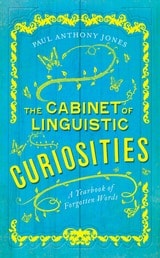
The Cabinet of Linguistic Curiosities
A Yearbook of Forgotten WordsPaul Anthony Jones
University of Chicago Press, 2019
On the day on which flirting was banned in New York City, for instance, you’ll discover why to “sheep’s-eye” someone once meant to look at them amorously. On the day on which a disillusioned San Franciscan declared himself Emperor of the United States, you’ll find the word “mamamouchi,” a term for people who consider themselves more important than they truly are. And on the day on which George Frideric Handel completed his 259-page Messiah after twenty-four days of frenzied work, you’ll see why a French loanword, literally meaning “a small wooden barrow,” is used to refer to an intense period of work undertaken to meet a deadline.
The English language is vast enough to supply us with a word for every occasion—and this linguistic “wunderkammer” is here to prove precisely that. So whatever date this book has found its way into your hands, there’s an entire year’s worth of linguistic curiosities waiting to be found.
The Chicago Guide to Grammar, Usage, and Punctuation
Bryan A. Garner
University of Chicago Press, 2016
Throughout the book Garner describes standard literary English—the forms that mark writers and speakers as educated users of the language. He also offers historical context for understanding the development of these forms. The section on grammar explains how the canonical parts of speech came to be identified, while the section on syntax covers the nuances of sentence patterns as well as both traditional sentence diagramming and transformational grammar. The usage section provides an unprecedented trove of empirical evidence in the form of Google Ngrams, diagrams that illustrate the changing prevalence of specific terms over decades and even centuries of English literature. Garner also treats punctuation and word formation, and concludes the book with an exhaustive glossary of grammatical terms and a bibliography of suggested further reading and references.
The Chicago Guide to Grammar, Usage, and Punctuation is a magisterial work, the culmination of Garner’s lifelong study of the English language. The result is a landmark resource that will offer clear guidelines to students, writers, and editors alike.
The Community College Writer
Exceeding ExpectationsHoward Tinberg and Jean-Paul Nadeau
Southern Illinois University Press, 2010
While there have been several studies of writing programs at larger, baccalaureate institutions, the community college classroom has often been overlooked. Authors Howard Tinberg and Jean-Paul Nadeau fill this gap with The Community College Writer, a systematic and unique case study of first semester writing students at a community college. Drawing on surveys, interviews, and samples of classroom assignments, Tinberg and Nadeau use their research at one community college to reach out to instructors throughout the nation, fostering communication between community college faculty members in the effort to establish full-fledged writing programs geared toward student success.
At the heart of the book are the voices of the students themselves, as they discuss both their teachers’ expectations and their own. Through a series of case studies, the authors reveal the challenges students face as budding writers, and their firsthand experiences with writing programs at the community college level.
With this informative study, Tinberg and Nadeau seek not only to encourage dialogue between student and teacher or community college instructors, but to expand the conversation about program improvement to include both two- and four-year colleges, bringing composition faculty together in an effort to improve writing programs in all schools. Included in the volume are seven appendices, including surveys and interviews with faculty and students, making The Community College Writer a comprehensive and practical guide to tackling the issues facing writing programs and instructors.
The Condensed ESL Writer's Handbook
Janine Carlock, Maeve Eberhardt, Jaime Horst, Lionel Menasche
University of Michigan Press, 2013
The CondensedESL Writer’s Handbook is a reference work for ESL students who are taking college-level courses. Because its purpose is to provide help with the broad variety of writing questions students may have when working on school assignments, the text focuses on English for Academic Purposes. Unlike other handbooks on the market, this book’s sole purpose is to address the issues of primary importance to language learners.
The Condensed Handbook complements a student writer’s dictionary, thesaurus, and grammar reference book. It would be suitable as a text for an advanced ESL writing course.
The Condensed Handbook is concise and easily navigated; is accessible, with clear and direct explanatory language; and limits its focus to the grammatical and style aspects of writing and reference material.
Included as special features in the Condensed Handbook are:
• The explanatory language is appropriate for ESL students, in contrast to the more complex and idiomatic language of other English handbooks.
• The level of detail is more manageable for ESL students, compared to what is in other English handbooks.
• Many of the examples of paragraphs and exercise sentences were written by ESL students; this encourages users of this Handbook to realize that they too can also become effective writers.
• Additional samples of MLA and APA reference entries.
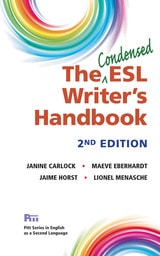
The Condensed ESL Writer's Handbook, 2nd Ed.
Janine Carlock, Maeve Eberhardt, Jaime Horst, and Lionel Menasche
University of Michigan Press, 2018
The Condensed version is concise and easily navigated; is accessible with clear and direct explanatory language; and limits its focus to the grammatical and style aspects of writing and reference material.
The 2nd Edition of The Condensed ESL Writer’s Handbook has been revised to better align with the exercises in Workbook for The ESL Writer’s Handbook, 2nd Ed.(978-0-472-03726-1). It also features an expanded Section 1 (to include more on pre-writing, drafting, revising, and editing), updated exercise items, and completely revised APA and MLA style guides (featuring MLA, 8th Edition). Overall, this handbook has these special features:
- The topic selection is based on ESL writers’ needs as observed by the authors over many years.
- The coverage of topics is more complete than the limited amount usually provided for ESL writers in first language or L1 handbooks.
- The explanatory language is appropriate for ESL students, in contrast to the more complex and idiomatic language of other English handbooks.
- Many of the text examples and exercise sentences were written by ESL students to help users realize that they too can become effective writers.

The Cree Language is Our Identity
The La Ronge lectures of Sarah WhitecalfSarah Whitecalf
University of Manitoba Press, 1983
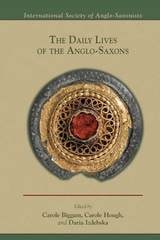
The Daily Lives of the Anglo-Saxons
Carole Biggam
Arizona Center for Medieval and Renaissance Studies, 2017
Insights into the lives of any group of historical people are provided by three main types of evidence: their language, their literature and their material culture. The contributors to this volume draw on all three types of evidence in order to present new research into the lives of the Anglo-Saxons. The particular focus is on daily life – the ordinary rather than the extraordinary, the normal rather than the exceptional. Rather than attempting an overview, the essays address individual scenarios in greater depth, but with an emphasis on shared experience.
The following scholars have contributed essays to this collection:
Martha Bayless
University of Oregon
Carole P. Biggam
University of Glasgow
Paul Cavill
University of Nottingham
Amy W. Clark
University of California, Berkeley
James Graham-Campbell
University College London
Antonina Harbus
Macquarie University, Sydney
Carole Hough
University of Glasgow
Daria Izdebska
Liverpool Hope University
Karen Louise Jolly
University of Hawai‘i at Mānoa
Alexandra Lester-Makin
University of Manchester
Elisabeth Okasha
University College, Cork
Phyllis Portnoy
University of Manitoba
Jane Roberts
University of London
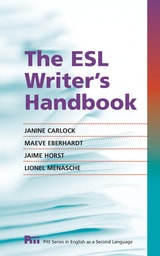
The ESL Writer's Handbook
Janine Carlock, Maeve Eberhardt, Jaime Horst, Lionel Menasche
University of Michigan Press, 2010
The ESL Writer’s Handbook is a reference work for ESL students who are taking college-level courses. Because its purpose is to provide help with the broad variety of writing questions students may have when working on school assignments, the text focuses on
English for Academic Purposes. Unlike other handbooks on the market, this book’s sole purpose is to address the issues of second language learners.
This spiral-bound Handbook complements a student writer’s dictionary, thesaurus, and grammar reference book. It would be suitable as a text for an advanced ESL writing course when used together with the companion Workbook (978-0-472-03404-8). The Handbook is concise and easily navigated; is accessible, with clear and direct explanatory language; features information on both APA and MLA styles (including a sample paper for each); and includes many examples from ESL student writers to provide realistic models.
Included as special features in the Handbook are:
• The topic selection is based on ESL writers’ needs as observed by the authors over many years.
• The coverage of topics is more complete than the limited amount usually provided for ESL writers in first language or L1 handbooks.
• The explanatory language is appropriate for ESL students, in contrast to the more complex and idiomatic language of other English handbooks.
• The level of detail is more manageable for ESL students, compared to what is in other English handbooks.
- Many of the examples of paragraphs, essays, research papers, and exercise sentences were written by ESL students; this encourages users of this Handbook to realize that they can also become effective writers.
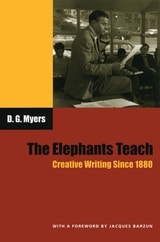
The Elephants Teach
Creative Writing Since 1880David Gershom Myers
University of Chicago Press, 2006
Myers explores more than a century of debate over how writing should be taught and whether it can or should be taught in a classroom at all. Along the way, he incorporates insights from a host of poets and teachers, including Henry Wadsworth Longfellow, Ralph Waldo Emerson, Robert Frost, John Berryman, John Dewey, Lionel Trilling, Robert Lowell, Ezra Pound, and Saul Bellow. And from his exhaustive research, Myers extracts relevant background information on nineteenth-century educational theory; shifts in technology, publishing, and marketing; the growth of critical theory in this country; and the politics of higher education. While he shows how creative writing has become a machine for creating more creative writing programs, Myers also suggests that its history supplies a precedent for something different—a way for creativity and criticism, poetry and scholarship, to join together to produce not just writing programs but good writers.
Updated with fresh commentary on what’s happened to creative writing in the academy since the first edition was published ten years ago, The Elephants Teach will be indispensable for students and teachers of writing, literature, and literary history.
The Eloquent Shakespeare
A Pronouncing Dictionary for the Complete Dramatic Works with Notes to Untie the Modern TongueGary Logan
University of Chicago Press, 2008
The End of Composition Studies
David W. Smit
Southern Illinois University Press, 2007
The English Department
A Personal and Institutional HistoryW. Ross Winterowd
Southern Illinois University Press, 1998
Tounderstand the history of "English," Ross Winterowd insists, one must understand how literary studies, composition-rhetoric studies, and influential textbooks interrelate. Stressing the interrelationship among these three forces, Winterowd presents a history of English studies in the university since the Enlightenment.
Winterowd’s history is unique in three ways. First, it tells the whole story of English studies: it does not separate the history of literary studies from that of composition-rhetoric studies, nor can it if it is going to be an authentic history. Second, it traces the massive influence on English studies exerted by textbooks such as Adventures in Literature, Understanding Poetry, English in Action, and the Harbrace College Handbook. Finally, Winterowd himself is very much a part of the story, a partisan with more than forty years of service to the discipline, not simply a disinterested scholar searching for the truth.
After demonstrating that literary studies and literary scholars are products of Romantic epistemology and values, Winterowd further invites controversy by reinterpreting the Romantic legacy inherited by English departments. His reinterpretation of major literary figures and theory, too, invites discussion, possibly argument. And by directly contradicting current histories of composition-rhetoric that allow for no points of contact with literature, Winterowd intensifies the argument by explaining the development of composition-rhetoric from the standpoint of literature and literary theory.
The Ghost of Meter
Culture and Prosody in American Free VerseAnnie Finch
University of Michigan Press, 1993
Population and environment are topics of intense current discussion and international action. Population growth rates have given rise to the metaphor of an exploding bomb, and accounts of oil spills, droughts, and rainforest destruction appear daily in the news. Despite the crowded agenda, observes Gayl Ness, the relationships between population and the environment still defy clear and comprehensive understanding. While they are closely intertwined in real life, they are separate in much of our thought and action. The contributors to this volume explore the basis of this separation and offer ways to integrate these closely interconnected areas, providing a forum for dialogue between those who support the interests of each. Topics covered include population-environment dynamics in historical perspective; constraints on sustainable growth in agricultural production; population as concept and parameter in the modeling of deforestation; powers and limits of the state and technology; resource control, fertility, and migration; and an ecosystem approach to the study of coastal areas.
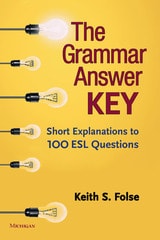
The Grammar Answer Key
Short Explanations to 100 ESL QuestionsKeith S. Folse
University of Michigan Press, 2018
The 100 questions are organized into 12 chapters on topics that teachers and students can relate to well: adjectives, articles, clauses, connectors, gerunds and infinitives, prepositions, pronouns, pronunciation, subject-verb agreement, suffixes, verbs, and vocabulary-grammar connections. The number of questions in each chapter ranges from 3 to 13 and is based on the questions submitted. Each chapter begins with a short overview of the topic that features key terminology and a chart explaining three common ESL errors.
Each question is presented in a box and is followed by an "answer" that can inform instruction, often in chart format. Examples of questions are:
- How do you know if a word is an adjective?
- Can I say the Monday or the January?
- Do you say on July or in July?
- I received an email from someone that said “Greetings from my wife and I.” Is this right? Why?
- How do I know which way to pronounce the -ed at the end of a word?
- Which verb tenses are the most common in English? Which ones should I study?
- Why do you say turn on the light instead of turn the light?
- In my language, we have one word for make and do. In English, when should I use make and when should I use do?
The book is the ideal teacher resource and professional development tool.
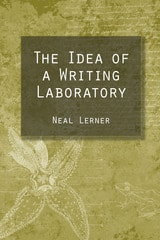
The Idea of a Writing Laboratory
Neal Lerner
Southern Illinois University Press, 2009
The Idea of a Writing Laboratory is a book about possibilities, about teaching and learning to write in ways that can transform both teachers and students.
Author Neal Lerner explores higher education’s rich history of writing instruction in classrooms, writing centers and science laboratories. By tracing the roots of writing and science educators’ recognition that the method of the lab––hands-on student activity—is essential to learning, Lerner offers the hope that the idea of a writing laboratory will be fully realized more than a century after both fields began the experiment.
Beginning in the late nineteenth century, writing instructors and science teachers recognized that mass instruction was inadequate for a burgeoning, “non-traditional” student population, and that experimental or laboratory methods could prove to be more effective. Lerner traces the history of writing instruction via laboratory methods and examines its successes and failures through case studies of individual programs and larger reform initatives. Contrasting the University of Minnesota General College Writing Laboratory with the Dartmouth College Writing Clinic, for example, Lerner offers a cautionary tale of the fine line between experimenting with teaching students to write and “curing” the students of the disease of bad writing.
The history of writing within science education also wends its way through Lerner’s engaging work, presenting the pedagogical origins of laboratory methods to offer educators in science in addition to those in writing studies possibilities for long-sought after reform. The Idea of a Writing Laboratory compels readers and writers to “don those white coats and safety glasses and discover what works” and asserts that “teaching writing as an experiment in what is possible, as a way of offering meaning-making opportunities for students no matter the subject matter, is an endeavor worth the struggle.”
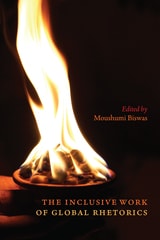
The Inclusive Work of Global Rhetorics
Moushumi Biswas
Utah State University Press, 2026
Envisioning the next step in the ongoing scholarly movement advocating inclusion of global rhetorics in the composition curriculum, The Inclusive Work of Global Rhetorics demonstrates that the question of why or whether to incorporate tenets of global/non-Western rhetorics into writing is long past. The focus has shifted to how to make this change—and to the best practices of such inclusion.
This book showcases the latest scholarship on rethinking the borders of traditional rhetorical studies, which are typically drawn within Greco-Roman and Euro-American confines, with the objective of incorporating non-Eurocentric rhetorical tenets into rhetoric and composition. This work fosters a spirit of inclusivity in the writing classroom by incorporating the many ways of rhetorical thinking gleaned from global/non-Western communication practices while also reflecting on their situatedness and intersectionalities.
Sitting at the crossroads of theory, methodology, and pedagogy, The Inclusive Work of Global Rhetoric puts in perspective a landmark moment in rhetorical studies, a time when it has become imperative to acknowledge the proliferation of non-Western rhetorical traditions in rhetorical practices and communication. Providing heuristics for creating inclusive composition/rhetoric pedagogy, this book serves students, teachers, scholars, and researchers of rhetoric, writing, and communication as both a classroom guide and a reference at the undergraduate and graduate level
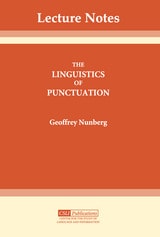
The Linguistics of Punctuation
Geoffrey Nunberg
CSLI, 1990
The Managerial Unconscious in the History of Composition Studies
Donna Strickland
Southern Illinois University Press, 2011
The Managerial Unconscious in the History of Composition Studies is the first book to address the history of composition studies as a profession rather than focusing on its pedagogical theories and systems. Strickland questions why writing and the teaching of writing have been the major areas of scholarly inquiry in the field when specialists often work primarily as writing program administrators, not teachers.
Strickland traces the emergence of writing programs in the early twentieth century, the founding of two professional organizations by and for writing program administrators, and the managerial overtones of the “social turn” of the field during the 1990s. She illustrates how these managerial imperatives not only have provided much of the impetus for the growth of composition studies over the past three decades but also have contributed to the stratified workplaces and managed writing practices the field’s pedagogical research often decries.
The Managerial Unconscious in the History of Composition Studies makes the case that administrative work should not be separated from intellectual work, calling attention to the interplay between these two kinds of work in academia at large and to the pronounced hierarchies of contingent faculty and tenure-track administrators endemic to college writing programs. The result is a reasoned plea for an alternative understanding of the very mission of the field itself.
The Memoir of Ednah Shepard Thomas
Ednah Shepard Thomas
University Press of Colorado, 2017