Results by title
434 books match the query 'Ethics & Moral Philosophy' and 102 start with t

Terrorism, Ticking Time-Bombs, and Torture
A Philosophical AnalysisFritz Allhoff
University of Chicago Press, 2012
The Aesthetics of Environment
Arnold Berleant
Temple University Press, 1995
The Affection in Between
From Common Sense to Sensing in CommonApril Flakne
Ohio University Press, 2022

The American Moralist
On Law, Ethics, And GovernmentGeorge Anastaplo
Ohio University Press, 1994
The Animal Claim
Sensibility and the Creaturely VoiceTobias Menely
University of Chicago Press, 2015
In the Restoration and eighteenth century, philosophers emphasized the role of sympathy in collective life and began regarding the passionate expression humans share with animals, rather than the spoken or written word, as the elemental medium of community. Menely shows how poetry came to represent this creaturely voice and, by virtue of this advocacy, facilitated the development of a viable discourse of animal rights in the emerging public sphere. Placing sensibility in dialogue with classical and early-modern antecedents as well as contemporary animal studies, The Animal Claim uncovers crucial connections between eighteenth-century poetry; theories of communication; and post-absolutist, rights-based politics.

The Anthrobscene
Jussi Parikka
University of Minnesota Press, 2014
Forerunners: Ideas First is a thought-in-process series of breakthrough digital publications. Written between fresh ideas and finished books, Forerunners draws on scholarly work initiated in notable blogs, social media, conference plenaries, journal articles, and the synergy of academic exchange. This is gray literature publishing: where intense thinking, change, and speculation take place in scholarship.
The Art of Time
Levinas, Ethics, and the Contemporary Peninsular NovelNina L. Molinaro
Bucknell University Press, 2019
Academicians and journalists in Spain and abroad have recently fastened on an emerging cluster of peninsular writers who, they argue, pertain to a discernible literary generation, provisionally referred to as Generación X. These writers are distinct from their predecessors; they and their literary texts are closely related to the specific socio-political and historical circumstances in Spain and their novels relate stories of more and less proximity, more and less responsibility, and more and less temporality. In short, they trace the temporal movement of alterity through narrative.
Published by Bucknell University Press. Distributed worldwide by Rutgers University Press.

The Bad Conscience
Vladimir Jankélévitch
University of Chicago Press, 2014
To this careful and sensitive English-language translation of The Bad Conscience, translator Andrew Kelley has added a substantial introduction situating the work in historical and intellectual context. Notes throughout indicate differences between this and earlier editions. A thought-provoking critique of standard conceptions of moral philosophy, The Bad Conscience restores this work by an important philosopher who has only recently begun to receive his due from the English-speaking world.
The Beneficiary
Bruce Robbins
Duke University Press, 2017
The Common Cause
Postcolonial Ethics and the Practice of Democracy, 1900-1955Leela Gandhi
University of Chicago Press, 2014
Reframing the way we think about some of the most consequential political events of the era, Gandhi presents moral imperfectionism as the lost tradition of global democratic thought and offers it to us as a key to democracy’s future. In doing so, she defends democracy as a shared art of living on the other side of perfection and mounts a postcolonial appeal for an ethics of becoming common.
The Culmination
Heidegger, German Idealism, and the Fate of PhilosophyRobert B. Pippin
University of Chicago Press, 2024
Heidegger claimed that Western philosophy ended—failed, even—in the German Idealist tradition. In The Culmination, Robert B. Pippin explores the ramifications of this charge through a masterful survey of Western philosophy, especially Heidegger’s critiques of Hegel and Kant. Pippin argues that Heidegger’s basic concern was to determine sources of meaning for human life, particularly those that had been obscured by Western philosophy’s attention to reason. The Culmination offers a new interpretation of Heidegger, German Idealism, and the fate of Western rationalism.
The Deepest Human Life
An Introduction to Philosophy for EveryoneScott Samuelson
University of Chicago Press, 2014
Sometimes it seems like you need a PhD just to open a book of philosophy. We leave philosophical matters to the philosophers in the same way that we leave science to scientists. Scott Samuelson thinks this is tragic, for our lives as well as for philosophy. In The Deepest Human Life he takes philosophy back from the specialists and restores it to its proper place at the center of our humanity, rediscovering it as our most profound effort toward understanding, as a way of life that anyone can live. Exploring the works of some of history’s most important thinkers in the context of the everyday struggles of his students, he guides us through the most vexing quandaries of our existence—and shows just how enriching the examined life can be.
Samuelson begins at the beginning: with Socrates, working his most famous assertion—that wisdom is knowing that one knows nothing—into a method, a way of approaching our greatest mysteries. From there he springboards into a rich history of philosophy and the ways its journey is encoded in our own quests for meaning. He ruminates on Epicurus against the sonic backdrop of crickets and restaurant goers in Iowa City. He follows the Stoics into the cell where James Stockdale spent seven years as a prisoner of war. He spins with al-Ghazali first in doubt, then in the ecstasy of the divine. And he gets the philosophy education of his life when one of his students, who authorized a risky surgery for her son that inadvertently led to his death, asks with tears in her eyes if Kant was right, if it really is the motive that matters and not the consequences. Through heartbreaking stories, humanizing biographies, accessible theory, and evocative interludes like “On Wine and Bicycles” or “On Zombies and Superheroes ,” he invests philosophy with the personal and vice versa. The result is a book that is at once a primer and a reassurance—that the most important questions endure, coming to life in each of us.
The Dialectical Necessity of Morality
An Analysis and Defense of Alan Gewirth's Argument to the Principle of Generic ConsistencyDeryck Beyleveld
University of Chicago Press, 1991
Beyleveld then classifies all the criticisms that Gewirth's argument has received and measures them against his reconstruction of the argument. The overall result is an immensely rich picture of the argument, in which all of its complex issues and key moves are clearly displayed and its validity can finally be discerned.
The comprehensiveness of Beyleveld's treatment provides ready access to the entire debate surrounding the foundational argument of Reason and Morality. It will be required reading for all who are interested in Gewirth's theory and deontological ethics and will be of central importance to moral and legal theorists.
The Distressed Body
Rethinking Illness, Imprisonment, and HealingDrew Leder
University of Chicago Press, 2016
Leder draws on literary examples, clinical and philosophical sources, his medical training, and his own struggle with chronic pain. He levies a challenge to the capitalist and Cartesian models that rule modern medicine. Similarly, he looks at the root paradigms of our penitentiary and factory farm systems and the way these produce distressed bodies, asking how such institutions can be reformed. Writing with coauthors ranging from a prominent cardiologist to long-term inmates, he explores alternative environments that can better humanize—even spiritualize—the way we treat one another, offering a very different vision of medical, criminal justice, and food systems. Ultimately Leder proposes not just new answers to important bioethical questions but new ways of questioning accepted concepts and practices.
The Early Works of John Dewey, Volume 3, 1882 - 1898
Essays and Outlines of a Critical Theory of Ethics, 1889-1892John Dewey. Edited by Jo Ann Boydston
Southern Illinois University Press, 2008
This third volume in the definitive edition of Dewey’s early work opens with his tribute to George Sylvester Morris, the former teacher who had brought Dewey to the University of Michigan. Morris’s death in 1889 left vacant the Department of Philosophy chairmanship and led to Dewey’s returning to fill that post after a year’s stay at Minnesota.
Appearing here, among all his writings from 1889 through 1892, are Dewey’s earliest comprehensive statements on logic and his first book on ethics. Dewey’s marked copy of the galley-proof for his important article “The Present Position of Logical Theory,” recently discovered among the papers of the Open Court Publishing Company, is used as the basis for the text, making available for the first time his final changes and corrections.
The textual studies that make The Early Works unique among American philosophical editions are reported in detail. One of these, “A Note on Applied Psychology,” documents the fact that Dewey did not co-author this book frequently attributed to him. Six brief unsigned articles written in 1891 for a University of Michigan student publication, the Inlander, have been identified as Dewey’s and are also included in this volume. In both style and content, these articles reflect Dewey’s conviction that philosophy should be used as a means of illuminating the contemporary scene; thus they add a new dimension to present knowledge of his early writing.
The Early Works of John Dewey, Volume 4, 1882 - 1898
Early Essays and The Study of Ethics, A Syllabus, 1893-1894John Dewey. Edited by Jo Ann Boydston
Southern Illinois University Press, 2008
Volume 4 of’ “The Early Works” series covers the period of Dewey’s last year and one-half at the University of Michigan and his first half-year at the University of Chicago. In addition to sixteen articles the present volume contains Dewey’s reviews of six books and three articles, verbatim reports of three oral statements made by Dewey, and a full-length book, The Study of Ethics.
Like its predecessors in this series, this volume presents a “clear text,” free of interpretive or reference material. Apparatus, including references, corrections, and emendations, is confined to appendix material. Fredson Bowers, the Consulting Textual Editor, has provided an essay on the textual principles and procedures, and Wayne A. R. Leys, Professor of Philosophy at Southern Illinois University, has written an Introduction discussing the relationship between Dewey’s writings of this period and his later work. That Dewey’s scholarship and writing was at an especially high level during 1893 and 1894 may be considered an index to the significance of this two-year period.
The Early Works of John Dewey, Volume 5, 1882 - 1898
Early Essays, 1895-1898John Dewey. Edited by Jo Ann Boydston
Southern Illinois University Press, 2008
This fifth and concluding volume of “The Early Works of John Dewey” is the only one of the series made up entirely of essays. The appearance during the four-year period, 1895–98, of thirty-eight items amply indicates that Dewey continued to maintain a high level of published output. These were the years of Dewey’s most extensive work and involvement at the University of Chicago.
Like its predecessors in this series, this volume presents a “clear text,” free of interpretive or reference material. Apparatus, including references, corrections, and emendations, is confined to appendix material. Fredson Bowers, the Consulting Textual Editor, has provided an essay on the textual principles and procedures, and William P. McKenzie, Professor of Philosophy and Education at Southern Illinois University, has written an introduction identifying the thread connecting the apparently diffuse material in the many articles of this volume—Dewey’s attempt to unite philosophy with psychology and sociology and with education.
The Embers and the Stars
Erazim Kohák
University of Chicago Press, 1987
"Those who share Kohák's concern to understand nature as other than a mere resource or matter in motion will find his temporally oriented interpretation of nature instructive. It is here in particular that Kohák turns moments of experience to account philosophically, turning what we habitually overlook or avoid into an opportunity and basis for self-knowledge. This is an impassioned attempt to see the vital order of nature and the moral order of our humanity as one."—Ethics
The Erotic Phenomenon
Jean-Luc Marion
University of Chicago Press, 2006
While humanists have pondered the subject of love to the point of obsessiveness, philosophers have steadfastly ignored it. One might wonder whether the discipline of philosophy even recognizes love. The word philosophy means “love of wisdom,” but the absence of love from philosophical discourse is curiously glaring. So where did the love go? In The Erotic Phenomenon, Jean-Luc Marion asks this fundamental question of philosophy, while reviving inquiry into the concept of love itself.
Marion begins his profound and personal book with a critique of Descartes’ equation of the ego’s ability to doubt with the certainty that one exists—“I think, therefore I am”—arguing that this is worse than vain. We encounter being, he says, when we first experience love: I am loved, therefore I am; and this love is the reason I care whether I exist or not. This philosophical base allows Marion to probe several manifestations of love and its variations, including carnal excitement, self-hate, lying and perversion, fidelity, the generation of children, and the love of God. Throughout, Marion stresses that all erotic phenomena, including sentimentality, pornography, and even boasts about one’s sexual conquests, stem not from the ego as popularly understood but instead from love.
A thoroughly enlightening and captivating philosophical investigation of a strangely neglected subject, The Erotic Phenomenon is certain to initiate feverish new dialogue about the philosophical meanings of that most desirable and mysterious of all concepts—love.
The Ethic of the Upward Gaze
Essays Inspired by Immanuel Kant and Nicolai Hartmannpredrag cicovacki
St. Augustine's Press, 2024
"Kant and Hartmann share a belief that is less common than it once was: that the aim of morality is to guide us toward becoming the best version of ourselves. Morality is not the same as prudence, nor is it a utilitarian calculus about what actions lead to our advantage. Yes, we do need to see what is in front of us, and handle what demands our immediate attention, in accordance with the rules endorsed by our societies. We also need to secure our existence as well as the material flourishing of ourselves and those who depend on us. But focusing exclusively on such issues deflects our consciousness from the high road of morality. […]
These essays explore ideas relating to the suffocating and hope-crushing atmosphere of negativity and disorientation in the contemporary world. The message of this collection is that, if we dare to open our eyes and our hearts, we can find that there is much in ourselves and the world that deserves our reverence and our loving gaze. It is not too late to recall that besides the natural and the social worlds, there is yet another order of being: the spiritual. And without a connection with this spiritual order, we cannot experience our humanity at its best."
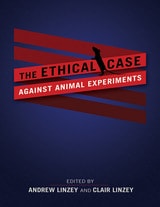
The Ethical Case against Animal Experiments
Andrew Linzey, Clair Linzey
University of Illinois Press, 2018
The Ethical Case against Animal Experiments begins with the Oxford Centre for Animal Ethics's groundbreaking and comprehensive ethical critique of the practice of animal experiments. A second section offers original writings that engage with, and elaborate on, aspects of the Oxford Centre report. The essayists explore historical, philosophical, and personal perspectives that range from animal experiments in classical times to the place of necessity in animal research to one researcher's painful journey from researcher to opponent.
A devastating look at a contemporary moral crisis, The Ethical Case against Animal Experiments melds logic and compassion to mount a powerful challenge to human cruelty.
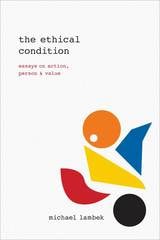
The Ethical Condition
Essays on Action, Person, and ValueMichael Lambek
University of Chicago Press, 2015
Organized chronologically, the essays begin among Malagasy speakers on the island of Mayotte and in northwest Madagascar. Building from ethnographic accounts there, they synthesize Aristotelian notions of practical judgment and virtuous action with Wittgensteinian notions of the ordinariness of ethical life and the importance of language, everyday speech, and ritual in order to understand how ethics are lived. They illustrate the multiple ways in which ethics informs personhood, character, and practice; explore the centrality of judgment, action, and irony to ethical life; and consider the relation of virtue to value. The result is a fully fleshed-out picture of ethics as a deeply rooted aspect of the human experience.
The Ethical Engineer
An "Ethics Construction Kit" Places Engineering in a New LightEugene Schlossberger
Temple University Press, 1993
On occasion, professionals need to use moral reasoning as well as engineering skills to function effectively in their occupation. Eugene Schlossberger has created a practical guide to ethical decision-making for engineers, students, and workers in business and industry.
The Ethical Engineer sets out the tools and materials essential to dealing with whistle-blowing, environmental and safety concerns, bidding, confidentiality, conflict of interest, sales ethics, advertising, employer-employee relations, when to fight a battle, and when to break the rules.
The author offers recommendations and techniques as well as rules, principles, and values that can guide the reader. Lively examples, engaging anecdotes, witty comments, and well-reasoned analysis prove his conviction that "ethics is good business."
The Ethics of History
John McCumber
Northwestern University Press, 2004
The Ethics of Organ Transplantation
Steven J. Jensen
Catholic University of America Press, 2011
The Ethics of Persuasion
Derrida's Rhetorical LegaciesBrooke Rollins
The Ohio State University Press, 2020
Drawing on Derrida’s (non)definition of ethics and his pointed accounts of performativity, Rollins argues that this vital ethical component of many ancient theories, practices, and pedagogies of persuasion has been undertheorized for more than two millennia. Through deconstructive readings of some of these texts, she shows us that we are not simply sovereign beings who both wield and guard against linguistic techniques of rule. Our persuasive endeavors, rather, are made possible by an ethics—an always prior encounter with otherness that interrupts self-presence.
The Ethics of Postmodernity
Current Trends in Continental ThoughtGary B. Madison and Marty Fairbarn
Northwestern University Press, 1997
Contributors include Barry Allen, Caroline Bayard, Robert Bernasconi, Thomas W. Busch, M.C. Dillon, Marty Fairbairn, Paul Fairfield, Morny Joy, Richard Kearney, Gary B. Madison, Joseph Margolis, Tom Rockmore, Charles E. Scott, Evan Simpson, and Mark Williams.

The Ethics of St. Thomas Aquinas
Happiness, Natural Law, and the VirtuesLeo Elders
Catholic University of America Press, 2019

The Fragile We
Ethical Implications Of Heidegger's "Being and Time"Lawrence Vogel
Northwestern University Press, 1994
In The Fragile "We": Ethical Implications of Heidegger's "Being and Time," Lawrence Vogel presents three interpretations of authentic existence—the existentialist, the historicist, and the cosmopolitan—each of which is a plausible version of the personal ideal depicted in Being and Time. He then draws parallels between these interpretations and three moments in the contemporary liberal-communitarian debate over the relationship of the "I" and the "We." His book contributes both to a diagnosis of what there is about Being and Time that invites moral nihilism and to a sense of how fundamental ontology might be recast so that "the other" is accorded an appropriate place in an account of human existence.
The Genesis of Desire
Jean-Michel Oughourlian
Michigan State University Press, 2010
We seem to be abandoning the codes that told previous generations who they should love. But now that many of us are free to choose whoever we want, nothing is less certain. The proliferation of divorces and separations reveal a dynamic we would rather not see: others sometimes reject us as passionately as we are attracted to them.
Our desire makes us sick. The throes of rivalry are at the heart of our attraction to one another. This is the central thesis of Jean-Michel Oughourlian's The Genesis of Desire, where the war of the sexes is finally given a scientific explanation. The discovery of mirror neurons corroborates his ideas, clarifying the phenomena of empathy and the mechanisms of violent reciprocity.
How can a couple be saved when they have declared war on one another? By helping them realize that desire originates not in the self but in the other. There are strategies that can help, which Dr. Oughourlian has prescribed successfully to his patients. This work, alternating between case studies and more theoretical statements, convincingly defends the possibility that breakups need not be permanent.

The Genesis of Values
Hans Joas
University of Chicago Press, 2001

The Gift of Active Empathy
Scheler, Bakhtin, and DostoevskyAlina Wyman
Northwestern University Press, 2016
The Good Is Love
The Body and Human Acts in Humanae Vitae and John Paul IIAdrian Reimers
St. Augustine's Press, 2020
Reimers draws upon the encyclical Humanae Vitae and John Paul II’s catechesis known as the theology of the body to respond to the stalled development of moral theology on the issues most crucial to human love and intimacy. “It is time, we are told, for a ‘paradigm shift’ in the Catholic Church’s moral teaching, such shift representing a more pastoral and less dogmatic approach to moral issues,” writes Reimers. His claim that “a paradigm shift in moral theology and philosophy may be valuable––perhaps vital––to scholars who think and write about these sciences and to teachers who communicate moral truth” is not an exhortation to redefine moral truths. Rather, he argues that an approach to contraception, for example, that relies exclusively on natural law is a hackneyed one and often “tedious.”
John Paul II’s series of catechetical addresses known as the theology of the body was originally composed in the 1970s after Paul VI’s encyclical Humanae Vitae. Albeit derived from the writing of an archbishop and not yet pope, Reimers identifies John Paul II’s perspectives on love, sex and contraception as an essential force behind this so-called paradigm shift in continuity with the profound and unchanging truths set forth in Humanae Vitae. As Reimers states, “Moral truths do not change, even if our ways to understand them improve.”
How, then, is our sense of the goodness or badness of contraception meant to be helped by such a development of thought? Ethics grounded philosophically tends to lean toward legalism in the context of moral actions, says Reimers, as it emphasizes conformity to God’s law and largely overlooks “the relationship between moral behavior and the human person’s ultimate end of beatitude with God.” The important principle of the necessarily two-fold description that natural law gives to sex––namely, as unitive and procreative––must not be the authoritative end of the discussion regarding the moral nature of contraception. In an age where technology has given human beings new power it seems there must be new rules as well, and the conquest of procreative acts changes the human perception of the limitations once associated with harmful acts. Herein lies the importance of John Paul II’s catechesis––the goodness or badness of acts is not just concerned with end of a particular act. As Reimers writes, “If we are to understand the complex relationships among love, marriage, and their sexual expression, we must situate these within the context of the end of the human being.”
A position on contraception and human sexuality cannot be comprehensive without a concept of love properly understood. Human acts must bring us closer to sanctity, not to comfort or possession. Holiness is the perfection of love, and its pursuit aims at ultimate beatitude. This end, the truest love human can know, is the end which ultimately condemns contraception once and for all, as “contracepted sex is contrary to holiness.” Reimers unpacks this sometimes difficult truth in eight chapters, which begin with love and conclude with faithfulness to moral norms and a spirituality of marriage.
The arguments surrounding contraception and “good sex” seem to have set the grounds for coherently choosing a side rather than to have succeeded in presenting certain human acts as definitively immoral. As Reimers notes, a natural law position on contraception often fails to employ its greatest ally: the reality of authentic human love and “victory” of the individual in one’s sanctity as achieved through that love. This work will reorient the objectives and claims of the moral debate, as well as influence the popular notion of what love is and what it cannot be. It is an aid to scholars, students and study groups, humanists, and those who seek to deepen the sense of love’s highest physical expression.
The Good Quit
Mastering the Fine Art of Giving UpJeffrey A. Lockwood
University of Wyoming Press, 2026
Masterful quitting contributes to genuine success, but this practice nevertheless has been largely overlooked by scholars, teachers, coaches, and leaders. This book is a three-part exploration. In conceptual terms it asks, Is it really quitting if the decision is reversible, involuntary, or partial? In normative terms, it explores whether quitting must be well-reasoned, -timed, and -enacted to be justifiable. In applicable terms, it emphasizes phronesis, or “practical wisdom,” and contributes to the understanding that what constitutes quitting, and doing so well, is vital to making decisions about whether to persevere or abandon difficult ventures.
Flourishing is more complex than “grit-or-quit” advocates suggest. To thrive, we must come to know why, when, and how to quit. The Good Quit approaches this topic from an expansive and philosophical point of view, making it valuable for anyone contemplating the what, when, why, and how of quitting.
The Great Debate
Nietzsche, Culture, and the Scandinavian Welfare SocietyGeorg Brandes and Harald Høffding
University of Wisconsin Press, 2024
Marking the moment at which the uniquely Nordic concept of social democratic welfare was first contested in the public sphere, this debate provides insights into not only Nietzschean philosophy and its immediate reception but also the foundational concept of modern Scandinavian social, cultural, and political organization. This volume presents, for the first time in any language other than Danish, the debate in its entirety: three essays by Brandes and three by Høffding. A critical introduction by editor and translator William Banks explores the exchange in its context and convincingly argues that the principles contested by the two Danish luminaries still very much resonate in Western society today.
The Greeks and Us
Essays in Honor of Arthur W. H. AdkinsEdited by Robert B. Louden and Paul Schollmeier
University of Chicago Press, 1996
The timely subjects addressed by the contributors include the relation between literature and moral understanding, moral and nonmoral values, and the contemporary meaning of ancient Greek ethics. The volume also includes an essay from the late Adkins himself illustrating his methodology in an analysis of the "Speech of Lysias" in Plato's Phaedrus.
The Greeks and Us will interest all those concerned with how ancient moral values do or do not differ from our own.
Contributors include Arthur W. H. Adkins, Stephanie Nelson, Martha C. Nussbaum, Paul Schollmeier, James Boyd White, Bernard Williams, and Lee Yearley.
Commentaries by Wendy Doniger, Charles M. Gray, David Grene, Robert B. Louden, Richard Posner, and Candace Vogler.
The Habit of Lying
Sacrificial Studies in Literature, Philosophy, and Fashion TheoryJohn Vignaux Smyth
Duke University Press, 2002
With recourse to Rene Girard, Paul de Man, Theodor Adorno, Leo Strauss, and other theoreticians not usually considered together, Smyth arrives at some surprising conclusions about the connections between lying, mimesis, sacrifice, sadomasochism, and the sacred, among other central subjects. Arguing that the relation between lying and truthtelling has been characterized in the West by sharply sacrificial features, he begins with a critique of the philosophies of lying espoused by Kant and Sissela Bok, then concludes that the problem of truth and lies leads to the further problem of the relation between law and arbitrariness as well as to the relation between rationality and unanimity. Constructively criticizing the work of such philosophers as Bertrand Russell, Ludwig Wittgenstein, Richard Rorty, and Nelson Goodman, Smyth shows how these problems occur comparably in fiction theory and how Paul de Man’s definition of fiction as arbitrariness finds confirmation in analytic philosophy. Through the novels of Defoe, Stendhal, and Beckett—with topics ranging from Defoe’s treatment of lies, fiction, and obscenity to Beckett’s treatment of the anus and the sacred—Smyth demonstrates how these texts generalize the issues of mendacity, concealment, and sacrificial arbitrariness in Girard’s sense to almost every aspect of experience, fiction theory, and cultural life. The final section of the book, taking its cue from Shakespeare, elaborates a sacrificial view of the history of fashion and dress concealment.
The Heart Is a Little to the Left
Essays on Public MoralityWilliam Sloane Coffin
Dartmouth College Press, 2011
The Heidegger Case
On Philosophy and Politicsedited by Tom Rockmore and Joseph Margolis
Temple University Press, 1992
The Holocaust
Theoretical ReadingsLevi, Neil
Rutgers University Press, 2003
This agenda-setting reader brings together both classic and new writings to demonstrate how concerns arising from the Nazi genocide shaped contemporary literary and cultural theory. Wide in its thematic scope, it covers such vital questions as:
- Authenticity and experience
- Memory and trauma
- Historiography and the philosophy of history
- Fascism and Nazi anti-Semitism
- Representation and identity formation
- Race, gender, and genocide
- Implications of the Holocaust for theories of the unconscious, ethics, politics, and aesthetics
The readings, which are fully contextualized by a general introduction, section introductions, and bibliographical notes, represent the work of many influential writers and theorists, including Theodor Adorno, Giorgio Agamben, Hannah Arendt, Jean Baudrillard, Zygmunt Bauman, Walter Benjamin, Cathy Caruth, Jacques Derrida, Shoshana Felman, Saul Friedlander, Paul Gilroy, Lawrence Langer, Emmanuel Levinas, Primo Levi, Jean-François Lyotard, Hayden White, and James E. Young. This multidisciplinary anthology will be welcomed by students and scholars of the Holocaust.
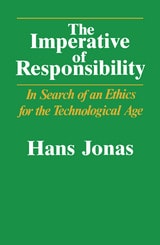
The Imperative of Responsibility
In Search of an Ethics for the Technological AgeHans Jonas
University of Chicago Press, 1984
Hans Jonas here rethinks the foundations of ethics in light of the awesome transformations wrought by modern technology: the threat of nuclear war, ecological ravage, genetic engineering, and the like. Though informed by a deep reverence for human life, Jonas's ethics is grounded not in religion but in metaphysics, in a secular doctrine that makes explicit man's duties toward himself, his posterity, and the environment. Jonas offers an assessment of practical goals under present circumstances, ending with a critique of modern utopianism.

The Kingdom Suffereth Violence
The Machiavelli / Erasmus / More Correspondence and Other Unpublished DocumentsPhilippe Bénéton
St. Augustine's Press, 2012

The Last Walk
Reflections on Our Pets at the End of Their LivesJessica Pierce
University of Chicago Press, 2012
The product of a lifetime of loving pets, studying philosophy, and collaborating with scientists at the forefront of the study of animal behavior and cognition, The Last Walk asks—and answers—the toughest questions pet owners face. The result is informative, moving, and consoling in equal parts; no pet lover should miss it.
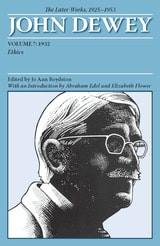
The Later Works of John Dewey, Volume 7, 1925 - 1953
1932, EthicsJohn Dewey. Edited by Jo Ann Boydston
Southern Illinois University Press, 2008
Introduction by Abraham Edel and Elizabeth Flower
This seventh volume provides an authoritative edition of Dewey and James H. Tufts’ 1932 Ethics.
Dewey and Tufts state that the book’s aim is: “To induce a habit of thoughtful consideration, of envisaging the full meaning and consequences of individual conduct and social policies,” insisting throughout that ethics must be constantly concerned with the changing problems of daily life.
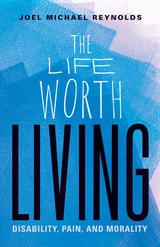
The Life Worth Living
Disability, Pain, and MoralityJoel Michael Reynolds
University of Minnesota Press, 2022
A philosophical challenge to the ableist conflation of disability and pain
More than 2,000 years ago, Aristotle said: “let there be a law that no deformed child shall live.” This idea is alive and well today. During the past century, Supreme Court Justice Oliver Wendell Holmes Jr. argued that the United States can forcibly sterilize intellectually disabled women and philosopher Peter Singer argued for the right of parents to euthanize certain cognitively disabled infants. The Life Worth Living explores how and why such arguments persist by investigating the exclusion of and discrimination against disabled people across the history of Western moral philosophy.
Joel Michael Reynolds argues that this history demonstrates a fundamental mischaracterization of the meaning of disability, thanks to the conflation of lived experiences of disability with those of pain and suffering. Building on decades of activism and scholarship in the field, Reynolds shows how longstanding views of disability are misguided and unjust, and he lays out a vision of what an anti-ableist moral future requires.
The Life Worth Living is the first sustained examination of disability through the lens of the history of moral philosophy and phenomenology, and it demonstrates how lived experiences of disability demand a far richer account of human flourishing, embodiment, community, and politics in philosophical inquiry and beyond.
Accessibility features: Retail e-book files for this title are screen-reader friendly with images accompanied by short alt text and/or extended descriptions.
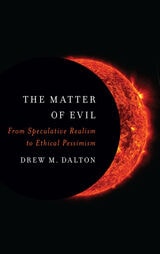
The Matter of Evil
From Speculative Realism to Ethical PessimismDrew M. Dalton
Northwestern University Press, 2024
In this radical reconsideration of ethical reasoning in contemporary European philosophy, Drew M. Dalton makes the case for an absolutely grounded account of ethical normativity developed from a scientifically informed and purely materialistic metaphysics. Expanding on speculative realist arguments, Dalton argues that the limits placed on the nature of ethical judgments by Kant’s critique can be overcome through a moral evaluation of the laws of nature—specifically, the entropic principle that undergirds the laws of physics, chemistry, and biology. In order to extract a moral meaning from this simple material fact, Dalton scrutinizes the presumptions of classical accounts and traditional understandings of good and evil within the history of Western philosophy and ultimately asserts that ethical normativity can be reestablished absolutely without reverting to dogmatism.
By overturning our assumptions about the nature and value of reality, The Matter of Evil: From Speculative Realism to Ethical Pessimism presents a provocative new model of ethical responsibility that is both logically justifiable and scientifically sound. Dalton argues for “ethical pessimism,” a position previously marginalized in the West, as a means to cultivate an account of ethical responsibility and political activism that takes seriously the unbecoming of being and the moral horror of existence.
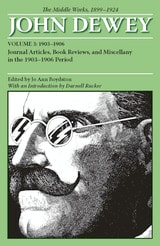
The Middle Works of John Dewey, Volume 3, 1899 - 1924
Journal Articles, Book Reviews, and Miscellany in the 1903-1906 PeriodJohn Dewey. Edited by Jo Ann Boydston
Southern Illinois University Press, 2008
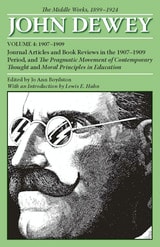
The Middle Works of John Dewey, Volume 4, 1899 - 1924
Journal Articles and Book Reviews in the 1907-1909 Period, and The Pragmatic Movement of Contemporary Thought and Moral Principles in EducationJohn Dewey. Edited by Jo Ann Boydston
Southern Illinois University Press, 2008
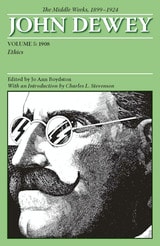
The Middle Works of John Dewey, Volume 5, 1899-1924
Ethics, 1908John Dewey. Edited by Jo Ann Boydston
Southern Illinois University Press, 2008
Thisfifth volume of the Middle Works contains Ethics by John Dewey and his former colleague at the University of Michigan, James H. Tufts, which appeared as one of the last in the Holt American Science series of textbooks. Within some six months after publication, Ethics was adopted as a textbook by thirty colleges. The book continued to be extremely popular and widely used, and was reprinted twenty-five times before both authors completely revised their respective parts for the new 1932edition.
Up to the time Ethics was published, Dewey’s approach to ethics was known primarily from two short publications that were developed for use by his classes at the University of Michigan: Outlines of a Critical Theory of Ethics (1891)and The Study of Ethics: A Syllabus (1894). Charles Stevenson notes in his Introduction to the present edition that Ethics afforded Dewey an opportunity to preserve and enrich the content of those earlier works and at the same time to expound his position in a more systematic manner.
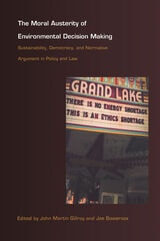
The Moral Austerity of Environmental Decision Making
Sustainability, Democracy, and Normative Argument in Policy and LawJohn Martin Gillroy and Joe Bowersox, eds.
Duke University Press, 2002
The contributors search for these assumptions and principles in short arguments and debates over the role of science, social justice, instrumental value, and intrinsic value in contemporary environmental policy. In their discussion of moral alternatives to enrich environmental decision making and in their search for a less austere and more robust role for normative discourse in practical policy making, they analyze a series of original case studies that deal with environmental sustainability and natural resources policy including pollution, land use, environmental law, globalism, and public lands. The unique structure of the book—which features the core contributors responding in a discourse format to the central chapters’ essays and debates—helps to highlight the role personal and public values play in democratic decision making generally and in the field of environmental politics specifically.
Contributors. Joe Bowersox, David Brower, Susan Buck, Celia Campbell-Mohn, John Martin Gillroy, Joel Kassiola, Jan Laitos, William Lowry, Bryan Norton, Robert Paehlke, Barry G. Rabe, Mark Sagoff, Anna K. Schwab, Bob Pepperman Taylor, Jonathan Wiener