3745 books match the query 'Europe' and 973 start with t
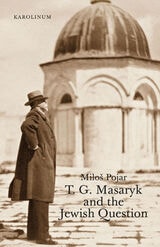
cover of T. G. Masaryk and the Jewish Question

T. G. Masaryk and the Jewish Question

Miloš Pojar

Karolinum Press, 2018

In this book, Miloš Pojar traces the development and transformation of the opinions about Jews and Judaism of the first Czechoslovak president, T. G. Masaryk. Pojar describes the key events and ideas that shaped Masaryk’s attitudes: his first contacts with the Jewish world as a child, and later as a student; his work as a philosopher and sociologist, through which his thinking on Marxism, social issues, Christianity, and Judaism evolved; and his later, pivotal, experience at the time of the anti-Semitic libel trials against Leopold Hilsner, known as the Hilsner Affair. Pojar also details the period when Masaryk, as president, formulated his position on matters such as the Czech-Jewish movement, the question of assimilation, and Zionism. Featuring an entire chapter on Masaryk’s celebrated 1927 trip to Palestine as well as a series of brief profiles of outstanding Jewish figures that explore both Masaryk’s attitudes to their ideas and their opinions of Masaryk, this book is a compelling personal portrait and a substantial contribution to our understanding of the history of Jews in the Czech lands.
[more]
cover of TEXT: Transactions of the Society for Textual Scholarship, Volume 7

TEXT

Transactions of the Society for Textual Scholarship, Volume 7

D. C. Greetham and W. Speed Hill, Editors

University of Michigan Press, 1994

The University of Michigan Press announces that it will assume the annual publication of TEXT: Transactions of the Society for Textual Scholarship, beginning with Volume 7. As the journal of the Society for Textual Scholarship, TEXT has always had a strong commitment to the theory as well as the practice of textual scholarship, and the new imprint strengthens this association. It will continue to be the best single source for keeping up with and following the increasingly active debate within the international textual community.
The Society for Textual Scholarship is an interdisciplinary organization devoted to providing a forum for the discussion of the cross-disciplinary implications of current research in various areas of contemporary textual work. These areas include the discovery, enumeration, description, bibliographical analysis, editing, and annotation of texts in disciplines such as literature, history, musicology, theater, film, linguistics, classical and biblical studies, philosophy, art history, history of science, legal history, computer science, library science, lexicography, epigraphy, paleography, codicology, and textual and literary theory. The contents of TEXT reflect this interdisciplinary concern and this range of fields.
TEXT 7 continues the tradition of offering its readers a series of sophisticated essays on specific textual problems, written by acknowledged experts in each field, balanced by a certain concern for those general problems in textual scholarship that all editors, bibliographers, and textual critics (not to mention literary critics) must confront. It is thus a further contribution to the "discourse" of the text and is as critical and ideological as it is descriptive and analytical.
The volume is organized in the same way as earlier ones, with an opening section of articles dealing with theoretical matters (e.g., Paul Eggert on document and text and Joseph Grigely on textual space), followed by articles arranged in chronological order of subject from medieval (e.g., Mary-Jo Arn on punctuation and Daniel Mosser on editing the Canterbury Tales) to Renaissance (e.g., Ted-Larry Pebworth on coterie poetry and Ernest W. Sullivan II on Donne) to modern (e.g., Heather Bryant Jordan on T. S. Eliot and Lawrence Rainey on Pound). Most of the essays in the chronological section also have a substantial theoretical argument. The final section of the volume consists of review-essays and reviews that give a thorough account and evaluation of books and editions while situating them in the various current debates on author, text, and culture. Highlights include reviews of editions of Marlowe, Burton, Johnson, and Thackeray and of George Landow's Hypertext, Ian Small and Marcus Walsh's Theory and Practice of Text-Editing, and D. C. Greetham's Textual Scholarship.
D. C. Greetham is Professor of English, City University of New York Graduate Center. W. Speed Hill is Professor of English, City University of New York. Peter Shillingsburg is Professor of English, Mississippi State University. All three are on the board of the Society for Textual Scholarship.
[more]
cover of TV Socialism

TV Socialism

Anikó Imre

Duke University Press, 2016

In TV Socialism, Anikó Imre provides an innovative history of television in socialist Europe during and after the Cold War. Rather than uniform propaganda programming, Imre finds rich evidence of hybrid aesthetic and economic practices, including frequent exchanges within the region and with Western media, a steady production of varied genre entertainment, elements of European public service broadcasting, and transcultural, multi-lingual reception practices. These televisual practices challenge conventional understandings of culture under socialism, divisions between East and West, and the divide between socialism and postsocialism. Taking a broad regional perspective encompassing Eastern Europe and the Soviet Union, Imre foregrounds continuities between socialist television and the region’s shared imperial histories, including the programming trends, distribution patterns, and reception practices that extended into postsocialism. Television, she argues, is key to understanding European socialist cultures and to making sense of developments after the end of the Cold War and the enduring global legacy of socialism.
[more]
cover of Taking Drugs in the Sun King’s Reign

Taking Drugs in the Sun King’s Reign

E. C. Spary

University of Chicago Press, 2027

The first full-length history of drugs during the first French Empire.

Taking Drugs in the Sun King’s Reign is the story of how the French came to know and consume new non-European plants between 1660 and 1730, a period during which many exotic substances—like coffee, tea, cinchona bark, chocolate, and ipecacuanha—became everyday commodities. E. C. Spary treats the trajectories of these drugs as fragile complexes, made and remade by every exchange. Her book addresses well-known cases, but also drugs that never became popular in France, such as betel. 

Taking Drugs is divided into three parts. The first offers a rich depiction of the world of drug-taking and drug-selling in Paris and Versailles at the outset of Louis XIV’s personal reign. The second explores features of monarchical power which explain the “drugs rush” of this period. Finally, the third offers an in-depth look at how priorities for the capture of exotic plant drugs changed within the royal naval administration. It asks how, under the conditions of early modern empires, information about drugs could be made or made trustworthy, who made it, and how it traveled. Spary shows how, over time, drugs transitioned from being natural bodies imbued with mysterious virtues to becoming calculable, replicable sources of profit. Her approach allows for new insights into how political and economic power transformed between the reigns of Louis XIV and his successor, Louis XV.
[more]
cover of Tales of Times Now Past: Sixty-Two Stories from a Medieval Japanese Collection

Tales of Times Now Past

Sixty-Two Stories from a Medieval Japanese Collection

Marian Ury

University of Michigan Press, 1993
Tales of Times Now Past is a translation of 62 outstanding tales freshly selected from Konjaku monogatari shu, a Japanese anthology dating from the early twelfth century. The original work, unique in world literature, contains more than one thousand systematically arranged tales from India, China, and Japan. It is the most important example of a genre of collections of brief tales which, because of their informality and unpretentious style, were neglected by Japanese critics until recent years but which are now acknowledged to be among the most significant prose literature of premodern Japan. “Konjaku” in particular has aroused the enthusiasm of such leading 20th-century writers as Akutagawa Ryunosuke and Tanizaki Jun’ichiro.
The stories, with sources in both traditional lore and contemporary gossip, cover an astonishing range—homiletic, sentimental, terrifying, practical-minded, humorous, ribald. Their topics include the life of the Buddha, descriptions of Heaven and Hell, feats of warriors, craftsmen, and musicians, unsuspected vice, virtue, and ingenuity, and the ways and wiles of bandits, ogres, and proverbially greedy provincial governors, to name just a few. Composed perhaps a century after the refined, allusive, aristocratic Tale of Genji, Konjaku represents a masculine outlook and comparatively plebeian social orientation, standing in piquant contrast to the earlier masterpiece. The unknown compiler was interested less in exploring psychological subtleties than in presenting vivid portraits of human foibles and eccentricities. The stories in the present selection have been chosen to provide an idea of the scope and structure of the book as a whole, and also for their appeal to the modern reader. And the translation is based on the premise that the most faithful rendering is also the liveliest.
[more]
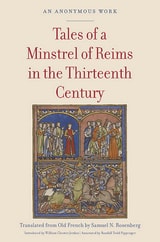
cover of Tales of a Minstrel of Reims in the Thirteenth Century

Tales of a Minstrel of Reims in the Thirteenth Century

Samuel N. Rosenberg

Catholic University of America Press, 2021

An anonymous minstrel in thirteenth-century France composed this gripping account of historical events in his time. Crusaders and Muslim forces battle for control of the Holy Land, while power struggles rage between and among religious authorities and their conflicting secular counterparts, pope and German emperor, the kings of England and the kings of France. Meanwhile, the kings cannot count on their independent-minded barons to support or even tolerate the royal ambitions. Although politics (and the collapse of a royal marriage) frame the narrative, the logistics of war are also in play: competing military machinery and the challenges of transporting troops and matariel. Inevitably, the civilian population suffers. The minstrel was a professional story-teller, and his livelihood likely depended on his ability to captivate an audience. Beyond would-be objective reporting, the minstrel dramatizes events through dialogue, while he delves into the motives and intentions of important figures, and imparts traditional moral guidance. We follow the deeds of many prominent women and witness striking episodes in the lives of Eleanor of Aquitaine, Richard the Lionhearted, Blanche of Castile, Frederick the Great, Saladin, and others. These tales survive in several manuscripts, suggesting that they enjoyed significant success and popularity in their day. Samuel N. Rosenberg produced this first scholarly translation of the Old French tales into English. References that might have been obvious to the minstrel’s original audience are explained for the modern reader in the indispensable annotations of medieval historian Randall Todd Pippenger. The introduction by eminent medievalist William Chester Jordan places the minstrel’s work in historical context and discusses the surviving manuscript sources.
[more]
cover of Talking History: Seminar Culture at the Institute of Historical Research, 1921–2021

Talking History

Seminar Culture at the Institute of Historical Research, 1921–2021

Edited by David Manning

University of London Press, 2024

Since its founding in 1921, the Institute of Historical Research (IHR) at the University of London has seen students and teachers come together, socially and intellectually, to engage in lively academic seminars. But for what purpose and with what value?

Talking History provides a defence of the seminar as a central element in historians' teaching, research and sense of community. Covering a range of the IHR’s long-running seminar series, which are differentiated by historical period, region and/or theme, the book presents the seminars as a local, national and international hub for scholarship that emerges from and is sustained by the ongoing learning practices of historians as scholars and people. Talking History bears witness to a seminar culture of evolving, multifarious synergies between teaching, researching and learning, historiography and participation — intertextual, interpersonal, intergenerational and intercultural. Viewed as such, the seminars constitute a living tradition, stimulating and incorporating dynamic change over time to contribute not just to the development of historiography but intellectual life more generally, often in conversation with major political events and cultural phenomena.

This original and significant book therefore reflects upon, and gives further expression to, the ongoing evolution of historical research and its role in wider society today.
[more]
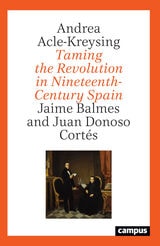
cover of Taming the Revolution

Taming the Revolution

Andrea Acle-Kreysing

Campus Verlag, 2022

An essential study of nineteenth-century Spanish political thought.

Jaime Balmes and Juan Donoso Cortés–the two most important conservative thinkers in nineteenth-century Spain–actively sought to preserve the centrality of church and monarchy in the wake of the rise of liberalism, while at the same time discrediting the stereotypical view of Spain as a backward and isolated country. Although they pursued a similar goal, their positions differed: while Balmes’ works anticipated a socially oriented Catholicism, Donoso presented Christianity as the supreme social good, incompatible with modern liberalism. In Taming the Revolution, Andrea Acle-Kreysing highlights the unresolved tensions in their works, escaping the dualistic interpretations of this period that defines tradition from modernity. This work endeavors to show how Spanish political thought was a compelling variation–rather than an aberration–of contemporary European debates.

 
[more]
cover of Tanegashima: The Arrival of Europe in Japan

Tanegashima

The Arrival of Europe in Japan

Olof Lidin

National University of Singapore Press, 2002
The year 1543 marked the beginning of a new global consciousness in Japan with the arrival of storm-blown Portuguese merchants in Tanegashima Island in southern Japan. Other Portuguese rapidly followed and Japan became aware of a world beyond India. The Portuguese brought with them the musket, which was quickly copied and began to change Japanese warfare. Francis Xavier arrived in 1549 and other Christian missionaries soon after. This is not a new story but it is the first time that Japanese, Portuguese and other European accounts have been brought together and presented in English.
[more]
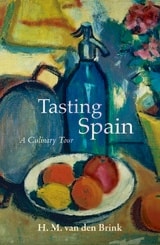
cover of Tasting Spain: A Culinary Tour

Tasting Spain

A Culinary Tour

H. M. van den Brink

Haus Publishing, 2017

Part travelogue, part memoir, and part cookbook, this addition to the Haus Armchair Traveller series offers a dynamic journey through Spain, one where the focus is on culinary delights found everywhere from Madrid’s cafes to Barcelona’s fish markets.

H. M. van den Brink paints an evocative scene of everyday life in Spain. Readers see the urban shop windows displaying famous serrano ham and Spanish sweet cakes, taste crispy pigs’ ears along with rich chickpea soup, and smell the strong coffee and steaming tortillas often enjoyed while breakfasting outdoors. An appealing blend of historical background and personal recollections, Tasting Spain shapes a lively account of the country and its culture, both in the city and out in the countryside. From exquisite restaurants to private settings, this is a book about eating—meals that Van den Brink has enjoyed solo or with friends—and about the vivid and sustaining memories such meals can create.

“I am not a cook, nor a historian, nor a critic,” writes Van den Brink. “I am just an eater.” With Tasting Spain, he opens new vistas on Spanish cuisine that will tickle the taste buds of readers and leave them hungry for more of this beautiful land.

[more]
cover of Tax Politics in Eastern Europe: Globalization, Regional Integration, and the Democratic Compromise

Tax Politics in Eastern Europe

Globalization, Regional Integration, and the Democratic Compromise

Hilary Appel

University of Michigan Press, 2011

“This is the first book to systematically examine the variation in policies of Eastern European countries. There is a theoretical contribution to understandings of variation in tax policies, but just as impressive is the in-depth empirical analysis and in particular the data from interviews with key players in the process.”
—Yoshiko Herrera, University of Wisconsin-Madison

Post-Communist tax reform, like institutional reform in other areas of the post-Communist transition, holds tremendous material consequences for different groups in society. Consequently, one would expect the allocation of resources and the distribution of the financial burden of that allocation to be highly sensitive to domestic politics. Indeed the political stakes should be especially high since post-Communist tax reform requires not merely a simple adjustment at the margin, but the fundamental reallocation of the responsibility for government revenue. In Eastern Europe, however, important areas of tax policy do not reflect traditional domestic variables (e.g., interest groups and partisanship) so much as the international imperatives associated with regional and global economic integration.

In Tax Politics in Eastern Europe, Hilary Appel analyzes the domestic and international factors that drive tax policy. She begins with a review of the greatest challenges in the initial creation of the capitalist tax systems in former Communist states and then turns to the evolution of specific forms of taxation in order to gauge the relative impact of domestic politics on tax policy. Appel concludes that, although some tax areas, such as personal income taxes, remain politicized, most other taxes, such as corporate income taxes and all forms of consumption taxes, have been less subject to domestic political pressures because of powerful constraints resulting from regional and global economic integration.
[more]
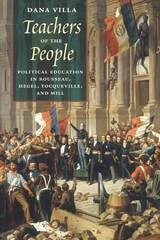
cover of Teachers of the People: Political Education in Rousseau, Hegel, Tocqueville, and Mill

Teachers of the People

Political Education in Rousseau, Hegel, Tocqueville, and Mill

Dana Villa

University of Chicago Press, 2017

2016 witnessed an unprecedented shock to political elites in both Europe and America. Populism was on the march, fueled by a substantial ignorance of, or contempt for, the norms, practices, and institutions of liberal democracy. It is not surprising that observers on the left and right have called for renewed efforts at civic education. For liberal democracy to survive, they argue, a form of political education aimed at “the people” is clearly imperative.

In Teachers of the People, Dana Villa takes us back to the moment in history when “the people” first appeared on the stage of modern European politics. That moment—the era just before and after the French Revolution—led many major thinkers to celebrate the dawning of a new epoch. Yet these same thinkers also worried intensely about the people’s seemingly evident lack of political knowledge, experience, and judgment. Focusing on Rousseau, Hegel, Tocqueville, and Mill, Villa shows how reformist and progressive sentiments were often undercut by skepticism concerning the political capacity of ordinary people. They therefore felt that “the people” needed to be restrained, educated, and guided—by laws and institutions and a skilled political elite. The result, Villa argues, was less the taming of democracy’s wilder impulses than a pervasive paternalism culminating in new forms of the tutorial state.
Ironically, it is the reliance upon the distinction between “teachers” and “taught” in the work of these theorists which generates civic passivity and ignorance. And this, in turn, creates conditions favorable to the emergence of an undemocratic and illiberal populism.
 
[more]
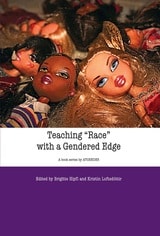
cover of Teaching "Race" with a Gendered Edge

Teaching "Race" with a Gendered Edge

Brigitte Hipfl

Central European University Press, 2012
How to deal with gender, women, gender roles, feminism and gender equality in teaching practices? Following in the footsteps of the ATHENA thematic network, ATGENDER brings together specialists in women’s and gender studies, feminist research, women’s rights, gender equality and diversity. In the book series ‘Teaching with Gender’ the partners in this network have collected articles on a wide range of teaching practices in the field of gender. The books in this series address challenges and possibilities of teaching about women and gender in a wide range of educational contexts. The authors discuss pedagogical, theoretical and political dimensions of learning and teaching about women and gender. The books contain teaching material, reflections on feminist pedagogies, and practical discussions about the development of gender-sensitive curricula in specific fields. All books address the crucial aspects of education in Europe today: increasing international mobility, the growing importance of interdisciplinarity, and the many practices of life-long learning and training that take place outside the traditional programmes of higher education. These books will be indispensable tools for educators who take seriously the challenge of teaching with gender. Teaching “Race” with a Gendered Edge responds to the need to approach the idea of race from a feminist perspective. This collection of essays aims to broaden our understanding of both race and gender by highlighting the intersections and intertwinedness of race, gender, and other axes of inequality. The book also points to the importance of taking colonial legacies into account when it comes to the understanding of contemporary forms of racisms. In an increasingly globalised and interconnected world this perspective is essential for understanding the dynamics of identity politics but also for pointing towards possible ways of intervention and change.The essays in the book discuss historically contextualised examples of the intersections of race and gender from different localities in Europe and beyond and provide readers with a rich body of resources and teaching material.
[more]
cover of Teaching Other Voices: Women and Religion in Early Modern Europe

Teaching Other Voices

Women and Religion in Early Modern Europe

Edited by Margaret L. King and Albert Rabil Jr.

University of Chicago Press, 2007

The books in The Other Voice in Early Modern Europe series chronicle the heretofore neglected stories of women between 1400 and 1700 with the aim of reviving scholarly interest in their thought as expressed in a full range of genres: treatises, orations, and history; lyric, epic, and dramatic poetry; novels and novellas; letters, biography, and autobiography; philosophy and science. Teaching Other Voices: Women and Religion in Early Modern Europe complements these rich volumes by identifying themes useful in literature, history, religion, women's studies, and introductory humanities courses. The volume's introduction, essays, and suggested course materials are intended as guides for teachers--but will serve the needs of students and scholars as well.

[more]
cover of Teaching Race in the European Renaissance: A Classroom Guide

Teaching Race in the European Renaissance

A Classroom Guide

Edited by Anna Wainwright and Matthieu Chapman

Arizona Center for Medieval and Renaissance Studies, 2023

A multidisciplinary guide to classroom discussion of race in the European Renaissance.
 
Teaching Race in the European Renaissance: A Classroom Guide provides both educators and students the tools they need to discuss race in the European Renaissance both in its unique historical contexts and as part of a broader continuum with racial thinking today. The volume gathers scholars of the English, French, Italian, and Iberian Renaissances to provide exercises, lesson plans, methodologies, readings, and other resources designed to bring discussions of race into a broad spectrum of classes on the early modern period, from literature to art history to the history of science. This book is designed to help educators create more diverse and inclusive syllabi and curricula that engage and address a diverse, twenty-first-century student body composed of students from a growing variety of cultural, national, ethnic, and racial backgrounds. By providing clear, concise, and diverse methodologies and analytical focuses, Teaching Race in the European Renaissance: A Classroom Guide will help educators in all areas of Renaissance Studies overcome the anxiety and fear that can come with stepping outside of their expertise to engage with the topic of race, while also providing expert scholars of race in the Renaissance with new techniques and pedagogies to enhance the classroom experience of their students.
[more]
cover of Teaching against Violence: The Reassessing Toolbox

Teaching against Violence

The Reassessing Toolbox

Inez Testoni

Central European University Press, 2014
Teaching Against Violence deals with gender based violence, paying particular attention to domestic violence, as in this field feminism has tenaciously sought to change the condition of women and, as a result, many international policies have promoted a significant social transformation. The chapters present active techniques that were adopted during the interventions to promote women's empowerment. The contributions face these issues from various perspectives, present the state of the art research in multiple fields of study and suggest educational best practices that can be used where this problem is particularly severe.
[more]
cover of Teaching the Eighteenth Century Now: Pedagogy as Ethical Engagement

Teaching the Eighteenth Century Now

Pedagogy as Ethical Engagement

Kate Parker

Bucknell University Press, 2024

In this timely collection, teacher-scholars of “the long eighteenth century,” a Eurocentric time frame from about 1680 to 1832, consider what teaching means in this historical moment: one of attacks on education, a global contagion, and a reckoning with centuries of trauma experienced by Black, Indigenous, and immigrant peoples. Taking up this challenge, each essay highlights the intellectual labor of the classroom, linking textual and cultural materials that fascinate us as researchers with pedagogical approaches that engage contemporary students. Some essays offer practical models for teaching through editing, sensory experience, dialogue, or collaborative projects. Others reframe familiar texts and topics through contemporary approaches, such as the health humanities, disability studies, and decolonial teaching. Throughout, authors reflect on what it is that we do when we teach—how our pedagogies can be more meaningful, more impactful, and more relevant.

Published by Bucknell University Press. Distributed worldwide by Rutgers University Press.
[more]
cover of Technologies of Empire: Writing, Imagination, and the Making of Imperial Networks, 1750–1820

Technologies of Empire

Writing, Imagination, and the Making of Imperial Networks, 1750–1820

Dermot Ryan

University of Delaware Press, 2013

Technologies of Empire looks at the ways in which writers of the long eighteenth century treat writing and imagination as technologies that can produce rather than merely portray empire. Authors ranging from Adam Smith to William Wordsworth consider writing not as part of a larger logic of orientalism that represents non-European subjects and spaces in fixed ways, but as a dynamic technology that organizes these subjects and transforms these spaces. Technologies of Empire reads the imagination as an instrument that works in tandem with writing, expanding and consolidating the networks of empire. Through readings across a variety of genres, ranging from Smith’s The Wealth of Nations and Edmund Burke’s Reflections on the Revolution in France to Maria Edgeworth’s Irish fiction and Wordsworth’s epic poetry, this study offers a new account of writing’s role in empire-building and uncovers a genealogy of the romantic imagination that is shot through by the imperatives of imperialism.

Published by University of Delaware Press. Distributed worldwide by Rutgers University Press.
 
[more]
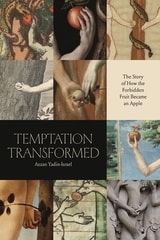
cover of Temptation Transformed: The Story of How the Forbidden Fruit Became an Apple

Temptation Transformed

The Story of How the Forbidden Fruit Became an Apple

Azzan Yadin-Israel

University of Chicago Press, 2022

A "brisk and entertaining" (Wall Street Journal) journey into the mystery behind why the forbidden fruit became an apple, upending an explanation that stood for centuries.
 
How did the apple, unmentioned by the Bible, become the dominant symbol of temptation, sin, and the Fall? Temptation Transformed pursues this mystery across art and religious history, uncovering where, when, and why the forbidden fruit became an apple.
 
Azzan Yadin-Israel reveals that Eden’s fruit, once thought to be a fig or a grape, first appears as an apple in twelfth-century French art. He then traces this image back to its source in medieval storytelling. Though scholars often blame theologians for the apple, accounts of the Fall written in commonly spoken languages—French, German, and English—influenced a broader audience than cloistered Latin commentators. Azzan Yadin-Israel shows that, over time, the words for “fruit” in these languages narrowed until an apple in the Garden became self-evident. A wide-ranging study of early Christian thought, Renaissance art, and medieval languages, Temptation Transformed offers an eye-opening revisionist history of a central religious icon.
[more]
cover of Temptation in the Archives: Essays in Golden Age Dutch Culture

Temptation in the Archives

Essays in Golden Age Dutch Culture

Lisa Jardine

University College London, 2015

Temptation in the Archives is a collection of essays by Lisa Jardine, that takes readers on a journey through the Dutch Golden Age. Through the study of such key figures as Sir Constantjin Huygens, a Dutch polymath and diplomat, we begin to see the Anglo-Dutch cultural connections that formed during this period against the backdrop of unfolding political events in England.Temptation in the Archives paints a picture of a unique relationship between the Netherlands and England in the 17th century forged through a shared experience – and reveals the lessons we can learn from it today.
[more]
cover of Tempting All the Gods: Joseph P. Kennedy, Ambassador to Great Britain, 1938–1940

Tempting All the Gods

Joseph P. Kennedy, Ambassador to Great Britain, 1938–1940

Jane Karoline Vieth

Michigan State University Press, 2021
Tempting All the Gods is a detailed study of Joseph P. Kennedy’s diplomatic career in London. It examines Kennedy’s role as ambassador to the Court of St. James’s from 1938–1940, a crucial time in world history. It describes his attitudes toward American foreign policy before the outbreak of war and after the war began, explains why he held those views, and assesses their impact on Anglo-American relations. It also looks at the diplomatic background against which he worked, at the political philosophies and personalities of the statesmen with whom he dealt, and at his relations with them, particularly President Franklin Roosevelt and British Prime Ministers Neville Chamberlain and Winston Churchill. Here the reader will find a meticulously researched account of Kennedy’s career based on the latest evidence available, providing a current and balanced historical reassessment. Scholars will be able to study Kennedy’s diplomatic career within the broader context of international relations and also to gain a fuller understanding of his view of his own motives and policies, including an understanding of why the ambassadorship was the greatest achievement—with the poorest outcome—in the varied life of an intensely ambitious man who was dedicated foremost to family, friends, and fortune. This book will prove significant to students of Anglo-American relations and of World War II, and to the general public, with its enduring fascination with the Kennedy family.
[more]
cover of Ten Books That Shaped the British Empire: Creating an Imperial Commons

Ten Books That Shaped the British Empire

Creating an Imperial Commons

Antionette Burton and Isabel Hofmeyr, eds.

Duke University Press, 2014

Combining insights from imperial studies and transnational book history, this provocative collection opens new vistas on both fields through ten accessible essays, each devoted to a single book. Contributors revisit well-known works associated with the British empire, including Charlotte Brontë's Jane Eyre, Thomas Macaulay's History of England, Charles Pearson's National Life and Character, and Robert Baden-Powell's Scouting for Boys. They explore anticolonial texts in which authors such as C. L. R. James and Mohandas K. Gandhi chipped away at the foundations of imperial authority, and they introduce books that may be less familiar to students of empire. Taken together, the essays reveal the dynamics of what the editors call an "imperial commons," a lively, empire-wide print culture. They show that neither empire nor book were stable, self-evident constructs. Each helped to legitimize the other.

Contributors. Tony Ballantyne, Elleke Boehmer, Catherine Hall, Isabel Hofmeyr, Aaron Kamugisha, Marilyn Lake, Charlotte Macdonald, Derek Peterson, Mrinalini Sinha, Tridip Suhrud, André du Toit
[more]
cover of Terms of Exchange: Brazilian Intellectuals and the French Social Sciences

Terms of Exchange

Brazilian Intellectuals and the French Social Sciences

Ian Merkel

University of Chicago Press, 2022

A collective intellectual biography that sheds new light on the Annales school, structuralism, and racial democracy.

Would the most recognizable ideas in the French social sciences have developed without the influence of Brazilian intellectuals? While any study of Brazilian social sciences acknowledges the influence of French scholars, Ian Merkel argues the reverse is also true: the “French” social sciences were profoundly marked by Brazilian intellectual thought, particularly through the University of São Paulo. Through the idea of the “cluster,” Merkel traces the intertwined networks of Claude Lévi-Strauss, Fernand Braudel, Roger Bastide, and Pierre Monbeig as they overlapped at USP and engaged with Brazilian scholars such as Mário de Andrade, Gilberto Freyre, and Caio Prado Jr..
 
Through this collective intellectual biography of Brazilian and French social sciences, Terms of Exchange reveals connections that shed new light on the Annales school, structuralism, and racial democracy, even as it prompts us to revisit established thinking on the process of knowledge formation through fieldwork and intellectual exchange. At a time when canons are being rewritten, this book reframes the history of modern social scientific thought.
[more]
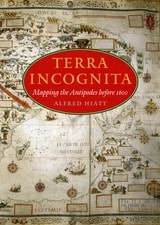
cover of Terra Incognita: Mapping the Antipodes before 1600

Terra Incognita

Mapping the Antipodes before 1600

Alfred Hiatt

University of Chicago Press, 2008

From the age of antiquity to the Middle Ages, scholars argued about the existence of places, and perhaps peoples, beyond the world known to Europeans. But to allow for the possibility of such lands and races raised troubling questions: Was it truly impossible to reach the underside of the earth? And, if so, how could its inhabitants receive the word of God?
In Terra Incognita, Alfred Hiatt draws on sources both literary and visual to understand the appeal of the antipodes. Examining maps and diagrams, as well as evidence contained in geographical and historical works, poetry, travel narratives, and legal documents, he challenges long-standing characterizations of medieval spatiality as exclusively symbolic and religious. Instead, Hiatt finds, the idea of people on the other side of the Earth provided a potent and malleable symbol for political theorists, satirists, scholars, and poets—as well as for map makers. Terra Incognita is, in the end, the history of a non-place, of lands conjured by the scientific imagination, which nevertheless drove exploration, and which continued to shape the world map, even as they slowly vanished from it.
[more]
cover of Terror And Its Discontents: Suspect Words In Revolutionary France

Terror And Its Discontents

Suspect Words In Revolutionary France

Caroline Weber

University of Minnesota Press, 2003

A timely exploration of the political uses of language and rhetoric

Camille Desmoulins, a journalist writing under the Montagnard regime of 1793-94, remarked that France’s government had replaced “the language of democracy” with “the cold poison of fear, which paralyzed thought in the bottom of people’s souls, and prevented it from pouring forth at the tribunal, or in writing.” How this happened, how the Reign of Terror reached even into the realms of thought and language, is the subject of Caroline Weber’s book, a revealing look into the paradoxical embargo on free expression that underpinned the Robespierrists’s self-proclaimed “despotism of liberty” during the French Revolution.

Weber examines Jean-Jacques Rousseau’s and the Robespierrists’s articulation of a series of initiatives designed to curtail and control the dissemination of alternative political and philosophical messages in the republic. Here Weber underscores the internal contradictions and limitations of an enterprise that promised universal freedom while oppressing particularism, and that railed against the very language that it was compelled to adopt as a principal political tool. The book then focuses on two eloquent contemporary critics of this phenomenon, Desmoulins and the Marquis de Sade, the infamous libertine author. Weber demonstrates how Desmoulins reconfigured the Montagnard regime’s rhetoric to conjure up a political system based on tolerance, not terror, and how Sade deftly parodied the Robespierrists’s brutality and hypocrisy, proposing a republic based on the ruthless elimination of dissident voices and on the unabashed celebration of despotism and bloodshed.A balanced account of how the “discourse of totality” actually restricted particular freedoms in the wake of the French Revolution, this book provides a highly original—and timely—exposition of the political uses of rhetoric and of the links between language and power.
[more]
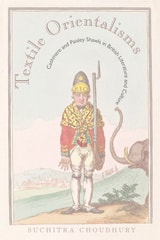
cover of Textile Orientalisms: Cashmere and Paisley Shawls in British Literature and Culture

Textile Orientalisms

Cashmere and Paisley Shawls in British Literature and Culture

Suchitra Choudhury

Ohio University Press, 2023

The first major study of Cashmere and Paisley shawls in nineteenth-century British literature, this book shows how they came to represent both high fashion and the British Empire. During the late eighteenth century, Cashmere shawls from the Indian subcontinent began arriving in Britain. At first, these luxury goods were tokens of wealth and prestige. Subsequently, affordable copies known as “Paisley” shawls were mass-produced in British factories, most notably in the Scottish town of the same name. Textile Orientalisms is the first full-length study of these shawls in British literature of the extended nineteenth century. Attentive to the juxtaposition of objects and their descriptions, the book analyzes the British obsession with Indian shawls through a convergence of postcolonial, literary, and cultural theories. Surveying a wide range of materials—plays, poems, satires, novels, advertisements, and archival sources—Suchitra Choudhury argues that while Cashmere and Paisley shawls were popular accoutrements in Romantic and Victorian Britain, their significance was not limited to fashion. Instead, as visible symbols of British expansion, for many imaginative writers they emerged as metaphorical sites reflecting the pleasures and anxieties of the empire. Attentive to new theorizations of history, fashion, colonialism, and gender, the book offers innovative readings of works by Sir Walter Scott, Wilkie Collins, William Thackeray, Frederick Niven, and Elizabeth Inchbald. In determining a key status for shawls in nineteenth-century literature, Textile Orientalisms reformulates the place of fashion and textiles in imperial studies. The book’s distinction rests primarily on three accounts. First, in presenting an original and extended discussion of Cashmere and Paisley shawls, Choudhury offers a new way of interpreting the British Empire. Second, by tracing how shawls represented the social and imperial experience, she argues for an associative link between popular consumption and the domestic experience of colonialism on the one hand and a broader evocation of texts and textiles on the other. Finally, discussions about global objects during the Victorian period tend to overlook that imperial Britain not only imported goods but also produced their copies and imitations on an industrial scale. By identifying the corporeal tropes of authenticity and imitation that lay at the heart of nineteenth-century imaginative production, Choudhury’s work points to a new direction in critical studies.
[more]
cover of Texts and Contexts from the History of Feminism and Women’s Rights: East Central Europe, Second Half of the Twentieth Century

Texts and Contexts from the History of Feminism and Women’s Rights

East Central Europe, Second Half of the Twentieth Century

Zsofia Lorand

Central European University Press, 2024

A compendium of one hundred sources, preceded by a short author’s bio and an introduction, this volume offers an English language selection of the most representative texts on feminism and women’s rights from East Central Europe between the end of the Second World War and the early 1990s. While communist era is the primary focus, the interwar years and the post-1989 transition period also receive attention. All texts are new translations from the original.

The book is organised around themes instead of countries; the similarities and differences between nations are nevertheless pointed out. The editors consider women not only in their local context, but also in conjunction with other systems of thought—including shared agendas with socialism, liberalism, nationalism, and even eugenics.

The choice of texts seeks to demonstrate how feminism as political thought was shaped and organised in the region. They vary in type and format from political treatises, philosophy to literary works, even films and the visual arts, with the necessary inclusion of the personal and the private. Women’s political rights, right to education, their role in nation-building, women, and war (and especially women and peace) are part of the anthology, alongside the gendered division of labour, violence against women, the body, and reproduction.
[more]
cover of Textual Magic: Charms and Written Amulets in Medieval England

Textual Magic

Charms and Written Amulets in Medieval England

Katherine Storm Hindley

University of Chicago Press, 2023

An expansive consideration of charms as a deeply integrated aspect of the English Middle Ages.
 

Katherine Storm Hindley explores words at their most powerful: words that people expected would physically change the world. Medieval Europeans often resorted to the use of spoken or written charms to ensure health or fend off danger. Hindley draws on an unprecedented archive of more than a thousand such charms from medieval England—more than twice the number gathered, transcribed, and edited in previous studies and including many texts still unknown to specialists on this topic. Focusing on charms from 1100 to 1350 CE as well as previously unstudied texts in Latin, French, and English, Hindley addresses important questions of how people thought about language, belief, and power. She describes seven hundred years of dynamic, shifting cultural landscapes, where multiple languages, alphabets, and modes of transmission gained and lost their protective and healing power. Where previous scholarship has bemoaned a lack of continuity in the English charms, Hindley finds surprising links between languages and eras, all without losing sight of the extraordinary variety of the medieval charm tradition: a continuous, deeply rooted part of the English Middle Ages.
[more]
cover of The "Spirit of Poesy": Essays on Jewish and German Literature and Thought in Honor of Geza von Molnar

The "Spirit of Poesy"

Essays on Jewish and German Literature and Thought in Honor of Geza von Molnar

Richard Block and Peter Fenves

Northwestern University Press, 2000

A testament to the "spirit of poesy" that informs the life and work of Geza von Molnar, this volume of essays comes together around his principal preoccupations: the philosophical foundations of Goethe's writings, the structure and reception of German romanticism, the ethics of reading, and the fate of European Jewry. At the center of this work is the idea of a genuinely free humanity—from its ambiguous presence in the aesthetic projects of Goethe and German romanticism to its utter absence in the Nazi extermination camps. Combining works in philosophy, literature, and Jewish studies by established and younger scholars, this collection contributes significantly to an understanding of German culture.
[more]
cover of The 1922 General Election Reconsidered: High Politics and the Birth of the Modern British Election

The 1922 General Election Reconsidered

High Politics and the Birth of the Modern British Election

G.H. Bennett

University of London Press, 2025

Revisiting the high-stakes politics of 1922, G.H. Bennett unveils how one election transformed Britain’s electoral system and redefined party alliances for decades to come.

The 1922 General Election was more than just another political contest; it was the turning point that shaped the modern British electoral landscape. In The 1922 General Election Reconsidered, G.H. Bennett revisits this pivotal moment with fresh insight, drawing on newly available archival materials and digitized resources to decipher the high-stakes maneuvering and backroom negotiations that defined the campaign. Covering the dramatic collapse of the Lloyd George coalition and the intricate web of party alliances and local political machinations, this book captures the election in unprecedented detail.

Bennett studies the key players and the seismic shifts that emerged in the wake of the vote. He also looks into how informal cooperation between parties blurred political lines and how media speculation shaped public perceptions. By placing the election in both its immediate and long-term context,  The 1922 General Election Reconsidered is a compelling reconsideration of an often-overlooked moment in British political history that continues to influence elections a century later.
[more]
cover of The 1956 Hungarian Revolution: A History in Documents

The 1956 Hungarian Revolution

A History in Documents

The National Security Archive Békés

Central European University Press, 2003

If there had been all-news television channels in 1956, viewers around the world would have been glued to their sets between October 23 and November 4. This book tells the story of the Hungarian Revolution in 120 original documents, ranging from the minutes of the first meeting of Khrushchev with Hungarian bosses after Stalin's death in 1953 to Yeltsin's declaration made in 1992. Other documents include letters from Yuri Andropov, Soviet Ambassador in Budapest during and after the revolt. The great majority of the material appears in English for the first time, and almost all come from archives that were inaccessible until the 1990s.
[more]
cover of The Accommodated Animal: Cosmopolity in Shakespearean Locales

The Accommodated Animal

Cosmopolity in Shakespearean Locales

Laurie Shannon

University of Chicago Press, 2013
Shakespeare wrote of lions, shrews, horned toads, curs, mastiffs, and hellhounds. But the word “animal” itself only appears very rarely in his work, which was in keeping with sixteenth-century usage. As Laurie Shannon reveals in The Accommodated Animal, the modern human / animal divide first came strongly into play in the seventeenth century, with Descartes’s famous formulation that reason sets humans above other species: “I think, therefore I am.” Before that moment, animals could claim a firmer place alongside humans in a larger vision of belonging, or what she terms cosmopolity.
 
With Shakespeare as her touchstone, Shannon explores the creaturely dispensation that existed until Descartes. She finds that early modern writers used classical natural history and readings of Genesis to credit animals with various kinds of stakeholdership, prerogative, and entitlement, employing the language of politics in a constitutional vision of cosmic membership. Using this political idiom to frame cross-species relations, Shannon argues, carried with it the notion that animals possess their own investments in the world, a point distinct from the question of whether animals have reason. It also enabled a sharp critique of the tyranny of humankind. By answering “the question of the animal” historically, The Accommodated Animal makes a brilliant contribution to cross-disciplinary debates engaging animal studies, political theory, intellectual history, and literary studies.
[more]
cover of The Aeneid of Virgil

The Aeneid of Virgil

Virgil

University of Michigan Press, 1995

Called "the best poem by the best poet," Virgil's Aeneid is perhaps the most famous work in Latin literature. It tells the story of Rome's founding by the Trojan prince Aeneas after many years of travel, and it contains many of the most famous stories about the Trojan War. It also reveals much of what the Romans felt and believed about themselves- the sensitive reader will see that these same values and issues often trouble us today.
In this new translation Edward McCrorie has performed the difficult task of rendering Virgil's compact, dense Latin into fine, readable, modern English verse. The sometimes complex text is made clear and comprehensible even for first-time readers, and a glossary of names helps identify characters and place-names in the poem. The translation is well suited for students at all levels, and readers already familiar with Virgil will find many fresh images and ideas.
"A brilliant effort."--Robert Bly
"I admire the ambition of the project, and the generosity of many of the lines."--Robert Fagles
Edward McCrorie is Professor of English, Providence College. His poetry and translations of Latin verse have been widely published.
[more]
cover of The Aesthetics of Resistance, Volume III: A Novel, Volume 3

The Aesthetics of Resistance, Volume III

A Novel, Volume 3

Peter Weiss

Duke University Press, 2025

A major literary event, the publication of the final volume of Peter Weiss’s three-volume novel The Aesthetics of Resistance makes one of the towering works of twentieth-century German literature available to English-speaking readers for the first time. Weiss’s crowning achievement, The Aesthetics of Resistance spans the period from the late 1930s to the end of World War II, dramatizing antifascist resistance and the rise and fall of proletarian political parties in Europe.

Volume III, initially published in 1981, teems with characters, many of whom are based on historical figures. It commences in May of 1940, as the narrator’s parents flee Nazi forces in Eastern Europe and reunite with their son in Sweden. While in Stockholm, the narrator and other Communist activists living in exile struggle to build structures in the German underground. The story then follows Communist resistance fighter Charlotte Bischoff as she is smuggled to Bremen on a freighter. In Berlin, she contacts the narrator’s friends and joins the Red Orchestra resistance group. Soon, the Gestapo cracks the underground group’s code, arrests a number of its members, and takes them to Plötzensee Prison, where most of them are executed. Featuring the narrator’s meditations on paintings, sculpture, and literature throughout, The Aesthetics of Resistance demonstrates the affinity between political resistance and art. Ultimately, Weiss argues that we must look to art for new models of political action and social understanding.
[more]
cover of The Age of Beloveds: Love and the Beloved in Early-Modern Ottoman and European Culture and Society

The Age of Beloveds

Love and the Beloved in Early-Modern Ottoman and European Culture and Society

Walter G. Andrews and Mehmet Kalpakli

Duke University Press, 2005

The Age of Beloveds offers a rich introduction to early modern Ottoman culture through a study of its beautiful lyric love poetry. At the same time, it suggests provocative cross-cultural parallels in the sociology and spirituality of love in Europe—from Istanbul to London—during the long sixteenth century. Walter G. Andrews and Mehmet Kalpakli provide a generous sampling of translations of Ottoman poems, many of which have never appeared in English, along with informative and inspired close readings. The authors explain that the flourishing of Ottoman power and culture during the “Turkish Renaissance” manifested itself, to some degree, as an “age of beloveds,” in which young men became the focal points for the desire and attention of powerful officeholders and artists as well as the inspiration for a rich literature of love.

The authors show that the “age of beloveds” was not just an Ottoman, eastern European, or Islamic phenomenon. It extended into western Europe as well, pervading the cultures of Venice, Florence, Rome, and London during the same period. Andrews and Kalpakli contend that in an age dominated by absolute rulers and troubled by war, cultural change, and religious upheaval, the attachments of dependent courtiers and the longings of anxious commoners aroused an intense interest in love and the beloved. The Age of Beloveds reveals new commonalities in the cultural history of two worlds long seen as radically different.

[more]
cover of The Age of Nightmare: The Gothic and British Culture, 1750–1900

The Age of Nightmare

The Gothic and British Culture, 1750–1900

Jeremy Black

St. Augustine's Press, 2022

Historian Jeremy Black is comprehensive, as ever, but in his treatment of the British Gothic novel his greatest service is the preservation of the detail––namely, the human impetus behind art that is often undervalued. Gothic novelists were purposeful, thoughtful, and engaged questions and feelings that ultimately shaped a century of culture. Black notes that the Gothic novel is also very much about "morality and deploying history accordingly." The true interest of the Gothic novel is more remarkable than it is grisly: the featured darkness and macabre are not meant to usurp heroism and purity, but will fall hard under the over-ruling hand of Providence and certainty of retribution. 

Black's understanding of the Gothic writer is a remarkable contribution to the legacy of British literature and the novel at large. Once again, in Black thoroughness meets fidelity and the reader is overcome with his own insights into the period on the merit of Black's efforts. 

In The Weight of Words Series, Black is devoted to the preservation of the memory of British literary genius, and in so doing he is carving out a niche for himself. As in the Gothic novel where landscapes give quarter to influences that seem to interact with the human fates that freely wander in, reading Black is an experience of suddenly finding oneself in possession of an education, and his allure takes a cue from the horrific Gothic tempt. 
[more]
cover of The Age of Subtlety: Nature and Rhetorical Conceits in Early Modern Europe

The Age of Subtlety

Nature and Rhetorical Conceits in Early Modern Europe

Javier Patiño Loira

University of Delaware Press, 2024
A craze for intricate metaphors, referred to as conceits, permeated all forms of communication in seventeenth-century Italy and Spain, reshaping reality in highly creative ways. The Age of Subtlety: Nature and Rhetorical Conceits in Early Modern Europe situates itself at the crossroads of rhetoric, poetics, and the history of science, analyzing technical writings on conceits by such scholars as Baltasar Gracián, Matteo Peregrini, and Emanuele Tesauro against the background of debates on telescopic and microscopic vision, the generation of living beings, and the boundaries between the natural and the artificial. It contends that in order to understand conceits, we must locate them within the early modern culture of ingenuity that was also responsible for the engineer’s machines, the juggler’s sleight of hand, the wiles of the statesman, and the discovery of truths about nature. 
[more]
cover of The Age of the Cathedrals: Art and Society, 980-1420

The Age of the Cathedrals

Art and Society, 980-1420

Georges Duby

University of Chicago Press, 1981

Recognizing that a work of art is the product of a particular time and place as much as it is the creation of an individual, Duby provides a sweeping survey of the changing mentalities of the Middle Ages as reflected in the art and architecture of the period.

"If Age of the Cathedrals has a fault, it is that Professor Duby knows too much, has too many new ideas and takes such a delight in setting them out. . . insights whiz to and fro like meteorites."—John Russell, New York Times Book Review
[more]
cover of The Albigensian Crusades

The Albigensian Crusades

Joseph R. Strayer

University of Michigan Press, 1992

Interprets thirteenth-century crusades in terms of the development of Europe, especially France
[more]
cover of The Alpine Enlightenment: Horace-Bénédict de Saussure and Nature’s Sensorium

The Alpine Enlightenment

Horace-Bénédict de Saussure and Nature’s Sensorium

Kathleen Kete

University of Chicago Press, 2024

A study of the experience of nature in the eighteenth century based on the life of Horace-Bénédict de Saussure (1740–99).
 
In The Alpine Enlightenment, historian Kathleen Kete takes us into the world of the Genevan geologist, physicist, inventor, and mountaineer Horace-Bénédict de Saussure. During his prodigious climbs into the upper ranges of the Alps, Saussure focused intensely on the natural phenomena he encountered—glaciers, crevasses, changes in the weather, and shifts in the color of the sky—and he described with great precision what he saw, heard, and touched. Kete uses Saussure’s evocative writings, which emphasized above all physical engagement with the earth, to uncover not just how people during the Enlightenment thought about nature, but how they experienced it. As Kete shows, Saussure thought with and through his body: he harnessed his senses to understand the forces that shaped the world around him. In so doing, he offered a vision of nature as worthy of respect independent of human needs, anticipating present-day concerns about the environment and our shared place within it.
[more]
cover of The Ambassador and the Courtesan: Political Bodies in Renaissance Italy

The Ambassador and the Courtesan

Political Bodies in Renaissance Italy

Paola De Santo

University of Delaware Press, 2026
Drawing on literature, legal texts, and archival materials, The Ambassador and the Courtesan offers a comparative analysis of these two emerging roles in the early modern period and in Renaissance Italian society. While these two figures may appear unrelated, this book demonstrates their shared relation to the body politic, including the relationship of their very bodies to that metaphorical body. One imagines the early modern ambassador as traveling from one center of power to another, gathering news and disseminating it in writing, as well as negotiating in person. The courtesan, in contrast, is normally imagined employing her body in the service of entertaining elite clients in the enclosed space of the urban salon. These characterizations reinforce their very different roles in Renaissance Italian society and culture, but by placing them in dialogue, salient points of convergence emerge detailing how they were integral to the concurrent emergence of a modern subjectivity of the individual and the formation of the modern state.
[more]
cover of The American Discovery of Europe

The American Discovery of Europe

Jack D. Forbes

University of Illinois Press, 2011
The American Discovery of Europe investigates the voyages of America's Native peoples to the European continent before Columbus's 1492 arrival in the "New World." The product of over twenty years of exhaustive research in libraries throughout Europe and the United States, the book paints a clear picture of the diverse and complex societies that constituted the Americas before 1492 and reveals the surprising Native American involvements in maritime trade and exploration. Starting with an encounter by Columbus himself with mysterious people who had apparently been carried across the Atlantic on favorable currents, Jack D. Forbes proceeds to explore the seagoing expertise of early Americans, theories of ancient migrations, the evidence for human origins in the Americas, and other early visitors coming from Europe to America, including the Norse. The provocative, extensively documented, and heartfelt conclusions of The American Discovery of Europe present an open challenge to received historical wisdom.
[more]
cover of The American Enemy: The History of French Anti-Americanism

The American Enemy

The History of French Anti-Americanism

Philippe Roger

University of Chicago Press, 2005

Georges-Louis Buffon, an eighteenth-century French scientist, was the first to promote the widespread idea that nature in the New World was deficient; in America, which he had never visited, dogs don't bark, birds don't sing, and—by extension—humans are weaker, less intelligent, and less potent. Thomas Jefferson, infuriated by these claims, brought a seven-foot-tall carcass of a moose from America to the entry hall of his Parisian hotel, but the five-foot-tall Buffon remained unimpressed and refused to change his views on America's inferiority.

Buffon, as Philippe Roger demonstrates here, was just one of the first in a long line of Frenchmen who have built a history of anti-Americanism in that country, a progressive history that is alternately ludicrous and trenchant. The American Enemy is Roger's bestselling and widely acclaimed history of French anti-Americanism, presented here in English translation for the first time.

With elegance and good humor, Roger goes back 200 years to unearth the deep roots of this anti-Americanism and trace its changing nature, from the belittling, as Buffon did, of the "savage American" to France's resigned dependency on America for goods and commerce and finally to the fear of America's global domination in light of France's thwarted imperial ambitions. Roger sees French anti-Americanism as barely acquainted with actual fact; rather, anti-Americanism is a cultural pillar for the French, America an idea that the country and its culture have long defined themselves against.

Sharon Bowman's fine translation of this magisterial work brings French anti-Americanism into the broad light of day, offering fascinating reading for Americans who care about our image abroad and how it came about.

“Mr. Roger almost single-handedly creates a new field of study, tracing the nuances and imagery of anti-Americanism in France over 250 years. He shows that far from being a specific reaction to recent American policies, it has been knit into the very substance of French intellectual and cultural life. . . . His book stuns with its accumulated detail and analysis.”—Edward Rothstein, New York Times
                                                                                            
“A brilliant and exhaustive guide to the history of French Ameriphobia.”—Simon Schama, New Yorker

[more]
cover of The American Presence in Ulster: A Diplomatic History, 1796–1996

The American Presence in Ulster

A Diplomatic History, 1796–1996

Francis M. Carroll

Catholic University of America Press, 2005
Tells the story of the link between Ulster and the United States and presents the first general history of the U.S. Consulate in Belfast.
[more]
cover of The Americas That Might Have Been: Native American Social Systems through Time

The Americas That Might Have Been

Native American Social Systems through Time

Julian Granberry

University of Alabama Press, 2005

Imagines the development of the Western Hemisphere without European contact and colonization
 
This work answers the hypothetical question: What would the Americas be like today—politically, economically, culturally—if Columbus and the Europeans had never found them, and how would American peoples interact with the world’s other societies? It assumes that Columbus did not embark from Spain in 1492 and that no Europeans found or settled the New World afterward, leaving the peoples of the two American continents free to follow the natural course of their Native lives.

The Americas That Might Have Been is a professional but layman-accessible, fact-based, nonfiction account of the major Native American political states that were thriving in the New World in 1492. Granberry considers a contemporary New World in which the glories of Aztec Mexico, Maya Middle America, and Inca Peru survived intact. He imagines the roles that the Iroquois Confederacy of the American Northeast, the powerful city-states along the Mississippi River in the Midwest and Southeast, the Navajo Nation and the Pueblo culture of the Southwest, the Eskimo Nation in the Far North, and the Taino/Arawak chiefdoms of the Caribbean would play in American and world politics in the 21st Century.

Following a critical examination of the data using empirical archaeology, linguistics, and ethnohistory, Granberry presents a reasoned and compelling discussion of native cultures and the paths they would have logically taken over the past five centuries. He reveals the spectacular futures these brilliant pre-Columbian societies might have had, if not for one epochal meeting that set off a chain of events so overwhelming to them that the course of human history was forever changed.
 
[more]
cover of The Ancient Shore: Dispatches from Naples

The Ancient Shore

Dispatches from Naples

Shirley Hazzard and Francis Steegmuller

University of Chicago Press, 2008

Born in Australia, Shirley Hazzard first moved to Naples as a young woman in the 1950s to take up a job with the United Nations. It was the beginning of a long love affair with the city. The Ancient Shore collects the best of Hazzard’s writings on Naples, along with a classic New Yorker essay by her late husband, Francis Steegmuller. For the pair, both insatiable readers, the Naples of Pliny, Gibbon, and Auden is constantly alive to them in the present.

With Hazzard as our guide, we encounter Henry James, Oscar Wilde, and of course Goethe, but Hazzard’s concern is primarily with the Naples of our own time—often violently unforgiving to innocent tourists, but able to transport the visitor who attends patiently to its rhythms and history. A town shadowed by both the symbol and the reality of Vesuvius can never fail to acknowledge the essential precariousness of life—nor, as the lover of Naples discovers, the human compassion, generosity, and friendship that are necessary to sustain it.

Beautifully illustrated by photographs from such masters as Henri Cartier-Bresson and Herbert List, The Ancient Shore is a lyrical letter to a lifelong love: honest and clear-eyed, yet still fervently, endlessly enchanted.

“Much larger than all its parts, this book does full justice to a place, and a time, where ‘nothing was pristine, except the light.’”—Bookforum

“Deep in the spell of Italy, Hazzard parses the difference between visiting and living and working in a foreign country. She writes with enormous eloquence and passion of the beauty of getting lost in a place.”—Susan Slater Reynolds, Los Angeles Times


“The two voices join in exquisite harmony. . . . A lovely book.”—Booklist, starred review

[more]
cover of The Anomie of the Earth: Philosophy, Politics, and Autonomy in Europe and the Americas

The Anomie of the Earth

Philosophy, Politics, and Autonomy in Europe and the Americas

Federico Luisetti, John Pickles, and Wilson Kaiser, eds.

Duke University Press, 2015

The contributors to The Anomie of the Earth explore the convergences and resonances between Autonomist Marxism and decolonial thinking. In discussing and rejecting Carl Schmitt's formulation of the nomos—a conceptualization of world order based on the Western tenets of law and property—the authors question the assumption of universal political subjects and look towards politics of the commons divorced from European notions of sovereignty. They contrast European Autonomism with North and South American decolonial and indigenous conceptions of autonomy, discuss the legacies of each, and examine social movements in the Americas and Europe. Beyond orthodox Marxism, their transatlantic exchanges point to the emerging categories disclosed by the collapse of the colonial and capitalist frameworks of Western modernity.

Contributors. Joost de Bloois, Jodi A. Byrd, Gustavo Esteva, Silvia Federici, Wilson Kaiser, Mara Kaufman, Frans-Willem Korsten, Federico Luisetti, Sandro Mezzadra, Walter D. Mignolo, Benjamin Noys, John Pickles, Alvaro Reyes, Catherine Walsh, Gareth Williams, Zac Zimmer

[more]
cover of The Anti-Journalist: Karl Kraus and Jewish Self-Fashioning in Fin-de-Siècle Europe

The Anti-Journalist

Karl Kraus and Jewish Self-Fashioning in Fin-de-Siècle Europe

Paul Reitter

University of Chicago Press, 2008
In turn-of-the-century Vienna, Karl Kraus created a bold new style of media criticism, penning incisive satires that elicited both admiration and outrage. Kraus’s spectacularly hostile critiques often focused on his fellow Jewish journalists, which brought him a reputation as the quintessential self-hating Jew. The Anti-Journalist overturns this view with unprecedented force and sophistication, showing how Kraus’s criticisms form the center of a radical model of German-Jewish self-fashioning, and how that model developed in concert with Kraus’s modernist journalistic style.
Paul Reitter’s study of Kraus’s writings situates them in the context of fin-de-siècle German-Jewish intellectual society. He argues that rather than stemming from anti-Semitism, Kraus’s attacks constituted an innovative critique of mainstream German-Jewish strategies for assimilation. Marshalling three of the most daring German-Jewish authors—Kafka, Scholem, and Benjamin—Reitter explains their admiration for Kraus’s project and demonstrates his influence on their own notions of cultural authenticity.
 
The Anti-Journalist is at once a new interpretation of a fascinating modernist oeuvre and a heady exploration of an important stage in the history of German-Jewish thinking about identity.
[more]
cover of The Anti-Semitic Moment: A Tour of France in 1898

The Anti-Semitic Moment

A Tour of France in 1898

Pierre Birnbaum

University of Chicago Press, 2011

In 1898, the Dreyfus Affair plunged French society into a yearlong frenzy. In Paris and provincial villages throughout the country, angry crowds paraded through the streets, threatening to attack Jews and destroy Jewish-owned businesses. Anger about the imagined power of Jewish capital, as well as fears of treason and racial degeneration, made anti-Semitism a convenient banner behind which social and political factions could fall in line. Anti-Semitic feelings that had been simmering in France for decades came boiling to the surface.

Here Pierre Birnbaum guides readers on a tour of France during this crisis. He shows that in the midst of violence, Jewish citizens bravely and effectively defended themselves and were aided by a police force determined to maintain order. Birnbaum paints a vivid portrait of French Jewish culture at the time and explains why the French state remained strong in this time of widespread unrest.

[more]
cover of The Apocalypse in Germany

The Apocalypse in Germany

Klaus Vondung & Translated by Stephen D. Ricks

University of Missouri Press, 2001

Originally published in German in 1988, The Apocalypse in Germany is now available for the first time in English. A fitting subject for the dawn of the new millennium, the apocalypse has intrigued humanity for the last two thousand years, serving as both a fascinating vision of redemption and a profound threat.

A cross-disciplinary study, The Apocalypse in Germany analyzes fundamental aspects of the apocalypse as a religious, political, and aesthetic phenomenon. Author Klaus Vondung draws from religious, philosophical, and political texts, as well as works of art and literature. Using classic Jewish and Christian apocalyptic texts as symbolic and historical paradigms, Vondung determines the structural characteristics and the typical images of the apocalyptic worldview. He clarifies the relationship between apocalyptic visions and utopian speculations and explores the question of whether modern apocalypses can be viewed as secularizations of the Judeo-Christian models.

Examining sources from the eighteenth century to the present, Vondung considers the origins of German nationalism, World War I, National Socialism, and the apocalyptic tendencies in Marxism as well as German literature—from the fin de siècle to postmodernism. His analysis of the existential dimension of the apocalypse explores the circumstances under which particular individuals become apocalyptic visionaries and explains why the apocalyptic tradition is so prevalent in Germany.

The Apocalypse in Germany offers an interdisciplinary perspective that will appeal to a broad audience. This book will also be of value to readers with an interest in German studies, as it clarifies the riddles of Germany's turbulent history and examines the profile of German culture, particularly in the past century.

[more]