Results by title
2706 books match the query 'European' and 622 start with t
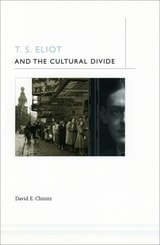
T. S. Eliot and the Cultural Divide
David E. Chinitz
University of Chicago Press, 2003
David Chinitz argues that Eliot was productively engaged with popular culture in some form at every stage of his career, and that his response to it, as expressed in his poetry, plays, and essays, was ambivalent rather than hostile. He shows that American jazz, for example, was a major influence on Eliot's poetry during its maturation. He discusses Eliot's surprisingly persistent interest in popular culture both in such famous works as The Waste Land and in such lesser-known pieces as Sweeney Agonistes. And he traces Eliot's long, quixotic struggle to close the widening gap between high art and popular culture through a new type of public art: contemporary popular verse drama.
What results is a work that will persuade adherents and detractors alike to return to Eliot and find in him a writer who liked a good show, a good thriller, and a good tune, as well as a "great" poem.
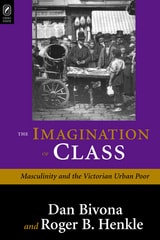
THE IMAGINATION OF CLASS
MASCULINITY AND THE VICTORIAN URBAN POORDan Bivona and Roger B. Henkle
The Ohio State University Press, 2006
Through carefully nuanced discussions of a variety of Victorian novelists, journalists, and sociological investigators (some well known, like Dickens, and others less well known, like Masterman and Greenwood), the book offers new insight into the role played by the imagination of the urban poor in the construction of Victorian middle class masculinity. Whereas many scholars have discussed the feminization of the poor, virtually no one has addressed how the poor have served as a site at which middle class men fashioned their own class and gender identity.
THE NOVEL AND THE MENAGERIE
TOTALITY, ENGLISHNESS, AND EMPIREKURT KOENIGSBERGER
The Ohio State University Press, 2007
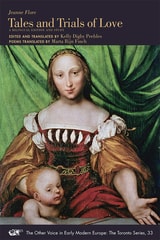
Tales and Trials of Love, Concerning Venus’s Punishment of Those Who Scorn True Love and Denounce Cupid’s Sovereignty
A Bilingual Edition and StudyJeanne Flore
Iter Press, 2014
Talk and Textual Production in Medieval England
Marisa Libbon
The Ohio State University Press, 2021
Taming the Revolution
Andrea Acle-Kreysing
Campus Verlag, 2022
Jaime Balmes and Juan Donoso Cortés–the two most important conservative thinkers in nineteenth-century Spain–actively sought to preserve the centrality of church and monarchy in the wake of the rise of liberalism, while at the same time discrediting the stereotypical view of Spain as a backward and isolated country. Although they pursued a similar goal, their positions differed: while Balmes’ works anticipated a socially oriented Catholicism, Donoso presented Christianity as the supreme social good, incompatible with modern liberalism. In Taming the Revolution, Andrea Acle-Kreysing highlights the unresolved tensions in their works, escaping the dualistic interpretations of this period that defines tradition from modernity. This work endeavors to show how Spanish political thought was a compelling variation–rather than an aberration–of contemporary European debates.
Technologies of Empire
Writing, Imagination, and the Making of Imperial Networks, 1750–1820Dermot Ryan
University of Delaware Press, 2013
Published by University of Delaware Press. Distributed worldwide by Rutgers University Press.

Technology's Pulse
Essays on Rhythm in German ModernismMichael Cowan
University of London Press, 2011
Telling Complexions
The Nineteenth-Century English Novel and the BlushMary Ann O Farrell
Duke University Press, 1997
Although the blush was used to tell the truth of character and body, O’Farrell shows how it is actually undermined as a stable indicator of character in novels such as Pride and Prejudice, Persuasion, North and South, and David Copperfield. She reveals how these writers then moved on in search of other bodily indicators of mortification and desire, among them the swoon, the scar, and the blunder. Providing unique and creative insights into the constructedness of the body and its semiotic play in literature and in culture, Telling Complexions includes parallel examples of the blush in contemporary culture and describes ways that textualized bodies are sometimes imagined to resist the constraints imposed by such construction.
Telling Rhythm
Body and Meaning in PoetryAmittai Aviram
University of Michigan Press, 1994
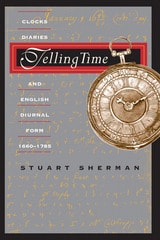
Telling Time
Clocks, Diaries, and English Diurnal Form, 1660-1785Stuart Sherman
University of Chicago Press, 1997
Through brilliant readings of Samuel Pepys's diary, Joseph Addison and Richard Steele's daily Spectator, the travel writings of Samuel Johnson and James Boswell, and the novels of Daniel Defoe and Frances Burney, Sherman traces the development of a new way of counting time in prose—the diurnal structure of consecutively dated installments—within the cultural context of the daily institutions which gave it form and motion. Telling Time is not only a major accomplishment for seventeenth- and eighteenth-century literary studies, but it also makes important contributions to current discourse in cultural studies.
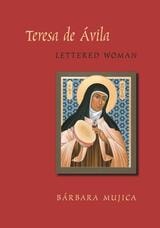
Teresa de Avila, Lettered Woman
Barbara Mujica
Vanderbilt University Press, 2009
Teresa's epistolary writing reveals how she used her political acumen to dodge inquisitors and negotiate the thorny issues of the reform, facing off the authorities--albeit with considerable tact--and reprimanding priests and nuns who failed to follow her orders. Her letters bring to light the different strategies she used--code names, secret routing--in order to communicate with nuns and male allies. They show how she manipulated language, varying her tone and rhetoric according to the recipient or slipping into deliberate vagueness in order to avoid divulging secrets. What emerges from her correspondence is a portrait of extraordinary courage, ability, and shrewdness.
In the sixteenth century, the word letrado (lettered) referred to the learned men of the Church. Teresa treated letrados with great respect and always insisted on her own lack of learning. The irony is that although women could not be letradas, Teresa was, as her correspondence shows, "lettered" in more ways than one.
Testaments
Two Novellas of Emigration and ExileDanuta Mostwin
Ohio University Press, 2005
Translated from Polish by Marta Erdman and Nina Dyke.
Polish émigrés have written poignantly about the pain of exile in letters, diaries, and essays; others, more recently, have recreated Polish-American communities in works of fiction. But it is Danuta Mostwin’s fiction, until now unavailable in English translation, that bridges the divide between Poland and America, exile and emigration.
Mostwin and her husband survived the ravages of World War II, traveled to Britain, and then emigrated to the United States. Mostwin devoted her scholarly career to the study of immigrants trapped between cultural worlds. Winner of international awards for her fiction, Danuta Mostwin here offers two novellas, translated by the late Marta Erdman, which are the first of her works published in English in the United States.
Deeply melancholic and moving in its unsentimental depiction of ordinary people trying to make sense of their uprooted lives, Testaments presents two powerful vignettes of life in immigrant America, The Last Will of Blaise Twardowski and Jocasta. This timely publication provides an introduction to Mostwin’s work that will ensure that she is recognized as the creator of one of the most nuanced and deeply moving pictures of emigration and exile in Polish-American literature.
Testimony after Catastrophe
Narrating the Traumas of Political ViolenceStevan Weine
Northwestern University Press, 2006
A deeply involving, compassionate, occasionally confrontational blend of practical hands-on experience and dialogic theory, emerging from the author's decade-long work in Europe and Chicago with survivors of the Balkan wars, this book is committed to the proposition that efforts to use testimony to address the consequences of political violence can be strengthened--though by no means guaranteed--if they are based on a fuller acknowledgment of the personal and ethical elements embodied in the narrative essence of testimony. These elements are what Testimony after Catastrophe seeks to reveal.
Textile Orientalisms
Cashmere and Paisley Shawls in British Literature and CultureSuchitra Choudhury
Ohio University Press, 2023
Textual Awareness
A Genetic Study of Late Manuscripts by Joyce, Proust, and MannDirk Van Hulle
University of Michigan Press, 2004
A key issue in both textual criticism and the so-called crisis of the novel is the tension between the finished and the unfinished. After a theoretical examination of the relationship between genetic and textual criticism, Dirk Van Hulle uses the three case studies to show how?at each stage in the writing process?the text still had the potential of becoming something entirely different; how and why these geneses proceeded the way they did; how Joyce, Proust, and Mann allowed contingencies to shape their work; how these authors recycled the words of their critics in order to inoculate their works against them; how they shaped an intertextual dimension through the processing of source texts and reading notes; and how text continually generated more text.
Van Hulle's exploration of process sheds new light on the remarkable fact that so many modernist authors protected their manuscripts, implying both the authors' urge to grasp everything and their awareness of the dangers of their encyclopedic projects. Textual Awareness offers new insights into the artificiality of the artifact?the novel?that are relevant to the study of literary modernism in general and the study of James Joyce, Marcel Proust, and Thomas Mann in particular.
Dirk Van Hulle is Assistant Professor of English and German Literature, University of Antwerp.
Textual Conspiracies
Walter Benjamin, Idolatry, and Political TheoryJames R. Martel
University of Michigan Press, 2012
“This is a sophisticated and fascinating argument written in a very enjoyably entertaining style. It is hard for me to see how readers initially interested in these texts will not be ‘swept off their feet’ by the core assertions of this author, and the devastatingly comprehensive way in which he demonstrates those arguments.”
—Brent Steele, University of Kansas
In Textual Conspiracies, James R. Martel applies the literary, theological, and philosophical insights of Walter Benjamin to the question of politics and the predicament of the contemporary left. Through the lens of Benjamin’s theories, as influenced by Kafka, of the fetishization of political symbols and signs, Martel looks at the ways in which various political and literary texts “speak” to each other across the gulf of time and space, thereby creating a “textual conspiracy” that destabilizes grand narratives of power and authority and makes the narratives of alternative political communities more apparent.
However, in keeping with Benjamin’s insistence that even he is complicit with the fetishism that he battles, Martel decentralizes Benjamin’s position as the key theorist for this conspiracy and contextualizes Benjamin in what he calls a “constellation” of pairs of thinkers and writers throughout history, including Alexis de Tocqueville and Edgar Allen Poe, Hannah Arendt and Federico García Lorca, and Frantz Fanon and Assia Djebar.
Textual Magic
Charms and Written Amulets in Medieval EnglandKatherine Storm Hindley
University of Chicago Press, 2023
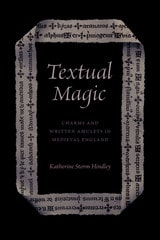
Katherine Storm Hindley explores words at their most powerful: words that people expected would physically change the world. Medieval Europeans often resorted to the use of spoken or written charms to ensure health or fend off danger. Hindley draws on an unprecedented archive of more than a thousand such charms from medieval England—more than twice the number gathered, transcribed, and edited in previous studies and including many texts still unknown to specialists on this topic. Focusing on charms from 1100 to 1350 CE as well as previously unstudied texts in Latin, French, and English, Hindley addresses important questions of how people thought about language, belief, and power. She describes seven hundred years of dynamic, shifting cultural landscapes, where multiple languages, alphabets, and modes of transmission gained and lost their protective and healing power. Where previous scholarship has bemoaned a lack of continuity in the English charms, Hindley finds surprising links between languages and eras, all without losing sight of the extraordinary variety of the medieval charm tradition: a continuous, deeply rooted part of the English Middle Ages.
Thackeray
The Sentimental CynicLambert Ennis
Northwestern University Press, 1950
The "Spirit of Poesy"
Essays on Jewish and German Literature and Thought in Honor of Geza von MolnarRichard Block and Peter Fenves
Northwestern University Press, 2000
The Abyss or Life Is Simple
Reading Knausgaard Writing ReligionCourtney Bender, Jeremy Biles, Liane Carlson, Joshua Dubler, Hannah C. Garvey, M. Cooper Harriss, Winnifred Fallers Sullivan, and Erik Thorstensen
University of Chicago Press, 2022
Min kamp, or My Struggle, is a six-volume novel by Karl Ove Knausgaard and one of the most significant literary works of the young twenty-first century. Published in Norwegian between 2009 and 2011, the novel presents an absorbing first-person narrative of the life of a writer with the same name as the author, in a world at once fully disillusioned and thoroughly enchanted.
In 2015, a group of scholars began meeting to discuss the peculiarly religious qualities of My Struggle. Some were interested in Knausgaard’s attention to explicitly religious subjects and artworks, others to what they saw as more diffuse attention to the religiousness of contemporary life. The group wondered what reading these textures of religion in these volumes might say about our times, about writing, and about themselves. The Abyss or Life Is Simple is the culmination of this collective endeavor—a collection of interlocking essays on ritual, beauty, and the end of the world.
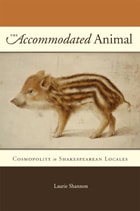
The Accommodated Animal
Cosmopolity in Shakespearean LocalesLaurie Shannon
University of Chicago Press, 2013

The Act and the Place of Poetry
Selected EssaysYves Bonnefoy
University of Chicago Press, 1989
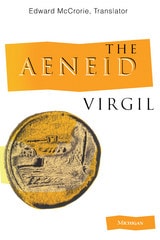
The Aeneid of Virgil
Virgil
University of Michigan Press, 1995
In this new translation Edward McCrorie has performed the difficult task of rendering Virgil's compact, dense Latin into fine, readable, modern English verse. The sometimes complex text is made clear and comprehensible even for first-time readers, and a glossary of names helps identify characters and place-names in the poem. The translation is well suited for students at all levels, and readers already familiar with Virgil will find many fresh images and ideas.
"A brilliant effort."--Robert Bly
"I admire the ambition of the project, and the generosity of many of the lines."--Robert Fagles
Edward McCrorie is Professor of English, Providence College. His poetry and translations of Latin verse have been widely published.
The Aesthetics of Kinship
Form and Family in the Long Eighteenth CenturyHeidi Schlipphacke
Bucknell University Press, 2023
The Aesthetics of Mythmaking in German Postwar Culture
André Fischer
Northwestern University Press, 2024
Myths are a central part of our reality. But merely debunking them lets us forget why they are created in the first place and why we need them. André Fischer draws on key examples from German postwar culture, from novelists Hans Henny Jahnn and Hubert Fichte, to sculptor and performance artist Joseph Beuys, and filmmaker Werner Herzog, to show that mythmaking is an indispensable human practice in times of crisis.
Against the background of mythologies based in nineteenth-century romanticism and their ideological continuation in Nazism, fresh forms of mythmaking in the narrative, visual, and performative arts emerged as an aesthetic paradigm in postwar modernism. Boldly rewriting the cultural history of an era and setting in transition, The Aesthetics of Mythmaking in German Postwar Culture counters the predominant narrative of an exclusively rational Vergangenheitsbewältigung (“coming to terms with the past”). Far from being merely reactionary, the turn toward myth offered a dimension of existential orientation that had been neglected by other influential aesthetic paradigms of the postwar period. Fischer’s wide-ranging, transmedia account offers an inclusive perspective on myth beyond storytelling and instead develops mythopoesis as a formal strategy of modernism at large.
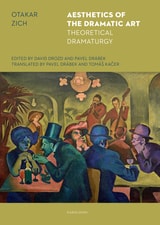
The Aesthetics of the Dramatic Art
Otakar Zich
Karolinum Press, 2024
Originally published in 1931, Otakar Zich’s Aesthetics of Dramatic Art laid the foundation for a systematic theory of modern theater and helped establish theater studies as an academic discipline. This volume is the first complete translation into any language and alongside Theatre Theory Reader: Prague School Writings provides thorough insight into Czech dramatic thought. Studying the theater from the audience’s perspective, Zich argues that the distinctive basis of dramatic art is human interaction rather than imitation, communication, fiction, or performed dialogue, as other theorists have argued. Covering spoken drama and opera, Zich’s Aesthetics of Dramatic Art is a foundational text of Czech theater practice that remains inspirational today for theater practitioners and theorists.
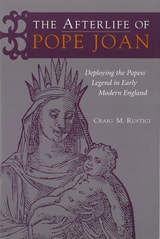
The Afterlife of Pope Joan
Deploying the Popess Legend in Early Modern EnglandCraig M. Rustici
University of Michigan Press, 2010
The legend concerning a popess had first taken written form in the thirteenth century and for several hundred years was more or less accepted. The Reformation, however, polarized discussions of the legend, pitting Catholics, who denied the story’s veracity, against Protestants, who suspected a cover-up and instantly cited Joan as evidence of papal depravity. In this heated environment, writers reimagined Joan variously as a sorceress, a hermaphrodite, and even a noteworthy author.
The Afterlife of Pope Joan examines sixteenth- and seventeenth-century debates concerning the popess’s existence, uncovering the disputants’ historiographic methods, rules of evidence, rhetorical devices, and assumptions concerning what is probable and possible for women and transvestites. Author Craig Rustici then investigates the cultural significance of a series of notions advanced in those debates: the claim that Queen Elizabeth I was a popess in her own right, the charge that Joan penned a book of sorcery, and the curious hypothesis that the popess was not a disguised woman at all but rather a man who experienced a sort of spontaneous sex change.
The Afterlife of Pope Joan draws upon the discourses of religion, politics, natural philosophy, and imaginative literature, demonstrating how the popess functioned as a powerful rhetorical instrument and revealing anxieties and ambivalences about gender roles that persist even today.
Craig M. Rustici is Associate Professor of English at Hofstra University.
The Age of Eclecticism
Literature and Culture in Britain, 1815–1885Christine Bolus-Reichert
The Ohio State University Press, 2009
The Age of Johnson
A Scholarly Annual (Volume 24)Jack Lynch
Bucknell University Press, 2021
The move to a new publisher has given The Age of Johnson: A Scholarly Annual the opportunity to recommit to what it does best: present to a wide readership cant-free scholarly articles and essays and searching book reviews, all featuring a wide variety of approaches, written by both seasoned scholars and relative newcomers. Volume 24 features commentary on a range of Johnsonian topics: his reaction to Milton, his relation to the Allen family, his notes in his edition of Shakespeare, his use of Oliver Goldsmith in his Dictionary, and his always fascinating Nachleben. The volume also includes articles on topics of strong interest to Johnson: penal reform, Charlotte Lennox's professional literary career, and the "conjectural history" of Homer in the eighteenth century.
For more than two decades, The Age of Johnson has presented a vast corpus of Johnsonian studies "in the broadest sense," as founding editor Paul J. Korshin put it in the preface to Volume 1, and it has retained the interest of a wide readership. In thousands of pages of articles, review essays, and reviews, The Age of Johnson has made a permanent contribution to our understanding of the eighteenth century, and particularly of Samuel Johnson, his circle, and his interests, and has also served as an outlet for writers who are not academics but have something important to say about the eighteenth century.
ISSN 0884-5816.
The Age of Johnson
A Scholarly Annual (Volume 25)Jack Lynch
Bucknell University Press, 2025
Published by Bucknell University Press. Distributed worldwide by Rutgers University Press.
ISSN 0884-5816
The Age of Nightmare
The Gothic and British Culture, 1750–1900Jeremy Black
St. Augustine's Press, 2022
Black's understanding of the Gothic writer is a remarkable contribution to the legacy of British literature and the novel at large. Once again, in Black thoroughness meets fidelity and the reader is overcome with his own insights into the period on the merit of Black's efforts.
In The Weight of Words Series, Black is devoted to the preservation of the memory of British literary genius, and in so doing he is carving out a niche for himself. As in the Gothic novel where landscapes give quarter to influences that seem to interact with the human fates that freely wander in, reading Black is an experience of suddenly finding oneself in possession of an education, and his allure takes a cue from the horrific Gothic tempt.
The Age of Subtlety
Nature and Rhetorical Conceits in Early Modern EuropeJavier Patiño Loira
University of Delaware Press, 2024
The Alliterative Morte Arthure
The Owl and the Nightingale and Five Other Middle English PoemsJohn Gardner
Southern Illinois University Press, 1973
Poets of every age deal with roughly the same human emotions, and for the experienced reader poetry is interesting or not depending upon the moment-by-moment intensity of its appeal. This skillful rendering by John Gardner of seven Middle English poems into sparklingly modern verse translation—most of them for the first time—represents a selection of poems that, generally, have real artistic value but are so difficult to read in the original that they are not as well known as they deserve to be. The seven poems are: The Alliterative Morte Arthure, Winner and Waster, The Parliament of the Three Ages, Summer Sunday, The Debate of Body and Soul, The Thrush and the Nightingale,and The Owl and the Nightingale.
The first four poems represent high points in the alliterative renaissance of the fourteenth century. Morte Arthure,here translated for the first time in its entirety into modern verse, is the only heroic romance in Middle English—a work roughly in the same genre as the French Song of Roland. The other three poems have been included in the anthology as further poetic examples.
With his employment of extensive comments and notes on the poems, Gardner provides a wealth of aids to appreciation and understanding of his outstanding translations. The anthology will be of interest to general readers as well as to students.
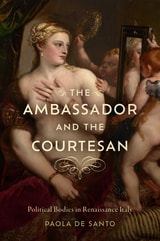
The Ambassador and the Courtesan
Political Bodies in Renaissance ItalyPaola De Santo
University of Delaware Press, 2026
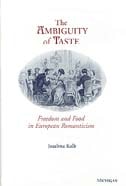
The Ambiguity of Taste
Freedom and Food in European RomanticismJocelyne Kolb
University of Michigan Press, 1995
In The Ambiguity of Taste, Jocelyne Kolb attempts to define changes in genre and metaphorical usage by undertaking close readings of six authors. She looks first at Molière and Fielding, whose culinary allusions herald poetic revolution but whose works do not themselves escape the limits of a neoclassical aesthetic. Byron and Heine, known as renegades, are treated in separate chapters and in the greatest detail. The penultimate chapter joins Goethe and Hugo as champions of poetic freedom, and in the final chapter Kolb briefly considers Thomas Mann and Proust, whose works display the gains of poetic revolution.
This book will be savored by students of comparative literature and European Romanticism. Its accessible style will tempt nonspecialists and food enthusiasts as well.
Jocelyne Kolb is Professor of German Studies, Smith College. This book was the winner of the 1995 American Conference on Romanticism Book Prize.
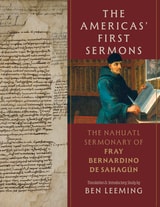
The Americas' First Sermons
The Nahuatl Sermonary of Fray Bernardino de SahagúnTranslation and Introduction study by Ben Leeming
University of Utah Press, 2025
The Americas’ First Sermons presents the first English translation and critical study of the complete set of sermons composed by Franciscan friar Bernardino de Sahagún and his Nahua students at the Imperial College of Santa Cruz in Tlatelolco, Mexico in 1540. The volume represents a crucial moment in the cultural exchange between European and Indigenous civilizations in sixteenth-century colonial Mexico.
With the collaboration of Mario Alberto Sánchez Aguilera, this edition offers unprecedented access to the collaboration between European friars and Nahua scholars in translating Christian concepts into Native languages. It captures Sahagún’s evolving methods across three phases (1530s–1560s) through his extensive annotations, bridging the divide between his ethnographic and doctrinal works. Unique in its analysis of both text and manuscript features—such as rare maguey paper—it highlights Indigenous intellectual contributions at the Colegio de Santa Cruz. This translation provides essential insights into early colonial religious negotiations and makes previously inaccessible material available to scholars across multiple disciplines.
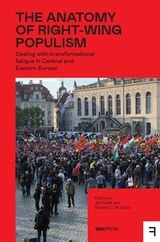
The Anatomy of Right-Wing Populism
Dealing with Transformational Fatigue in Central and Eastern EuropeEdited by Jan Kubik and Richard C. M. Mole
University College London, 2025
Over the past two decades, populist politicians and parties have enjoyed remarkable success across the globe. To develop a multidisciplinary understanding of the rise and functioning of right-wing populism in Central and Eastern Europe, The Anatomy of Right-Wing Populism examines two original concepts. The first, neo-feudalism, refers to an economic system whereby a relatively small group of elites holds most of the political power and controls a significant portion of the country’s economy. The second concept, neo-traditionalism, is a cultural strategy that aims to legitimize neo-feudal systems. Based on this framework, this volume provides empirical and theoretical analysis of populist movements and offers policy recommendations on how to resist illiberalism.
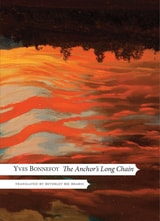
The Anchor’s Long Chain
Yves Bonnefoy
Seagull Books, 2015
Yves Bonnefoy has wowed the literary world for decades with his diffuse volumes. First published in France in 2008, The Anchor’s Long Chain is an indispensable addition to his oeuvre. Enriching Bonnefoy’s earlier work, the volume, translated by Beverley Bie Brahic, also innovates, including an unprecedented sequence of nineteen sonnets. These sonnets combine the strictness of the form with the freedom to vary line length and create evocative fragments. Compressed, emotionally powerful, and allusive, the poems are also autobiographical—but only in glimpses. Throughout, Bonnefoy conjures up life’s eternal questions with each new poem.
Longer, discursive pieces, including the title poem’s meditation on a prehistoric stone circle and a legend about a ship, are also part of this volume, as are a number of poetic prose pieces in which Bonnefoy, like several of his great French predecessors, excels. Long-time fans will find much to praise here, while newer readers will quickly find themselves under the spell of Bonnefoy’s powerful, discursive poetry.
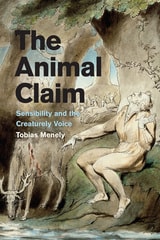
The Animal Claim
Sensibility and the Creaturely VoiceTobias Menely
University of Chicago Press, 2015
In the Restoration and eighteenth century, philosophers emphasized the role of sympathy in collective life and began regarding the passionate expression humans share with animals, rather than the spoken or written word, as the elemental medium of community. Menely shows how poetry came to represent this creaturely voice and, by virtue of this advocacy, facilitated the development of a viable discourse of animal rights in the emerging public sphere. Placing sensibility in dialogue with classical and early-modern antecedents as well as contemporary animal studies, The Animal Claim uncovers crucial connections between eighteenth-century poetry; theories of communication; and post-absolutist, rights-based politics.
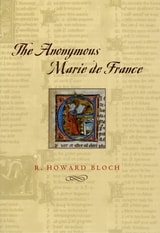
The Anonymous Marie de France
R. Howard Bloch
University of Chicago Press, 2003
Evidence about Marie de France's life is so meager that we know next to nothing about her-not where she was born and to what rank, who her parents were, whether she was married or single, where she lived and might have traveled, whether she dwelled in cloister or at court, nor whether in England or France. In the face of this great writer's near anonymity, scholars have assumed her to be a simple, naive, and modest Christian figure. Bloch's claim, in contrast, is that Marie is among the most self-conscious, sophisticated, complicated, and disturbing figures of her time-the Joyce of the twelfth century. At a moment of great historical turning, the so-called Renaissance of the twelfth century, Marie was both a disrupter of prevailing cultural values and a founder of new ones. Her works, Bloch argues, reveal an author obsessed by writing, by memory, and by translation, and acutely aware not only of her role in the preservation of cultural memory, but of the transforming psychological, social, and political effects of writing within an oral tradition.
Marie's intervention lies in her obsession with the performative capacities of literature and in her acute awareness of the role of the subject in interpreting his or her own world. According to Bloch, Marie develops a theology of language in the Lais, which emphasize the impossibility of living in the flesh along with a social vision of feudalism in decline. She elaborates an ethics of language in the Fables, which, within the context of the court of Henry II, frame and form the urban values and legal institutions of the Anglo-Norman world. And in her Espurgatoire, she produces a startling examination of the afterlife which Bloch links to the English conquest and occupation of medieval Ireland.
With a penetrating glimpse into works such as these, The Anonymous Marie de France recovers the central achievements of one of the most pivotal figures in French literature. It is a study that will be of enormous value to medievalists, literary scholars, historians of France, and anyone interested in the advent of female authorship.
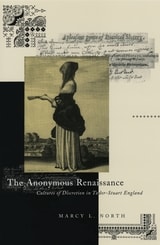
The Anonymous Renaissance
Cultures of Discretion in Tudor-Stuart EnglandMarcy L. North
University of Chicago Press, 2003
The Renaissance was in many ways the beginning of modern and self-conscious authorship, a time when individual genius was celebrated and an author's name could become a book trade commodity. Why, then, did anonymous authorship flourish during the Renaissance rather than disappear? In addressing this puzzle, Marcy L. North reveals the rich history and popularity of anonymity during this period.
The book trade, she argues, created many intriguing and paradoxical uses for anonymity, even as the authorial name became more marketable. Among ecclesiastical debaters, for instance, anonymity worked to conceal identity, but it could also be used to identify the moral character of the author being concealed. In court and coterie circles, meanwhile, authors turned name suppression into a tool for the preservation of social boundaries. Finally, in both print and manuscript, anonymity promised to liberate an authentic female voice, and yet made it impossible to authenticate the gender of an author. In sum, the writers and book producers who helped to create England's literary culture viewed anonymity as a meaningful and useful practice.
Written with clarity and grace, The Anonymous Renaissance will fill a prominent gap in the study of authorship and English literary history.
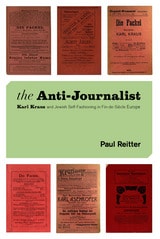
The Anti-Journalist
Karl Kraus and Jewish Self-Fashioning in Fin-de-Siècle EuropePaul Reitter
University of Chicago Press, 2008
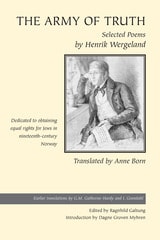
The Army of Truth
Selected PoemsHenrik Wergeland
University of Wisconsin Press, 2003
One of Norway’s most celebrated literary figures of the nineteenth century, Henrik Wergeland worked tirelessly for the civil rights of Jews in Norway. He used the words and structure of his poetry to enliven the ideals of truth, freedom, and equality. This translated volume, containing several of Wergeland’s most prominent poems, beautifully encapsulates the compelling force of his message, allowing its enduring influence to benefit a wider contemporary audience.
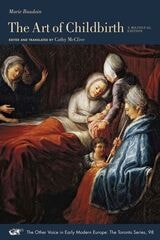
The Art of Childbirth
A Seventeenth-Century Midwife’s Epistolary Treatise to Doctor Vallant: A Bilingual EditionMarie Baudoin
Iter Press, 2022
In 1671, Marie Baudoin (1625–1700), head midwife and governor of the Hôtel-Dieu of Clermont-Ferrand, sent a treatise on the art of childbirth to her powerful Parisian patron, Dr. Vallant. The story of how Baudoin’s knowledge and expertise as a midwife came to be expressed, recorded, and archived raises the question: Was Baudoin exceptional because she was herself extraordinary, or because her voice has reached us through Vallant’s careful archival practices? Either way, Baudoin’s treatise invites us to reconsider the limits of what we thought we knew midwives “could be and do” in seventeenth-century France. Grounding Marie Baudoin’s text in a microanalysis of her life, work, and the Jansenist network between Paris and Clermont-Ferrand, this book connects historiographies of midwifery, Jansenism, hospital administration, public health, knowledge and record-keeping, and women’s work, underscoring both Baudoin’s capabilities and the archival accidents and intentions behind the preservation of her treatise in a letter.
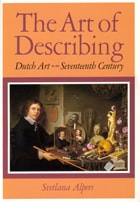
The Art of Describing
Dutch Art in the Seventeenth CenturySvetlana Alpers
University of Chicago Press, 1984
"There is no doubt that thanks to Alpers's highly original book the study of the Dutch masters of the seventeenth century will be thoroughly reformed and rejuvenated. . . . She herself has the verve, the knowledge, and the sensitivity to make us see familiar sights in a new light."—E. H. Gombrich, New York Review of Books
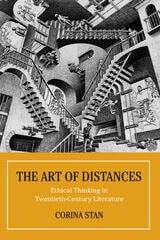
The Art of Distances
Ethical Thinking in Twentieth-Century LiteratureCorina Stan
Northwestern University Press, 2018
In The Art of Distances, Corina Stan identifies an insistent preoccupation with interpersonal distance in a strand of twentieth-century European and Anglophone literature that includes the work of George Orwell, Paul Morand, Elias Canetti, Iris Murdoch, Walter Benjamin, Annie Ernaux, Günter Grass, and Damon Galgut. Specifically, Stan shows that these authors all engage in philosophical meditations, in the realm of literary writing, on the ethical question of how to live with others and how to find an ideal interpersonal distance at historical moments when there are no obviously agreed-upon social norms for ethical behavior.
Bringing these authors into dialogue with philosophers such as Michel de Montaigne, Ralph Waldo Emerson, Friedrich Nietzsche, Sigmund Freud, Helmuth Plessner, Martin Heidegger, Jean-Luc Nancy, Emmanuel Levinas, Peter Sloterdijk, Guillaume le Blanc, and Pierre Zaoui, Stan shows how the question of the right interpersonal distance became a fundamental one for the literary authors under consideration and explores what forms and genres they proposed in order to convey the complexity of this question. Albeit unknowingly, she suggests, they are engaged in fleshing out what Roland Barthes called “a science, or perhaps an art, of distances.”
The Art of Good Manners
Edited by the Bodleian Library
Bodleian Library Publishing, 2014
The Art of Good Manners ranges broadly across topics including courtship, children’s behavior, and civilized conversation before taking the reader through each course at a dinner party, where readers are reminded to neither gurgle the soup nor to make haste with the fruit course since “to peel an orange, apple or pear with a fruit knife and fork requires some practice.”
Charmingly presented, The Art of Good Manners is by turns humorously old-fashioned and timeless, and it makes the perfect gift for all who miss this elegant bygone era.
The Art of Letter Writing
Edited by the Bodleian Library
Bodleian Library Publishing, 2014
The Art of Letter Writing provides more than fifty examples of well-crafted correspondence that will lend confidence whether one needs to break off an engagement, accept an invitation to a country house weekend, complain about a courier, or write to a countess.
Charmingly presented, The Art of Good Letter Writing is by turns humorously old-fashioned and timeless, and it makes the perfect gift for all who miss this elegant bygone era.
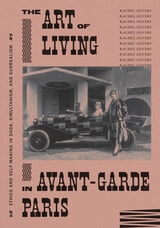
The Art of Living in Avant-Garde Paris
Ethics and Self-Making in Dada, Simultanism, and SurrealismRachel Silveri
University of Chicago Press, 2026
With The Art of Living in Avant-Garde Paris, Rachel Silveri takes a fresh look at the desire to unify art and life, an ambition long regarded as foundational to the European historical avant-gardes. She reveals how many early twentieth-century artists saw their own everyday lives—their bodies, identities, and relationships—as a type of creative material and a central component to their avant-garde practice. These artists abandoned traditional forms of artmaking and venues of art viewing, instead aspiring to integrate art with everyday life, creating an “art of living.”
Considering Tristan Tzara’s performances of Dadaist identity, Sonia Delaunay’s simultaneous fashions and self-branding, and the collective endeavor to open and operate the Surrealist Research Bureau, Silveri offers a new narrative about how the artists of interwar Paris developed experiential life practices that resisted dominant forms of “lifestyle” and normative discourses surrounding gender, ethnicity, and office work. This book argues that ethical questions of “How should I live?” and “How should I relate to others?” were as important to the avant-garde as politics, and that aspirations to change the world played out in daily practices of self-making.