Results by title
147 books match the query 'Freedom' and 30 start with t
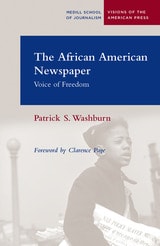
The African American Newspaper
Voice of FreedomPatrick S. Washburn
Northwestern University Press, 2006
In March of 1827 the nation's first black newspaper appeared in New York City—to counter attacks on blacks by the city's other papers. From this signal event, The African American Newspaper traces the evolution of the black newspaper—and its ultimate decline--for more than 160 years until the end of the twentieth century.
The book chronicles the growth of the black press into a powerful and effective national voice for African Americans during the period from 1910 to 1950--a period that proved critical to the formation and gathering strength of the civil rights movement that emerged so forcefully in the following decades. In particular, author Patrick S. Washburn explores how the Pittsburgh Courier and the Chicago Defender led the way as the two most influential black newspapers in U.S. history, effectively setting the stage for the civil rights movement's successes. Washburn also examines the numerous reasons for the enormous decline of black newspapers in influence and circulation in the decades immediately following World War II. His book documents as never before how the press's singular accomplishments provide a unique record of all areas of black history and a significant and shaping affect on the black experience in America.
The Ambiguity of Taste
Freedom and Food in European RomanticismJocelyne Kolb
University of Michigan Press, 1995
In The Ambiguity of Taste, Jocelyne Kolb attempts to define changes in genre and metaphorical usage by undertaking close readings of six authors. She looks first at Molière and Fielding, whose culinary allusions herald poetic revolution but whose works do not themselves escape the limits of a neoclassical aesthetic. Byron and Heine, known as renegades, are treated in separate chapters and in the greatest detail. The penultimate chapter joins Goethe and Hugo as champions of poetic freedom, and in the final chapter Kolb briefly considers Thomas Mann and Proust, whose works display the gains of poetic revolution.
This book will be savored by students of comparative literature and European Romanticism. Its accessible style will tempt nonspecialists and food enthusiasts as well.
Jocelyne Kolb is Professor of German Studies, Smith College. This book was the winner of the 1995 American Conference on Romanticism Book Prize.
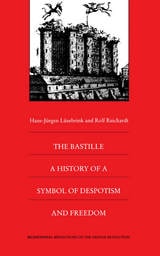
The Bastille
A History of a Symbol of Despotism and FreedomHans-Jürgen Lüsebrink and Rolf Reichardt
Duke University Press, 1997
To facilitate the symbolic nature of the investigation, this analysis of the evolving signification of the Bastille moves from the French Revolution to the nineteenth century to contemporary history. The narrative also shifts from France to other cultural arenas, like the modern European colonial sphere, where the overthrow of the Bastille acquired radical new signification in the decolonization period of the 1940s and 1950s. The Bastille demonstrates the potency of the interdisciplinary historical research that has characterized the end of this century, combining quantitative and qualitative approaches, and taking its methodological tools from history, sociology, linguistics, and cultural and literary studies.
The Brink of Freedom
Improvising Life in the Nineteenth-Century Atlantic WorldDavid Kazanjian
Duke University Press, 2016
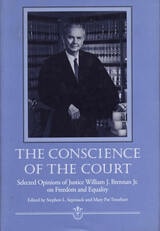
The Conscience of the Court
Selected Opinions of Justice William J. Brennan Jr. on Freedom and EqualityEdited by Stephen L. Sepinuck and Mary Pat Treuthart
Southern Illinois University Press, 1999
The Conscience of the Court celebrates the work of Justice William J. Brennan Jr., who served on the United States Supreme Court for thirty-four years (1956–1990).
Stephen L. Sepinuck and Mary Pat Treuthart introduce and present selected judicial opinions written by Justice Brennan on issues involving personal freedom, civil liberties, and equality. Brennan is ranked by many as the best writer ever to have served on the Supreme Court, and his written opinions depict real people, often in desperate, emotional situations. Remarkable for their clarity of analysis, for their eloquence, and for their forcefulness and persuasiveness, his opinions demonstrate that judicial thought need not be a proprietary enclave of lawyers or the intellectual elite.
The extended excerpts selected by Sepinuck and Treuthart highlight Brennan's approach to judicial decision making. Concerned always with how each decision would actually affect people's lives, Brennan possessed a rare quality of empathy. In Brennan, the editors note, "people and groups who lacked influence in society—Communists and flag burners, children and foreigners, criminal defendants and racial minorities"—found a champion they could count on "to listen to their causes and judge them unmoved by the passions of the politically powerful."
In their introduction to each opinion, the editors provide background facts, discuss how the excerpted opinion transformed the law or otherwise fit into the realm of constitutional jurisprudence, and delve into Justice Brennan's judicial philosophy, his method of constitutional interpretation, and the language he used.

The Constitution, the Law, and Freedom of Expression
1787-1987James Brewer Stewart
Southern Illinois University Press, 1987
In recognition of the bicentennial of the Constitution of the United States, former chief justice Warren E. Burger, Justice Antonin Scalia, ACLU president Norman Dorsen, and others delivered papers at the first annual DeWitt Wallace Conference on the Liberal Arts, held at Macalester College, St. Paul.
Joining some of the best legal minds in America were novelist John Edgar Wideman, chemist Harry B. Gray, historian Mary Beth Norton, and psychiatrist and social psychologist Robert Jay Lifton.
Opening the conference and this book, former chief Justice Burger emphasizes the daring of those who drafted the Constitution. Justice Scalia, noting the great reduction in curbs to freedom of expression since World War I, points out that the proliferation of freedom has forced courts to distinguish between types of expression.
Although the views expressed in these essays differ widely, opinion concerning the major issue falls into two definite camps: Burger, Scalia, and Dorsen contend that freedom of expression depends on the legal structure for survival; Wideman, Gray, Lifton, and Norton maintain that social forces determine freedom of expression.
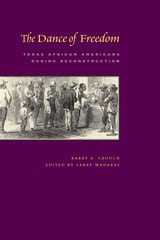
The Dance of Freedom
Texas African Americans during ReconstructionBy Barry Crouch
University of Texas Press, 2007
This anthology brings together the late Barry A. Crouch's most important articles on the African American experience in Texas during Reconstruction. Grouped topically, the essays explore what freedom meant to the newly emancipated, how white Texans reacted to the freed slaves, and how Freedmen's Bureau agents and African American politicians worked to improve the lot of ordinary African American Texans. The volume also contains Crouch's seminal review of Reconstruction historiography, "Unmanacling Texas Reconstruction: A Twenty-Year Perspective." The introductory pieces by Arnoldo De Leon and Larry Madaras recapitulate Barry Crouch's scholarly career and pay tribute to his stature in the field of Reconstruction history.
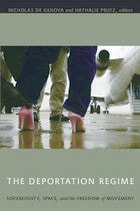
The Deportation Regime
Sovereignty, Space, and the Freedom of MovementNicholas De Genova and Nathalie Peutz, eds.
Duke University Press, 2010
Whether investigating the power that individual and corporate sponsors have over the fate of foreign laborers in Bahrain, the implications of Germany’s temporary suspension of deportation orders for pregnant and ill migrants, or the significance of the detention camp, the contributors reveal how deportation reflects and reproduces notions about public health, racial purity, and class privilege. They also provide insight into how deportation and deportability are experienced by individuals, including Arabs, South Asians, and Muslims in the United States. One contributor looks at asylum claims in light of an unusual anti-deportation campaign mounted by Algerian refugees in Montreal; others analyze the European Union as an entity specifically dedicated to governing mobility inside and across its official borders. The Deportation Regime addresses urgent issues related to human rights, international migration, and the extensive security measures implemented by nation-states since September 11, 2001.
Contributors: Rutvica Andrijasevic, Aashti Bhartia, Heide Castañeda , Galina Cornelisse , Susan Bibler Coutin, Nicholas De Genova, Andrew M. Gardner, Josiah Heyman, Serhat Karakayali, Sunaina Marr Maira, Guillermina Gina Nuñez, Peter Nyers, Nathalie Peutz, Enrica Rigo, Victor Talavera, William Walters, Hans-Rudolf Wicker, Sarah S. Willen
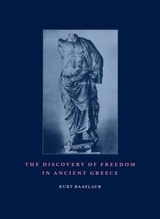
The Discovery of Freedom in Ancient Greece
Revised and Updated EditionKurt Raaflaub
University of Chicago Press, 2003
To find out, Raaflaub analyses ancient Greek texts from Homer to Thucydides in their social and political contexts. Archaic Greece, he concludes, had little use for the idea of political freedom; the concept arose instead during the great confrontation between Greeks and Persians in the early fifth century BCE. Raaflaub then examines the relationship of freedom with other concepts, such as equality, citizenship, and law, and pursues subsequent uses of the idea—often, paradoxically, as a tool of domination, propaganda, and ideology.
Raaflaub's book thus illuminates both the history of ancient Greek society and the evolution of one of humankind's most important values, and will be of great interest to anyone who wants to understand the conceptual fabric that still shapes our world views.
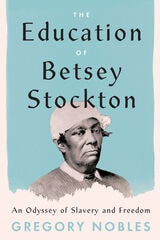
The Education of Betsey Stockton
An Odyssey of Slavery and FreedomGregory Nobles
University of Chicago Press, 2022
The life of Betsey Stockton (ca. 1798–1865) is a remarkable story of a Black woman’s journey from slavery to emancipation, from antebellum New Jersey to the Hawai‘ian Islands, and from her own self-education to a lifetime of teaching others—all told against the backdrop of the early United States’ pervasive racism. It’s a compelling chronicle of a critical time in American history and a testament to the courage and commitment of a woman whose persistence grew into a potent form of resistance.
When Betsey Stockton was a child, she was “given, as a slave” to the household of Rev. Ashbel Green, a prominent pastor and later the president of what is now Princeton University. Although she never went to school, she devoured the books in Green’s library. After being emancipated, she used that education to benefit other people of color, first in Hawai‘i as a missionary, then Philadelphia, and, for the last three decades of her life, Princeton—a college town with a genteel veneer that never fully hid its racial hostility. Betsey Stockton became a revered figure in Princeton’s sizeable Black population, a founder of religious and educational institutions, and a leader engaged in the day-to-day business of building communities.
In this first book-length telling of Betsey Stockton’s story, Gregory Nobles illuminates both a woman and her world, following her around the globe, and showing how a determined individual could challenge her society’s racial obstacles from the ground up. It’s at once a revealing lesson on the struggles of Stockton’s times and a fresh inspiration for our own.
The Emancipation Circuit
Black Activism Forging a Culture of FreedomThulani Davis
Duke University Press, 2022
The Ends of Freedom
Reclaiming America's Lost Promise of Economic RightsMark Paul
University of Chicago Press, 2023
Since the Founding, Americans have debated the true meaning of freedom. For some, freedom meant the provision of life’s necessities, those basic conditions for the “pursuit of happiness.” For others, freedom meant the civil and political rights enumerated in the Bill of Rights and unfettered access to the marketplace—nothing more. As Mark Paul explains, the latter interpretation—thanks in large part to a particularly influential cadre of economists—has all but won out among policymakers, with dire repercussions for American society: rampant inequality, endemic poverty, and an economy built to benefit the few at the expense of the many.
In this book, Paul shows how economic rights—rights to necessities like housing, employment, and health care—have been a part of the American conversation since the Revolutionary War and were a cornerstone of both the New Deal and the Civil Rights Movement. Their recuperation, he argues, would at long last make good on the promise of America’s founding documents. By drawing on FDR’s proposed Economic Bill of Rights, Paul outlines a comprehensive policy program to achieve a more capacious and enduring version of American freedom. Among the rights he enumerates are the right to a good job, the right to an education, the right to banking and financial services, and the right to a healthy environment.
Replete with discussions of some of today’s most influential policy ideas—from Medicare for All to a federal job guarantee to the Green New Deal—The Ends of Freedom is a timely and urgent call to reclaim the idea of freedom from its captors on the political right—to ground America’s next era in the country’s progressive history and carve a path toward a more economically dynamic and equitable nation.
The Fragility of Freedom
Tocqueville on Religion, Democracy, and the American FutureJoshua Mitchell
University of Chicago Press, 1995
Focusing on Democracy in America, The Fragility of Freedom examines Tocqueville's key works and argues that his analysis of democracy is ultimately rooted in an Augustinian view of human psychology. As much a work of political philosophy as of religion, The Fragility of Freedom argues for the importance of a political theology that recognizes moderation.
"An intelligent and sharply drawn portrait of a conservative Toqueville."—Anne C. Rose, Journal of American History
"I recommend this book as one of a very few to approach seriously the sources of Tocqueville's intellectual and moral greatness."—Peter Augustine Lawler, Journal of Politics
"Mitchell ably places Democracy in America in the long conversation of Western political and theological thought."—Wilfred M. McClay, First Things
"Learned and thought-provoking."—Peter Berkowitz, New Republic
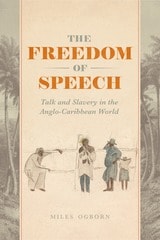
The Freedom of Speech
Talk and Slavery in the Anglo-Caribbean WorldMiles Ogborn
University of Chicago Press, 2019
The Freedom of the Migrant
Objections to NationalismVilém Flusser. Translated to the German by Kenneth Kronenberg. Edited and with an Introduction by Anke K. Finger
University of Illinois Press, 2013
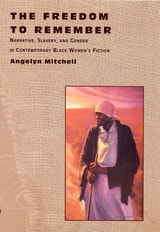
The Freedom to Remember
Narrative, Slavery, and Gender in Contemporary Black Women's FictionMitchell, Angelyn
Rutgers University Press, 2002
The Freedom to Remember examines contemporary literary revisions of slavery in the United States by black women writers. The narratives at the center of this book include: Octavia E. Butler’s Kindred, Sherley Anne Williams’s Dessa Rose, Toni Morrison’s Beloved, J. California Cooper’s Family, and Lorene Cary’s The Price of a Child.
Recent studies have investigated these works only from the standpoint of victimization. Angelyn Mitchell changes the conceptualization of these narratives, focusing on the theme of freedom, not slavery, defining these works as “liberatory narratives.” These works create a space to problematize the slavery/freedom dichotomy from which contemporary black women writers have the “safe” vantage point to reveal aspects of enslavement that their ancestors could not examine. The nineteenth-century female emancipatory narrative, by contrast, was written to aid the cause of abolition by revealing the unspeakable realitiesof slavery. Mitchell shows how the liberatory narrative functions to emancipate its readers from the legacies of slavery in American society: by facilitating a deeper discussion of the issues and by making them new through illumination and interrogation.
The Gift of Freedom
War, Debt, and Other Refugee PassagesMimi Thi Nguyen
Duke University Press, 2012

The Interval of Freedom
Soviet Literature During the Thaw, 1954-1957George Gibian
University of Minnesota Press, 1960
The Interval of Freedom was first published in 1960. Minnesota Archive Editions uses digital technology to make long-unavailable books once again accessible, and are published unaltered from the original University of Minnesota Press editions.
When Boris Pasternak's Doctor Zhivago was published in Europe and America in 1957 and 1958, the Western world was astonished and elated. But Doctor Zhivago is not the only significant literary work to come out of Soviet Russia recently. During four extraordinary years, 1954 to 1957, from Stalin's death to the aftermath of the Hungarian revolt, Soviet Russian authors were able to express their minds with unusual freedom. In this volume Professor Gibian examines various revelations made in Soviet literature during this interval of comparative freedom.
Nearly a score of contemporary Soviet writers are considered in detail. The authors and their works are grouped according to three major subjects to which Soviet writers have devoted much attention: science, love and sex, and the literary villain or "negative" character. Works of the following writers are discussed in depth: Alexander Bek, Leonid Leonov, Daniel Granin, Venyamin Kaverin, Vladimir Dudintsev, Semen Kirsanov, S. Aleshin, Viktor Nekrasov, Nikolai Pogodin, Galina Nikolaeva, Alexander Korneichuk, Alexander Shtein, Alexander Volodin, Nikolai Gorbunov, Nikolai Zhdanov, and Alexander Yahin. An entire chapter is devoted to Doctor Zhivago. In an introductory chapter, the author provides a survey of literary developments during the interval of freedom. In a final chapter he draws conclusions about the nature of the thinking of Soviet literary intelligentsia, comparing it with Western literary thought. The book is illuminating from social and political as well as literary viewpoints.
The Narrow Path of Freedom and Other Essays
Eugene Davidson
University of Missouri Press, 2002
The Problem of Evil
Slavery, Freedom and the Ambiguities of American ReformSteven Mintz
University of Massachusetts Press, 2007
Divided into four parts, with introductions to each section by editors Steven Mintz and John Stauffer, the essays provide succinct guides to the evolution of American slavery, the origins of antislavery thought, the challenges of emancipation, and the post-emancipation legacy of slavery. They also offer fresh perspectives on key individuals, from Benjamin Franklin and Frederick Douglass to Harriet Jacobs and John Brown, and shed new light on the differences between female and male critiques of slavery, the defense of slavery by the South's intellectual elite, and Catholic attitudes toward slavery and abolition.
Above all, The Problem of Evil helps us understand the circumstances that allow social evils to happen, how intelligent and ostensibly moral people can participate in the most horrendous crimes, and how, at certain historical moments, some individuals are able to rise above their circumstances, address evil in fundamental ways, and expand our moral consciousness.
The Propaganda of Freedom
JFK, Shostakovich, Stravinsky, and the Cultural Cold WarJoseph Horowitz
University of Illinois Press, 2023
Eloquently extolled by President John F. Kennedy, the idea that only artists in free societies can produce great art became a bedrock assumption of the Cold War. That this conviction defied centuries of historical evidence--to say nothing of achievements within the Soviet Union--failed to impact impregnable cultural Cold War doctrine.
Joseph Horowitz writes: “That so many fine minds could have cheapened freedom by over-praising it, turning it into a reductionist propaganda mantra, is one measure of the intellectual cost of the Cold War.” He shows how the efforts of the CIA-funded Congress for Cultural Freedom were distorted by an anti-totalitarian “psychology of exile” traceable to its secretary general, the displaced Russian aristocrat/composer Nicolas Nabokov, and to Nabokov’s hero Igor Stravinsky.
In counterpoint, Horowitz investigates personal, social, and political factors that actually shape the creative act. He here focuses on Stravinsky, who in Los Angeles experienced a “freedom not to matter,” and Dmitri Shostakovich, who was both victim and beneficiary of Soviet cultural policies. He also takes a fresh look at cultural exchange and explores paradoxical similarities and differences framing the popularization of classical music in the Soviet Union and the United States. In closing, he assesses the Kennedy administration’s arts advocacy initiatives and their pertinence to today’s fraught American national identity.
Challenging long-entrenched myths, The Propaganda of Freedom newly explores the tangled relationship between the ideology of freedom and ideals of cultural achievement.
The Sweetness of Freedom
Stories of ImmigrantsMartha Aladjem Bloomfield
Michigan State University Press, 2010
The Sweetness of Freedom presents an eclectic grouping of late nineteenth- and twentieth-century immigrants' narratives and the personal artifacts, historical documents, and photographs these travelers brought on their journeys to Michigan. Most of the oral histories in this volume are based on interviews conducted with the immigrants themselves.
Some of the immigrants presented here hoped to gain better education and jobs. Others—refugees—fled their homelands because of war, poverty, repression, religious persecution, or ethnic discrimination. All dreamt of freedom and opportunity. They tell why they left their homelands, why they chose to settle in Michigan, and what they brought or left behind. Some wanted to preserve their heritage, religious customs, traditions, and ethnic identity. Others wanted to forget past conflicts and lost family members. Their stories reveal how they established new lives far away from home, how they endured homesickness and separation, what they gave up and what they gained.
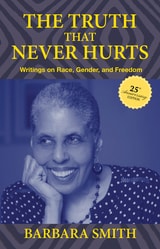
The Truth That Never Hurts 25th anniversary edition
Writings on Race, Gender, and FreedomBarbara Smith
Rutgers University Press, 2024
Barbara Smith has been doing groundbreaking work since the early 1970s, describing a Black feminism for Black women. Her work in Black women's literary traditions; in examining the sexual politics of the lives of women of color; in representing the lives of Black lesbians and gay men; and in making connections between race, class, sexuality and gender is gathered in The Truth That Never Hurts. This collection contains some of her major essays on Black women's literature, Black lesbian writing, racism in the women's movement, Black-Jewish relations, and homophobia in the Black community. Her forays into these areas ignited dialogue about topics that few other writers were addressing at the time, and which, sadly, remain pertinent to this day. This twenty-fifth anniversary edition, in a beautiful new package, also contains the essays from the original about the 1968 Chicago convention demonstrations; attacks on the NEA; the Anita Hill-Clarence Thomas Senate hearings; and police brutality against Rodney King and Abner Louima, which, after twenty-five years, still have the urgency they did when they were first written.
The Truth That Never Hurts
Writings on Race, Gender, and FreedomSmith, Barbara
Rutgers University Press, 2000
Smith’s essay “Toward a Black Feminist Criticism,” is often cited as a major catalyst in opening the field of black women’s literature. Pieces about racism in the women’s movement, black and Jewish relations, and homophobia in the Black community have ignited dialogue about topics that few other writers address. The collection also brings together topical political commentaries on the 1968 Chicago convention demonstrations; attacks on the NEA; the Anita Hill–Clarence Thomas Senate hearings; and police brutality against Rodney King and Abner Louima. It also includes a never-before-published personal essay on racial violence and the bonds between black women that make it possible to survive.
The Virtual Point of Freedom
Essays on Politics, Aesthetics, and ReligionLorenzo Chiesa
Northwestern University Press, 2016
Theology and the Cartesian Doctrine of Freedom
Etienne Gilson
St. Augustine's Press, 2015
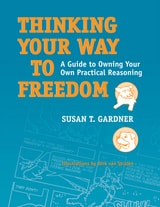
Thinking Your Way to Freedom
A Guide to Owning Your Own Practical ReasoningSusan T. Gardner
Temple University Press, 2009
Thinking Your Way to Freedom is a critical-thinking textbook with a difference. Rather than focusing exclusively on improving college students’ academic achievement, Susan Gardner seeks to dramatically change how students think through issues that are important in their lives beyond school. Gardner created 66 original and entertaining comic strips—featuring her dogs, Diva and Ben—that add a light touch as they encourage intellectual and personal autonomy. Through a clear step-by-step method of practical reasoning, students are taught how to think impartially and how to neutralize invisible biases that limit their freedom of thought and action. With the help of Diva and Ben, readers learn to evaluate the strengths of arguments and to recognize fallacies, all the while avoiding the paralyzing effects of relativism.
Thinking Your Way to Freedom includes the writing of short essays so that students can improve their critical thinking and writing at the same time. A Teacher’s Manual for this book will be available online.
Time and Freedom
Christophe Bouton
Northwestern University Press, 2014

True Songs of Freedom
Uncle Tom’s Cabin in Russian Culture and SocietyJohn MacKay
University of Wisconsin Press, 2013
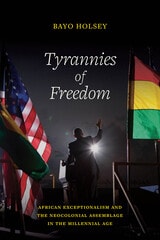
Tyrannies of Freedom
African Exceptionalism and the Neocolonial Assemblage in the Millennial AgeBayo Holsey
University of Chicago Press, 0
Examines the enduring myth of Ghanaian exceptionalism and neoliberal freedom.
What is the legacy of the African Revolution today? Black Studies scholar and anthropologist Bayo Holsey addresses this question by examining the twenty-first-century relationship between the United States and Ghana, a nation that was once associated with a powerful vision of Black freedom. In Tyrannies of Freedom, she demonstrates that the period that saw the expansion of the US counterterror state also witnessed attempts to discredit this vision of freedom and replace it with another—one that centers the agency of US politicians, media pundits, and development experts.
Analyzing international development discourses, the anti-trafficking regime’s representational economy, and the expansion of Ghana’s branding as a homeland of the African diaspora, Holsey interrogates the operation of a millennial neocolonial assemblage that asserts, in various ways, that the United States is the guarantor of Ghanaian freedom while simultaneously implementing policies of surveillance, endangerment, and exploitation. At the same time, Holsey shows how Ghanaians and other Black subjects have contested these projects. Tracking the transformation of the Ghanaian nation from a beacon of Black freedom and Pan-African possibility to a battleground over the meanings of African sovereignty in a post-9/11 world, this important book addresses pressing questions concerning the operation of US power in Africa and the production and legitimation of a racialized global hierarchy.