Results by title
153 books match the query 'Genres' and 31 start with t
TV Family Values
Gender, Domestic Labor, and 1980s SitcomsAlice Leppert
Rutgers University Press, 2019
Televising Feminism
How Gender Politics Shapes Scripted TVJessica Ford
University of Illinois Press, 2026
Jessica Ford examines popular media’s tendency to apply the feminist label to all women-centric TV. Focusing on the post-Sex and the City era that began in 2005, Ford explores how women-centric scripted TV absorbed the feminisms of its past. It now televises these feminisms in divergent, diffuse, and distinct ways that find expression as a sensibility rather than a cogent politic, genre, or category. Ford’s analysis examines shows identified as feminist alongside programs that negotiate ideas, offer critiques, generate feelings and sentiments, and deploy aesthetics in both low-key and visible political ways.
Innovative and insightful, Televising Feminism looks at the construction and expression of the many feminisms at work on American scripted television.

Television Drama in Spain and Latin America
Genre and Format TranslationPaul Julian Smith
University of London Press, 2018
The Animated Bestiary
Animals, Cartoons, and CultureWells, Paul
Rutgers University Press, 2008
The Animated Bestiary critically evaluates the depiction of animals in cartoons and animation more generally. Paul Wells argues that artists use animals to engage with issues that would be more difficult to address directly because of political, religious, or social taboos. Consequently, and principally through anthropomorphism, animation uses animals to play out a performance of gender, sex and sexuality, racial and national traits, and shifting identity, often challenging how we think about ourselves.
Wells draws on a wide range of examples, from the original King Kongto Nick Park's Chicken Run to Disney cartoonsùsuch as Tarzan, The Jungle Book, and Brother Bearùto reflect on people by looking at the ways in which they respond to animals in cartoons and films.
The Art of Witnessing
Documentary Literature, Film and Theater in Eastern Europe and the BalticsJohanna Lindbladh
Central European University Press, 2026
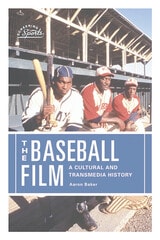
The Baseball Film
A Cultural and Transmedia HistoryAaron Baker
Rutgers University Press, 2022
This study offers an extensive look at nearly one hundred years of baseball-themed movies, documentaries, and TV shows. Film and sports scholar Aaron Baker examines works like A League of their Own (1992) and Sugar (2008), which dramatize the underrepresented contributions of female and immigrant players, alongside classic baseball movies like The Natural that are full of nostalgia for a time when native-born white men could use the game to achieve the American dream. He further explores how biopics have both mythologized and demystified such legendary figures as Ty Cobb, Babe Ruth, Lou Gehrig, Jackie Robinson and Fernando Valenzuela.
The Baseball Film charts the variety of ways that Hollywood presents the game as integral to American life, whether showing little league as a site of parent-child bonding or depicting fans’ lifelong love affairs with their home teams. Covering everything from Bull Durham (1988) to The Bad News Bears (1976), this book offers an essential look at one of the most cinematic of all sports.
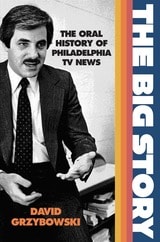
The Big Story
The Oral History of Philadelphia TV NewsDavid Grzybowski
Temple University Press, 2025
“We were the only station that stayed on the air continuously. We even pre-empted the CBS evening news.”—Larry Kane, anchor at WCAU, about covering the MOVE bombing
“The highs of working during the pandemic were keeping people informed of this deadly virus and what they had to do to take care of themselves and each other.”—Ukee Washington, KYW anchor, on the pandemic
The Big Story is David Grzybowski’s engrossing oral history of Philadelphia TV news from the perspective of reporters, photographers, producers, and news directors. Covering all the big stories from the late 1970s through the present, this fast-paced running commentary reflects on the uncertainty of the Three Mile Island disaster, the thrill of the Live Aid concert, the “Storm of the Century” (that wasn’t), and the championship victories of the Phillies and the Eagles, among other notable events, local, national, and global.
The Big Story features more than 200 interviews, including anecdotes from seasoned Philadelphia anchors Jim Gardner, Larry Kane, Lisa Thomas-Laury, Mike Jerrick, Vai Sikahema, Tamala Edwards, Pat Ciarrocchi, and Cecily Tynan, among others, about their experience on and off the job. Decision makers reflect on how to cover hot news stories such as Pennsylvania State Treasure R. Budd Dwyer’s on-air suicide. (“It was a big bloody horrifying mess,” according to Chris Wagner, WPVI anchor.)
Grzybowski highlights the Mummers, the launch of Good Day Philadelphia, off-the-air scandals, and how the Action News style secured a loyal following with Philadelphians while the Eyewitness News format competed hard to gain ratings. But the Big Story is how The Big Story provides compelling stories about Philadelphia’s news breakers and newsmakers.

The Castaways
How Producers Lost Their Independence and Conjured Up the Outsider SitcomLarry Durst
Rutgers University Press, 2027
In the early 1960s a new style of situation comedy took over primetime as Bewitched, Gilligan’s Island, Gomer Pyle, U.S.M.C., I Dream of Jeannie, My Favorite Martian, and other “Outsider Sitcoms” featuring alien characters disrupting their TV environments shot to the top of the ratings. Departing from a critical approach that understands these series as reflections of the decade’s many social disruptions, The Castaways reveals the programs as emotional responses by their creators to a more personal upheaval: their loss of influence in the broadcast industry. As network executives turned increasingly to audience research, independent producers felt the ability that had been most crucial to their success in broadcasting was being devalued: gut creative intuition. Drawing on memoirs, show treatments, and other original documents, The Castaways uncovers how leading characters on the programs served as emotional proxies for their creators’ fears of industry irrelevance as they were cast out from the corporate halls of power where their series’—and personal—fates were decided.
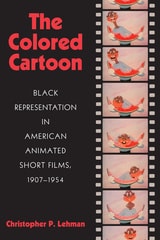
The Colored Cartoon
Black Presentation in American Animated Short Films, 1907-1954Christopher P. Lehman
University of Massachusetts Press, 2007
From the introduction of animated film in the early 1900s to the 1950s, ethnic humor was a staple of American-made cartoons. Yet as Christopher Lehman shows in this revealing study, the depiction of African Americans in particular became so inextricably linked to the cartoon medium as to influence its evolution through those five decades. He argues that what is in many ways most distinctive about American animation reflects white animators' visual interpretations of African American cultural expression.
The first American animators drew on popular black representations, many of which were caricatures rooted in the culture of southern slavery. During the 1920s, the advent of the sound-synchronized cartoon inspired animators to blend antebellum-era black stereotypes with the modern black cultural expressions of jazz musicians and Hollywood actors. When the film industry set out to desexualize movies through the imposition of the Hays Code in the early 1930s, it regulated the portrayal of African Americans largely by segregating black characters from others, especially white females. At the same time, animators found new ways to exploit the popularity of African American culture by creating animal characters like Bugs Bunny who exhibited characteristics associated with African Americans without being identifiably black.
By the 1950s, protests from civil rights activists and the growing popularity of white cartoon characters led animators away from much of the black representation on which they had built the medium. Even so, animated films today continue to portray African American characters and culture, and not necessarily in a favorable light.
Drawing on a wide range of sources, including interviews with former animators, archived scripts for cartoons, and the films themselves, Lehman illustrates the intimate and unmistakable connection between African Americans and animation.
The Comedy Studies Reader
Edited by Nick Marx and Matt Sienkiewicz
University of Texas Press, 2018
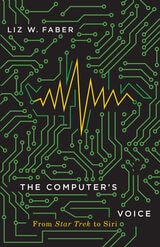
The Computer's Voice
From Star Trek to SiriLiz W. Faber
University of Minnesota Press, 2020
A deconstruction of gender through the voices of Siri, HAL 9000, and other computers that talk
Although computer-based personal assistants like Siri are increasingly ubiquitous, few users stop to ask what it means that some assistants are gendered female, others male. Why is Star Trek’s computer coded as female, while HAL 9000 in 2001: A Space Odyssey is heard as male? By examining how gender is built into these devices, author Liz W. Faber explores contentious questions around gender: its fundamental constructedness, the rigidity of the gender binary, and culturally situated attitudes on male and female embodiment.
Faber begins by considering talking spaceships like those in Star Trek, the film Dark Star, and the TV series Quark, revealing the ideologies that underlie space-age progress. She then moves on to an intrepid decade-by-decade investigation of computer voices, tracing the evolution from the masculine voices of the ’70s and ’80s to the feminine ones of the ’90s and ’00s. Faber ends her account in the present, with incisive looks at the film Her and Siri herself.
Going beyond current scholarship on robots and AI to focus on voice-interactive computers, The Computer’s Voice breaks new ground in questions surrounding media, technology, and gender. It makes important contributions to conversations around the gender gap and the increasing acceptance of transgender people.
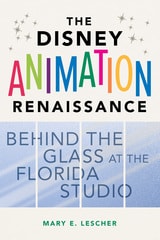
The Disney Animation Renaissance
Behind the Glass at the Florida StudioMary E. Lescher
University of Illinois Press, 2023
A ground-level look at the entertainment giant, The Disney Animation Renaissance profiles the people and purpose behind a little-known studio during a historic era.
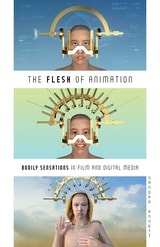
The Flesh of Animation
Bodily Sensations in Film and Digital MediaSandra Annett
University of Minnesota Press, 2024
How animation can reconnect us with bodily experiences
Film and media studies scholarship has often argued that digital cinema and CGI provoke a sense of disembodiment in viewers; they are seen as merely fantastic or unreal. In her in-depth exploration of the phenomenology of animation, Sandra Annett offers a new perspective: that animated films and digital media in fact evoke vivid embodied sensations in viewers and connect them with the lifeworld of experience.
Starting with the emergence of digital technologies in filmmaking in the 1980s, Annett argues that contemporary digital media is indebted to the longer history of animation. She looks at a wide range of animation—from Disney films to anime, electro swing music videos to Vocaloids—to explore how animation, through its material forms and visual styles, can evoke bodily sensations of touch, weight, and orientation in space. Each chapter discusses well-known forms of animation from the United States, France, Japan, South Korea, and China, examining how they provoke different sensations in viewers, such as floating and falling in Howl’s Moving Castle and My Beautiful Girl Mari, and how the body is mediated in films that combine animation and live action, as seen in Who Framed Roger Rabbit and Song of the South. These films set the stage for an exploration of how animation and embodiment manifest in contemporary global media, from CGI and motion capture in Disney’s “live action remakes” to new media installations by artists like Lu Yang.
Leveraging an array of case studies through a new approach to film phenomenology, The Flesh of Animation offers an enlightening discussion of why animation provides a sensational experience for viewers not replicable through other media forms.
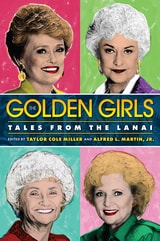
The Golden Girls
Tales from the LanaiTaylor Cole Miller
Rutgers University Press, 2025

The Intellect Handbook of Documentary
Edited by Kate Nash and Deane Williams
Intellect Books, 2025
The Intellect Handbook of Documentary is an important go-to resource for practitioners, scholars, and students in this burgeoning field. It tackles key topics and debates including the role of documentary in post-truth culture, the rise of streaming giants, and the implications for national documentary cultures, as well as the shifting, increasingly hybrid, practices of documentary activism and the professionalization of impact. Featuring work by key figures in international documentary scholarship and talented emerging scholars, the Handbook is a landmark publication for documentary studies in the twenty-first century.
The Handbook is broad in its scope, incorporating historical, theoretical, empirical, and practical scholarship. It is organized around ten key themes and debates: What and where is documentary (studies); documentary in an age of epistemic uncertainty; documentary histories; documentary and the archive; audio and visualities; documentary relationalities; beyond the Anthropocene; digital and documentary practices; documentary and (new) politics; and a golden age of documentary distribution and funding. Importantly, the Handbook incorporates the voices and practices of practitioners from the Global South, challenging the dominance of Western voices in documentary scholarship.
The Intellect Handbook of Nordic Cinema
Edited by Gunnar Iversen and Mariah Larsson
Intellect Books, 2026
The Intellect Handbook of Nordic Cinema offers a comprehensive overview of cinema in the Nordic region—Sweden, Denmark, Norway, Finland, Iceland, and Sápmi. While each nation has distinct cinematic traditions and media histories, they also share many institutional and thematic features. A key example is the reliance of film production across all five countries, and in Sápmi, on various forms of government support.
Focusing primarily on feature films, the volume also addresses documentaries and animation, situating Nordic film production within today’s evolving media landscape where television and streaming services act as both partners and competitors. Combining detailed case studies with thematic explorations, it broadens understanding of genres such as occupation dramas, comedies, disaster movies, and children’s films while offering in-depth examinations of recurring cultural motifs and themes, including nature, nationality, sexuality, and digital piracy. With contributions from leading scholars, this handbook provides an essential reference for anyone seeking to understand the diversity, commonalities, and global relevance of Nordic cinema.
The Live-Action Animated Film
Kyle Meikle
Rutgers University Press, 2026
The Long Hallway
Richard Scott Larson
University of Wisconsin Press, 2024
Larson was only nine years old when he recognized something of his own experience in how Michael Myers hid his true face from the world. This spark of recognition ignited his imagination while he searched for clues to what the future might hold for boys like him, all the while being made to understand his nascent sexuality as deviant and punishable. Like in the movies, his superficially safe suburban childhood was in fact filled with threat: a classmate’s murder, his father’s alcoholism and death, and his own sexual assault by a much older man. The figurative mask Larson learned to wear could not contain his yearning to be seen and desired. In the aftermath of this violence, his boyhood self came to believe that fear and desire would be forever intertwined.
This lyrical memoir expresses a boy’s search for identity while navigating the darkness and isolation of a deeply private inner world. With introspection and tenderness, Larson reflects on how little we understand in the moment about the experiences that mark us forever.
The Modern British Horror Film
Gerrard, Steven
Rutgers University Press, 2017
Tracking the revitalization of the British horror film industry over the past two decades, media expert Steven Gerrard also investigates why audiences have flocked to these movies. To answer that question, he focuses on three major trends: “hoodie horror” movies responding to fears about Britain’s urban youth culture; “great outdoors” films where Britain’s forests, caves, and coasts comprise a terrifying psychogeography; and psychological horror movies in which the monster already lurks within us.
Offering in-depth analysis of numerous films, including The Descent, Outpost, and The Woman in Black, this book takes readers on a lively tour of the genre’s highlights, while provocatively exploring how these films reflect viewers’ gravest fears about the state of the nation. Whether you are a horror buff, an Anglophile, or an Anglophobe, The Modern British Horror Film is sure to be a thrilling read.
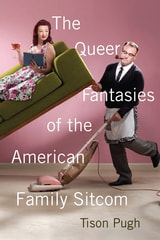
The Queer Fantasies of the American Family Sitcom
Pugh, Tison
Rutgers University Press, 2018
The Queer Fantasies of the American Family Sitcom examines the evasive depictions of sexuality in domestic and family-friendly sitcoms. Tison Pugh charts the history of increasing sexual depiction in this genre while also unpacking how sitcoms use sexuality as a source of power, as a kind of camouflage, and as a foundation for family building. The book examines how queerness, at first latent, became a vibrant yet continually conflicted part of the family-sitcom tradition.
Taking into account elements such as the casting of child actors, the use of and experimentation with plot traditions, the contradictory interpretive valences of comedy, and the subtle subversions of moral standards by writers and directors, Pugh points out how innocence and sexuality conflict on television. As older sitcoms often sit on a pedestal of nostalgia as representative of the Golden Age of the American Family, television history reveals a deeper, queerer vision of family bonds.
Download open access ebook here.
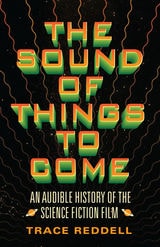
The Sound of Things to Come
An Audible History of the Science Fiction FilmTrace Reddell
University of Minnesota Press, 2018
A groundbreaking approach to sound in sci-fi films offers new ways of construing both sonic innovation and science fiction cinema
Including original readings of classics like The Day the Earth Stood Still, 2001: A Space Odyssey, Star Wars, and Blade Runner, The Sound of Things to Come delivers a comprehensive history of sound in science fiction cinema. Approaching movies as sound objects that combine cinematic apparatus and consciousness, Trace Reddell presents a new theory of sonic innovation in the science fiction film.
Reddell assembles a staggering array of movies from sixty years of film history—including classics, blockbusters, B-movies, and documentaries from the United States, Britain, France, Germany, Japan, and the Soviet Union—all in service to his powerful conception of sound making as a speculative activity in its own right. Reddell recasts debates about noise and music, while arguing that sound in the science fiction film provides a medium for alien, unknown, and posthuman sound objects that transform what and how we hear.
Avoiding genre criticism’s tendency to obsess over utopias, The Sound of Things to Come draws on film theory, sound studies, and philosophies of technology to advance conversations about the avant-garde, while also opening up opportunities to examine cinematic sounds beyond the screen.
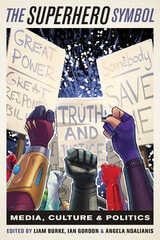
The Superhero Symbol
Media, Culture, and PoliticsLiam Burke
Rutgers University Press, 2020
It is hard to imagine a time when superheroes have been more pervasive in our culture. Today, superheroes are intellectual property jealously guarded by media conglomerates, icons co-opted by grassroots groups as a four-color rebuttal to social inequities, masks people wear to more confidently walk convention floors and city streets, and bulletproof banners that embody regional and national identities. From activism to cosplay, this collection unmasks the symbolic function of superheroes.
Bringing together superhero scholars from a range of disciplines, alongside key industry figures such as Harley Quinn co-creator Paul Dini, The Superhero Symbol provides fresh perspectives on how characters like Captain America, Iron Man, and Wonder Woman have engaged with media, culture, and politics, to become the “everlasting” symbols to which a young Bruce Wayne once aspired.
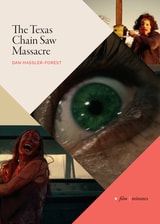
The Texas Chain Saw Massacre
By Dan Hassler-Forest
Lever Press, 2027
The infamous low-budget horror film The Texas Chain Saw Massacre (1974) profoundly reshaped our understanding of the horror genre. Its influence looms large over the genre as the direct progenitor of the slasher and the enduring fascination for exploitation cinema as an allegory for brutal class warfare in a post-industrial society. By looking closely at the filmmakers’ individual choices in framing, editing, scoring, staging, lighting, and performance, Dan Hassler-Forest gives readers a fresh perspective on the familiar tropes of the Final Girl, Leatherface as prototype for countless psycho killers and the masterpiece that bought splatter cinema into the mainstream.
Volumes in the film|minutes series cut up films into segments of exactly one minute and transform each minute into an innovative tool for thinking with the film. Each volume works rigorously with the concept of “the minute” as a non-cinematic scale/quantity, a means to zoom in on (dis)orderly fragments that do not necessarily respect the confinements of cinematic form or meaning. As a critical practice, the focus on minutes causes disruptions and displacement that create novel connections and perspectives, and uncovers hidden traces, making it possible to watch each film anew.
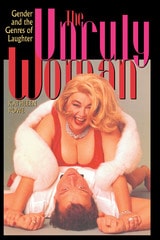
The Unruly Woman
Gender and the Genres of LaughterBy Kathleen Rowe
University of Texas Press, 1995
Unruly women have been making a spectacle of themselves in film and on television from Mae West to Roseanne Arnold. In this groundbreaking work, Kathleen Rowe explores how the unruly woman—often a voluptuous, noisy, joke-making rebel or "woman on top"—uses humor and excess to undermine patriarchal norms and authority.
At the heart of the book are detailed analyses of two highly successful unruly women—the comedian Roseanne Arnold and the Muppet Miss Piggy. Putting these two figures in a deeper cultural perspective, Rowe also examines the evolution of romantic film comedy from the classical Hollywood period to the present, showing how the comedic roles of actresses such as Katharine Hepburn, Barbara Stanwyck, and Marilyn Monroe offered an alternative, empowered image of women that differed sharply from the "suffering heroine" portrayed in classical melodramas.
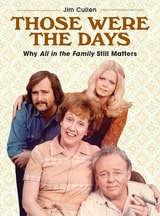
Those Were the Days
Why All in the Family Still MattersJim Cullen
Rutgers University Press, 2020
Between 1971 and 1979, All in the Family was more than just a wildly popular television sitcom that routinely drew 50 million viewers weekly. It was also a touchstone of American life, so much so that the living room chairs of the two main characters have spent the last 40 years on display at the Smithsonian. How did a show this controversial and boundary-breaking manage to become so widely beloved?
Those Were the Days is the first full-length study of this remarkable television program. Created by Norman Lear and produced by Bud Yorkin, All in the Family dared to address such taboo topics as rape, abortion, menopause, homosexuality, and racial prejudice in a way that no other sitcom had before. Through a close analysis of the sitcom’s four main characters—boorish bigot Archie Bunker, his devoted wife Edith, their feminist daughter Gloria, and her outspoken liberal husband Mike—Jim Cullen demonstrates how All in the Family was able to bridge the generation gap and appeal to a broad spectrum of American viewers in an age when a network broadcast model of television created a shared national culture.
Locating All in the Family within the larger history of American television, this book shows how it transformed the medium, not only spawning spinoffs like Maude and The Jeffersons, but also helping to inspire programs like Roseanne, Married... with Children, and The Simpsons. And it raises the question: could a show this edgy ever air on broadcast television today?
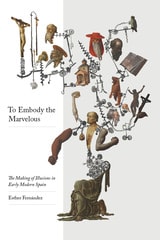
To Embody the Marvelous
The Making of Illusions in Early Modern SpainEsther Fernández
Vanderbilt University Press, 2021
Winner of the Nancy Staub Award, UNIMA-USA (Union Internationale de la Marionnette), 2023
In its exploration of puppetry and animation as the performative media of choice for mastering the art of illusion, To Embody the Marvelous engages with early modern notions of wonder in religious, artistic, and social contexts.
From jointed, wood-carved figures of Christ, saintly marionettes that performed hagiographical dramas, experimental puppets and automata in Cervantes' Don Quixote, and the mechanical sets around which playwright Calderón de la Barca devised secular magic shows to deconstruct superstitions, these historical and fictional artifacts reenvisioned religious, artistic, and social notions that led early modern society to critically wrestle with enchantment and disenchantment.
The use of animated performance objects in Spanish theatrical contexts during the sixteenth and seventeenth centuries became one of the most effective pedagogical means to engage with civil society. Regardless of social strata, readers and spectators alike were caught up in a paradigm shift wherein belief systems were increasingly governed by reason—even though the discursive primacy of supernatural doxa and Christian wonder remained firmly entrenched. Thanks to their potential for motion, religious and profane puppets, automata, and mechanical stage props deployed a rationalized sense of wonder that illustrates the relationship between faith and reason, reevaluates the boundaries of fiction in art and entertainment cultures, acknowledges the rise of science and technology, and questions normative authority.
To Embody the Marvelous
The Making of Illusions in Early Modern SpainEsther Fernández
Vanderbilt University Press, 2022
Winner of the Nancy Staub Award, UNIMA-USA (Union Internationale de la Marionnette), 2023
In its exploration of puppetry and animation as the performative media of choice for mastering the art of illusion, To Embody the Marvelous engages with early modern notions of wonder in religious, artistic, and social contexts.
From jointed, wood-carved figures of Christ, saintly marionettes that performed hagiographical dramas, experimental puppets and automata in Cervantes' Don Quixote, and the mechanical sets around which playwright Calderón de la Barca devised secular magic shows to deconstruct superstitions, these historical and fictional artifacts reenvisioned religious, artistic, and social notions that led early modern society to critically wrestle with enchantment and disenchantment.
The use of animated performance objects in Spanish theatrical contexts during the sixteenth and seventeenth centuries became one of the most effective pedagogical means to engage with civil society. Regardless of social strata, readers and spectators alike were caught up in a paradigm shift wherein belief systems were increasingly governed by reason—even though the discursive primacy of supernatural doxa and Christian wonder remained firmly entrenched. Thanks to their potential for motion, religious and profane puppets, automata, and mechanical stage props deployed a rationalized sense of wonder that illustrates the relationship between faith and reason, reevaluates the boundaries of fiction in art and entertainment cultures, acknowledges the rise of science and technology, and questions normative authority.
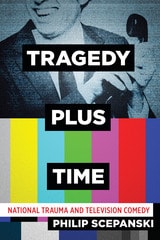
Tragedy Plus Time
National Trauma and Television ComedyBy Philip Scepanski
University of Texas Press, 2021
Following the most solemn moments in recent American history, comedians have tested the limits of how soon is “too soon” to joke about tragedy. Comics confront the horrifying events and shocking moments that capture national attention and probe the acceptable, or “sayable,” boundaries of expression that shape our cultural memory. In Tragedy Plus Time, Philip Scepanski examines the role of humor, particularly televised comedy, in constructing and policing group identity and memory in the wake of large-scale events.
Tragedy Plus Time is the first comprehensive work to investigate tragedy-driven comedy in the aftermaths of such traumas as the JFK assassination and 9/11, as well as during the administration of Donald Trump. Focusing on the mass publicization of television comedy, Scepanski considers issues of censorship and memory construction in the ways comedians negotiate emotions, politics, war, race, and Islamophobia. Amid the media frenzy and conflicting expressions of grief following a public tragedy, comedians provoke or risk controversy to grapple publicly with national traumas that all Americans are trying to understand for themselves.
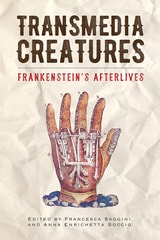
Transmedia Creatures
Frankenstein’s AfterlivesSaggini, Francesca
Bucknell University Press, 2018
Published by Bucknell University Press. Distributed worldwide by Rutgers University Press.
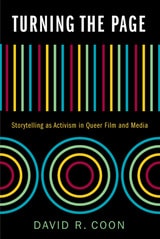
Turning the Page
Storytelling as Activism in Queer Film and MediaCoon, David R
Rutgers University Press, 2018
Surprisingly, Hollywood is still clumsily grappling with its representation of sexual minorities, and LGBTQ filmmakers struggle to find a place in the mainstream movie industry. However, organizations outside the mainstream are making a difference, helping to produce and distribute authentic stories that are both by and for LGBTQ people.
Turning the Page introduces readers to three nonprofit organizations that, in very different ways, have each positively transformed the queer media landscape. David R. Coon takes readers inside In the Life Media, whose groundbreaking documentaries on the LGBTQ experience aired for over twenty years on public television stations nationwide. Coon reveals the successes of POWER UP, a nonprofit production company dedicated to mentoring filmmakers who can turn queer stories into fully realized features and short films. Finally, he turns to Three Dollar Bill Cinema, an organization whose film festivals help queer media find an audience and whose filmmaking camps for LGBTQ youth are nurturing the next generation of queer cinema.
Combining a close analysis of specific films and video programs with extensive interviews of industry professionals, Turning the Page demonstrates how queer storytelling in visual media has the potential to empower individuals, strengthen communities, and motivate social justice activism.
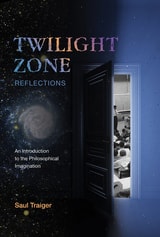
Twilight Zone Reflections
An Introduction to the Philosophical ImaginationSaul Traiger
Lever Press, 2024
Each short chapter dives into a single episode and concludes with helpful cross-references to other episodes that explore similar philosophical problems and subjects. For example, a reader may be interested in questions about the nature of the mind and whether machines can think. By referencing this book, they could easily discover the thematic connections between episodes like “I Sing the Body Electric” or “The Lateness of the Hour,” and learn how both episodes introduce the viewer to possible worlds that challenge us to consider whether our idea of the mind, and even our very personhood, extends beyond the human to robots and other artificial intelligences. Each chapter introduces fundamental philosophical questions such as these through the lens of The Twilight Zone and inspires additional exploration. Further readings are suggested for all episodes, making this volume indispensable to academics, students, and fans of the show. Each chapter is short and accessible, ensuring that this book is the perfect resource to accompany a complete series re-watch.
The Twilight Zone considered questions that strike at the heart of philosophical inquiry, such as the nature of self, the existence of god, the possibility of an afterlife, the relationship between knowledge and mental illness, the nature of possibility, even the nature of imagination itself, and so much more. Traiger argues that each episode can serve as an entry point for philosophical reflection. Twilight Zone Reflections is a valuable reference for anyone interested in exploring a well-known slice of popular culture history that doubles as a vast store of philosophical ideas.